

The DOI matches its Crossref record; 50 of the 50 references it cites were found in a registry or an index.
Atypical Social Modulation of Imitation in Autism Spectrum Conditions
Open accessAbstract
Appropriate modulation of imitation according to social context is important for successful social interaction. In the present study we subliminally primed high-functioning adults with ASC and age- and IQ-matched controls with either a pro- or non- social attitude. Following priming, an automatic imitation paradigm was used to acquire an index of imitation. Whereas imitation levels were higher for pro-socially primed relative to non-socially primed control participants, there was no difference between pro- and non- socially primed individuals with ASC. We conclude that high-functioning adults with ASC demonstrate atypical social modulation of imitation. Given the importance of imitation in social interaction we speculate that difficulties with the modulation of imitation may contribute to the social problems characteristic of ASC.
Overview
The claims and statistics of this paper haven’t been checked yet.
Run the check — free, no account needed. It reads the open-access text and checks the sources it cites.
Integrity signals
Registry
Cites
Statistics
Figures
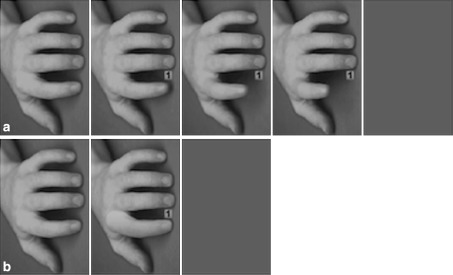
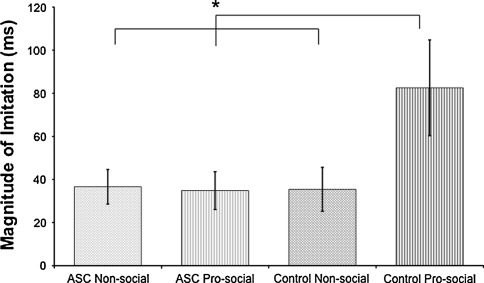
Verification
Claims the paper makes
The claims and statistics of this paper haven’t been checked yet.
Run the check — free, no account needed. It reads the open-access text and checks the sources it cites.
Claims other papers make about this one
Each is checked against this paper’s own text: does it say what the citing paper says it does?
The source backs part of the claim, not all of it — or backs it for a different population, condition or comparison.
In the citing paper
“While high-functioning ASD individuals do not show modulation of automatic imitation (Cook & Bird, 2012)”
From Interplay of self-other distinction and cognitive control mechanisms in a social automatic imitation task: An ERP study (2021) · cites this paper as Cook & Bird, 2012
Experimental — accuracy not yet measured
Self-check
Percentages, sums and reported differences re-computed from the paper’s own numbers.
The self-check needs the paper’s full text.
Citations
Cites
Diagnostic and Statistical Manual of Mental Disorders
Williams, J. B. W., & First, M. B. (2013) · Oxford University Press eBooks · doi:10.1093/acrefore/9780199975839.013.104 · Cited by 109,845
Diagnostic and Statistical Manual of Mental Disorders
American Psychiatric Association (2022) · doi:10.1176/appi.books.9780890425787 · Cited by 23,476
Philosophical transactions of the Royal Society of London. B
Press, H. (1886) · Cited by 10,087
Diagnostic and Statistical Manual of Mental Disorders
Siegel, L. J., & Fletcher‐Janzen, E. (2008) · Wiley eBooks · doi:10.1002/9780470373699.speced0655 · Cited by 8,467
Lord, C., Risi, S., Lambrecht, L., Cook, E. H., Leventhal, B. L., DiLavore, P. C., Pickles, A., & Rutter, M. (2000) · Journal of Autism and Developmental Disorders · doi:10.1023/a:1005592401947 · Cited by 7,520
The chameleon effect: the perception–behavior link and social interaction
Chartrand, T. L., & Bargh, J. A. (1999) · Journal of Personality and Social Psychology · doi:10.1037/0022-3514.76.6.893 · Cited by 3,674
Cortical mechanisms of human imitation
Iacoboni, M., Woods, R. P., Brass, M., Bekkering, H., Mazziotta, J. C., & Rizzolatti, G. (1999) · Science · doi:10.1126/science.286.5449.2526 · Cited by 2,683
Handbook of Research Methods in Social and Personality Psychology
West, T., Reis, H. T., Judd, C. M., Banaji, M. R., Crandall, C., Giner-Sorolla, R., Biernat, M., Fiedler, K., Ermark, F., Tepper, S. J., et al. (2024) · Cambridge University Press eBooks · doi:10.1017/9781009170123 · Cited by 2,134
Dapretto, M., Davies, M. S., Pfeifer, J. H., Scott, A. A., Sigman, M., Bookheimer, S. Y., & Iacoboni, M. (2006) · Nature Neuroscience · doi:10.1038/nn1611 · Cited by 1,694
Using nonconscious behavioral mimicry to create affiliation and rapport
Lakin, J. L., & Chartrand, T. L. (2003) · Psychological Science · doi:10.1111/1467-9280.14481 · Cited by 1,297
Research works printed but not linked: 1
- Brothers, L. (1990). The social brain: A project fr integrating primate behaviour and neurophysiology in a new domain. Concepts in Neuroscience, 1, 27–51.
Cited by
Sorted by citations
Bird, G., & Viding, E. (2014) · Neuroscience & Biobehavioral Reviews · doi:10.1016/j.neubiorev.2014.09.021 · Cited by 472
Self-citationThe Structure of Social Cognition: In(ter)dependence of Sociocognitive Processes
Happe, F. G. E., Cook, J. L., & Bird, G. (2016) · Annual Review of Psychology · doi:10.1146/annurev-psych-010416-044046 · Cited by 478
Self-citationSantiesteban (2012) · doi:10.1016/j.cub.2012.10.018 · Cited by 357
Self-citationReflecting on the mirror neuron system in autism: A systematic review of current theories
Hamilton, A. F. D. C. (2012) · Developmental Cognitive Neuroscience · doi:10.1016/j.dcn.2012.09.008 · Cited by 378
What Happened to Mirror Neurons?
Heyes, C. M., & Catmur, C. (2021) · Perspectives on Psychological Science · doi:10.1177/1745691621990638 · Cited by 318
Metadata
- Authors
- Cook, J. L., & Bird, G.
- Affiliations
- University College London (GB)
- Corresponding author
- Bird, Geoffrey
- Venue
- Journal of Autism and Developmental Disorders
- Published
- 2011-08-11
- Volume
- 42
- Issue
- 6
- Pages
- 1045-1051
- ISSN
- 0162-3257 (ISSN-L)
- 1573-3432
- PMC
- PMC3360861
- OpenAlex
- W2130002698
- Cited by
- 111
- References
- 50
- Citations by year
- 2026: 1 · 2025: 4 · 2024: 5 · 2023: 3 · 2022: 3 · 2021: 7 · 2020: 7 · 2019: 6 · 2018: 7 · 2017: 13 · 2016: 19 · 2015: 9 · 2014: 11 · 2013: 9 · 2012: 7
- FWCI
- 4.38
- Type
- journal article
- Language
- en
- Open access
- hybrid
- doi.org
- Licence
- cc-by-nc
- Locations
- Journal of Autism and Developmental Disorders (publishedVersion, cc-by-nc)
- PubMed Central (publishedVersion, cc-by-nc)
- PubMed (publishedVersion)
- City Research Online (City University London) (acceptedVersion)
- UCL Discovery (University College London) (submittedVersion)
- Research Portal (King's College London) (submittedVersion)
- University of Birmingham Research Portal (University of Birmingham) (submittedVersion)
- Funders
- Wellcome Trust
- Topics
- Life Sciences › Neuroscience › Cognitive Neuroscience › Autism Spectrum Disorder Research
- Social Sciences › Psychology › Social Psychology › Action Observation and Synchronization
- Social Sciences › Psychology › Developmental and Educational Psychology › Child and Animal Learning Development
- Keywords
- autism spectrum disorder, imitation, subliminal priming, prosocial attitudes, automatic imitation, high-functioning adults, social interaction
- MeSH terms
- Adult, Child, Child Development Disorders, Pervasive, Female, Humans, Imitative Behavior, Male, Middle Aged, Reaction Time, Social Behavior, Mirror Neurons
About these checks
Registry, retraction, Cites and statistics results are computed, not judged, with one exception: a printed reference that no index lists is read once by a model before it counts as a citation error. Claims are extracted by a model and kept only when their quote appears verbatim in the text; each cited source is then checked, with a model’s help, for whether it says what the claim relies on. Those verdicts can be wrong — read the claim’s quote and the cited source before relying on one.
Statistics and arithmetic are recomputed, not judged.
Confidence bands are shown only for fields calibrated on our annotated test set. None is calibrated yet, so no band is shown.
What counts as a claim ›How we measure confidence ›How we check this ›
Are you an author, or do you see a problem with this page? Request a review
