

Systematic Review of the Relationship Between Autism Stigma and Informal Caregiver Mental Health
Open accessThe DOI matches its Crossref record; 63 of the 64 references it cites were found in a registry or an index.
Abstract
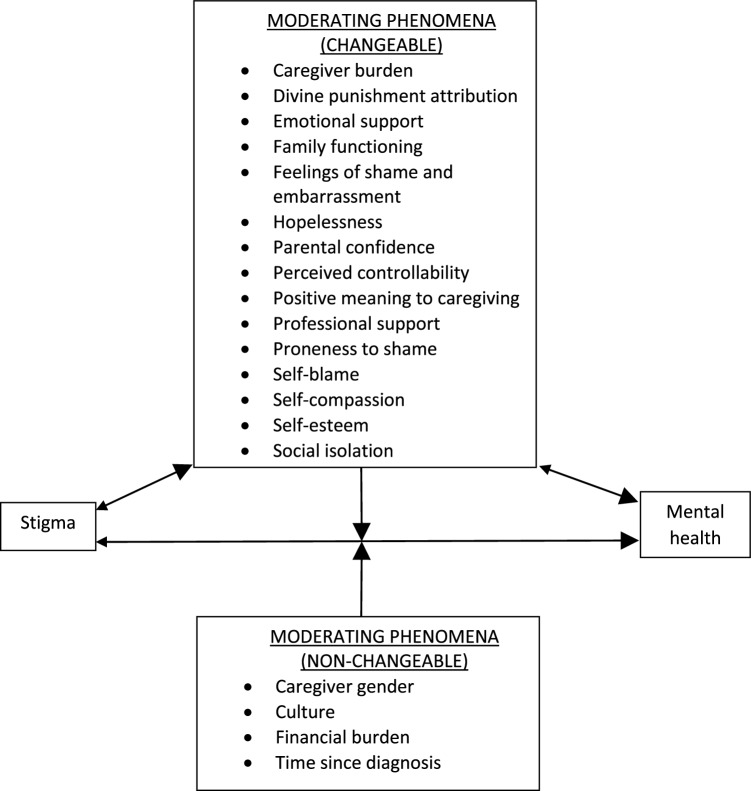
Families play a crucial role in determining the mental health of the autistic individual(s) they are caring for. However, the stigma associated with autism can impair caregiver health. To investigate this, empirical evidence pertaining to stigma's impact on informal caregivers' mental health was systematically reviewed. All twelve included studies (n = 1442 informal caregivers) consistently reported the impact of autism related stigma upon caregiver mental health to be significant, meaningful and complex. A new theoretical framework describing the relationship between stigma and caregiver mental health is constructed. Moderating variables include those both changeable through intervention (e.g. hopelessness, self-esteem, self-compassion) and not changeable (gender, culture, financial burden and time since diagnosis). Implications and recommendations for professionals, interventions and future research are proposed.
Overview
The claims and statistics of this paper haven’t been checked yet.
Free: it reads the open-access text and checks the first 5 claims that cite a source we can check. Create a free account to check every claim.
Integrity signals
Registry
Cites
Statistics
Figures
Verification
Claims the paper makes
The claims and statistics of this paper haven’t been checked yet.
Free: it reads the open-access text and checks the first 5 claims that cite a source we can check. Create a free account to check every claim.
Claims other papers make about this one
Each is checked against this paper’s own text: does it say what the citing paper says it does?
The source backs part of the claim, not all of it — or backs it for a different population, condition or comparison.
In the citing paper
“Across East Asia, the Middle East, and Western societies, a recent review suggested a strong negative impact of ASD stigma on some caregivers resulting in attempts to hide their circumstances (sometimes the child with ASD as well) to avoid rejection from the community (Papadopoulos et al. 2019).”
From The Diagnosis of Autism: From Kanner to DSM-III to DSM-5 and Beyond (2021) · cites this paper as Papadopoulos et al. 2019
Experimental — accuracy not yet measured
Self-check
Percentages, sums and reported differences re-computed from the paper’s own numbers.
The self-check needs the paper’s full text.
Citations
Cites
The CES-D Scale: A Self-Report Depression Scale for Research in the General Population
Radloff, L. S. (1977) · Applied Psychological Measurement · doi:10.1177/014662167700100306 · Cited by 53,267
The PHQ-9: Validity of a brief depression severity measure
Kroenke, K., Spitzer, R. L., & Williams, J. B. W. (2001) · Journal of General Internal Medicine · doi:10.1046/j.1525-1497.2001.016009606.x · Cited by 44,910
A Brief Measure for Assessing Generalized Anxiety Disorder: The GAD-7
Spitzer, R. L., Kroenke, K., Williams, J. B. W., & Löwe, B. (2006) · Archives of Internal Medicine · doi:10.1001/archinte.166.10.1092 · Cited by 31,765
International Journal of Business and Social Science
(2018) · International Journal of Business and Social Science · doi:10.30845/ijbss · Cited by 4,284
Clinical Psychology: Science and Practice
(2021) · Clinical Psychology Science and Practice · doi:10.1111/(issn)1468-2850 · Cited by 3,672
The structure of psychological distress and well-being in general populations.
Veit, C. T., & Ware, J. E. (1983) · Journal of Consulting and Clinical Psychology · doi:10.1037//0022-006x.51.5.730 · Cited by 1,967
The paradox of self-stigma and mental illness.
Corrigan, P. W., & Watson, A. C. (2002) · Clinical Psychology: Science and Practice · doi:10.1093/clipsy.9.1.35 · Cited by 1,872 · cited 1×
“2009) and being more likely to perceive themselves and their situation negatively (Corrigan and Watson 2002).”
Background(2022) · Singapore Medical Journal · doi:10.11622/smedj · Cited by 1,730
Self-stigma and the “why try” effect: impact on life goals and evidence-based practices
CORRIGAN, P. W., LARSON, J. E., & RÜSCH, N. (2009) · World Psychiatry · doi:10.1002/j.2051-5545.2009.tb00218.x · Cited by 1,074
Loneliness and friendship in high-functioning children with autism
Bauminger, N., & Kasari, C. (2000) · Child Development · doi:10.1111/1467-8624.00156 · Cited by 980
Research works printed but not linked: 1
- 49. Sesame Workshop (No date). See amazing in all children. Available at: http://www.sesam ework shop.org/what-we-do/our-initi ative s/ autis m/.
Cited by
Items 101–179 of 179
Prommersberger, M., Witzmann, M., & Schuwerk, T. (2026) · Prävention und Gesundheitsförderung · doi:10.1007/s11553-025-01290-9 · Cited by 2
In Search of Informal Caregivers in HRI: A Critical Narrative Review of HRI Conference Papers
Tanqueray, L., Larsson, S., & Winkle, K. (2026) · International Journal of Social Robotics · doi:10.1007/s12369-025-01340-4 · Cited by 3
“Furthermore, informal caregivers’ caring responsibili - ties can often be overlooked by society generally [94 ], and their role is stigmatised [95 ].”
Lonn, H., Ndep, A. O., Ekpenyong, B. N., Cockburn, L., Awa, J. C., Tchiaze, A. T. G., Jingkuo, G. H. M., Abua, E. E., & Isho, M. C. (2026) · BMC Neurology · doi:10.1186/s12883-026-04976-5 · Cited by 2
“Such internalized stigma undermines coping capacity, increases emotional isolation, and may delay care-seeking, aligning with studies that highlight internalized stigma as a barrier to timely intervention [44, 45].”
Aktu, Y., Toğluk, S., & Vural, B. (2026) · Journal of Autism and Developmental Disorders · doi:10.1007/s10803-026-07405-1 · Cited by 2
Targan, A., & Roberts, C. C. (2023) · Springer eBooks · doi:10.1007/978-3-031-29171-5_7 · Cited by 3
Filha, F. S. S. C., dos Santos, J. C., Franco, V. R., de Araújo, M. M. M., & Filho, I. M. D. M. (2024) · Revista Brasileira de Pesquisa em Saúde/Brazilian Journal of Health Research · doi:10.47456/rbps.v26i1.40751 · Cited by 2
Reclaiming Joy: Finding Resilience in Families with Children with Autism
Hashimoto, N. K. (2020) · Digital Commons-DePaul (DePaul University) · Cited by 8
Kanja, M. W., Mwenje, M. K., & Githui, P. (2022) · International Journal of Education Psychology and Counseling · doi:10.35631/ijepc.745026 · Cited by 2
Azubuike, A. O., Azubuike, P. C., Afape, A. O., Enyam, M. O., Akinreni, T., Imo, U. F., Nwadiche, M., Ogbonna, C. K., Timothy, P. N., Uchegbu, E. R., et al. (2024) · Research Square · doi:10.21203/rs.3.rs-4790501/v1 · Cited by 2
The Goldilocks rule: just the right amount of support for caregivers of autistic children
Lovell, B. (2024) · International Journal of Developmental Disabilities · doi:10.1080/20473869.2024.2307121 · Cited by 1
“This would be in keeping with research that has reported on the socially isolating nature of caring for an autistic child (Blanche et al. 2015, Lodder et al. 2019).”
Loomis, A. M., Mogro‐Wilson, C., Rose, D. M., & Longo, E. (2024) · Journal of Developmental and Physical Disabilities · doi:10.1007/s10882-024-09958-4 · Cited by 2
“This was counter to our hypothesis, as affiliate stigma has been linked to other factors related to parent experiences, such as parent mental health, social isolation, and depression (Chen et al., 2021; Papadopoulos et al., 2019).”
InfluentialSeymour, M., McMahon, G., Fogarty, A., O’Connor, B. C., Feinberg, M., Hock, R., & Giallo, R. (2025) · Autism · doi:10.1177/13623613251316014 · Cited by 1
“Parents of autistic children consistently report experiencing high levels of parenting stress and mental health difficulties (e.g. depression, anxiety) and significantly more so than parents of non-autistic children (Hayes & Watson, 2013; Papadopoulos et al., 2019; Seymour et al., 2017).”
Understanding Autism through the Eyes of Nurses: a Cross‐Sectional Study
Albloushi, M., Alghamdi, R. S., & Alqahtani, M. A. M. (2026) · Brain and Behavior · doi:10.1002/brb3.71217 · Cited by 1
Alaqel, A., Saed, S. A., Alsaber, A. R., & Albustan, S. A. (2026) · Journal of Autism and Developmental Disorders · doi:10.1007/s10803-026-07295-3 · Cited by 1
Xu, Y., Peasgood, T., Rencz, F., & Xu, R. H. (2026) · Health and Quality of Life Outcomes · doi:10.1186/s12955-026-02661-2 · Cited by 1
Looking Back: Twice-Exceptional Adults’ Perspectives on Their Educational Experiences
Townend, G., McGregor, M., Jung, J. Y., Merrington, H., Robinson, A., & Clark, T. (2026) · Education Sciences · doi:10.3390/educsci16081254 · Cited by 1
van Dinteren, E., & de Jonge, M. V. (2021) · Bohn Stafleu van Loghum eBooks · doi:10.1007/978-90-368-2665-5_11 · Cited by 1
Scott, H., Creedon, J., & Sanderson, J. (2022) · Autism and child psychopathology series · doi:10.1007/978-3-031-06120-2_19 · Cited by 1
Akdağ, B., Gürbüz, A. A., Çeltik, S. Ö., Kopuz, H. Y., Çelebi, S. B., & Gül, M. E. (2025) · Middle East Current Psychiatry · doi:10.1186/s43045-025-00526-w · Cited by 1
“This process, termed self-stigma , has been linked to adverse mental health outcomes, including heightened parenting stress [12] and psychological distress [10, 13].”
El estigma asociado a los trastornos mentales: una revisión integradora
Benages, C. A. (2020) · Repositori UJI (Universitat Jaume I) · Cited by 1
Relationship Between Autism Stigma and Informal Caregiver Mental Health
Papadopoulos, C. (2021) · Springer eBooks · doi:10.1007/978-3-319-91280-6_102321 · Cited by 1
Self-citationRelationship Between Autism Stigma and Informal Caregiver Mental Health
Papadopoulos, C. (2020) · Springer eBooks · doi:10.1007/978-1-4614-6435-8_102321-1 · Cited by 1
Self-citationPapadopoulos, C., & Patikis, A. (2025) · Research Square · doi:10.21203/rs.3.rs-6731958/v1 · Cited by 1
Self-citationBolton, M. J., Ault, L. K., & Meigs, S. D. (2020) · PsyArXiv (OSF Preprints) · doi:10.31234/osf.io/3jzt5
Oshita, E., Oshima, F., Hongo, M., Guan, S., Nitta, Y., & Shimizu, E. (2022) · Research Square · doi:10.21203/rs.3.rs-1385134/v1
Sun, J. (2022) · Advances in Social Science, Education and Humanities Research/Advances in social science, education and humanities research · doi:10.2991/978-2-494069-89-3_136
The Psychological Symptoms and Difficulties Experienced By Parents of Children with Autism
Köse, S., SEZER, H. K., & Küçükoğlu, S. (2024) · Bangladesh Journal of Medical Science · doi:10.3329/bjms.v23i1.70715 · Cited by 2
“Post-diagnosis anxiety, followed by depression, results in decreased family relationships and hostility (towards oneself and perhaps the child) 56,57 .”
BackgroundBellalou, L. (2019) · theses.fr (ABES) · doi:10.70675/1cc23caaz6c21z4d57z8c7dze2df6b9a6c02
Autism Knowledge, Awareness, Misinformation and Stigma: Mixed-Methods Study
Madali, N. P. (2024) · University of North Texas Digital Library (University of North Texas) · doi:10.12794/metadc2332606
Scheerer, N. E., Hargreaves, A., Ng, C. S. M., & Lerner, M. (2024) · Frontiers research topics · doi:10.3389/978-2-8325-5703-7
Tourzani, M. M. Z., Azizi, M. P., & Rad, E. H. (2024) · doi:10.61838/kman.aftj.5.5.20
Özel Gereksinimli Çocukların Gelişimi ve Psikolojisi
Kılınç, Ş., Özmert, E. N., İskender, H. C., Çiftci, B. G., Değirmenci, G. Y., Dikici, H., Çam, E. C., Pekel, İ. B., ÇOBAN, Ç., Ömercioğlu, E., et al. (2025) · Akademisyen Kitabevi eBooks · doi:10.37609/akya.3506
de Jesus, L. A., Sousa, E. M. D. S., Alves, M. E. D. S., Barbosa, P. H. O., Nobre, N. D. S., & de Araújo, L. F. (2025) · Revista de Gestão Social e Ambiental · doi:10.24857/rgsa.v19n3-143
“A study with families showed that the less the stigma related to autism, the better tends to be the caretakers’ mental health (Papadopoulos et al., 2019).”
Parenting autism: what supports do Australian mothers need?
Gauchan, P., Mohi, S. R., O’Reilly, N., & Quinlan, E. (2025) · The Educational and Developmental Psychologist · doi:10.1080/20590776.2025.2488735
“Such programs can offer a sense of belonging and reduce feelings of stigma and isolation commonly experienced by parents raising autistic children (Broady et al., 2017; Gill & Liamputtong, 2011; Papadopoulos et al., 2019).”
Intergroup Communication with Autistic People via Music: An Imagined Contact Study
Sakura, M., Gim, H., & Harwood, J. (2025) · Intercultural Communication Studies · doi:10.53941/ics.2025.100001
“Autistic people reported experiencing more stigmatization than their non-autistic counterparts (Papadopoulos et al., 2019).”
Chen, Z., Xu, X., & Tian, J. (2025) · Journal of Autism and Developmental Disorders · doi:10.1007/s10803-025-06991-w · Cited by 1
Chakurian, D., & Popejoy, L. (2025) · Autism in Adulthood · doi:10.1177/25739581251366361
Szlamka, Z., Ahmed, I., Genovesi, E., Kinfe, M., Hoekstra, R. A., & Hanlon, C. (2024) · Figshare · doi:10.6084/m9.figshare.24844722
Szlamka, Z., Ahmed, I., Genovesi, E., Kinfe, M., Hoekstra, R. A., & Hanlon, C. (2024) · Figshare · doi:10.6084/m9.figshare.26654656
A REVIEW OF THE BARRIERS TO THE CULTURAL AND LINGUISTIC DIVERSITY OF AUTISM SCREENING TOOLS
Schwake, J. (2023) · Carolina Digital Repository (University of North Carolina at Chapel Hill) · doi:10.17615/8mpc-gz20
Oduyemi, A. Y., Okafor Ifeoma, P., Eze, U. T., Akodu, B. A., & Roberts, A. A. (2021) · Figshare · doi:10.6084/m9.figshare.17058717
Szlamka, Z., Ahmed, I., Genovesi, E., Kinfe, M., Hoekstra, R. A., & Hanlon, C. (2024) · Figshare · doi:10.6084/m9.figshare.26654653
Szlamka, Z., Ahmed, I., Genovesi, E., Kinfe, M., Hoekstra, R. A., & Hanlon, C. (2024) · Figshare · doi:10.6084/m9.figshare.26654659
Szlamka, Z., Ahmed, I., Genovesi, E., Kinfe, M., Hoekstra, R. A., & Hanlon, C. (2023) · Figshare · doi:10.6084/m9.figshare.24844580
Rogan, L. (2023) · White Rose eTheses Online (University of Leeds, The University of Sheffield, University of York) · Cited by 2
Shoesmith, G. (2024) · Open Access at Essex (University of Essex)
Umagami, K. (2023) · UCL Discovery (University College London) · Cited by 7
Soares, S. C. C. M. P. (2024) · Portuguese National Funding Agency for Science, Research and Technology (RCAAP Project by FCT)
Deans, R. (2025) · Digital Access to Scholarship at Harvard (DASH) (Harvard University)
Salamanca, A. B. P. (2025) · Repository of Digital Objects for Teaching Research and Culture (University of Valencia)
Saveikienė, D., & Baranauskienė, I. (2025) · Special Education · doi:10.15388/se.2025.48.3
Lee, C. (2023) · TSpace (University of Toronto)
Tomas, V. (2023) · TSpace (University of Toronto) · Cited by 2
Ruiz, M. C. T. (2025) · Universidad Industrial de Santander
“You can't whoop autism”: Intersectional stigma in the Black community
Singh, J. S., & Nicholas, J. (2026) · Social Science & Medicine · doi:10.1016/j.socscimed.2026.119218
Cultural Considerations in Global Autism Research: a Systematic Short Review
Genç, H. A., Albayrak, Z. S., Kurt, Ş., Ilki, D., Konakci, B. O., & Özulucan, M. T. (2026) · Current Developmental Disorders Reports · doi:10.1007/s40474-026-00352-7
Rahayu, E., Sugiharto, D. Y. P., Purwanto, E. , & Awalya, A. (2026) · Jurnal Psikologi · doi:10.14710/jp.25.1.52-72
Madali, N. P., & Hawamdeh, S. (2026) · Behavioral Sciences · doi:10.3390/bs16050660 · Cited by 1
“…and stigma (Krishna & Thompson, 2021; White, 2014). that stigma is a socially constructed process that is driven by labeling, stereotyping, and social exclusion, which is often reinforced through cultural narratives and misinformation (Weiss et al., 2006; Papadopoulos et al., 2019).”
Moqbel, M., Bartelt, V. L., Riemenschneider, C. K., Albizri, A., & Zaza, S. (2026) · Information & Management · doi:10.1016/j.im.2026.104371
Lloyd, A., Airdrie, J. N., & Waters, C. (2026) · International Journal of Developmental Disabilities · doi:10.1080/20473869.2026.2671185
Benedetto, L., Marafioti, M., Niosi, A., & Rollo, S. (2026) · International Journal of Developmental Disabilities · doi:10.1080/20473869.2026.2675032
Yılmaz, E., Gür, G. C., Uğur, K., & Ayyıldız, Y. E. (2026) · Perspectives In Psychiatric Care · doi:10.1155/ppc/8808923
Between neuroaffirmation and access: Parents’ experiences of autism caregiving in England
Farooq, A., Mason, R., Sclafani, V., & Kargas, N. (2026) · PLoS ONE · doi:10.1371/journal.pone.0353994
“Stigma emerged as a pervasive and universal experience [21].”
Comunidades y Vacunas: Findings on Vaccine Hesitancy in Latine Families with Autistic Children
Limon-Mialkowski, D. L. (2025) · ScholarsArchive (Brigham Young University)
Menschen mit verschiedenen psychischen Erkrankungen und deren Angehörige
Rüsch, N. (2021) · Elsevier eBooks · doi:10.1016/b978-3-437-23520-7.00005-2
(2021) · Elsevier eBooks · doi:10.1016/b978-3-437-23520-7.09981-5
Mixed Methods Insights into Understandings of and Stigma Towards Autism in Children and Young Adults
Esch, N. V. (2026) · Scholars Commons (Wilfrid Laurier University)
Rodrigues, J. V. S., Takeshita, W. M., Garcia, R. A., Aranega, A. M., de Molon, R. S., & Theodoro, L. H. (2026) · Einstein (São Paulo) · doi:10.31744/einstein_journal/2026ao2383
“(31) Consistent with previous reports, children with ASD in this study showed higher levels of dependence in activities of daily living and oral hygiene.”
Rumination, Mood Issues and Quality of Life among Young Adults
Sahfique, S., & Malik, A. (2026) · Pakistan Journal of Positive Psychology · doi:10.67785/pjpp.1.204
Hussain, W., & Malik, A. (2026) · Pakistan Journal of Positive Psychology · doi:10.67785/pjpp.4.203
“(Papadopoulos et al. 2019; Zuckerman et al. 2018).”
Dambi, J. M., Zimunya, C., Mlambo, T., & Jelsma, J. M. (2026) · Disability and Rehabilitation · doi:10.1080/09638288.2026.2723378
Navigating Complex Change: Parental Experiences of Raising Autistic Adolescents in Military Families
White, P. (2026) · Worcester Research and Publications (University of Worcester)
Wang, J., Su, X., Yi, L., & Zeng, X. (2026) · Journal of Autism and Developmental Disorders · doi:10.1007/s10803-026-07535-6
Pierote, M. R., Rocon, I. P., da Silva, G. G., & Soares, F. L. P. (2026) · Frontiers in Nutrition · doi:10.3389/fnut.2026.1775100
“The diagnosis of ASD reverberates beyond the individual on the spectrum, substantially impacting family dynamics (3).”
Muhammad, N. A., & Chyi, S. J. C. J. (2024) · Journal of Southeast Asia Psychology (SAPJ) · doi:10.51200/sapj.v9i1.4962
Moiz, M., Afzal, S., & Dogar, I. A. (2026) · Pakistan Journal of Medical & Cardiological Review · doi:10.66021/pakmcr857
Ervite, J. E., & Emboltura, F. S. (2026) · International Journal of Research and Innovation in Social Science · doi:10.47772/ijriss.2026.100900859
Metadata
- Authors
- Papadopoulos, C., Lodder, A., Constantinou, G., & Randhawa, G.
- Affiliations
- University of Bedfordshire (GB)
- Corresponding author
- Papadopoulos, Chris
- Venue
- Journal of Autism and Developmental Disorders
- Published
- 2018-12-19
- Volume
- 49
- Issue
- 4
- Pages
- 1665-1685
- ISSN
- 0162-3257 (ISSN-L)
- 1573-3432
- PMC
- PMC6450836
- OpenAlex
- W2903958701
- Semantic Scholar
- 8cb80f50e703a126cad24e0b1efdb27d5811e2bf
- Cited by
- 146
- References
- 64
- Citations by year
- 2026: 22 · 2025: 24 · 2024: 20 · 2023: 18 · 2022: 23 · 2021: 20 · 2020: 14 · 2019: 4 · 2018: 1
- FWCI
- 1.64
- Type
- journal article
- Language
- en
- Open access
- hybrid
- doi.org
- Licence
- cc-by
- creativecommons.org/licenses/by/4.0 (tdm)
- Locations
- Journal of Autism and Developmental Disorders (publishedVersion, cc-by)
- PubMed Central (publishedVersion, cc-by)
- PubMed (publishedVersion)
- City Research Online (City University London) (acceptedVersion)
- University of Bedfordshire Repository (University of Bedfordshire) (submittedVersion, cc-by-nc-nd)
- Funders
- Autistica (7241)
- Topics
- Social Sciences › Psychology › Clinical Psychology › Family and Disability Support Research
- Social Sciences › Psychology › Clinical Psychology › Family Caregiving in Mental Illness
- Life Sciences › Neuroscience › Cognitive Neuroscience › Autism Spectrum Disorder Research
- Keywords
- autism stigma, informal caregivers, caregiver mental health, family caregiving, theoretical framework, hopelessness, self-esteem, self-compassion, financial burden, gender differences, cultural factors, time since diagnosis
- MeSH terms
- Autistic Disorder, Empathy, Asia, Eastern, Humans, Mental Health, Middle East, United States, Caregivers, Social Stigma
About these checks
Registry, retraction, Cites and statistics results are computed, not judged, with one exception: a printed reference that no index lists is read once by a model before it counts as a citation error. Claims are extracted by a model and kept only when their quote appears verbatim in the text; each cited source is then checked, with a model’s help, for whether it says what the claim relies on. Those verdicts can be wrong — read the claim’s quote and the cited source before relying on one.
Statistics and arithmetic are recomputed, not judged.
Confidence bands are shown only for fields calibrated on our annotated test set. None is calibrated yet, so no band is shown.
What counts as a claim ›How we measure confidence ›How we check this ›
Are you an author, or do you see a problem with this page? Request a review
Data sources
Bibliographic data: Semantic Scholar, OpenAlex, Crossref.
Contains information from the Semantic Scholar Academic Graph Datasets, made available under the ODC Attribution License (ODC-BY 1.0).
Semantic Scholar’s data is described in: Kinney, R., et al. (2023). The Semantic Scholar Open Data Platform. arXiv:2301.10140.
