

Indigenous Autism in Canada: A Scoping Review
Open accessPublished version of a preprint
The DOI matches its Crossref record; 37 of the 38 references it cites were found in a registry or an index, and 1 are not checked yet; 10 of the 48 sources its claims cite were checked for support.
Abstract
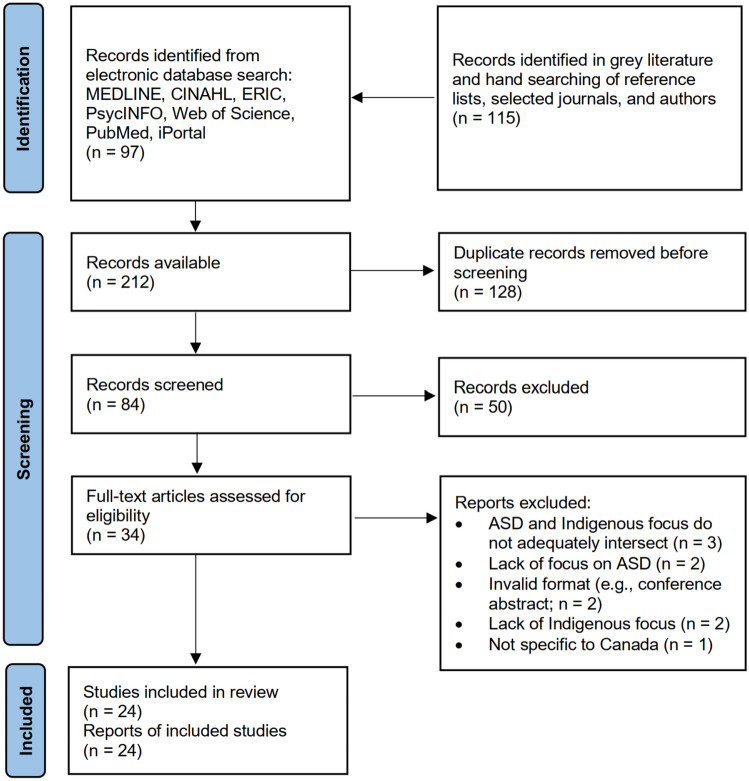
Currently there is a severe lack of research on autism and Indigenous people in Canada. This scoping review explores this literature gap and assesses the same literature from an Indigenous perspective. Scoping reviews are an effective means to explore the literature in a specific area, in this case, autism and Indigenous people in Canada. We explored existing literature as it pertains to Indigenous populations and autism in Canada. To support this review, the Indigenous Quality Assessment Tool (QAT) was adapted to appraise the quality of literature. In total, there were a total of 212 articles identified of which 24 met the inclusion criteria: (1) some focus on autism, (2) a component specific to Indigenous people, and (3) specific to Canada. Of the 24 articles and reports, 15 were peer-reviewed and the rest considered grey literature. Most articles focused on program delivery with some literature using primary data (quantitative and/or qualitative). Overall, the quality of the research was appraised as poor, as determined by the QAT. Findings reaffirm the critical need for research that addresses autism in Indigenous communities within Canada and show the importance of having research done in full partnership with, or led by, Indigenous people.
Verified 2026-11-25 · 1 reference not checked yet
Overview
CoChat Summary
TL;DR
This scoping review identified 24 articles/reports on autism and Indigenous peoples in Canada, finding a severe literature gap and generally low research quality from an Indigenous perspective. It concludes there is a critical need for Indigenous-led, high-quality research on prevalence and lived experience.
Key findings
- Of 212 records identified, 24 met inclusion criteria; 15 were peer-reviewed and 9 were grey literature. Most focused on program delivery; 22 were Canada-focused and 2 included international focus, while 14 had a pan-Indigenous focus, 9 focused on First Nations, 1 on First Nations and Métis, and none explicitly focused on Inuit populations.
- IQAT appraisal found none of the articles met all 14 criteria; 2 were high quality, 3 moderate, and 19 low. Highest scores were Manitoba First Nations Child and Family Services (2017) at 11/14, Cowessess First Nation (2021) at 10/14, and Lindblom (2017a) and Woodgate et al. (2013) at 7/14.
- Only 7 of 24 articles had self-identified Indigenous authorship or co-authorship, and none had self-identified Autistic authors. Full Indigenous involvement in developing and implementing the study was present in 3 (12.50%), substantial involvement in 7 (29.17%), no involvement in 10 (41.67%), and uncertain in 4 (16.67%).
- Interrater agreement was κ = 0.633 with 81.81% proportional agreement at title/abstract screening, and κ = 0.655 with 84.38% proportional agreement at full-text review. Just under half of included articles (n = 11) were reviews, reports, or commentaries; six primary peer-reviewed studies were not led by Indigenous people.
Methods
- Scoping review following Arksey and O’Malley’s five stages plus a sixth quality-appraisal stage, using PRISMA-ScR through Covidence; protocol registered with Open Science Framework.
- Searched MEDLINE, CINAHL, ERIC, PsycINFO, Web of Science, Cochrane Library, PubMed, Google Scholar, and North American Indigenous research databases; limited to English articles published 2000–2022. Inclusion required some focus on autism, a component specific to Indigenous peoples, and a Canadian context.
- Two reviewers independently screened and charted data, resolving disagreements by consensus. Quality was assessed with an adapted Indigenous Quality Assessment Tool (IQAT) of 14 questions; high quality was ≥10/14, moderate 6–9/14, and low ≤5/14.
Limitations
- Stated: the broad scoping review yielded much grey literature; the IQAT was developed in Australia and carries cultural influences different from the local Canadian context; the IQAT appraises only what is present in a manuscript, so unpublished details may be missed; and a pan-Indigenous approach was used because of the limited body of literature.
- Evident from the text: no included article explicitly focused on Inuit populations, and none had self-identified Autistic authors, which may limit representation and applicability.
- Evident from the text: many IQAT items were scored unclear, especially whether research benefited Indigenous communities (unclear = 12), and quality thresholds were based on previous applications of the IQAT.
Model-written summary. Check it against the paper before relying on it.
Integrity signals
Registry
Cites
Statistics
Figures
Verification
Claims the paper makes
8 Valid · 3 Not valid · 24 Not checked · 63 Own results and interpretations
The cited sources support only part of this claim — read each source’s verdict below.
In the paper
“Only three articles were considered to have full involvement of Indigenous peoples in the planning and execution of the research (Cowessess First Nation, 2021; Gerlach et al., 2022; Manitoba First Nations Child and Family Services, 2017).”
§ Indigenous Autism in Canada: A Scoping Review > Results > Research Question 1: What is Known About Autism in Indigenous Communities in Canada Based on the Literature?
What the sources say
- Not matchedcites Cowessess First Nation, 2021
An author–year citation the paper’s reference list doesn’t settle. We don’t search these by name.
- Partly supportedcites Gerlach et al., 2022 matched to “Autism and Autism Services with Indigenous Families and Children in the Settler-Colonial Context of Canada: A Critical Scoping Review” (2022) sourceExperimental — accuracy not yet measured
In “The Hegemony of a Medical Worldview” (page unavailable), the review says three of 19 studies recruited Indigenous adult participants. It does not say those participants were fully involved in planning and executing the research; the claim turns a count of studies with participants into a count of studies with full research involvement. (LLM, conf=0.86)
- Not matchedcites Manitoba First Nations Child and Family Services, 2017
An author–year citation the paper’s reference list doesn’t settle. We don’t search these by name.
plain- Asserted: passes — The authors put it forward as true.
- Checkable: passes — It can be checked against evidence.
- Load-bearing: passes — The paper’s conclusions depend on it.
- Based: passes — The paper gives a reason why it holds.
- Not matched
None of the sources cited for this claim could be matched to a paper, so there is nothing to check it against.
In the paper
“Of these three articles, two were community reports (Cowessess First Nation, 2021; Manitoba First Nations Child and Family Services, 2017).”
§ Indigenous Autism in Canada: A Scoping Review > Results > Research Question 1: What is Known About Autism in Indigenous Communities in Canada Based on the Literature?
What the sources say
- Not matchedcites Cowessess First Nation, 2021
An author–year citation the paper’s reference list doesn’t settle. We don’t search these by name.
- Not matchedcites Manitoba First Nations Child and Family Services, 2017
An author–year citation the paper’s reference list doesn’t settle. We don’t search these by name.
plain- Asserted: passes — The authors put it forward as true.
- Checkable: passes — It can be checked against evidence.
- Load-bearing: unclear — It is unclear whether the paper’s conclusions depend on it.
- Based: passes — The paper gives a reason why it holds.
- Not matched
A claim is checked only against the cited paper’s full text, never its abstract, and none is available for its sources.
In the paper
“The literature generally offered some focus on the experiences of autism, with the exception of five articles (Burstyn et al., 2010; Di Pietro & Illes, 2014; El-Hayek, 2007; Ouellette-Kuntz et al., 2006; Stavropoulou-Kampoukou, 2019).”
§ Indigenous Autism in Canada: A Scoping Review > Results > Research Question 2: What are the Areas of Focus of Published Research on Autism and Indigenous Peoples in Canada?
What the sources say
- Not checked — no full text of the sourcecites Burstyn et al., 2010 matched to “Autism spectrum disorders, maternal char vacteristics and obstetric complications among singletons born in Alberta, Canada” (2010) source
- Not checked — no full text of the sourcecites Di Pietro & Illes, 2014 matched to “Disparities in Canadian Indigenous Health Research on Neurodevelopmental Disorders” (2014) source
- Not checked — no full text of the sourcecites El-Hayek, 2007
plain- Asserted: passes — The authors put it forward as true.
- Checkable: passes — It can be checked against evidence.
- Load-bearing: unclear — It is unclear whether the paper’s conclusions depend on it.
- Based: passes — The paper gives a reason why it holds.
A result the paper reports from its own data — it cites no other source for it, so there is none to check. The quote shows it is in the paper.
In the paper
“All but two articles had some focus on program delivery relative to autism.”
§ Indigenous Autism in Canada: A Scoping Review > Results > Research Question 2: What are the Areas of Focus of Published Research on Autism and Indigenous Peoples in Canada?
plain- Asserted: passes — The authors put it forward as true.
- Checkable: passes — It can be checked against evidence.
- Load-bearing: unclear — It is unclear whether the paper’s conclusions depend on it.
- Based: passes — The paper gives a reason why it holds.
A result the paper reports from its own data — it cites no other source for it, so there is none to check. The quote shows it is in the paper.
In the paper
“Overall, the quality of the research was appraised as poor, as determined by the QAT.”
§ Indigenous Autism in Canada: A Scoping Review > Abstract
plain- Asserted: passes — The authors put it forward as true.
- Checkable: passes — It can be checked against evidence.
- Load-bearing: passes — The paper’s conclusions depend on it.
- Based: passes — The paper gives a reason why it holds.
24 more claims
Create a free account to see all 98 claims and to verify the 5 references still open.
- Probably not a substantial claim. 41
- It may state two separate claims as one. 39
- The quote only partly states this claim. 1
Self-check
Percentages, sums and reported differences re-computed from the paper’s own numbers.
Each contradiction between two passages listed here was confirmed by an independent check.
Rated minor: it would not touch a result — a value no result rests on, a p-value that stays on the same side of the significance level, or a conflict that is clerical, resolved elsewhere in the paper, or outside its own findings.
In the paper
§ Indigenous Autism in Canada: A Scoping Review > Results > General Characteristics
“only 2 studies (Shochet et al., 2020; Simpson, 2021) included an international focus”
§ Indigenous Autism in Canada: A Scoping Review > Results > General Characteristics
“17 sources (including both academic and grey literature) across the United States, the Netherlands, Ghana, Korea, Australia, and Canada, published 2003 to 2013.”
Rated minor: it would not touch a result — a value no result rests on, a p-value that stays on the same side of the significance level, or a conflict that is clerical, resolved elsewhere in the paper, or outside its own findings.
In the paper
§ Indigenous Autism in Canada: A Scoping Review > Results > Research Question 3: What is the Quality of Research on Autism in Indigenous Communities in Canada?
“7 (yes = 0, partially = 1)”
§ Indigenous Autism in Canada: A Scoping Review > Results > Selection of Sources of Evidence
“7. Did the researchers negotiate agreements to protect Indigenous ownership of intellectual and cultural property created through the research? | 1 (4.17) | 1 (4.17) | 17 (70.83) | 5 (20.83)”
Citations
Cites
Diagnostic and Statistical Manual of Mental Disorders
American Psychiatric Association (2013) · doi:10.1176/appi.books.9780890425596 · Cited by 116,369
PRISMA Extension for Scoping Reviews (PRISMA-ScR): Checklist and Explanation
Tricco, A. C., Lillie, E., Zarin, W., O'Brien, K. K., Colquhoun, H., Levac, D., Moher, D., Peters, M. D. J., Horsley, T., Weeks, L., et al. (2018) · Annals of Internal Medicine · doi:10.7326/m18-0850 · Cited by 43,565 · cited 5×
“Covidence automatically generated Cohen’s kappa coefficients (κ) to determine interrater agreement.”
MethodInfluentialScoping studies: towards a methodological framework
Arksey, H., & O'Malley, L. (2005) · International Journal of Social Research Methodology · doi:10.1080/1364557032000119616 · Cited by 36,742 · cited 3×
“Arksey and O’Malley (2005) identified the following five stages in a scoping review: (1) determining the research question, (2) identifying relevant studies, (3) study selection, (4) charting the data, and (5) collating, summarizing and reporting the results.”
BackgroundMethodMunn, Z., Peters, M. D. J., Stern, C., Tufanaru, C., McArthur, A., & Aromataris, E. (2018) · BMC Medical Research Methodology · doi:10.1186/s12874-018-0611-x · Cited by 11,385 · cited 1×
“These reviews clarify key concepts and definitions within the field of inquiry, examine how research is conducted, and identify key characteristics or factors related to a concept, and finally analyze knowledge gaps (Munn et al., 2018).”
BackgroundIndigenous health part 1: Determinants and disease patterns
Gracey, M., & King, M. (2009) · The Lancet · doi:10.1016/s0140-6736(09)60914-4 · Cited by 1,303 · cited 1×
“…disease, shorter life expectancy, higher rates of malnutrition, substance abuse, life-style-related chronic diseases and conditions, accidents, homicide, violence, and suicides than the mainstream population (Barnabe, 2021; Gracey & King, 2009; Smylie & Anderson, 2006; Wilson & Young, 2008).”
BackgroundHarfield, S., Pearson, O., Morey, K., Kite, E., Canuto, K., Glover, K., Gomersall, J. S., Carter, D., Davy, C., Aromataris, E., et al. (2020) · BMC Medical Research Methodology · doi:10.1186/s12874-020-00959-3 · Cited by 313 · cited 2×
“Some reviews assess quality and we have adopted this sixth stage; methodologic/research rigor was analyzed using the Indigenous Quality Assessment Tool (IQAT) (Harfield et al., 2020).”
BackgroundMethodResidential schools and the effects on Indigenous health and well-being in Canada—a scoping review
Wilk, P., Maltby, A., & Cooke, M. (2017) · Public Health Reviews · doi:10.1186/s40985-017-0055-6 · Cited by 293 · cited 1×
“Such policy and widespread practices are still being felt in First Nations communities across Canada today (Wilk et al., 2017).”
BackgroundBeyond deficit: ‘strengths‐based approaches’ in Indigenous health research
Bryant, J., Bolt, R., Botfield, J. R., Martin, K., Doyle, M., Murphy, D., Graham, S., Newman, C. E., Bell, S., Treloar, C., et al. (2021) · Sociology of Health & Illness · doi:10.1111/1467-9566.13311 · Cited by 196 · cited 1×
“These strengths are means by which Indigenous families can support Autistic relatives and those in their communities, and through strength-based lens this review aimed to emphasize the importance of Indigenous led work to eventually better support Indigenous families (Bryant et al., 2021).”
BackgroundBurstyn, I., Sithole, F., & Zwaigenbaum, L. (2010) · Chronic Diseases and Injuries in Canada · doi:10.24095/hpcdp.30.4.04 · Cited by 159 · cited 3×
“The literature generally offered some focus on the experiences of autism, with the exception of five articles (Burstyn et al., 2010; Di Pietro & Illes, 2014; El-Hayek, 2007; Ouel-lette-Kuntz et al., 2006; Stavropoulou-Kampoukou, 2019).”
BackgroundSelf-citationThe use of language in autism research
Monk, R., Whitehouse, A. J. O., & Waddington, H. (2022) · Trends in Neurosciences · doi:10.1016/j.tins.2022.08.009 · Cited by 154 · cited 1×
“Autism also has an evolving terminology (Monk et al., 2022).”
Smylie, J. (2006) · Canadian Medical Association Journal · doi:10.1503/cmaj.060940 · Cited by 115 · cited 1×
“…disease, shorter life expectancy, higher rates of malnutrition, substance abuse, life-style-related chronic diseases and conditions, accidents, homicide, violence, and suicides than the mainstream population (Barnabe, 2021; Gracey & King, 2009; Smylie & Anderson, 2006; Wilson & Young, 2008).”
BackgroundCanada's residential schools: the final report of the Truth and Reconciliation Commission of Canada
(2016) · Choice Reviews Online · doi:10.5860/choice.196543 · Cited by 99
Wilson, K., & Young, K. (2008) · International Journal of Circumpolar Health · doi:10.3402/ijch.v67i2-3.18260 · Cited by 72 · cited 1×
“…disease, shorter life expectancy, higher rates of malnutrition, substance abuse, life-style-related chronic diseases and conditions, accidents, homicide, violence, and suicides than the mainstream population (Barnabe, 2021; Gracey & King, 2009; Smylie & Anderson, 2006; Wilson & Young, 2008).”
BackgroundBarnabe, C. (2021) · BMJ Global Health · doi:10.1136/bmjgh-2020-004052 · Cited by 68 · cited 1×
“…disease, shorter life expectancy, higher rates of malnutrition, substance abuse, life-style-related chronic diseases and conditions, accidents, homicide, violence, and suicides than the mainstream population (Barnabe, 2021; Gracey & King, 2009; Smylie & Anderson, 2006; Wilson & Young, 2008).”
BackgroundChristidis, R., Lock, M., Walker, T., Egan, M., & Browne, J. (2021) · International Journal for Equity in Health · doi:10.1186/s12939-021-01551-x · Cited by 57 · cited 1×
“Studies were assessed as “high quality” if they met at least 10 of the 14 appraisal questions, “moderate quality” if meeting 6 to 9 out of 14 questions, and “low quality” if meeting 5 or less questions, based on previous applications of the IQAT in literature (Christidis et al., 2021).”
MethodCorrelates of age at diagnosis of autism spectrum disorders in six Canadian regions
Coo, H., Ouellette-Kuntz, H., Lam, M., Yu, C. T., Dewey, D., Bernier, F. P., Chudley, A. E., Hennessey, P. E., Breitenbach, M. M., Noonan, A. L., et al. (2012) · Chronic Diseases and Injuries in Canada · doi:10.24095/hpcdp.32.2.05 · Cited by 56
The Complainant: The Canadian Human Rights Case on First Nations Child Welfare
Blackstock, C. (2017) · McGill Law Journal · doi:10.7202/1040049ar · Cited by 55
Indigenous Australians with autism: A scoping review
Bailey, B., & Arciuli, J. (2020) · Autism · doi:10.1177/1362361319894829 · Cited by 47
Blanchet Garneau, A., Bélisle, M., Lavoie, P., & Laurent Sédillot, C. (2021) · International Journal for Equity in Health · doi:10.1186/s12939-021-01475-6 · Cited by 47 · cited 1×
“…about autism in First Nations communities, lack of research capacity for Indigenous people, and/or ongoing mistrust of research institutions (Blanchet Garneau et al., 2021) While Gerlach’s et al. review provides important insights, ensuring the literature is reliable, credible, and…”
BackgroundTruth and Reconciliation Commission of Canada (2016) · McGill-Queen's University Press · doi:10.2307/j.ctt19qghck · Cited by 41
Disparities in Canadian Indigenous Health Research on Neurodevelopmental Disorders
Di Pietro, N. C., & Illes, J. (2014) · Journal of Developmental & Behavioral Pediatrics · doi:10.1097/dbp.0000000000000002 · Cited by 39 · cited 3×
“The literature generally offered some focus on the experiences of autism, with the exception of five articles (Burstyn et al., 2010; Di Pietro & Illes, 2014; El-Hayek, 2007; Ouel-lette-Kuntz et al., 2006; Stavropoulou-Kampoukou, 2019).”
BackgroundPrevalence of pervasive developmental disorders in two Canadian provinces
Ouellette‐Kuntz, H., Coo, H., Yu, C. T., Chudley, A. E., Noonan, A., Breitenbach, M., Ramji, N., Prosick, T., Bedard, A., & Holden, J. J. A. (2006) · Journal of Policy and Practice in Intellectual Disabilities · doi:10.1111/j.1741-1130.2006.00076.x · Cited by 39 · cited 1×
“…et al., 2010; Di Pietro & Illes, 2014; Pietro & Illes, 2016; El-Hayek, 2007; Gerlach et al., 2022; Inman, 2019; Lindblom, 2014, 2016, 2017a, b; Ouellette-Kuntz et al., 2006; Shochet et al., 2020; Simpson, 2021; Thompson, 2012) and 9 were considered grey literature (Auerbach, 2007; Canadian…”
Under-detection of autism among First Nations children in British Columbia, Canada
Lindblom, A. (2014) · Disability & Society · doi:10.1080/09687599.2014.923750 · Cited by 37 · cited 4×
“Examples included ethnography (Lindblom, 2014; Lindblom, 2017a, b, c) and Touchstones of Hope (Manitoba First Nations Child and Family Services, 2017) which comprises a set of principles guiding reconciliation, fostering relationships, and facilitating conversations on systems reform.”
BackgroundInfluentialLindblom, A. (2017) · Psychology of Music · doi:10.1177/0305735616659553 · Cited by 35 · cited 3×
“…(Antony et al., 2022; Burstyn et al., 2010; Di Pietro & Illes, 2014; Pietro & Illes, 2016; El-Hayek, 2007; Gerlach et al., 2022; Inman, 2019; Lindblom, 2014, 2016, 2017a, b; Ouellette-Kuntz et al., 2006; Shochet et al., 2020; Simpson, 2021; Thompson, 2012) and 9 were considered grey…”
BackgroundMāori and autism: A scoping review
Tupou, J., Curtis, S., Taare-Smith, D., Glasgow, A., & Waddington, H. (2021) · Autism · doi:10.1177/13623613211018649 · Cited by 35 · cited 2×
“When contrasting the findings of this scoping review with the others done in Canada, Australia, and New Zealand, the emergent themes are similar across reviews, including challenges to diagnosis, different understandings of autism, and the lack of research in this area.”
BackgroundDi Pietro, N., & Illes, J. (2016) · Neuroethics · doi:10.1007/s12152-016-9281-8 · Cited by 27 · cited 2×
“…et al., 2022; Burstyn et al., 2010; Canadian Academy of Health Sciences, 2022; Canadian Autism Partnership Project, 2017; Di Pietro and Illes, 2014; Di Pietro and Illes, 2016; El-Hayek, 2007; Gerlach et al., 2022; Inman, 2019; Shochet et al., 2020; Simpson, 2021; Stavropoulou-Kampoukou, 2019;…”
BackgroundSimpson, H. A. (2021) · AlterNative An International Journal of Indigenous Peoples · doi:10.1177/11771801211039274 · Cited by 26 · cited 4×
“…Project, 2017; Di Pietro and Illes, 2014; Di Pietro and Illes, 2016; El-Hayek, 2007; Gerlach et al., 2022; Inman, 2019; Shochet et al., 2020; Simpson, 2021; Stavropoulou-Kampoukou, 2019; Virginia Lane, 2022), with some focusing strictly on First Nations (Auerbach, 2007; Cowessess First…”
BackgroundInfluentialFunding Priorities: Autism and the Need for a More Balanced Research Agenda in Canada
Krahn, T. M., & Fenton, A. (2012) · Public Health Ethics · doi:10.1093/phe/phs027 · Cited by 22 · cited 1×
“Autism research in Canada disproportionately focusses on the bio-medical and clinical aspects of autism rather than the public health or social aspects (Krahn & Fenton, 2012).”
BackgroundGerlach, A. J., Matthiesen, A., Moola, F. J., & Watts, J. (2022) · Canadian Journal of Disability Studies · doi:10.15353/cjds.v11i2.886 · Cited by 20 · cited 4×
“Only three articles were considered to have full involvement of Indigenous peoples in the planning and execution of the research (Cowessess First Nation, 2021; Gerlach et al., 2022; Manitoba First Nations Child and Family Services, 2017).”
BackgroundInfluentialThrice disabling disability: enabling inclusive, socially just teacher education
Thompson, S. A. (2011) · International Journal of Inclusive Education · doi:10.1080/13603111003671640 · Cited by 17 · cited 3×
“…Lane, 2022), with some focusing strictly on First Nations (Auerbach, 2007; Cowessess First Nation, 2021; Lindblom, 2014, 2016, 2017a, b; Manitoba First Nations Child and Family Services, 2017; Woodgate et al., 2013), and one was Métis in focus (which also included First Nations) (Thompson, 2012).”
BackgroundExploring autism and music interventions through a First Nations lens
Lindblom, A. (2017) · AlterNative An International Journal of Indigenous Peoples · doi:10.1177/1177180117729854 · Cited by 14 · cited 10×
“The highest scoring article was positively scored in 11 of the 14 IQAT categories/questions (Manitoba First Nations Child and Family Services, 2017), followed by 10 out of 14 (Cow-essess First Nation, 2021), and then 7 out of 14 (Lindblom, 2017a; Woodgate et al., 2013).”
BackgroundInfluentialShochet, I. M., Orr, J. A., Kelly, R. L., Wurfl, A. M., Saggers, B. R., & Carrington, S. B. (2020) · International Journal for Equity in Health · doi:10.1186/s12939-020-01247-8 · Cited by 13 · cited 3×
“…Canadian Autism Partnership Project, 2017; Di Pietro and Illes, 2014; Di Pietro and Illes, 2016; El-Hayek, 2007; Gerlach et al., 2022; Inman, 2019; Shochet et al., 2020; Simpson, 2021; Stavropoulou-Kampoukou, 2019; Virginia Lane, 2022), with some focusing strictly on First Nations (Auerbach,…”
BackgroundInfluentialAntony, C., Campbell, M., Côté, S., Bruno, G., Tinglin, C., & Lai, J. (2022) · Frontiers in Psychiatry · doi:10.3389/fpsyt.2022.916256 · Cited by 13 · cited 3×
“The programs described included special education (Auerbach, 2007; Manitoba First Nations Child and Family Services, 2017) (Antony et al., 2022; Lindblom, 2017a; Shochet et al., 2020; Thompson, 2012), negative systemic impacts and stereotyping (Gerlach et al., 2022), and inequitable access to…”
BackgroundSelf-citationLindblom, A. (2017) · UEF eRepo (University of Eastern Finland) · Cited by 10
Absence and Epidemic: Autism and fetal alcohol spectrum disorder in Indigenous populations in Canada
Inman, C. E. (2019) · Canadian Journal of Disability Studies · doi:10.15353/cjds.v8i4.531 · Cited by 9 · cited 2×
“…2022; Canadian Autism Partnership Project, 2017; Di Pietro and Illes, 2014; Di Pietro and Illes, 2016; El-Hayek, 2007; Gerlach et al., 2022; Inman, 2019; Shochet et al., 2020; Simpson, 2021; Stavropoulou-Kampoukou, 2019; Virginia Lane, 2022), with some focusing strictly on First Nations…”
Background(2007) · Cited by 8
Thoughts and Experiences from Ethnographic Fieldwork with First Nations
Lindblom, A. (2015) · SAGE Publications Ltd eBooks · doi:10.4135/978144627305015595378 · Cited by 4 · cited 4×
“…al., 2022; Burstyn et al., 2010; Di Pietro & Illes, 2014; Pietro & Illes, 2016; El-Hayek, 2007; Gerlach et al., 2022; Inman, 2019; Lindblom, 2014, 2016, 2017a, b; Ouellette-Kuntz et al., 2006; Shochet et al., 2020; Simpson, 2021; Thompson, 2012) and 9 were considered grey literature (Auerbach,…”
BackgroundInfluentialIndigenous Autism in Canada: A Scoping Review
Bruno, G., Chan, T. A., Zwaigenbaum, L., Nicholas, D., & Coombs, E. (2023) · doi:10.21203/rs.3.rs-2661859/v1 · Cited by 2
Self-citation
Research works printed but not linked: 5
- Auerbach, S. (2007). Special needs students in First Nations schools: Inclusion in school based special education programs. First Nations Education Steering Committee & First Nations Schools Association.
- Bartlett, R. H. (1977). The Indian Act of Canada. Buff L Rev, 27, 581.
- Canadian Academy of Health Sciences. (2022). Autism in Canada: Considerations for future public policy development—Weaving together evidence and lived experience. Canadian Academy of Health Sciences.
- Cowessess First Nation. (2021). Cowessess First Nation and the Autism Resource Centre: Building Block Program. Public Health Agency of Canada.
- Stavropoulou-Kampoukou, I. (2019). Culturally safe service delivery approaches for Indigenous children with Autism Spectrum Disorder: A literature review. University of Victoria.
Cited by
Neurodivergence, intersectionality, and eating disorders: a lived experience-led narrative review
Cobbaert, L., Millichamp, A., Elwyn, R., Silverstein, S., Schweizer, K., Thomas, E., & Miskovic‐Wheatley, J. (2024) · Journal of Eating Disorders · doi:10.1186/s40337-024-01126-5 · Cited by 95
“Research also suggests that autism and ADHD are underdiagnosed in racially marginalised individuals, due, in part, to Western ethnocentrism embedded in diagnostic measures [96, 97].”
Bruno, G., Lindblom, A., Masternes, J.-A., Tupou, J., Waisman, T., Toby, S., Vining, C. B., & Magiati, I. (2025) · Autism · doi:10.1177/13623613251318399 · Cited by 25
“Moreover, in 2016, Canada was found guilty of human rights abuses against First Nations children by inequitably funding services and support in First Nations communities (Blackstock, 2011, 2016).”
InfluentialSelf-citationde López, K. M. J., & Møller, H. T. (2024) · Neuropsychiatric Disease and Treatment · doi:10.2147/ndt.s466081 · Cited by 20
Frozen in Time, a Focused Review of Autism Prevalence in Canadian Indigenous Communities
Hus, Y. (2023) · Neuropsychiatric Disease and Treatment · doi:10.2147/ndt.s439450 · Cited by 7
Ishaque, S., Ela, O., Dowling, A., Rissel, C. E., Canuto, K. J., Hall, K., Bidargaddi, N. P., Briley, A. L., Roberts, C. T., & Bonevski, B. (2025) · Journal of Medical Internet Research · doi:10.2196/57019 · Cited by 10
Metadata
- Authors
- Bruno, G., Chan, T. A., Zwaigenbaum, L., Coombs, E., Circle, T. I. R., & Nicholas, D.
- Affiliations
- University of Alberta (CA)
- University of Calgary (CA)
- Corresponding author
- Bruno, Grant
- Venue
- Journal of Autism and Developmental Disorders
- Published
- 2023-07-22
- Volume
- 54
- Issue
- 9
- Pages
- 3478-3491
- ISSN
- 0162-3257 (ISSN-L)
- 1573-3432
- PMC
- PMC11362183
- OpenAlex
- W4385074406
- Semantic Scholar
- 7306b5ab696ccb75cf40df4a6c2955735bc83246
- Cited by
- 12
- References
- 38
- Citations by year
- 2026: 3 · 2025: 4 · 2024: 3 · 2023: 2
- FWCI
- 0.59
- Type
- journal article
- Language
- en
- Open access
- hybrid
- doi.org
- Licence
- cc-by
- creativecommons.org/licenses/by/4.0 (tdm)
- creativecommons.org/licenses/by/4.0 (vor)
- Locations
- Journal of Autism and Developmental Disorders (publishedVersion, cc-by)
- PubMed Central (publishedVersion, cc-by)
- PubMed (publishedVersion)
- Funders
- Stollery Children’s Hospital Foundation
- Women and Children's Health Research Institute
- Brain Canada
- Transitioning Autism Care Consortium
- Autism Edmonton
- Autism Research Center
- Topics
- Social Sciences › Health › Indigenous Health, Education, and Rights
- Life Sciences › Neuroscience › Cognitive Neuroscience › Autism Spectrum Disorder Research
- Health Sciences › Medicine › Public Health, Environmental and Occupational Health › Down syndrome and intellectual disability research
- Keywords
- autism spectrum disorder, indigenous peoples, Canada, Indigenous perspectives, research gaps, research quality, community-based programs, research collaboration
- MeSH terms
- Indigenous Canadians, Autistic Disorder, Canada, Humans
About these checks
Registry, retraction, Cites and statistics results are computed, not judged, with one exception: a printed reference that no index lists is read once by a model before it counts as a citation error. Claims are extracted by a model and kept only when their quote appears verbatim in the text; each cited source is then checked, with a model’s help, for whether it says what the claim relies on. Those verdicts can be wrong — read the claim’s quote and the cited source before relying on one.
The claim verdicts this report counts are experimental: their accuracy is not yet measured.
A language model drew the claims from the paper on 2026-10-10, under version 3 of the claim definition (model deepseek-v4.1-flash, prompt extract-v3).
A second model labelled each claim on 2026-10-10 (model jev-1.13-20260917, definition revision gold-guideline-v0.2).
Cited sources are checked with a language model’s help (gpt-6-sol).
Statistics and arithmetic are recomputed, not judged.
Confidence bands are shown only for fields calibrated on our annotated test set. None is calibrated yet, so no band is shown.
What counts as a claim ›How we measure confidence ›How we check this ›
Are you an author, or do you see a problem with this page? Request a review
Data sources
Bibliographic data: Semantic Scholar, OpenAlex, Crossref.
Contains information from the Semantic Scholar Academic Graph Datasets, made available under the ODC Attribution License (ODC-BY 1.0).
Semantic Scholar’s data is described in: Kinney, R., et al. (2023). The Semantic Scholar Open Data Platform. arXiv:2301.10140.
