

Health School-based Mindfulness Interventions for Improving Mental Health: A Systematic Review and Thematic Synthesis of Qualitative Studies
Open accessThe DOI matches its Crossref record; 41 of the 42 references it cites were found in a registry or an index.
Abstract
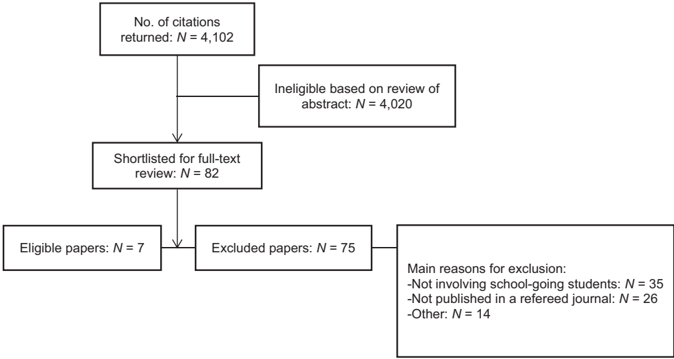
School-based mindfulness interventions have recently shown promise for treating and preventing mental health issues in young people. However, the literature lacks a high-level perspective of the impact of mindfulness on young people’s mental health according to their own first-hand accounts. Therefore, the objective of this study was to conduct the first systematic review and thematic synthesis to rigorously evaluate the qualitative evidence pertaining to students’ experiences of school-based MBIs. The following electronic databases were searched for qualitative school-based mindfulness intervention papers published up until the end of March 2019: PubMed , Web of Science , Scopus , ProQuest , and Google Scholar . An assessment of study quality was undertaken using the Critical Appraisal Skills Programme qualitative checklist. The initial literature search returned 4102 papers and seven studies met all of the inclusion criteria. The thematic synthesis identified four major themes of (i) using attentional processes to regulate emotions and cognitions, (ii) stress reduction, (iii) improved coping and social skills, and (iv) calming and/or relaxation. Findings show that school-based MBIs are experienced by students as having a range of benefits to mental health, including in both preventative and treatment contexts. However, efforts should be made to improve methodological quality, including taking steps to minimise recall bias and provide a greater degree of transparency regarding how students are selected to attend qualitative interviews or focus groups.
Overview
The claims and statistics of this paper haven’t been checked yet.
Free: it reads the open-access text and checks the first 5 claims that cite a source we can check. Create a free account to check every claim.
Integrity signals
Registry
Cites
Statistics
Figures
Verification
Claims the paper makes
The claims and statistics of this paper haven’t been checked yet.
Free: it reads the open-access text and checks the first 5 claims that cite a source we can check. Create a free account to check every claim.
Claims other papers make about this one
Each is checked against this paper’s own text: does it say what the citing paper says it does?
The cited source says what the claim attributes to it.
In the citing paper
“In child and adolescent population, MBIs have been related to symptom reduction, increased wellbeing [1,10,14,15,31,32,33,34,35,36]”
From Systematic Review of Mindfulness-Based Interventions in Child-Adolescent Population: A Developmental Perspective (2022) · cites this paper as [36]
Experimental — accuracy not yet measuredThe cited source says what the claim attributes to it.
In the citing paper
“(4) Include only qualitative studies [36]”
From Systematic Review of Mindfulness-Based Interventions in Child-Adolescent Population: A Developmental Perspective (2022) · cites this paper as [36]
Self-check
Percentages, sums and reported differences re-computed from the paper’s own numbers.
The self-check needs the paper’s full text.
Citations
Cites
Methods for the thematic synthesis of qualitative research in systematic reviews
Thomas, J., & Harden, A. (2008) · BMC Medical Research Methodology · doi:10.1186/1471-2288-8-45 · Cited by 9,312
McInnes, M. D. F., Moher, D., Thombs, B. D., McGrath, T. A., Bossuyt, P. M., and the PRISMA-DTA Group, Clifford, T., Cohen, J. F., Deeks, J. J., Gatsonis, C., et al. (2018) · JAMA · doi:10.1001/jama.2017.19163 · Cited by 3,210
Critical appraisal skills programme
Singh, J. (2013) · Journal of Pharmacology and Pharmacotherapeutics · doi:10.4103/0976-500x.107697 · Cited by 2,556
The strategy of preventive medicine
(1993) · Choice Reviews Online · doi:10.5860/choice.30-5633 · Cited by 1,880
What is resilience? A review and concept analysis.
Windle, G. (2011) · Reviews in Clinical Gerontology · doi:10.1017/s0959259810000420 · Cited by 1,761 · cited 1×
“In addition to seeking to enhance mental illness treatment approaches for young people, there is growing awareness of the benefits of cultivating resiliency and protective traits (Sapthiang et al. 2019b; Schonert-Reichl and Lawlor 2010; Windle 2011).”
BackgroundSchonert-Reichl, K. A., & Lawlor, M. S. (2010) · Mindfulness · doi:10.1007/s12671-010-0011-8 · Cited by 758
Dray, J., Bowman, J., Campbell, E., Freund, M., Wolfenden, L., Hodder, R. K., McElwaine, K., Tremain, D., Bartlem, K., Bailey, J., et al. (2017) · Journal of the American Academy of Child & Adolescent Psychiatry · doi:10.1016/j.jaac.2017.07.780 · Cited by 566
Morton, R. L., Tong, A., Howard, K., Snelling, P., & Webster, A. C. (2010) · BMJ · doi:10.1136/bmj.c112 · Cited by 563
Lucas, P. J., Baird, J., Arai, L., Law, C., & Roberts, H. M. (2007) · BMC Medical Research Methodology · doi:10.1186/1471-2288-7-4 · Cited by 553
Effectiveness of the Mindfulness in Schools Programme: non-randomised controlled feasibility study
Kuyken, W., Weare, K., Ukoumunne, O. C., Vicary, R., Motton, N., Burnett, R., Cullen, C., Hennelly, S., & Huppert, F. (2013) · British Journal of Psychiatry · doi:10.1192/bjp.bp.113.126649 · Cited by 427
Research works printed but not linked: 2
- Boland, A., Cherry, G., & Dickson, R. (2013). Doing a systematic review. London: Sage.
- Jin, Y. (2016). A qualitative study about effects and risks of the mindfulness program at the girls' training school. Japanese Journal of Mindfulness, 1, 28-40.
Cited by
Mindfulness-based interventions: an overall review
Zhang, D., Lee, E. K. P., Mak, E. C. W., Ho, C. Y., & Wong, S. Y. S. (2021) · British Medical Bulletin · doi:10.1093/bmb/ldab005 · Cited by 668
“b’, mindful schools, well and resilience program) have been implemented across the world.(79,80) These programmes can target at students, teachers, and even parents or caregivers.”
BackgroundPhan, M. L., Renshaw, T. L., Caramanico, J., Greeson, J. M., Mackenzie, E., Atkinson‐Diaz, Z., Doppelt, N., Tai, H., Mandell, D. S., & Nuske, H. J. (2022) · Mindfulness · doi:10.1007/s12671-022-01885-9 · Cited by 251
Wright, M., Reitegger, F., Cela, H., Papst, A., & Gasteiger‐Klicpera, B. (2023) · Journal of Youth and Adolescence · doi:10.1007/s10964-023-01735-4 · Cited by 114
“…al., 2018), on F2F interventions (Carsley et al., 2018; Dray et al., 2017; Sapthiang et al., 2019), on school-based interventions (Cilar et al., 2020), but not on this specific focus, and in some cases the relevant meta-analysis has also been neglected (Clarke et al., 2015; Sapthiang et al., 2019).”
BackgroundPorter, B., Oyanadel, C., Sáez-Delgado, F., Andaur, A., & Peñate, W. (2022) · European Journal of Investigation in Health, Psychology and Education · doi:10.3390/ejihpe12080085 · Cited by 45
“Nevertheless, the following limitations are observed: (1) Only consider primary studies with a population belonging to some specific stages of development [35,51,52]; (2) Only consider a population with a specific socioeconomic condition [45]; (3) Consider effects of MBI on specific symptoms [1]; (4) Include only qual…”
BackgroundInfluentialGómez-Odriozola, J., & Calvete, E. (2021) · Journal of Child and Family Studies · doi:10.1007/s10826-021-01953-z · Cited by 45
Social-emotional learning in TESOL: What, why, and how
Herrera, P., & Javier, L. (2020) · Cited by 32
Mindful parenting: future directions and challenges
Cowling, C., & Gordon, W. V. (2021) · International Journal of Spa and Wellness · doi:10.1080/24721735.2021.1961114 · Cited by 51
Types of Digital Mindfulness: Improving Mental Health Among College Students – A Scoping Review
Yosep, I., Suryani, S., Mediani, H. S., Mardhiyah, A., & Ibrahim, K. (2024) · Journal of Multidisciplinary Healthcare · doi:10.2147/jmdh.s443781 · Cited by 41
Father involvement during early childhood: A systematic review of qualitative studies
Diniz, E., Brandão, T., & Veríssimo, M. (2023) · Family Relations · doi:10.1111/fare.12858 · Cited by 28
Benefits of a Mindfulness-based Intervention at School from the Perspective of At-risk Children
Andreu, C. I., Araya-Véliz, C., & García‐Rubio, C. (2021) · Mindfulness · doi:10.1007/s12671-021-01624-6 · Cited by 29
The search for scientific meaning in mindfulness research: Insights from a scoping review
Phan-Le, N. T., Brennan, L. L., & Parker, L. (2022) · PLoS ONE · doi:10.1371/journal.pone.0264924 · Cited by 33
Contemplative Psychology: History, Key Assumptions, and Future Directions
Gordon, W. V., Sapthiang, S., & Shonin, E. (2021) · Perspectives on Psychological Science · doi:10.1177/1745691620984479 · Cited by 34
Self-citationSchussler, D. L., Oh, Y., Mahfouz, J., Levitan, J., Frank, J. L., Broderick, P. C., Mitra, J. L., Berrena, E., Kohler, K. M., & Greenberg, M. T. (2020) · Journal of Child and Family Studies · doi:10.1007/s10826-020-01864-5 · Cited by 35
Spencer, L., McGovern, R., & Kaner, E. (2020) · Journal of Public Health · doi:10.1093/pubmed/fdaa214 · Cited by 25
Mindfulness as a Coping Strategy for EFL Learning in Education
Skelly, K. J., & Chichón, J. L. E. (2021) · International Journal of Instruction · doi:10.29333/iji.2021.14356a · Cited by 33
“…studies that suggest practising mindfulness could have a significant impact on improving the ability to learn and acquire English as a Foreign Language (EFL) (Fallah, 2016; Charoensukmongkol, 2019; Riggs & Brown, 2017) of adolescents (Lueke & Lueke, 2019; Mrazek, 2013; Sapthiang et al., 2019).”
Peri, S., Neppala, G. K., Shaik, R., & Parvaz, M. A. (2024) · Current Addiction Reports · doi:10.1007/s40429-024-00582-y · Cited by 24
“Importantly, MBIs have the advantage of being implementable in clinical settings [114], schools [115], and workplaces [116], are cost-effective, and require less training compared to other techniques, such as CBT [117].”
UK maternity care experiences of ethnic minority and migrant women: Systematic review
Obionu, I. M., Onyedinma, C., Mielewczyk, F. J., & Boyle, E. M. (2023) · Public Health Nursing · doi:10.1111/phn.13240 · Cited by 22
Listen to the Children: Elementary School Students' Perspectives on a Mindfulness Intervention
D’Alessandro, A. M., Butterfield, K. M., Hanceroglu, L., & Roberts, K. P. (2022) · Journal of Child and Family Studies · doi:10.1007/s10826-022-02292-3 · Cited by 22
“Limited research has considered children’s perspectives of classroom-based mindfulness interventions (e.g., Ager et al., 2015, Campion & Rocco, 2009, Cruchon, 2009, Dariotis et al., 2017, Sapthiang et al., 2019, Thomas & Atkinson, 2017).”
BackgroundResultInfluentialExperience of an 8-Week Online Mindfulness Intervention for Nursing Students: Qualitative Findings
Spadaro, K. C., & Hunker, D. F. (2021) · Nurse Educator · doi:10.1097/nne.0000000000000881 · Cited by 14
von Salisch, M., & Voltmer, K. (2023) · Mindfulness · doi:10.1007/s12671-023-02158-9 · Cited by 18
Aboul-Yazeed, R. S., Darwish, A. A., & Hassanien, A. E. (2025) · Frontiers in Virtual Reality · doi:10.3389/frvir.2025.1429038 · Cited by 15
Nelson, L., Roots, K., Dunn, T. J., Rees, A., Hull, D. D., & Gordon, W. V. (2021) · International Journal of Spa and Wellness · doi:10.1080/24721735.2021.1909865 · Cited by 14
“…audience (Bluth et al., 2016; Dray et al., 2017;Huppert, 2009;Weisz et al., 2005), delivering interventions asawhole class activityminimises inequality in accessing the intervention while reducing stigma and social comparison (Durlack et al., 2011; Kuyken et al., 2013; Sapthiang et al., 2019a).”
BackgroundGoodwin, J., Savage, E., O’Brien, N., & O’Donovan, Á. (2023) · International Journal of Qualitative Studies on Health and Well-Being · doi:10.1080/17482631.2023.2249287 · Cited by 19
Sumner, A. L., Cartwright, T., Ballieux, H., & Edginton, T. L. (2025) · British Journal of Health Psychology · doi:10.1111/bjhp.12793 · Cited by 17
“Similarly, a thematic synthesis of mindfulness interventions described benefits for adolescents' emotional awareness, emotional regulation, stress reduction, coping, social skills, and relaxation (Sapthiang et al., 2019).”
InfluentialHai, A. H., Franklin, C., Cole, A. H., Panisch, L. S., Yan, Y., & Jones, K. V. (2021) · Children and Youth Services Review · doi:10.1016/j.childyouth.2021.105981 · Cited by 18
Shinde, S., Pereira, B., & Khandeparkar, P. (2022) · Indian Journal of Psychiatry · doi:10.4103/indianjpsychiatry.indianjpsychiatry_293_22 · Cited by 9
“[25,26] In the field of mindfulness education, we present the first study from a low-resource setting to describe the acceptability and feasibility of a teacher-led mindfulness curriculum.”
The Core Curricular Content of School-Based Mindfulness Programs
Schussler, D. L., Fosco, S. L. D., & Kohler, K. M. (2023) · School Mental Health · doi:10.1007/s12310-023-09623-9 · Cited by 9
“…are a number of rigorous reviews (qualitative and quantitative) and meta-analyses that provide important information synthesizing current understandings of SBMP outcomes for particular participants (see McKeering & Hwang, 2019; Pickerell et al., 2023; Sapthiang et al., 2019; Tudor et al., 2022).”
McDonald, M., Waitoki, W., & Rolleston, A. K. (2021) · MAI Journal A New Zealand Journal of Indigenous Scholarship · doi:10.20507/maijournal.2021.10.2.1 · Cited by 6
How can we optimise learning from trials in child and adolescent mental health?
Axford, N., Berry, V., Lloyd, J., & Wyatt, K. M. (2022) · Evidence-Based Mental Health · doi:10.1136/ebmental-2022-300500 · Cited by 8
Grunewald, N. M., & Foley‐Nicpon, M. (2023) · Psychology in the Schools · doi:10.1002/pits.23059 · Cited by 9
Magalhães, S., Carvalhais, L. S. D. A., Oliveira, P., Francisco, C., Mourisco, C., Leal, T., & Limpo, T. (2023) · Mindfulness · doi:10.1007/s12671-023-02269-3 · Cited by 8
“In addition to the ease, convenience, and cost-effectiveness of implementing interventions in a classroom context, providing whole-class activities diminishes stigma, inequalities, and social evaluations (Sapthiang et al., 2019).”
Abbott, P., Nixon, G., Stanley, I., & D’Ambruoso, L. (2024) · Frontiers in Public Health · doi:10.3389/fpubh.2023.1309649 · Cited by 8
Matiz, A., Fabbro, F., & Crescentini, C. (2024) · Psychology Research and Behavior Management · doi:10.2147/prbm.s441494 · Cited by 10
“…themes regarding the children’s gains in terms of improvement of well-being, personal growth, and self-knowledge are consistent with the general aims of MBPs and have already emerged from previous qualitative research on other mindfulness programs for children 65,68,69 and for adults (eg, 70 ).”
Understanding the Needs of Primary School Teachers in Supporting Their Students' Emotion Regulation
Petrovic, J., Mettler, J., Argento, A., Carsley, D., Bloom, E. L., Sullivan, S., & Heath, N. L. (2022) · Journal of School Health · doi:10.1111/josh.13191 · Cited by 6
Sapthiang, S., Shonin, E., Barrows, P. D., & Gordon, W. V. (2024) · International Journal of Transpersonal Studies · doi:10.24972/ijts.2023.42.2.101 · Cited by 7
Self-citationEvaluation of Effects of the Mindfulness Program .b for Youth: Subjective Measures and Biomarkers
Ashitani, M. (2024) · The Japanese Journal of Educational Psychology · doi:10.5926/jjep.72.121 · Cited by 4
School-based mindfulness: Application of the PARiHS framework to contextualize implementation
Schussler, D. L., Fosco, S. L. D., & Brown, M. A. (2024) · Journal of School Psychology · doi:10.1016/j.jsp.2024.101404 · Cited by 5
Frenkel, M. O., Georg, A. K., & Plessner, H. (2020) · Praxis der Kinderpsychologie und Kinderpsychiatrie · doi:10.13109/prkk.2020.69.4.321 · Cited by 3
Tumminia, M. J., DeVlieger, S., Colvin, S. E., Akiva, T., & Galla, B. M. (2022) · Mindfulness · doi:10.1007/s12671-022-01932-5 · Cited by 2
Relaxed minds for healthier food choice at school: A field experiment in southern Mexico
Viera, M. E. D., Mecheva, M. D. V., Nguyen, T., & van den Berg, M. (2024) · Appetite · doi:10.1016/j.appet.2024.107529 · Cited by 3
Exploring stress and recovery among students: examining the role of study modes
Stang, P., Weiss, M., Jaensch, P., & Scholz, S. (2025) · Discover Mental Health · doi:10.1007/s44192-025-00186-6 · Cited by 33
“…terms of practical implications, mental health education at universities can be promoted through compulsory courses for first-year students, workshops on stress management, mindfulness-based group training and awareness-raising campaigns, particularly targeting full-time students and women [32–35].”
Exploring Stress and Recovery among Students: Implications for Well-being and Academic PerformancePreprint
Stang, P., Weiss, M., Jaensch, P., & Scholz, S. (2024) · Research Square · doi:10.21203/rs.3.rs-4239872/v1 · Cited by 2
Razza, R. A., Zhang, Y., & Edelstein, A. (2025) · School Psychology International · doi:10.1177/01430343251361133 · Cited by 4
“%) and increase focus/concentration (69%); these are two key themes that emerged from a recent systematic review of qualitative studies capturing adolescents ’ experiences of school-based MBPs (Sapthiang et al., 2019).”
Yu, M., Shi, L., Wang, B., He, C., Cheng, S. Y., Zhang, T., & Liu, Q. (2026) · International Journal of Human-Computer Interaction · doi:10.1080/10447318.2026.2619621 · Cited by 1
“Handling cognitive load and providing proper context would be crucial for a positive experience (Sapthiang et al., 2019).”
Implementing Social-Emotional Learning in the Virtual Environment for K-12 Classrooms
Patterson, E. L. (2022) · Advances in medical education, research, and ethics (AMERE) book series · doi:10.4018/978-1-7998-9490-2.ch008 · Cited by 1
Duranleau, C., Rousseau, N., & Dionne, F. (2023) · Éducation et francophonie · doi:10.7202/1100074ar · Cited by 1
Hubungan antara Mindfulness dengan Regulasi Emosi pada Guru yang Mengajar Anak Berkebutuhan Khusus
Irmayani, I., Amna, Z., Khairani, M., & Sari, N. W. (2023) · Psycho Idea · doi:10.30595/psychoidea.v21i1.16156 · Cited by 8
Abbott, P., D’Ambruoso, L., Shanks, R., Engdawork, K., & Mihretu, A. (2025) · Qeios · doi:10.32388/up1vr6 · Cited by 3
Primdahl, N. L. (2022) · Transdisciplinary perspectives in educational research · doi:10.1007/978-3-030-95205-1_6
Mindfulness and its Application for Mind–Body Challenges in Children and Adolescents
Choudhury, A., Clare, C., Koduri, S., & Saxena, K. (2023) · Springer eBooks · doi:10.1007/978-3-031-18377-5_32
Relaxed minds for healthier food choice at school: A field experiment in southern MexicoPreprint
Viera, M. E. D., Mecheva, M. D. V., Nguyen, T., & van den Berg, M. (2024) · Research Square · doi:10.21203/rs.3.rs-3869301/v1
Studi Kepustakaan Manajemen Pendidikan Karakter Berbasis Mindfulness
Barus, R., Nurhattati, N., & Kamaludin, K. (2024) · Journal on Education · doi:10.31004/joe.v7i2.7784
Spitzenstetter, F., & Marion, C. (2025) · Pratiques Psychologiques · doi:10.1016/j.prps.2025.04.003
A scoping review of 50 years of school-based mindfulness programs for children and adolescents
O’Neal, C. S., Begeny, J. C., & Smith, B. (2026) · Children and Youth Services Review · doi:10.1016/j.childyouth.2026.108840
Dai, X., Barajas, A. K. G., Burn, A., Lyu, R., & Lu, S. (2026) · Mindfulness · doi:10.1007/s12671-026-02769-y
Li, J. I., Galla, B. M., & Tumminia, M. J. (2026) · Mindfulness · doi:10.1007/s12671-026-02905-8
Shanks, R., Thomson, S., Simpson, C., & Abbott, P. (2026) · Research Square · doi:10.21203/rs.3.rs-10308535/v1 · Cited by 1
Metadata
- Authors
- Sapthiang, S., Van Gordon, W., & Shonin, E.
- Affiliations
- University of Essex (GB)
- Venue
- Journal of Child and Family Studies
- Published
- 2019-06-05
- Volume
- 28
- Issue
- 10
- Pages
- 2650-2658
- ISSN
- 1062-1024 (ISSN-L)
- 1573-2843
- OpenAlex
- W2948596801
- Cited by
- 60
- References
- 42
- Citations by year
- 2026: 5 · 2025: 7 · 2024: 11 · 2023: 12 · 2022: 10 · 2021: 10 · 2020: 5
- FWCI
- 0.99
- Type
- journal article
- Language
- en
- Open access
- hybrid
- doi.org
- Licence
- cc-by
- creativecommons.org/licenses/by/4.0 (tdm)
- creativecommons.org/licenses/by/4.0 (vor)
- Locations
- Journal of Child and Family Studies (publishedVersion, cc-by)
- University of Derby Online Research Archive. (University of Derby) (submittedVersion)
- Topics
- Social Sciences › Psychology › Clinical Psychology › Mindfulness and Compassion Interventions
- Health Sciences › Medicine › Public Health, Environmental and Occupational Health › School Health and Nursing Education
- Social Sciences › Psychology › Developmental and Educational Psychology › Student Stress and Coping
- Keywords
- mindfulness-based interventions, student mental health, youth, student experience, emotion regulation, stress reduction, coping, social skills, relaxation, mental health prevention, psychotherapy
About these checks
Registry, retraction, Cites and statistics results are computed, not judged, with one exception: a printed reference that no index lists is read once by a model before it counts as a citation error. Claims are extracted by a model and kept only when their quote appears verbatim in the text; each cited source is then checked, with a model’s help, for whether it says what the claim relies on. Those verdicts can be wrong — read the claim’s quote and the cited source before relying on one.
Statistics and arithmetic are recomputed, not judged.
Confidence bands are shown only for fields calibrated on our annotated test set. None is calibrated yet, so no band is shown.
What counts as a claim ›How we measure confidence ›How we check this ›
Are you an author, or do you see a problem with this page? Request a review
Data sources
Bibliographic data: Semantic Scholar, OpenAlex, Crossref.
Contains information from the Semantic Scholar Academic Graph Datasets, made available under the ODC Attribution License (ODC-BY 1.0).
Semantic Scholar’s data is described in: Kinney, R., et al. (2023). The Semantic Scholar Open Data Platform. arXiv:2301.10140.
