

A Pilot Study Examining the Effect of Acceptance and Commitment Therapy as Parent Counseling
Open accessThe DOI matches its Crossref record; 42 of the 43 references it cites were found in a registry or an index.
Abstract
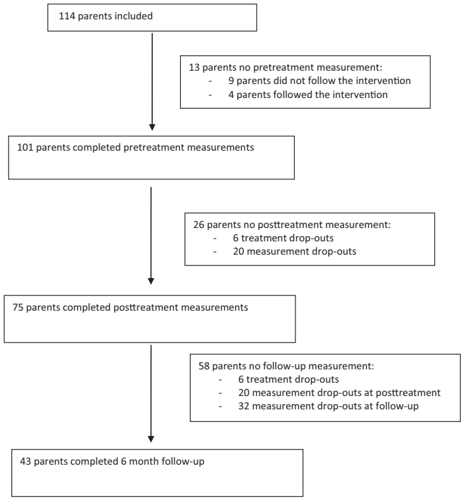
There is some scientific evidence to support the applicability and preliminary effects of ACT as a parent intervention but more research is needed. In this pilot research, Acceptance and Commitment Therapy (ACT) is provided as a parent counseling therapy in order to increase psychological flexibility which in turn helps parents to choose attuned parenting behavior, invest in a helpful parent-child relationship, deal with feelings of incompetence, and cope with their own psychopathology. ACT parent counseling is developed for parents of children (3–18 years old) with psychiatric problems. The mean age of the parents (n = 101) was 47.1 years (range = 30–66). A repeated measures design was used including pretreatment, posttreatment, and 6-month follow-up measurements. The main outcomes were ACT measures (psychological flexibility, parental psychological inflexibility, and cognitive fusion). Secondary outcomes included parenting behavior, the quality of the parent-child interaction, parental competence, parental psychopathology, and the satisfaction with the treatment program. This is the first study we know of that showed statistically significant improvements on parental psychological flexibility, parenting behavior (except behavioral control), parent-child relations, parental competence, and parental internalizing psychopathology directly after treatment. At 6-month follow-up, significantly less conflicts, more parental competence, and less parental psychopathology was found. However, the improvements were not clinically significant, as calculated with the RCI. No control group was used in this uncontrolled pilot study but preliminary findings indicate that ACT parent counseling can help parents to increase psychological flexibility in order to choose more flexible and effective parenting behavior.
Overview
The claims and statistics of this paper haven’t been checked yet.
Free: it reads the open-access text and checks the first 5 claims that cite a source we can check. Create a free account to check every claim.
Integrity signals
Registry
Cites
Statistics
Figures
Verification
Claims the paper makes
The claims and statistics of this paper haven’t been checked yet.
Free: it reads the open-access text and checks the first 5 claims that cite a source we can check. Create a free account to check every claim.
Claims other papers make about this one
Each is checked against this paper’s own text: does it say what the citing paper says it does?
The source backs part of the claim, not all of it — or backs it for a different population, condition or comparison.
In the citing paper
“and can enhance child well-being and behaviour.20”
From Telehealth-delivered naturalistic developmental behavioural intervention with and without caregiver acceptance and commitment therapy for autistic children and their caregivers: Protocol for a multi-arm parallel group randomised clinical trial (2023) · cites this paper as [20]
Experimental — accuracy not yet measured
Self-check
Percentages, sums and reported differences re-computed from the paper’s own numbers.
The self-check needs the paper’s full text.
Citations
Cites
Discovering Statistics Using SPSS
Field, A. P., & Miles, J. N. V. (2000) · Medical Entomology and Zoology · Cited by 28,294
Jacobson, N. S., & Truax, P. (1991) · Journal of Consulting and Clinical Psychology · doi:10.1037/0022-006x.59.1.12 · Cited by 7,770 · cited 2×
“As an indication of clinical significance, we calculated the Reliable Change Index (RCI; Jacobson & Truax, 1991).”
MethodAcceptance and commitment therapy: model, processes and outcomes
Hayes, S. C., Luoma, J. B., Bond, F. W., Masuda, A., & Lillis, J. (2006) · Behaviour Research and Therapy · doi:10.1016/j.brat.2005.06.006 · Cited by 6,587 · cited 5×
“Also studies on parent interventions show decreases on depression (Blackledge & Hayes, 2006) and mental health (Tani et al., 2013) after ACT workshops.”
BackgroundResultInfluentialBond, F. W., Hayes, S. C., Baer, R. A., Carpenter, K. M., Guenole, N., Orcutt, H. K., Waltz, T., & Zettle, R. D. (2011) · Behavior Therapy · doi:10.1016/j.beth.2011.03.007 · Cited by 3,950
Parental Psychological Control: Revisiting a Neglected Construct
Barber, B. K. (1996) · Child Development · doi:10.1111/j.1467-8624.1996.tb01915.x · Cited by 2,619 · cited 1×
“Psychological control, the degree in which the parent tries to control the child in an intrusive way is measured using the Psychological Control Scale (PCS; Barber, 1996).”
MethodChildren's perceptions of the personal relationships in their social networks.
Furman, W., & Buhrmester, D. (1985) · Developmental Psychology · doi:10.1037//0012-1649.21.6.1016 · Cited by 2,338
A Measure of Parenting Satisfaction and Efficacy
Johnston, C., & Mash, E. J. (1989) · Journal of Clinical Child Psychology · doi:10.1207/s15374424jccp1802_8 · Cited by 1,840
Pinquart, M. (2017) · Developmental psychology · doi:10.1037/dev0000295 · Cited by 1,339 · cited 1×
“For example, several meta-analyses have shown associations between child psychopathology and more negative, avoidant, controlling, or overprotecting parenting (e.g. Yap & Jorm, 2015; Pinquart, 2017).”
BackgroundA-Tjak, J. G. L., Davis, M. L., Morina, N., Powers, M. B., Smits, J. A. J., & Emmelkamp, P. M. G. (2015) · Psychotherapy and Psychosomatics · doi:10.1159/000365764 · Cited by 1,031
Parent-Adolescent Communication and the Circumplex Model
Barnes, H. L., & OLSON, D. H. L. (1985) · Child Development · doi:10.1111/j.1467-8624.1985.tb00118.x · Cited by 919
Research works printed but not linked: 4
- Achenbach, T. M., & Rescorla, L. A. (2003). Manual for the ASEBA Adult Forms and Profiles. Burlington, VT: University of Ver- mont, Research Center for Children, Youth, and Families.
- Berlin, K. S., Sato, A., & Jastrowski, K. (2006). Effects of experiential avoidance on parenting practices and adolescent outcomes [Paper presentation]. Chicago: Association for Behavioral and Cognitive Therapies.
- Jacobs, N., Kleen, M., de Groot, F., & A-Tjak, J. (2008). Het meten van experiëntiële vermijding: De Nederlandstalige versie van de Acceptance and Action Questionnaire-II (AAQ-II). Gedrags- therapie, 41, 349-361.
- Slater, M. A., & Power, T. G. (1987). Multidimensional assessment of parenting in single-parent families. In J. P. Vincent (Ed.), Advances in family intervention, assessment, & theory (pp.197-228).
Cited by
Psychological flexibility of parents of children with disabilities: A systematic literature review
Gur, A., & Reich, A. (2023) · Research in Developmental Disabilities · doi:10.1016/j.ridd.2023.104490 · Cited by 44
Flujas-Contreras, J. M., Recio-Berlanga, Á., Andrés, M. P., Fernández-Torres, M., Sánchez-López, P., & Gómez, I. (2023) · Journal of Contextual Behavioral Science · doi:10.1016/j.jcbs.2023.07.006 · Cited by 27
Future Directions in Youth Irritability Research
Evans, S. C., Shaughnessy, S., & Karlovich, A. R. (2023) · Journal of Clinical Child & Adolescent Psychology · doi:10.1080/15374416.2023.2209180 · Cited by 21
“Less research has considered parent-or youth-directed ACT as an approach for youth with behavioral problems (e.g., Bodden & Matthijssen, 2021; Whittingham et al., 2019); this may be a useful direction for future research, however differences in terminology may need to be reconciled (e.g., cognitive…”
Wang, J., Liu, R., & Lin, J. (2025) · Child and Adolescent Psychiatry and Mental Health · doi:10.1186/s13034-025-00863-y · Cited by 18
Raftery-Helmer, J. N., Hart, A. S., Levitt, M. R., Hodge, S. M., Coyne, L. W., & Moore, P. S. (2024) · Frontiers in Child and Adolescent Psychiatry · doi:10.3389/frcha.2024.1347295 · Cited by 4
Metadata
- Authors
- Bodden, D. H. M., & Matthijssen, D.
- Affiliations
- Utrecht University (NL)
- Altrecht GGZ (NL)
- Corresponding author
- Bodden, Denise H. M.
- ORCID
- Bodden, Denise H. M.
- Venue
- Journal of Child and Family Studies
- Published
- 2021-02-27
- Volume
- 30
- Issue
- 4
- Pages
- 978-988
- ISSN
- 1062-1024 (ISSN-L)
- 1573-2843
- OpenAlex
- W3134247354
- Cited by
- 13
- References
- 43
- Citations by year
- 2026: 3 · 2025: 5 · 2024: 2 · 2023: 3
- FWCI
- 0.85
- Type
- journal article
- Language
- en
- Open access
- hybrid
- doi.org
- Licence
- cc-by
- creativecommons.org/licenses/by/4.0 (tdm)
- creativecommons.org/licenses/by/4.0 (vor)
- Locations
- Journal of Child and Family Studies (publishedVersion, cc-by)
- Utrecht University Repository (Utrecht University) (submittedVersion, other-oa)
- Topics
- Social Sciences › Psychology › Clinical Psychology › Mindfulness and Compassion Interventions
- Social Sciences › Psychology › Clinical Psychology › Family and Disability Support Research
- Social Sciences › Psychology › Clinical Psychology › Psychotherapy Techniques and Applications
- Keywords
- acceptance and commitment therapy, parental counseling, psychological flexibility, parental behavior, parent-child interaction, parenting skills, parental psychopathology, cognitive fusion, parent-child conflict
About these checks
Registry, retraction, Cites and statistics results are computed, not judged, with one exception: a printed reference that no index lists is read once by a model before it counts as a citation error. Claims are extracted by a model and kept only when their quote appears verbatim in the text; each cited source is then checked, with a model’s help, for whether it says what the claim relies on. Those verdicts can be wrong — read the claim’s quote and the cited source before relying on one.
Statistics and arithmetic are recomputed, not judged.
Confidence bands are shown only for fields calibrated on our annotated test set. None is calibrated yet, so no band is shown.
What counts as a claim ›How we measure confidence ›How we check this ›
Are you an author, or do you see a problem with this page? Request a review
Data sources
Bibliographic data: Semantic Scholar, OpenAlex, Crossref.
Contains information from the Semantic Scholar Academic Graph Datasets, made available under the ODC Attribution License (ODC-BY 1.0).
Semantic Scholar’s data is described in: Kinney, R., et al. (2023). The Semantic Scholar Open Data Platform. arXiv:2301.10140.
