

Hybrid intelligence failure analysis for industry 4.0: a literature review and future prospective
Open accessThe DOI matches its Crossref record; 127 of the 127 references it cites were found in a registry or an index.
Abstract
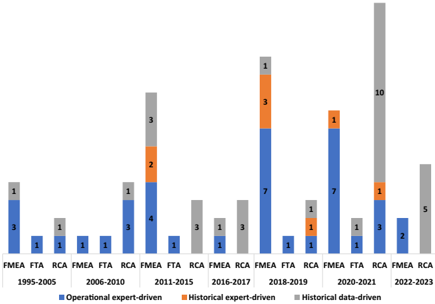
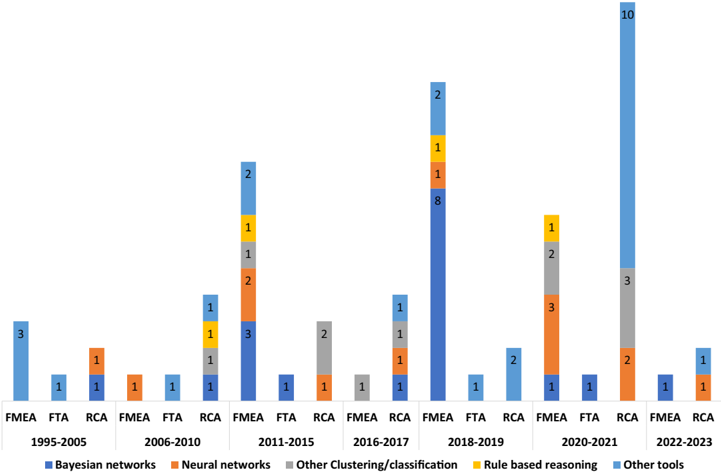
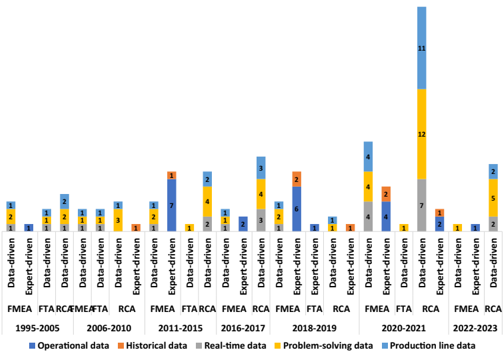
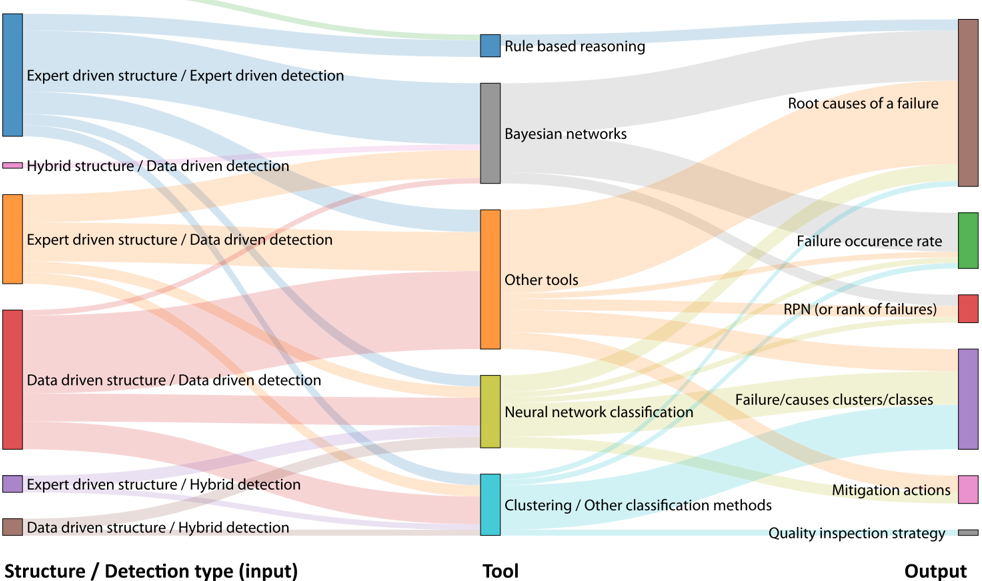
Industry 4.0 and advanced technology, such as sensors and human–machine cooperation, provide new possibilities for infusing intelligence into failure analysis. Failure analysis is the process of identifying (potential) failures and determining their causes and effects to enhance reliability and manufacturing quality. Proactive methodologies, such as failure mode and effects analysis (FMEA), and reactive methodologies, such as root cause analysis (RCA) and fault tree analysis (FTA), are used to analyze failures before and after their occurrence. This paper focused on failure analysis methodologies intelligentization literature applied to FMEA, RCA, and FTA to provide insights into expert-driven, data-driven, and hybrid intelligence failure analysis advancements. Types of data to establish an intelligence failure analysis, tools to find a failure’s causes and effects, e.g., Bayesian networks, and managerial insights are discussed. This literature review, along with the analyses within it, assists failure and quality analysts in developing effective hybrid intelligence failure analysis methodologies that leverage the strengths of both proactive and reactive methods.
Overview
The claims and statistics of this paper haven’t been checked yet.
Free: it reads the open-access text and checks the first 5 claims that cite a source we can check. Create a free account to check every claim.
Integrity signals
Registry
Cites
Statistics
Figures
Verification
Claims the paper makes
The claims and statistics of this paper haven’t been checked yet.
Free: it reads the open-access text and checks the first 5 claims that cite a source we can check. Create a free account to check every claim.
Self-check
Percentages, sums and reported differences re-computed from the paper’s own numbers.
The self-check needs the paper’s full text.
Citations
Cites
(1988) · Cited by 16,582
Literature review of Industry 4.0 and related technologies
Oztemel, E., & Gursev, S. (2020) · Journal of Intelligent Manufacturing · doi:10.1007/s10845-018-1433-8 · Cited by 2,143 · cited 1×
“Advances in artificial intelligence theory and technology have brought new tools to strengthen failure analysis methodologies(Oztemel&Gursev,2020).”
Failure Mode and Effect Analysis: FMEA From Theory to Execution
Schneider, H. (1996) · Technometrics · doi:10.1080/00401706.1996.10484424 · Cited by 1,493 · cited 1×
“FMEA is a most commonly used bottom-up proactive qualitative methodologies for potential quality failure analysis (Huang et al., 2020; Stamatis, 2003).”
An Introduction to Reliability and Maintainability Engineering
Ebeling, C. E. (1996) · Medical Entomology and Zoology · Cited by 1,452
(1989) · European Journal of Operational Research · doi:10.1016/0377-2217(89)90373-1 · Cited by 1,324
Mangalathu, S., Hwang, S.-H., & Jeon, J.-S. (2020) · Engineering Structures · doi:10.1016/j.engstruct.2020.110927 · Cited by 1,071 · cited 1×
“…network (Liu et al., 2021), MCDM/optimization (Yucesan et al., 2021; Jomthanachai et al., 2021; Ma et al., 2021; Sun et al., 2021), game theory (Mangalathu et al., 2020), fuzzy evidential reasoning and Petri nets (Shi et al., 2020), and maximum spanning tree, conditional Granger causality,…”
Wiley Interdisciplinary Reviews: Data Mining and Knowledge Discovery
(2011) · Wiley Interdisciplinary Reviews Data Mining and Knowledge Discovery · doi:10.1002/(issn)1942-4795 · Cited by 1,007
Risk evaluation approaches in failure mode and effects analysis: A literature review
Liu, H.-C., Liu, L., & Liu, N. (2013) · Expert Systems with Applications · doi:10.1016/j.eswa.2012.08.010 · Cited by 965 · cited 3×
“Liu et al. (2013) reviewed FMEA risk evaluation tools including rule-based systems, mathematical programming, and multi-criteria decision-making (MCDM).”
InfluentialFault tree analysis: A survey of the state-of-the-art in modeling, analysis and tools
Ruijters, E., & Stoelinga, M. (2015) · Computer Science Review · doi:10.1016/j.cosrev.2015.03.001 · Cited by 847 · cited 2×
“Ruijters and Stoelinga (2015) provided FTA qualitative and quantitative analysis methods.”
Dellermann, D., Ebel, P., Söllner, M., & Leimeister, J. M. (2019) · Business & Information Systems Engineering · doi:10.1007/s12599-019-00595-2 · Cited by 826 · cited 2×
“For instance, while ChatGPT interacts well with humans, it currently does not update its knowledge using human knowledge input for future cases (Dellermann et al., 2019; Correia et al., 2023).”
Research works printed but not linked: 3
- Du, S., Lv, J., & Xi, L. (2012). A robust approach for root causes iden- tification in machining processes using hybrid learning algorithm and engineering knowledge. Journal of Intelligent Manufacturing, 23(5), 1833-1847.
- Steenwinckel B, Heyvaert P, De Paepe D, Janssens O, Vanden Hautte S, Dimou A, De Turck F, Van Hoecke S, Ongenae F (2018) Towards adaptive anomaly detection and root cause analysis by automated extraction of knowledge from risk analyses. 9th Inter- national Semantic Sensor Networks Workshop, Co-Located with 17th International Semantic Web Conference (ISWC 2018), Vol. 2213, pp. 17-31.
- Yuniarto, H. (2012). The shortcomings of existing root cause analysis tools. Proceedings of the World Congress on Engineering, 3, 186- 191.
Cited by
Pietsch, D., Matthes, M., Wieland, U., Ihlenfeldt, S., & Munkelt, T. (2024) · Journal of Manufacturing and Materials Processing · doi:10.3390/jmmp8060277 · Cited by 58
Resilience and Failure Analysis in Next-Generation Communication Networks: A Contemporary Survey
Bi, S., Yuan, X., Hu, S., Li, K., Ni, W., Hossain, E., & Wang, X. (2025) · IEEE Transactions on Network Science and Engineering · doi:10.1109/tnse.2025.3620950 · Cited by 34
“The optimal strategy for failure analysis can be a hybrid approach to ensure speed and precision, where AI offers real-time detection and prioritization, while classical techniques provide root-cause validation and compliance [69], [70].”
Aleksić, A., Tadić, D., Komatina, N., & Nestić, S. (2025) · Mathematics · doi:10.3390/math13132216 · Cited by 11
Hybrid AI Systems for Tool Wear Monitoring in Manufacturing: A Systematic Review
Saatçı, B. T., Ulaş, M., & Gürgenç, T. (2025) · Applied Sciences · doi:10.3390/app16010208 · Cited by 15
A multi-level root cause analysis method for production anomalies in manufacturing workshops
Wang, S., Guo, Y., Huang, S., Qi, Q., Geng, S., & Qian, W. (2025) · Journal of Manufacturing Systems · doi:10.1016/j.jmsy.2025.04.008 · Cited by 7
Martínez, M. A. D., Salinas, R. V. R., García, G. E. R., Grande-Ramírez, J. R., & Fuentes-Rubio, Y. A. (2025) · Cogent Engineering · doi:10.1080/23311916.2025.2573853 · Cited by 11
“Another key strategy is investing in workforce training programs focused on data literacy, enabling employees to understand and leverage analytical insights effectively (Mokhtarzadeh et al., 2024).”
The Meta Holonic Management Tree: review, steps, and roadmap to industrial Cybernetics 5.0
Pirani, M., Carbonari, A., Cucchiarelli, A., Giretti, A., & Spalazzi, L. (2024) · Journal of Intelligent Manufacturing · doi:10.1007/s10845-024-02510-3 · Cited by 8
“For example, Mokhtarzadeh et al. (2024) provide a literature review that should assist analysts in developing hybrid failure analysis methodologies that leverage the strengths of both proactive methodologies like failure mode and effects analysis (FMEA) and reactive methods such as root cause…”
Intelligent fault diagnosis in power systems using Random Forest and ensemble learning
Redwan, K., Shamim, M. M. R., Sultana, A., Tuhin, D. H., Hannan, N., Ahmed, M., & Shufian, A. (2026) · Measurement Energy · doi:10.1016/j.meaene.2026.100098 · Cited by 4
Saley, A. M., Moyaux, T., Sekhari, A., Cheutet, V., & Danielou, J.-B. (2025) · Computers & Industrial Engineering · doi:10.1016/j.cie.2025.111387 · Cited by 4
“Reflecting this view, Peng et al. (2010) and subsequent works (Kok-sal et al., 2024; Mokhtarzadeh et al., 2024; Ubesigha et al., 2025) advocate for hybrid approaches that combine data-driven learning with domain knowledge to enhance robustness, transparency, and relevance.”
Zhou, Z., Hu, N., Yang, Y., Yin, Z., Hu, J., & Lin, X. (2025) · Measurement · doi:10.1016/j.measurement.2025.119613 · Cited by 3
Pure Data-Driven Machine Learning Challenges for pFMEA: A Case Study
Mokhtarzadeh, M., Rodríguez-Echeverría, J., Zeren, Z., Noten, J. V., & Gautama, S. (2024) · IFAC-PapersOnLine · doi:10.1016/j.ifacol.2024.09.225 · Cited by 3
Self-citationKaftan, P., Lanquillon, C., & Stache, N. C. (2025) · Lecture notes in computer science · doi:10.1007/978-3-031-93415-5_11 · Cited by 2
Darbari, J. D., Sharma, S., Pinto, M. C. B., Romero, R. D. C., & Jha, P. C. (2025) · Cleaner Logistics and Supply Chain · doi:10.1016/j.clscn.2025.100292 · Cited by 2
An Intelligent Framework for Implementing AIAG–VDA FMEA and Action Priority (AP) Assessment
Oancea, A.-V., Ionescu, L.-M., Rontescu, C., Ionescu, N., Misztal, A., Bogatu, A.-M., Știrbu, C., Cicic, D.-T., & Stanciu, E.-M. (2026) · Applied Sciences · doi:10.3390/app16052591 · Cited by 1
Maestro, P., Romero, P. E., Ramírez‐Sanz, J. M., & Bustillo, A. (2025) · Journal of Intelligent Manufacturing · doi:10.1007/s10845-025-02704-3 · Cited by 1
“As recent reviews outline (Mokhtarzadeh et al., 2025 ; Malik et al., 2024; Jan et al., 2023 ; Chen et al., 2023 ; Lee & Lim, 2021 ; Peres et al., 2020 ), those improvements are mainly focused on energy optimization, predictive maintenance and quality control, enabling what is now referred to as…”
A framework for integrated data-supported failure and root cause analysis
Mokhtarzadeh, M., Rodríguez-Echeverría, J., & Gautama, S. (2025) · Reliability Engineering & System Safety · doi:10.1016/j.ress.2025.112099 · Cited by 2
Self-citationFubing, X., Wang, Y., Jia, F., & Hu, J. (2026) · Industrial Management & Data Systems · doi:10.1108/imds-04-2025-0519 · Cited by 2
Chen, Y., & Xin, J. (2026) · Journal of Global Information Management · doi:10.4018/jgim.401375 · Cited by 1
Use of blockchain technology within the failure analysis of conveyor belts for pipe conveyors
Fedorko, G., Molnár, V., Mikušová, N., & Honus, S. (2026) · Engineering Failure Analysis · doi:10.1016/j.engfailanal.2026.110892 · Cited by 1
No Risk No Progress—A Quick Tour Focusing on Materials and Structures
de Castro, P. M. S. T. (2024) · Advanced structured materials · doi:10.1007/978-3-031-73906-4_13
de Oliveira, P. S. G., da Silva, L. F., de Araujo, P. T., Reis, G. F. G., & Otero, M. A. S. G. (2025) · Operations Research Forum · doi:10.1007/s43069-025-00552-8
ИСПОЛЬЗОВАНИЕ МАШИННОГО ОБУЧЕНИЯ ПРИ КОНЦЕПТУАЛЬНОМ ПРОЕКТИРОВАНИИ САМОЛЕТА
Adigwe, E. O., & Borgest, N. M. (2025) · Высшая школа: научные исследования · doi:10.15622/rcai.2025.064
Targeting Toward Optimal Inventory in Automotive Industry—An Analysis Based on Six Sigma Methodology
Puiu, I.-R., Petre, I. D., & Boșcoianu, M. (2025) · Logistics · doi:10.3390/logistics10010008
“FMEA complements RCA by prioritizing risks based on their RPN, allowing organizations to systematically identify and address the most critical potential failures [32].”
Tahiri, K. B., Boumane, A., & Chater, Y. (2026) · Lecture notes in networks and systems · doi:10.1007/978-3-032-18548-8_12
Wang, K., Su, F., Fei, K., Zhao, K., Qiu, L., & Fan, P. (2026) · Engineering Failure Analysis · doi:10.1016/j.engfailanal.2026.110807
HUANG, P., Liang, Z., Tang, C., & Wenxuan, Z. (2026) · SSRN Electronic Journal · doi:10.2139/ssrn.6862098
Hua, H., Zhang, Z., & Liu, X. R. (2026) · Engineering Failure Analysis · doi:10.1016/j.engfailanal.2026.111191
Advancing semiconductor manufacturing through ai-based fault detection and root cause analysis
Ahmed, A., Mohammad, N., Rob, M. A., Ridoy, J. H., Aric, M. S. H., Islam, S. M. M., Sharmin, S., Vanu, N., & Parvin, M. R. (2026) · The International Journal of Advanced Manufacturing Technology · doi:10.1007/s00170-026-18777-0
Chen, J., Guo, J., Pan, Z., Chen, C., Meng, Q., & Liu, Z. (2026) · Journal of Intelligent Manufacturing · doi:10.1007/s10845-026-02942-z
A Machine Learning-Enhanced FMEA Framework for Explainable Risk Assessment in Hotel OperationsPreprint
Korkmaz, H., & Göksal, F. P. (2026) · SSRN Electronic Journal · doi:10.2139/ssrn.7435054
Reviewing Human-Centric Aspects of AI Collaboration in Manufacturing
Jakšić, S., Notarianni, A. C., Salunkhe, O., Simões, A. C., Syberfeldt, A., & Stahre, J. (2026) · IFIP advances in information and communication technology · doi:10.1007/978-3-032-38610-6_10
Zhao, J., Fan, J., & Li, T. (2026) · International Conference on Advanced Algorithms and Neural Networks (AANN) · doi:10.1109/aann71145.2026.11709209
“Overall, root cause ranking, evidence consistency, and recommendation matching show a positive correlation, indicating good computational consistency between graph paths, neighborhood propagation probability, and document retrieval evidence [9-10].”
Toderaş, M. (2026) · Lubricants · doi:10.3390/lubricants14100384
“Recent research [84,106,126–128] un-derscores the essential contribution of advanced technologies, on one hand, through the utilization of computer vision systems—based on cameras positioned at the working face for the automated analysis of bucket teeth (G.E.T.) pro fi les to identify critical wear…”
Menanno, M., Bruno, A., Riccio, C., & Savino, M. M. (2026) · Research Square · doi:10.21203/rs.3.rs-10862049/v1
pFMEA-based Decision-Support Systems for Quality Management: A Case Study
Mokhtarzadeh, M., Rodríguez-Echeverría, J., & Gautama, S. (2026) · International Conference on Information Fusion (FUSION) · doi:10.23919/fusion67272.2026.11726647
“…can span dozens of pages and are typically documented without considering the possibility of subsequent analysis [6]– [8]. p FMEA documents and operational data, captured through quality control (QC) plans and factory floor measurements, are often maintained and analyzed separately [3], [9].”
Self-citation
Metadata
- Authors
- Mokhtarzadeh, M., Rodríguez-Echeverría, J., Semanjski, I., & Gautama, S.
- Affiliations
- Ghent University (BE)
- Escuela Superior Politecnica del Litoral (EC)
- Corresponding author
- Mokhtarzadeh, Mahdi
- Venue
- Journal of Intelligent Manufacturing
- Published
- 2024-04-22
- Volume
- 36
- Issue
- 4
- Pages
- 2309-2334
- ISSN
- 0956-5515 (ISSN-L)
- 1572-8145
- OpenAlex
- W4395003589
- Cited by
- 35
- References
- 126
- Citations by year
- 2026: 17 · 2025: 14 · 2024: 4
- FWCI
- 5.47
- Type
- journal article
- Language
- en
- Open access
- hybrid
- doi.org
- Licence
- cc-by
- creativecommons.org/licenses/by/4.0 (tdm)
- creativecommons.org/licenses/by/4.0 (vor)
- Locations
- Journal of Intelligent Manufacturing (publishedVersion, cc-by)
- Ghent University Academic Bibliography (Ghent University) (submittedVersion, cc-by)
- RePEc: Research Papers in Economics (submittedVersion)
- Funders
- Flanders Make (SBO AQUME project)
- Topics
- Physical Sciences › Engineering › Control and Systems Engineering › Fault Detection and Control Systems
- Physical Sciences › Engineering › Safety, Risk, Reliability and Quality › Reliability and Maintenance Optimization
- Physical Sciences › Engineering › Industrial and Manufacturing Engineering › Digital Transformation in Industry
- Keywords
- failure analysis, hybrid intelligence, Industry 4.0, failure mode and effects analysis, root cause analysis, fault tree analysis, Bayesian networks, human-machine collaboration, sensors, production reliability, quality management
About these checks
Registry, retraction, Cites and statistics results are computed, not judged, with one exception: a printed reference that no index lists is read once by a model before it counts as a citation error. Claims are extracted by a model and kept only when their quote appears verbatim in the text; each cited source is then checked, with a model’s help, for whether it says what the claim relies on. Those verdicts can be wrong — read the claim’s quote and the cited source before relying on one.
Statistics and arithmetic are recomputed, not judged.
Confidence bands are shown only for fields calibrated on our annotated test set. None is calibrated yet, so no band is shown.
What counts as a claim ›How we measure confidence ›How we check this ›
Are you an author, or do you see a problem with this page? Request a review
Data sources
Bibliographic data: Semantic Scholar, OpenAlex, Crossref.
Contains information from the Semantic Scholar Academic Graph Datasets, made available under the ODC Attribution License (ODC-BY 1.0).
Semantic Scholar’s data is described in: Kinney, R., et al. (2023). The Semantic Scholar Open Data Platform. arXiv:2301.10140.
