

The DOI matches its Crossref record; 63 of the 63 references it cites were found in a registry or an index.
Machine Learning for Health: Algorithm Auditing & Quality Control
Open accessAbstract
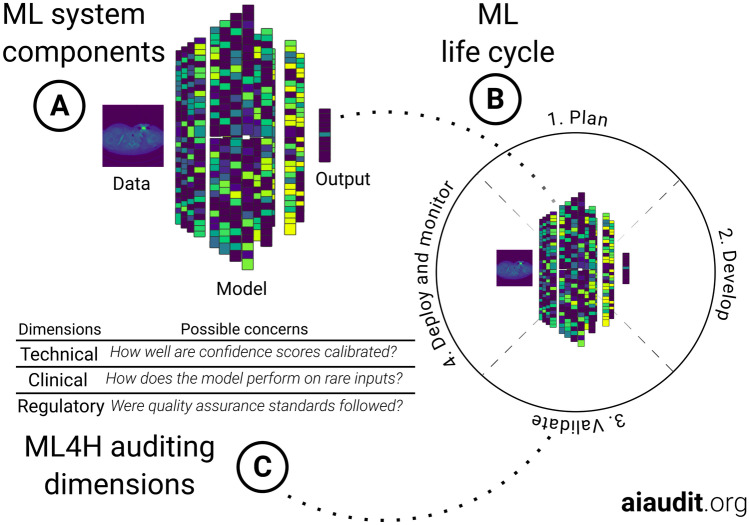
Developers proposing new machine learning for health (ML4H) tools often pledge to match or even surpass the performance of existing tools, yet the reality is usually more complicated. Reliable deployment of ML4H to the real world is challenging as examples from diabetic retinopathy or Covid-19 screening show. We envision an integrated framework of algorithm auditing and quality control that provides a path towards the effective and reliable application of ML systems in healthcare. In this editorial, we give a summary of ongoing work towards that vision and announce a call for participation to the special issue Machine Learning for Health: Algorithm Auditing & Quality Control in this journal to advance the practice of ML4H auditing.
Overview
The claims and statistics of this paper haven’t been checked yet.
Free: it reads the open-access text and checks the first 5 claims that cite a source we can check. Create a free account to check every claim.
Integrity signals
Registry
Cites
Statistics
Figures
Verification
Claims the paper makes
The claims and statistics of this paper haven’t been checked yet.
Free: it reads the open-access text and checks the first 5 claims that cite a source we can check. Create a free account to check every claim.
Claims other papers make about this one
Each is checked against this paper’s own text: does it say what the citing paper says it does?
The source backs part of the claim, not all of it — or backs it for a different population, condition or comparison.
In the citing paper
“AI traceability will also enable continuous auditing of AI models,47 identify risks and limitations, and update the AI models when needed.”
From FUTURE-AI: international consensus guideline for trustworthy and deployable artificial intelligence in healthcare (2025) · cites this paper as [47]
Experimental — accuracy not yet measured
Self-check
Percentages, sums and reported differences re-computed from the paper’s own numbers.
The self-check needs the paper’s full text.
Citations
Cites
UNet++: A Nested U-Net Architecture for Medical Image Segmentation
Zhou, Z., Rahman Siddiquee, M. M., Tajbakhsh, N., & Liang, J. (2018) · Lecture Notes in Computer Science · doi:10.1007/978-3-030-00889-5_1 · Cited by 9,610
Towards Evaluating the Robustness of Neural Networks
Carlini, N., & Wagner, D. (2017) · 2017 IEEE Symposium on Security and Privacy (SP) · doi:10.1109/sp.2017.49 · Cited by 8,859
Intriguing properties of neural networks
Szegedy, C., Zaremba, W., Sutskever, I., Bruna, J., Erhan, D., Goodfellow, I., & Fergus, R. (2013) · arXiv · doi:10.48550/arxiv.1312.6199 · Cited by 8,143
On calibration of modern neural networks
Guo, C., Pleiss, G., Sun, Y., & Weinberger, K. Q. (2017) · arXiv · doi:10.48550/arxiv.1706.04599 · Cited by 3,435
Improved protein structure prediction using potentials from deep learning
Senior, A. W., Evans, R., Jumper, J., Kirkpatrick, J., Sifre, L., Green, T., Qin, C., Žídek, A., Nelson, A. W. R., Bridgland, A., et al. (2020) · Nature · doi:10.1038/s41586-019-1923-7 · Cited by 3,378
Key challenges for delivering clinical impact with artificial intelligence
Kelly, C. J., Karthikesalingam, A., Suleyman, M., Corrado, G., & King, D. (2019) · BMC Medicine · doi:10.1186/s12916-019-1426-2 · Cited by 3,136
What Uncertainties Do We Need in Bayesian Deep Learning for Computer Vision?
Kendall, A., & Gal, Y. (2017) · arXiv · doi:10.48550/arxiv.1703.04977 · Cited by 3,088
Raji, I. D., Smart, A., White, R. N., Mitchell, M., Gebru, T., Hutchinson, B., Smith-Loud, J., Theron, D., & Barnes, P. (2020) · Proceedings of the 2020 Conference on Fairness, Accountability, and Transparency · doi:10.1145/3351095.3372873 · Cited by 2,245
Explaining Deep Neural Networks and Beyond: A Review of Methods and Applications
Samek, W., Montavon, G., Lapuschkin, S., Anders, C. J., & Muller, K.-R. (2021) · Proceedings of the IEEE · doi:10.1109/jproc.2021.3060483 · Cited by 1,477 · cited 1×
“These include model-oriented metrics, such as predictive performance, robustness [33, 34], interpretability [1, 35], disparity [36] or uncertainty [13, 24, 37] but also dataoriented metrics related to sample size determination [38], sparseness [39], bias [40] distribution mismatch [41, 42] and label quality [7].”
Self-citationLiu, X., Cruz Rivera, S., Moher, D., Calvert, M. J., Denniston, A. K., The SPIRIT-AI and CONSORT-AI Working Group, SPIRIT-AI and CONSORT-AI Steering Group, Chan, A.-W., Darzi, A., Holmes, C., et al. (2020) · Nature Medicine · doi:10.1038/s41591-020-1034-x · Cited by 1,421
Self-citation
Research works printed but not linked: 2
- Oala, L., Heiß, C., MacDonald, J., März, M., Samek, W., and Kutyniok, G. Interval neural networks: Uncertainty scores. CoRR abs/2003.11566 (2020). · arXiv
- Rivera, S. C., Liu, X., Chan, A.-W., Denniston, A. K., and Calvert, M. J. Guidelines for clinical trial protocols for interventions involving artificial intelligence: the SPIRIT-AI Extension. Bmj 370 (2020), m3210. · DOI · Paper page
Cited by
Lekadir, K., Frangi, A. F., Porras, A. R., Glocker, B., Cintas, C., Langlotz, C. P., Weicken, E., Asselbergs, F. W., Prior, F., Collins, G. S., et al. (2025) · BMJ · doi:10.1136/bmj-2024-081554 · Cited by 957
“The AI tool should be developed and deployed with mechanisms for continuous monitoring and quality control of the AI inputs and outputs, 47 such as to identify missing or out-of-range input variables, inconsistent data formats or units, incorrect annotations or data preprocessing, and erroneous or…”
Self-citationFehr, J., Citro, B., Malpani, R., Lippert, C., & Madai, V. I. (2024) · Frontiers in Digital Health · doi:10.3389/fdgth.2024.1267290 · Cited by 188
Self-citationMinkkinen, M., Laine, J., & Mäntymäki, M. (2022) · Digital Society · doi:10.1007/s44206-022-00022-2 · Cited by 161
Cai, Y., Cai, Y.-Q., Tang, L.-Y., Wang, Y.-H., Gong, M., Jing, T.-C., Li, H.-J., Li-Ling, J., Hu, W., Yin, Z., et al. (2024) · BMC Medicine · doi:10.1186/s12916-024-03273-7 · Cited by 122
Implementation frameworks for end-to-end clinical AI: derivation of the SALIENT framework
van der Vegt, A. H., Scott, I. A., Dermawan, K., Schnetler, R. J., Kalke, V. R., & Lane, P. J. (2023) · Journal of the American Medical Informatics Association · doi:10.1093/jamia/ocad088 · Cited by 109
Metadata
- Authors
- Oala, L., Murchison, A. G., Balachandran, P., Choudhary, S., Fehr, J., Leite, A. W., Goldschmidt, P. G., Johner, C., Schörverth, E. D. M., Nakasi, R., Meyer, M., Cabitza, F., Baird, P., Prabhu, C., Weicken, E., Liu, X., Wenzel, M., Vogler, S., Akogo, D., Alsalamah, S., Kazim, E., Koshiyama, A., Piechottka, S., Macpherson, S., Shadforth, I., Geierhofer, R., Matek, C., Krois, J., Sanguinetti, B., Arentz, M., Bielik, P., Calderon-Ramirez, S., Abbood, A., Langer, N., Haufe, S., Kherif, F., Pujari, S., Samek, W., & Wiegand, T.
- Affiliations
- Fraunhofer Institute for Telecommunications, Heinrich Hertz Institute (DE)
- Oxford University Hospitals NHS Trust (GB)
- University of Oxford (GB)
- Hasso Plattner Institute (DE)
- Universidade de Brasília (BR)
- Johner Institut (Germany) (DE)
- Makerere University (UG)
- Siemens Healthineers (Germany) (DE)
- University of Milano-Bicocca (IT)
- Office of the Auditor General of Norway (NO)
- University Hospitals Birmingham NHS Foundation Trust (GB)
- Bayer (Germany) (DE)
- King Saud University (SA)
- University College London (GB)
- Helmholtz Munich (DE)
- Charité – Universitätsmedizin Berlin (DE)
- University of Washington (US)
- ETH Zurich (CH)
- Instituto Tecnológico de Costa Rica (CR)
- Robert Koch Institute (DE)
- University of Zurich (CH)
- Technische Universität Berlin (DE)
- Centre Hospitalier Universitaire Vaudois (CH)
- World Health Organization (CH)
- Corresponding author
- Oala, Luis
- ORCID
- Oala, Luis
- Murchison, Andrew G.
- Balachandran, Pradeep
- Fehr, Jana
- Nakasi, Rose
- Meyer, Martin
- Cabitza, Federico
- Weicken, Eva
- Liu, Xiaoxuan
- Wenzel, Markus
- Vogler, Steffen
- Akogo, Darlington
- Alsalamah, Shada
- Kazim, Emre
- Koshiyama, Adriano
- Matek, Christian
- Krois, Joachim
- Arentz, Matthew
- Abbood, Auss
- Langer, Nicolas
- Haufe, Stefan
- Kherif, Ferath
- Pujari, Sameer
- Samek, Wojciech
- Wiegand, Thomas
- Venue
- Journal of Medical Systems
- Published
- 2021-11-02
- Volume
- 45
- Issue
- 12
- Pages
- 105-105
- ISSN
- 0148-5598 (ISSN-L)
- 1573-689X
- PMC
- PMC8562935
- OpenAlex
- W3208920975
- Cited by
- 48
- References
- 63
- Citations by year
- 2026: 3 · 2025: 12 · 2024: 12 · 2023: 10 · 2022: 11
- Type
- journal article
- Language
- en
- Open access
- hybrid
- doi.org
- Licence
- cc-by
- creativecommons.org/licenses/by/4.0 (tdm)
- creativecommons.org/licenses/by/4.0 (vor)
- Locations
- Journal of Medical Systems (publishedVersion, cc-by)
- Europe PMC (PubMed Central) (publishedVersion, other-oa)
- PubMed Central (publishedVersion, cc-by)
- PubMed (publishedVersion)
- Zurich Open Repository and Archive (University of Zurich) (acceptedVersion, cc-by)
- Publication server of the Robert Koch Institute (Robert Kock Institute) (submittedVersion, cc-by)
- PuSH - Publication Server of Helmholtz Zentrum München (submittedVersion, cc-by)
- BOA (University of Milano-Bicocca) (submittedVersion, cc-by)
- Publikationsdatenbank der Fraunhofer-Gesellschaft (Fraunhofer-Gesellschaft) (submittedVersion, other-oa)
- Informationszentrum Lebenswissenschaften (ZB MED) (submittedVersion, cc-by)
- IRIS (submittedVersion, cc-by)
- Site cant be reached (submittedVersion, cc-by)
- Fraunhofer-Publica (Fraunhofer-Gesellschaft) (submittedVersion)
- SERVAL (Université de Lausanne) (submittedVersion, cc-by)
- Repository for Publications and Research Data (ETH Zurich) (submittedVersion, cc-by)
- Zurich Open Repository and Archive (University of Zurich) (submittedVersion, cc-by)
- ETH Zürich Research Collection (cc-by)
- Zurich Open Repository and Archive (University of Zurich)
- Funders
- Fraunhofer-Gesellschaft zur Förderung der angewandten Forschung e.V.
- Topics
- Health Sciences › Medicine › Health Informatics › Artificial Intelligence in Healthcare and Education
- Physical Sciences › Computer Science › Artificial Intelligence › Explainable Artificial Intelligence (XAI)
- Physical Sciences › Computer Science › Artificial Intelligence › Ethics and Social Impacts of AI
- Keywords
- algorithmic auditing, quality control, diabetic retinopathy detection, COVID-19 screening, clinical decision support
- MeSH terms
- Machine Learning, Algorithms, Humans, Quality Control
About these checks
Registry, retraction, Cites and statistics results are computed, not judged, with one exception: a printed reference that no index lists is read once by a model before it counts as a citation error. Claims are extracted by a model and kept only when their quote appears verbatim in the text; each cited source is then checked, with a model’s help, for whether it says what the claim relies on. Those verdicts can be wrong — read the claim’s quote and the cited source before relying on one.
Statistics and arithmetic are recomputed, not judged.
Confidence bands are shown only for fields calibrated on our annotated test set. None is calibrated yet, so no band is shown.
What counts as a claim ›How we measure confidence ›How we check this ›
Are you an author, or do you see a problem with this page? Request a review
How to cite
Cite CoChat for the checks on this page, and the paper for its own findings.
- This page
- CoChat. (2026). Citation check: Machine Learning for Health: Algorithm Auditing & Quality Control. https://app.cochat.ai/papers/10.1007/s10916-021-01783-y
- The paper
- Oala, L., Murchison, A. G., Balachandran, P., Choudhary, S., Fehr, J., Leite, A. W., Goldschmidt, P. G., Johner, C., Schörverth, E. D. M., Nakasi, R., Meyer, M., Cabitza, F., Baird, P., Prabhu, C., Weicken, E., Liu, X., Wenzel, M., Vogler, S., Akogo, D., . . . Wiegand, T. (2021). Machine Learning for Health: Algorithm Auditing & Quality Control. Journal of Medical Systems. https://doi.org/10.1007/s10916-021-01783-y
Data sources
Bibliographic data: Semantic Scholar, OpenAlex, Crossref.
Contains information from the Semantic Scholar Academic Graph Datasets, made available under the ODC Attribution License (ODC-BY 1.0).
Semantic Scholar’s data is described in: Kinney, R., et al. (2023). The Semantic Scholar Open Data Platform. arXiv:2301.10140.
