

Machine Learning for Health: Algorithm Auditing & Quality Control
Open accessThe DOI matches its Crossref record; 63 of the 63 references it cites were found in a registry or an index.
Abstract
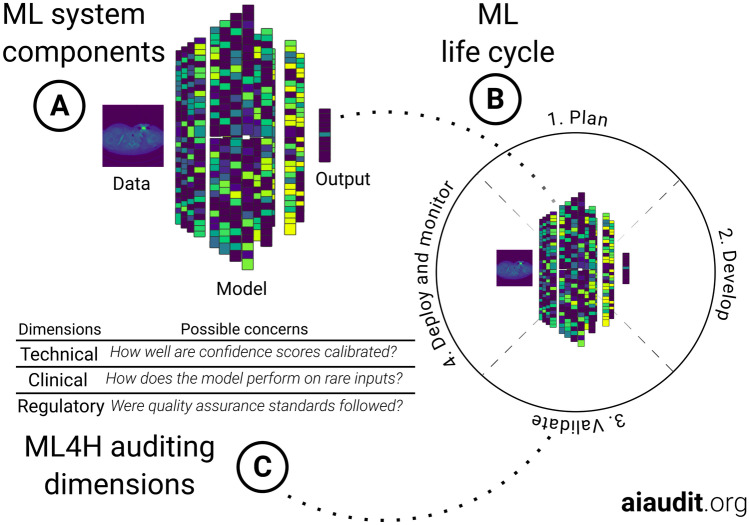
Developers proposing new machine learning for health (ML4H) tools often pledge to match or even surpass the performance of existing tools, yet the reality is usually more complicated. Reliable deployment of ML4H to the real world is challenging as examples from diabetic retinopathy or Covid-19 screening show. We envision an integrated framework of algorithm auditing and quality control that provides a path towards the effective and reliable application of ML systems in healthcare. In this editorial, we give a summary of ongoing work towards that vision and announce a call for participation to the special issue Machine Learning for Health: Algorithm Auditing & Quality Control in this journal to advance the practice of ML4H auditing.
Overview
The claims and statistics of this paper haven’t been checked yet.
Free: it reads the open-access text and checks the first 5 claims that cite a source we can check. Create a free account to check every claim.
Integrity signals
Registry
Cites
Statistics
Figures
Verification
Claims the paper makes
The claims and statistics of this paper haven’t been checked yet.
Free: it reads the open-access text and checks the first 5 claims that cite a source we can check. Create a free account to check every claim.
Claims other papers make about this one
Each is checked against this paper’s own text: does it say what the citing paper says it does?
The source backs part of the claim, not all of it — or backs it for a different population, condition or comparison.
In the citing paper
“AI traceability will also enable continuous auditing of AI models,47 identify risks and limitations, and update the AI models when needed.”
From FUTURE-AI: international consensus guideline for trustworthy and deployable artificial intelligence in healthcare (2025) · cites this paper as [47]
Experimental — accuracy not yet measured
Self-check
Percentages, sums and reported differences re-computed from the paper’s own numbers.
The self-check needs the paper’s full text.
Citations
Cites
UNet++: A Nested U-Net Architecture for Medical Image Segmentation
Zhou, Z., Rahman Siddiquee, M. M., Tajbakhsh, N., & Liang, J. (2018) · Lecture Notes in Computer Science · doi:10.1007/978-3-030-00889-5_1 · Cited by 9,610
Towards Evaluating the Robustness of Neural Networks
Carlini, N., & Wagner, D. (2017) · 2017 IEEE Symposium on Security and Privacy (SP) · doi:10.1109/sp.2017.49 · Cited by 8,859
Intriguing properties of neural networks
Szegedy, C., Zaremba, W., Sutskever, I., Bruna, J., Erhan, D., Goodfellow, I., & Fergus, R. (2013) · arXiv · doi:10.48550/arxiv.1312.6199 · Cited by 8,143 · cited 1×
“Certain changes to image data that may not change the decision of a human expert can completely alter the output of an image classification [12] or regression [13, 14] model.”
On calibration of modern neural networks
Guo, C., Pleiss, G., Sun, Y., & Weinberger, K. Q. (2017) · arXiv · doi:10.48550/arxiv.1706.04599 · Cited by 3,435 · cited 1×
“The decision heuristics a model learns can differ from the heuristics we may expect a human to use [46,39,23, 47], and model predictions may come with ill-calibrated statements of confidence [22, 6,44] or no estimate of uncertainty altogether [37].”
Improved protein structure prediction using potentials from deep learning
Senior, A. W., Evans, R., Jumper, J., Kirkpatrick, J., Sifre, L., Green, T., Qin, C., Žídek, A., Nelson, A. W. R., Bridgland, A., et al. (2020) · Nature · doi:10.1038/s41586-019-1923-7 · Cited by 3,378 · cited 1×
“A large number of institutions and companies are ambitiously working on fulfilling this promise spanning tasks such as medical image classification [23], segmentation [80] or reconstruction [3], protein structure prediction [65] and electrocardiography interpretation [73], among others1.”
BackgroundKey challenges for delivering clinical impact with artificial intelligence
Kelly, C. J., Karthikesalingam, A., Suleyman, M., Corrado, G., & King, D. (2019) · BMC Medicine · doi:10.1186/s12916-019-1426-2 · Cited by 3,136
What Uncertainties Do We Need in Bayesian Deep Learning for Computer Vision?
Kendall, A., & Gal, Y. (2017) · arXiv · doi:10.48550/arxiv.1703.04977 · Cited by 3,088 · cited 2×
“The decision heuristics a model learns can differ from the heuristics we may expect a human to use [1, 18–20], and model predictions may come with illcalibrated statements of confidence [21–23] or no estimate of uncertainty altogether [24].”
Raji, I. D., Smart, A., White, R. N., Mitchell, M., Gebru, T., Hutchinson, B., Smith-Loud, J., Theron, D., & Barnes, P. (2020) · Proceedings of the 2020 Conference on Fairness, Accountability, and Transparency · doi:10.1145/3351095.3372873 · Cited by 2,245
Explaining Deep Neural Networks and Beyond: A Review of Methods and Applications
Samek, W., Montavon, G., Lapuschkin, S., Anders, C. J., & Muller, K.-R. (2021) · Proceedings of the IEEE · doi:10.1109/jproc.2021.3060483 · Cited by 1,477 · cited 1×
“These include model-oriented metrics, such as predictive performance, robustness [33, 34], interpretability [1, 35], disparity [36] or uncertainty [13, 24, 37] but also dataoriented metrics related to sample size determination [38], sparseness [39], bias [40] distribution mismatch [41, 42] and label quality [7].”
Self-citationLiu, X., Cruz Rivera, S., Moher, D., Calvert, M. J., Denniston, A. K., The SPIRIT-AI and CONSORT-AI Working Group, SPIRIT-AI and CONSORT-AI Steering Group, Chan, A.-W., Darzi, A., Holmes, C., et al. (2020) · Nature Medicine · doi:10.1038/s41591-020-1034-x · Cited by 1,421
Self-citationBenchmarking Neural Network Robustness to Common Corruptions and Perturbations
Hendrycks, D., & Dietterich, T. (2019) · arXiv · doi:10.48550/arxiv.1903.12261 · Cited by 1,335 · cited 1×
“These include model-oriented metrics, such as predictive performance, robustness [33, 34], interpretability [1, 35], disparity [36] or uncertainty [13, 24, 37] but also dataoriented metrics related to sample size determination [38], sparseness [39], bias [40] distribution mismatch [41, 42] and label quality [7].”
PTB-XL, a large publicly available electrocardiography dataset
Wagner, P., Strodthoff, N., Bousseljot, R.-D., Kreiseler, D., Lunze, F. I., Samek, W., & Schaeffter, T. (2020) · Scientific Data · doi:10.1038/s41597-020-0495-6 · Cited by 1,315 · cited 1×
“A large number of institutions and companies are ambitiously working on fulfilling this promise spanning tasks such as medical image classification [23], segmentation [80] or reconstruction [3], protein structure prediction [65] and electrocardiography interpretation [73], among others1.”
BackgroundSelf-citationThe Many Faces of Robustness: A Critical Analysis of Out-of-Distribution Generalization
Hendrycks, D., Basart, S., Mu, N., Kadavath, S., Wang, F., Dorundo, E., Desai, R., Zhu, T., Parajuli, S., Guo, M., et al. (2021) · 2021 IEEE/CVF International Conference on Computer Vision (ICCV) · doi:10.1109/iccv48922.2021.00823 · Cited by 1,250 · cited 1×
“Model performance estimates are often not valid for the types of varying input distribution that can occur during real world deployment [15–17].”
BackgroundNagendran, M., Chen, Y., Lovejoy, C. A., Gordon, A. C., Komorowski, M., Harvey, H., Topol, E. J., Ioannidis, J. P. A., Collins, G. S., & Maruthappu, M. (2020) · BMJ · doi:10.1136/bmj.m689 · Cited by 1,152
Unmasking Clever Hans predictors and assessing what machines really learn
Lapuschkin, S., Wäldchen, S., Binder, A., Montavon, G., Samek, W., & Müller, K.-R. (2019) · Nature Communications · doi:10.1038/s41467-019-08987-4 · Cited by 1,047 · cited 1×
“The decision heuristics a model learns can differ from the heuristics we may expect a human to use [46,39,23, 47], and model predictions may come with ill-calibrated statements of confidence [22, 6,44] or no estimate of uncertainty altogether [37].”
BackgroundSelf-citationRoberts, M., Driggs, D., Thorpe, M., Gilbey, J., Yeung, M., Ursprung, S., Aviles-Rivero, A. I., Etmann, C., McCague, C., Beer, L., et al. (2021) · Nature Machine Intelligence · doi:10.1038/s42256-021-00307-0 · Cited by 1,044 · cited 1×
“Developers proposing new ML4H technologies sometimes promise to match or even surpass the performance of existing methods [58] yet the reality is often more complicated.”
BackgroundRoberts, M. T., Driggs, D., Thorpe, M., Gilbey, J., Yeung, M., Ursprung, S., Avilés-Rivero, A. I., Etmann, C., McCague, C., Beer, L., et al. (2020) · Apollo (University of Cambridge) · doi:10.17863/cam.64000 · Cited by 895
Do ImageNet Classifiers Generalize to ImageNet?
Recht, B., Roelofs, R., Schmidt, L., & Shankar, V. (2019) · arXiv · doi:10.48550/arxiv.1902.10811 · Cited by 790 · cited 1×
“However, the deployment of machine learning for health (ML4H) tools into real-world applications has been slow because existing approval processes [6] may not account for the particular failure modes and risks that accompany (ML) technology [7–11].”
BackgroundUnmasking Clever Hans predictors and assessing what machines really learn
Lapuschkin, S., Wäldchen, S., Binder, A., Montavon, G., Samek, W., & Müller, K. (2019) · RePEc: Research Papers in Economics · Cited by 580
Self-citationAequitas: A Bias and Fairness Audit Toolkit
Saleiro, P., Kuester, B., Hinkson, L., London, J., Stevens, A., Anisfeld, A., Rodolfa, K. T., & Ghani, R. (2018) · arXiv · doi:10.48550/arxiv.1811.05577 · Cited by 496 · cited 1×
“These include model-oriented metrics, such as predictive performance, robustness [33, 34], interpretability [1, 35], disparity [36] or uncertainty [13, 24, 37] but also dataoriented metrics related to sample size determination [38], sparseness [39], bias [40] distribution mismatch [41, 42] and label quality [7].”
Wu, E., Wu, K., Daneshjou, R., Ouyang, D., Ho, D. E., & Zou, J. (2021) · Nature Medicine · doi:10.1038/s41591-021-01312-x · Cited by 494 · cited 1×
“chine learning for health (ML4H) tools into real-world applications has been slow because existing approval processes [77] may not account for the particular failure modes and risks that accompany ML technology [56,21,54,10,5].”
BackgroundRivera, S. C., Liu, X., Chan, A.-W., Denniston, A. K., & Calvert, M. J. (2020) · BMJ · doi:10.1136/bmj.m3210 · Cited by 463 · cited 2×
“The EQUATOR-network, including STARD-AI [67], CONSORT-AI [40] and SPIRIT-AI [57], as well as different scientific journals and associations [4,64,29,63], have developed guidelines for the design, implementation,”
MethodSelf-citationHernandez-Boussard, T., Bozkurt, S., Ioannidis, J. P. A., & Shah, N. H. (2020) · Journal of the American Medical Informatics Association · doi:10.1093/jamia/ocaa088 · Cited by 410 · cited 1×
“The EQUATOR-network, including STARD-AI [67], CONSORT-AI [40] and SPIRIT-AI [57], as well as different scientific journals and associations [4,64,29,63], have developed guidelines for the design, implementation,”
MethodUnderspecification Presents Challenges for Credibility in Modern Machine Learning
D'Amour, A., Heller, K., Moldovan, D., Adlam, B., Alipanahi, B., Beutel, A., Chen, C., Deaton, J., Eisenstein, J., Hoffman, M. D., et al. (2020) · arXiv · doi:10.48550/arxiv.2011.03395 · Cited by 398 · cited 1×
“chine learning for health (ML4H) tools into real-world applications has been slow because existing approval processes [77] may not account for the particular failure modes and risks that accompany ML technology [56,21,54,10,5].”
Artificial intelligence in dental research: Checklist for authors, reviewers, readers
Schwendicke, F., Singh, T., Lee, J.-H., Gaudin, R., Chaurasia, A., Wiegand, T., Uribe, S., & Krois, J. (2021) · Journal of Dentistry · doi:10.1016/j.jdent.2021.103610 · Cited by 360 · cited 1×
“The EQUATOR-network, including STARD-AI [67], CONSORT-AI [40] and SPIRIT-AI [57], as well as different scientific journals and associations [4,64,29,63], have developed guidelines for the design, implementation,”
MethodSelf-citationBalki, I., Amirabadi, A., Levman, J., Martel, A. L., Emersic, Z., Meden, B., Garcia-Pedrero, A., Ramirez, S. C., Kong, D., Moody, A. R., et al. (2019) · Canadian Association of Radiologists Journal · doi:10.1016/j.carj.2019.06.002 · Cited by 299 · cited 1×
“These include model-oriented metrics, such as predictive performance, robustness [8,27], interpretability [61,23], disparity [60] or uncertainty [37,52,41] but also data-oriented metrics related to sample size determination [2], sparseness [43],”
BackgroundThe need to separate the wheat from the chaff in medical informatics
Cabitza, F., & Campagner, A. (2021) · International Journal of Medical Informatics · doi:10.1016/j.ijmedinf.2021.104510 · Cited by 276 · cited 2×
“The EQUATOR-network, including STARD-AI [67], CONSORT-AI [40] and SPIRIT-AI [57], as well as different scientific journals and associations [4,64,29,63], have developed guidelines for the design, implementation,”
BackgroundMethodSelf-citationSounderajah, V., Ashrafian, H., Aggarwal, R., De Fauw, J., Denniston, A. K., Greaves, F., Karthikesalingam, A., King, D., Liu, X., Markar, S. R., et al. (2020) · Nature Medicine · doi:10.1038/s41591-020-0941-1 · Cited by 270 · cited 2×
“The EQUATOR-network, including STARD-AI [67], CONSORT-AI [40] and SPIRIT-AI [57], as well as different scientific journals and associations [4,64,29,63], have developed guidelines for the design, implementation,”
MethodSelf-citationHadzhiev, Y., Qureshi, H. K., Wheatley, L., Cooper, L., Jasiulewicz, A., Van Nguyen, H., Wragg, J. W., Poovathumkadavil, D., Conic, S., Bajan, S., et al. (2019) · Nature Communications · doi:10.1038/s41467-019-08487-5 · Cited by 256
Geographic Distribution of US Cohorts Used to Train Deep Learning Algorithms
Kaushal, A., Altman, R., & Langlotz, C. (2020) · JAMA · doi:10.1001/jama.2020.12067 · Cited by 239 · cited 1×
“populations that are similar to the intended use population [5,35] and whether the output translates to medically meaningful parameters [45].”
BackgroundNoseworthy, P. A., Attia, Z. I., Brewer, L. C., Hayes, S. N., Yao, X., Kapa, S., Friedman, P. A., & Lopez-Jimenez, F. (2020) · Circulation: Arrhythmia and Electrophysiology · doi:10.1161/circep.119.007988 · Cited by 220 · cited 1×
“These include model-oriented metrics, such as predictive performance, robustness [33, 34], interpretability [1, 35], disparity [36] or uncertainty [13, 24, 37] but also dataoriented metrics related to sample size determination [38], sparseness [39], bias [40] distribution mismatch [41, 42] and label quality [7].”
Measuring Robustness to Natural Distribution Shifts in Image Classification
Taori, R., Dave, A., Shankar, V., Carlini, N., Recht, B., & Schmidt, L. (2020) · arXiv · doi:10.48550/arxiv.2007.00644 · Cited by 206 · cited 1×
“Model performance estimates are often not valid for the types of varying input distribution that can occur during real world deployment [26,69,75].”
Raji, I. D., Smart, A., White, R. N., Mitchell, M., Gebru, T., Hutchinson, B., Smith-Loud, J., Theron, D., & Barnes, P. (2020) · arXiv · doi:10.48550/arxiv.2001.00973 · Cited by 179
Mårtensson, G., Ferreira, D., Granberg, T., Cavallin, L., Oppedal, K., Padovani, A., Rektorova, I., Bonanni, L., Pardini, M., Kramberger, M. G., et al. (2020) · Medical Image Analysis · doi:10.1016/j.media.2020.101714 · Cited by 176 · cited 1×
“bias [48] distribution mismatch [55,42] and label quality [5].”
BackgroundHägele, M., Seegerer, P., Lapuschkin, S., Bockmayr, M., Samek, W., Klauschen, F., Müller, K.-R., & Binder, A. (2020) · Scientific Reports · doi:10.1038/s41598-020-62724-2 · Cited by 165 · cited 3×
“A large number of institutions and companies are ambitiously working on fulfilling this promise spanning tasks such as medical image classification [23], segmentation [80] or reconstruction [3], protein structure prediction [65] and electrocardiography interpretation [73], among others1.”
BackgroundSelf-citationData Analysis Strategies in Medical Imaging
Parmar, C., Barry, J. D., Hosny, A., Quackenbush, J., & Aerts, H. J. W. L. (2018) · Clinical Cancer Research · doi:10.1158/1078-0432.ccr-18-0385 · Cited by 161 · cited 1×
“Rigorous statistical analysis of the model metrics is a common pitfall in both research and industry, and thus plays an important role during technical validation [43].”
Revisiting the Calibration of Modern Neural Networks
Minderer, M., Djolonga, J., Romijnders, R., Hubis, F., Zhai, X., Houlsby, N., Tran, D., & Lucic, M. (2021) · arXiv · doi:10.48550/arxiv.2106.07998 · Cited by 160 · cited 1×
“The decision heuristics a model learns can differ from the heuristics we may expect a human to use [1, 18–20], and model predictions may come with ill-calibrated statements of confidence [21–23] or no estimate of uncertainty altogether [24].”
MethodCost-effectiveness of Artificial Intelligence for Proximal Caries Detection
Schwendicke, F., Rossi, J. G., Göstemeyer, G., Elhennawy, K., Cantu, A. G., Gaudin, R., Chaurasia, A., Gehrung, S., & Krois, J. (2021) · Journal of Dental Research · doi:10.1177/0022034520972335 · Cited by 152 · cited 1×
“Key concerns are whether the ML4H tool delivers utility in clinical pathways, how cost-effective the clinician-tool interaction is [62] and whether it provides the desired benefits for the intended users [19].”
BackgroundSelf-citationClinician checklist for assessing suitability of machine learning applications in healthcare
Scott, I., Carter, S., & Coiera, E. (2021) · BMJ Health & Care Informatics · doi:10.1136/bmjhci-2020-100251 · Cited by 143 · cited 1×
“The EQUATOR-network, including STARD-AI [67], CONSORT-AI [40] and SPIRIT-AI [57], as well as different scientific journals and associations [4,64,29,63], have developed guidelines for the design, implementation,”
MethodBubba, T. A., Kutyniok, G., Lassas, M., März, M., Samek, W., Siltanen, S., & Srinivasan, V. (2019) · Inverse Problems · doi:10.1088/1361-6420/ab10ca · Cited by 127 · cited 1×
“A large number of institutions and companies are ambitiously working on fulfilling this promise spanning tasks such as medical image classification [23], segmentation [80] or reconstruction [3], protein structure prediction [65] and electrocardiography interpretation [73], among others1.”
BackgroundSelf-citationAdversarial Examples Are a Natural Consequence of Test Error in Noise
Ford, N., Gilmer, J., Carlini, N., & Cubuk, E. D. (2019) · arXiv (Cornell University) · doi:10.48550/arxiv.1901.10513 · Cited by 120 · cited 1×
“chine learning for health (ML4H) tools into real-world applications has been slow because existing approval processes [77] may not account for the particular failure modes and risks that accompany ML technology [56,21,54,10,5].”
Interpretable heartbeat classification using local model-agnostic explanations on ECGs
Neves, I., Folgado, D., Santos, S., Barandas, M., Campagner, A., Ronzio, L., Cabitza, F., & Gamboa, H. (2021) · Computers in Biology and Medicine · doi:10.1016/j.compbiomed.2021.104393 · Cited by 117 · cited 1×
“The decision heuristics a model learns can differ from the heuristics we may expect a human to use [46,39,23, 47], and model predictions may come with ill-calibrated statements of confidence [22, 6,44] or no estimate of uncertainty altogether [37].”
BackgroundSelf-citationDevelopments in MLflow: A System to Accelerate the Machine Learning Lifecycle
Chen, A., Chow, A., Davidson, A., DCunha, A., Ghodsi, A., Hong, S. A., Konwinski, A., Mewald, C., Murching, S., Nykodym, T., et al. (2020) · Proceedings of the Fourth International Workshop on Data Management for End-to-End Machine Learning · doi:10.1145/3399579.3399867 · Cited by 112
Koshiyama, A., Kazim, E., Treleaven, P., Rai, P., Szpruch, L., Pavey, G., Ahamat, G., Leutner, F., Goebel, R., Knight, A., et al. (2024) · Royal Society Open Science · doi:10.1098/rsos.230859 · Cited by 110
Self-citationKoshiyama, A., Kazim, E., Treleaven, P. C., Rai, P., Szpruch, Ł., Pavey, G., Ahamat, G., Leutner, F., Goebel, R. G., Knight, A., et al. (2021) · SSRN Electronic Journal · doi:10.2139/ssrn.3778998 · Cited by 98
Self-citationvon der Heyde, B., Emmanouilidou, A., Mazzaferro, E., Vicenzi, S., Höijer, I., Klingström, T., Jumaa, S., Dethlefsen, O., Snieder, H., de Geus, E., et al. (2020) · Scientific Reports · doi:10.1038/s41598-020-68567-1 · Cited by 91
The dangers of faulty, biased, or malicious algorithms requires independent oversight
Shneiderman, B. (2016) · Proceedings of the National Academy of Sciences · doi:10.1073/pnas.1618211113 · Cited by 73 · cited 1×
“It can be carried out to anticipate, monitor, or retrospectively review operations of the tool [66,38].”
BackgroundWHO and ITU establish benchmarking process for artificial intelligence in health
Wiegand, T., Krishnamurthy, R., Kuglitsch, M., Lee, N., Pujari, S., Salathé, M., Wenzel, M., & Xu, S. (2019) · The Lancet · doi:10.1016/s0140-6736(19)30762-7 · Cited by 66 · cited 3×
“The FG-AI4H has identified and critically reviewed general yet fundamental regulatory considerations related to ML4H.”
Self-citationML4H Auditing: From Paper to Practice
Oala, L., Fehr, J., Gilli, L., Balachandran, P., Leite, A. W., Calderón-Ramírez, S., Xie-Li, D., Nobis, G., Alvarado, E. A. M., Jaramillo-Gutierrez, G., et al. (2020) · SERVAL (Université de Lausanne) · Cited by 53
Self-citationLioi, G., Cury, C., Perronnet, L., Mano, M., Bannier, E., Lécuyer, A., & Barillot, C. (2020) · Scientific Data · doi:10.1038/s41597-020-0498-3 · Cited by 52
Do Deep Generative Models Know What They Don't Know?
Nalisnick, E., Matsukawa, A., Teh, Y. W., Görür, D., & Lakshminarayanan, B. (2018) · arXiv (Cornell University) · doi:10.48550/arxiv.1810.09136 · Cited by 52
Calderon-Ramirez, S., Yang, S., Moemeni, A., Colreavy‐Donnelly, S., Elizondo, D. A., Oala, L., Rodríguez‐Capitán, J., Jiménez-Navarro, M. F., López‐Rubio, E., & Molina‐Cabello, M. A. (2021) · IEEE Access · doi:10.1109/access.2021.3085418 · Cited by 51 · cited 1×
“The decision heuristics a model learns can differ from the heuristics we may expect a human to use [1, 18–20], and model predictions may come with ill-calibrated statements of confidence [21–23] or no estimate of uncertainty altogether [24].”
MethodSelf-citationAs if sand were stone. New concepts and metrics to probe the ground on which to build trustable AI
Cabitza, F., Campagner, A., & Sconfienza, L. M. (2020) · BMC Medical Informatics and Decision Making · doi:10.1186/s12911-020-01224-9 · Cited by 48 · cited 3×
“…addition whether the ML4H tool is suited to the clinical setting in which it will be used; for example, whether the training and test data represent patient populations that are similar to the intended use population [7, 57] and whether the output translates to medically meaningful parameters [58].”
BackgroundMethodSelf-citationEvalAI: Towards Better Evaluation Systems for AI Agents
Yadav, D., Jain, R., Agrawal, H., Chattopadhyay, P., Singh, T., Jain, A., Singh, S. B., Lee, S., & Batra, D. (2019) · arXiv · doi:10.48550/arxiv.1902.03570 · Cited by 42
Patterns, predictions, and actions: A story about machine learningPreprint
Hardt, M., & Recht, B. (2021) · arXiv (Cornell University) · doi:10.48550/arxiv.2102.05242 · Cited by 41
The Many Faces of Robustness: A Critical Analysis of Out-of-Distribution GeneralizationPreprint
Hendrycks, D., Basart, S., Mu, N., et al. (2020) · arXiv (Cornell University) · doi:10.48550/arxiv.2006.16241 · Cited by 19 · cited 1×
“Model performance estimates are often not valid for the types of varying input distribution that can occur during real world deployment [15–17].”
BackgroundDetecting failure modes in image reconstructions with interval neural network uncertainty
Oala, L., Heiß, C., Macdonald, J., März, M., Kutyniok, G., & Samek, W. (2021) · International Journal of Computer Assisted Radiology and Surgery · doi:10.1007/s11548-021-02482-2 · Cited by 18 · cited 1×
“Certain changes to image data that may not change the decision of a human expert can completely alter the output of an image classification [68] or regression [41,51] model.”
BackgroundSelf-citationMendez, M., Calderon, S., & Tyrrell, P. N. (2020) · Communications in computer and information science · doi:10.1007/978-3-030-41005-6_21 · Cited by 12 · cited 1×
“These include model-oriented metrics, such as predictive performance, robustness [8,27], interpretability [61,23], disparity [60] or uncertainty [37,52,41] but also data-oriented metrics related to sample size determination [2], sparseness [43],”
BackgroundInterval Neural Networks: Uncertainty ScoresPreprint
Oala, L., Heiß, C., Macdonald, J., März, M., Samek, W., & Kutyniok, G. (2020) · arXiv (Cornell University) · doi:10.48550/arxiv.2003.11566 · Cited by 12 · cited 1×
“These include model-oriented metrics, such as predictive performance, robustness [33, 34], interpretability [1, 35], disparity [36] or uncertainty [13, 24, 37] but also dataoriented metrics related to sample size determination [38], sparseness [39], bias [40] distribution mismatch [41, 42] and label quality [7].”
Self-citationSoftware product quality assurance
Ryan, J. R. (1982) · AFIPS National Computer Conference (NCC) · doi:10.1145/1500774.1500823 · Cited by 7 · cited 1×
“Further, they can also be used by manufacturers and researchers themselves to carry out internal quality control [59].”
BackgroundMore Than Meets The Eye: Semi-supervised Learning Under Non-IID DataPreprint
Calderon-Ramirez, S., & Oala, L. (2021) · arXiv (Cornell University) · doi:10.48550/arxiv.2104.10223 · Cited by 6 · cited 1×
“…metrics, such as predictive performance, robustness [33, 34], interpretability [1, 35], disparity [36] or uncertainty [13, 24, 37] but also data-oriented metrics related to sample size determination [38], sparseness [39], bias [40] distribution mismatch [41, 42] and label quality [7].”
BackgroundSelf-citationInterval Neural Networks as Instability Detectors for Image Reconstructions
Macdonald, J., März, M., Oala, L., & Samek, W. (2021) · Informatik aktuell · doi:10.1007/978-3-658-33198-6_79 · Cited by 3
Self-citationPost-Hoc Domain Adaptation via Guided Data HomogenizationPreprint
Willis, K., & Oala, L. (2021) · arXiv (Cornell University) · doi:10.48550/arxiv.2104.03624 · Cited by 2 · cited 1×
“Model performance estimates are often not valid for the types of varying input distribution that can occur during real world deployment [15–17].”
BackgroundSelf-citation
Research works printed but not linked: 1
- Rivera SC Liu X Chan A-W Denniston AK Calvert MJ Guidelines for clinical trial protocols for interventions involving artificial intelligence: the SPIRIT-AI Extension Bmj 2020 370 m3210 10.1136/bmj.m3210 32907797 PMC7490785 · DOI · Paper page
Cited by
Lekadir, K., Frangi, A. F., Porras, A. R., Glocker, B., Cintas, C., Langlotz, C. P., Weicken, E., Asselbergs, F. W., Prior, F., Collins, G. S., et al. (2025) · BMJ · doi:10.1136/bmj-2024-081554 · Cited by 957
“The AI tool should be developed and deployed with mechanisms for continuous monitoring and quality control of the AI inputs and outputs, 47 such as to identify missing or out-of-range input variables, inconsistent data formats or units, incorrect annotations or data preprocessing, and erroneous or…”
Self-citationFehr, J., Citro, B., Malpani, R., Lippert, C., & Madai, V. I. (2024) · Frontiers in Digital Health · doi:10.3389/fdgth.2024.1267290 · Cited by 188
Self-citationMinkkinen, M., Laine, J., & Mäntymäki, M. (2022) · Digital Society · doi:10.1007/s44206-022-00022-2 · Cited by 88
Cai, Y., Cai, Y.-Q., Tang, L.-Y., Wang, Y.-H., Gong, M., Jing, T.-C., Li, H.-J., Li-Ling, J., Hu, W., Yin, Z., et al. (2024) · BMC Medicine · doi:10.1186/s12916-024-03273-7 · Cited by 122
“…decision-making at various stages in the clinical pathway [161, 189], we still suggest that experts in this field should put more emphasis on establishment and implementation of scientific research guidelines, for example, promoting ML4H supervision and management for AI prediction models [188].”
BackgroundMethodImplementation frameworks for end-to-end clinical AI: derivation of the SALIENT framework
van der Vegt, A. H., Scott, I. A., Dermawan, K., Schnetler, R. J., Kalke, V. R., & Lane, P. J. (2023) · Journal of the American Medical Informatics Association · doi:10.1093/jamia/ocad088 · Cited by 109
Metadata
- Authors
- Oala, L., Murchison, A. G., Balachandran, P., Choudhary, S., Fehr, J., Leite, A. W., Goldschmidt, P. G., Johner, C., Schörverth, E. D. M., Nakasi, R., Meyer, M., Cabitza, F., Baird, P., Prabhu, C., Weicken, E., Liu, X., Wenzel, M., Vogler, S., Akogo, D., Alsalamah, S., Kazim, E., Koshiyama, A., Piechottka, S., Macpherson, S., Shadforth, I., Geierhofer, R., Matek, C., Krois, J., Sanguinetti, B., Arentz, M., Bielik, P., Calderon-Ramirez, S., Abbood, A., Langer, N., Haufe, S., Kherif, F., Pujari, S., Samek, W., & Wiegand, T.
- Affiliations
- Fraunhofer Institute for Telecommunications, Heinrich Hertz Institute (DE)
- Oxford University Hospitals NHS Trust (GB)
- University of Oxford (GB)
- Hasso Plattner Institute (DE)
- Universidade de Brasília (BR)
- Johner Institut (Germany) (DE)
- Makerere University (UG)
- Siemens Healthineers (Germany) (DE)
- University of Milano-Bicocca (IT)
- Office of the Auditor General of Norway (NO)
- University Hospitals Birmingham NHS Foundation Trust (GB)
- Bayer (Germany) (DE)
- King Saud University (SA)
- University College London (GB)
- Helmholtz Munich (DE)
- Charité – Universitätsmedizin Berlin (DE)
- University of Washington (US)
- ETH Zurich (CH)
- Instituto Tecnológico de Costa Rica (CR)
- Robert Koch Institute (DE)
- University of Zurich (CH)
- Technische Universität Berlin (DE)
- Centre Hospitalier Universitaire Vaudois (CH)
- World Health Organization (CH)
- Corresponding author
- Oala, Luis
- ORCID
- Oala, Luis
- Murchison, Andrew G.
- Balachandran, Pradeep
- Fehr, Jana
- Nakasi, Rose
- Meyer, Martin
- Cabitza, Federico
- Weicken, Eva
- Liu, Xiaoxuan
- Wenzel, Markus
- Vogler, Steffen
- Akogo, Darlington
- Alsalamah, Shada
- Kazim, Emre
- Koshiyama, Adriano
- Matek, Christian
- Krois, Joachim
- Arentz, Matthew
- Abbood, Auss
- Langer, Nicolas
- Haufe, Stefan
- Kherif, Ferath
- Pujari, Sameer
- Samek, Wojciech
- Wiegand, Thomas
- Venue
- Journal of Medical Systems
- Published
- 2021-11-02
- Volume
- 45
- Issue
- 12
- Pages
- 105-105
- ISSN
- 0148-5598 (ISSN-L)
- 1573-689X
- PMC
- PMC8562935
- OpenAlex
- W3208920975
- Cited by
- 48
- References
- 63
- Citations by year
- 2026: 3 · 2025: 12 · 2024: 12 · 2023: 10 · 2022: 11
- Type
- journal article
- Language
- en
- Open access
- hybrid
- doi.org
- Licence
- cc-by
- creativecommons.org/licenses/by/4.0 (tdm)
- creativecommons.org/licenses/by/4.0 (vor)
- Locations
- Journal of Medical Systems (publishedVersion, cc-by)
- Europe PMC (PubMed Central) (publishedVersion, other-oa)
- PubMed Central (publishedVersion, cc-by)
- PubMed (publishedVersion)
- Zurich Open Repository and Archive (University of Zurich) (acceptedVersion, cc-by)
- Publication server of the Robert Koch Institute (Robert Kock Institute) (submittedVersion, cc-by)
- PuSH - Publication Server of Helmholtz Zentrum München (submittedVersion, cc-by)
- BOA (University of Milano-Bicocca) (submittedVersion, cc-by)
- Publikationsdatenbank der Fraunhofer-Gesellschaft (Fraunhofer-Gesellschaft) (submittedVersion, other-oa)
- Informationszentrum Lebenswissenschaften (ZB MED) (submittedVersion, cc-by)
- IRIS (submittedVersion, cc-by)
- Site cant be reached (submittedVersion, cc-by)
- Fraunhofer-Publica (Fraunhofer-Gesellschaft) (submittedVersion)
- SERVAL (Université de Lausanne) (submittedVersion, cc-by)
- Repository for Publications and Research Data (ETH Zurich) (submittedVersion, cc-by)
- Zurich Open Repository and Archive (University of Zurich) (submittedVersion, cc-by)
- ETH Zürich Research Collection (cc-by)
- Zurich Open Repository and Archive (University of Zurich)
- Funders
- Fraunhofer-Gesellschaft zur Förderung der angewandten Forschung e.V.
- Topics
- Health Sciences › Medicine › Health Informatics › Artificial Intelligence in Healthcare and Education
- Physical Sciences › Computer Science › Artificial Intelligence › Explainable Artificial Intelligence (XAI)
- Physical Sciences › Computer Science › Artificial Intelligence › Ethics and Social Impacts of AI
- Keywords
- algorithmic auditing, quality control, diabetic retinopathy detection, COVID-19 screening, clinical decision support
- MeSH terms
- Machine Learning, Algorithms, Humans, Quality Control
About these checks
Registry, retraction, Cites and statistics results are computed, not judged, with one exception: a printed reference that no index lists is read once by a model before it counts as a citation error. Claims are extracted by a model and kept only when their quote appears verbatim in the text; each cited source is then checked, with a model’s help, for whether it says what the claim relies on. Those verdicts can be wrong — read the claim’s quote and the cited source before relying on one.
Statistics and arithmetic are recomputed, not judged.
Confidence bands are shown only for fields calibrated on our annotated test set. None is calibrated yet, so no band is shown.
What counts as a claim ›How we measure confidence ›How we check this ›
Are you an author, or do you see a problem with this page? Request a review
Data sources
Bibliographic data: Semantic Scholar, OpenAlex, Crossref.
Contains information from the Semantic Scholar Academic Graph Datasets, made available under the ODC Attribution License (ODC-BY 1.0).
Semantic Scholar’s data is described in: Kinney, R., et al. (2023). The Semantic Scholar Open Data Platform. arXiv:2301.10140.
