

Are You on My Wavelength? Interpersonal Coordination in Dyadic Conversations
Open accessThe DOI matches its Crossref record; 56 of the 57 references it cites were found in a registry or an index.
Abstract
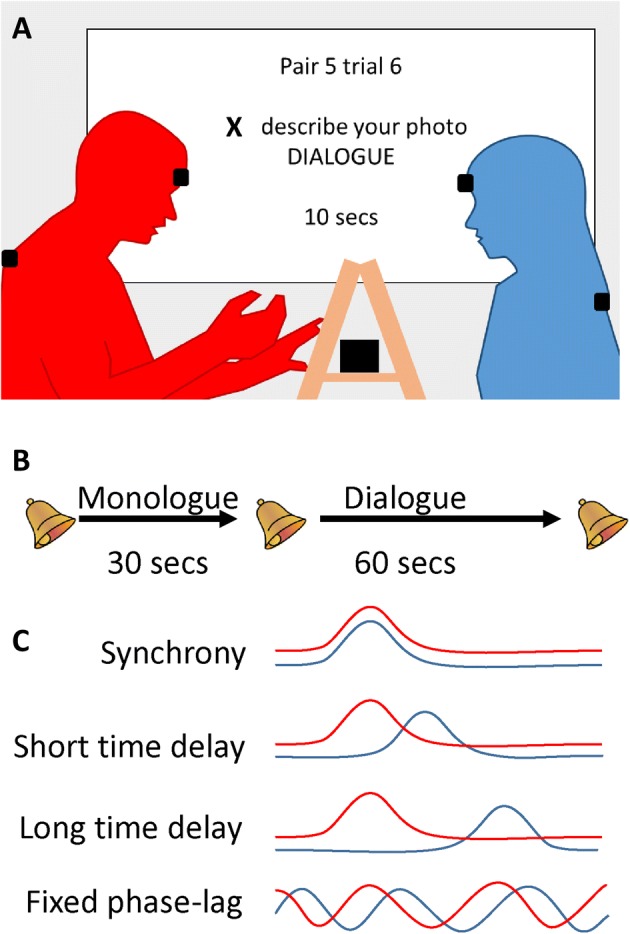
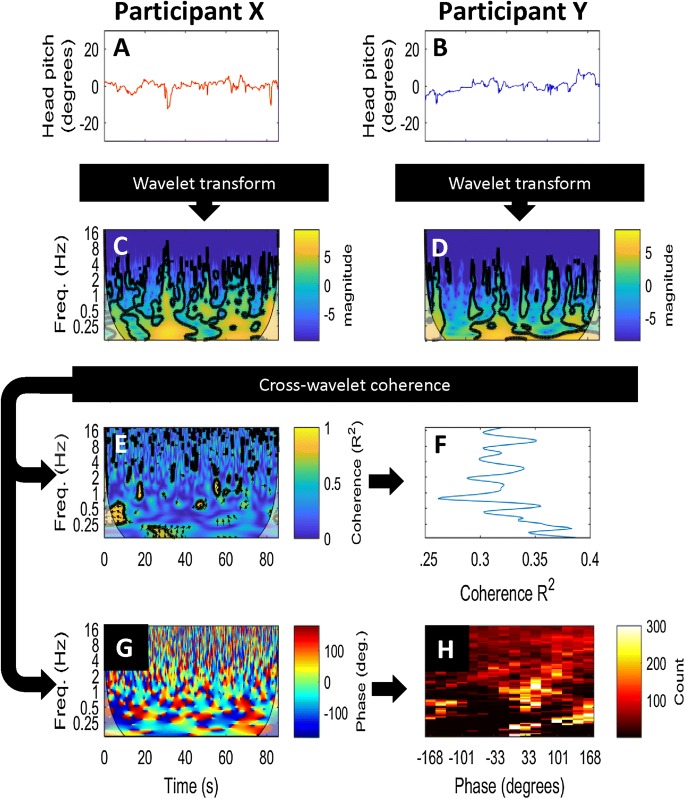
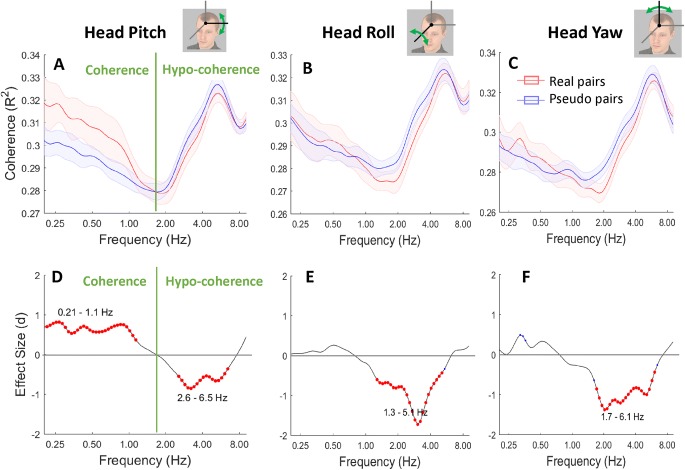
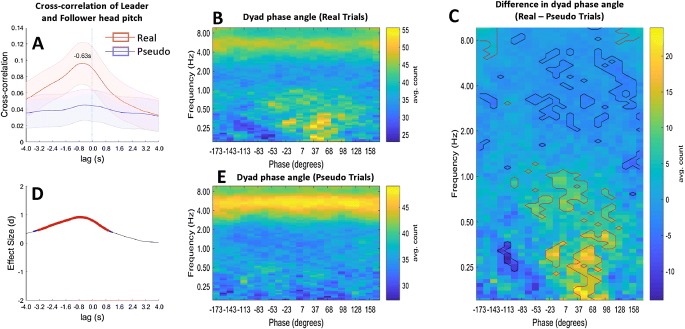
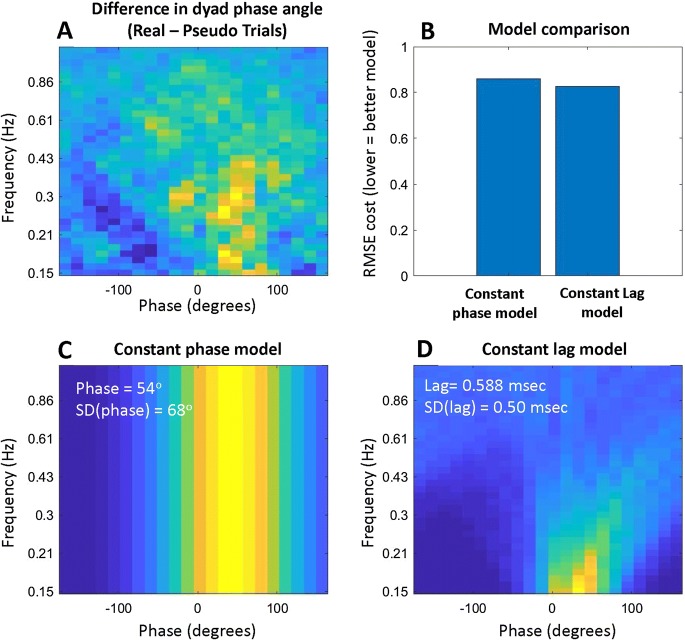
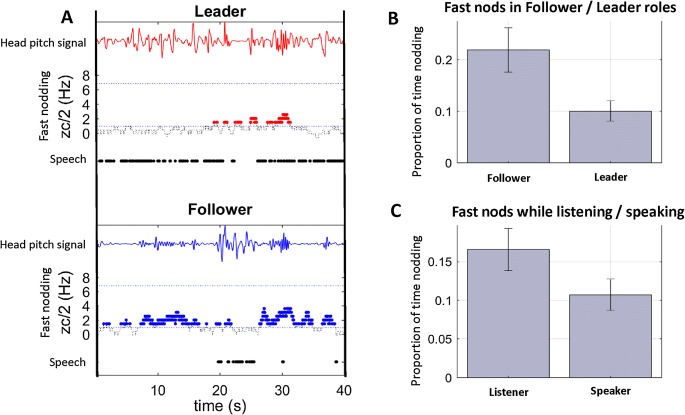
Conversation between two people involves subtle nonverbal coordination in addition to speech. However, the precise parameters and timing of this coordination remain unclear, which limits our ability to theorize about the neural and cognitive mechanisms of social coordination. In particular, it is unclear if conversation is dominated by synchronization (with no time lag), rapid and reactive mimicry (with lags under 1 s) or traditionally observed mimicry (with several seconds lag), each of which demands a different neural mechanism. Here we describe data from high-resolution motion capture of the head movements of pairs of participants (n = 31 dyads) engaged in structured conversations. In a pre-registered analysis pathway, we calculated the wavelet coherence of head motion within dyads as a measure of their nonverbal coordination and report two novel results. First, low-frequency coherence (0.2–1.1 Hz) is consistent with traditional observations of mimicry, and modeling shows this behavior is generated by a mechanism with a constant 600 ms lag between leader and follower. This is in line with rapid reactive (rather than predictive or memory-driven) models of mimicry behavior, and could be implemented in mirror neuron systems. Second, we find an unexpected pattern of lower-than-chance coherence between participants, or hypo-coherence, at high frequencies (2.6–6.5 Hz). Exploratory analyses show that this systematic decoupling is driven by fast nodding from the listening member of the dyad, and may be a newly identified social signal. These results provide a step towards the quantification of real-world human behavior in high resolution and provide new insights into the mechanisms of social coordination.
Overview
The claims and statistics of this paper haven’t been checked yet.
Free: it reads the open-access text and checks the first 5 claims that cite a source we can check. Create a free account to check every claim.
Integrity signals
Registry
Cites
Statistics
Figures
Verification
Claims the paper makes
The claims and statistics of this paper haven’t been checked yet.
Free: it reads the open-access text and checks the first 5 claims that cite a source we can check. Create a free account to check every claim.
Claims other papers make about this one
Each is checked against this paper’s own text: does it say what the citing paper says it does?
The cited source says what the claim attributes to it.
In the citing paper
“Recently, cross-wavelets were used to analyse movement features from dyads in conversation, and revealed how people tend to synchronise with one another at specific frequencies [14, 23, 24].”
From Using Wearable Sensors to Measure Interpersonal Synchrony in Actors and Audience Members During a Live Theatre Performance (2023) · cites this paper as [24]
Self-check
Percentages, sums and reported differences re-computed from the paper’s own numbers.
The self-check needs the paper’s full text.
Citations
Cites
Controlling the False Discovery Rate: A Practical and Powerful Approach to Multiple Testing
Benjamini, Y., & Hochberg, Y. (1995) · Journal of the Royal Statistical Society Series B: Statistical Methodology · doi:10.1111/j.2517-6161.1995.tb02031.x · Cited by 109,482 · cited 2×
“We correct for multiple comparisons using FDR (Benjamini and Hochberg 1995) and plot the results both in terms of mean coherence levels and effect sizes for head pitch, yaw, and roll (see Fig.”
BackgroundMethodClark, H. H. (1996) · doi:10.1017/cbo9780511620539 · Cited by 5,123
The chameleon effect: the perception–behavior link and social interaction
Chartrand, T. L., & Bargh, J. A. (1999) · Journal of Personality and Social Psychology · doi:10.1037/0022-3514.76.6.893 · Cited by 3,674
Using language: Communicative acts
Clark, H. H. (1996) · Cited by 2,721
Using language: Index of names
Clark, H. H. (1996) · Cited by 2,720
Cortical mechanisms of human imitation
Iacoboni, M., Woods, R. P., Brass, M., Bekkering, H., Mazziotta, J. C., & Rizzolatti, G. (1999) · Science · doi:10.1126/science.286.5449.2526 · Cited by 2,683 · cited 2×
“Thus, our finding provides support for the claim that mirror neuron systems (Iacoboni et al. 1999) or general visuomotor priming mechanisms (Heyes 2011) are sufficient to implement mimicry of real-world head movements in conversation.”
BackgroundResultToward a second-person neuroscience
Schilbach, L., Timmermans, B., Reddy, V., Costall, A., Bente, G., Schlicht, T., & Vogeley, K. (2013) · Behavioral and Brain Sciences · doi:10.1017/s0140525x12000660 · Cited by 1,510
The Duchenne smile: Emotional expression and brain physiology: II.
Ekman, P., Davidson, R. J., & Friesen, W. V. (1990) · Journal of Personality and Social Psychology · doi:10.1037/0022-3514.58.2.342 · Cited by 1,371
Neuroscience Needs Behavior: Correcting a Reductionist Bias
Krakauer, J. W., Ghazanfar, A. A., Gomez-Marin, A., MacIver, M. A., & Poeppel, D. (2017) · Neuron · doi:10.1016/j.neuron.2016.12.041 · Cited by 1,358
It's All in the Timing: Interpersonal Synchrony Increases Affiliation
Hove, M. J., & Risen, J. L. (2009) · Social Cognition · doi:10.1521/soco.2009.27.6.949 · Cited by 1,334
Cited by
Eye contact marks the rise and fall of shared attention in conversation
Wohltjen, S., & Wheatley, T. (2021) · Proceedings of the National Academy of Sciences · doi:10.1073/pnas.2106645118 · Cited by 102
“Finally, a study investigating interpersonal coordination during conversation found that dyads decoupled their head movements during conversation in a way that tracked with their status as a speaker or listener (62).”
BackgroundNonverbal communication in virtual reality: Nodding as a social signal in virtual interactions
Aburumman, N., Gillies, M. F. P., Ward, J. A., & Hamilton, A. F. D. C. (2022) · International Journal of Human-Computer Studies · doi:10.1016/j.ijhcs.2022.102819 · Cited by 115
“The study presented by (Hale et al., 2020) employed motion capture technology to investigate head nodding in the human-human dyadic social interaction (31 dyads), where cross-wavelet analysis was used to examine the data.”
InfluentialSelf-citationSpontaneous dyadic behavior predicts the emergence of interpersonal neural synchrony
Koul, A., Ahmar, D., Iannetti, G. D., & Novembre, G. (2023) · NeuroImage · doi:10.1016/j.neuroimage.2023.120233 · Cited by 75
Synchronized affect in shared experiences strengthens social connection
Cheong, J. H., Molani, Z., Sadhukha, S., & Chang, L. J. (2023) · Communications Biology · doi:10.1038/s42003-023-05461-2 · Cited by 75
“This can be observed in “ chameleon ” effects, in which individuals mutually adapt to each other ’ s behaviors during an interaction 42 – 52 .”
A review of theories and methods in the science of face-to-face social interaction
Hadley, L. V., Naylor, G., & Hamilton, A. F. D. C. (2022) · Nature Reviews Psychology · doi:10.1038/s44159-021-00008-w · Cited by 104
“For example, in their study on communicative blinking, Hömke et al. 140”
BackgroundSelf-citation
Metadata
- Authors
- Hale, J., Ward, J. A., Buccheri, F., Oliver, D., & Hamilton, A. F. D. C.
- Affiliations
- University College London (GB)
- Corresponding author
- Hamilton, Antonia F. de C.
- Venue
- Journal of Nonverbal Behavior
- Published
- 2019-10-15
- Volume
- 44
- Issue
- 1
- Pages
- 63-83
- ISSN
- 0191-5886 (ISSN-L)
- 1573-3653
- PMC
- PMC7054373
- OpenAlex
- W2966251175
- Cited by
- 83
- References
- 57
- Citations by year
- 2026: 15 · 2025: 6 · 2024: 6 · 2023: 22 · 2022: 11 · 2021: 11 · 2020: 10 · 2019: 2
- FWCI
- 10.68
- Type
- journal article
- Language
- en
- Open access
- hybrid
- doi.org
- Licence
- cc-by
- creativecommons.org/licenses/by/4.0 (tdm)
- creativecommons.org/licenses/by/4.0 (vor)
- Locations
- Journal of Nonverbal Behavior (publishedVersion, cc-by)
- PubMed Central (publishedVersion, cc-by)
- PubMed (publishedVersion)
- Goldsmiths (University of London) (acceptedVersion)
- UCL Discovery (University College London) (submittedVersion)
- Funders
- European Research Council (313398)
- Defence Science and Technology Laboratory
- Leverhulme Trust (RPG-2016-251)
- Topics
- Social Sciences › Psychology › Social Psychology › Action Observation and Synchronization
- Social Sciences › Arts and Humanities › Language and Linguistics › Language, Discourse, Communication Strategies
- Social Sciences › Psychology › Social Psychology › Health, Education, and Physical Culture
- Keywords
- interpersonal coordination, dyadic conversation, mimicry, wavelet coherence, head movement, nodding, mirror neuron system, social coordination, social signals
About these checks
Registry, retraction, Cites and statistics results are computed, not judged, with one exception: a printed reference that no index lists is read once by a model before it counts as a citation error. Claims are extracted by a model and kept only when their quote appears verbatim in the text; each cited source is then checked, with a model’s help, for whether it says what the claim relies on. Those verdicts can be wrong — read the claim’s quote and the cited source before relying on one.
Statistics and arithmetic are recomputed, not judged.
Confidence bands are shown only for fields calibrated on our annotated test set. None is calibrated yet, so no band is shown.
What counts as a claim ›How we measure confidence ›How we check this ›
Are you an author, or do you see a problem with this page? Request a review
Data sources
Bibliographic data: Semantic Scholar, OpenAlex, Crossref.
Contains information from the Semantic Scholar Academic Graph Datasets, made available under the ODC Attribution License (ODC-BY 1.0).
Semantic Scholar’s data is described in: Kinney, R., et al. (2023). The Semantic Scholar Open Data Platform. arXiv:2301.10140.
