

The DOI matches its Crossref record; 65 of the 67 references it cites were found in a registry or an index.
Reducing stress and enhancing academic buoyancy among adolescents using a brief web- based program based on acceptance and commitment therapy: A randomized controlled trial
Open accessAbstract
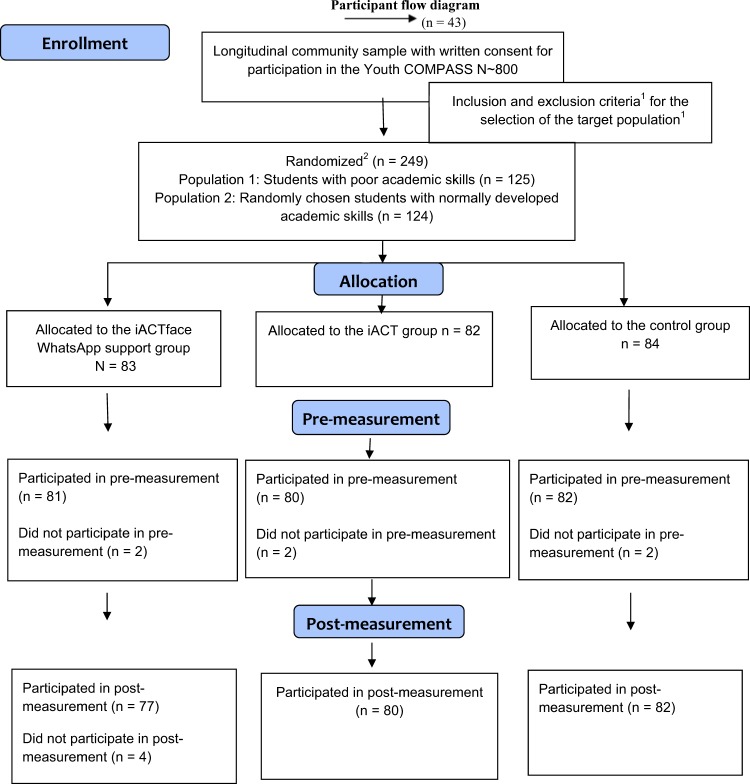
Acceptance and commitment therapy programs have rarely been used as preventive tools for alleviating stress and enhancing coping skills among adolescents. This randomized controlled trial examined the efficacy of a novel Finnish web- and mobile-delivered five-week intervention program called Youth COMPASS among a general sample of ninth-grade adolescents (n= 249, 49% females). The intervention group showed a small but significant decrease in overall stress (between-group Cohen's d = 0.22) and an increase in academic buoyancy (d= 0.27). Academic skills did not influence the intervention gains, but the intervention gains were largest among high-stressed participants. The results suggest that the acceptance and commitment based Youth COMPASS program may be well suited for promoting adolescents' well-being in the school context.
Overview
The claims and statistics of this paper haven’t been checked yet.
Run the check — free, no account needed. It reads the open-access text and checks the sources it cites.
Integrity signals
Registry
Cites
Statistics
Figures
Verification
Claims the paper makes
The claims and statistics of this paper haven’t been checked yet.
Run the check — free, no account needed. It reads the open-access text and checks the sources it cites.
Claims other papers make about this one
Each is checked against this paper’s own text: does it say what the citing paper says it does?
The source backs part of the claim, not all of it — or backs it for a different population, condition or comparison.
In the citing paper
“Stress Stress measure designed for study >.05 (Intention-to- treat analysis) ES not reported”
From Acceptance and commitment therapy interventions in secondary schools and their impact on students' mental health and well-being: A systematic review (2022) · cites this paper as Puolakanaho et al. (2019)
Experimental — accuracy not yet measuredThe source backs part of the claim, not all of it — or backs it for a different population, condition or comparison.
In the citing paper
“Stress Stress measure designed for study 0.037* (Per protocol analysis) BG pre-post ES = small (d = 0.22)”
From Acceptance and commitment therapy interventions in secondary schools and their impact on students' mental health and well-being: A systematic review (2022) · cites this paper as Puolakanaho et al. (2019)
Experimental — accuracy not yet measuredThe source backs part of the claim, not all of it — or backs it for a different population, condition or comparison.
In the citing paper
“We previously reported that the earlier version of the guided online ACT intervention under investigation in the current paper was effective in alleviating depression and stress and improving life satisfaction among adolescents who actively participated in the intervention ((Puolakanaho et al., 2019); (Lappalainen et al., 2021)).”
From Brief online ACT intervention to improve adolescents' well-being: Effectiveness among adolescents with depressive symptoms during COVID-19. (2024) · cites this paper as Puolakanaho et al., 2019
Experimental — accuracy not yet measuredThe source backs part of the claim, not all of it — or backs it for a different population, condition or comparison.
In the citing paper
“the intervention is based on an earlier version of the program, Youth Compass , which has been previ ously reported to be effective in improving life satisfaction and academic buoyancy and decreasing stress (Puolakanaho et al., 2019).”
From Brief online ACT intervention to improve adolescents' well-being: Effectiveness among adolescents with depressive symptoms during COVID-19. (2024) · cites this paper as Puolakanaho et al., 2019
Experimental — accuracy not yet measuredThe cited source says what the claim attributes to it.
In the citing paper
“One out of the six studies that demonstrated significant results used a universal intervention (Puolakanaho et al., 2019).”
From Acceptance and commitment therapy interventions in secondary schools and their impact on students' mental health and well-being: A systematic review (2022) · cites this paper as Puolakanaho et al., 2019
Self-check
Percentages, sums and reported differences re-computed from the paper’s own numbers.
The self-check needs the paper’s full text.
Citations
Cites
Statistical Power Analysis for the Behavioral Sciences
Muller, K. E., & Cohen, J. (1989) · Technometrics · doi:10.2307/1270020 · Cited by 99,603
Statistical power analysis for the behavioral sciences
Cohen, J. (1990) · Computers Environment and Urban Systems · doi:10.1016/0198-9715(90)90050-4 · Cited by 65,417
Statistical Power Analysis for the Behavioral Sciences (2nd ed.).
Lachenbruch, P. A., & Cohen, J. (1989) · Journal of the American Statistical Association · doi:10.2307/2290095 · Cited by 37,421
Acceptance and commitment therapy: model, processes and outcomes
Hayes, S. C., Luoma, J. B., Bond, F. W., Masuda, A., & Lillis, J. (2006) · Behaviour Research and Therapy · doi:10.1016/j.brat.2005.06.006 · Cited by 6,587 · cited 1×
“Behavioral principles are used to clarify one’s personal values and to take actions that lead to goal accomplishment (Hayes et al. 2006; Hofmann and Asmundson 2008; Williams et al. 2008).”
Background(1999) · Cited by 5,934
Polanczyk, G. V., Salum, G. A., Sugaya, L. S., Caye, A., & Rohde, L. A. (2015) · Journal of Child Psychology and Psychiatry · doi:10.1111/jcpp.12381 · Cited by 3,990
Rudd (2006) · doi:10.1002/(issn)1097-4679 · Cited by 2,635
Steinberg, L., & Morris, A. S. (2001) · Annual Review of Psychology · doi:10.1146/annurev.psych.52.1.83 · Cited by 2,517
Currie, C. E., Zanotti, C., Morgan, A. M., Currie, D. B., de Looze, M. E., Roberts, C., Samdal, O., Smith, O. R. F., & Barnekow, V. (2012) · Cited by 1,591
Advantages and limitations of Internet-based interventions for common mental disorders
Andersson, G., & Titov, N. (2014) · World Psychiatry · doi:10.1002/wps.20083 · Cited by 1,160
Research works printed but not linked: 9
- APA (American Psychological Association). (2014). Stress in America. Retrieved from http://www.apa.org/news/press/releases/2014/02/teen-stress.aspx.
- Coe, R., (2002, September 12-14). It’s the Effect Size, Stupid. What effect size is and why it is important. Paper presented at the Annual Conference of the British Educational Research Association, University of Exeter, England. Retrieved from https://www.leeds.ac.uk/educol/documents/00002182.htm.
- Cortiella, C., & Horowitz, S. H. (2014). The state of learning disabilities: Facts, trends and emerging issues. 3rd ed. New York, NY: National Center for Learning Disabilities.
- Currie, C., Zanotti, C., Morgan, A., Currie, D., De Looze, M., Roberts, C., & Barnekow, V. (2012). Social determinants of health and well-being among young people: HBSC international report from the 2009/2010 survey. Paris: World Health Organization.
- Holopainen, L., Kairaluoma, L., Nevala, J., Ahonen, T., & Aro, M. (2004). The dyslexia screening methods for adolescents and adults. Jyväskylä: Niilo Mäki institute.
- Landerl, K., Wimmer, H., & Moser, E. (1997). Salzburger Lese- und Rechtschreibtest [Salzburg reading and spelling test]. Bern: Huber.
- Livheim, F. (2004). Acceptance and commitment therapy in school setting: to cope with stress, a randomized controlled trial (Unpublished master’s thesis). Uppsala University, Sweden. Retrieved from http://www.livskompass.se/wp-content/uploads/2012/11/act-i-skolan-2004.pdf.
- Muthén, L. K., & Muthén, B. O. (1998). Mplus user’s guide. 7th ed. Los Angeles, CA: Muthén & Muthén. 2012.
- Strosahl, K. D., Robinson, P. J., & Gustavsson, T. (2012). Brief interventions for radical change: Principles and practice of focused acceptance and commitment therapy. Oakland, CA: New Harbinger Publications.
Cited by
Sorted by citations
Jiang, S., Ren, Q., Jiang, C., & Wang, L. (2021) · Journal of Affective Disorders · doi:10.1016/j.jad.2021.08.085 · Cited by 219
Musiat, P., Johnson, C., Atkinson, M., Wilksch, S., & Wade, T. (2022) · Psychological Medicine · doi:10.1017/s0033291721004621 · Cited by 166
van Loon, A. W. G., Creemers, H. E., Beumer, W. Y., Okorn, A., Vogelaar, S., Saab, N., Miers, A. C., Westenberg, P. M., & Asscher, J. J. (2020) · Journal of Youth and Adolescence · doi:10.1007/s10964-020-01201-5 · Cited by 128
Are online mental health interventions for youth effective? A systematic review.
Zhou, X., Edirippulige, S., Bai, X., & Bambling, M. (2021) · Journal of Telemedicine and Telecare · doi:10.1177/1357633x211047285 · Cited by 107
Martin, A. J., & Marsh, H. W. (2019) · International Journal of Behavioral Development · doi:10.1177/0165025419885027 · Cited by 98
Metadata
- Authors
- Puolakanaho, A., Lappalainen, R., Lappalainen, P., Muotka, J. S., Hirvonen, R., Eklund, K. M., Ahonen, T. P. S., & Kiuru, N.
- Affiliations
- University of Jyväskylä (FI)
- Corresponding author
- Puolakanaho, Anne
- ORCID
- Venue
- Journal of Youth and Adolescence
- Published
- 2018-12-17
- Volume
- 48
- Issue
- 2
- Pages
- 287-305
- ISSN
- 0047-2891 (ISSN-L)
- 1573-6601
- PMC
- PMC6394525
- OpenAlex
- W2904044857
- Cited by
- 122
- References
- 67
- Citations by year
- 2026: 10 · 2025: 17 · 2024: 22 · 2023: 18 · 2022: 24 · 2021: 20 · 2020: 5 · 2019: 6
- FWCI
- 9.09
- Type
- journal article
- Language
- en
- Open access
- hybrid
- doi.org
- Licence
- Locations
- Journal of Youth and Adolescence (publishedVersion, cc-by)
- Europe PMC (PubMed Central) (publishedVersion, cc-by)
- PubMed Central (publishedVersion, cc-by)
- PubMed (publishedVersion)
- Jyväskylä University Digital Archive (University of Jyväskylä) (submittedVersion, cc-by)
- Funders
- Keski-Suomen Rahasto
- Strategic Research Council (292466 for 2015–20)
- Suomalainen Tiedeakatemia (No. 2016-2019)
- Topics
- Social Sciences › Psychology › Clinical Psychology › Mindfulness and Compassion Interventions
- Social Sciences › Psychology › Developmental and Educational Psychology › Student Stress and Coping
- Social Sciences › Psychology › Applied Psychology › Digital Mental Health Interventions
- Keywords
- acceptance and commitment therapy, adolescents, stress reduction, academic buoyancy, online intervention, coping strategies, school well-being, ninth grade students, preventive interventions
- MeSH terms
- Treatment Adherence and Compliance, Academic Success, Adaptation, Psychological, Adolescent, Female, Finland, Humans, Male, School Health Services, Stress, Psychological, Students, Internet, Acceptance and Commitment Therapy
About these checks
Registry, retraction, Cites and statistics results are computed, not judged, with one exception: a printed reference that no index lists is read once by a model before it counts as a citation error. Claims are extracted by a model and kept only when their quote appears verbatim in the text; each cited source is then checked, with a model’s help, for whether it says what the claim relies on. Those verdicts can be wrong — read the claim’s quote and the cited source before relying on one.
Statistics and arithmetic are recomputed, not judged.
Confidence bands are shown only for fields calibrated on our annotated test set. None is calibrated yet, so no band is shown.
What counts as a claim ›How we measure confidence ›How we check this ›
Are you an author, or do you see a problem with this page? Request a review
