

The Effects of Youth Mentoring Programs: A Meta-analysis of Outcome Studies
Open accessThe DOI matches its Crossref record; 69 of the 71 references it cites were found in a registry or an index; 9 of the 64 sources its claims cite were checked for support.
Abstract
Mentoring programs, which pair youth with caring, non-parental adults with the goal of promoting positive youth development, are an increasingly popular strategy for early intervention with at-risk youth. However, important questions remain about the extent to which these interventions improve youth outcomes. The present study involved a comprehensive meta-analysis of all outcome studies of intergenerational, one-on-one youth mentoring programs written in the English language between 1975 and 2017, using rigorous inclusion criteria designed to align with developmental theories of youth mentoring. Analysis of 70 mentoring outcome studies, with a sample size of 25,286 youth (average age of 12 years old), yielded a statistically significant effect of mentoring programs across all youth outcomes. The observed effect size fell within the medium/moderate range according to empirical guidelines derived from universal prevention programs for youth, and was consistent with past meta-analyses of youth mentoring. Moderation analyses indicated that programs serving a larger proportion of male youth, deploying a greater percentage of male mentors or mentors with a helping profession background, and requiring shorter meetings yielded larger effect sizes, as did evaluations that relied on questionnaires and youth self-report. Taken together, these findings provide some support for the efficacy of mentoring interventions, while also emphasizing the need to remain realistic about the modest impact of these programs as currently implemented, and highlighting opportunities for improving the quality and rigor of mentoring practices.
Overview
CoChat Summary
## TL;DR
This meta-analysis of 70 youth mentoring outcome studies (25,286 mentees) found that mentoring programs had a statistically significant overall effect on youth outcomes, Hedges’ g = .21. Effects varied by some sample and program features, but not by broad outcome domain or by several study design factors.
## Key findings
- Across 70 studies and 25,286 youth, the average effect of youth mentoring was g = .21 (p < .001; 95% CI: .14 to .28).
- Effects were statistically significant across all five broad outcome domains, with no significant differences among them (school, psychological, health, cognitive, and social outcomes; omnibus F(4, 700) = .31, p = .78).
- Larger effects were found in samples with a higher percentage of male youth (B = .38; F(1, 603) = 4.81, p < .05) and male mentors (B = .36; F(1, 408) = 4.56, p < .05), and when more mentors worked in helping professions (B = .25; F(1, 289) = 5.49, p < .05).
- Programs with longer meeting durations had smaller effects (B = -.01; F(1, 346) = 3.92, p < .05).
- Questionnaire-based assessments produced larger effects (g = .22) than other measures (g = .14; F(1, 693) = 5.68, p < .05); youth self-reports also tended to show larger effects than school or teacher reports.
## Methods
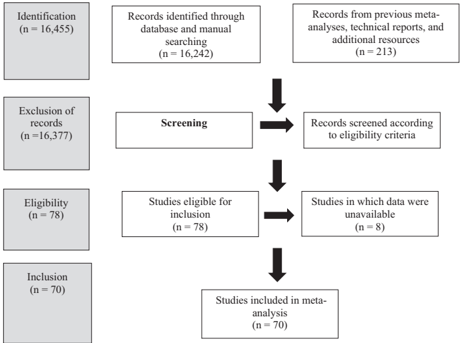
- Comprehensive meta-analysis of intergenerational, one-on-one youth mentoring programs written in English, covering studies from 1975 to 2017.
- Literature search across PsycINFO, ERIC, and ProQuest, plus manual searches; final sample included 70 studies after applying inclusion/exclusion criteria.
- Effect sizes were computed as standardized mean differences transformed to Hedges’ g and analyzed using a three-level multilevel meta-analysis in R to handle dependent effect sizes and test moderators/publication bias.
## Limitations
- The paper states that only English-language evaluations were included, which may limit generalizability beyond English-speaking contexts.
- The authors note that results may still have been influenced by reporter bias or unreliable/poorly validated measures in original studies, and that some moderators could not be tested because they were not reported.
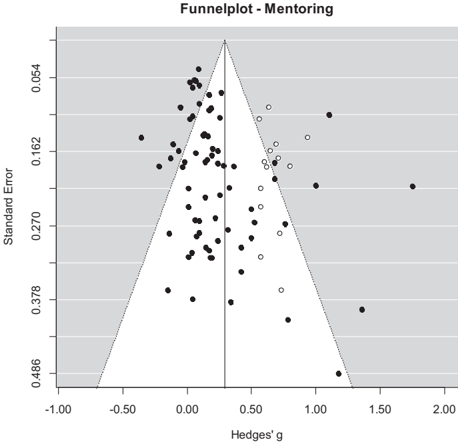
- Evident from the text: publication bias/selection bias was not fully ruled out; although the funnel plot suggested publication bias was unlikely, 14 effect sizes were missing on the right side and trim-and-fill gave a somewhat larger estimate (g = .29), indicating possible selection bias.
Model-written summary of a shortened version of the paper’s full text (it is longer than we read). Check it against the paper before relying on it.
Integrity signals
Registry
Cites
Statistics
Figures
Verification
Claims the paper makes
9 Valid · 0 Not valid · 46 Not checked · 111 Own results and interpretations
Every source the paper cites for this claim was checked and supports it.
In the paper
“Another meta-analysis of three large-scale, school-based mentoring evaluations showed positive effects of mentoring on a range of school-related outcomes (Cohen ' s d ranging from .07 to .18; Wheeler et al. 2010).”
What the sources say
- Supportedcites Wheeler et al. 2010 matched to “Review of Three Recent Randomized Trials of School-Based Mentoring and commentaries” (2010) source
The Meta-analytic Synthesis of Findings section says the authors combined findings from three large-scale randomized trials using Cohen’s d and found favorable effects on six outcomes, with effect sizes from .07 to .18. These include truancy, scholastic efficacy, school-related misconduct, and absenteeism, as well as measures of support from adults and peers. (LLM, conf=0.93)
plainstates a cause- Asserted: passes — The authors put it forward as true.
- Checkable: passes — It can be checked against evidence.
- Load-bearing: unclear — It is unclear whether the paper’s conclusions depend on it.
- Based: passes — The paper gives a reason why it holds.
- Supported
The cited sources support only part of this claim — read each source’s verdict below.
In the paper
“increases statistical power compared to the traditional meta-analytic approach”
What the sources say
- Partly supportedcites Van den Noortgate et al. 2014 matched to “Meta-analysis of multiple outcomes: a multilevel approach” (2015) sourceExperimental — accuracy not yet measured
The Conclusions (page unavailable) say that three-level meta-analysis makes efficient use of all available effect sizes, and the section on varying outcomes reports larger standard errors when fewer effect sizes are available. But the paper does not establish that it has greater statistical power than the traditional approach. Its direct comparison instead finds that the traditional two-level model can underestimate standard errors when outcomes are dependent. (LLM, conf=0.79)
plainstates a cause- Asserted: passes — The authors put it forward as true.
- Checkable: passes — It can be checked against evidence.
- Load-bearing: unclear — It is unclear whether the paper’s conclusions depend on it.
- Based: passes — The paper gives a reason why it holds.
- Partly supported
Every source the paper cites for this claim was checked and supports it.
In the paper
“The major advantage of the three-level approach is that all (dependent) effect sizes extracted from the same study can be included in the analysis, which preserves all available information.”
What the sources say
- Supportedcites Van den Noortgate et al. 2014 matched to “Meta-analysis of multiple outcomes: a multilevel approach” (2015) source
The Conclusions state that the three-level model can accommodate different numbers of effect sizes across studies and “makes efficient use of all available effect sizes.” The paper also describes the model as accounting for dependence among multiple effect sizes within a study. (LLM, conf=0.93)
plainstates a cause- Asserted: passes — The authors put it forward as true.
- Checkable: passes — It can be checked against evidence.
- Load-bearing: passes — The paper’s conclusions depend on it.
- Based: passes — The paper gives a reason why it holds.
- Supported
Every source the paper cites for this claim was checked and supports it.
In the paper
“Moreover, three-level meta-analysis accounts for both withinand between-study variability”
What the sources say
- Supportedcites Van den Noortgate et al. 2014 matched to “Meta-analysis of multiple outcomes: a multilevel approach” (2015) source
The Additional information section identifies variance between studies and between outcomes within studies as components of the three-level model. The Conclusions section likewise describes variation both between studies and between multiple effects within studies. Page numbers were not provided. (LLM, conf=0.94)
plainstates a cause- Asserted: passes — The authors put it forward as true.
- Checkable: passes — It can be checked against evidence.
- Load-bearing: passes — The paper’s conclusions depend on it.
- Based: passes — The paper gives a reason why it holds.
- Supported
Every source the paper cites for this claim was checked and supports it.
In the paper
“A three-level approach to meta-analysis was therefore applied in order to deal with the interdependency of effect sizes (Van den Noortgate et al. 2014).”
What the sources say
- Supportedcites Van den Noortgate et al. 2014 matched to “Meta-analysis of multiple outcomes: a multilevel approach” (2015) source
The Conclusions state that the paper evaluated a three-level approach to account for dependence between multiple effect sizes within studies. This supports using the approach to deal with interdependent effect sizes; page numbers were not provided in our copy. (LLM, conf=0.94)
plainstates a cause- Asserted: passes — The authors put it forward as true.
- Checkable: passes — It can be checked against evidence.
- Load-bearing: passes — The paper’s conclusions depend on it.
- Based: passes — The paper gives a reason why it holds.
- Supported
97 more claims · 2 with their cited sources checked
Create a free account to see all 166 claims and to verify the 7 references still open.
- It may state two separate claims as one. 36
- Probably not a substantial claim. 34
Claims other papers make about this one
Each is checked against this paper’s own text: does it say what the citing paper says it does?
The source backs part of the claim, not all of it — or backs it for a different population, condition or comparison.
In the citing paper
“with many of those studies yielding statistically signi fi cant, but small effect sizes (i.e., ranging from g =0.18 -0.21; DuBois et al., 2002, 2011; Raposa et al., 2019).”
From Cross-age peer mentoring for youth: A meta-analysis (2022) · cites this paper as Raposa et al., 2019
Experimental — accuracy not yet measuredThe source backs part of the claim, not all of it — or backs it for a different population, condition or comparison.
In the citing paper
“Our findings also correspond with the literature (Moor, 2018; Raposa et al., 2019; Keller et al., 2020; Kuperminc et al., 2020), indicating that the school functioning, self-esteem, and well-being of the mentored group significantly improved after mentoring.”
From Outcome domains and assessment measures in school-based youth mentoring programs: a systematic review (2026) · cites this paper as Raposa et al., 2019
Experimental — accuracy not yet measuredThe source backs part of the claim, not all of it — or backs it for a different population, condition or comparison.
In the citing paper
“However, programs with expectations for longer match durations produced smaller effect sizes [17].”
From Unpacking Community-Based Youth Mentoring Relationships: An Integrative Review (2021) · cites this paper as [17]
Experimental — accuracy not yet measuredThe cited source says what the claim attributes to it.
In the citing paper
“Yet, empirical studies of mentoring programs demonstrate that these programs are associated with small‐to‐moderate positive effects on a wide range of social, academic, and behavioral outcomes (DuBois et al., 2011; Raposa, Rhodes, et al., 2019).”
From Strategies for monitoring mentoring relationship quality to predict early program dropout (2022) · cites this paper as Raposa, Rhodes, et al., 2019
The cited source says what the claim attributes to it.
In the citing paper
“some youth demographic characteristics, such as youth gender composition of the program, appear to play a role in predicting effect sizes in intergenerational mentoring programs (DuBois et al., 2002, 2011; Raposa et al., 2019).”
From Cross-age peer mentoring for youth: A meta-analysis (2022) · cites this paper as Raposa et al., 2019
8 more claims about this paper
Create a free account to see every claim other papers make about this one.
Statistics that don’t add up
Each reported p-value recomputed from its test statistic and degrees of freedom, each partial η² from its F, and each ratio, mean difference or B printed with a p checked against its own confidence interval.
Rated minor: it would not touch a result — a value no result rests on, a p-value that stays on the same side of the significance level, or a conflict that is clerical, resolved elsewhere in the paper, or outside its own findings.
In the paper
“F (4, 700) = .31, p = .78”
Reported p = .78 · recomputed p = .871
Statistics recomputed
Every reported test result, recomputed from its test statistic and degrees of freedom. A result shows as not adding up only once an independent check has confirmed it.
- Doesn’t add upF(4, 700) = 0.31reported p = .78 · recomputed p = .871
“F (4, 700) = .31, p = .78”
- ConsistentF(14, 690) = 0.77reported p = .7 · recomputed p = .702
“F (14, 690) = 0.77, p = .70”
- ConsistentF(2, 168) = 2.79reported p < .1 · recomputed p = .064
“F (2, 168) = 2.79, p < .10”
- ConsistentF(1, 703) = 4.47reported p < .05 · recomputed p = .035
“F (1, 703) = 4.47, p < .05”
- ConsistentF(4, 700) = 2.3reported p < .1 · recomputed p = .057
“F (4, 700) = 2.30, p < .10”
5 more recomputed tests
Create a free account to see every test the Stats check recomputed.
Self-check
Percentages, sums and reported differences re-computed from the paper’s own numbers.
Each contradiction between two passages listed here was confirmed by an independent check.
Rated major: it would touch a result — a value a result rests on, reported and recomputed p-values on opposite sides of the significance level, two passages that conflict with no sign which is right, or a cited work retracted before this paper was published.
In the paper
§ Differences in Effects of Mentoring Based on Youth Outcome Type
“Results suggested no signi fi cant differences in effect sizes across these fi ve types of outcomes ( F (4, 700) = .31, p = .78),”
§ Differences in Effects of Mentoring Based on Youth Outcome Type
“| Broad outcome domains | | | | | | | F (4, 690) = 0.68 |”
Citations
Cites
Tabachnick, B. G., & Fidell, L. S. (1983) · Cited by 80,058
Bias in meta-analysis detected by a simple, graphical test
Egger, M., Smith, G. D., Schneider, M., & Minder, C. (1997) · BMJ · doi:10.1136/bmj.315.7109.629 · Cited by 56,722
Conducting Meta-Analyses in R with the metafor Package
Viechtbauer, W. (2010) · Journal of Statistical Software · doi:10.18637/jss.v036.i03 · Cited by 20,464
Duval, S., & Tweedie, R. (2000) · Biometrics · doi:10.1111/j.0006-341x.2000.00455.x · Cited by 14,099 · cited 1×
“The present study used both a funnel plot and a trim-andfill analysis (Duval and Tweedie 2000), conducted with the function ‘trimfill’ in the metafor package (Viechtbauer 2010).”
Method(2000) · Cited by 9,198
The file drawer problem and tolerance for null results.
Rosenthal, R. (1979) · Psychological Bulletin · doi:10.1037/0033-2909.86.3.638 · Cited by 9,068 · cited 1×
“Not including these studies may lead to an overestimation of the true effect size, a phenomenon known as “publication bias” (Rosenthal 1979).”
BackgroundMarkus, H., & Nurius, P. (1986) · American Psychologist · doi:10.1037/0003-066x.41.9.954 · Cited by 5,806 · cited 1×
“Markus and Nurius (1986) have referred to possible selves: individuals’ ideas of what they might become, what they would like to become, and what they fear becoming.”
BackgroundA secure base: parent-child attachment and healthy human development
(1989) · Choice Reviews Online · doi:10.5860/choice.26-4750 · Cited by 4,886
(1904) · The American Journal of Psychology · doi:10.2307/1412635 · Cited by 4,187
Improved tests for a random effects meta‐regression with a single covariate
Knapp, G., & Hartung, J. (2003) · Statistics in Medicine · doi:10.1002/sim.1482 · Cited by 2,075 · cited 1×
“The restricted maximum likelihood estimate was used to estimate all model parameters, and the Knapp and Hartung (2003) method was used for testing individual regression coefficients of the meta-analytic models and for calculating the corresponding confidence intervals (see also Assink and Wibbelink…”
Method
Research works printed but not linked: 5
- Cavell, T. A., & Elledge, L. C. (2014). Mentoring and prevention science. In D. DuBois & M. Karcher (Eds.), Handbook of Youth Mentoring (2nd Edn, pp. 29 -42). Los Angeles: Sage.
- Everhart, K. (2000). Promoting Resiliency in at-risk children through an integrated adult-child mentoring and character development program: an analysis of mentoring strategies with regard to outcomes. (Unpublished doctoral dissertation). University of South Carolina.
- Gatto, M. (2006). The effects of a goal-oriented mentoring group on the self-ef fi cacy of children. Unpublished doctoral dissertation, Adelphi University, Garden City, New York.
- Hedges, L., & Olkin, I. (1985). Statistical models for meta-analysis . New York: Academic Press.
- Rogoff, B. (1978). Spot observation: an introduction and examination. Quarterly Newsletter of the Institute for Comparative Human Development, 2(2C), 21–26.
Cited by
Public mental health: required actions to address implementation failure in the context of COVID-19
Campion, J., Javed, A., Lund, C., Sartorius, N., Saxena, S., Marmot, M., Allan, J., & Udomratn, P. (2022) · The Lancet Psychiatry · doi:10.1016/s2215-0366(21)00199-1 · Cited by 177
Van Dam, L., Smit, D., Wildschut, B., Branje, S. J. T., Rhodes, J. E., Assink, M., & Stams, G. J. J. M. (2018) · American Journal of Community Psychology · doi:10.1002/ajcp.12248 · Cited by 174
“…studies, as well as those that may have been neglected in past studies, showed a statistically signi fi cant, but small effect of mentoring programs on a range of youth outcomes: psychological, social, cognitive, health, or school, r = .09 (Raposa, Erikson et al., 2018; Raposa, Stams et al., 2018).”
ResultSelf-citationNon-specific versus targeted approaches to youth mentoring: A follow-up meta-analysis
Christensen, K. M., Hagler, M. A., Stams, G.-J., Raposa, E. B., Burton, S., & Rhodes, J. E. (2020) · Journal of Youth and Adolescence · doi:10.1007/s10964-020-01233-x · Cited by 107
Self-citationEstablishing effective STEM mentoring relationships through mentor training
Stelter, R. L., Kupersmidt, J. B., & Stump, K. N. (2020) · Annals of the New York Academy of Sciences · doi:10.1111/nyas.14470 · Cited by 133
Self-citationBack to the Future: Mentoring as Means and End in Promoting Child Mental Health
Cavell, T. A., Spencer, R., & McQuillin, S. D. (2021) · Journal of Clinical Child & Adolescent Psychology · doi:10.1080/15374416.2021.1875327 · Cited by 67
“The field also had to grapple with meta-analytic findings that consistently suggested mentoring produces, on average, rather modest effects for participating youth (DuBois et al., 2002, 2011; Raposa et al., 2019).”
BackgroundUnpacking Community-Based Youth Mentoring Relationships: An Integrative Review
Goldner, L., & Ben-Eliyahu, A. (2021) · International Journal of Environmental Research and Public Health · doi:10.3390/ijerph18115666 · Cited by 67
“Similarly, a recent meta-analysis of 70 CBM and SBM mentoring programs [17] and a meta-analysis composed of five studies on mentoring programs among youth with externalizing and internalizing behavioral problems [43] did not find an observed effect based on program length.”
BackgroundMethodResultInfluentialAssessment for Experiential Learning
Chan, C. K. Y. (2022) · Routledge eBooks · doi:10.4324/9781003018391 · Cited by 63
Key issues in professionalizing mentoring practices
Stoeger, H., Balestrini, D. P., & Ziegler, A. (2020) · Annals of the New York Academy of Sciences · doi:10.1111/nyas.14537 · Cited by 101
Gubbels, J., van der Put, C. E., Stams, G. J. J. M., Prinzie, P., & Assink, M. (2021) · Child Abuse & Neglect · doi:10.1016/j.chiabu.2021.104981 · Cited by 63
Self-citationAbelson, S., Lipson, S. K., & Eisenberg, D. (2022) · Higher education · doi:10.1007/978-3-030-76660-3_6 · Cited by 83
McQuillin, S. D., Hagler, M., Werntz, A. J., & Rhodes, J. E. (2021) · American Journal of Community Psychology · doi:10.1002/ajcp.12546 · Cited by 57
“Research suggests that mentoring programs can successfully move the needle on youth mental health symptoms (Bauldry, 2006; Raposa et al., 2019).”
BackgroundResultInfluentialSelf-citationYouth Initiated Mentoring: A Meta-analytic Study of a Hybrid Approach to Youth Mentoring
van Dam, L., Blom, D., Kara, E., Assink, M., Stams, G. J. J. M., Schwartz, S. E. O., & Rhodes, J. E. (2020) · Journal of Youth and Adolescence · doi:10.1007/s10964-020-01336-5 · Cited by 67
Self-citationAsthana, S., & Gibson, A. (2021) · Journal of Public Health · doi:10.1093/pubmed/fdab130 · Cited by 56
Informal mentoring among foster youth entering higher education
Gowdy, G., & Hogan, S. (2020) · Children and Youth Services Review · doi:10.1016/j.childyouth.2020.105716 · Cited by 40
Emergence and evolution of developmental resilience science over half a century
Masten, A. S. (2024) · Development and Psychopathology · doi:10.1017/s0954579424000154 · Cited by 58
Cross-age peer mentoring for youth: A meta-analysis
Burton, S., Raposa, E. B., Poon, C. Y. S., Stams, G. J. J. M., & Rhodes, J. (2022) · American Journal of Community Psychology · doi:10.1002/ajcp.12579 · Cited by 38
Self-citationMichaelis, J. E., & Weintrop, D. (2022) · ACM Transactions on Computing Education · doi:10.1145/3487054 · Cited by 45
“A central strategy for shifting perceptions of who does computing is the use of mentors [12, 116].”
BackgroundIdentification of red flag child sexual grooming behaviors
Jeglic, E. L., Winters, G. M., & Johnson, B. N. (2023) · Child Abuse & Neglect · doi:10.1016/j.chiabu.2022.105998 · Cited by 48
Spencer, R., Pryce, J. M., Barry, J. E., Walsh, J., & Basualdo‐Delmonico, A. (2020) · Children and Youth Services Review · doi:10.1016/j.childyouth.2020.105043 · Cited by 46
Mentoring in the Time of COVID‐19: An Analysis of Online Focus Groups with Mentors to Youth
Kaufman, M. R., Wright, K., Simon, J., Edwards, G., Thrul, J., & DuBois, D. L. (2021) · American Journal of Community Psychology · doi:10.1002/ajcp.12543 · Cited by 43
“In line with these possibilities, research indicates that participation in formal mentoring programs can positively impact youth in a number of ways, including protection against aggression, depressive symptoms, delinquent behaviors, victimization, and substance use, as well as advancing cognitive and identity develop…”
BackgroundThe role of social capital in promoting work readiness among opportunity youth
Boat, A. A., Syvertsen, A. K., & Scales, P. C. (2021) · Children and Youth Services Review · doi:10.1016/j.childyouth.2021.106270 · Cited by 53
Understanding Youth Mentoring Relationships: Advancing the Field with Direct Observational Methods
Pryce, J. M., Deane, K. L., Barry, J. E., & Keller, T. E. (2020) · Adolescent Research Review · doi:10.1007/s40894-019-00131-z · Cited by 45
Herrera, C., DuBois, D. L., Heubach, J., & Grossman, J. B. (2023) · Children and Youth Services Review · doi:10.1016/j.childyouth.2022.106742 · Cited by 35
A developmental view of mentoring talented students in academic and nonacademic domains
Subotnik, R. F., Olszewski‐Kubilius, P., Khalid, M., & Finster, H. P. (2019) · Annals of the New York Academy of Sciences · doi:10.1111/nyas.14286 · Cited by 44
A Meta-analysis of the Effects of Mentoring on Youth in Foster Care
Poon, C. Y. S., Christensen, K. M., & Rhodes, J. E. (2021) · Journal of Youth and Adolescence · doi:10.1007/s10964-021-01472-6 · Cited by 29
Self-citationDeane, K. L., Boat, A. A., Haddock, S. A., Henry, K. L., Zimmerman, T. S., & Weiler, L. M. (2022) · Journal of Youth and Adolescence · doi:10.1007/s10964-022-01584-7 · Cited by 45
“Accordingly, there is a growing need to discern which mentor characteristics are most predictive of relationship quality because these are important mediators of program effectiveness (Rhodes & Lowe, 2009) in a field characterized by small and variable effects (Raposa et al., 2019).”
BackgroundConnecting Youth: The Role of Mentoring Approach
Austin, L., Parnes, M. F., Jarjoura, G. R., Keller, T. E., Herrera, C., Tanyu, M., & Schwartz, S. E. O. (2020) · Journal of Youth and Adolescence · doi:10.1007/s10964-020-01320-z · Cited by 41
“Furthermore, communitybased mentoring can lead to mentees’ increased perception of support, connectedness, and social self-efficacy, as well as improvements in parent–child relationship quality and improved communication between parent and child (Raposa et al. 2019).”
BackgroundInfluentialSelf-citationThe Effects of Mentoring Programs on Emotional Well-Being in Youth: a Meta-analysis
Claro, A., & Perelmiter, T. (2022) · Contemporary School Psychology · doi:10.1007/s40688-021-00377-2 · Cited by 28
Koper, N., Boin, Y., Creemers, H. E., van Dam, L., Stams, G. J. J. M., & Branje, S. (2024) · BMC Public Health · doi:10.1186/s12889-023-17506-6 · Cited by 32
Self-citationSheehan, K., Bhatti, P. K., Yousuf, S., Rosenow, W., Roehler, D. R., Hazekamp, C. S., Wu, H.-W., Orbuch, R., Bartell, T. R., Quinlan, K. P., et al. (2022) · BMC Public Health · doi:10.1186/s12889-022-13016-z · Cited by 42
Spaces of possibilities: a theoretical analysis of mentoring from a regulatory perspective
Ziegler, A., Gryc, K. L., Hopp, M. D. S., & Stoeger, H. (2020) · Annals of the New York Academy of Sciences · doi:10.1111/nyas.14419 · Cited by 34
Abelson, S., Lipson, S. K., & Eisenberg, D. (2021) · Higher education · doi:10.1007/978-3-030-66959-1_6-1 · Cited by 43
McQuillin, S. D., & Lyons, M. D. (2021) · Prevention Science · doi:10.1007/s11121-020-01200-9 · Cited by 24
Taussig, H. N., Dmitrieva, J., Garrido, E. F., Cooley, J. L., & Crites, E. L. (2021) · Prevention Science · doi:10.1007/s11121-021-01235-6 · Cited by 49
“Across the meta-analyses of youth mentoring, effects sizes were strongest when (1) programs targeted youth with problems and/or those who had been exposed to substantial environmental risk; (2) mentors were motivated by gaining experience for their professional development, and there was a fit between their experience…”
BackgroundMental Health and Positive Development Prevention Interventions: Overview of Systematic Reviews
Harrison, L., Sharma, N., Irfan, O., Zaman, M., Vaivada, T., & Bhutta, Z. A. (2022) · PEDIATRICS · doi:10.1542/peds.2021-053852g · Cited by 32
Mobile fNIRS for exploring inter-brain synchrony across generations and time
Moffat, R., Casale, C. E., & Cross, E. S. (2024) · Frontiers in Neuroergonomics · doi:10.3389/fnrgo.2023.1260738 · Cited by 28
Combining MTSS and Community-Based Mentoring Programs
Hart, M. J., Flitner, A. M., Kornbluh, M., Thompson, D. C., Davis, A. L., Lanza-Gregory, J., McQuillin, S. D., González, J. E., & Strait, G. G. (2021) · School Psychology Review · doi:10.1080/2372966x.2021.1922937 · Cited by 25
“Further, Raposa et al. (2019) analysis, which looked at a range of outcomes (e.g., health, psychological, school, and social) found positive, significant effects of mentoring on youth development (mean g = 0.21).”
BackgroundMethodInfluentialEffectiveness of 12 Types of Interventions in Reducing Juvenile Offending and Antisocial Behaviour
Farrington, D. P., Gaffney, H., & White, H. (2022) · Canadian Journal of Criminology and Criminal Justice/La Revue canadienne de criminologie et de justice pénale · doi:10.3138/cjccj.2022-0022 · Cited by 39
Radlick, R. L., Mirkovic, J., Przedpelska, S., Halvorsen Brendmo, E., & Gammon, D. (2020) · JMIR Formative Research · doi:10.2196/15500 · Cited by 20
Alarcón, X., Bobowik, M., & Prieto‐Flores, Ò. (2021) · International Journal of Environmental Research and Public Health · doi:10.3390/ijerph18105210 · Cited by 32
“The meta-analyses, mostly with evidence from US programmes for general youth populations, highlight that youth mentoring interventions have a modest but significant effect on improving diverse outcomes across the behavioural, emotional, social, and academic domains [52,53].”
BackgroundCharacteristics of volunteer motivation to mentor youth
Shier, M. L., Larsen-Halikowski, J., & Gouthro, S. (2020) · Children and Youth Services Review · doi:10.1016/j.childyouth.2020.104885 · Cited by 29
King, C. A., Gipson, P. Y., Arango, A., Lernihan, D., Clark, M., Foster, C. E., Caldwell, C. H., Ghaziuddin, N., & Stone, D. M. (2021) · American Journal of Community Psychology · doi:10.1002/ajcp.12528 · Cited by 23
A meta‐analysis of the effects of after‐school programmes among youth with marginalized identities
Christensen, K. M., Kremer, K. P., Poon, C. Y. S., & Rhodes, J. E. (2023) · Journal of Community & Applied Social Psychology · doi:10.1002/casp.2681 · Cited by 31
“Research investigating other organized youth programmes such as mentoring suggests that males may benefit more than females (Raposa et al., 2019), although more research is necessary to explore whether similar trends occur in ASPs.”
BackgroundSelf-citationStrategies for monitoring mentoring relationship quality to predict early program dropout
Lyons, M. D., & Edwards, K. D. (2022) · American Journal of Community Psychology · doi:10.1002/ajcp.12585 · Cited by 17
McQuillin, S. D., & McDaniel, H. L. (2021) · Annals of the New York Academy of Sciences · doi:10.1111/nyas.14334 · Cited by 16
McClain, C. M., Kelner, W. C., & Elledge, L. C. (2021) · American Journal of Community Psychology · doi:10.1002/ajcp.12539 · Cited by 16
Are adults influenced by the experience of mentoring youth? A scoping review
Anderson, A. J., & DuBois, D. L. (2022) · Journal of Community Psychology · doi:10.1002/jcop.22954 · Cited by 18
Improving understanding of how mentoring works: Measuring multiple intervention processes
Tolan, P. H., McDaniel, H. L., Richardson, M., Arkin, N., Augenstern, J. M., & DuBois, D. L. (2020) · Journal of Community Psychology · doi:10.1002/jcop.22408 · Cited by 22
Natural Mentoring and LGBTQ Youth: A Systematic Review
Burningham, K. L., & Weiler, L. M. (2021) · Adolescent Research Review · doi:10.1007/s40894-020-00146-x · Cited by 25
Mentoring Latinx Children and Adolescents: A Systematic Review
Reyes, W. D. L., Sánchez, B., Polo, A. J., Quiroz, A., Bourke, K. T., O’Donnell, A. J., & Monjaras‐Gaytan, L. Y. (2021) · Adolescent Research Review · doi:10.1007/s40894-021-00156-3 · Cited by 18
Skills mismatch in the agricultural labour market in Benin: vertical and horizontal mismatch
Kaki, R. S., Gbèdomon, R. C., THOTO, F. S., Houessou, M. D., Gandji, K., & Aoudji, A. K. N. (2022) · International Journal of Lifelong Education · doi:10.1080/02601370.2022.2075480 · Cited by 15
“…soft, and digital skills (Table 2) used in the instrument were generated after conducting a thorough literature review (Pitan & Adedeji, 2012;; Rayner & Papakonstantinou, 2015; Siekmann & Korbel, 2016; McGunagle & Zizka, 2018; Miroro, 2019; Akdere et al., 2019; McGunagle & Zizka, 2020) and…”
MethodFostering social connectedness among adolescents and adults with autism: A qualitative analysis
Tomfohrde, O., Hudock, R. L., Kremer, K. B., Fatiha, N., & Weiler, L. M. (2022) · Psychology in the Schools · doi:10.1002/pits.22759 · Cited by 18
Jones, K. V., Parra-Cardona, R., Sánchez, B., Vohra-Gupta, S., & Franklin, C. (2022) · Child & Youth Care Forum · doi:10.1007/s10566-022-09720-x · Cited by 20
Haddock, S. A., Weiler, L. M., Lee, H., Henry, K. L., Lucas‐Thompson, R. G., Zimmerman, T. S., Krafchick, J. L., Fredrickson, G. F., Yetz, N. D., & Youngblade, L. M. (2020) · Journal of Youth and Adolescence · doi:10.1007/s10964-020-01267-1 · Cited by 19
van Dam, L., Bakhuizen, R. E., Schwartz, S. E. O., de Winter, M., Zwaanswijk, M., Wissink, I. B., & Stams, G. J. J. M. (2019) · Youth & Society · doi:10.1177/0044118x19857867 · Cited by 19
Self-citationAdapting a School-Based Motivational Interviewing Mentoring Program for Use in India
Hart, M. J., Sable, R. R., Gupta, A., Boddu, J., & McQuillin, S. D. (2022) · School Psychology International · doi:10.1177/01430343221080782 · Cited by 12
Robertson, H. A., Biel, M. G., Hayes, K. R., Snowden, S., Curtis, L., Charlot‐Swilley, D., Clauson, E. S., Gavins, A., Sisk, C. M., Bravo, N., et al. (2023) · International Journal of Environmental Research and Public Health · doi:10.3390/ijerph20115921 · Cited by 14
“Mentors who receive specific training that focuses on helping youth to develop relevant social, emotional, and cognitive skills can have a significantly positive effect on youth mental health [55,66].”
BackgroundMentoring as prevention of early school leaving: a qualitative systematic literature review
Fehérvári, A., & Varga, A. (2023) · Frontiers in Education · doi:10.3389/feduc.2023.1156725 · Cited by 25
Bagnoli, L. S., & Estache, A. (2021) · The World Bank Research Observer · doi:10.1093/wbro/lkab005 · Cited by 25
Merrin, G. J., Leadbeater, B. J. R., Sturgess, C. M. B., Ames, M. E., & Thompson, K. (2021) · Journal of Drug Issues · doi:10.1177/00220426211049356 · Cited by 14
“…for all youth to be engaged in positive peer activities that are not conditioned on affordability, talent, equipment costs, or good grades, and behavior may be a lifeline for youth who are gradually disconnecting from mainstream activities (Raposa et al., 2019) and engaging with deviant peers.”
BackgroundNgalesoni, O. L., Mwakifwamba, G. A., & Pandisha, H. (2024) · International Journal of Entrepreneurship and Project Management · doi:10.47604/ijepm.2366 · Cited by 17
Increasing resilience among LGBTQ youth: The protective role of natural mentors
Sulimani‐Aidan, Y., Shilo, G., & Paul, J. C. (2024) · Children and Youth Services Review · doi:10.1016/j.childyouth.2024.107570 · Cited by 15
Mentoring for inclusion: A scoping review of the literature
Radlick, R. L., & Mevatne, M. (2023) · Nordisk välfärdsforskning | Nordic Welfare Research · doi:10.18261/nwr.8.1.6 · Cited by 17
Multi-layered mentoring: exemplars from a U.S. STEM teacher education program
Craig, C. J., Evans, P. K., Stokes, D. W., McAlister-Shields, L., & Curtis, G. A. (2023) · Teachers and Teaching · doi:10.1080/13540602.2023.2236957 · Cited by 14
“…the case under study involves many iterations of mentoring, including peer mentoring (i.e. Budge, 2006; Collings et al., 2014), parent mentoring (i.e. Raposa et al., 2019; Stokes, 2023), and the mentoring of underserved populations of students (i.e. Holloway-Friesen, 2021; Zalaquett & Lopez, 2006).”
Interpersonal Dynamics Shaping Positive Mentee and Mentor Relationships
Shier, M. L., Larsen-Halikowski, J., & Gouthro, S. (2020) · Child and Adolescent Social Work Journal · doi:10.1007/s10560-020-00660-w · Cited by 12
Mauer, V. A., Waterman, E. A., Edwards, K. M., & Banyard, V. L. (2021) · Journal of Interpersonal Violence · doi:10.1177/08862605211031252 · Cited by 11
“Formal mentoring relationships are shown to promote positive youth development, including benefits to academic outcomes, psychological well-being, and physical health (DuBois et al., 2002, 2011; Raposa et al., 2019).”
BackgroundHagler, M. (2023) · Journal of Community Psychology · doi:10.1002/jcop.23003 · Cited by 21
Luo, L., & Stoeger, H. (2023) · Journal of Community Psychology · doi:10.1002/jcop.23082 · Cited by 22
“Therefore, to realize the potential of mentoring for promoting youth development, more attention needs to be given to understanding the conditions for effective mentoring (programs) and professionalizing mentoring practices (Raposa et al., 2019; Stoeger, Balestrini, et al., 2021).”
InfluentialHagler, M., Jones, K. V., Anderson, A. J., McQuillin, S. D., Weiler, L. M., & Sánchez, B. (2023) · American Journal of Community Psychology · doi:10.1002/ajcp.12702 · Cited by 15
Poon, C. Y. S., Herrera, C., Jarjoura, R., McQuillin, S. D., Keller, T. E., & Rhodes, J. E. (2022) · The Journal of Early Adolescence · doi:10.1177/02724316221078833 · Cited by 15
“Given the modest effects found in recent mentoring meta-analyses (e.g., Raposa et al., 2019), moving away from variable-centered approaches to a person-centered approach can help identify those youth having more or less positive mentoring experiences and outcomes.”
BackgroundSelf-citationSwinkels, L. T. A., van der Pol, T. M., Twisk, J. W. R., ter Harmsel, J. F., Dekker, J., & Popma, A. (2023) · Frontiers in Psychiatry · doi:10.3389/fpsyt.2023.1129492 · Cited by 9
The effectiveness of interventions for youth that activate the social network: a meta-analytic study
Koper, N., van der Heijden, R. M., Donk, S., Kieu, T., Creemers, H. E., van Dam, L., Branje, S., & Stams, G. J. J. M. (2024) · Applied Developmental Science · doi:10.1080/10888691.2024.2317714 · Cited by 13
“…sizes were found in predominantly female samples than in samples with predominantly males or with equal gender distribution (van Dam et al., 2020), whereas other mentoring meta-analyses demonstrated larger effects in programs serving more male youth (DuBois et al., 2011; Raposa et al., 2019).”
Self-citationKazlauskaite, V., Braughton, J. E., Weiler, L. M., Haddock, S., Henry, K. L., & Lucas-Thompson, R. (2020) · Children and Youth Services Review · doi:10.1016/j.childyouth.2020.105040 · Cited by 10
It’s Not a Bug, It’s a Feature: Evaluating Mentoring Programs with Heterogeneous Activities
Lyons, M. D., & McQuillin, S. D. (2021) · Child & Youth Care Forum · doi:10.1007/s10566-021-09609-1 · Cited by 14
Kanchewa, S. S., Christensen, K. M., Poon, C. Y. S., Parnes, M. F., & Schwartz, S. E. O. (2020) · Children and Youth Services Review · doi:10.1016/j.childyouth.2020.105757 · Cited by 10
Self-citationSuh, B. C., Gallaway, M. S., & Celaya, M. F. (2024) · Children · doi:10.3390/children11020161 · Cited by 17
“Addressing the detrimental effects of ACEs and offering support to vulnerable families facing mental health challenges has underscored the imperative for evidence-based public health initiatives; examples include after-school activities, home visitation [35], and mentoring programs [36].”
BackgroundExamining the Role of Mentoring on Perceived Employability Among University Students in China
Niu, Y., Xu, X., Lewis, S., Xie, L., & Reed, M. (2024) · Journal of Career Assessment · doi:10.1177/10690727241256291 · Cited by 17
“However, not all research fi ndings indicate that duration plays a signi fi cant role (Raposa et al., 2019).”
Scholtes, C. M., & Cederbaum, J. A. (2024) · Child Abuse & Neglect · doi:10.1016/j.chiabu.2024.107049 · Cited by 12
Needs of Youth and Parents From Multi-Problem Families in the Search for Youth-Initiated Mentors
Koper, N., Creemers, H. E., van Dam, L., Stams, G. J. J. M., & Branje, S. (2021) · Youth & Society · doi:10.1177/0044118x211058217 · Cited by 14
“Including YIM mentors in mental health care for youth seems promising for improving a wide range of outcomes, including wellbeing and academic achievement (Christensen et al., 2020; Raposa et al., 2019; van Dam et al., 2021).”
BackgroundSelf-citationSpencer, R., Drew, A. L., & Gowdy, G. (2023) · Journal of Community Psychology · doi:10.1002/jcop.23006 · Cited by 10
Fallavollita, W. L., & Lyons, M. D. (2023) · Journal of Community Psychology · doi:10.1002/jcop.23002 · Cited by 13
Keller, T. E., Drew, A. L., Herrera, C., Clark‐Shim, H., & Spencer, R. (2023) · Journal of Community Psychology · doi:10.1002/jcop.23019 · Cited by 14
Andersen, T. S., & Wellen, H. (2023) · Journal of Community Psychology · doi:10.1002/jcop.23051 · Cited by 17
Caregiver-Initiated Mentoring: Developing a Working Model to Mitigate Social Isolation
Weiler, L. M., Scafe, M. J., Spencer, R., & Cavell, T. A. (2019) · Clinical Social Work Journal · doi:10.1007/s10615-019-00723-1 · Cited by 12
van Dam, L., Rhodes, J. E., & Spencer, R. (2021) · JAMA Psychiatry · doi:10.1001/jamapsychiatry.2021.0490 · Cited by 9
Self-citationEvans, J. M. (2022) · Qualitative Sociology · doi:10.1007/s11133-022-09514-6 · Cited by 15
“That said, these exclusionary processes can still be disrupted through mentorship in programs where marginalized youth form relationships with peers and mentors who both share their background and are part of a high-value field or career path (Ben-Eliyahu et al. 2014; Raposa et al. 2019).”
BackgroundJones, K. V., Parra-Cardona, R., Sánchez, B., Vohra-Gupta, S., & Franklin, C. (2023) · Children and Youth Services Review · doi:10.1016/j.childyouth.2023.106996 · Cited by 13
The Impact of School-Based Mentoring on the Academic Achievement Gap
Grey, L. D. (2019) · Professional School Counseling · doi:10.1177/2156759x19890258 · Cited by 11
“This is consistent with the prevailing literature (Herrera, Grossman, Kauh, & McMaken, 2011; McDaniel & Besnoy, 2019; Raposa et al., 2019).”
ResultAresi, G., Pozzi, M., & Marta, E. (2020) · Journal of Community & Applied Social Psychology · doi:10.1002/casp.2495 · Cited by 10
Uebler, C., Emmerdinger, K. J., Ziegler, A., & Stoeger, H. (2023) · Journal of Community Psychology · doi:10.1002/jcop.23039 · Cited by 11
Supriadi, U., Islamy, M. R. F., & Faqihuddin, A. (2023) · JURNAL IQRA · doi:10.25217/ji.v8i2.2747 · Cited by 23
“In her essay published in the Springer journal, academician Elizabeth B Raposa found that mentoring can enhance positive adolescent development (Raposa, 2019).”
BackgroundMentorship for young gay men in Hong Kong: A pilot mixed‐methods randomized controlled trial
Huang, Y., Chong, E. S. K., Lau, C., & Chow, L. Z. (2024) · American Journal of Community Psychology · doi:10.1002/ajcp.12749 · Cited by 8
Pozzi, M., Marzana, D., Marta, E., Jiménez, M. L. V., & Aresi, G. (2020) · International Journal of Mentoring and Coaching in Education · doi:10.1108/ijmce-05-2020-0019 · Cited by 11
The identity imperative: mentoring as a tool for Christian young adult identity formation
Brailey, G. S., & Parker, S. (2020) · International Journal of Children s Spirituality · doi:10.1080/1364436x.2020.1819775 · Cited by 15
Empathy, cognitive functioning, and prosocial behavior in mentored children
Braun, T., & von Oertzen, T. (2021) · New Directions for Child and Adolescent Development · doi:10.1002/cad.20409 · Cited by 11
“Nevertheless, even for the social–emotional development effect sizes were of comparable size to those found using self-reports (Raposa et al., 2019).”
BackgroundMethodResultInfluentialThe role of family relationships in youth mentoring: An ecological perspective
Downey, S. K., Lyons, M. D., & Williams, J. L. (2022) · Children and Youth Services Review · doi:10.1016/j.childyouth.2022.106508 · Cited by 10
Engaging youth at risk of violence in services: Messages from research
Axford, N., Tredinnick‐Rowe, J., Rybczynska‐Bunt, S., Burns, L., Green, F., & Thompson, T. (2022) · Children and Youth Services Review · doi:10.1016/j.childyouth.2022.106713 · Cited by 30
Heppe, E. C. M., Willemen, A. M., Kef, S., & Schuengel, C. (2020) · British Journal of Visual Impairment · doi:10.1177/0264619620935944 · Cited by 9
“Positive effects of such mentoring on social and emotional functioning within different risk populations have been repeatedly demonstrated (DuBois et al., 2011; Raposa et al., 2019).”
BackgroundBrowne, R. K., Jarjoura, G. R., Keller, T. E., Tanyu, M., Herrera, C., & Schwartz, S. E. O. (2022) · American Journal of Community Psychology · doi:10.1002/ajcp.12608 · Cited by 12
Self-citationHart, M. J., Sung, J. Y., McQuillin, S. D., & Schleider, J. L. (2022) · Journal of Community Psychology · doi:10.1002/jcop.22927 · Cited by 14
Metadata
- Authors
- Raposa, E. B., Rhodes, J., Stams, G. J. J. M., Card, N., Burton, S., Schwartz, S., Sykes, L. A. Y., Kanchewa, S., Kupersmidt, J., & Hussain, S.
- Affiliations
- William & Mary (US)
- University of Massachusetts Boston (US)
- University of Amsterdam (NL)
- University of Connecticut (US)
- Suffolk University (US)
- Innovation Research and Training (US)
- University of Virginia (US)
- Corresponding author
- Raposa, Elizabeth B.
- ORCID
- Venue
- Journal of Youth and Adolescence
- Published
- 2019-01-19
- Volume
- 48
- Issue
- 3
- Pages
- 423-443
- ISSN
- 0047-2891 (ISSN-L)
- 1573-6601
- OpenAlex
- W2910504629
- Cited by
- 366
- References
- 71
- Citations by year
- 2026: 60 · 2025: 40 · 2024: 53 · 2023: 63 · 2022: 59 · 2021: 45 · 2020: 36 · 2019: 9
- FWCI
- 5.75
- Type
- journal article
- Language
- en
- Open access
- bronze
- doi.org
- Licence
- www.springer.com/tdm (tdm)
- Locations
- Journal of Youth and Adolescence (publishedVersion)
- PubMed (publishedVersion)
- UvA-DARE (University of Amsterdam) (submittedVersion, other-oa)
- Data Archiving and Networked Services (DANS) (submittedVersion, other-oa)
- Funders
- John D. and Catherine T. MacArthur Foundation (Research Network on Connected Learning)
- MENTOR: The National Mentoring Partnership (n/a)
- Topics
- Social Sciences › Education › Mentoring and Academic Development
- Social Sciences › Psychology › Developmental and Educational Psychology › Youth Development and Social Support
- Social Sciences › Sociology and Political Science › Crime Patterns and Interventions
- Keywords
- youth mentoring, mentoring programs, positive youth development, at-risk youth, early intervention, program effectiveness, effect size, young men, universal prevention
- MeSH terms
- Mentoring, Adolescent, Adult, Child, Female, Humans, Interpersonal Relations, Male, Mentors, Surveys and Questionnaires, Social Support, Program Evaluation, Outcome Assessment, Health Care, Self Report
About these checks
Registry, retraction, Cites and statistics results are computed, not judged, with one exception: a printed reference that no index lists is read once by a model before it counts as a citation error. Claims are extracted by a model and kept only when their quote appears verbatim in the text; each cited source is then checked, with a model’s help, for whether it says what the claim relies on. Those verdicts can be wrong — read the claim’s quote and the cited source before relying on one.
The claim verdicts this report counts are experimental: their accuracy is not yet measured.
A language model drew the claims from the paper on 2026-10-11, under version 3 of the claim definition (model deepseek-v4.1-flash, prompt extract-v3).
A second model labelled each claim on 2026-10-11 (model jev-1.13-20260917, definition revision gold-guideline-v0.2).
Cited sources are checked with a language model’s help (gpt-6-sol).
Statistics and arithmetic are recomputed, not judged.
Confidence bands are shown only for fields calibrated on our annotated test set. None is calibrated yet, so no band is shown.
What counts as a claim ›How we measure confidence ›How we check this ›
Are you an author, or do you see a problem with this page? Request a review
Data sources
Bibliographic data: Semantic Scholar, OpenAlex, Crossref.
Contains information from the Semantic Scholar Academic Graph Datasets, made available under the ODC Attribution License (ODC-BY 1.0).
Semantic Scholar’s data is described in: Kinney, R., et al. (2023). The Semantic Scholar Open Data Platform. arXiv:2301.10140.
