

The Effects of Youth Mentoring Programs: A Meta-analysis of Outcome Studies
Open accessThe DOI matches its Crossref record; 69 of the 71 references it cites were found in a registry or an index; 9 of the 64 sources its claims cite were checked for support.
Abstract
Mentoring programs, which pair youth with caring, non-parental adults with the goal of promoting positive youth development, are an increasingly popular strategy for early intervention with at-risk youth. However, important questions remain about the extent to which these interventions improve youth outcomes. The present study involved a comprehensive meta-analysis of all outcome studies of intergenerational, one-on-one youth mentoring programs written in the English language between 1975 and 2017, using rigorous inclusion criteria designed to align with developmental theories of youth mentoring. Analysis of 70 mentoring outcome studies, with a sample size of 25,286 youth (average age of 12 years old), yielded a statistically significant effect of mentoring programs across all youth outcomes. The observed effect size fell within the medium/moderate range according to empirical guidelines derived from universal prevention programs for youth, and was consistent with past meta-analyses of youth mentoring. Moderation analyses indicated that programs serving a larger proportion of male youth, deploying a greater percentage of male mentors or mentors with a helping profession background, and requiring shorter meetings yielded larger effect sizes, as did evaluations that relied on questionnaires and youth self-report. Taken together, these findings provide some support for the efficacy of mentoring interventions, while also emphasizing the need to remain realistic about the modest impact of these programs as currently implemented, and highlighting opportunities for improving the quality and rigor of mentoring practices.
Overview
CoChat Summary
## TL;DR
This meta-analysis of 70 youth mentoring outcome studies (25,286 mentees) found that mentoring programs had a statistically significant overall effect on youth outcomes, Hedges’ g = .21. Effects varied by some sample and program features, but not by broad outcome domain or by several study design factors.
## Key findings
- Across 70 studies and 25,286 youth, the average effect of youth mentoring was g = .21 (p < .001; 95% CI: .14 to .28).
- Effects were statistically significant across all five broad outcome domains, with no significant differences among them (school, psychological, health, cognitive, and social outcomes; omnibus F(4, 700) = .31, p = .78).
- Larger effects were found in samples with a higher percentage of male youth (B = .38; F(1, 603) = 4.81, p < .05) and male mentors (B = .36; F(1, 408) = 4.56, p < .05), and when more mentors worked in helping professions (B = .25; F(1, 289) = 5.49, p < .05).
- Programs with longer meeting durations had smaller effects (B = -.01; F(1, 346) = 3.92, p < .05).
- Questionnaire-based assessments produced larger effects (g = .22) than other measures (g = .14; F(1, 693) = 5.68, p < .05); youth self-reports also tended to show larger effects than school or teacher reports.
## Methods
- Comprehensive meta-analysis of intergenerational, one-on-one youth mentoring programs written in English, covering studies from 1975 to 2017.
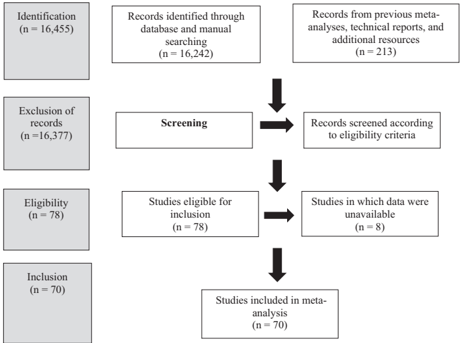
- Literature search across PsycINFO, ERIC, and ProQuest, plus manual searches; final sample included 70 studies after applying inclusion/exclusion criteria.
- Effect sizes were computed as standardized mean differences transformed to Hedges’ g and analyzed using a three-level multilevel meta-analysis in R to handle dependent effect sizes and test moderators/publication bias.
## Limitations
- The paper states that only English-language evaluations were included, which may limit generalizability beyond English-speaking contexts.
- The authors note that results may still have been influenced by reporter bias or unreliable/poorly validated measures in original studies, and that some moderators could not be tested because they were not reported.
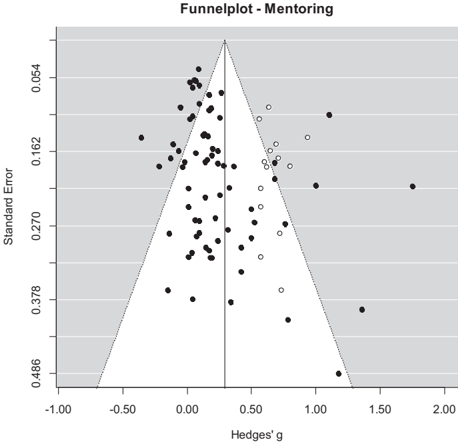
- Evident from the text: publication bias/selection bias was not fully ruled out; although the funnel plot suggested publication bias was unlikely, 14 effect sizes were missing on the right side and trim-and-fill gave a somewhat larger estimate (g = .29), indicating possible selection bias.
Model-written summary of a shortened version of the paper’s full text (it is longer than we read). Check it against the paper before relying on it.
Integrity signals
Registry
Cites
Statistics
Figures
Verification
Claims the paper makes
9 Valid · 0 Not valid · 46 Not checked · 111 Own results and interpretations
Every source the paper cites for this claim was checked and supports it.
In the paper
“Another meta-analysis of three large-scale, school-based mentoring evaluations showed positive effects of mentoring on a range of school-related outcomes (Cohen ' s d ranging from .07 to .18; Wheeler et al. 2010).”
What the sources say
- Supportedcites Wheeler et al. 2010 matched to “Review of Three Recent Randomized Trials of School-Based Mentoring and commentaries” (2010) source
The Meta-analytic Synthesis of Findings section says the authors combined findings from three large-scale randomized trials using Cohen’s d and found favorable effects on six outcomes, with effect sizes from .07 to .18. These include truancy, scholastic efficacy, school-related misconduct, and absenteeism, as well as measures of support from adults and peers. (LLM, conf=0.93)
plainstates a cause- Asserted: passes — The authors put it forward as true.
- Checkable: passes — It can be checked against evidence.
- Load-bearing: unclear — It is unclear whether the paper’s conclusions depend on it.
- Based: passes — The paper gives a reason why it holds.
- Supported
The cited sources support only part of this claim — read each source’s verdict below.
In the paper
“increases statistical power compared to the traditional meta-analytic approach”
What the sources say
- Partly supportedcites Van den Noortgate et al. 2014 matched to “Meta-analysis of multiple outcomes: a multilevel approach” (2015) sourceExperimental — accuracy not yet measured
The Conclusions (page unavailable) say that three-level meta-analysis makes efficient use of all available effect sizes, and the section on varying outcomes reports larger standard errors when fewer effect sizes are available. But the paper does not establish that it has greater statistical power than the traditional approach. Its direct comparison instead finds that the traditional two-level model can underestimate standard errors when outcomes are dependent. (LLM, conf=0.79)
plainstates a cause- Asserted: passes — The authors put it forward as true.
- Checkable: passes — It can be checked against evidence.
- Load-bearing: unclear — It is unclear whether the paper’s conclusions depend on it.
- Based: passes — The paper gives a reason why it holds.
- Partly supported
Every source the paper cites for this claim was checked and supports it.
In the paper
“The major advantage of the three-level approach is that all (dependent) effect sizes extracted from the same study can be included in the analysis, which preserves all available information.”
What the sources say
- Supportedcites Van den Noortgate et al. 2014 matched to “Meta-analysis of multiple outcomes: a multilevel approach” (2015) source
The Conclusions state that the three-level model can accommodate different numbers of effect sizes across studies and “makes efficient use of all available effect sizes.” The paper also describes the model as accounting for dependence among multiple effect sizes within a study. (LLM, conf=0.93)
plainstates a cause- Asserted: passes — The authors put it forward as true.
- Checkable: passes — It can be checked against evidence.
- Load-bearing: passes — The paper’s conclusions depend on it.
- Based: passes — The paper gives a reason why it holds.
- Supported
Every source the paper cites for this claim was checked and supports it.
In the paper
“Moreover, three-level meta-analysis accounts for both withinand between-study variability”
What the sources say
- Supportedcites Van den Noortgate et al. 2014 matched to “Meta-analysis of multiple outcomes: a multilevel approach” (2015) source
The Additional information section identifies variance between studies and between outcomes within studies as components of the three-level model. The Conclusions section likewise describes variation both between studies and between multiple effects within studies. Page numbers were not provided. (LLM, conf=0.94)
plainstates a cause- Asserted: passes — The authors put it forward as true.
- Checkable: passes — It can be checked against evidence.
- Load-bearing: passes — The paper’s conclusions depend on it.
- Based: passes — The paper gives a reason why it holds.
- Supported
Every source the paper cites for this claim was checked and supports it.
In the paper
“A three-level approach to meta-analysis was therefore applied in order to deal with the interdependency of effect sizes (Van den Noortgate et al. 2014).”
What the sources say
- Supportedcites Van den Noortgate et al. 2014 matched to “Meta-analysis of multiple outcomes: a multilevel approach” (2015) source
The Conclusions state that the paper evaluated a three-level approach to account for dependence between multiple effect sizes within studies. This supports using the approach to deal with interdependent effect sizes; page numbers were not provided in our copy. (LLM, conf=0.94)
plainstates a cause- Asserted: passes — The authors put it forward as true.
- Checkable: passes — It can be checked against evidence.
- Load-bearing: passes — The paper’s conclusions depend on it.
- Based: passes — The paper gives a reason why it holds.
- Supported
97 more claims · 2 with their cited sources checked
Create a free account to see all 166 claims and to verify the 7 references still open.
- It may state two separate claims as one. 36
- Probably not a substantial claim. 34
Claims other papers make about this one
Each is checked against this paper’s own text: does it say what the citing paper says it does?
The source backs part of the claim, not all of it — or backs it for a different population, condition or comparison.
In the citing paper
“with many of those studies yielding statistically signi fi cant, but small effect sizes (i.e., ranging from g =0.18 -0.21; DuBois et al., 2002, 2011; Raposa et al., 2019).”
From Cross-age peer mentoring for youth: A meta-analysis (2022) · cites this paper as Raposa et al., 2019
Experimental — accuracy not yet measuredThe source backs part of the claim, not all of it — or backs it for a different population, condition or comparison.
In the citing paper
“Our findings also correspond with the literature (Moor, 2018; Raposa et al., 2019; Keller et al., 2020; Kuperminc et al., 2020), indicating that the school functioning, self-esteem, and well-being of the mentored group significantly improved after mentoring.”
From Outcome domains and assessment measures in school-based youth mentoring programs: a systematic review (2026) · cites this paper as Raposa et al., 2019
Experimental — accuracy not yet measuredThe source backs part of the claim, not all of it — or backs it for a different population, condition or comparison.
In the citing paper
“However, programs with expectations for longer match durations produced smaller effect sizes [17].”
From Unpacking Community-Based Youth Mentoring Relationships: An Integrative Review (2021) · cites this paper as [17]
Experimental — accuracy not yet measuredThe cited source says what the claim attributes to it.
In the citing paper
“Yet, empirical studies of mentoring programs demonstrate that these programs are associated with small‐to‐moderate positive effects on a wide range of social, academic, and behavioral outcomes (DuBois et al., 2011; Raposa, Rhodes, et al., 2019).”
From Strategies for monitoring mentoring relationship quality to predict early program dropout (2022) · cites this paper as Raposa, Rhodes, et al., 2019
The cited source says what the claim attributes to it.
In the citing paper
“some youth demographic characteristics, such as youth gender composition of the program, appear to play a role in predicting effect sizes in intergenerational mentoring programs (DuBois et al., 2002, 2011; Raposa et al., 2019).”
From Cross-age peer mentoring for youth: A meta-analysis (2022) · cites this paper as Raposa et al., 2019
8 more claims about this paper
Create a free account to see every claim other papers make about this one.
Statistics that don’t add up
Each reported p-value recomputed from its test statistic and degrees of freedom, each partial η² from its F, and each ratio, mean difference or B printed with a p checked against its own confidence interval.
Rated minor: it would not touch a result — a value no result rests on, a p-value that stays on the same side of the significance level, or a conflict that is clerical, resolved elsewhere in the paper, or outside its own findings.
In the paper
“F (4, 700) = .31, p = .78”
Reported p = .78 · recomputed p = .871
Statistics recomputed
Every reported test result, recomputed from its test statistic and degrees of freedom. A result shows as not adding up only once an independent check has confirmed it.
- Doesn’t add upF(4, 700) = 0.31reported p = .78 · recomputed p = .871
“F (4, 700) = .31, p = .78”
- ConsistentF(14, 690) = 0.77reported p = .7 · recomputed p = .702
“F (14, 690) = 0.77, p = .70”
- ConsistentF(2, 168) = 2.79reported p < .1 · recomputed p = .064
“F (2, 168) = 2.79, p < .10”
- ConsistentF(1, 703) = 4.47reported p < .05 · recomputed p = .035
“F (1, 703) = 4.47, p < .05”
- ConsistentF(4, 700) = 2.3reported p < .1 · recomputed p = .057
“F (4, 700) = 2.30, p < .10”
5 more recomputed tests
Create a free account to see every test the Stats check recomputed.
Self-check
Percentages, sums and reported differences re-computed from the paper’s own numbers.
Each contradiction between two passages listed here was confirmed by an independent check.
Rated major: it would touch a result — a value a result rests on, reported and recomputed p-values on opposite sides of the significance level, two passages that conflict with no sign which is right, or a cited work retracted before this paper was published.
In the paper
§ Differences in Effects of Mentoring Based on Youth Outcome Type
“Results suggested no signi fi cant differences in effect sizes across these fi ve types of outcomes ( F (4, 700) = .31, p = .78),”
§ Differences in Effects of Mentoring Based on Youth Outcome Type
“| Broad outcome domains | | | | | | | F (4, 690) = 0.68 |”
Citations
Cites
Tabachnick, B. G., & Fidell, L. S. (1983) · Cited by 80,058
Bias in meta-analysis detected by a simple, graphical test
Egger, M., Smith, G. D., Schneider, M., & Minder, C. (1997) · BMJ · doi:10.1136/bmj.315.7109.629 · Cited by 56,722
Conducting Meta-Analyses in R with the metafor Package
Viechtbauer, W. (2010) · Journal of Statistical Software · doi:10.18637/jss.v036.i03 · Cited by 20,464
Duval, S., & Tweedie, R. (2000) · Biometrics · doi:10.1111/j.0006-341x.2000.00455.x · Cited by 14,099 · cited 1×
“The present study used both a funnel plot and a trim-andfill analysis (Duval and Tweedie 2000), conducted with the function ‘trimfill’ in the metafor package (Viechtbauer 2010).”
Method(2000) · Cited by 9,198
The file drawer problem and tolerance for null results.
Rosenthal, R. (1979) · Psychological Bulletin · doi:10.1037/0033-2909.86.3.638 · Cited by 9,068 · cited 1×
“Not including these studies may lead to an overestimation of the true effect size, a phenomenon known as “publication bias” (Rosenthal 1979).”
BackgroundMarkus, H., & Nurius, P. (1986) · American Psychologist · doi:10.1037/0003-066x.41.9.954 · Cited by 5,806 · cited 1×
“Markus and Nurius (1986) have referred to possible selves: individuals’ ideas of what they might become, what they would like to become, and what they fear becoming.”
BackgroundA secure base: parent-child attachment and healthy human development
(1989) · Choice Reviews Online · doi:10.5860/choice.26-4750 · Cited by 4,886
(1904) · The American Journal of Psychology · doi:10.2307/1412635 · Cited by 4,187
Improved tests for a random effects meta‐regression with a single covariate
Knapp, G., & Hartung, J. (2003) · Statistics in Medicine · doi:10.1002/sim.1482 · Cited by 2,075 · cited 1×
“The restricted maximum likelihood estimate was used to estimate all model parameters, and the Knapp and Hartung (2003) method was used for testing individual regression coefficients of the meta-analytic models and for calculating the corresponding confidence intervals (see also Assink and Wibbelink…”
Method
Research works printed but not linked: 5
- Cavell, T. A., & Elledge, L. C. (2014). Mentoring and prevention science. In D. DuBois & M. Karcher (Eds.), Handbook of Youth Mentoring (2nd Edn, pp. 29 -42). Los Angeles: Sage.
- Everhart, K. (2000). Promoting Resiliency in at-risk children through an integrated adult-child mentoring and character development program: an analysis of mentoring strategies with regard to outcomes. (Unpublished doctoral dissertation). University of South Carolina.
- Gatto, M. (2006). The effects of a goal-oriented mentoring group on the self-ef fi cacy of children. Unpublished doctoral dissertation, Adelphi University, Garden City, New York.
- Hedges, L., & Olkin, I. (1985). Statistical models for meta-analysis . New York: Academic Press.
- Rogoff, B. (1978). Spot observation: an introduction and examination. Quarterly Newsletter of the Institute for Comparative Human Development, 2(2C), 21–26.
Cited by
Items 101–200 of 363
Reflections on Improving Women’s Experiences of Mentorship in Canadian Coaching
Kramers, S., Bean, C. N., Hummell, C., Allan, V., Johnson, A., & Turnnidge, J. (2023) · International Sport Coaching Journal · doi:10.1123/iscj.2022-0091 · Cited by 10
From crisis to capacity: Lessons learned from youth e-mentoring during the COVID-19 pandemic
Wright, K., Levine, D., Salcido, M., Garringer, M., Almendra, T., Bazell, A. T., & Kaufman, M. R. (2024) · Computers in Human Behavior Reports · doi:10.1016/j.chbr.2024.100400 · Cited by 10
Gowdy, G., Jones, K. V., & Griffith, A. N. (2024) · Youth · doi:10.3390/youth4030076 · Cited by 9
Damm, A. P., von Essen, E., Jensen, A. J., Kerrn-Jespersen, F., & van Mastrigt, S. B. (2022) · International Journal of Environmental Research and Public Health · doi:10.3390/ijerph19052906 · Cited by 8
Cody, C., Bovarnick, S., & Peace, D. (2022) · Child Abuse Review · doi:10.1002/car.2789 · Cited by 8
Dantzer, B., & Perry, N. E. (2022) · Youth · doi:10.3390/youth2040042 · Cited by 12
Lucas‐Thompson, R. G., Miller, R. L., Moran, M. J., Rzonca, A. J., Krause, J. T., Montavon, J. K., Johnson, S., Haddock, S. A., Zimmerman, T. S., & Shomaker, L. B. (2024) · Mindfulness · doi:10.1007/s12671-024-02334-5 · Cited by 8
“Adjustment Reducing adjustment problems is a goal of both mentoring programs (Claro & Perelmiter, 2022; Raposa et al., 2019) and MBIs (Kallapiran et al., 2015; Reangsing et al., 2021; Ruiz-Íñiguez et al., 2020).”
Anna Vannucii Receives Emerging Scholar Best Article Award, 2020
Levesque, R. J. R. (2020) · Journal of Youth and Adolescence · doi:10.1007/s10964-020-01327-6 · Cited by 8
Australian Men’s Sheds and Their Role in the Health and Wellbeing of Men: A Systematic Review
Barbagallo, M. S., Brito, S., & Porter, J. E. (2023) · Health & Social Care in the Community · doi:10.1155/2023/2613413 · Cited by 7
Mentors’ Supporting Approaches of Mentees’ Cognitive Emotion Regulation Strategies
Kiadarbandsari, A. (2023) · Journal of Adolescent Research · doi:10.1177/07435584231163568 · Cited by 14
“Based on the findings of two recent meta-analyses (Raposa et al., 2019; Van Dam et al., 2018), both natural (adults in youth’s social systems such as older siblings, extended family members, neighbors, etc.) and formal (assigned mentors in program-based mentoring programs) mentoring relationships…”
Administrators’ perspectives on organizational environmental factors facing 4-H youth development
Elliott‐Engel, J., Westfall-Rudd, D. M., Seibel, M., Kaufman, E. K., & Radhakrishna, R. B. (2023) · Children and Youth Services Review · doi:10.1016/j.childyouth.2023.107358 · Cited by 13
Quimby, D., Richards, M. H., Onyeka, O. “., Miller, K. M., McCrea, K. T., Smith, Z. R., & Denton, D. (2022) · Youth & Society · doi:10.1177/0044118x221115761 · Cited by 9
“Cross-age peer mentoring is one intervention that can respond to those needs by promoting the strengths of youth of color, sustaining positive social networks, and creating opportunities to build community cultural wealth (Raposa et al., 2019; Wood et al., 2009; Yosso, 2005) .”
BackgroundLeathers, S. J., Holtschneider, C., Ludington, M., Ross, E. V., & Barnett, J. L. (2023) · Children and Youth Services Review · doi:10.1016/j.childyouth.2023.107095 · Cited by 9
Boering, A., Groenman, A. P., van Dam, L., & Overbeek, G. J. (2024) · Health & Justice · doi:10.1186/s40352-024-00258-9 · Cited by 17
“…programs, where youth are matched to non-parental adults who volunteer within a non-professional context, such as a school or community program (Raposa et al., 2019), informal mentoring programs focus on involving a non-parental adult from within the adolescents’ social network, someone with…”
BackgroundAdebayo, B. O., & Sunderman, H. M. (2024) · International Journal of Mentoring and Coaching in Education · doi:10.1108/ijmce-08-2023-0081 · Cited by 8
Radlick, R. L., Svedberg, P., Nygren, J., Przedpelska, S., & Gammon, D. (2020) · JMIR Research Protocols · doi:10.2196/16472 · Cited by 8
“Additionally, because the literature suggests that mentoring produces better outcomes for some groups (eg, high-risk male youth) over others [50], we will conduct exploratory analyses to investigate differing effects of the intervention based on age, gender, and time in Norway.”
Drew, A. L., & Spencer, R. (2020) · Children and Youth Services Review · doi:10.1016/j.childyouth.2020.105846 · Cited by 20
Wathen, M. V., Decker, P. L. F., Richards, M. H., McCrea, K. T., Onyeka, O. “., Weishar, C. N., DiClemente, C. M., & Donnelly, W. (2021) · Children and Youth Services Review · doi:10.1016/j.childyouth.2021.106032 · Cited by 7
A Response to Lesak et al. (2021), “Recommendations for Educating Youth about Sex Trafficking”
Edwards, K. M., Kulig, T. C., & Diamond-Welch, B. K. (2022) · Journal of Human Trafficking · doi:10.1080/23322705.2022.2078593 · Cited by 8
“…and formal mentors, religious leaders – not only to serve as protective factors against experiencing violence, including sex trafficking, but to promote positive youth development across myriad domains (Chisolm-Straker et al., 2018; Mauer et al., 2021; Raposa et al., 2019; Rothman et al., 2020).”
Oshiro, Wisener, Nash, Stanley, & Jarvis-Selinger (2023) · Rural and Remote Health · doi:10.22605/rrh8216 · Cited by 11
Mixed Methods Evaluation of Formal Mentoring: Journey UP for Aging out of Foster Care
Bonella, B., Beirwolf, K., Coleman, L., Sterger, C., Pulli, K., Anguiano, C., & Barton, K. (2019) · Global Social Welfare · doi:10.1007/s40609-019-00157-0 · Cited by 10
Koper, N., Creemers, H. E., Branje, S., Stams, G. J. J. M., & van Dam, L. (2020) · BMC Health Services Research · doi:10.1186/s12913-020-05553-3 · Cited by 14
“As previous research stresses the importance of measuring treatment integrity [38], and suggests that high mentoring relationship quality [24, 25, 39], and the collaborative relationship between the YIM and case manager [18] are associated with positive outcomes, these factors will be examined as predictors.”
Self-citationJablon, E. M., & Lyons, M. D. (2021) · Journal of Community Psychology · doi:10.1002/jcop.22477 · Cited by 6
Hatzikiriakidis, K., Hillman, C., Soh, S., Savaglio, M., O’Donnell, R., & Ayton, D. (2021) · International Journal of Adolescence and Youth · doi:10.1080/02673843.2021.1911816 · Cited by 7
Johnson, S. L., Jones, V., Ryan, L. M., DuBois, D. L., Fein, J. A., & Cheng, T. L. (2022) · Prevention Science · doi:10.1007/s11121-022-01406-z · Cited by 11
Hastings, L. J., Sunderman, H. M., & Sellon, A. (2023) · International Journal of Mentoring and Coaching in Education · doi:10.1108/ijmce-09-2022-0079 · Cited by 7
The Impact of Mother Support and Natural Mentoring on the Depressive Symptoms of Black Youth
Jones, K. V., Boyd, D. T., & Quinn, C. R. (2021) · Journal of Child and Family Studies · doi:10.1007/s10826-021-02049-4 · Cited by 7
Anderson, A. J., Jones, K. V., Melton, T. N., Keller, T. E., & DuBois, D. L. (2023) · Journal of Community Psychology · doi:10.1002/jcop.23073 · Cited by 8
Ethnic-Racial (Mis)Match between Mentors and Mentees on Perceived Strength of Relationship
Koide, J., McDaniel, H. L., & Lyons, M. D. (2024) · Education Sciences · doi:10.3390/educsci14040398 · Cited by 7
A scoping review of therapeutic mentoring for youth mental health
Werntz, A. J., Rhodes, J. E., Brockstein, H. J., Fallon, L. M., & Cook, A. L. (2025) · Frontiers in Child and Adolescent Psychiatry · doi:10.3389/frcha.2025.1509971 · Cited by 5
“…the overall effectiveness of youth mentoring on well-being outcomes (broadly de fi ned) is minimal when examined across all mentoring studies (12, 13), research on particular programs (14, 15) and meta-analytic evidence suggests that when mentors use targeted interventions with their mentees,…”
Self-citationBuilding academic confidence through peer mentoring and motivational modules
Springer, A., Scanlan, T., & Kimble, J. (2025) · Mentoring & Tutoring Partnership in Learning · doi:10.1080/13611267.2025.2471424 · Cited by 8
“Ongoing training is critically important for mentors after initial training (J.-L. Mondisa & McComb, 2018; Raposa et al., 2019).”
Castro, E. M., & Cohen, A. K. (2020) · Journal of Community Psychology · doi:10.1002/jcop.22482 · Cited by 9
Informal Mentoring for Foster Youth Students: Core and Capital Mentors Over Time
Gowdy, G., Hogan, S., Roosevelt, K., Saastamoinen, M., & Levine, S. (2022) · Child and Adolescent Social Work Journal · doi:10.1007/s10560-022-00899-5 · Cited by 8
Brumovská, T., & Málková, G. (2023) · Journal of Community Psychology · doi:10.1002/jcop.23004 · Cited by 8
Stelter, R. L., Stump, K. N., Rhodes, J. E., & Kupersmidt, J. B. (2023) · Journal of Community Psychology · doi:10.1002/jcop.23017 · Cited by 8
“Youth mentoring programs, in general, have been somewhat stymied by low to moderate effect sizes (DuBois et al., 2011; Raposa et al., 2019) and researchers and practitioners have been in search of practices and approaches that help to improve the impact of mentoring to produce stronger effects on…”
BackgroundSelf-citationSpotlighting racism in schools: Teacher mentors and the mediating effect of school safety
Flitner, A. M., McQuillin, S. D., Kornbluh, M., & Thompson, D. (2023) · American Journal of Community Psychology · doi:10.1002/ajcp.12680 · Cited by 6
Folco, M. (2023) · Child and Adolescent Social Work Journal · doi:10.1007/s10560-023-00937-w · Cited by 5
“…that caring relationships with nonparental adults can model prosocial skills and provide a consistent and safe relational context to help youth better connect with others, manage interpersonal challenges, and become more receptive to adult values, advice, and perspectives (Raposa, et al., 2019).”
Informal and Formal Mentoring of Sexual and Gender Minority Youth: A Systematic Review.
Edwards, K. M., Scheer, J. R., & Mauer, V. A. (2022) · PubMed · Cited by 13
Radlick, R. L., & Przedpelska, S. (2023) · Children and Youth Services Review · doi:10.1016/j.childyouth.2023.107205 · Cited by 8
Anderson, A. J., Simpson, S. B., & Sánchez, B. (2024) · Children and Youth Services Review · doi:10.1016/j.childyouth.2024.107803 · Cited by 7
Jones, K. V., Gowdy, G., & Griffith, A. N. (2024) · Youth · doi:10.3390/youth4030085 · Cited by 11
Nixon, C. L., & Linkie, C. A. (2023) · Springer eBooks · doi:10.1007/978-3-031-31547-3_100 · Cited by 11
Marino, C., Cardillo, R., Canale, N., Lenzi, M., Bergamin, M., Bonichini, S., & Santinello, M. (2021) · Frontiers in Education · doi:10.3389/feduc.2021.702539 · Cited by 4
“6:702539. doi: 10.3389/feduc.2021.702539 Frontiers in Education | www.frontiersin.org October 2021 | Volume 6 | Article 7025391 ORIGINAL RESEARCH published: 20 October 2021 doi: 10.3389/feduc.2021.702539 emotional functioning (La Valle, 2015; Raposa et al., 2019).”
BackgroundInfluentialSánchez, B., Anderson, A. J., Herrera, C., DuBois, D. L., Bourke, K. T., Sack, J. K., Lee, S. J., Burchwell, K., Monjaras‐Gaytan, L. Y., & Garcia‐Murillo, Y. (2025) · BMC Public Health · doi:10.1186/s12889-025-21508-x · Cited by 6
Williford, A., Bytolas, J., Yoder, J. R., Duncan, D., Espelage, D. L., Woolweaver, A. B., Ortega, L., LoMurray, S., Robinson, L. E., Drescher, A., et al. (2023) · Children and Youth Services Review · doi:10.1016/j.childyouth.2023.107051 · Cited by 6
When do prevocational programs ease the transition to vocational education and training?
Busse, R., & Maué, E. (2025) · Vocations and Learning · doi:10.1007/s12186-025-09357-6 · Cited by 9
“Small influences of mentoring have also been found regarding other educational and employment outcomes (e.g., DuBois et al., 2002; Raposa et al., 2019) and may also be due to various pitfalls and conflicting effects for those who receive support.”
Deng, Z., & Chen, Z. (2023) · Journal of the Knowledge Economy · doi:10.1007/s13132-023-01491-7 · Cited by 6
“A Early efforts in 2004 and 2010 were met with criticism and suspension, while more recent attempts in 2019 introduced a pilot content rating system (Raposa et al., 2019).”
RetractedExperiences of Girls and Mentors With an Urban Kenyan Afterschool Support Program
Abuya, B. A., Muhia, N., & Mokaya, P. O. (2019) · Journal of Educational Research and Practice · doi:10.5590/jerap.2019.09.1.31 · Cited by 7
Kaferly, J. G., Furniss, A., & Allison, M. A. (2020) · Child Abuse & Neglect · doi:10.1016/j.chiabu.2020.104662 · Cited by 6
Jardí, A., Acquah, E. O., Ianos, A., & Aguadé, I. P. (2021) · European Educational Research Journal · doi:10.1177/14749041211002304 · Cited by 6
“Raposa et al. (2019), considering the empirical guidelines derived from universal prevention programs for youth, found effect sizes between medium to moderate.”
BackgroundPerceptions of At-Promise Youth in a Therapeutic Youth Mentoring Program
Stutey, D. M., Solis, A. E., Severn, K., Notestine, L., Enkler, K., Wehrman, J. D., & Cammell, M. (2022) · The Professional Counselor · doi:10.15241/dms.12.1.17 · Cited by 7
“Numerous researchers have discussed how the role of a mentor in a mentee’s life helped the mentee with improved self-esteem, enhanced health, instilled hope for the future, and reduced reoffending behaviors (Raposa et al., 2019; Rhodes, 2002; Weiler, Boat, & Haddock, 2019; Weiss et al., 2019).”
BackgroundThe social and emotional foundations of learning
Gotlieb, R. J. M., Hickey-Moody, A. C., Güroğlu, B., Burnard, P., Horn, C., Willcox, M. G., Saadatmand, M., Linzarini, A., Vandenbroucke, A. R. E., Albanese, D., et al. (2022) · UNESCO MGIEP eBooks · doi:10.56383/yrhy1735 · Cited by 10
Cammack, A. L., & Suglia, S. F. (2022) · Preventive Medicine · doi:10.1016/j.ypmed.2022.107339 · Cited by 5
Hagler, M., & Poon, C. Y. S. (2023) · Journal of Community Psychology · doi:10.1002/jcop.23016 · Cited by 6
Ratner, K., Zhu, G., Li, Q., Estevez, M., & Burrow, A. L. (2023) · Journal of Adolescence · doi:10.1002/jad.12149 · Cited by 4
“…of next ‐ day psychosocial functioning in our model, we wonder whether the small same ‐ day boosts to psychosocial functioning we observed accumulate into e ff ect sizes on the scale of those observed in outcome ‐ based studies of mentored youth (e.g., van Dam et al., 2018; Raposa et al., 2019).”
Axford, N., Bjornstad, G. J., Matthews, J., Whybra, L., Berry, V., Ukoumunne, O. C., Hobbs, T., Wrigley, Z., Brook, L., Taylor, R. S., et al. (2020) · Prevention Science · doi:10.1007/s11121-020-01132-4 · Cited by 7
Mader, M., Stoeger, H., Veas, A., & Ziegler, A. (2021) · Frontiers in Psychology · doi:10.3389/fpsyg.2021.737014 · Cited by 5
Az egyéni mentorálás gyakorlata és a mentoráltak visszajelzései
Horváth, G., & Boda, V. L. (2021) · Tudásmenedzsment · doi:10.15170/tm.2021.22.1.8 · Cited by 4
Alwani, N. A., Lyons, M. D., & Edwards, K. D. (2023) · Journal of Community Psychology · doi:10.1002/jcop.22938 · Cited by 4
Lee, H., Salcedo, J., Chen, K., & Anderson, A. J. (2025) · Journal of Community Psychology · doi:10.1002/jcop.23182 · Cited by 4
He, Y.-Z., Yuan, X., Ye, W.-Y., Li, S., Gu, W.-H., Yang, S.-Y., & Nie, Y. (2025) · Acta Psychologica · doi:10.1016/j.actpsy.2025.105843 · Cited by 5
Heppe, E. C. M., Kupersmidt, J. B., & Kef, S. (2021) · Journal of Adolescent Research · doi:10.1177/07435584211034874 · Cited by 3
“The positive effects of mentoring programs on a wide range of youth outcomes have been demonstrated in meta-analyses (DuBois et al., 2011; Raposa et al., 2019; Tolan et al., 2014).”
BackgroundSelf-citationSpencer, R., Drew, A. L., Herrera, C., McBeath, B., & Keller, T. E. (2021) · Journal of the Society for Social Work and Research · doi:10.1086/718516 · Cited by 3
“…models, and pop-ulationsserved(Karcher etal.,2006) — meta-analyticreviews demonstratetheoverall effectiveness of mentoring in enhancing youth outcomes across a number of social, developmental, behavioral, and academic domains (DuBois et al., 2002, 2011; Raposa et al., 2019; Tolan et al., 2014).”
BackgroundWilburn, V. G., Huber, M. E., Senter, D., & Stoll, H. B. (2022) · The Open Journal of Occupational Therapy · doi:10.15453/2168-6408.1800 · Cited by 5
A Cross-Cultural Examination of the Role of Youth Emotion Regulation in Mentoring Relationships
Simpson, S. B., Hsu, T., Hoffman, L., & Raposa, E. B. (2022) · Prevention Science · doi:10.1007/s11121-022-01365-5 · Cited by 6
“Despite the promise of mentoring programs, metaanalyses indicate that, on average, these interventions produce small effects across outcomes, and there is significant heterogeneity in the impact of youth mentoring, both within and across programs (DuBois et al., 2011; Raposa et al., 2019).”
BackgroundSelf-citationFernández-Rouco, N., Fernández‐Fuertes, A. A., Lastra, M. G., & Chico, C. E. (2022) · Canadian Journal of School Psychology · doi:10.1177/08295735221127059 · Cited by 8
“Consistent evidence suggests that adolescents’ aggression behaviors can be significantly reduced by well-planned interventions (Raposa et al., 2019; ValdésCuervo et al., 2018).”
BackgroundQuantitative text analysis in gifted and talented research
Balestrini, D. P., Stoeger, H., & Ziegler, A. (2023) · High Ability Studies · doi:10.1080/13598139.2023.2167812 · Cited by 4
“…reviews and meta-analyses of mentoring research do not acknowledge a salient link between mentoring and giftedness or talent (e.g. Eby et al., 2008; Raposa et al., 2019), which suggests a possible disinclination to conceptualize mentoring as a “natural” form of giftedness or talent development.”
BackgroundBuilding Resilience in Juvenile Offenders
Mallett, C. A. (2023) · Springer eBooks · doi:10.1007/978-3-031-14728-9_16 · Cited by 10
Stark, C., Wehrman, J., Stutey, D. M., Solis, A., Severn, K., Cammell, M., Gloden, H., Enkler, K., Notestine, L., & Palacios, A. F. (2021) · Journal of Human Services · doi:10.52678/001c.75388 · Cited by 7
“Youth mentees report many positive changes when participating in mentoring programs, such as improvement in self-worth, social acceptance, levels of intimacy, communication, trust, and academic performance (Anastasia et al., 2012; Keller & Pryce, 2012; Raposa et al., 2019; Rhodes, 2005).”
BackgroundBenefícios da tutoria em contexto escolar
da Cunha, J. S., Martins, J. A. O., Freitas, L. M. G. D. C., & Rosário, P. J. S. L. F. (2023) · Revista de Educação PUC-Campinas · doi:10.24220/2318-0870v28e2023a7209 · Cited by 4
Marino, C., Gaboardi, M., Kaufman, M. R., Bonichini, S., Bergamin, M., Canale, N., & Santinello, M. (2022) · Mentoring & Tutoring Partnership in Learning · doi:10.1080/13611267.2022.2070993 · Cited by 6
“…Portillo, Rhodes, Silverthorn, & Valentine, 2011), which can help diminish problematic behaviors (including school dropout, criminality, and social isolation; Raposa et al., 2019) and increase the likelihood of positive social-emotional and academic outcomes (Marino et al., 2020; Rhodes, 2005).”
BackgroundLovell, C. C., Valdez, E. S., Chan, J., Beatriz, E. D., & Gubrium, A. (2022) · Sex Education · doi:10.1080/14681811.2022.2106560 · Cited by 7
“Studies of the efficacy of mentoring on a range of adolescent outcomes consistently show significant effects (Raposa et al. 2019).”
BackgroundDevelopmental Relationships and Student Academic Motivation: Current Research and Future Directions
Scales, P. C., Pekel, K., & Houltberg, B. J. (2022) · Springer eBooks · doi:10.1007/978-3-031-07853-8_13 · Cited by 6
Hart, M. J., Sung, J. Y., McQuillin, S. D., et al. (2021) · doi:10.31234/osf.io/d2j6a · Cited by 3
Rhodes, J. E., Lowe, S. R., Schwartz, S. E. O., & Jasman, M. (2023) · Elsevier eBooks · doi:10.1016/b978-0-323-96023-6.00060-9 · Cited by 3
Self-citationGreen, F., Preece, C., Allen, K., Manzi, S., Mannes, J., Callaghan, L., Berry, V., de Lima, E. S., Woodburn, A., Hobbs, T., et al. (2026) · Journal of Prevention · doi:10.1007/s10935-025-00888-1 · Cited by 2
“These include school-based bullying and dating violence prevention and social-emotional learning programmes, as well as one-on-one youth mentoring (Gaffney et al., 2021 ; Raposa et al., 2019 ; Maxwell & Corliss, 2020 ; Farmer et al., 2023; Chawla et al., 2024 ).”
Hudock, R. L., Kremer, K. B., Kaplan, N., Goldberg, E., Austin, J. D., Khan, L. B., & Weiler, L. M. (2024) · Advances in Neurodevelopmental Disorders · doi:10.1007/s41252-023-00388-5 · Cited by 3
“Several meta-analyses provide evidence for the breadth of child and adolescent outcomes, including mental health, affected by adult-youth mentoring interventions (e.g., Raposa et al., 2019).”
InfluentialVoices from inside focused deterrence: Implications for implementation
Kochel, T. R., & McGarrell, E. F. (2025) · Journal of Criminal Justice · doi:10.1016/j.jcrimjus.2025.102483 · Cited by 5
Werntz, A. J., Deng, Y., Jasman, M., Yowell, C. M., & Rhodes, J. E. (2026) · International Journal of Mentoring and Coaching in Education · doi:10.1108/ijmce-03-2025-0027 · Cited by 6
Self-citationStoeger, H., Uebler, C., Bayer, S., Emmerdinger, K. J., & Ziegler, A. (2026) · International Journal of STEM Education · doi:10.1186/s40594-026-00600-7 · Cited by 3
“However, to bring about positive changes, mentoring programs need to adhere to specific quality standards and success criteria (DuBois et al., 2002, 2011; Eby et al., 2008; Luo & Stoeger, 2023; Raposa et al., 2019; Stoeger et al., 2021a).”
Peer Mentoring For Leader Development
Sunderman, H. M., & Adebayo, B. (2025) · Emerald Group Publishing Limited eBooks · doi:10.1108/978-1-83708-544-620251023 · Cited by 3
Younginer, S. T., & Elledge, L. C. (2021) · Journal of Community Psychology · doi:10.1002/jcop.22654 · Cited by 7
Kurt, Y., Özkan, Ç. G., & Öztürk, H. (2022) · Nurse Education Today · doi:10.1016/j.nedt.2022.105455 · Cited by 2
Gelingensbedingungen und Wirkungspotenziale von Patenschaften
Gesemann, F. (2022) · Voluntaris Zeitschrift für Freiwilligendienste · doi:10.5771/2196-3886-2022-1-9 · Cited by 2
Galbraith, K., Tarbox, J., & Huey, S. J. (2022) · Journal of Child and Family Studies · doi:10.1007/s10826-022-02504-w · Cited by 3
“…adopted Ross and McKay’s (1976) general approach, while integrating evidence-based strategies from the peer mentoring (e.g., DeMarco, 1993; Raposa et al., 2019), social skills training (e.g., Dryburgh et al., 2020; Jackson et al., 1983), and behavior modification (e.g., Axelrod & Hall,…”
MethodNixon, C. L., & Linkie, C. A. (2023) · Springer eBooks · doi:10.1007/978-3-030-98711-4_100-1 · Cited by 3
Yanay‐Ventura, G., Yakhnich, L., Michael, K., & Sharabi, M. (2023) · Voluntary Sector Review · doi:10.1332/204080521x16867272645608 · Cited by 3
Impact of mentoring on the likelihood of getting jobs in the agricultural sector in Benin
Kaki, R. S., Houessou, M. D., Gbèdomon, R. C., THOTO, F. S., Gandji, K., Aoudji, A. K. N., & Biaou, G. (2023) · Development in Practice · doi:10.1080/09614524.2023.2240039 · Cited by 2
“Furthermore, mentoring can facilitate the transition from school to work, by helping to build con fi dence, in addition to sometimes providing practical training in employability skills (Raposa et al. 2019).”
BackgroundMize, M., Park, Y., & Ferguson, S. (2024) · Reading & Writing Quarterly · doi:10.1080/10573569.2023.2298501 · Cited by 2
“Previous research studies have explored the impact of mentoring programs on youth and reported positive outcomes on academics, health, and behavior (DuBois et al., 2002; Grossman & Rhodes, 2002; Raposa et al., 2019; Rhodes & DuBois, 2008]).”
Le mentorat : une nouvelle politique en direction des jeunes vulnérables ?
Kerivel, A., & Bricet, R. (2024) · Sciences & Actions Sociales · doi:10.3917/sas.020.0002 · Cited by 2
A realist evaluation of a multi-component program with disengaged students
Owen-Boukra, E., Knight, C. J., & Hill, D. M. (2024) · Evaluation and Program Planning · doi:10.1016/j.evalprogplan.2024.102417 · Cited by 4
Turienzo, C. F., Kamara, M., November, L., Kamara, P., Kingsford, A. M., Ridout, A. E., Thomas, S., Seed, P. T., Shennan, A. H., Sandall, J., et al. (2024) · PLoS ONE · doi:10.1371/journal.pone.0294538 · Cited by 3
Gunty, K. Y., Weiler, L. M., Keyzers, A., & Hudock, R. L. (2022) · Developmental Disabilities Network Journal · doi:10.59620/2694-1104.1030 · Cited by 2
“Such relationships can positively influence many outcomes, including interpersonal relationships, academic achievement, self-confidence, mental health, and problem behaviors (Raposa et al., 2019).”
Hennig, F., Wesche, J. S., Handke, L., & Kerschreiter, R. (2024) · Information and Learning Sciences · doi:10.1108/ils-10-2023-0155 · Cited by 5
Mairaj, F. (2024) · Social Sciences · doi:10.3390/socsci13110586 · Cited by 3
Implementing a migrant and refugee mentoring program through action research
Koirala, S., Mekonnen, G. T., Deller, B., Arinaitwe, G., Kezabu, K. L., Swabey, K., & Kember, D. R. (2024) · Heliyon · doi:10.1016/j.heliyon.2024.e40470 · Cited by 3
“This research has shown the value of mentoring to recently arrived refugee and migrant children in secondary school years 9 and 10.”
Daunicht, T.-M., Emmerdinger, K. J., Stoeger, H., & Ziegler, A. (2025) · Education Sciences · doi:10.3390/educsci15020162 · Cited by 3
Hartung, C., McGregor, J. R., Mills, X., & Shepherd, S. M. (2025) · Journal of Youth Studies · doi:10.1080/13676261.2025.2471806 · Cited by 2
Mentoring: A revolutionary act
Gómez‐Ospina, J. C., & García‐Perdomo, H. A. (2019) · International Journal of Surgery · doi:10.1016/j.ijsu.2019.03.018 · Cited by 2
Close, C., Elek, E., Roberts, C. A., Dunlap, L. J., Graham, P., Scaglione, N. M., Palen, L., & Clarke, T. (2021) · Prevention Science · doi:10.1007/s11121-021-01229-4 · Cited by 2
“Available information on alternative activities indicates that mentoring programs are generally effective, whereas evidence on after-school programs is more mixed (Kremer et al., 2015; Raposa et al., 2019).”
Background
Metadata
- Authors
- Raposa, E. B., Rhodes, J., Stams, G. J. J. M., Card, N., Burton, S., Schwartz, S., Sykes, L. A. Y., Kanchewa, S., Kupersmidt, J., & Hussain, S.
- Affiliations
- William & Mary (US)
- University of Massachusetts Boston (US)
- University of Amsterdam (NL)
- University of Connecticut (US)
- Suffolk University (US)
- Innovation Research and Training (US)
- University of Virginia (US)
- Corresponding author
- Raposa, Elizabeth B.
- ORCID
- Venue
- Journal of Youth and Adolescence
- Published
- 2019-01-19
- Volume
- 48
- Issue
- 3
- Pages
- 423-443
- ISSN
- 0047-2891 (ISSN-L)
- 1573-6601
- OpenAlex
- W2910504629
- Cited by
- 366
- References
- 71
- Citations by year
- 2026: 60 · 2025: 40 · 2024: 53 · 2023: 63 · 2022: 59 · 2021: 45 · 2020: 36 · 2019: 9
- FWCI
- 5.75
- Type
- journal article
- Language
- en
- Open access
- bronze
- doi.org
- Licence
- www.springer.com/tdm (tdm)
- Locations
- Journal of Youth and Adolescence (publishedVersion)
- PubMed (publishedVersion)
- UvA-DARE (University of Amsterdam) (submittedVersion, other-oa)
- Data Archiving and Networked Services (DANS) (submittedVersion, other-oa)
- Funders
- John D. and Catherine T. MacArthur Foundation (Research Network on Connected Learning)
- MENTOR: The National Mentoring Partnership (n/a)
- Topics
- Social Sciences › Education › Mentoring and Academic Development
- Social Sciences › Psychology › Developmental and Educational Psychology › Youth Development and Social Support
- Social Sciences › Sociology and Political Science › Crime Patterns and Interventions
- Keywords
- youth mentoring, mentoring programs, positive youth development, at-risk youth, early intervention, program effectiveness, effect size, young men, universal prevention
- MeSH terms
- Mentoring, Adolescent, Adult, Child, Female, Humans, Interpersonal Relations, Male, Mentors, Surveys and Questionnaires, Social Support, Program Evaluation, Outcome Assessment, Health Care, Self Report
About these checks
Registry, retraction, Cites and statistics results are computed, not judged, with one exception: a printed reference that no index lists is read once by a model before it counts as a citation error. Claims are extracted by a model and kept only when their quote appears verbatim in the text; each cited source is then checked, with a model’s help, for whether it says what the claim relies on. Those verdicts can be wrong — read the claim’s quote and the cited source before relying on one.
The claim verdicts this report counts are experimental: their accuracy is not yet measured.
A language model drew the claims from the paper on 2026-10-11, under version 3 of the claim definition (model deepseek-v4.1-flash, prompt extract-v3).
A second model labelled each claim on 2026-10-11 (model jev-1.13-20260917, definition revision gold-guideline-v0.2).
Cited sources are checked with a language model’s help (gpt-6-sol).
Statistics and arithmetic are recomputed, not judged.
Confidence bands are shown only for fields calibrated on our annotated test set. None is calibrated yet, so no band is shown.
What counts as a claim ›How we measure confidence ›How we check this ›
Are you an author, or do you see a problem with this page? Request a review
Data sources
Bibliographic data: Semantic Scholar, OpenAlex, Crossref.
Contains information from the Semantic Scholar Academic Graph Datasets, made available under the ODC Attribution License (ODC-BY 1.0).
Semantic Scholar’s data is described in: Kinney, R., et al. (2023). The Semantic Scholar Open Data Platform. arXiv:2301.10140.
