

The Effects of Youth Mentoring Programs: A Meta-analysis of Outcome Studies
Open accessThe DOI matches its Crossref record; 69 of the 71 references it cites were found in a registry or an index; 9 of the 64 sources its claims cite were checked for support.
Abstract
Mentoring programs, which pair youth with caring, non-parental adults with the goal of promoting positive youth development, are an increasingly popular strategy for early intervention with at-risk youth. However, important questions remain about the extent to which these interventions improve youth outcomes. The present study involved a comprehensive meta-analysis of all outcome studies of intergenerational, one-on-one youth mentoring programs written in the English language between 1975 and 2017, using rigorous inclusion criteria designed to align with developmental theories of youth mentoring. Analysis of 70 mentoring outcome studies, with a sample size of 25,286 youth (average age of 12 years old), yielded a statistically significant effect of mentoring programs across all youth outcomes. The observed effect size fell within the medium/moderate range according to empirical guidelines derived from universal prevention programs for youth, and was consistent with past meta-analyses of youth mentoring. Moderation analyses indicated that programs serving a larger proportion of male youth, deploying a greater percentage of male mentors or mentors with a helping profession background, and requiring shorter meetings yielded larger effect sizes, as did evaluations that relied on questionnaires and youth self-report. Taken together, these findings provide some support for the efficacy of mentoring interventions, while also emphasizing the need to remain realistic about the modest impact of these programs as currently implemented, and highlighting opportunities for improving the quality and rigor of mentoring practices.
Overview
CoChat Summary
## TL;DR
This meta-analysis of 70 youth mentoring outcome studies (25,286 mentees) found that mentoring programs had a statistically significant overall effect on youth outcomes, Hedges’ g = .21. Effects varied by some sample and program features, but not by broad outcome domain or by several study design factors.
## Key findings
- Across 70 studies and 25,286 youth, the average effect of youth mentoring was g = .21 (p < .001; 95% CI: .14 to .28).
- Effects were statistically significant across all five broad outcome domains, with no significant differences among them (school, psychological, health, cognitive, and social outcomes; omnibus F(4, 700) = .31, p = .78).
- Larger effects were found in samples with a higher percentage of male youth (B = .38; F(1, 603) = 4.81, p < .05) and male mentors (B = .36; F(1, 408) = 4.56, p < .05), and when more mentors worked in helping professions (B = .25; F(1, 289) = 5.49, p < .05).
- Programs with longer meeting durations had smaller effects (B = -.01; F(1, 346) = 3.92, p < .05).
- Questionnaire-based assessments produced larger effects (g = .22) than other measures (g = .14; F(1, 693) = 5.68, p < .05); youth self-reports also tended to show larger effects than school or teacher reports.
## Methods
- Comprehensive meta-analysis of intergenerational, one-on-one youth mentoring programs written in English, covering studies from 1975 to 2017.
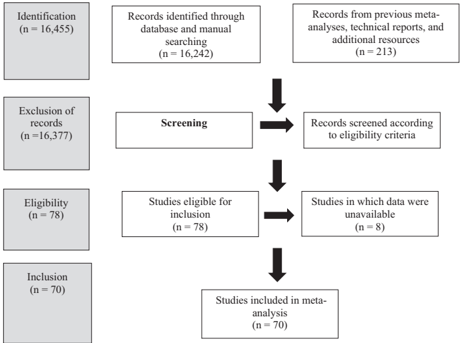
- Literature search across PsycINFO, ERIC, and ProQuest, plus manual searches; final sample included 70 studies after applying inclusion/exclusion criteria.
- Effect sizes were computed as standardized mean differences transformed to Hedges’ g and analyzed using a three-level multilevel meta-analysis in R to handle dependent effect sizes and test moderators/publication bias.
## Limitations
- The paper states that only English-language evaluations were included, which may limit generalizability beyond English-speaking contexts.
- The authors note that results may still have been influenced by reporter bias or unreliable/poorly validated measures in original studies, and that some moderators could not be tested because they were not reported.
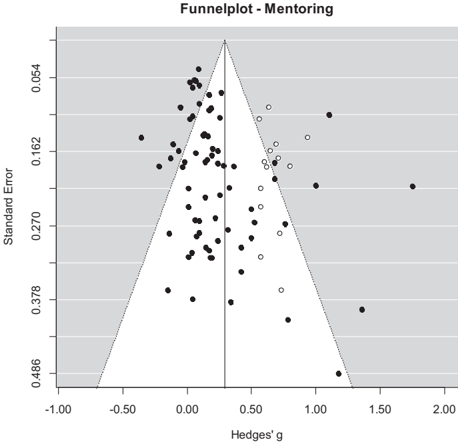
- Evident from the text: publication bias/selection bias was not fully ruled out; although the funnel plot suggested publication bias was unlikely, 14 effect sizes were missing on the right side and trim-and-fill gave a somewhat larger estimate (g = .29), indicating possible selection bias.
Model-written summary of a shortened version of the paper’s full text (it is longer than we read). Check it against the paper before relying on it.
Integrity signals
Registry
Cites
Statistics
Figures
Verification
Claims the paper makes
9 Valid · 0 Not valid · 46 Not checked · 111 Own results and interpretations
Every source the paper cites for this claim was checked and supports it.
In the paper
“Another meta-analysis of three large-scale, school-based mentoring evaluations showed positive effects of mentoring on a range of school-related outcomes (Cohen ' s d ranging from .07 to .18; Wheeler et al. 2010).”
What the sources say
- Supportedcites Wheeler et al. 2010 matched to “Review of Three Recent Randomized Trials of School-Based Mentoring and commentaries” (2010) source
The Meta-analytic Synthesis of Findings section says the authors combined findings from three large-scale randomized trials using Cohen’s d and found favorable effects on six outcomes, with effect sizes from .07 to .18. These include truancy, scholastic efficacy, school-related misconduct, and absenteeism, as well as measures of support from adults and peers. (LLM, conf=0.93)
plainstates a cause- Asserted: passes — The authors put it forward as true.
- Checkable: passes — It can be checked against evidence.
- Load-bearing: unclear — It is unclear whether the paper’s conclusions depend on it.
- Based: passes — The paper gives a reason why it holds.
- Supported
The cited sources support only part of this claim — read each source’s verdict below.
In the paper
“increases statistical power compared to the traditional meta-analytic approach”
What the sources say
- Partly supportedcites Van den Noortgate et al. 2014 matched to “Meta-analysis of multiple outcomes: a multilevel approach” (2015) sourceExperimental — accuracy not yet measured
The Conclusions (page unavailable) say that three-level meta-analysis makes efficient use of all available effect sizes, and the section on varying outcomes reports larger standard errors when fewer effect sizes are available. But the paper does not establish that it has greater statistical power than the traditional approach. Its direct comparison instead finds that the traditional two-level model can underestimate standard errors when outcomes are dependent. (LLM, conf=0.79)
plainstates a cause- Asserted: passes — The authors put it forward as true.
- Checkable: passes — It can be checked against evidence.
- Load-bearing: unclear — It is unclear whether the paper’s conclusions depend on it.
- Based: passes — The paper gives a reason why it holds.
- Partly supported
Every source the paper cites for this claim was checked and supports it.
In the paper
“The major advantage of the three-level approach is that all (dependent) effect sizes extracted from the same study can be included in the analysis, which preserves all available information.”
What the sources say
- Supportedcites Van den Noortgate et al. 2014 matched to “Meta-analysis of multiple outcomes: a multilevel approach” (2015) source
The Conclusions state that the three-level model can accommodate different numbers of effect sizes across studies and “makes efficient use of all available effect sizes.” The paper also describes the model as accounting for dependence among multiple effect sizes within a study. (LLM, conf=0.93)
plainstates a cause- Asserted: passes — The authors put it forward as true.
- Checkable: passes — It can be checked against evidence.
- Load-bearing: passes — The paper’s conclusions depend on it.
- Based: passes — The paper gives a reason why it holds.
- Supported
Every source the paper cites for this claim was checked and supports it.
In the paper
“Moreover, three-level meta-analysis accounts for both withinand between-study variability”
What the sources say
- Supportedcites Van den Noortgate et al. 2014 matched to “Meta-analysis of multiple outcomes: a multilevel approach” (2015) source
The Additional information section identifies variance between studies and between outcomes within studies as components of the three-level model. The Conclusions section likewise describes variation both between studies and between multiple effects within studies. Page numbers were not provided. (LLM, conf=0.94)
plainstates a cause- Asserted: passes — The authors put it forward as true.
- Checkable: passes — It can be checked against evidence.
- Load-bearing: passes — The paper’s conclusions depend on it.
- Based: passes — The paper gives a reason why it holds.
- Supported
Every source the paper cites for this claim was checked and supports it.
In the paper
“A three-level approach to meta-analysis was therefore applied in order to deal with the interdependency of effect sizes (Van den Noortgate et al. 2014).”
What the sources say
- Supportedcites Van den Noortgate et al. 2014 matched to “Meta-analysis of multiple outcomes: a multilevel approach” (2015) source
The Conclusions state that the paper evaluated a three-level approach to account for dependence between multiple effect sizes within studies. This supports using the approach to deal with interdependent effect sizes; page numbers were not provided in our copy. (LLM, conf=0.94)
plainstates a cause- Asserted: passes — The authors put it forward as true.
- Checkable: passes — It can be checked against evidence.
- Load-bearing: passes — The paper’s conclusions depend on it.
- Based: passes — The paper gives a reason why it holds.
- Supported
97 more claims · 2 with their cited sources checked
Create a free account to see all 166 claims and to verify the 7 references still open.
- It may state two separate claims as one. 36
- Probably not a substantial claim. 34
Claims other papers make about this one
Each is checked against this paper’s own text: does it say what the citing paper says it does?
The source backs part of the claim, not all of it — or backs it for a different population, condition or comparison.
In the citing paper
“with many of those studies yielding statistically signi fi cant, but small effect sizes (i.e., ranging from g =0.18 -0.21; DuBois et al., 2002, 2011; Raposa et al., 2019).”
From Cross-age peer mentoring for youth: A meta-analysis (2022) · cites this paper as Raposa et al., 2019
Experimental — accuracy not yet measuredThe source backs part of the claim, not all of it — or backs it for a different population, condition or comparison.
In the citing paper
“Our findings also correspond with the literature (Moor, 2018; Raposa et al., 2019; Keller et al., 2020; Kuperminc et al., 2020), indicating that the school functioning, self-esteem, and well-being of the mentored group significantly improved after mentoring.”
From Outcome domains and assessment measures in school-based youth mentoring programs: a systematic review (2026) · cites this paper as Raposa et al., 2019
Experimental — accuracy not yet measuredThe source backs part of the claim, not all of it — or backs it for a different population, condition or comparison.
In the citing paper
“However, programs with expectations for longer match durations produced smaller effect sizes [17].”
From Unpacking Community-Based Youth Mentoring Relationships: An Integrative Review (2021) · cites this paper as [17]
Experimental — accuracy not yet measuredThe cited source says what the claim attributes to it.
In the citing paper
“Yet, empirical studies of mentoring programs demonstrate that these programs are associated with small‐to‐moderate positive effects on a wide range of social, academic, and behavioral outcomes (DuBois et al., 2011; Raposa, Rhodes, et al., 2019).”
From Strategies for monitoring mentoring relationship quality to predict early program dropout (2022) · cites this paper as Raposa, Rhodes, et al., 2019
The cited source says what the claim attributes to it.
In the citing paper
“some youth demographic characteristics, such as youth gender composition of the program, appear to play a role in predicting effect sizes in intergenerational mentoring programs (DuBois et al., 2002, 2011; Raposa et al., 2019).”
From Cross-age peer mentoring for youth: A meta-analysis (2022) · cites this paper as Raposa et al., 2019
8 more claims about this paper
Create a free account to see every claim other papers make about this one.
Statistics that don’t add up
Each reported p-value recomputed from its test statistic and degrees of freedom, each partial η² from its F, and each ratio, mean difference or B printed with a p checked against its own confidence interval.
Rated minor: it would not touch a result — a value no result rests on, a p-value that stays on the same side of the significance level, or a conflict that is clerical, resolved elsewhere in the paper, or outside its own findings.
In the paper
“F (4, 700) = .31, p = .78”
Reported p = .78 · recomputed p = .871
Statistics recomputed
Every reported test result, recomputed from its test statistic and degrees of freedom. A result shows as not adding up only once an independent check has confirmed it.
- Doesn’t add upF(4, 700) = 0.31reported p = .78 · recomputed p = .871
“F (4, 700) = .31, p = .78”
- ConsistentF(14, 690) = 0.77reported p = .7 · recomputed p = .702
“F (14, 690) = 0.77, p = .70”
- ConsistentF(2, 168) = 2.79reported p < .1 · recomputed p = .064
“F (2, 168) = 2.79, p < .10”
- ConsistentF(1, 703) = 4.47reported p < .05 · recomputed p = .035
“F (1, 703) = 4.47, p < .05”
- ConsistentF(4, 700) = 2.3reported p < .1 · recomputed p = .057
“F (4, 700) = 2.30, p < .10”
5 more recomputed tests
Create a free account to see every test the Stats check recomputed.
Self-check
Percentages, sums and reported differences re-computed from the paper’s own numbers.
Each contradiction between two passages listed here was confirmed by an independent check.
Rated major: it would touch a result — a value a result rests on, reported and recomputed p-values on opposite sides of the significance level, two passages that conflict with no sign which is right, or a cited work retracted before this paper was published.
In the paper
§ Differences in Effects of Mentoring Based on Youth Outcome Type
“Results suggested no signi fi cant differences in effect sizes across these fi ve types of outcomes ( F (4, 700) = .31, p = .78),”
§ Differences in Effects of Mentoring Based on Youth Outcome Type
“| Broad outcome domains | | | | | | | F (4, 690) = 0.68 |”
Citations
Cites
Tabachnick, B. G., & Fidell, L. S. (1983) · Cited by 80,058
Bias in meta-analysis detected by a simple, graphical test
Egger, M., Smith, G. D., Schneider, M., & Minder, C. (1997) · BMJ · doi:10.1136/bmj.315.7109.629 · Cited by 56,722
Conducting Meta-Analyses in R with the metafor Package
Viechtbauer, W. (2010) · Journal of Statistical Software · doi:10.18637/jss.v036.i03 · Cited by 20,464
Duval, S., & Tweedie, R. (2000) · Biometrics · doi:10.1111/j.0006-341x.2000.00455.x · Cited by 14,099 · cited 1×
“The present study used both a funnel plot and a trim-andfill analysis (Duval and Tweedie 2000), conducted with the function ‘trimfill’ in the metafor package (Viechtbauer 2010).”
Method(2000) · Cited by 9,198
The file drawer problem and tolerance for null results.
Rosenthal, R. (1979) · Psychological Bulletin · doi:10.1037/0033-2909.86.3.638 · Cited by 9,068 · cited 1×
“Not including these studies may lead to an overestimation of the true effect size, a phenomenon known as “publication bias” (Rosenthal 1979).”
BackgroundMarkus, H., & Nurius, P. (1986) · American Psychologist · doi:10.1037/0003-066x.41.9.954 · Cited by 5,806 · cited 1×
“Markus and Nurius (1986) have referred to possible selves: individuals’ ideas of what they might become, what they would like to become, and what they fear becoming.”
BackgroundA secure base: parent-child attachment and healthy human development
(1989) · Choice Reviews Online · doi:10.5860/choice.26-4750 · Cited by 4,886
(1904) · The American Journal of Psychology · doi:10.2307/1412635 · Cited by 4,187
Improved tests for a random effects meta‐regression with a single covariate
Knapp, G., & Hartung, J. (2003) · Statistics in Medicine · doi:10.1002/sim.1482 · Cited by 2,075 · cited 1×
“The restricted maximum likelihood estimate was used to estimate all model parameters, and the Knapp and Hartung (2003) method was used for testing individual regression coefficients of the meta-analytic models and for calculating the corresponding confidence intervals (see also Assink and Wibbelink…”
Method
Research works printed but not linked: 5
- Cavell, T. A., & Elledge, L. C. (2014). Mentoring and prevention science. In D. DuBois & M. Karcher (Eds.), Handbook of Youth Mentoring (2nd Edn, pp. 29 -42). Los Angeles: Sage.
- Everhart, K. (2000). Promoting Resiliency in at-risk children through an integrated adult-child mentoring and character development program: an analysis of mentoring strategies with regard to outcomes. (Unpublished doctoral dissertation). University of South Carolina.
- Gatto, M. (2006). The effects of a goal-oriented mentoring group on the self-ef fi cacy of children. Unpublished doctoral dissertation, Adelphi University, Garden City, New York.
- Hedges, L., & Olkin, I. (1985). Statistical models for meta-analysis . New York: Academic Press.
- Rogoff, B. (1978). Spot observation: an introduction and examination. Quarterly Newsletter of the Institute for Comparative Human Development, 2(2C), 21–26.
Cited by
Items 301–363 of 363
Manoni-Millar, S., Hopley, A., Labelle, P., et al. (2025) · SSRN Electronic Journal · doi:10.2139/ssrn.5251886
Miles, R. M. (2025) · PDXScholar (Portland State University) · doi:10.15760/etd.3899
Preventive measures are as important to the mental health pandemic as they are to COVID-19
Sokolovic, N. (2021) · The Conversation · doi:10.64628/aam.5jvj5rssd
Bayer, S., Stoeger, H., & Ziegler, A. (2025) · Frontiers in Psychology · doi:10.3389/fpsyg.2025.1559060
Griffith, A. N., Pryce, J. M., DuBois, D. L., Brezina, T., Stewart, K. E., & Garringer, M. (2025) · Prevention Science · doi:10.1007/s11121-025-01841-8
“…is a robust base of evidence to indicate that the youth in mentoring programs often benefit in areas like problem behavior avoidance and relationships with parents and peers (e.g., Raposa et al., 2019; Tolan et al., 2014), the effects tend to be relatively small and vary across and within programs.”
Developing Lifelong Learning Skills for Adults With ADHD Through Mentoring
Tasiou, K., & Nikolaou, E. N. (2025) · IGI Global eBooks · doi:10.4018/979-8-3373-3516-2.ch008
Cory, M., Rice, J., Chavis, C., Carter, J., Sánchez, B., Michel, R. E., DuBois, D. L., Chen, E., & Grant, K. E. (2025) · Journal of Community Psychology · doi:10.1002/jcop.70044
Mentor-mentee similarity in college peer mentoring: untangling conflicting results
Ramadurai, R., Deng, Y., Werntz, A. J., Yowell, C. M., & Rhodes, J. E. (2025) · Studies in Higher Education · doi:10.1080/03075079.2025.2572504 · Cited by 1
Self-citationThe Inside Scoop: Facilitator Perspectives on an Afterschool Group Mentoring Program for Youth
Wong, J. S., Nielsen, J., & Neilsen, K. (2025) · Child & Youth Care Forum · doi:10.1007/s10566-025-09902-3
“A recent meta-analysis found that mentoring programs were beneficial for youth in multiple domains, such as academic achievement and engagement, externalizing and internalizing behavior, self-regulation, physical health, cognitive functioning, and social support (Raposa et al., 2019).”
Jones, K. V., Satchell, K., Dove, L. M., Muñiz, J. O., Hulman, E., Eddy, J. M., Haggerty, K. P., Cohen, D., Skinner, M. L., & Hanson, K. G. (2025) · Journal of Applied Youth Studies · doi:10.1007/s43151-025-00189-8
“This framework underscores the many ways mentoring programs—and specifically professional mentors can—promote positive youth development and act as barriers against risk factors linked to negative psychological, behavioral, and problematic behaviors (DuBois et al. 2011; Raposa et al. 2019a).”
Understanding patterns of hope from informal mentoring through latent class analysis
Dow, B. R., McQuillin, S. D., Simpson, S. B., & Huebner, E. S. (2025) · Children and Youth Services Review · doi:10.1016/j.childyouth.2025.108660 · Cited by 1
The Art of Mentoring Trauma-Informed Educators: Considerations for Teacher-Education Programs
Laffier, J., Westley, M., & Rehman, A. (2025) · Springer texts in education · doi:10.1007/978-3-032-02333-9_10
The Art and Science of Mentoring
Allen, T. D., & Eby, L. T. D. T. (2020) · Emerald Group Publishing Limited eBooks · doi:10.1108/978-1-64802-287-620251006
Becoming-with-others: Young people's aspirations for social change in the context of community
Humphries, A., Toscano, M., & Arndt, S. (2025) · International Journal of Educational Research · doi:10.1016/j.ijer.2025.102927
Mentoring Activities for Building Developmental Assets
Karcher, M. J., Kuperminc, G. P., Melton, T. N., Nakkula, M. J., & Weiler, L. M. (2026) · Springer eBooks · doi:10.1007/978-3-032-05580-4_10
Lakind, D., Coleman, C. A., Kolberg, B. B., Raiford, J. R., & Eddy, J. M. (2026) · Springer eBooks · doi:10.1007/978-3-032-05580-4_24
Establishing Professional Mentoring Programs as a Critical Part of the Community
Jones, K. V., & Marsh, D. D. (2026) · Springer eBooks · doi:10.1007/978-3-032-05580-4_35
Mentoring Youth with Families Involved in Systems
Brady, B. (2026) · Springer eBooks · doi:10.1007/978-3-032-05580-4_12
Melton, T. N., Karcher, M. J., & DuBois, D. L. (2026) · Springer eBooks · doi:10.1007/978-3-032-05580-4_6 · Cited by 1
Exploring Profiles of Risk and Protective Factors Among Youth Mentees: For Whom Does Mentoring Work?
Meldrum, M., & Lyons, M. D. (2026) · Prevention Science · doi:10.1007/s11121-026-01878-3
“More recently, a meta-analysis of mentoring programs found consistent effects across outcomes for youth with varied levels of risk (Raposa et al., 2019).”
InfluentialMiddle marvels: a review of middle-school-based mentoring to support youth
Hart, M. J., & DiGiacomo, G. A. (2026) · Mentoring & Tutoring Partnership in Learning · doi:10.1080/13611267.2026.2616439
“Other findings suggest that school-based mentoring is the fastest-growing form of youth mentoring (Raposa et al., 2019).”
InfluentialWerntz, A. J., Jasman, M., Cherry, J., Borer, A., Johnston, A., Meany, M. K., Stettin, J., McCarron, T., & Rhodes, J. E. (2026) · Mentoring & Tutoring Partnership in Learning · doi:10.1080/13611267.2026.2632131
“Nonetheless, the overall effect size for mentoring programs remains highly variable across programs (Christensen et al., 2020; Raposa et al., 2019), suggesting that some have a greater impact on youth outcomes than others.”
Self-citationChilds, K. K., Peck, J. H., & Soderstrom, M. F. P. (2026) · Journal of Criminal Justice · doi:10.1016/j.jcrimjus.2026.102614
Migrant minds, shifting selves: Navigating relationships and identity in internal migration
Narayan, A. C., & Chakraborty, R. (2026) · International Journal of Intercultural Relations · doi:10.1016/j.ijintrel.2026.102387
Wolfe, E. C., Werntz, A. J., Michel, A., Zhang, Y., Rucker, M., Boukhechba, M., Barnes, L. E., Rhodes, J. E., & Teachman, B. A. (2026) · PLOS Digital Health · doi:10.1371/journal.pdig.0001187
“Despite its potential to address mental health needs, most mentoring produces only small effects on youth outcomes, in part because they tend to take a nonspecific, relationship-focused approach [36].”
Self-citationHummell, C., & Bean, C. N. (2026) · Youth · doi:10.3390/youth6010033 · Cited by 1
“These perspectives mirror findings from general youth mentoring literature that links mentorship to gains in youths’ psychosocial and cognitive development (Raposa et al., 2019; Rhodes, 2005).”
Mentoring for social inclusion with refugees in high-Income countries: a scoping review
Aresi, G., Mutti, M., Marzana, D., Prieto‐Flores, Ò., & Marta, E. (2026) · European Journal of Social Work · doi:10.1080/13691457.2026.2649891
Davis, A. L., Koide, J., Simpson, S. B., McQuillin, S. D., & Lyons, M. D. (2026) · Education Sciences · doi:10.3390/educsci16040549 · Cited by 1
Boen, F., Ywana, S., & Deak, V. (2026) · Journal of Community and Development · doi:10.47134/comdev.v6i3.1916
Fallavollita, W. L., & Lyons, M. D. (2026) · American Journal of Community Psychology · doi:10.1002/ajcp.70073
Strieter, L., Wang, S., Bhatt, T. S., Heybach, J. P., & Arena, R. A. (2026) · Journal of Education and Health Promotion · doi:10.4103/jehp.jehp_1508_25 · Cited by 1
Mentoring Relationships in the Lives of Boys and Young Men
Rhodes, J. E. (2024) · The Annals of the American Academy of Political and Social Science · doi:10.1177/00027162261431696
“Only about 5 percent of U.S. children and adolescents are served by mentoring programs, but not every child needs or wants this approach (Raposa et al. 2019).”
InfluentialSelf-citationGunlicks‐Stoessel, M., Weiler, L. M., Choy-Brown, M., Rydberg, K., Beckley, T., He, Y., Hanson, A. N., & Davis, M. (2026) · Evidence-Based Practice in Child and Adolescent Mental Health · doi:10.1080/23794925.2026.2673937
Culturally Responsive Practices in a Science Mentoring Program Serving Racially Minoritized Youth
Sánchez, B., Sanford‐Dolly, C. W., Chung, H., Garcia‐Murillo, Y., Bourke, K. T., Jarvis, N., Arsenault, A., & Kennedy, M. (2026) · Youth · doi:10.3390/youth6020066
“Meta-analyses of youth mentoring programs generally have revealed only moderate effects of mentoring in promoting positive developmental outcomes (Raposa et al., 2019).”
Dow, B. R., Simpson, S. B., McQuillin, S. D., Limberg, D., Hills, K. J., & Huebner, E. S. (2026) · Behavioral Sciences · doi:10.3390/bs16060835
“Mentors are well-positioned community members who are already embedded in the daily lives and microsystems of youth to support positive youth development (DuBois et al., 2011; Raposa et al., 2019).”
Spencer, R., Adams, P., Komplee, S. (., Li, X., Poole, M., & Basualdo‐Delmonico, A. (2026) · Children and Youth Services Review · doi:10.1016/j.childyouth.2026.109076
Turienzo, C. F., Kamara, M., November, L., Kamara, P., Backer, K. D., Rayment‐Jones, H., Kingsford, A. M., Williams, P. T., & Sandall, J. (2026) · Journal of Global Health · doi:10.7189/jogh.16.04135
“Raposa and colleagues’ meta-analysis [ 5 ] supports the importance of mentoring duration and relational quality, which this review also highlights as key to successful interventions.”
Kerr, R., Lightfoot, K., Crowther, J., Khan, N. A., Butt, A., & Dogra, S. A. (2026) · Journal of Youth Studies · doi:10.1080/13676261.2026.2677032
Kuperminc, G. P., Arce, M. A., Partoví, R., & Roche, K. M. (2026) · Behavioral Sciences · doi:10.3390/bs16060910 · Cited by 1
Davenport, L., Mwiinga, B., Kassu, A., Drabo, M. L., & Egarievwe, S. U. (2026) · Creative Education · doi:10.4236/ce.2026.176056
Hanson, K. G., Satchell, A. K., Skinner, M. L., & Eddy, J. M. (2026) · International Journal of Adolescence and Youth · doi:10.1080/02673843.2026.2685864
“In the United States, youth mentoring programmes have often been employed as a means to provide support to children facing multiple challenges as they strive to achieve developmental outcomes (Raposa et al., 2019).”
Can I Help With That? The Role of Goal Setting in a Technology‐Enabled Peer Mentoring Program
Hersch, E., Werntz, A. J., Deng, Y., Jasman, M., & Rhodes, J. E. (2026) · Journal of Community Psychology · doi:10.1002/jcop.70115
“This has resulted in minimal or insignificant improvements in students' academic and mental health outcomes (Christensen et al. 2020; Raposa et al. 2019).”
Self-citationCombs, K. M., Racz, S. J., Finigan‐Carr, N., & Taussig, H. N. (2026) · Child Abuse & Neglect · doi:10.1016/j.chiabu.2026.108172
Online group college preparation mentoring program for neurodivergent high schoolers
Hillier, A. J., Desruisseaux, J., Veneziano, J., Lopez, J., & Niklasson, L. B. (2026) · International Journal of Mentoring and Coaching in Education · doi:10.1108/ijmce-09-2025-0141
Social Connection and Leadership Identity Formation through Mentoring in Positive Youth Development
Arshad, M. M., Ismail, I. A., Fesol, S. N. F. A., et al. (2026) · Pertanika Journal of professional Development and Continuing Education · doi:10.47836/proced.2.1.10
Jones, K. V., Melton, T. N., Anderson, A. J., Keller, T. E., & DuBois, D. L. (2026) · Youth · doi:10.3390/youth6030088
“…as some research indicates that high school and college-age mentors tend to be less effective than older mentors (Herrera et al., 2008; Grossman et al., 2012), and other research has illustrated that the age of the mentor is not a significant factor in program outcomes (Raposa et al., 2019b).”
InfluentialAnderson, A. J., Monjaras‐Gaytan, L. Y., & Reyes, W. D. L. (2026) · Journal of Prevention & Intervention in the Community · doi:10.1080/10852352.2026.2700153
The Impact of Formal One-to-One Mentoring Upon Vulnerable Young People: A Systematic Review
Cuming, T., Hoffman, L. M., Biles, B. J., & Verdon, S. E. (2026) · Youth & Society · doi:10.1177/0044118x261469877 · Cited by 1
Horváth, G. (2026) · International journal of evidence based coaching and mentoring · doi:10.1177/17418305261472069
Mikaïloff, N., Ciavaldini-Cartaut, S., & Bayet, M.-N. (2025) · Questions vives recherches en éducation · doi:10.4000/16nax
Hamilton, S. N., Ramian, K., DuBois, D. L., Gaylord‐Harden, N. K., Tolan, P. H., McDonald, A. R., Milbauer, I., Weymouth, R., Rivera-Reynolds, L., & Grant, K. E. (2026) · School Mental Health · doi:10.1007/s12310-026-09901-2
A developmental perspective on educational opportunities
Dearing, E., McCoy, D. C., Sabol, T. J., Simpkins, S. D., Bustamante, A. S., Zachrisson, H. D., & Vandell, D. L. (2026) · Advances in child development and behavior · doi:10.1016/bs.acdb.2026.07.003
Institutional Mentoring, Educational Aspirations, and Social Inequality in Hungary
Horváth, Z., & Nagy, E. K. (2026) · Social Sciences · doi:10.3390/socsci15080546
“(University coordinator) These findings are consistent with international literature emphasising the modest and context-dependent nature of mentoring effects (Raposa et al. 2019; Rhodes et al. 2006).”
Taussig, H. N., Racz, S. J., LeTendre, M. L., & Weiler, L. M. (2026) · Journal of Clinical Child & Adolescent Psychology · doi:10.1080/15374416.2026.2711223
Staff development through attunement: applying the mentoring FAN in youth services
Pryce, J. M., Gentile, J., Lotz, C., Colindres, M., & Gilkerson, L. (2026) · Children and Youth Services Review · doi:10.1016/j.childyouth.2026.109242
Mentoring Within a Culturally Responsive Program: Insights From Black Males and Adolescents
Jones, K. V., Porter, S., Cooley, S., Haizlip, A., Parish, L., Muhammad, A. A., & Hawkins, I. L. (2026) · Urban Education · doi:10.1177/00420859261474227 · Cited by 1
Houghton, S., Brophy, L. M., Gooding, P., & Zirnsak, T. (2026) · International Journal of Qualitative Methods · doi:10.1177/16094069261474743 · Cited by 1
Kaufman, M. R., Wright, K., Palen, L., Kibria, G. M. A., Simon, J., DuBois, D. L., & Latkin, C. A. (2026) · Substance Use Research and Treatment · doi:10.1177/29768357261478677
Jewell, T., & Aeschbach, C. J. (2026) · Maternal and Child Health Journal · doi:10.1007/s10995-026-04293-w
Long-term impacts of youth mentoring and therapy: Experimental evidence from Chicago
Abdul-Razzak, N., Domash, B., Hallberg, K., & Poehls, C. P. (2026) · Journal of Public Economics · doi:10.1016/j.jpubeco.2026.105771 · Cited by 6
Song, J., Han, D., Park, C., Smith‐Adcock, S., & Shannonhouse, L. (2026) · Journal of Interpersonal Violence · doi:10.1177/08862605261473552
Lu, D., Kong, Y., & Tang, J. (2026) · Frontiers in Psychology · doi:10.3389/fpsyg.2026.1807335
Purwaningsih, S., Sutopo, A., Harsono, ., Sulistyanto, H., & Sumardjoko, B. (2026) · KnE Social Sciences · doi:10.18502/kss.v11i7.21718
Metadata
- Authors
- Raposa, E. B., Rhodes, J., Stams, G. J. J. M., Card, N., Burton, S., Schwartz, S., Sykes, L. A. Y., Kanchewa, S., Kupersmidt, J., & Hussain, S.
- Affiliations
- William & Mary (US)
- University of Massachusetts Boston (US)
- University of Amsterdam (NL)
- University of Connecticut (US)
- Suffolk University (US)
- Innovation Research and Training (US)
- University of Virginia (US)
- Corresponding author
- Raposa, Elizabeth B.
- ORCID
- Venue
- Journal of Youth and Adolescence
- Published
- 2019-01-19
- Volume
- 48
- Issue
- 3
- Pages
- 423-443
- ISSN
- 0047-2891 (ISSN-L)
- 1573-6601
- OpenAlex
- W2910504629
- Cited by
- 366
- References
- 71
- Citations by year
- 2026: 60 · 2025: 40 · 2024: 53 · 2023: 63 · 2022: 59 · 2021: 45 · 2020: 36 · 2019: 9
- FWCI
- 5.75
- Type
- journal article
- Language
- en
- Open access
- bronze
- doi.org
- Licence
- www.springer.com/tdm (tdm)
- Locations
- Journal of Youth and Adolescence (publishedVersion)
- PubMed (publishedVersion)
- UvA-DARE (University of Amsterdam) (submittedVersion, other-oa)
- Data Archiving and Networked Services (DANS) (submittedVersion, other-oa)
- Funders
- John D. and Catherine T. MacArthur Foundation (Research Network on Connected Learning)
- MENTOR: The National Mentoring Partnership (n/a)
- Topics
- Social Sciences › Education › Mentoring and Academic Development
- Social Sciences › Psychology › Developmental and Educational Psychology › Youth Development and Social Support
- Social Sciences › Sociology and Political Science › Crime Patterns and Interventions
- Keywords
- youth mentoring, mentoring programs, positive youth development, at-risk youth, early intervention, program effectiveness, effect size, young men, universal prevention
- MeSH terms
- Mentoring, Adolescent, Adult, Child, Female, Humans, Interpersonal Relations, Male, Mentors, Surveys and Questionnaires, Social Support, Program Evaluation, Outcome Assessment, Health Care, Self Report
About these checks
Registry, retraction, Cites and statistics results are computed, not judged, with one exception: a printed reference that no index lists is read once by a model before it counts as a citation error. Claims are extracted by a model and kept only when their quote appears verbatim in the text; each cited source is then checked, with a model’s help, for whether it says what the claim relies on. Those verdicts can be wrong — read the claim’s quote and the cited source before relying on one.
The claim verdicts this report counts are experimental: their accuracy is not yet measured.
A language model drew the claims from the paper on 2026-10-11, under version 3 of the claim definition (model deepseek-v4.1-flash, prompt extract-v3).
A second model labelled each claim on 2026-10-11 (model jev-1.13-20260917, definition revision gold-guideline-v0.2).
Cited sources are checked with a language model’s help (gpt-6-sol).
Statistics and arithmetic are recomputed, not judged.
Confidence bands are shown only for fields calibrated on our annotated test set. None is calibrated yet, so no band is shown.
What counts as a claim ›How we measure confidence ›How we check this ›
Are you an author, or do you see a problem with this page? Request a review
Data sources
Bibliographic data: Semantic Scholar, OpenAlex, Crossref.
Contains information from the Semantic Scholar Academic Graph Datasets, made available under the ODC Attribution License (ODC-BY 1.0).
Semantic Scholar’s data is described in: Kinney, R., et al. (2023). The Semantic Scholar Open Data Platform. arXiv:2301.10140.
