

Trajectories of Perceived Parental Psychological Control across Adolescence and Implications for the Development of Depressive and Anxiety Symptoms
The DOI matches its Crossref record; 42 of the 42 references it cites were found in a registry or an index.
Abstract
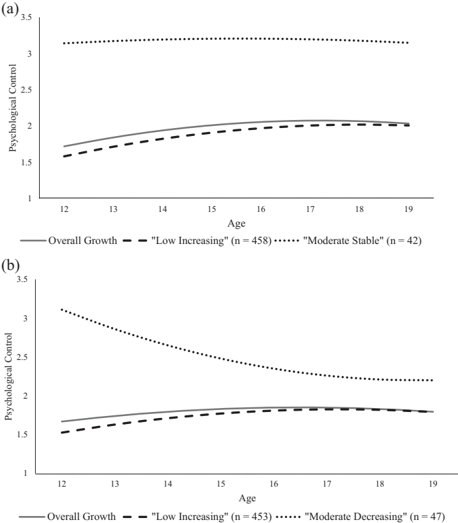
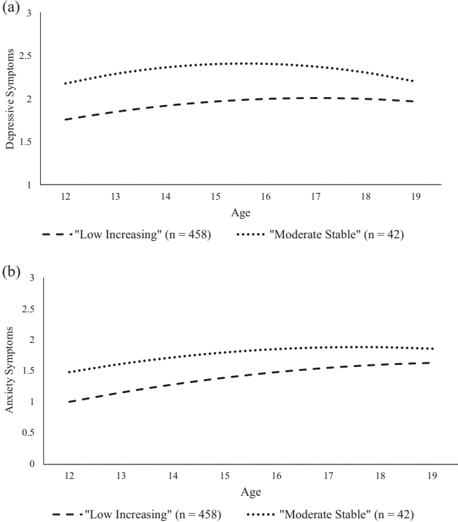
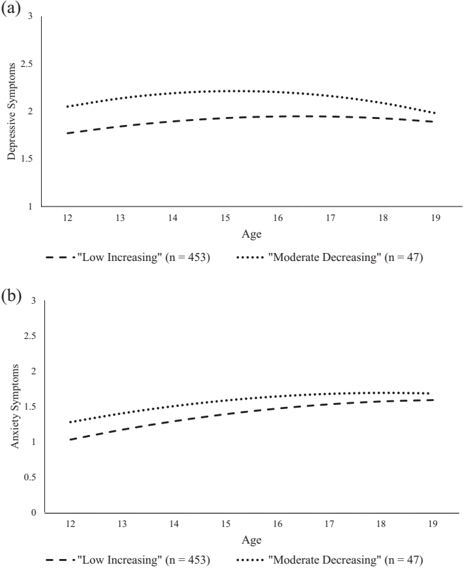
Theory and research indicate considerable changes in parental control across adolescence (e.g., declining behavioral control), but the developmental course and significance of psychological control remains largely unknown. This study examined trajectories of adolescents' reports of mothers' and fathers' psychological control from ages 12 to 19, predictors of occupying distinct trajectories, and the developmental significance of these trajectories for adolescents' development of depressive and anxiety symptoms. It used eight waves of survey data on 500 adolescents (M age = 11.83, SD = 1.03; 52% female; 67% White, 12% African American) and their parents from the Pacific Northwest United States. Most adolescents (about 90%) reported low but increasing levels of parental psychological control over time, with a small but significant subset (about 10%) perceiving perpetually elevated levels. Mothers' (but not fathers') depressive symptoms, reported at the age 12 assessment, predicted adolescents' membership in the elevated psychological control trajectory. Adolescents occupying these elevated trajectories showed more problematic growth in depressive and anxiety symptoms across adolescence. Taken together, the findings suggest that many adolescents experience increased parental psychological control as they age, and that variability in these trends indicates individual differences in their development of depressive and anxiety symptoms over time.
Overview
The claims and statistics of this paper haven’t been checked yet.
Free: it reads the open-access text and checks the first 5 claims that cite a source we can check. Create a free account to check every claim.
Integrity signals
Registry
Cites
Statistics
Figures
Verification
Claims the paper makes
The claims and statistics of this paper haven’t been checked yet.
Free: it reads the open-access text and checks the first 5 claims that cite a source we can check. Create a free account to check every claim.
Claims other papers make about this one
Each is checked against this paper’s own text: does it say what the citing paper says it does?
The cited source doesn’t support the claim as written.
In the citing paper
“The effect size for both maternal control (.34) and parental control (.06) were found to be small in relation to reported depression.”
From A Systematic Review of “Helicopter Parenting” and Its Relationship With Anxiety and Depression (2022) · cites this paper as Rogers et al. (2020)
Checked by a reasoning model — may be wrong.
Experimental — accuracy not yet measuredThe cited source doesn’t support the claim as written.
In the citing paper
“However, the effect size of maternal control (1.05) and parental control (0.8) were big in terms of reported adolescent anxiety.”
From A Systematic Review of “Helicopter Parenting” and Its Relationship With Anxiety and Depression (2022) · cites this paper as Rogers et al. (2020)
Checked by a reasoning model — may be wrong.
Experimental — accuracy not yet measuredThe cited source doesn’t support the claim as written.
In the citing paper
“Additionally, although the effect size for both maternal and parental control was found to be quite small regarding its effect on depression, it was much bigger in terms of adolescent anxiety.”
From A Systematic Review of “Helicopter Parenting” and Its Relationship With Anxiety and Depression (2022) · cites this paper as Rogers et al. (2020)
Checked by a reasoning model — may be wrong.
Experimental — accuracy not yet measuredThe source backs part of the claim, not all of it — or backs it for a different population, condition or comparison.
In the citing paper
“Thus, although the theoretical framework and structure are the same, ABFT for adolescent anxiety focuses on specific aspects of family interactions that contribute to childhood anxiety disorders, including parental beliefs about anxiety, overprotection and accommodation, and psychological control (56–59).”
From Combining attachment-based family therapy and cognitive behavioral therapy to improve outcomes for adolescents with anxiety (2023) · cites this paper as [58]
Experimental — accuracy not yet measuredThe source backs part of the claim, not all of it — or backs it for a different population, condition or comparison.
In the citing paper
“Three studies only used child self-report, thereby exposing their study to the risk of mono-method bias and response bias (Overbeek et al., 2007; Knappe et al., 2012; Rogers et al., 2020).”
From A Systematic Review of “Helicopter Parenting” and Its Relationship With Anxiety and Depression (2022) · cites this paper as Rogers et al., 2020
Experimental — accuracy not yet measured
9 more claims about this paper
Create a free account to see every claim other papers make about this one.
Self-check
Percentages, sums and reported differences re-computed from the paper’s own numbers.
The self-check needs the paper’s full text.
Citations
Cites
Information Theory and an Extension of the Maximum Likelihood Principle
Akaike, H. (1998) · Springer Series in Statistics · doi:10.1007/978-1-4612-1694-0_15 · Cited by 17,781
A test of missing completely at random for multivariate data with missing values
Little, R. J. A. (1988) · Journal of the American Statistical Association · doi:10.1080/01621459.1988.10478722 · Cited by 8,963 · cited 1×
“Little’s MCAR test (Little 1988) was, X2 (10,308)= 11,628.5, p 0.001, leading to the rejection of the null hypothesis that the missing values were missing completely at random.”
MethodInfluential(2010) · Cited by 7,034
(1996) · Institutional Research Information System University of Turin (University of Turin) · doi:10.1111/j · Cited by 5,486
Algebraic decay in hierarchical graphs
Garcia, A., Sonnino, G., Malek-Mansour, M.-A., & Baras, F. (1997) · doi:10.1023/a · Cited by 5,187
Deci, E. L., & Ryan, R. M. (2012) · Handbook of Theories of Social Psychology: Volume 1 · doi:10.4135/9781446249215.n21 · Cited by 3,161
Parental Psychological Control: Revisiting a Neglected Construct
Barber, B. K. (1996) · Child Development · doi:10.2307/1131780 · Cited by 2,629
Parental Psychological Control: Revisiting a Neglected Construct
Barber, B. K. (1996) · Child Development · doi:10.1111/j.1467-8624.1996.tb01915.x · Cited by 2,619
A measure of anxiety symptoms among children
Spence, S. H. (1998) · Behaviour Research and Therapy · doi:10.1016/s0005-7967(98)00034-5 · Cited by 1,928 · cited 1×
“From ages 14 to 19, adolescents completed the six item generalized anxiety disorder subscale from the Spence Child Anxiety Inventory (Spence 1998), for which construct validity has been established among adolescent populations in prior studies (e.g., Essau et al. 2002).”
MethodDishion, T. J., & McMahon, R. J. (1998) · Clinical Child and Family Psychology Review · doi:10.1023/a:1021800432380 · Cited by 1,333
Research works printed but not linked: 3
- Asparouhov, T., & Muthén, B. (2012). Using Mplus TECH11 and TECH14 to test the number of latent classes. Mplus Web Notes , 14 , 22.
- Muthén, L. K., & Muthén, B. O. (1998 -2018). Mplus user ' s guide . Seventh edition Los Angeles: Muthén & Muthén.
- Springer Journal of Youth & Adolescence is a copyright of Springer, 2020. All Rights Reserved.
Cited by
Rogers, A. A., Ha, T., & Ockey, S. (2021) · Journal of Adolescent Health · doi:10.1016/j.jadohealth.2020.09.039 · Cited by 349
“Adolescents spend more time with friends thanwith parents, and the parent-child relationship experiences tension around adolescents’ emerging independence [6,7].”
Self-citationA Systematic Review of “Helicopter Parenting” and Its Relationship With Anxiety and Depression
Vigdal, J. S., & Brønnick, K. K. (2022) · Frontiers in Psychology · doi:10.3389/fpsyg.2022.872981 · Cited by 174
The Mental Health Impacts of COVID-19 on PK–12 Students: A Systematic Review of Emerging Literature
Naff, D., Williams, S. E., Furman, J., & Yeung, M. (2022) · AERA Open · doi:10.1177/23328584221084722 · Cited by 106
Understanding the Associations between Helicopter Parenting and Emerging Adults’ Adjustment
Cook, E. C. (2020) · Journal of Child and Family Studies · doi:10.1007/s10826-020-01716-2 · Cited by 78
Huang, Y., Zhao, Q., & Li, C. (2021) · Acta Psychologica Sinica · doi:10.3724/sp.j.1041.2021.00515 · Cited by 67
Juan, C., Li, X., Ye, Z., Xie, M., & Lin, D. (2020) · Current Psychology · doi:10.1007/s12144-020-00980-1 · Cited by 52
Chen, H., Ng, J., & Pomerantz, E. M. (2021) · Journal of Youth and Adolescence · doi:10.1007/s10964-021-01474-4 · Cited by 42
Zhang, W., Yu, G., Fu, W., & Li, R. (2022) · International Journal of Environmental Research and Public Health · doi:10.3390/ijerph191811691 · Cited by 46
Zhou, J., Zhao, H., Wang, L., & Zhu, D. (2023) · Journal of Behavioral Addictions · doi:10.1556/2006.2023.00054 · Cited by 34
Xu, X., Dai, D. Y., Liu, M., & Deng, C. (2019) · British Journal of Developmental Psychology · doi:10.1111/bjdp.12308 · Cited by 34
Ingoglia, S., Liga, F., Coco, A. L., & Inguglia, C. (2021) · Journal of Applied Developmental Psychology · doi:10.1016/j.appdev.2021.101333 · Cited by 37
Shek, D. T. L., & Dou, D. (2020) · International Journal of Environmental Research and Public Health · doi:10.3390/ijerph17114083 · Cited by 36
“Parents may increasingly adjust psychological control when they perceive losing direct control of adolescent behavior [21].”
BackgroundInfluentialBasili, E., Zuffianò, A., Pastorelli, C., Thartori, E., Lunetti, C., Favini, A., Cirimele, F., Di Giunta, L., Gerbino, M., Bacchini, D., et al. (2021) · PLOS ONE · doi:10.1371/journal.pone.0251437 · Cited by 23
“[34] examined the developmental course of adolescents’ perceptions of mothers’ and fathers’ PC across an 8-year period spanning early to late adolescence (ages 12–19).”
BackgroundZheng, Y., Fang, Y., Jin, Y., Zuo, X., Lian, Q., Lou, C., Yu, C., Tu, X., Li, L., & Hong, P. (2022) · International Journal of Environmental Research and Public Health · doi:10.3390/ijerph19127497 · Cited by 28
“Behavioral control is linked with a series of positive outcomes, while psychological control is linked to negative outcomes, especially psychological problems, such as depression and anxiety [21].”
BackgroundZhu, Y., Wang, Q., Liu, J., & Huang, J. (2024) · Archives of Psychiatric Nursing · doi:10.1016/j.apnu.2024.05.002 · Cited by 27
Parenting, Peers and Psychosocial Adjustment: Are the Same—or Different—Children Affected by Each?
Sayler, K., Zhang, X., Steinberg, L. D., & Belsky, J. (2022) · Journal of Youth and Adolescence · doi:10.1007/s10964-022-01574-9 · Cited by 24
Rogers, A. A., Memmott‐Elison, M. K., Padilla‐Walker, L. M., & Byon, J. (2019) · Developmental Psychology · doi:10.1037/dev0000818 · Cited by 20
Self-citationZhou, J., Zheng, X., & Gong, X. (2025) · Journal of Youth and Adolescence · doi:10.1007/s10964-025-02187-8 · Cited by 19
“However, the developmental trajectory of psychological control remains less conclusive, with some studies documenting increases during adolescence (Rogers et al., 2020), and others reporting gradual declines (Desjardins & Leadbeater, 2017).”
InfluentialZhai, M., Gao, W., Feng, Y., Jian, J., & Xu, F. (2024) · Journal of Youth and Adolescence · doi:10.1007/s10964-024-02038-y · Cited by 25
“Anxiety aggregates in families, and previous studies have found a close association between parental control and children ’ s anxiety (Rogers et al., 2020; Creswell et al., 2020).”
The Mediation of Family Context and Youth Depressive Symptoms by Adolescent Emotion Regulation
LaMontagne, L. G., Diehl, D. C., Doty, J. L., & Smith, S. (2022) · Youth & Society · doi:10.1177/0044118x211067266 · Cited by 26
Leung, J. T. Y., & Shek, D. T. L. (2024) · Journal of Research on Adolescence · doi:10.1111/jora.12960 · Cited by 20
Zhou, H., Liu, J., & Deng, C. (2024) · Journal of Youth and Adolescence · doi:10.1007/s10964-024-01995-8 · Cited by 23
“…suggest that Western parents do not change their use of psychological control over adolescence (Baudat et al., 2020; Van Heel et al., 2019; but not Rogers et al., 2020), whereas Chinese parents tend to use psychological control more frequently after their children ’ s entry of adolescence (Fu &…”
InfluentialZhang, J., Lin, G., Cai, Q., Hu, Q., Xu, Y., Guo, Z., Hong, D., Huang, Y., Lv, Y., Chen, J., et al. (2022) · Frontiers in Psychiatry · doi:10.3389/fpsyt.2022.914055 · Cited by 18
“It further indicated that parental psychological control was closely related to adolescent depressive symptoms (51).”
BackgroundAl-Nuaim, A. A., & Safi, A. (2023) · International Journal of Environmental Research and Public Health · doi:10.3390/ijerph20105785 · Cited by 12
“During the period of adolescence, young people experience increasing independence from parental figures [12,13].”
BackgroundLi, S. D., Xia, Y., Xiong, R., Li, J., & Chen, Y. (2020) · International Journal of Environmental Research and Public Health · doi:10.3390/ijerph17103538 · Cited by 17
“Research has shown that coercive parents’ use of psychological control interferes with adolescents’ development of autonomy and independence, resulting in adolescent psychosocial maladjustment and academic difficulties [26,27].”
BackgroundHerres, J., Krauthamer Ewing, E. S., Levy, S., Creed, T. A., & Diamond, G. S. (2023) · Frontiers in Psychiatry · doi:10.3389/fpsyt.2023.1096291 · Cited by 11
Deng, C., Li, D., Li, Y., Liu, Y., Zhang, J., Huang, P. M., & Zhai, B. (2024) · Journal of Affective Disorders · doi:10.1016/j.jad.2024.06.088 · Cited by 17
Tong, Y., Xie, F., Wen, X., Li, Y., Yuan, M., Zhang, X., Chen, J., Wang, G., & Su, P. (2024) · Depression and Anxiety · doi:10.1155/2024/6671415 · Cited by 13
“Negative interactions — including poor parenting, abuse, bullying vic-timization, and aggression — reduce family satisfaction, which, in turn, is strongly associated with the development of depressive symptoms among adolescents [27].”
Basili, E., Zuffianò, A., Pastorelli, C., Thartori, E., Lunetti, C., Favini, A., Giunta, L. D., Bacchini, D., Gerbino, M., & Lansford, J. E. (2021) · Journal of Family Psychology · doi:10.1037/fam0000845 · Cited by 13
Zhou, Z., Li, M., Wu, J., & Li, X. (2021) · Frontiers in Psychology · doi:10.3389/fpsyg.2021.681940 · Cited by 12
“Accumulated empirical evidence showed that psychological control contributed to a higher level of adolescent depressive symptoms both directly and indirectly through decreased self-worth, self-esteem, and unsatisfied basic psychological needs (Garber et al., 1997; Plunkett et al., 2007; Cheah et al., 2019; Rogers et a…”
BackgroundLi, X., Su, S., Xiao, J., Yiru, Z., & Lin, D. (2021) · Applied Psychology Health and Well-Being · doi:10.1111/aphw.12270 · Cited by 11
Sznitman, G. A., Antonietti, J., Petegem, S. V., Schwartz, S. J., Baudat, S., & Zimmermann, G. (2022) · Developmental Psychology · doi:10.1037/dev0001367 · Cited by 18
“First, with regard to perceived parenting typologies, in line with previous findings (Rogers et al., 2020; Van Petegem et al., 2017) we expected to identify three trajectory classes: (1) Moderate Stable Autonomy Support/ Low Stable Psychological Control), (2) Low Decreasing Autonomy Support/…”
InfluentialZhao, H. M., Wan, L., Li, Y., Zhang, M., & Zhao, C. X. (2024) · Psychology Research and Behavior Management · doi:10.2147/prbm.s478008 · Cited by 15
“17 Behavioral control depends on parental guidance, supervision and setting rules regarding children’s behaviors, providing them with the guidance they need to develop not inhibiting their individualized development.”
Baudat, S., Petegem, S. V., Antonietti, J., Sznitman, G. A., & Zimmermann, G. (2020) · Journal of Youth and Adolescence · doi:10.1007/s10964-020-01281-3 · Cited by 13
“This variability has been confirmed in previous studies (Rogers et al. 2020; Van Petegem et al. 2017), which described distinct developmental trajectories of controlling parenting style.”
BackgroundResultInfluentialLiu, S., Wang, M., & Fu, C. (2021) · Children and Youth Services Review · doi:10.1016/j.childyouth.2021.106154 · Cited by 13
Alsancak-Akbulut, C., & Akik, B. K. (2024) · Current Psychology · doi:10.1007/s12144-024-06107-0 · Cited by 14
Xie, Z., Jin, G., Cheng, X., Liu, X., Feng, N., & Cui, L. (2024) · Current Psychology · doi:10.1007/s12144-024-07219-3 · Cited by 9
Lucarelli, L., Vismara, L., Chatoor, I., & Sechi, C. (2023) · Children · doi:10.3390/children10030565 · Cited by 9
Yang, J., & Yang, L. (2025) · Current Psychology · doi:10.1007/s12144-024-07276-8 · Cited by 11
“Additionally, previous research has indicated that gender, age, and socioeconomic status (SES) likely affect the study variables (Rogers et al., 2020; Werner et al., 2016; Yu, Wu, & Zhang, 2017 ).”
InfluentialCosta, S., Cannavò, M., Liga, F., Cuzzocrea, F., & Gugliandolo, M. C. (2025) · The Journal of Genetic Psychology · doi:10.1080/00221325.2025.2454321 · Cited by 8
“Indeed, various studies have shown greater anxious and depressive symptomatology occur in the presence of higher parental psychological control (Rogers et al., 2020; Soenens et al., 2012; Soenens & Vansteenkiste, 2010).”
Lu, F., Wen, M., Niu, W., Wu, X., & Zhang, C. (2025) · Acta Psychologica · doi:10.1016/j.actpsy.2025.105348 · Cited by 13
Bennett, M. L., McClure, A., Khalesi, H., Vu, M. T. N., Feng, J., Reupert, A., & Yap, M. B. H. (2025) · Journal of Affective Disorders · doi:10.1016/j.jad.2025.120085 · Cited by 13
Luo, Y., Li, R., Yang, Z., Luo, R., Yu, H., Chen, F., & Wang, Y. (2025) · Journal of Youth and Adolescence · doi:10.1007/s10964-025-02272-y · Cited by 14
Song, G., & Smetana, J. G. (2024) · Journal of Youth and Adolescence · doi:10.1007/s10964-024-02050-2 · Cited by 11
“Psychological control has been associated with internalizing (Rogers et al., 2020) and externalizing behavior (Barber et al., 2012), as well as aggression and involvement with deviant peers (Yu et al., 2021).”
Li, L., Ma, X., Liu, X., Yao, Z., Feng, L., & Huang, L. J. (2024) · Current Psychology · doi:10.1007/s12144-024-05770-7 · Cited by 6
“…excessive support and controlling their child’s behavior to the extent that they do not allow their child to exercise autonomy appropriate to their age (Kwon et al., 2016, 2017; Nelson et al., 2011; Rogers et al., 2020 ; Padilla-Walker & Nelson, 2012; Willoughby et al., 2015 ; Xia & Kong, 2021).”
Klettner, A. M., Luo, S., White, T. D., Elkin, T. B., Hersey, G. C., & Wu, H. (2023) · Psychological Reports · doi:10.1177/00332941231203576 · Cited by 9
“…self-esteem, emotion dysregulation, and both internalizing and externalizing issues (Barber et al., 1994; Barber & Harmon, 2002; Cui et al., 2014; Rogers et al., 2020; Rogers et al., 2020, 2020; Rudy & Halgunseth, 2005; Soenens & Duriez, 2008; Young et al., 2011; Nigela et al., 2015; Young et…”
Xiao, H., Wu, Y., Chen, Z., & Nie, Y. (2024) · Children and Youth Services Review · doi:10.1016/j.childyouth.2024.107779 · Cited by 10
Dizon, L. C. T., & Alampay, L. P. (2024) · International Journal of Behavioral Development · doi:10.1177/01650254241233532 · Cited by 10
Song, S., Xu, N., Yuan, B., & Li, C. (2025) · Journal of Youth and Adolescence · doi:10.1007/s10964-025-02210-y · Cited by 8
“Prior research has demonstrated good reliability and construct validity of this scale (Rogers et al., 2020).”
Guerra, G. C., Paone, A., Lionetti, F., Spinelli, M., Fasolo, M., & D’Urso, G. (2024) · Children · doi:10.3390/children11020259 · Cited by 9
“Parental control that leans towards dependence Additionally, considering the autonomy development process, adolescents strive to establish a sense of independence and identity. may impede this process, leading to internal conflicts and emotional distress [6,21].”
BackgroundFatemi, M., Bakhtiarpour, S., & Hafezi, F. (2024) · Journal of Psychologists and Counsellors in Schools · doi:10.1177/20556365241239130 · Cited by 10
“…problems, such as anxiety and depression, in children and adolescents (Azadian Bojnordi et al., 2019; Bleys et al., 2018; Costa et al., 2019; León-del-Barco et al., 2019; Nanda et al., 2012; Norouzi et al., 2022; Rogers et al., 2020; Soenens et al., 2012; Soroush, 2021; Yosefi et al., 2022).”
BackgroundLiu, H., Fu, L., Liang, X., Zhang, J., Zhang, L., Zhai, Y., & Zhao, J. (2025) · BMC Psychology · doi:10.1186/s40359-025-02945-0 · Cited by 8
“A higher degree of parental psychological control is associated with increased severity of depressive symptomatology among junior middle school students, aligning with previous research [2, 4, 27].”
Percepción de prácticas parentales y\n\t\t\t\t ansiedad en adolescentes mexicanos
González-Fuentes, M. B., & Andrade-Palos, P. (2021) · LA Referencia (Red Federada de Repositorios Institucionales de Publicaciones Científicas) · Cited by 4
Rodríguez‐Menéndez, C., Inda, M., García, C. M. F., & García, L. M. (2021) · Acta Colombiana de Psicología · doi:10.14718/acp.2021.24.1.10 · Cited by 8
“, 2003; 2020), particularly on depressive symptoms (Ahmad & Soenens, 2010; Barber 1996, Barber et al., 2005; Rogers et al., 2020; Romm et al., 2020; Rudy et al., 2008), low academic perfomance (Lu et al.”
BackgroundSuicidal ideation and psychological control in emerging adults: The role of trait EI
Barberis, N., Verrastro, V., Papa, F., & Quattropani, M. C. A. (2020) · MALTRATTAMENTO E ABUSO ALL INFANZIA · doi:10.3280/mal2020-002002 · Cited by 6
Zhu, X., Zong, W., Luo, X., Cui, L., & Zhou, K. (2026) · The Journal of Early Adolescence · doi:10.1177/02724316261442207 · Cited by 3
Bouffard, T., Marquis-Trudeau, A., Bonneville‐Roussy, A., Vezeau, C., & Pansu, P. (2023) · Frontiers in Education · doi:10.3389/feduc.2023.1036577 · Cited by 6
“As research showed that a majority of young people perceived weak parental psychological control throughout adolescence (Roth et al., 2009; Assor and Tal, 2012; Rogers et al., 2020; Steffgen et al., 2022), this trajectory should include most of the students.”
BackgroundResultSu, S., Yao, C., Yang, K., Zhu, X., Wang, X., Shang, X., & Gao, S. (2024) · Journal of Psychosocial Nursing and Mental Health Services · doi:10.3928/02793695-20231215-01 · Cited by 2
Yang, J. (2024) · Journal of Adolescence · doi:10.1002/jad.12337 · Cited by 3
Cyberbullying and Cybervictimization: The Role of Parental Psychological Control and Dark Triad
Calaresi, D., Verrastro, V., Giordano, F., & Saladino, V. (2025) · Social Sciences · doi:10.3390/socsci14060370 · Cited by 3
“When youths experience heightened degrees of parental psychological control, it can lead to adverse psychological consequences, including heightened anxiety and depression (Rogers et al. 2020).”
Ling, T. (2025) · Journal of Happiness Studies · doi:10.1007/s10902-025-00945-w · Cited by 2
“During the developmental course, students tend to need more responsibility and independence from their parents (Rogers et al., 2020), while it is not easy for parents to provide high autonomy support to their children (Duineveld et al., 2017).”
Yu, M., Mao, M., Tang, C., & Xing, S. (2025) · Journal of Youth and Adolescence · doi:10.1007/s10964-025-02242-4 · Cited by 3
“…the trajectories of adolescent-perceived parental psychological control and depressive symptoms during adolescence, indicating that adolescents exposed to higher levels of parental psychological control would exhibit more growth in depressive symptoms throughout adolescence (Rogers et al., 2020).”
Xu, J., Dai, S., Jiang, S., & Xu, H. (2025) · Frontiers in Psychology · doi:10.3389/fpsyg.2025.1664970 · Cited by 8
“Adolescents who experience high levels of PPC often exhibit increased symptoms of depression and anxiety (Rogers et al., 2020).”
Yang, C., Tang, M., Li, W., Zhao, Y., Li, X., Huang, Z., & Li, J. (2025) · Death Studies · doi:10.1080/07481187.2025.2598313 · Cited by 2
Ren, L., Bi Ying, H. U., Chen, M., & Chen, Y. (2025) · Early Education and Development · doi:10.1080/10409289.2025.2602143 · Cited by 3
“For instance, Rogers et al. (2020) showed an overall increase in parental psychological control throughout adolescence.”
Jamil, B., Su, J., Elam, K. K., Lemery‐Chalfant, K., Cruz, R. A., Grimm, K. J., & Seaton, E. K. (2025) · Development and Psychopathology · doi:10.1017/s0954579425101028 · Cited by 4
“Whereas high amounts of family conflict within the home increase risk for the development of depressive symptoms across Black, Latinx, and White youth (Choe et al., 2014; Cohen et al., 2015; Montoro & Ceballo, 2021; Rogers et al., 2020).”
Zhu, Y., Xue, A., Wang, Z., Wang, Q., & Luo, X. (2026) · BMC Public Health · doi:10.1186/s12889-025-26049-x · Cited by 2
“Complementarily, Rogers and colleagues [88] found that adolescents exposed to parental over-protection, excessive control, or intrusiveness were more prone to depression and anxiety, further corroborating our result.”
Wei, Y., & Mei, R. (2026) · Frontiers in Psychology · doi:10.3389/fpsyg.2026.1728108 · Cited by 3
Guo, Z., & Zhang, H. (2026) · Addictive Behaviors · doi:10.1016/j.addbeh.2026.108637 · Cited by 2
Fite, P. J., Griffith, R., Tampke, E. C., Hesse, D. R., & Barnhart, E. L. (2022) · Journal of Child and Family Studies · doi:10.1007/s10826-021-02192-y · Cited by 2
Cuzzocrea, F., Costa, S., Cannavò, M., & Gugliandolo, M. C. (2020) · MALTRATTAMENTO E ABUSO ALL INFANZIA · doi:10.3280/mal2020-002004 · Cited by 4
Parenting in a Rainbow Nation: A South African Perspective on Parenting
Roman, N. V., & Benjamin, F. (2022) · Science across cultures · doi:10.1007/978-3-031-15359-4_2 · Cited by 2
Karababa, A. (2024) · Families in Society The Journal of Contemporary Social Services · doi:10.1177/10443894231217764 · Cited by 3
“On the contrary, evidence has indicated that parents tend to be more punitive and psychologically controlling or less supportive of their children over time (Brand & Klimes-Dougan, 2010; Rogers et al., 2020; Soenens et al., 2008).”
Stanić, L. (2024) · Psihologijske teme · doi:10.31820/pt.33.2.1 · Cited by 1
Intrusive Parenting and Adolescent Information Management
Padilla‐Walker, L. M., Jankovich, M. O., & Archibald, C. (2024) · Cambridge University Press eBooks · doi:10.1017/9781009418652.009 · Cited by 1
Self-citationWu, W., Li, J., & Zhang, Y. (2025) · Children and Youth Services Review · doi:10.1016/j.childyouth.2025.108414 · Cited by 3
Li, S., Chen, J., Xiong, Y., Ying, Y., & Ren, P. (2025) · Journal of Research on Adolescence · doi:10.1111/jora.70053 · Cited by 1
Jie, S. (2025) · Frontiers in Psychology · doi:10.3389/fpsyg.2025.1669771 · Cited by 1
Review of Parental Psychological Control Research: Antecedent Variable Analysis
张, 怡. (2022) · Advances in Psychology · doi:10.12677/ap.2022.127287 · Cited by 2
Familial pot boiler: Pressures from inside and outside and parental psychological control
Goldner, L., Scharf, M., & Scharf, N. (2024) · Applied Developmental Science · doi:10.1080/10888691.2024.2359702 · Cited by 2
“…functioning are hampered (Barber, 1996, 2002; Barber & Harmon, 2002; Soenens & Vansteenkiste, 2010), which can further result in internalizing and externalizing problems, anxiety and depression, low self-esteem, and social problems (for a review, see Scharf & Goldner, 2018; Rogers et al., 2020).”
Nizamettinoglu, N., Öztürk, C. Ş., Kuzucu, Y., Şakiroğlu, M., & Dereboy, Ç. (2021) · Journal of Clinical Psychiatry · doi:10.5505/kpd.2020.46548 · Cited by 1
Improving understanding of adolescents' perceptions of their relationships with their parents.
McKenna, S. (2021) · ANU Open Research (Australian National University) · doi:10.25911/xa4q-tc64 · Cited by 3
Bai, S., & Chiang, S. (2023) · Elsevier eBooks · doi:10.1016/b978-0-323-91497-0.00114-4 · Cited by 4
The Delayed Effect of Parental Control on the Adaptation of Men and Women in Adulthood
Yakymchuk, B. A., Yakymchuk, I. P., Vakhotska, I. O., Лівандовська, І., & Hychko, Y. V. (2021) · Journal of Intellectual Disability - Diagnosis and Treatment · doi:10.6000/2292-2598.2021.09.03.5
Zhu, J. (2023) · Lecture Notes in Education Psychology and Public Media · doi:10.54254/2753-7048/13/20230841
Batra, A. (2023) · The Research Repository @ WVU (West Virginia University) · doi:10.33915/etd.12213
Shadabmehr, F., Esmaeily, M., Na’imi, E., & Mirsaleh, Y. R. (2024) · doi:10.61838/kman.jayps.5.4.7
Ma, J., Chen, L., Gao, X., Li, Y., & Xing, S. (2024) · Research Square · doi:10.21203/rs.3.rs-4495061/v1
Park, E., & Kang, M. J. (2024) · Korean Journal of Child Studies · doi:10.5723/kjcs.2024.45.3.173
Empathy, emotional expression and peer relationship among Chinese college students
Xiao, H. (2024) · International Journal of Research Studies in Psychology · doi:10.5861/ijrsp.2024.039
Reconsidering Parenting and Parental Knowledge
Smetana, J. G., Campione-Barr, N., & Tilton-Weaver, L. C. (2024) · Cambridge University Press eBooks · doi:10.1017/9781009418652.007
Vargas, J. J. T., Fonseca-Beltrán, L., Romero-Acosta, K., Tous, I. L., Uparela, L. C., Doria-Dávila, D., & Arrieta, G. J. (2025) · Revista sobre la infancia y la adolescencia · doi:10.4995/reinad.2025.20847
Liu, G., Liu, H., Wang, M., Jinglan, J., Li, D., & Zhang, R. (2025) · Clinical Psychologist · doi:10.1080/13284207.2025.2588194
Parental empathy and behavior: A study on discipline, punishment, and psychological control
Nguyen, H. T., Ly, H. T. M., Tran, T. L., Nguyen, H. T., & Nguyen, H.-D. (2026) · International Journal of ADVANCED AND APPLIED SCIENCES · doi:10.21833/ijaas.2026.01.007
Chen, H., & Zeng, Z. (2026) · Personality and Individual Differences · doi:10.1016/j.paid.2026.113686
Wang, D., Hou, Q., Li, J., & Zhang, C. (2026) · BMC Psychology · doi:10.1186/s40359-026-04278-y
“This result is consistent with the conclusion drawn by Rogers et al., [59] from their 4-wave tracking.”
Zhu, C., Ren, S., Li, J., Tong, X., Liu, X., & Zhang, D. (2026) · BMC Psychology · doi:10.1186/s40359-026-04583-6
“This finding differs from some studies reporting persistent direct effects [49, 55].”
Chen, X., & Hou, J. (2026) · Journal of Adolescence · doi:10.1002/jad.70224
Zhao, Y., Wang, Z., Li, S., & Cui, L. (2026) · Journal of Youth and Adolescence · doi:10.1007/s10964-026-02395-w
“…from longitudinal research indicates that middle adolescence is characterized by a sharp decline in parental behavioral control (Keijsers & Poulin, 2013), a concurrent rapid increase in psychological control (Rogers et al., 2020), and a peak in adolescents’ need for autonomy (Beyers et al., 2025).”
Metadata
- Authors
- Rogers, A. A., Padilla-Walker, L. M., McLean, R. D., & Hurst, J. L.
- Affiliations
- Brigham Young University (US)
- Corresponding author
- Rogers, Adam A.
- Venue
- Journal of Youth and Adolescence
- Published
- 2019-07-04
- Volume
- 49
- Issue
- 1
- Pages
- 136-149
- ISSN
- 0047-2891 (ISSN-L)
- 1573-6601
- OpenAlex
- W2954380608
- Semantic Scholar
- 9fe9ed2cc400c2f5e31fae2d023be6710185e29b
- Cited by
- 105
- References
- 39
- Citations by year
- 2026: 15 · 2025: 20 · 2024: 27 · 2023: 9 · 2022: 11 · 2021: 13 · 2020: 8 · 2019: 2
- FWCI
- 9.93
- Type
- journal article
- Language
- en
- Open access
- closed
- Licence
- www.springer.com/tdm (tdm)
- www.springer.com/tdm (vor)
- Locations
- Journal of Youth and Adolescence (publishedVersion)
- PubMed (publishedVersion)
- ScholarsArchive (Brigham Young University) (submittedVersion)
- Topics
- Social Sciences › Psychology › Clinical Psychology › Child and Adolescent Psychosocial and Emotional Development
- Social Sciences › Psychology › Developmental and Educational Psychology › Psychosocial Factors Impacting Youth
- Social Sciences › Psychology › Social Psychology › Attachment and Relationship Dynamics
- Keywords
- parental psychological control, adolescent development, depressive symptoms, anxiety symptoms, developmental trajectories, mothers, fathers, individual differences, adolescent mental health, parent-adolescent relationships
- MeSH terms
- Adolescent, Adolescent Behavior, Adult, Anxiety, Depression, Female, Humans, Male, Parent-Child Relations, Parents, Northwestern United States, Parenting, Adolescent Development, Young Adult
About these checks
Registry, retraction, Cites and statistics results are computed, not judged, with one exception: a printed reference that no index lists is read once by a model before it counts as a citation error. Claims are extracted by a model and kept only when their quote appears verbatim in the text; each cited source is then checked, with a model’s help, for whether it says what the claim relies on. Those verdicts can be wrong — read the claim’s quote and the cited source before relying on one.
Statistics and arithmetic are recomputed, not judged.
Confidence bands are shown only for fields calibrated on our annotated test set. None is calibrated yet, so no band is shown.
What counts as a claim ›How we measure confidence ›How we check this ›
Are you an author, or do you see a problem with this page? Request a review
Data sources
Bibliographic data: Semantic Scholar, OpenAlex, Crossref.
Contains information from the Semantic Scholar Academic Graph Datasets, made available under the ODC Attribution License (ODC-BY 1.0).
Semantic Scholar’s data is described in: Kinney, R., et al. (2023). The Semantic Scholar Open Data Platform. arXiv:2301.10140.
