

Trajectories of Perceived Parental Psychological Control across Adolescence and Implications for the Development of Depressive and Anxiety Symptoms
The DOI matches its Crossref record; 40 of the 42 references it cites were found in a registry or an index, and 2 are not checked yet.
Abstract
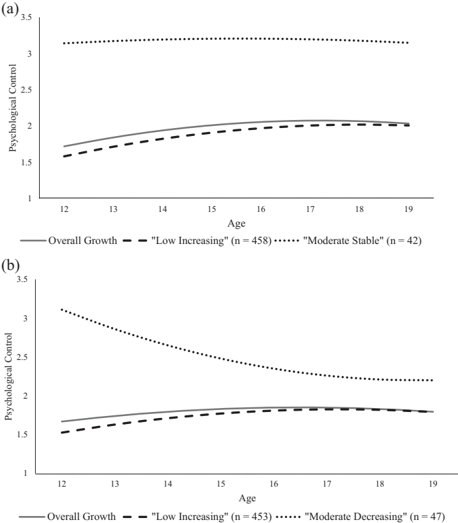
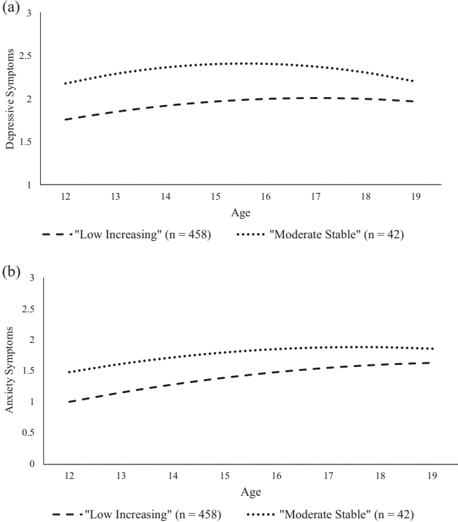
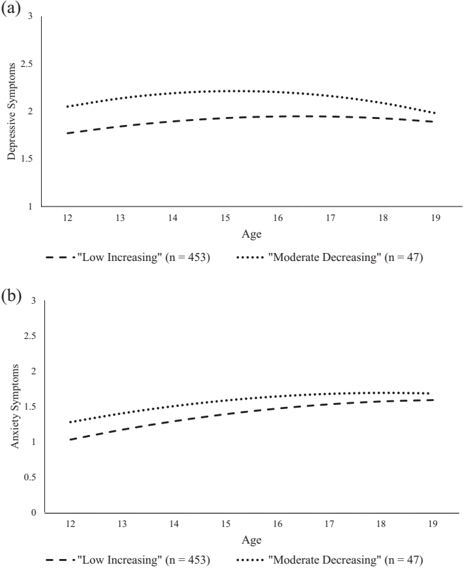
Theory and research indicate considerable changes in parental control across adolescence (e.g., declining behavioral control), but the developmental course and significance of psychological control remains largely unknown. This study examined trajectories of adolescents' reports of mothers' and fathers' psychological control from ages 12 to 19, predictors of occupying distinct trajectories, and the developmental significance of these trajectories for adolescents' development of depressive and anxiety symptoms. It used eight waves of survey data on 500 adolescents (M age = 11.83, SD = 1.03; 52% female; 67% White, 12% African American) and their parents from the Pacific Northwest United States. Most adolescents (about 90%) reported low but increasing levels of parental psychological control over time, with a small but significant subset (about 10%) perceiving perpetually elevated levels. Mothers' (but not fathers') depressive symptoms, reported at the age 12 assessment, predicted adolescents' membership in the elevated psychological control trajectory. Adolescents occupying these elevated trajectories showed more problematic growth in depressive and anxiety symptoms across adolescence. Taken together, the findings suggest that many adolescents experience increased parental psychological control as they age, and that variability in these trends indicates individual differences in their development of depressive and anxiety symptoms over time.
Overview
The claims and statistics of this paper haven’t been checked yet.
Free: it reads the open-access text and checks the first 5 claims that cite a source we can check. Create a free account to check every claim.
Integrity signals
Registry
Cites
Statistics
Figures
Verification
Claims the paper makes
The claims and statistics of this paper haven’t been checked yet.
Free: it reads the open-access text and checks the first 5 claims that cite a source we can check. Create a free account to check every claim.
Claims other papers make about this one
Each is checked against this paper’s own text: does it say what the citing paper says it does?
The cited source doesn’t support the claim as written.
In the citing paper
“The effect size for both maternal control (.34) and parental control (.06) were found to be small in relation to reported depression.”
From A Systematic Review of “Helicopter Parenting” and Its Relationship With Anxiety and Depression (2022) · cites this paper as Rogers et al. (2020)
Checked by a reasoning model — may be wrong.
Experimental — accuracy not yet measuredThe cited source doesn’t support the claim as written.
In the citing paper
“However, the effect size of maternal control (1.05) and parental control (0.8) were big in terms of reported adolescent anxiety.”
From A Systematic Review of “Helicopter Parenting” and Its Relationship With Anxiety and Depression (2022) · cites this paper as Rogers et al. (2020)
Checked by a reasoning model — may be wrong.
Experimental — accuracy not yet measuredThe cited source doesn’t support the claim as written.
In the citing paper
“Additionally, although the effect size for both maternal and parental control was found to be quite small regarding its effect on depression, it was much bigger in terms of adolescent anxiety.”
From A Systematic Review of “Helicopter Parenting” and Its Relationship With Anxiety and Depression (2022) · cites this paper as Rogers et al. (2020)
Checked by a reasoning model — may be wrong.
Experimental — accuracy not yet measuredThe source backs part of the claim, not all of it — or backs it for a different population, condition or comparison.
In the citing paper
“Thus, although the theoretical framework and structure are the same, ABFT for adolescent anxiety focuses on specific aspects of family interactions that contribute to childhood anxiety disorders, including parental beliefs about anxiety, overprotection and accommodation, and psychological control (56–59).”
From Combining attachment-based family therapy and cognitive behavioral therapy to improve outcomes for adolescents with anxiety (2023) · cites this paper as [58]
Experimental — accuracy not yet measuredThe source backs part of the claim, not all of it — or backs it for a different population, condition or comparison.
In the citing paper
“Three studies only used child self-report, thereby exposing their study to the risk of mono-method bias and response bias (Overbeek et al., 2007; Knappe et al., 2012; Rogers et al., 2020).”
From A Systematic Review of “Helicopter Parenting” and Its Relationship With Anxiety and Depression (2022) · cites this paper as Rogers et al., 2020
Experimental — accuracy not yet measured
9 more claims about this paper
Create a free account to see every claim other papers make about this one.
Self-check
Percentages, sums and reported differences re-computed from the paper’s own numbers.
The self-check needs the paper’s full text.
Citations
Cites
Information Theory and an Extension of the Maximum Likelihood Principle
Akaike, H. (1998) · Springer Series in Statistics · doi:10.1007/978-1-4612-1694-0_15 · Cited by 17,781
A test of missing completely at random for multivariate data with missing values
Little, R. J. A. (1988) · Journal of the American Statistical Association · doi:10.1080/01621459.1988.10478722 · Cited by 8,963 · cited 1×
“Little’s MCAR test (Little 1988) was, X2 (10,308)= 11,628.5, p 0.001, leading to the rejection of the null hypothesis that the missing values were missing completely at random.”
MethodInfluential(2010) · Cited by 7,034
(1996) · Institutional Research Information System University of Turin (University of Turin) · doi:10.1111/j · Cited by 5,486
Algebraic decay in hierarchical graphs
Garcia, A., Sonnino, G., Malek-Mansour, M.-A., & Baras, F. (1997) · doi:10.1023/a · Cited by 5,187
Deci, E. L., & Ryan, R. M. (2012) · Handbook of Theories of Social Psychology: Volume 1 · doi:10.4135/9781446249215.n21 · Cited by 3,161
Parental Psychological Control: Revisiting a Neglected Construct
Barber, B. K. (1996) · Child Development · doi:10.2307/1131780 · Cited by 2,629
Parental Psychological Control: Revisiting a Neglected Construct
Barber, B. K. (1996) · Child Development · doi:10.1111/j.1467-8624.1996.tb01915.x · Cited by 2,619
A measure of anxiety symptoms among children
Spence, S. H. (1998) · Behaviour Research and Therapy · doi:10.1016/s0005-7967(98)00034-5 · Cited by 1,928 · cited 1×
“From ages 14 to 19, adolescents completed the six item generalized anxiety disorder subscale from the Spence Child Anxiety Inventory (Spence 1998), for which construct validity has been established among adolescent populations in prior studies (e.g., Essau et al. 2002).”
MethodDishion, T. J., & McMahon, R. J. (1998) · Clinical Child and Family Psychology Review · doi:10.1023/a:1021800432380 · Cited by 1,333
Likelihood of a model and information criteria
Akaike, H. (1981) · Journal of Econometrics · doi:10.1016/0304-4076(81)90071-3 · Cited by 1,274 · cited 1×
“The best-fitting model among these was retained, using the Akaike Information Criterion (AIC; Akaike 1973) and Bayesian Information Criterion (BIC; Akaike 1981) as indicators of model fit.”
MethodSoenens, B., & Vansteenkiste, M. (2010) · Developmental Review · doi:10.1016/j.dr.2009.11.001 · Cited by 1,161
Barber (2005) · doi:10.1111/j.1540-5834.2005.00365.x · Cited by 1,063
Pettit, G. S., Laird, R. D., Dodge, K. A., Bates, J. E., & Criss, M. M. (2001) · Child Development · doi:10.1111/1467-8624.00298 · Cited by 930
WEISSMAN, M. M., ORVASCHEL, H., & PADIAN, N. (1980) · The Journal of Nervous and Mental Disease · doi:10.1097/00005053-198012000-00005 · Cited by 890
Adams, N., Little, T. D., & Ryan, R. M. (2017) · Development of Self-Determination Through the Life-Course · doi:10.1007/978-94-024-1042-6_4 · Cited by 886
Wang, Q., Pomerantz, E. M., & Chen, H. (2007) · Child Development · doi:10.1111/j.1467-8624.2007.01085.x · Cited by 769
Growth modeling structural equation and multilevel modeling approaches
Grimm, K. J., Ram, N., & Estabrook, R. (2017) · Cited by 706
Mark Cummings, E., Keller, P. S., & Davies, P. T. (2005) · Journal of Child Psychology and Psychiatry · doi:10.1111/j.1469-7610.2004.00368.x · Cited by 564
Disclosure and Secrecy in Adolescent–Parent Relationships
Smetana, J. G., Metzger, A., Gettman, D. C., & Campione-Barr, N. (2006) · Child Development · doi:10.1111/j.1467-8624.2006.00865.x · Cited by 529
Developmental changes in parent–child communication throughout adolescence
Keijsers, L., & Poulin, F. (2013) · Developmental Psychology · doi:10.1037/a0032217 · Cited by 301
Yap, M. B. H., Allen, N. B., & Ladouceur, C. D. (2008) · Child Development · doi:10.1111/j.1467-8624.2008.01196.x · Cited by 269
Stockings, E., Degenhardt, L., Lee, Y. Y., Mihalopoulos, C., Liu, A., Hobbs, M., & Patton, G. (2015) · Journal of Affective Disorders · doi:10.1016/j.jad.2014.11.061 · Cited by 267
Parental psychological control and dimensions of identity formation in emerging adulthood.
Luyckx, K., Soenens, B., Vansteenkiste, M., Goossens, L., & Berzonsky, M. D. (2007) · Journal of Family Psychology · doi:10.1037/0893-3200.21.3.546 · Cited by 256
Van Lissa, C. J., Keizer, R., Van Lier, P. A. C., Meeus, W. H. J., & Branje, S. (2019) · Developmental Psychology · doi:10.1037/dev0000612 · Cited by 247
Soenens, B., Vansteenkiste, M., & Beyers, W. (2019) · Routledge eBooks · doi:10.4324/9780429440847-4 · Cited by 218
Essau, C. A., Muris, P., & Ederer, E. M. (2002) · Journal of Behavior Therapy and Experimental Psychiatry · doi:10.1016/s0005-7916(02)00005-8 · Cited by 216
De Los Reyes, A., Goodman, K. L., Kliewer, W., & Reid-Quiñones, K. (2010) · Journal of Youth and Adolescence · doi:10.1007/s10964-009-9496-7 · Cited by 212
Center for Epidemiological Studies Depression Scale
Radloff, L. S. (1977) · PsycTESTS Dataset · doi:10.1037/t02942-000 · Cited by 142 · cited 1×
“When their adolescents were 12 years old, parents also completed a shortened version of the Center for Epidemiologic Studies—Depression scale (CESD; Radloff 1977).”
MethodSoenens, B., Luyckx, K., Vansteenkiste, M., Duriez, B., & Goossens, L. (2008) · Merrill-Palmer Quarterly · doi:10.1353/mpq.0.0005 · Cited by 140
Steeger, C. M., & Gondoli, D. M. (2013) · Developmental Psychology · doi:10.1037/a0028599 · Cited by 133
King, K. M., Littlefield, A. K., McCabe, C. J., Mills, K. L., Flournoy, J., & Chassin, L. (2018) · Developmental Cognitive Neuroscience · doi:10.1016/j.dcn.2017.11.009 · Cited by 111
Dietvorst, E., Hiemstra, M., Hillegers, M. H. J., & Keijsers, L. (2018) · Child Development · doi:10.1111/cdev.13002 · Cited by 102
Makol, B. A., Reyes, A. D. L., Ostrander, R. S., & Reynolds, E. K. (2019) · Research on Child and Adolescent Psychopathology · doi:10.1007/s10802-019-00540-7 · Cited by 95
Keijsers, L., Voelkle, M. C., Maciejewski, D., Branje, S., Koot, H., Hiemstra, M., & Meeus, W. (2016) · Developmental Psychology · doi:10.1037/dev0000220 · Cited by 86
Desjardins, T., & Leadbeater, B. J. R. (2016) · Emerging Adulthood · doi:10.1177/2167696816666974 · Cited by 74
Taraban, L., Shaw, D. S., Leve, L. D., Wilson, M. N., Dishion, T. J., Natsuaki, M. N., Neiderhiser, J. M., & Reiss, D. (2017) · Developmental Psychology · doi:10.1037/dev0000261 · Cited by 70
Werner, L., der Graaff, J. V., Meeus, W., & Branje, S. (2015) · Research on Child and Adolescent Psychopathology · doi:10.1007/s10802-015-0106-8 · Cited by 59
Relations between Parent Psychological Control and Parent and Adolescent Social Aggression
Meter, D. J., Ehrenreich, S. E., & Underwood, M. K. (2018) · Journal of Child and Family Studies · doi:10.1007/s10826-018-1240-z · Cited by 24
Externalizing Problem Behavior in Adolescence: Parenting Interacting With DAT1 and DRD4 Genes
Janssens, A., Noortgate, W. V. D., Goossens, L., Colpin, H., Verschueren, K., Claes, S. J., & Leeuwen, K. G. V. (2016) · Journal of Research on Adolescence · doi:10.1111/jora.12271 · Cited by 21
Rogers, A. A., Memmott‐Elison, M. K., Padilla‐Walker, L. M., & Byon, J. (2019) · Developmental Psychology · doi:10.1037/dev0000818 · Cited by 20
Self-citationV. ASSESSING RELEVANCE ACROSS CULTURE: CROSS-NATIONAL REPLICATIONS
(2005) · Monographs of the Society for Research in Child Development · doi:10.1111/j.1540-5834.2005.00369.x · Cited by 20
Research works printed but not linked: 3
- Asparouhov, T., & Muthén, B. (2012). Using Mplus TECH11 and TECH14 to test the number of latent classes. Mplus Web Notes , 14 , 22.
- Muthén, L. K., & Muthén, B. O. (1998 -2018). Mplus user ' s guide . Seventh edition Los Angeles: Muthén & Muthén.
- Springer Journal of Youth & Adolescence is a copyright of Springer, 2020. All Rights Reserved.
Cited by
Rogers, A. A., Ha, T., & Ockey, S. (2021) · Journal of Adolescent Health · doi:10.1016/j.jadohealth.2020.09.039 · Cited by 349
“Adolescents spend more time with friends thanwith parents, and the parent-child relationship experiences tension around adolescents’ emerging independence [6,7].”
Self-citationA Systematic Review of “Helicopter Parenting” and Its Relationship With Anxiety and Depression
Vigdal, J. S., & Brønnick, K. K. (2022) · Frontiers in Psychology · doi:10.3389/fpsyg.2022.872981 · Cited by 174
The Mental Health Impacts of COVID-19 on PK–12 Students: A Systematic Review of Emerging Literature
Naff, D., Williams, S. E., Furman, J., & Yeung, M. (2022) · AERA Open · doi:10.1177/23328584221084722 · Cited by 106
Understanding the Associations between Helicopter Parenting and Emerging Adults’ Adjustment
Cook, E. C. (2020) · Journal of Child and Family Studies · doi:10.1007/s10826-020-01716-2 · Cited by 78
Huang, Y., Zhao, Q., & Li, C. (2021) · Acta Psychologica Sinica · doi:10.3724/sp.j.1041.2021.00515 · Cited by 67
Metadata
- Authors
- Rogers, A. A., Padilla-Walker, L. M., McLean, R. D., & Hurst, J. L.
- Affiliations
- Brigham Young University (US)
- Corresponding author
- Rogers, Adam A.
- Venue
- Journal of Youth and Adolescence
- Published
- 2019-07-04
- Volume
- 49
- Issue
- 1
- Pages
- 136-149
- ISSN
- 0047-2891 (ISSN-L)
- 1573-6601
- OpenAlex
- W2954380608
- Cited by
- 105
- References
- 39
- Citations by year
- 2026: 15 · 2025: 20 · 2024: 27 · 2023: 9 · 2022: 11 · 2021: 13 · 2020: 8 · 2019: 2
- FWCI
- 9.93
- Type
- journal article
- Language
- en
- Open access
- closed
- Licence
- www.springer.com/tdm (tdm)
- www.springer.com/tdm (vor)
- Locations
- Journal of Youth and Adolescence (publishedVersion)
- PubMed (publishedVersion)
- ScholarsArchive (Brigham Young University) (submittedVersion)
- Topics
- Social Sciences › Psychology › Clinical Psychology › Child and Adolescent Psychosocial and Emotional Development
- Social Sciences › Psychology › Developmental and Educational Psychology › Psychosocial Factors Impacting Youth
- Social Sciences › Psychology › Social Psychology › Attachment and Relationship Dynamics
- Keywords
- parental psychological control, adolescent development, depressive symptoms, anxiety symptoms, developmental trajectories, mothers, fathers, individual differences, adolescent mental health, parent-adolescent relationships
- MeSH terms
- Adolescent, Adolescent Behavior, Adult, Anxiety, Depression, Female, Humans, Male, Parent-Child Relations, Parents, Northwestern United States, Parenting, Adolescent Development, Young Adult
About these checks
Registry, retraction, Cites and statistics results are computed, not judged, with one exception: a printed reference that no index lists is read once by a model before it counts as a citation error. Claims are extracted by a model and kept only when their quote appears verbatim in the text; each cited source is then checked, with a model’s help, for whether it says what the claim relies on. Those verdicts can be wrong — read the claim’s quote and the cited source before relying on one.
Statistics and arithmetic are recomputed, not judged.
Confidence bands are shown only for fields calibrated on our annotated test set. None is calibrated yet, so no band is shown.
What counts as a claim ›How we measure confidence ›How we check this ›
Are you an author, or do you see a problem with this page? Request a review
Data sources
Bibliographic data: Semantic Scholar, OpenAlex, Crossref.
Contains information from the Semantic Scholar Academic Graph Datasets, made available under the ODC Attribution License (ODC-BY 1.0).
Semantic Scholar’s data is described in: Kinney, R., et al. (2023). The Semantic Scholar Open Data Platform. arXiv:2301.10140.
