

AI4People—An Ethical Framework for a Good AI Society: Opportunities, Risks, Principles, and Recommendations
Open accessThe DOI matches its Crossref record; 6 of the 8 references it cites were found in a registry or an index; 1 of the 33 sources its claims cite were checked for support.
Abstract
This article reports the findings of AI4People, an Atomium-EISMD initiative designed to lay the foundations for a "Good AI Society". We introduce the core opportunities and risks of AI for society; present a synthesis of five ethical principles that should undergird its development and adoption; and offer 20 concrete recommendations-to assess, to develop, to incentivise, and to support good AI-which in some cases may be undertaken directly by national or supranational policy makers, while in others may be led by other stakeholders. If adopted, these recommendations would serve as a firm foundation for the establishment of a Good AI Society.
Overview
CoChat Summary
## TL;DR
AI4People proposes an ethical framework for a “Good AI Society” by synthesizing AI’s major social opportunities and risks, five guiding principles, and 20 policy recommendations. The paper argues that ethics adds a “dual advantage”: it helps organizations capture socially valuable AI opportunities while avoiding costly harms.
## Key findings
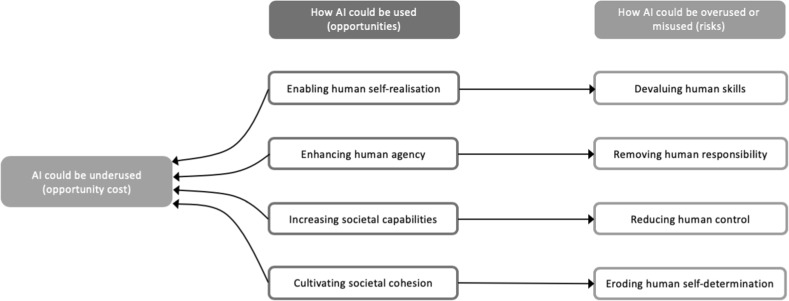
- The authors identify four chief opportunities AI offers society: who we can become, what we can do, what we can achieve, and how we can interact.
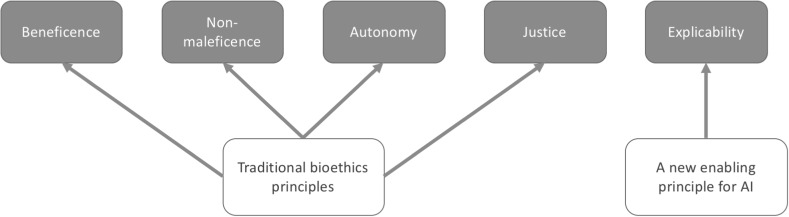
- They synthesize 47 principles from six high-profile AI ethics documents and argue these converge on five principles for AI: beneficence, non-maleficence, autonomy, justice, and explicability.
- The paper argues that AI should be developed to decrease inequality, increase shared benefits, and remain explicable, because explicability is described as critical for public trust and understanding.
- The recommendations section sets out 20 Action Points grouped into assessment, development, incentivisation, and support.
## Methods
- The paper is a conceptual and comparative ethics analysis, not an empirical study.
- It reviews six existing AI ethics documents: Asilomar, Montreal, IEEE, EGE, AIUK, and the Partnership on AI, and compares their principles.
- The authors then synthesize these into a framework and derive 20 recommendations for a Good AI Society.
## Limitations
- The paper states that it presents a European approach meant to be complementary to other approaches, so its recommendations are not claimed to be universally exhaustive or final.
- The text itself makes evident that the analysis is normative and document-based, not based on original empirical data or tested interventions (text-evident limitation).
- The paper also presents the recommendations as a “living document”, implying they are provisional and meant to evolve rather than serve as a definitive endpoint.
Model-written summary. Check it against the paper before relying on it.
Integrity signals
Registry
Cites
Statistics
Figures
Verification
Claims the paper makes
1 Valid · 1 Not valid · 27 Not checked · 35 Own results and interpretations
The cited sources support only part of this claim — read each source’s verdict below.
In the paper
“Everything from email scams to full-scale cyber-warfare may be accelerated or intensified by the malicious use of AI technologies (Taddeo 2018).”
§ AI4People—An Ethical Framework for a Good AI Society: Opportunities, Risks, Principles, and Recommendations > The Opportunities and Risks of AI for Society
What the sources say
- Partly supportedcites Taddeo 2018 matched to “The Limits of Deterrence Theory in Cyberspace” (2018) sourceExperimental — accuracy not yet measured
Section 4.3 (page unavailable) says machine-learning systems deployed for cyber defence can pose risks of unforeseen, disproportionate damage, supporting a narrower concern that AI could intensify harm in cyber conflict. It does not address malicious AI use, email scams, or AI accelerating attacks across that range. (LLM, conf=0.77)
hedgedstates a possible cause- Asserted: passes — The authors put it forward as true.
- Checkable: passes — It can be checked against evidence.
- Load-bearing: unclear — It is unclear whether the paper’s conclusions depend on it.
- Based: passes — The paper gives a reason why it holds.
- Rests on an assumption not shown here.
- Partly supported
None of the sources cited for this claim could be matched to a paper, so there is nothing to check it against.
In the paper
“Taken together, they yield 47 principles.5”
§ AI4People—An Ethical Framework for a Good AI Society: Opportunities, Risks, Principles, and Recommendations > A Unified Framework of Principles for AI in Society
What the sources say
- Not matchedcites Asilomar AI Principles 2017
An author–year citation the paper’s reference list doesn’t settle. We don’t search these by name.
- Not matchedcites Montreal Declaration 2017
An author–year citation the paper’s reference list doesn’t settle. We don’t search these by name.
- Not matchedcites IEEE 2017
An author–year citation the paper’s reference list doesn’t settle. We don’t search these by name.
plainstates a cause- Asserted: passes — The authors put it forward as true.
- Checkable: passes — It can be checked against evidence.
- Load-bearing: passes — The paper’s conclusions depend on it.
- Based: passes — The paper gives a reason why it holds.
- Not matched
A conclusion the paper draws from its own results — it cites no other source for it, so there is none to check. The quote shows it is in the paper.
In the paper
“But they are not exhaustive.”
§ AI4People—An Ethical Framework for a Good AI Society: Opportunities, Risks, Principles, and Recommendations > A Unified Framework of Principles for AI in Society
plain- Asserted: passes — The authors put it forward as true.
- Checkable: passes — It can be checked against evidence.
- Load-bearing: passes — The paper’s conclusions depend on it.
- Based: passes — The paper gives a reason why it holds.
A conclusion the paper draws from its own results — it cites no other source for it, so there is none to check. The quote shows it is in the paper.
In the paper
“On the basis of the following comparative analysis, we argue that one more, new principle is needed in addition: explicability, understood as incorporating both intelligibility and accountability.”
§ AI4People—An Ethical Framework for a Good AI Society: Opportunities, Risks, Principles, and Recommendations > A Unified Framework of Principles for AI in Society
plain- Asserted: passes — The authors put it forward as true.
- Checkable: passes — It can be checked against evidence.
- Load-bearing: passes — The paper’s conclusions depend on it.
- Based: passes — The paper gives a reason why it holds.
A conclusion the paper draws from its own results — it cites no other source for it, so there is none to check. The quote shows it is in the paper.
In the paper
“The four bioethical principles adapt surprisingly well to the fresh ethical challenges posed by artificial intelligence.”
§ AI4People—An Ethical Framework for a Good AI Society: Opportunities, Risks, Principles, and Recommendations > A Unified Framework of Principles for AI in Society
boosted- Asserted: passes — The authors put it forward as true.
- Checkable: passes — It can be checked against evidence.
- Load-bearing: passes — The paper’s conclusions depend on it.
- Based: passes — The paper gives a reason why it holds.
5 more claims
Create a free account to see all 64 claims and every source verdict.
- Probably not a substantial claim. 51
- It may state two separate claims as one. 9
- Not yet classified. 2
- The quote only partly states this claim. 1
Claims other papers make about this one
Each is checked against this paper’s own text: does it say what the citing paper says it does?
The source backs part of the claim, not all of it — or backs it for a different population, condition or comparison.
In the citing paper
“While AI systems can influence learning outcomes through adaptive contributions, they cannot bear responsibility for those outcomes, engage in ethical reflection about educational goals, or possess the experiential understanding that grounds pedagogical wisdom”
From Towards a philosophy of ensemble cognition: Reconceptualising agency and mind in AI-mediated educational environments (2026) · cites this paper as Floridi et al., 2018
Experimental — accuracy not yet measuredThe source backs part of the claim, not all of it — or backs it for a different population, condition or comparison.
In the citing paper
“This trust will be important for the future of AI as a lack of trust could permanently harm the reputation of AI in healthcare, or lead to additional costs through inefficient regulation or repeated amendment (Floridi et al., 2018).”
From Liability for harm caused by AI in healthcare: an overview of the core legal concepts (2023) · cites this paper as Floridi et al., 2018
Experimental — accuracy not yet measuredThe source backs part of the claim, not all of it — or backs it for a different population, condition or comparison.
In the citing paper
“Indeed, the framework played a valuable role in the work of AI 4 People, Europe's first global forum on the social impact of AI, which recently adopted it to propose 20 concrete recommendations for a 'Good AI Society' to the European Commission (Floridi et al., 2018 ).”
From A Unified Framework of Five Principles for AI in Society (2019) · cites this paper as Floridi et al., 2018
Experimental — accuracy not yet measuredThe source backs part of the claim, not all of it — or backs it for a different population, condition or comparison.
In the citing paper
“De manera complementaria, autores como Floridi et al. (2018) abogan por incorporar principios como la justicia, la beneficencia y el respeto por la autonomía en todas las etapas del desarrollo de herramientas basadas en IA [23].”
From Avances, Retos Éticos y Perspectivas de la Inteligencia Artificial (IA) en la Educación de América Latina (2025) · cites this paper as [23]
Experimental — accuracy not yet measuredThe source backs part of the claim, not all of it — or backs it for a different population, condition or comparison.
In the citing paper
“Talos represents ancient human fears about the uncontrollable power of man-made creations, fears that persist into contemporary concerns about AI (Floridi et al., 2018; Sebastian, 2023; Tabassi, 2023b).”
From Delegated agency and moral responsibility in artificial intelligence (2026) · cites this paper as Floridi et al., 2018
Experimental — accuracy not yet measured
30 more claims about this paper
Create a free account to see every claim other papers make about this one.
Citations
Cites
Floridi, L. (2013) · Oxford University Press eBooks · doi:10.1093/acprof:oso/9780199641321.001.0001 · Cited by 651
Self-citationSoft Ethics and the Governance of the Digital
Floridi, L. (2018) · Philosophy & Technology · doi:10.1007/s13347-018-0303-9 · Cited by 325 · cited 2×
“2 The analysis in this and the following two sections is also available in Cowls and Floridi (2018).”
BackgroundSelf-citationArtificial Intelligence Crime: An Interdisciplinary Analysis of Foreseeable Threats and Solutions
King, T. C., Aggarwal, N., Taddeo, M., & Floridi, L. (2020) · Science and Engineering Ethics · doi:10.1007/s11948-018-00081-0 · Cited by 271
Self-citationThe Limits of Deterrence Theory in Cyberspace
Taddeo, M. (2018) · Philosophy & Technology · doi:10.1007/s13347-017-0290-2 · Cited by 98
Prolegomena to a White Paper on an Ethical Framework for a Good AI Society
Cowls, J., & Floridi, L. (2018) · SSRN Electronic Journal · doi:10.2139/ssrn.3198732 · Cited by 76
Self-citationArtificial Intelligence Crime: An Interdisciplinary Analysis of Foreseeable Threats and Solutions
King, T., Aggarwal, N., Taddeo, M., & Floridi, L. (2018) · SSRN Electronic Journal · doi:10.2139/ssrn.3183238 · Cited by 17
Self-citation
Research works printed but not linked: 3
- Asilomar AI Principles. (2017). Principles developed in conjunction with the 2017 Asilomar conference [Benevolent AI 2017]. Retrieved September 18, 2018 from https://futureoflife.org/ai-principles.
- Cowls, J., & Floridi, L. (2018). Prolegomena to a White Paper on Recommendations for the Ethics of AI (June 19, 2018). Available at SSRN: https://ssrn.com/abstract=3198732.
- The IEEE Initiative on Ethics of Autonomous and Intelligent Systems. (2017). Ethically Aligned Design, v2. Retrieved September 18, 2018 from https://ethicsinaction.ieee.org.
Cited by
Items 1,401–1,500 of 4,603
Administrative Decisions in the Era of Artificial Intelligence
Pszczyński, M. (2020) · Przegląd Prawniczy Uniwersytetu im Adama Mickiewicza · doi:10.14746/ppuam.2020.11.13 · Cited by 7
Zhang, Z., Zhang, C., & Li, X. (2022) · Sustainability · doi:10.3390/su14042303 · Cited by 7
The Explanation Game: A Formal Framework for Interpretable Machine Learning
Watson, D., & Floridi, L. (2021) · Digital ethics lab yearbook · doi:10.1007/978-3-030-80083-3_11 · Cited by 6
Self-citationArtificial Intelligence Systems and problems of the concept of author. Reflections on a recent book
Lana, M. (2022) · JLIS it · doi:10.36253/jlis.it-458 · Cited by 7
Michalke, S., Lohrenz, L., Lattemann, C., & Robra-Bissantz, S. (2022) · Electronic Markets · doi:10.1007/s12525-022-00589-1 · Cited by 5
Akande, S. A., & Enyejo, J. O. (2023) · International Journal of Scientific Research and Modern Technology. · doi:10.38124/ijsrmt.v3i12.1055 · Cited by 17
The Ghost in the Machine: The Ethical Risks of AI
Ormond, E. (2019) · The Thinker · doi:10.2139/ssrn.3719745 · Cited by 9
Urban Computing: The Technological Framework for Smart Cities
Bouroche, M., & Dusparić, I. (2021) · Springer eBooks · doi:10.1007/978-3-030-69698-6_5 · Cited by 9
Gauld, C., Micoulaud‐Franchi, J., & Dumas, G. (2021) · Psychological Medicine · doi:10.1017/s0033291721000684 · Cited by 5
The Punishment Gap: The Infeasible Public Attribution of Punishment to AI and RobotsPreprint
Lima, G., Cha, M., Jeon, C., & Park, K. (2020) · arXiv (Cornell University) · Cited by 5
Implementing and managing Algorithmic Decision-Making in the public sectorPreprint
Rocco, S. (2022) · SocArXiv (OSF Preprints) · doi:10.31235/osf.io/ex93w · Cited by 9
Moral Values in Medical AI: A Scoping ReviewPreprint
Victor, G., Barbu, A., & Bélisle‐Pipon, J. (2024) · Research Square · doi:10.21203/rs.3.rs-4391239/v1 · Cited by 8
Robotics Application in the Hospital Domain: Operator-Patient- Robot InterfacePreprint
Cruz, E. M. G. N. V., Oliveira, S. M., & Correia, A. M. C. (2024) · Preprints.org · doi:10.20944/preprints202406.1161.v1 · Cited by 8
A Blueprint for Auditing Generative AIPreprint
Mökander, J., Curl, J., & Kshirsagar, M. (2024) · SSRN Electronic Journal · doi:10.2139/ssrn.4887768 · Cited by 7
The Soul of the AI: Governance, Ethics, and the Future of Human–AI IntegrationPreprint
Mahajan, P. T. (2025) · doi:10.14293/pr2199.001783.v1 · Cited by 5
Jundon, S. C., Niyomves, B., Kaewlamai, S., & Pawala, T. (2025) · Journal of Education and Learning Reviews · doi:10.60027/jelr.2025.1458 · Cited by 10
Implementing AI ethics: the VPCIO model
Martin, D., Schmidt, M., & Hillerbrand, R. (2025) · AI and Ethics · doi:10.1007/s43681-025-00723-7 · Cited by 4
Mwakalinga, S. E., & Mabilika, F. A. (2025) · Cogent Education · doi:10.1080/2331186x.2025.2557611 · Cited by 13
Operationalising digital ethics: establishment of an ethics evaluation tool for data analytics
Charton, J. E., Lucas, S., Vogd, W., Halter, W., & Becker, S. J. (2025) · AI & Society · doi:10.1007/s00146-025-02621-2 · Cited by 7
Aragona, B., & Acampa, S. (2025) · Futures · doi:10.1016/j.futures.2025.103722 · Cited by 17
Survey on AI Ethics: A Socio‐Technical Perspective
Mbiazi, D., Bhange, M., Babaei, M., Sheth, I., Kenfack, P. J., & Kahou, S. E. (2025) · Computational Intelligence · doi:10.1111/coin.70149 · Cited by 48
Structural oppression and AI: A systematic review of data policy frameworks in India
Biju, P. R., & Gayathri, O. (2025) · Technological Forecasting and Social Change · doi:10.1016/j.techfore.2025.124415 · Cited by 15
Career shocks in the age of AI: A double-edged sword for job insecurity and career compromise
Yan, C., & Huang, L. S. (2025) · Acta Psychologica · doi:10.1016/j.actpsy.2025.105925 · Cited by 8
Artificial Intelligence for Social Good
Oyenuga, M. O. (2025) · African Journal of Economics and Sustainable Development · doi:10.52589/ajesd-0j428jii · Cited by 6
Ethical challenges in biomarker research and precision medicine – a qualitative study in dermatology
Fritzsche, M.-C., Hangel, N., & Buyx, A. (2025) · BMC Medical Ethics · doi:10.1186/s12910-025-01258-6 · Cited by 7
Caldarelli, G. (2025) · Frontiers in Blockchain · doi:10.3389/fbloc.2025.1682623 · Cited by 11
Velotto, G. (2025) · AI and Ethics · doi:10.1007/s43681-025-00880-9 · Cited by 4
Lin, P., Deng, Q., & Zhou, Y. (2026) · Computers and Education: Artificial Intelligence · doi:10.1016/j.caeai.2025.100534 · Cited by 4
AI-Driven Personalized Learning Pathways Customizing Education for Every Student
Waladi, C., Lamarti, M. S., & Khaldi, M. (2025) · Advances in educational technologies and instructional design book series · doi:10.4018/979-8-3693-8965-2.ch004 · Cited by 6
Panizzon, M., & Janissek-Muniz, R. (2025) · Futures · doi:10.1016/j.futures.2025.103753 · Cited by 10
A scoping review of AI for sustainability and sustainable AI in higher education
Daniel, B. K., Podgorodnichenko, N., & Carr, S. (2026) · Discover Computing · doi:10.1007/s10791-025-09861-2 · Cited by 19
Slamani, M., Louhichi, B., Arslane, M., & Alawad, M. A. (2026) · The International Journal of Advanced Manufacturing Technology · doi:10.1007/s00170-026-17413-1 · Cited by 13
Aina, R. A. (2026) · Industry and Higher Education · doi:10.1177/09504222261423356 · Cited by 4
Leineweber, M., Keusgen, C. V., Bubeck, M. J., Ranisch, R., Haltaufderheide, J., & Klingler, C. (2026) · Medicine Health Care and Philosophy · doi:10.1007/s11019-025-10313-3 · Cited by 13
Addressing vulnerability in customer experience with AI-agents
Jha, G., Wright, J., Singhal, A., Zhang, Y., Burton, J., & McColl‐Kennedy, J. R. (2026) · Journal of service management · doi:10.1108/josm-04-2025-0182 · Cited by 6
FAIR: A Design Theory for Artificial Intelligence Fairness
Rai, A., Tian, J., & Xue, L. (2026) · MIS Quarterly · doi:10.25300/misq/2026/17971 · Cited by 16
Blame the Robot: Role Responsibility and Ethical Issues Regarding AI-Based Care Robots
Kropf, M., Spöck, C., & Werner, R. (2026) · International Journal of Social Robotics · doi:10.1007/s12369-026-01369-z · Cited by 6
Kulintang, M. B. M., Ngo, A. L., Salas, C. J., Sumaoy, K., & Alquwez, N. (2026) · Nurse Education Today · doi:10.1016/j.nedt.2026.107050 · Cited by 7
Probst, T. M., Shoss, M. K., Bankins, S., Behrend, T. S., Dragano, N., Jetha, A., Koopman, J., Selenko, E., Tang, P. M., Tay, L., et al. (2026) · Occupational Health Science · doi:10.1007/s41542-026-00262-5 · Cited by 5
“Various forms of ethical AI principles exist (e.g., Department of Industry, Science And Resources, 2025 ; Floridi et al., 2018 ), but they generally coalesce around the need for AI systems to be used in ways that maximize community benefit, are fair, just and inclusive, safeguard human autonomy,…”
Alibašić, H. (2026) · Standards · doi:10.3390/standards6020020 · Cited by 6
“The layer translates Floridi et al.’s [11] principle of explicability into an institutional mechanism.”
InfluentialCorreia, U. A., de Souza, A. M., Santana, J. A., Alves, D. S., Conceição, M. M., & SILVA, M. S. R. (2026) · RECIMA21 - Revista Científica Multidisciplinar · doi:10.47820/recima21.v7i6.8273 · Cited by 5
Responsible Development of Emerging Technologies
Schulte, P. A., Leso, V., & Iavicoli, I. (2024) · Journal of Occupational and Environmental Medicine · doi:10.1097/jom.0000000000003100 · Cited by 4
Cañas, P., Nieto, M., Otaegui, O., & Rodríguez, I. (2024) · SAE International Journal of Connected and Automated Vehicles · doi:10.4271/12-08-01-0010 · Cited by 4
Varela, D. T. (2024) · Open Journal of Social Sciences · doi:10.4236/jss.2024.1212012 · Cited by 6
Adeyemo, A., Coffey, A., & Kingston, L. (2025) · Journal of Nursing Regulation · doi:10.1016/s2155-8256(25)00030-4 · Cited by 5
Psychosocial risks and ethical implications of technology: considerations for decent work
Schulte, P. A., & Streit, J. M. K. (2025) · Annals of Work Exposures and Health · doi:10.1093/annweh/wxaf003 · Cited by 5
Mavļutova, I., Lešinskis, K., & Hermanis, J. (2025) · Procedia Computer Science · doi:10.1016/j.procs.2025.02.147 · Cited by 9
Leveraging Ethics for Supporting Students' Artificial Intelligence Skills Development in Namibia
Uunona, G. N., & Goosen, L. (2025) · Advances in educational technologies and instructional design book series · doi:10.4018/979-8-3693-8965-2.ch011 · Cited by 4
Integración de la inteligencia artificial en la enseñanza del inglés como lengua extranjera
Bermúdez, H. D. R., Medranda, Á. D. R. P., Ramírez, F. L. Z., & Muñoz, J. D. Z. (2025) · Código Científico Revista de Investigación · doi:10.55813/gaea/ccri/v6/ne1/828 · Cited by 6
Leveraging Data Analytics for Predictive Consumer Behavior Modelling
Tariq, M. U. (2025) · Advances in marketing, customer relationship management, and e-services book series · doi:10.4018/979-8-3693-3799-8.ch011 · Cited by 7
Explainable Artificial Intelligence (XAI) for Ethical and Trustworthy Decision-Making in 6G Networks
Arya, L., Raju, E. S., Santosh, M. V. S., Santosh Kumar, M. P. J., Rastogi, R., Elloumi, M., Arumugam, T., & Namasivayam, B. (2025) · Advances in wireless technologies and telecommunication book series · doi:10.4018/979-8-3373-0568-4.ch008 · Cited by 5
Generative AI, generating crisis: framing opportunity and threat in AI governance
Cheung, S. (2025) · Information Communication & Society · doi:10.1080/1369118x.2025.2542356 · Cited by 6
Synthetic voice and the philosophy of agency, authenticity, and ethics in AI-mediated speech
Muskaan, M. (2025) · AI and Ethics · doi:10.1007/s43681-025-00820-7 · Cited by 9
Zhu, Z. Y. (2025) · Transforming Government People Process and Policy · doi:10.1108/tg-06-2025-0191 · Cited by 6
Responsible AI for AI Sustainable Future: Governance, Ethics, and The Reality Behind the Promise
Atianashie Miracle, A., Kuffour, M. K., Kyiewu, B., & Serwaa, P. (2025) · Journal of Information Technology Cybersecurity and Artificial Intelligence · doi:10.70715/jitcai.2025.v2.i2.012 · Cited by 15
Examining trends in AI ethics across countries and institutions via quantitative discourse analysis
Bar-Gil, O. (2025) · AI & Society · doi:10.1007/s00146-025-02673-4 · Cited by 12
Agarwal, B., Urlings, C. C., van Lankveld, G., & Klemke, R. (2026) · International Journal of Artificial Intelligence in Education · doi:10.1016/j.ijaied.2026.100004 · Cited by 11
Grüneberg, P. (2021) · Springer eBooks · doi:10.1007/978-981-33-6280-2_10 · Cited by 4
Vivir con robots. Reflexiones éticas, jurídicas, sociales y culturales
Martín, M. T., & Ruiz, M. A. G. (2021) · Arbor · doi:10.3989/arbor.2021.802001 · Cited by 4
Engström, E. (2022) · Social and cultural studies of robots and AI · doi:10.1007/978-3-030-88615-8_4 · Cited by 4
AI ETHICS IN BUSINESS – A BIBLIOMETRIC APPROACH
CIOBANU, A. C., & Meșniță, G. (2021) · Review of Economic and Business Studies · doi:10.47743/rebs-2021-2-0009 · Cited by 11
Rodríguez, C. P. (2022) · Studia Prawnicze KUL · doi:10.31743/sp.13029 · Cited by 10
Gestionar la complejidad: la contribución de la UE a la gobernanza de la inteligencia artificial
Antonov, A. (2022) · Revista CIDOB d Afers Internacionals · doi:10.24241/rcai.2022.131.2.41/en · Cited by 17
SHAPES Project Pilots' Self-assessment for Trustworthy AI
Rajamäki, J., Rocha, P. A. L., Perenius, M., & Gioulekas, F. (2022) · International Conference on Dependable Systems, Services and Technologies (DESSERT) · doi:10.1109/dessert58054.2022.10018790 · Cited by 6
Calzati, S. (2023) · Journal of Information Communication and Ethics in Society · doi:10.1108/jices-12-2022-0108 · Cited by 6
den Hartog, F. B., van den Akker, R., & van Houdt, F. (2023) · Cities · doi:10.1016/j.cities.2023.104690 · Cited by 6
Artificial Intelligence in Public Administration: A Bibliometric Review in Comparative Perspective
Aristovnik, A., Umek, L., & Ravšelj, D. (2024) · Lecture notes in networks and systems · doi:10.1007/978-3-031-50755-7_13 · Cited by 12
Bearing the weight: A qualitative study on expert views on integrating ethics in autonomous vehicles
Milford, S. R., Elger, B. S., & Shaw, D. (2024) · Transportation Research Interdisciplinary Perspectives · doi:10.1016/j.trip.2024.101096 · Cited by 6
Maghfirah, P., & Eni, Y. (2024) · International journal of business management and economic review · doi:10.35409/ijbmer.2024.3584 · Cited by 31
Applying the Triarchic Theory of Cognitive Disposition in AI stewardship
Oosthuizen, J. H. (2024) · South African Journal of Business Management · doi:10.4102/sajbm.v55i1.4363 · Cited by 6
Ethical and Privacy Considerations in Artificial Emotional Intelligence Deployment
Goel, P. K. (2024) · Advances in computational intelligence and robotics book series · doi:10.4018/979-8-3693-6806-0.ch022 · Cited by 5
Challenges in Large Language Model Development and AI Ethics
Sandfreni, S., & Bansal, R. (2024) · Advances in computational intelligence and robotics book series · doi:10.4018/979-8-3693-3860-5.ch002 · Cited by 4
Generative AI: Next Frontier for Competitive Advantage
Bharti, I., Chauhan, K., & Aggarwal, P. (2024) · Advances in linguistics and communication studies · doi:10.4018/979-8-3693-9246-1.ch001 · Cited by 8
Alhosni, R. H., Masengu, R., & Tsikada, C. (2024) · Advances in marketing, customer relationship management, and e-services book series · doi:10.4018/979-8-3693-6760-5.ch010 · Cited by 4
Driving Business Sustainability Through Effective Marketing Leveraging on Artificial Intelligence
Mtengwa, E., Muchenje, C., Maregere, L. L., & Masengu, R. (2024) · Advances in marketing, customer relationship management, and e-services book series · doi:10.4018/979-8-3693-6760-5.ch005 · Cited by 9
Towards Engineering Explainable Autonomous Systems
Winikoff, M. (2024) · Lecture notes in computer science · doi:10.1007/978-3-031-71152-7_9 · Cited by 6
Ventura‐León, J., Lino‐Cruz, C., Sánchez‐Villena, A. R., Tocto‐Muñoz, S., Martinez‐Munive, R., Talledo‐Sánchez, K., & Casiano‐Valdivieso, K. (2024) · The Journal of General Psychology · doi:10.1080/00221309.2024.2433278 · Cited by 7
Dordunoo, L. (2024) · Advances in human resources management and organizational development book series · doi:10.4018/979-8-3693-8562-3.ch009 · Cited by 4
Ethics in AI and Computation in Automated Decision-Making
Jadaan, O. A., Zaidi, H., AlFaress, M. Y., & Jabas, A. O. (2024) · Advances in computational intelligence and robotics book series · doi:10.4018/979-8-3693-6230-3.ch012 · Cited by 9
Eren, F., Dülek, L. N., Uraz, Ö. A., Kuşcu, B., & Sakallı, M. (2024) · Bilgi ve İletişim Teknolojileri Dergisi · doi:10.53694/bited.1601239 · Cited by 6
The Impacts of Big Data Analytics and Artificial Intelligence on Marketing Strategies
Nwobodo, L. K. (2025) · Global journal of economic and finance research. · doi:10.55677/gjefr/05-2025-vol02e1 · Cited by 10
Mahto, H., & Mahato, D. (2025) · Sustainable landscape planning and natural resources management · doi:10.1007/978-3-031-75937-6_12 · Cited by 9
Kennedy-Mayo, D., & Gord, J. (2025) · Lecture notes in networks and systems · doi:10.1007/978-3-031-84457-7_11 · Cited by 10
Education 2070: A Conceptual Framework
Carvalho, I., Iglesias, M., & Ivanov, S. H. (2025) · World Futures · doi:10.1080/02604027.2025.2482504 · Cited by 4
Building an Ethical AI Culture Within Organizations
Yadav, R. (2025) · Advances in computational intelligence and robotics book series · doi:10.4018/979-8-3693-9894-4.ch001 · Cited by 4
The Transformative Impact of Artificial Intelligence on the Digital Maturity of Hospitals
Gachago, J. (2025) · Springer eBooks · doi:10.1007/978-3-031-80704-6_16 · Cited by 5
ESG Criteria in the Deep Learning Era: Opportunities and Challenges
Ayyoub, T., & Regragui, F. (2025) · International Conference on Artificial Intelligence, Computer, Data Sciences and Applications (ACDSA) · doi:10.1109/acdsa65407.2025.11166528 · Cited by 7
El valor de la dignidad humana frente a la tecnociencia
Vinueza-Martínez, C. N., Ponce-Rivera, O. S., Díaz-Vásquez, S. M., et al. (2025) · Revista Científica Zambos. · doi:10.69484/rcz/v4/n3/135 · Cited by 4
Kox, T., Harrison, S., Ziegler, F., & Gerhold, L. (2025) · International Journal of Disaster Risk Reduction · doi:10.1016/j.ijdrr.2025.105817 · Cited by 9
Modeling People-AI Interaction: A Case Discussion with Using an Interaction Design Language
Ferreira, J. J., Fucs, A., & Segura, V. (2019) · Lecture notes in computer science · doi:10.1007/978-3-030-23541-3_27 · Cited by 4
Good Life Ecosystems – Ethics and Responsibility in the Silver Market
Leikas, J., Sigfrids, A., Stenvall, J., & Nieminen, M. (2020) · Lecture notes in computer science · doi:10.1007/978-3-030-50267-6_9 · Cited by 6
Doing and Feeling: Relationships Between Moods, Productivity and Task-Switching
Alibasa, M. J., Purwanto, R. W., Yacef, K., Glozier, N., & Calvo, R. A. (2020) · IEEE Transactions on Affective Computing · doi:10.1109/taffc.2020.3029440 · Cited by 5
Groß, M. (2021) · Management for professionals · doi:10.1007/978-3-030-66913-3_10 · Cited by 8
AI Governance and the Fundamental Principles of International Law
Tzimas, T. (2021) · Law, governance and technology series · doi:10.1007/978-3-030-78585-7_5 · Cited by 5
Schönau, A. (2022) · AI and Ethics · doi:10.1007/s43681-022-00158-4 · Cited by 7
Buhr, L., & Schicktanz, S. (2022) · Big Data & Society · doi:10.1177/20539517221092653 · Cited by 5
Huang, G., & Yu, Y. M. (2022) · Lecture notes on data engineering and communications technologies · doi:10.1007/978-3-031-04809-8_63 · Cited by 4
Delfos, J., Zuiderwijk, A., van Cranenburgh, S., & Chorus, C. G. (2022) · International Conference on Theory and Practice of Electronic Governance · doi:10.1145/3560107.3560122 · Cited by 7
Requirements Elicitation Techniques and Tools in the Context of Artificial Intelligence
Silva, A. F. D. S., Silva, G. R. S., & Canedo, E. D. (2022) · Lecture notes in computer science · doi:10.1007/978-3-031-21686-2_2 · Cited by 6
Metadata
- Authors
- Floridi, L., Cowls, J., Beltrametti, M., Chatila, R., Chazerand, P., Dignum, V., Luetge, C., Madelin, R., Pagallo, U., Rossi, F., Schafer, B., Valcke, P., & Vayena, E.
- Affiliations
- University of Oxford (GB)
- Centre National de la Recherche Scientifique (FR)
- Digital Europe (BE)
- Umeå University (SE)
- University of Turin (IT)
- IBM (United States) (US)
- Bocconi University (IT)
- ETH Zurich (CH)
- Corresponding author
- Floridi, Luciano
- ORCID
- Venue
- Minds and Machines
- Published
- 2018-11-26
- Volume
- 28
- Issue
- 4
- Pages
- 689-707
- ISSN
- 0924-6495 (ISSN-L)
- 1572-8641
- PMC
- PMC6404626
- OpenAlex
- W2902634493
- Cited by
- 4,774
- References
- 8
- Citations by year
- 2026: 1965 · 2025: 1116 · 2024: 523 · 2023: 413 · 2022: 287 · 2021: 255 · 2020: 145 · 2019: 70
- FWCI
- 234.15
- Type
- journal article
- Language
- en
- Open access
- hybrid
- doi.org
- Licence
- cc-by
- creativecommons.org/licenses/by/4.0 (tdm)
- Locations
- Minds and Machines (publishedVersion, cc-by)
- Europe PMC (PubMed Central) (publishedVersion, other-oa)
- PubMed Central (publishedVersion, cc-by)
- PubMed (publishedVersion)
- Institutional Research Information System University of Turin (University of Turin) (submittedVersion, other-oa)
- Lirias (submittedVersion, cc-by)
- Data Archiving and Networked Services (DANS) (submittedVersion, cc-by)
- DiVA at Umeå University (Umeå University) (submittedVersion, other-oa)
- mediaTUM – the media and publications repository of the Technical University Munich (Technical University Munich) (submittedVersion, other-oa)
- mediaTUM – the media and publications repository of the Technical University Munich (Technical University Munich) (submittedVersion)
- PhilPapers (PhilPapers Foundation) (submittedVersion)
- Edinburgh Research Explorer (University of Edinburgh) (submittedVersion, cc-by)
- Research Repository (Delft University of Technology) (submittedVersion)
- Repository for Publications and Research Data (ETH Zurich) (submittedVersion, cc-by)
- ETH Zürich Research Collection (cc-by)
- Funders
- Atomium
- Topics
- Physical Sciences › Computer Science › Artificial Intelligence › Ethics and Social Impacts of AI
- Social Sciences › Law › Digitalization, Law, and Regulation
- Physical Sciences › Environmental Science › Management, Monitoring, Policy and Law › Innovation, Sustainability, Human-Machine Systems
- Keywords
- AI ethics, ethical principles, AI policy recommendations, AI governance, artificial intelligence adoption
About these checks
Registry, retraction, Cites and statistics results are computed, not judged, with one exception: a printed reference that no index lists is read once by a model before it counts as a citation error. Claims are extracted by a model and kept only when their quote appears verbatim in the text; each cited source is then checked, with a model’s help, for whether it says what the claim relies on. Those verdicts can be wrong — read the claim’s quote and the cited source before relying on one.
The claim verdicts this report counts are experimental: their accuracy is not yet measured.
A language model drew the claims from the paper on 2026-09-28, under version 3 of the claim definition (model deepseek-v4.1-flash, prompt extract-v3).
A second model labelled each claim on 2026-09-28 (model jev-1.13-20260917, definition revision gold-guideline-v0.2).
Cited sources are checked with a language model’s help (gpt-6-sol).
Statistics and arithmetic are recomputed, not judged.
Confidence bands are shown only for fields calibrated on our annotated test set. None is calibrated yet, so no band is shown.
What counts as a claim ›How we measure confidence ›How we check this ›
Are you an author, or do you see a problem with this page? Request a review
Data sources
Bibliographic data: Semantic Scholar, OpenAlex, Crossref.
Contains information from the Semantic Scholar Academic Graph Datasets, made available under the ODC Attribution License (ODC-BY 1.0).
Semantic Scholar’s data is described in: Kinney, R., et al. (2023). The Semantic Scholar Open Data Platform. arXiv:2301.10140.
