

AI4People—An Ethical Framework for a Good AI Society: Opportunities, Risks, Principles, and Recommendations
Open accessThe DOI matches its Crossref record; 6 of the 8 references it cites were found in a registry or an index; 1 of the 33 sources its claims cite were checked for support.
Abstract
This article reports the findings of AI4People, an Atomium-EISMD initiative designed to lay the foundations for a "Good AI Society". We introduce the core opportunities and risks of AI for society; present a synthesis of five ethical principles that should undergird its development and adoption; and offer 20 concrete recommendations-to assess, to develop, to incentivise, and to support good AI-which in some cases may be undertaken directly by national or supranational policy makers, while in others may be led by other stakeholders. If adopted, these recommendations would serve as a firm foundation for the establishment of a Good AI Society.
Overview
CoChat Summary
## TL;DR
AI4People proposes an ethical framework for a “Good AI Society” by synthesizing AI’s major social opportunities and risks, five guiding principles, and 20 policy recommendations. The paper argues that ethics adds a “dual advantage”: it helps organizations capture socially valuable AI opportunities while avoiding costly harms.
## Key findings
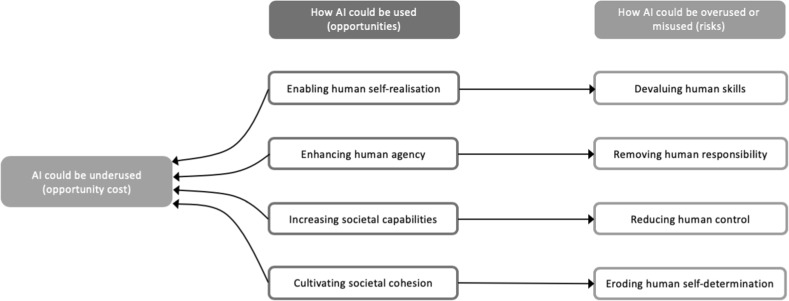
- The authors identify four chief opportunities AI offers society: who we can become, what we can do, what we can achieve, and how we can interact.
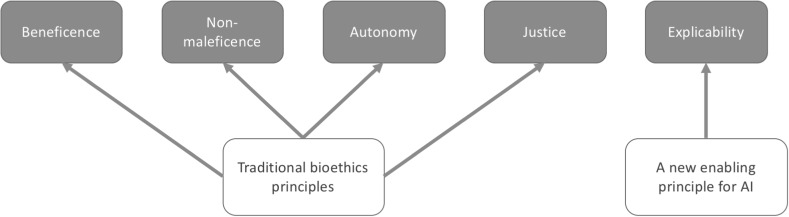
- They synthesize 47 principles from six high-profile AI ethics documents and argue these converge on five principles for AI: beneficence, non-maleficence, autonomy, justice, and explicability.
- The paper argues that AI should be developed to decrease inequality, increase shared benefits, and remain explicable, because explicability is described as critical for public trust and understanding.
- The recommendations section sets out 20 Action Points grouped into assessment, development, incentivisation, and support.
## Methods
- The paper is a conceptual and comparative ethics analysis, not an empirical study.
- It reviews six existing AI ethics documents: Asilomar, Montreal, IEEE, EGE, AIUK, and the Partnership on AI, and compares their principles.
- The authors then synthesize these into a framework and derive 20 recommendations for a Good AI Society.
## Limitations
- The paper states that it presents a European approach meant to be complementary to other approaches, so its recommendations are not claimed to be universally exhaustive or final.
- The text itself makes evident that the analysis is normative and document-based, not based on original empirical data or tested interventions (text-evident limitation).
- The paper also presents the recommendations as a “living document”, implying they are provisional and meant to evolve rather than serve as a definitive endpoint.
Model-written summary. Check it against the paper before relying on it.
Integrity signals
Registry
Cites
Statistics
Figures
Verification
Claims the paper makes
1 Valid · 1 Not valid · 27 Not checked · 35 Own results and interpretations
The cited sources support only part of this claim — read each source’s verdict below.
In the paper
“Everything from email scams to full-scale cyber-warfare may be accelerated or intensified by the malicious use of AI technologies (Taddeo 2018).”
§ AI4People—An Ethical Framework for a Good AI Society: Opportunities, Risks, Principles, and Recommendations > The Opportunities and Risks of AI for Society
What the sources say
- Partly supportedcites Taddeo 2018 matched to “The Limits of Deterrence Theory in Cyberspace” (2018) sourceExperimental — accuracy not yet measured
Section 4.3 (page unavailable) says machine-learning systems deployed for cyber defence can pose risks of unforeseen, disproportionate damage, supporting a narrower concern that AI could intensify harm in cyber conflict. It does not address malicious AI use, email scams, or AI accelerating attacks across that range. (LLM, conf=0.77)
hedgedstates a possible cause- Asserted: passes — The authors put it forward as true.
- Checkable: passes — It can be checked against evidence.
- Load-bearing: unclear — It is unclear whether the paper’s conclusions depend on it.
- Based: passes — The paper gives a reason why it holds.
- Rests on an assumption not shown here.
- Partly supported
None of the sources cited for this claim could be matched to a paper, so there is nothing to check it against.
In the paper
“Taken together, they yield 47 principles.5”
§ AI4People—An Ethical Framework for a Good AI Society: Opportunities, Risks, Principles, and Recommendations > A Unified Framework of Principles for AI in Society
What the sources say
- Not matchedcites Asilomar AI Principles 2017
An author–year citation the paper’s reference list doesn’t settle. We don’t search these by name.
- Not matchedcites Montreal Declaration 2017
An author–year citation the paper’s reference list doesn’t settle. We don’t search these by name.
- Not matchedcites IEEE 2017
An author–year citation the paper’s reference list doesn’t settle. We don’t search these by name.
plainstates a cause- Asserted: passes — The authors put it forward as true.
- Checkable: passes — It can be checked against evidence.
- Load-bearing: passes — The paper’s conclusions depend on it.
- Based: passes — The paper gives a reason why it holds.
- Not matched
A conclusion the paper draws from its own results — it cites no other source for it, so there is none to check. The quote shows it is in the paper.
In the paper
“But they are not exhaustive.”
§ AI4People—An Ethical Framework for a Good AI Society: Opportunities, Risks, Principles, and Recommendations > A Unified Framework of Principles for AI in Society
plain- Asserted: passes — The authors put it forward as true.
- Checkable: passes — It can be checked against evidence.
- Load-bearing: passes — The paper’s conclusions depend on it.
- Based: passes — The paper gives a reason why it holds.
A conclusion the paper draws from its own results — it cites no other source for it, so there is none to check. The quote shows it is in the paper.
In the paper
“On the basis of the following comparative analysis, we argue that one more, new principle is needed in addition: explicability, understood as incorporating both intelligibility and accountability.”
§ AI4People—An Ethical Framework for a Good AI Society: Opportunities, Risks, Principles, and Recommendations > A Unified Framework of Principles for AI in Society
plain- Asserted: passes — The authors put it forward as true.
- Checkable: passes — It can be checked against evidence.
- Load-bearing: passes — The paper’s conclusions depend on it.
- Based: passes — The paper gives a reason why it holds.
A conclusion the paper draws from its own results — it cites no other source for it, so there is none to check. The quote shows it is in the paper.
In the paper
“The four bioethical principles adapt surprisingly well to the fresh ethical challenges posed by artificial intelligence.”
§ AI4People—An Ethical Framework for a Good AI Society: Opportunities, Risks, Principles, and Recommendations > A Unified Framework of Principles for AI in Society
boosted- Asserted: passes — The authors put it forward as true.
- Checkable: passes — It can be checked against evidence.
- Load-bearing: passes — The paper’s conclusions depend on it.
- Based: passes — The paper gives a reason why it holds.
5 more claims
Create a free account to see all 64 claims and every source verdict.
- Probably not a substantial claim. 51
- It may state two separate claims as one. 9
- Not yet classified. 2
- The quote only partly states this claim. 1
Claims other papers make about this one
Each is checked against this paper’s own text: does it say what the citing paper says it does?
The source backs part of the claim, not all of it — or backs it for a different population, condition or comparison.
In the citing paper
“While AI systems can influence learning outcomes through adaptive contributions, they cannot bear responsibility for those outcomes, engage in ethical reflection about educational goals, or possess the experiential understanding that grounds pedagogical wisdom”
From Towards a philosophy of ensemble cognition: Reconceptualising agency and mind in AI-mediated educational environments (2026) · cites this paper as Floridi et al., 2018
Experimental — accuracy not yet measuredThe source backs part of the claim, not all of it — or backs it for a different population, condition or comparison.
In the citing paper
“This trust will be important for the future of AI as a lack of trust could permanently harm the reputation of AI in healthcare, or lead to additional costs through inefficient regulation or repeated amendment (Floridi et al., 2018).”
From Liability for harm caused by AI in healthcare: an overview of the core legal concepts (2023) · cites this paper as Floridi et al., 2018
Experimental — accuracy not yet measuredThe source backs part of the claim, not all of it — or backs it for a different population, condition or comparison.
In the citing paper
“Indeed, the framework played a valuable role in the work of AI 4 People, Europe's first global forum on the social impact of AI, which recently adopted it to propose 20 concrete recommendations for a 'Good AI Society' to the European Commission (Floridi et al., 2018 ).”
From A Unified Framework of Five Principles for AI in Society (2019) · cites this paper as Floridi et al., 2018
Experimental — accuracy not yet measuredThe source backs part of the claim, not all of it — or backs it for a different population, condition or comparison.
In the citing paper
“De manera complementaria, autores como Floridi et al. (2018) abogan por incorporar principios como la justicia, la beneficencia y el respeto por la autonomía en todas las etapas del desarrollo de herramientas basadas en IA [23].”
From Avances, Retos Éticos y Perspectivas de la Inteligencia Artificial (IA) en la Educación de América Latina (2025) · cites this paper as [23]
Experimental — accuracy not yet measuredThe source backs part of the claim, not all of it — or backs it for a different population, condition or comparison.
In the citing paper
“Talos represents ancient human fears about the uncontrollable power of man-made creations, fears that persist into contemporary concerns about AI (Floridi et al., 2018; Sebastian, 2023; Tabassi, 2023b).”
From Delegated agency and moral responsibility in artificial intelligence (2026) · cites this paper as Floridi et al., 2018
Experimental — accuracy not yet measured
30 more claims about this paper
Create a free account to see every claim other papers make about this one.
Citations
Cites
Floridi, L. (2013) · Oxford University Press eBooks · doi:10.1093/acprof:oso/9780199641321.001.0001 · Cited by 651
Self-citationSoft Ethics and the Governance of the Digital
Floridi, L. (2018) · Philosophy & Technology · doi:10.1007/s13347-018-0303-9 · Cited by 325 · cited 2×
“2 The analysis in this and the following two sections is also available in Cowls and Floridi (2018).”
BackgroundSelf-citationArtificial Intelligence Crime: An Interdisciplinary Analysis of Foreseeable Threats and Solutions
King, T. C., Aggarwal, N., Taddeo, M., & Floridi, L. (2020) · Science and Engineering Ethics · doi:10.1007/s11948-018-00081-0 · Cited by 271
Self-citationThe Limits of Deterrence Theory in Cyberspace
Taddeo, M. (2018) · Philosophy & Technology · doi:10.1007/s13347-017-0290-2 · Cited by 98
Prolegomena to a White Paper on an Ethical Framework for a Good AI Society
Cowls, J., & Floridi, L. (2018) · SSRN Electronic Journal · doi:10.2139/ssrn.3198732 · Cited by 76
Self-citationArtificial Intelligence Crime: An Interdisciplinary Analysis of Foreseeable Threats and Solutions
King, T., Aggarwal, N., Taddeo, M., & Floridi, L. (2018) · SSRN Electronic Journal · doi:10.2139/ssrn.3183238 · Cited by 17
Self-citation
Research works printed but not linked: 3
- Asilomar AI Principles. (2017). Principles developed in conjunction with the 2017 Asilomar conference [Benevolent AI 2017]. Retrieved September 18, 2018 from https://futureoflife.org/ai-principles.
- Cowls, J., & Floridi, L. (2018). Prolegomena to a White Paper on Recommendations for the Ethics of AI (June 19, 2018). Available at SSRN: https://ssrn.com/abstract=3198732.
- The IEEE Initiative on Ethics of Autonomous and Intelligent Systems. (2017). Ethically Aligned Design, v2. Retrieved September 18, 2018 from https://ethicsinaction.ieee.org.
Cited by
Items 1,801–1,900 of 4,603
Haider, B. A., Gorti, A., Chadha, A. R., & Gaur, M. (2026) · Communications in computer and information science · doi:10.1007/978-3-032-20447-9_5 · Cited by 8
The BEETS framework for responsible artificial intelligence
Tettegah, S. Y. (2026) · Discover Artificial Intelligence · doi:10.1007/s44163-026-01597-2 · Cited by 2
“…such as transparency, accountability, respect for autonomy, and attention to human experience, including its affective and relational dimensions, not only provide normative guidance but also recognize the feelings of vulnerability, dignity, and hope that accompany public engagement with AI [18].”
InfluentialLioliou, E., Seitanidi, M. M., & Stadtler, L. (2026) · Information Systems Frontiers · doi:10.1007/s10796-026-10762-y · Cited by 9
Babu, A. M., & Madhan, E. S. (2026) · Frontiers in Digital Health · doi:10.3389/fdgth.2026.1827007 · Cited by 6
“Ethical scrutiny procedures should be offered in the future governance structures in a meaningful way intervention of the risk communities, and preventive health measures inequities (17 – 19, 26, 30).”
InfluentialHuman-centered AI for teacher educators: Designing professional learning for critical AI literacy
Baran, E., Dilek, M., Ziba, M., & Xiao, X. (2026) · Computers and Education Open · doi:10.1016/j.caeo.2026.100399 · Cited by 4
Schirone, M., D’Ambrosio, G., & Paparella, A. (2026) · Foods · doi:10.3390/foods15142562 · Cited by 5
“Although primarily targeted at law enforcement and public administration, such provisions may also become relevant in digital food environments where AI systems influence consumer behaviour through profiling or behavioural nudging mechanisms [143,144].”
Industry 5.0 and Human-Centric Sustainability in the Age of Intelligent Technologies
Mhlanga, D. (2026) · Sustainability · doi:10.3390/su18157527 · Cited by 2
AI for science: Progress, challenges, and perspectives
Xu, Y., Shao, Z., Liu, X., Li, Y., An, Z., Fu, C., Huang, C., Zhang, L., Gao, F., Li, J., et al. (2026) · The Innovation · doi:10.1016/j.xinn.2026.101530 · Cited by 15
Salem, M. A., & Khalil, Z. A. (2026) · Information · doi:10.3390/info17090815 · Cited by 5
“Employees working in executive and strategic functions, information systems and data analytics, or operational and support functions may differ in their domain expertise, exposure to AI, and ways of evaluating AI-generated information [50–52].”
Public-sector digital transformation in the age of generative AI
Jonathan, G. M. (2026) · Discover Artificial Intelligence · doi:10.1007/s44163-026-02077-3 · Cited by 2
“…GenAI systems produce probabilistic rather than deterministic outputs, can be adopted directly by individual employees without formal procurement processes, and raise significant concerns regarding transparency, accountability, administrative discretion, bias and due process [23, 24, 26, 27].”
InfluentialA Playground for the Value Alignment Problem
Perelló-Moragues, A., & Pablo Noriega, A. (2019) · Lecture notes in computer science · doi:10.1007/978-3-030-33749-0_33 · Cited by 2
L’émergence du mouvement IA responsable dans les organisations : structuration et enjeux
Jeannin, H. (2021) · Communication & management · doi:10.3917/comma.172.0105 · Cited by 6
A critique of the ‘as–if’ approach to machine ethics
You, J. K. (2021) · AI and Ethics · doi:10.1007/s43681-021-00070-3 · Cited by 2
Personalisation, Markets, and Contract: The Limits of Legal Incrementalism
Arvind, T. (2021) · Cambridge University Press eBooks · doi:10.1017/9781108891325.009 · Cited by 2
Umbrello, S. (2021) · Institutional Research Information System University of Turin (University of Turin) · doi:10.13140/rg.2.2.20431.41128 · Cited by 5
Artificial Intelligence and Taxation: Assessment and Critical Issues of Tax-Levy Models
Parente, S. A. (2021) · Białostockie Studia Prawnicze · doi:10.15290/bsp.2021.26.03.07 · Cited by 2
THE EFFECT OF ARTIFICIAL INTELLIGENCE ON SUSTAINABLE DEVELOPMENT GOAL
Özdemir, Ş., Özuyar, P. G., & Sundu, M. (2021) · Tarih okulu · doi:10.29228/joh.50630 · Cited by 2
From AI for people to AI for the world and the universe
Baum, S. D., & Owe, A. (2022) · AI & Society · doi:10.1007/s00146-022-01402-5 · Cited by 4
Ruban, D. A. (2022) · Journal of Applied Economic Research · doi:10.15826/vestnik.2022.21.2.014 · Cited by 4
Design and Applications of a Trustworthy AI System Favoring the Well Being of a Community of People
Burzagli, L., & Colcelli, V. (2022) · Lecture notes in electrical engineering · doi:10.1007/978-3-031-08838-4_9 · Cited by 2
Рідей, Н. М., Walat, W., Tytova, N. M., Stepanenko, L., & Aleksanian, A. (2022) · Cuestiones Políticas · doi:10.46398/cuestpol.4073.50 · Cited by 2
1. An introduction to moral design and technology
Wernaart, B. F. W. (2022) · Wageningen Academic Publishers eBooks · doi:10.3920/978-90-8686-922-0_1 · Cited by 3
Brandão, R., & Arbix, G. (2022) · Journal of Service Science and Management · doi:10.4236/jssm.2022.155032 · Cited by 8
Como gerenciar os riscos de inteligência artificial
Brandão, C. E., & Becker, J. L. (2022) · GV executivo \b (Impresso)/GV Executivo · doi:10.12660/gvexec.v21n4.2022.88403 · Cited by 4
Model Transparency: Why Do We Care?
Papantonis, I., & Belle, V. (2023) · International Conference on Agents and Artificial Intelligence (ICAART) · doi:10.5220/0011726300003393 · Cited by 2
INTELIGÊNCIA ARTIFICIAL, FUNDAMENTOS, CONCEITOS, APLICAÇÕES E TENDÊNCIAS
Mendonça, M., Bovolenta, M. G., Rosa, B. O., et al. (2023) · doi:10.22533/at.ed.5362305044 · Cited by 2
Adoption Frameworks for Artificial Intelligence in the Public Sector
Alshehhi, K., Cheaitou, A., & Rashid, H. S. (2023) · International Conference on Industrial Engineering and Operations Management (IEOM) · doi:10.46254/sa03.20220211 · Cited by 10
Agossah, A., Krupa, F., Silva, M. P. D., Deconde, G., & Callet, P. L. (2023) · Sciences du Design · doi:10.3917/sdd.016.0068 · Cited by 2
Datenethik zwischen gesellschaftlichem Anspruch und betrieblicher Praxis
Hemel, U. (2023) · Springer eBooks · doi:10.1007/978-3-662-66278-6_7 · Cited by 2
أخلاقيات الذكاء الاصطناعي في التعليم الجامعي: التحديات الجديدة والفرص الجديدة
حمايل, م. ع. (2023) · المجلة العربية للتربية النوعية · doi:10.21608/ejev.2023.308222 · Cited by 2
Artificial Intelligence in Public Health: Facts and Hyperboles
Devgun, P., & Sadana, P. (2023) · AMEI's Current Trends in Diagnosis & Treatment · doi:10.5005/jp-journals-10055-0154 · Cited by 2
Economics of AI behavior: nudging the digital minds toward greater societal benefit
Sezgın, E. (2023) · AI & Society · doi:10.1007/s00146-023-01742-w · Cited by 2
Responsible AI for Earth Observation: Attitudes Among Experts
Šćepanović, S., Bogucka, E. P., Quercia, D., & Nattero, C. (2023) · IEEE International Geoscience and Remote Sensing Symposium (IGARSS) · doi:10.1109/igarss52108.2023.10282983 · Cited by 3
Guiding the Next Technological Revolution: Principles for Responsible AI and Nanotech Progress
Gutierrez, R. (2023) · Advances in computational intelligence and robotics book series · doi:10.4018/979-8-3693-0368-9.ch011 · Cited by 8
The Waning Intellect Theory: A Theory on Ensuring Artificial Intelligence Security for the Future
Sarsia, P., Munshi, A., Joshi, A., Pawar, V., & Shrivastava, A. (2023) · International Conference on Recent Advances in Science and Engineering (RAiSE) · doi:10.3390/engproc2023059060 · Cited by 3
Dismantling Four Myths in AI & EU Law Through Legal Information ‘About’ Reality
Pagallo, U. (2023) · Law, governance and technology series · doi:10.1007/978-3-031-41264-6_13 · Cited by 13
Self-citationThe implications of artificial intelligence for strategic and organisational communication
Buhmann, A. (2023) · Communication et organisation · doi:10.4000/communicationorganisation.13066 · Cited by 7
Políticas públicas ante la revolución de la inteligencia artificial en Colombia
Vanegas, W. J., Santamaria, M. G. P., & Molina, M. K. R. (2024) · Revista Venezolana de Gerencia · doi:10.52080/rvgluz.29.106.26 · Cited by 2
Predicting Ethical Orientation Based on Personality for Tailored Cyberethics Training
Bajwa, M. H. A., Richards, D., & Formosa, P. (2024) · Lecture notes in computer science · doi:10.1007/978-3-031-58226-4_6 · Cited by 2
Hueso, L. C., & de Ágreda, Á. G. (2024) · Novum Jus · doi:10.14718/novumjus.2024.18.1.9 · Cited by 13
Philosophical paradigms in information technology research
Nyabuto, G. M., & Wabwoba, F. (2024) · World Journal of Advanced Engineering Technology and Sciences · doi:10.30574/wjaets.2024.11.2.0141 · Cited by 11
The Use of AI in Personalized Marketing: Balancing Benefits and Privacy Concerns
Yadav, M., Kumar, A., & Jha, R. (2024) · International Journal of Advanced Research in Science Communication and Technology · doi:10.48175/ijarsct-17823 · Cited by 7
An Analysis of Artificial Intelligence Adoption in the Human Resource Management
Kumar, A. (2024) · INTERANTIONAL JOURNAL OF SCIENTIFIC RESEARCH IN ENGINEERING AND MANAGEMENT · doi:10.55041/ijsrem32681 · Cited by 4
AI-Powered Teaching Plan: Present and Post Evaluation
Sivakumar, J., & Harthy, K. A. (2024) · Advances in educational technologies and instructional design book series · doi:10.4018/979-8-3693-2145-4.ch007 · Cited by 2
HR in the Era of AI Paradoxes: Balancing Automation and Human Touch
Suneetha, S., Sudheer, A. K., Shankar, C., & Metta, S. (2024) · Advances in economics, business and management research/Advances in Economics, Business and Management Research · doi:10.2991/978-94-6463-433-4_40 · Cited by 11
Psychometric properties of a brief non-verbal test of g factor intelligence
Anunciação, L., Marques, L. D. N., Murray, C., Portugal, A. C. D. A., Rabelo, I., Landeira-Fernández, J., & Cruz, R. (2024) · Journal of Psychological Perspective · doi:10.47679/jopp.617532024 · Cited by 8
Data Privacy and Security Risks in AI-Based Code Understanding
Adhyapak, S. (2024) · International Journal for Research in Applied Science and Engineering Technology · doi:10.22214/ijraset.2024.63423 · Cited by 4
Solaja, O. M. (2024) · The Journal of V N Karazin Kharkiv National University Series Law · doi:10.26565/2075-1834-2024-37-10 · Cited by 3
Eticista digital: uma função emergente no campo da Informação
Rockembach, M., & Geerts, D. (2024) · Boletim do Arquivo da Universidade de Coimbra · doi:10.14195/2182-7974_37_1_3 · Cited by 6
Requirements Analysis for Responsible Explainable AI for Pediatric Sleep Apnea Diagnosis
López, M. Q., Plagemann, T., Goebel, V., Adams, J., Hui, D., Øverland, B., Akre, H., & Arnesen, L. A. S. (2024) · IEEE International Conference on Smart Computing · doi:10.1109/smartcomp61445.2024.00082 · Cited by 4
Ethical Limitations of AI Algorithms: Insights from the Altug Scenario
Țugui, A. (2024) · Algorithms for intelligent systems · doi:10.1007/978-981-97-3191-6_49 · Cited by 2
Dushatova, S., Mirzayeva, G., qizi, G. M. S., Akhmedova, M., Qodirberganovna, A. N., & Xusanboyevna, A. S. (2024) · International Conference on Advance Computing and Innovative Technologies in Engineering (ICACITE) · doi:10.1109/icacite60783.2024.10616476 · Cited by 2
Rout, B., Swain, S. C., Sarangi, P., Agrawalla, R., & Dash, S. R. (2024) · International Conference on Advance Computing and Innovative Technologies in Engineering (ICACITE) · doi:10.1109/icacite60783.2024.10616560 · Cited by 5
Deep Reinforcement Learning and Influenced Games
Brady, C. E., Gonen, R., & Rabinovich, G. (2024) · IEEE Access · doi:10.1109/access.2024.3443873 · Cited by 2
Fostering Sustainable Growth via the Fusion of Artificial Intelligence and Computer Vision
Garg, T., Kumar, U., Yadav, H., & Jain, A. (2024) · Communications in computer and information science · doi:10.1007/978-3-031-71729-1_10 · Cited by 2
Ethical and Social Consideration in Mechatronics
Mobarak, M. H., Hasan, M. J., Rahman, M., Rana, M., Shaikat, A. S., & Tasnim, R. (2024) · Emerging trends in mechatronics · doi:10.1007/978-981-97-7117-2_8 · Cited by 4
Tech-Driven Operations: Transforming Modern Management Practices
Sharma, M., Gupta, S., & Kumar, T. M. (2024) · Advances in logistics, operations, and management science book series · doi:10.4018/979-8-3693-6205-1.ch001 · Cited by 2
Algorithmic Exploitation of Consumers
Mik, E. (2024) · Cambridge University Press eBooks · doi:10.1017/9781009483599.019 · Cited by 2
Using AI to Improve the Supply of Digital Government Solutions
Dilip, R., Manasa, K., Chandrashekhar, L., Nethravathi, H. M., Tejashwini, N., Anilkumar, K., & Pramanik, S. (2024) · Advances in educational marketing, administration, and leadership book series · doi:10.4018/979-8-3693-2252-9.ch006 · Cited by 3
Burlacu, M. (2024) · Studia Universitatis Babes-Bolyai - Theologia Orthodoxa · doi:10.24193/subbto.2024.1.03 · Cited by 7
Ambrose, G. O., Mokuolu, O. A., Abdulkadir, M. B., Ibrahim, S., Funsho, I. I., Mokuolu, T., & Lawal, L. (2024) · Elsevier eBooks · doi:10.1016/b978-0-443-27574-6.00015-1 · Cited by 2
Computing-Model and Computing-Hardware Selection for ICT Under Societal and Judicial Constraints
Bock, Y. N., Boche, H., Fitzek, F. H. P., & Gitta Kutyniok, B. (2024) · IEEE Access · doi:10.1109/access.2024.3519979 · Cited by 2
Guidelines for Responsible Smart Home Development
Bugeja, J., & Jacobsson, A. (2024) · IEEE World Forum on Internet of Things (WF-IoT) · doi:10.1109/wf-iot62078.2024.10811342 · Cited by 5
Chat GPT's Impact on Journalism and Training Future Journalists from an Educational Perspective
Motta, A., & Palomino-Flores, P. (2024) · IEEE International Conference on Advanced Learning Technologies on Education & Research (ICALTER) · doi:10.1109/icalter65499.2024.10819235 · Cited by 6
Steen, M., Hogenelst, K., & Huijgen, H. (2024) · Journal of Military Ethics · doi:10.1080/15027570.2024.2444759 · Cited by 2
Pawar, V., Chavan, P., Vhatkar, A., Khang, A., & Gawankar, S. (2025) · Lecture notes in intelligent transportation and infrastructure · doi:10.1007/978-3-031-72617-0_28 · Cited by 5
Navigating the complex terrain: An in-depth analysis of the challenges of the metaverse
Sachdeva, P., & Mitra, A. (2025) · Elsevier eBooks · doi:10.1016/b978-0-443-24132-1.00002-8 · Cited by 2
Building Partnerships and Networks for Collaborative Practice-Led Research Initiatives
Gupta, S., & Sharma, M. (2025) · Advances in library and information science (ALIS) book series · doi:10.4018/979-8-3693-6376-8.ch008 · Cited by 2
Ethical, Social, and Practical Considerations
Qudrat‐Ullah, H. (2025) · Springer eBooks · doi:10.1007/978-3-031-82742-6_6 · Cited by 2
How AI Tools are Accepted and Utilized in Academia: A Mixed Methods Study
Fabia, J. N., Napoles, V., Goh, J. E. E., & Borbon, M. R. (2025) · Journal of Social and Scientific Education · doi:10.58230/josse.v2i1.295 · Cited by 5
Digital governance and AI: boosting OFDI’s impact on regional innovation performance
Wang, Z., Gao, Y., Zhou, Y. J., & Xue, L. (2025) · Science and Public Policy · doi:10.1093/scipol/scae087 · Cited by 5
Creative Artificial Intelligence Supports to FinOps
Kandpal, V., Ozili, P. K., Jeyanthi, P., Ranjan, D. K., & Chandra, D. (2025) · Emerald Group Publishing Limited eBooks · doi:10.1108/978-1-83662-088-420251004 · Cited by 4
Exploring Distinct Ethical Challenges Deriving from AI-RPA Technical Characteristics
Tuls, J. (2025) · Journal of Computer and Communications · doi:10.4236/jcc.2025.132002 · Cited by 3
STRIFE: A Socio-Technical Framework for Threat Modeling of Artificial Intelligence Systems
Parthasarathy, R., Rangarajan, A., Ghatak, S., & Bingi, P. (2025) · International Journal of Intelligent Information Technologies · doi:10.4018/ijiit.370967 · Cited by 2
Empowering Financial Access: A Generative AI Perspective
Tandon, N., & Bansal, D. (2025) · Information systems engineering and management · doi:10.1007/978-3-031-76957-3_16 · Cited by 3
Bohlens, C. (2025) · Advances in human and social aspects of technology book series · doi:10.4018/979-8-3693-9035-1.ch011 · Cited by 3
Can AI principlism without explicability be coherent? A response to Segers and De Proost
Adams, J. (2025) · Metamedicine · doi:10.1007/s11017-025-09709-2 · Cited by 2
Redefining Work in the Age of AI: Navigating Employment, Automation, and Ethics
Giri, A., & Sharma, A. K. M. M. (2025) · Advances in computational intelligence and robotics book series · doi:10.4018/979-8-3373-3384-7.ch009 · Cited by 3
Artificial intelligence in business: Challenges and development prospects (foresight 2024)
Савин, С. В., & Murzin, A. D. (2025) · Economics and Management · doi:10.35854/1998-1627-2025-2-179-195 · Cited by 4
Management of Artificial Intelligence as an Assistive Tool for Enhanced Educational Outcomes
Thompson, C. C., & Okonkwo, S. (2025) · IGI Global eBooks · doi:10.4018/979-8-3373-3678-7.ch009 · Cited by 3
Diyabet Yönetiminde Yapay Zeka Destekli Sanal Hemşirelerin Rolü ve Geleceği
Ceviz, A., & Özden, G. (2025) · Artuklu Health · doi:10.58252/artukluhealth.1577432 · Cited by 3
A Quantitative Legal Support System for Transnational Autonomous Vehicle Design
Yu, Z., Lu, Y., Zhan, H. K., Yu, Y., & Wang, Z. (2025) · Drones · doi:10.3390/drones9040316 · Cited by 2
Bridging the Ethical Gap: Privacy-Preserving Artificial Intelligence in the Age of Pervasive Data
Methuku, V., Kamatala, S., & Myakala, P. K. (2021) · International Journal Of Scientific Advances · doi:10.51542/ijscia.v2i6.21 · Cited by 9
Solutions and trends of recommendation systems for massive open online courses
Campos, R., dos Santos, R. P., & Oliveira, J. (2025) · Technological Forecasting and Social Change · doi:10.1016/j.techfore.2025.124118 · Cited by 6
Chauhan, U. S., Raju, S. S., Rana, V., & Bansal, T. (2025) · IGI Global eBooks · doi:10.4018/979-8-3373-1005-3.ch019 · Cited by 3
Philosophical grounds for regulating the lawful operation of autonomous vehicles
Kasap, A. (2025) · International Review of Law Computers & Technology · doi:10.1080/13600869.2025.2506312 · Cited by 2
Mensch, K. G., & Ochasi, A. (2025) · Philosophy & Technology · doi:10.1007/s13347-025-00892-7 · Cited by 5
The Influence of Artificial Intelligence on Students’ Creativity: Perspectives and Perceptions
Aakanksha, Sharma, R., Shrivastava, S., & Singh, S. (2025) · Journal of Artificial Intelligence and Autonomous Intelligence · doi:10.54364/jaiai.2024.1114 · Cited by 11
Yapay zekâ sosyolojisi: Kavramsal bir çerçeve ve alan önerisi
Demir, M. (2025) · Business And Management Studies An International Journal · doi:10.15295/bmij.v13i2.2568 · Cited by 5
Trustworthy and Responsible LLM
Ogbuokiri, B. (2025) · Springer eBooks · doi:10.1007/978-981-95-3658-0_51 · Cited by 4
Motivating older adults with special needs for learning using generative artificial intelligence
Chopra, K. (2025) · Educational Gerontology · doi:10.1080/03601277.2025.2538205 · Cited by 4
Human-Centered Machine Learning
Schillizzi, C. (2025) · Springer eBooks · doi:10.1007/978-981-95-3658-0_25 · Cited by 3
Dragomir, A.-N. (2025) · SDGs Studies Review. · doi:10.37497/sdgs.v6istudies.35 · Cited by 3
AI in Augmented Reality and Virtual Reality Applications
Jegadeesan, R., Pachiappan, K., Mythili, B., Sherly, S. I., Augustine, P. J., & Isaac, J. S. (2025) · International Conference on Emerging Trends in Engineering and Technology (ICETET) · doi:10.1109/icetetsip64213.2025.11156490 · Cited by 3
Correlation Metrics for Safe Artificial Intelligence
Babaei, G., & Giudici, P. (2025) · Risks · doi:10.3390/risks13090178 · Cited by 2
A Manifesto for Responsible AI: Healthcare Use-Case of the TAFES Framework
Sharma, R., Loucif, S., Khalil, A., & Zahid, A. (2025) · Lecture notes in networks and systems · doi:10.1007/978-981-96-9248-4_28 · Cited by 3
Lumbanraja, A. D. (2025) · International Journal for the Semiotics of Law - Revue internationale de Sémiotique juridique · doi:10.1007/s11196-025-10376-8 · Cited by 3
Communicating Ethical Considerations in Generative AI Systems
Comes, L., Silveira, J. C. S., Martins, H. C., Lana, C. A., & Villela, M. L. B. (2025) · Simpósio Brasileiro de Fatores Humanos em Sistemas Computacionais (IHC) · doi:10.5753/ihc.2025.10939 · Cited by 3
Sharma, M., Kumar, R., Malik, N., & Chaudhry, R. (2025) · IGI Global eBooks · doi:10.4018/979-8-3373-3700-5.ch005 · Cited by 2
Ibrampur, N. V., Kandasamy, L., & Alam, A. S. (2026) · Information systems engineering and management · doi:10.1007/978-3-032-06099-0_12 · Cited by 5
Metadata
- Authors
- Floridi, L., Cowls, J., Beltrametti, M., Chatila, R., Chazerand, P., Dignum, V., Luetge, C., Madelin, R., Pagallo, U., Rossi, F., Schafer, B., Valcke, P., & Vayena, E.
- Affiliations
- University of Oxford (GB)
- Centre National de la Recherche Scientifique (FR)
- Digital Europe (BE)
- Umeå University (SE)
- University of Turin (IT)
- IBM (United States) (US)
- Bocconi University (IT)
- ETH Zurich (CH)
- Corresponding author
- Floridi, Luciano
- ORCID
- Venue
- Minds and Machines
- Published
- 2018-11-26
- Volume
- 28
- Issue
- 4
- Pages
- 689-707
- ISSN
- 0924-6495 (ISSN-L)
- 1572-8641
- PMC
- PMC6404626
- OpenAlex
- W2902634493
- Cited by
- 4,774
- References
- 8
- Citations by year
- 2026: 1965 · 2025: 1116 · 2024: 523 · 2023: 413 · 2022: 287 · 2021: 255 · 2020: 145 · 2019: 70
- FWCI
- 234.15
- Type
- journal article
- Language
- en
- Open access
- hybrid
- doi.org
- Licence
- cc-by
- creativecommons.org/licenses/by/4.0 (tdm)
- Locations
- Minds and Machines (publishedVersion, cc-by)
- Europe PMC (PubMed Central) (publishedVersion, other-oa)
- PubMed Central (publishedVersion, cc-by)
- PubMed (publishedVersion)
- Institutional Research Information System University of Turin (University of Turin) (submittedVersion, other-oa)
- Lirias (submittedVersion, cc-by)
- Data Archiving and Networked Services (DANS) (submittedVersion, cc-by)
- DiVA at Umeå University (Umeå University) (submittedVersion, other-oa)
- mediaTUM – the media and publications repository of the Technical University Munich (Technical University Munich) (submittedVersion, other-oa)
- mediaTUM – the media and publications repository of the Technical University Munich (Technical University Munich) (submittedVersion)
- PhilPapers (PhilPapers Foundation) (submittedVersion)
- Edinburgh Research Explorer (University of Edinburgh) (submittedVersion, cc-by)
- Research Repository (Delft University of Technology) (submittedVersion)
- Repository for Publications and Research Data (ETH Zurich) (submittedVersion, cc-by)
- ETH Zürich Research Collection (cc-by)
- Funders
- Atomium
- Topics
- Physical Sciences › Computer Science › Artificial Intelligence › Ethics and Social Impacts of AI
- Social Sciences › Law › Digitalization, Law, and Regulation
- Physical Sciences › Environmental Science › Management, Monitoring, Policy and Law › Innovation, Sustainability, Human-Machine Systems
- Keywords
- AI ethics, ethical principles, AI policy recommendations, AI governance, artificial intelligence adoption
About these checks
Registry, retraction, Cites and statistics results are computed, not judged, with one exception: a printed reference that no index lists is read once by a model before it counts as a citation error. Claims are extracted by a model and kept only when their quote appears verbatim in the text; each cited source is then checked, with a model’s help, for whether it says what the claim relies on. Those verdicts can be wrong — read the claim’s quote and the cited source before relying on one.
The claim verdicts this report counts are experimental: their accuracy is not yet measured.
A language model drew the claims from the paper on 2026-09-28, under version 3 of the claim definition (model deepseek-v4.1-flash, prompt extract-v3).
A second model labelled each claim on 2026-09-28 (model jev-1.13-20260917, definition revision gold-guideline-v0.2).
Cited sources are checked with a language model’s help (gpt-6-sol).
Statistics and arithmetic are recomputed, not judged.
Confidence bands are shown only for fields calibrated on our annotated test set. None is calibrated yet, so no band is shown.
What counts as a claim ›How we measure confidence ›How we check this ›
Are you an author, or do you see a problem with this page? Request a review
Data sources
Bibliographic data: Semantic Scholar, OpenAlex, Crossref.
Contains information from the Semantic Scholar Academic Graph Datasets, made available under the ODC Attribution License (ODC-BY 1.0).
Semantic Scholar’s data is described in: Kinney, R., et al. (2023). The Semantic Scholar Open Data Platform. arXiv:2301.10140.
