

AI4People—An Ethical Framework for a Good AI Society: Opportunities, Risks, Principles, and Recommendations
Open accessThe DOI matches its Crossref record; 6 of the 8 references it cites were found in a registry or an index; 1 of the 33 sources its claims cite were checked for support.
Abstract
This article reports the findings of AI4People, an Atomium-EISMD initiative designed to lay the foundations for a "Good AI Society". We introduce the core opportunities and risks of AI for society; present a synthesis of five ethical principles that should undergird its development and adoption; and offer 20 concrete recommendations-to assess, to develop, to incentivise, and to support good AI-which in some cases may be undertaken directly by national or supranational policy makers, while in others may be led by other stakeholders. If adopted, these recommendations would serve as a firm foundation for the establishment of a Good AI Society.
Overview
CoChat Summary
## TL;DR
AI4People proposes an ethical framework for a “Good AI Society” by synthesizing AI’s major social opportunities and risks, five guiding principles, and 20 policy recommendations. The paper argues that ethics adds a “dual advantage”: it helps organizations capture socially valuable AI opportunities while avoiding costly harms.
## Key findings
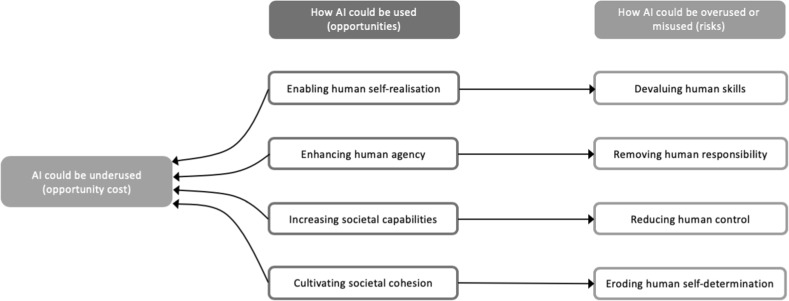
- The authors identify four chief opportunities AI offers society: who we can become, what we can do, what we can achieve, and how we can interact.
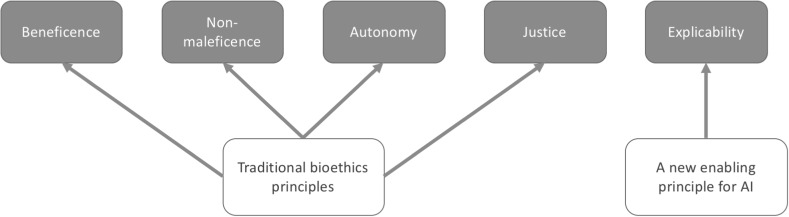
- They synthesize 47 principles from six high-profile AI ethics documents and argue these converge on five principles for AI: beneficence, non-maleficence, autonomy, justice, and explicability.
- The paper argues that AI should be developed to decrease inequality, increase shared benefits, and remain explicable, because explicability is described as critical for public trust and understanding.
- The recommendations section sets out 20 Action Points grouped into assessment, development, incentivisation, and support.
## Methods
- The paper is a conceptual and comparative ethics analysis, not an empirical study.
- It reviews six existing AI ethics documents: Asilomar, Montreal, IEEE, EGE, AIUK, and the Partnership on AI, and compares their principles.
- The authors then synthesize these into a framework and derive 20 recommendations for a Good AI Society.
## Limitations
- The paper states that it presents a European approach meant to be complementary to other approaches, so its recommendations are not claimed to be universally exhaustive or final.
- The text itself makes evident that the analysis is normative and document-based, not based on original empirical data or tested interventions (text-evident limitation).
- The paper also presents the recommendations as a “living document”, implying they are provisional and meant to evolve rather than serve as a definitive endpoint.
Model-written summary. Check it against the paper before relying on it.
Integrity signals
Registry
Cites
Statistics
Figures
Verification
Claims the paper makes
1 Valid · 1 Not valid · 27 Not checked · 35 Own results and interpretations
The cited sources support only part of this claim — read each source’s verdict below.
In the paper
“Everything from email scams to full-scale cyber-warfare may be accelerated or intensified by the malicious use of AI technologies (Taddeo 2018).”
§ AI4People—An Ethical Framework for a Good AI Society: Opportunities, Risks, Principles, and Recommendations > The Opportunities and Risks of AI for Society
What the sources say
- Partly supportedcites Taddeo 2018 matched to “The Limits of Deterrence Theory in Cyberspace” (2018) sourceExperimental — accuracy not yet measured
Section 4.3 (page unavailable) says machine-learning systems deployed for cyber defence can pose risks of unforeseen, disproportionate damage, supporting a narrower concern that AI could intensify harm in cyber conflict. It does not address malicious AI use, email scams, or AI accelerating attacks across that range. (LLM, conf=0.77)
hedgedstates a possible cause- Asserted: passes — The authors put it forward as true.
- Checkable: passes — It can be checked against evidence.
- Load-bearing: unclear — It is unclear whether the paper’s conclusions depend on it.
- Based: passes — The paper gives a reason why it holds.
- Rests on an assumption not shown here.
- Partly supported
None of the sources cited for this claim could be matched to a paper, so there is nothing to check it against.
In the paper
“Taken together, they yield 47 principles.5”
§ AI4People—An Ethical Framework for a Good AI Society: Opportunities, Risks, Principles, and Recommendations > A Unified Framework of Principles for AI in Society
What the sources say
- Not matchedcites Asilomar AI Principles 2017
An author–year citation the paper’s reference list doesn’t settle. We don’t search these by name.
- Not matchedcites Montreal Declaration 2017
An author–year citation the paper’s reference list doesn’t settle. We don’t search these by name.
- Not matchedcites IEEE 2017
An author–year citation the paper’s reference list doesn’t settle. We don’t search these by name.
plainstates a cause- Asserted: passes — The authors put it forward as true.
- Checkable: passes — It can be checked against evidence.
- Load-bearing: passes — The paper’s conclusions depend on it.
- Based: passes — The paper gives a reason why it holds.
- Not matched
A conclusion the paper draws from its own results — it cites no other source for it, so there is none to check. The quote shows it is in the paper.
In the paper
“But they are not exhaustive.”
§ AI4People—An Ethical Framework for a Good AI Society: Opportunities, Risks, Principles, and Recommendations > A Unified Framework of Principles for AI in Society
plain- Asserted: passes — The authors put it forward as true.
- Checkable: passes — It can be checked against evidence.
- Load-bearing: passes — The paper’s conclusions depend on it.
- Based: passes — The paper gives a reason why it holds.
A conclusion the paper draws from its own results — it cites no other source for it, so there is none to check. The quote shows it is in the paper.
In the paper
“On the basis of the following comparative analysis, we argue that one more, new principle is needed in addition: explicability, understood as incorporating both intelligibility and accountability.”
§ AI4People—An Ethical Framework for a Good AI Society: Opportunities, Risks, Principles, and Recommendations > A Unified Framework of Principles for AI in Society
plain- Asserted: passes — The authors put it forward as true.
- Checkable: passes — It can be checked against evidence.
- Load-bearing: passes — The paper’s conclusions depend on it.
- Based: passes — The paper gives a reason why it holds.
A conclusion the paper draws from its own results — it cites no other source for it, so there is none to check. The quote shows it is in the paper.
In the paper
“The four bioethical principles adapt surprisingly well to the fresh ethical challenges posed by artificial intelligence.”
§ AI4People—An Ethical Framework for a Good AI Society: Opportunities, Risks, Principles, and Recommendations > A Unified Framework of Principles for AI in Society
boosted- Asserted: passes — The authors put it forward as true.
- Checkable: passes — It can be checked against evidence.
- Load-bearing: passes — The paper’s conclusions depend on it.
- Based: passes — The paper gives a reason why it holds.
5 more claims
Create a free account to see all 64 claims and every source verdict.
- Probably not a substantial claim. 51
- It may state two separate claims as one. 9
- Not yet classified. 2
- The quote only partly states this claim. 1
Claims other papers make about this one
Each is checked against this paper’s own text: does it say what the citing paper says it does?
The source backs part of the claim, not all of it — or backs it for a different population, condition or comparison.
In the citing paper
“While AI systems can influence learning outcomes through adaptive contributions, they cannot bear responsibility for those outcomes, engage in ethical reflection about educational goals, or possess the experiential understanding that grounds pedagogical wisdom”
From Towards a philosophy of ensemble cognition: Reconceptualising agency and mind in AI-mediated educational environments (2026) · cites this paper as Floridi et al., 2018
Experimental — accuracy not yet measuredThe source backs part of the claim, not all of it — or backs it for a different population, condition or comparison.
In the citing paper
“This trust will be important for the future of AI as a lack of trust could permanently harm the reputation of AI in healthcare, or lead to additional costs through inefficient regulation or repeated amendment (Floridi et al., 2018).”
From Liability for harm caused by AI in healthcare: an overview of the core legal concepts (2023) · cites this paper as Floridi et al., 2018
Experimental — accuracy not yet measuredThe source backs part of the claim, not all of it — or backs it for a different population, condition or comparison.
In the citing paper
“Indeed, the framework played a valuable role in the work of AI 4 People, Europe's first global forum on the social impact of AI, which recently adopted it to propose 20 concrete recommendations for a 'Good AI Society' to the European Commission (Floridi et al., 2018 ).”
From A Unified Framework of Five Principles for AI in Society (2019) · cites this paper as Floridi et al., 2018
Experimental — accuracy not yet measuredThe source backs part of the claim, not all of it — or backs it for a different population, condition or comparison.
In the citing paper
“De manera complementaria, autores como Floridi et al. (2018) abogan por incorporar principios como la justicia, la beneficencia y el respeto por la autonomía en todas las etapas del desarrollo de herramientas basadas en IA [23].”
From Avances, Retos Éticos y Perspectivas de la Inteligencia Artificial (IA) en la Educación de América Latina (2025) · cites this paper as [23]
Experimental — accuracy not yet measuredThe source backs part of the claim, not all of it — or backs it for a different population, condition or comparison.
In the citing paper
“Talos represents ancient human fears about the uncontrollable power of man-made creations, fears that persist into contemporary concerns about AI (Floridi et al., 2018; Sebastian, 2023; Tabassi, 2023b).”
From Delegated agency and moral responsibility in artificial intelligence (2026) · cites this paper as Floridi et al., 2018
Experimental — accuracy not yet measured
30 more claims about this paper
Create a free account to see every claim other papers make about this one.
Citations
Cites
Floridi, L. (2013) · Oxford University Press eBooks · doi:10.1093/acprof:oso/9780199641321.001.0001 · Cited by 651
Self-citationSoft Ethics and the Governance of the Digital
Floridi, L. (2018) · Philosophy & Technology · doi:10.1007/s13347-018-0303-9 · Cited by 325 · cited 2×
“2 The analysis in this and the following two sections is also available in Cowls and Floridi (2018).”
BackgroundSelf-citationArtificial Intelligence Crime: An Interdisciplinary Analysis of Foreseeable Threats and Solutions
King, T. C., Aggarwal, N., Taddeo, M., & Floridi, L. (2020) · Science and Engineering Ethics · doi:10.1007/s11948-018-00081-0 · Cited by 271
Self-citationThe Limits of Deterrence Theory in Cyberspace
Taddeo, M. (2018) · Philosophy & Technology · doi:10.1007/s13347-017-0290-2 · Cited by 98
Prolegomena to a White Paper on an Ethical Framework for a Good AI Society
Cowls, J., & Floridi, L. (2018) · SSRN Electronic Journal · doi:10.2139/ssrn.3198732 · Cited by 76
Self-citationArtificial Intelligence Crime: An Interdisciplinary Analysis of Foreseeable Threats and Solutions
King, T., Aggarwal, N., Taddeo, M., & Floridi, L. (2018) · SSRN Electronic Journal · doi:10.2139/ssrn.3183238 · Cited by 17
Self-citation
Research works printed but not linked: 3
- Asilomar AI Principles. (2017). Principles developed in conjunction with the 2017 Asilomar conference [Benevolent AI 2017]. Retrieved September 18, 2018 from https://futureoflife.org/ai-principles.
- Cowls, J., & Floridi, L. (2018). Prolegomena to a White Paper on Recommendations for the Ethics of AI (June 19, 2018). Available at SSRN: https://ssrn.com/abstract=3198732.
- The IEEE Initiative on Ethics of Autonomous and Intelligent Systems. (2017). Ethically Aligned Design, v2. Retrieved September 18, 2018 from https://ethicsinaction.ieee.org.
Cited by
Items 2,001–2,100 of 4,603
Ethical Implications of AI Applications in Nonprofit and Charity Sectors
Kravchuk, I. І. (2025) · COMPUTER-INTEGRATED TECHNOLOGIES EDUCATION SCIENCE PRODUCTION · doi:10.36910/6775-2524-0560-2025-58-06 · Cited by 2
Babšek, M., Ravšelj, D., Umek, L., & Aristovnik, A. (2025) · SAGE Open · doi:10.1177/21582440251335516 · Cited by 9
Nurturing Virtues with Digital Democratic Innovations
Mikhaylovskaya, A., & Rouméas, É. (2025) · Philosophy & Technology · doi:10.1007/s13347-025-00906-4 · Cited by 3
Ethics in NDE 4.0: Perspectives and Possibilities
Singh, R. R., & Clifford, T. (2025) · Springer eBooks · doi:10.1007/978-3-031-84477-5_61 · Cited by 1
Groenner, L. C., de Faria, L. I. L., & Gracioso, L. D. S. (2025) · Informação & Informação · doi:10.5433/1981-8920.2025v30n1p55 · Cited by 1
From Customer Relationships to AI Companionships: Transforming Marketing with Feeling AI
Chaturvedi, R., Verma, S., & Srivastava, V. (2025) · Vision The Journal of Business Perspective · doi:10.1177/09722629251340483 · Cited by 3
Ali, M., & Wood-Harper, A. T. (2025) · Springer eBooks · doi:10.1007/978-3-031-87604-2_10 · Cited by 1
Revolutionary Impact of Artificial Intelligence on Society and Its Challenges and Opportunities
Kaur, B., & Kour, M. (2025) · Advances in computational intelligence and robotics book series · doi:10.4018/979-8-3373-2612-2.ch014 · Cited by 1
Ethical Challenges in AI-Assisted Translation
Preciado, J. S. A., Ramírez, H. J. S., Sánchez, B. P., & Pérez, E. E. G. (2025) · EthAIca · doi:10.56294/ai2025151 · Cited by 8
What Makes an AI System Human-Centered? Preliminary Findings from an Empirical Study
Pyae, A. (2025) · Creativity and Cognition · doi:10.1145/3698061.3734407 · Cited by 2
Pimentel, A. P., da Motta, C. L. R., Correia, A., de Souza, J. M., & Schneider, D. (2025) · International Conference on Computer Supported Cooperative Work in Design (CSCWD) · doi:10.1109/cscwd64889.2025.11033464 · Cited by 3
Transparency and XAI in AI-Assisted Management Decisions
Kadyan, P., & Singh, R. K. (2025) · Advances in computational intelligence and robotics book series · doi:10.4018/979-8-3373-1737-3.ch001 · Cited by 5
Amrullah, A., Gopindo, R., Ledyawati, & Pakpahan, F. N. (2024) · Business and Investment Review · doi:10.61292/birev.187 · Cited by 2
AI Tools for Enhancing Student Engagement
Pandey, V. K., & Poonia, R. C. (2025) · Advances in computational intelligence and robotics book series · doi:10.4018/979-8-3373-5092-9.ch008 · Cited by 2
Lu, C., & Ruijuan, H. (2025) · Frontiers in Public Health · doi:10.3389/fpubh.2025.1592228 · Cited by 1
Healthcare Outcome Data Analytics through Electronic Health Records (EHR) and LLMs
Marripudugala, M. (2025) · International Conferences on Information Science and System · doi:10.1109/iciss63372.2025.11076450 · Cited by 1
Gitalan, P. V., & Regis, J. M. M. (2025) · Journal of Education and Learning Reviews · doi:10.60027/jelr.2025.2031 · Cited by 1
Toward a responsible and ethical authorization to operate: A case study in AI consulting
Pittman, J. M., & Schaefer, G. (2025) · Journal of Responsible Technology · doi:10.1016/j.jrt.2025.100130 · Cited by 2
Santos, J. C. D., Ribau, C. P., & Martins, I. O. (2025) · IGI Global eBooks · doi:10.4018/979-8-3373-1787-8.ch002 · Cited by 1
Ethical Considerations in the Integration of Artificial Intelligence: A Systematic Review
Geçikli, M. (2025) · IGI Global eBooks · doi:10.4018/979-8-3373-1702-1.ch014 · Cited by 2
The Impact of Artificial Intelligence (AI) on the Sharing Economy: Automation and Optimization
Marin, G.-I., Chițu, F., & Mecu, A. N. (2025) · Proceedings of the ... International Conference on Business Excellence · doi:10.2478/picbe-2025-0260 · Cited by 1
ICAIMT — The Digital Oath for Corporate Governance: A First Model
Najm, M., & Giovani, J. F. D. A. (2025) · Journal of Information & Knowledge Management · doi:10.1142/s0219649225500716 · Cited by 2
A Paradigm Shift from Data Mining to Wisdom Mining
Khan, S. (2025) · Lecture notes in electrical engineering · doi:10.1007/978-981-96-5848-0_12 · Cited by 1
Artificial Intelligence and Equal Opportunity in Education
Üstün, A. G., & Sur, E. (2025) · Advances in computational intelligence and robotics book series · doi:10.4018/979-8-3373-5097-4.ch002 · Cited by 2
Ethics in Danish healthcare AI policy: A document analysis
Jensen, V. V., Jørgensen, M. J., Jensen, R. H., Lange, J., Wolff, J., & Høybye, M. T. (2025) · International Journal of Medical Informatics · doi:10.1016/j.ijmedinf.2025.106065 · Cited by 6
Artificial Intelligence in Chemistry: A Transformative Review
Yadav, S. K., Tripathy, P., & Shahi, S. (2025) · Journal for Research in Applied Sciences and Biotechnology · doi:10.55544/jrasb.4.3.20 · Cited by 3
Sensor-Based to Interaction-Based AI Models in Education: The JOINclusion Case Study
Hortal, E., Semerci, Y. C., Mazzucato, A., & Christidis, J. (2025) · Communications in computer and information science · doi:10.1007/978-3-031-93999-0_16 · Cited by 2
Public Perception in AI-Driven Sustainable Edge-Cloud Management
Pujol, F. A., Ramírez-Gordillo, T., Mora, H., & García, A. M. (2025) · IEEE International Conference on Edge Computing and Communications (EDGE) · doi:10.1109/edge67623.2025.00028 · Cited by 2
The Business Case for AI in Sustainable Development
Mohieldin, M., González-Pérez, M. A., & Zahran, M. (2025) · Springer eBooks · doi:10.1007/978-3-031-93357-8_4 · Cited by 1
Artificial intelligence competence needs for youth workers
Κεχαγιάς, Κ. (2025) · Journal of Non-Formal and Digital Education · doi:10.63734/jnfde.01.01.007 · Cited by 1
Designing Trustworthy AI Systems for PTSD Follow-Up
Cazares, M. F., Miño, J., Ortiz, I., & Andrade, R. (2025) · Technologies · doi:10.3390/technologies13080361 · Cited by 1
Appiah-Kubi, P., Zouhri, K., & Lee, Y. (2025) · ASEE Annual Conference & Exposition · doi:10.18260/1-2--57155 · Cited by 1
Engineering U.S. Responsible AI Policy, A Survey, 2020-2025
Byrne, D. (2025) · ASEE Annual Conference & Exposition · doi:10.18260/1-2--55292 · Cited by 3
Zhang, W., Yao, Y., Xie, R., & Li, D. (2025) · Behaviour and Information Technology · doi:10.1080/0144929x.2025.2546975 · Cited by 4
Орлов, О. (2025) · Public administration aspects · doi:10.15421/152520 · Cited by 10
Knowledge mapping of library digital transformation: A bibliometric study using visual analysis
Yan, C., Zhang, H., & Wang, H. (2025) · Journal of Librarianship and Information Science · doi:10.1177/09610006251353222 · Cited by 2
The Next Frontier of Cybercrime Law for Artificial Intelligence and Criminal Liability
Sattar, S. (2025) · International Journal of Law and Policy · doi:10.59022/ijlp.355 · Cited by 1
AI and IoT in Global Health: Ethical Lessons From Pandemic Response
Pokhrel, L., Kumar, A., Garg, P., Anand, N., & Singh, N. S. S. (2025) · IGI Global eBooks · doi:10.4018/979-8-3373-4134-7.ch013 · Cited by 27
Trustworthy and Interpretable AI for Robust Fraud Detection in Financial Transactions
Prajwalasimha, S. N., Saini, D. K. J. B., Shelke, N. M., Pimpalkar, A. P., Kumar, G. H., & R, P. S. H. (2025) · International Conference for Emerging Technology (INCET) · doi:10.1109/incet64471.2025.11140975 · Cited by 3
Integrating AI-Optimized Smart Grids With Renewable Energy for Accelerated Net-Zero Transition
Jain, N. (2025) · IGI Global eBooks · doi:10.4018/979-8-3373-3226-0.ch015 · Cited by 4
Garba, A. S. (2025) · The Review of Faith & International Affairs · doi:10.1080/15570274.2025.2531643 · Cited by 2
AI as a Catalyst for Expanding CSR: The Case of Moroccan Entreprises
Anouar, H., & Kasbaoui, T. (2025) · International Conference on Circuit, Systems and Communication (ICCSC) · doi:10.1109/iccsc66714.2025.11135146 · Cited by 1
Identifying AI Challenges in Research Practices Through Research Ethics Reviews
Giouvanopoulou, K., Ziouvelou, X., Papademas, M., Karpouzis, K. C., & Karkaletsis, V. (2025) · Lecture notes in computer science · doi:10.1007/978-3-032-01429-0_2 · Cited by 1
Alsarayreh, R., & Alhajahjeh, D. A. (2025) · Human Systems Management · doi:10.1177/01672533251374984 · Cited by 3
A comprehensive survey of AI trust frameworks in healthcare: current state and future directions
Eke, C. I., Shuib, L. M., & Phiri, M. (2025) · Health Services and Outcomes Research Methodology · doi:10.1007/s10742-025-00351-y · Cited by 2
Abdalla, A. A. (2025) · Communications in computer and information science · doi:10.1007/978-3-031-94940-1_15 · Cited by 1
Bibliometric analysis: Ethics in Artificial Intelligence Research Production
Ramsaroop, N. (2025) · Conference on Information Communications Technology and Society (ICTAS) · doi:10.1109/ictas64866.2025.11155741 · Cited by 1
Onder, O. (2025) · AI & Society · doi:10.1007/s00146-025-02603-4 · Cited by 3
Chou, W., Chen, W., & Chen, K. (2025) · Elsevier eBooks · doi:10.1016/b978-0-443-30010-3.00002-7 · Cited by 2
Karadimitriou, A. (2025) · IGI Global eBooks · doi:10.4018/979-8-3693-8729-0.ch004 · Cited by 1
Elamin, M. O. I. (2025) · Lecture notes in computer science · doi:10.1007/978-3-031-97775-6_34 · Cited by 5
Lin, S.-K., & Chung, H.-C. (2025) · SAGE Open · doi:10.1177/21582440251377226 · Cited by 3
Media Literacy in News from World War I to the Artificial Intelligence Era: Reality and Challenges
Aldamen, Y. (2025) · Springer eBooks · doi:10.1007/978-3-031-96720-7_4 · Cited by 1
Protecting Privacy and Ethics in AI-driven Conversational Systems using Laplace Mechanism
Arora, K., Gupta, N., Upreti, K., Jain, R., & Radhakrishnan, G. (2025) · Turkish Journal of Engineering · doi:10.31127/tuje.1690888 · Cited by 2
AI-Driven Consumer Behavior and Decision Making
Jain, S., & Pandey, D. (2025) · Advances in computational intelligence and robotics book series · doi:10.4018/979-8-3373-2502-6.ch005 · Cited by 1
Kayadibi, S. Y. (2026) · Frontiers in Artificial Intelligence · doi:10.3389/frai.2026.1732691 · Cited by 11
Ethical strategic framing of algorithmic authority in global organizations
Kumar, D. (2025) · Journal of Information Communication and Ethics in Society · doi:10.1108/jices-05-2025-0122 · Cited by 2
Atik, S., & Erdemir, N. (2025) · BMC Psychology · doi:10.1186/s40359-025-03246-2 · Cited by 3
Trevisan, A. A. (2025) · IntechOpen eBooks · doi:10.5772/intechopen.1012317 · Cited by 2
AI Ethicist in Action: Strategies for Operationalising AI Ethics
Carnevale, A. (2025) · Springer eBooks · doi:10.1007/978-3-032-05526-2_4 · Cited by 1
Duarte, M., & Mercer, J. (2025) · Gestion et management public · doi:10.3917/e.gmp.134.0117 · Cited by 1
Artificial Intelligence for Sustainable Development: A Systematic Review of Literature
Gupta, K. (2025) · Advances in computational intelligence and robotics book series · doi:10.4018/979-8-3373-7584-7.ch005 · Cited by 1
Yavuz, M., & Kayalı, B. (2025) · Advances in computational intelligence and robotics book series · doi:10.4018/979-8-3373-3815-6.ch006 · Cited by 1
AI-generated urban health indicators: an empirical investigation from Egypt
Bakir, R. A., & Attia, S. (2025) · International Journal of Architectural Research Archnet-IJAR · doi:10.1108/arch-01-2025-0024 · Cited by 3
Dharman, S. (2025) · Nurse Leader · doi:10.1016/j.mnl.2025.102570 · Cited by 1
Ethical Considerations in AI-Enabled Education System
Pratap, A., & Shukla, R. (2025) · BENTHAM SCIENCE PUBLISHERS eBooks · doi:10.2174/9798898811266125050017 · Cited by 2
Guided and Federated RAG: Architectural Models for Trustworthy AI in Data Spaces
Braga, C. M., Serrano, M., & Fernández‐Medina, E. (2025) · Lecture notes in computer science · doi:10.1007/978-3-032-10489-2_31 · Cited by 3
Ferjani, I., Alzahrani, F., & Bouzir, N. M. (2025) · Procedia Computer Science · doi:10.1016/j.procs.2025.09.598 · Cited by 3
Sun, F., Isovic, D., & Dodig-Crnković, G. (2025) · doi:10.3390/proceedings2025126017 · Cited by 2
The Ethics and Problems of Artificial Intelligence
Munavarov, A., & Abdullaeva, M. (2025) · Scientia. Technology, science and society. · doi:10.59324/stss.2025.2(11).10 · Cited by 1
Ramachandran, M. (2025) · Springer eBooks · doi:10.1007/978-981-95-2909-4_5 · Cited by 1
Ramachandran, M. (2025) · Springer eBooks · doi:10.1007/978-981-95-2909-4_10 · Cited by 1
AI Ethics by Design with AI Reference Architecture: Embedding Ethics by Design in AI Architecture
Ramachandran, M. (2025) · Springer eBooks · doi:10.1007/978-981-95-2909-4_9 · Cited by 1
AI Governance: Ethics of Trustworthy AI in Healthcare
Skubis, I. (2025) · International Joint Conference on Neural Networks (IJCNN) · doi:10.1109/ijcnn64981.2025.11229217 · Cited by 5
Kochupillai, M. (2025) · Springer eBooks · doi:10.1007/978-3-031-97445-8_4 · Cited by 2
Xing, Y., He, Y., & Zeng, L. (2025) · Technological Forecasting and Social Change · doi:10.1016/j.techfore.2025.124445 · Cited by 2
Explainable AI for Decision-Making in Decentralized Energy Trading
Sharma, V. C., & Babber, K. (2025) · Advances in computational intelligence and robotics book series · doi:10.4018/979-8-3373-5540-5.ch005 · Cited by 2
Estiri, M., Dahooie, J. H., Ghorbani, A., Mohammadi, N., Khanam, M., Moughari, M. M., & Daim, T. U. (2025) · Review of Managerial Science · doi:10.1007/s11846-025-00963-1 · Cited by 4
Intercultural Design for Human-Centered AI Solutions
Heimgärtner, R. (2025) · Springer eBooks · doi:10.1007/978-981-95-3658-0_77 · Cited by 1
Human at the Center: A Framework for Human‐Driven AI Development
Hu, D., Acosta-Navas, D., Gaube, S., Mozannar, H., Taylor, M. E., Dvijotham, K., & Bondi, E. (2025) · AI Magazine · doi:10.1002/aaai.70043 · Cited by 4
Artificial Intelligence in Project Management: Challenges, Strategies and Best Practices
Mogbojuri, A. O., Obiseye, O., Wali, A., & Dewa, M. (2025) · F1000Research · doi:10.12688/f1000research.169682.1 · Cited by 10
MERDİN, M., & Karaçor, S. (2025) · Selçuk Üniversitesi Sosyal Bilimler Meslek Yüksekokulu dergisi · doi:10.29249/selcuksbmyd.1781509 · Cited by 1
Making sense of the ‘Human’ in human-centered AI: an Arendtian perspective
Stellinga, L., Korenhof, P., & Blok, V. (2025) · AI & Society · doi:10.1007/s00146-025-02769-x · Cited by 2
Deepfake Detection and Cybersecurity Index: The Role of Computer Vision as a Digital Forensic Tool
Modupeola, T., Oluwasusi, V. A., Azar, N. A. N., & Ichull, A. P. (2025) · International Symposium on Multidisciplinary Studies and Innovative Technologies (ISMSIT) · doi:10.1109/ismsit67332.2025.11268234 · Cited by 1
The meaning of prompts: a semiotic approach to human–machine communication
Thellefsen, M., Dewi, A. N., & Sørensen, B. M. (2026) · Journal of Documentation · doi:10.1108/jd-03-2026-0140 · Cited by 6
Marsili, M. (2025) · Applied Cybersecurity & Internet Governance · doi:10.60097/acig/214045 · Cited by 1
Artificial Intelligence–Based Clinical Assessment in Mood Disorders: A Narrative Review
Çömlekci, M. N., & Yılmaz, T. (2025) · Psikiyatride Guncel Yaklasimlar - Current Approaches in Psychiatry · doi:10.18863/pgy.1749490 · Cited by 1
Artificial Intelligence and Automation in the Brazilian Judicial System
da Silva, F. C. C., & de Oliveira, A. F. (2025) · Brazilian Journal of Information Science research trends · doi:10.36311/1981-1640.2025.v19.e025039 · Cited by 1
Vanam, L., Kundurthy, O. H., & Ghadiyaram, R. (2025) · Asian Conference on Innovation in Technology (ASIANCON) · doi:10.1109/asiancon66527.2025.11280739 · Cited by 2
Reflexivity and positionality statements: a way to tackle “second-level arbitrariness” bias in AI?
Conti, L. G., & Seele, P. (2025) · Humanities and Social Sciences Communications · doi:10.1057/s41599-025-06208-6 · Cited by 4
A study on vulnerability analysis process of generative AI-based digital medical contents
Ko, H., Měsíček, L., Ogiela, M. R., & Cho, Y. (2025) · Internet of Things · doi:10.1016/j.iot.2025.101759 · Cited by 4
Towards a General Principle of Vulnerability: Is Private Law Ready for the Digital Age?
Otero, B. G. (2025) · Springer eBooks · doi:10.1007/978-3-031-97389-5_7 · Cited by 1
Human-Controllable AI: Meaningful Human Control
Liu, C., & Xu, W. (2025) · Springer eBooks · doi:10.1007/978-981-97-8440-0_58-1 · Cited by 26
Barman, T., & Çakın, İ. (2025) · Ankara Üniversitesi ilef dergisi/Ankara üniversitesi ilef dergisi · doi:10.24955/ilef.1662275 · Cited by 1
Introduction: Gestion de l’éducation et intelligence artificielle. Freins et leviers
Boulaamane, K., & Bouchamma, Y. (2025) · Enjeux et société Approches transdisciplinaires · doi:10.7202/1122019ar · Cited by 2
ROY, N. (2025) · Journal of Multidisciplinary Knowledge · doi:10.36676/jmk.v5.i2.76 · Cited by 2
Teknolojinin İş Sağlığı ve Güvenliği Üzerindeki Yansımaları: Dijitalleşme ve Yenilikler
Taşdemir, D. Ç. (2025) · Osmaniye Korkut Ata Üniversitesi Fen Bilimleri Enstitüsü Dergisi · doi:10.47495/okufbed.1658610 · Cited by 1
A review of ethical AI frameworks in product development: taking stock and moving forward
Wecker, L., Nielsen, J. A., Nasrollahi, K., & Ploug, T. (2025) · AI and Ethics · doi:10.1007/s43681-025-00952-w · Cited by 2
Unveiling the Capacity of Artificial Intelligence in Mitigating Nurse Burnout
Choudhary, P., & Poonia, M. (2025) · JONA The Journal of Nursing Administration · doi:10.1097/nna.0000000000001673 · Cited by 2
Metadata
- Authors
- Floridi, L., Cowls, J., Beltrametti, M., Chatila, R., Chazerand, P., Dignum, V., Luetge, C., Madelin, R., Pagallo, U., Rossi, F., Schafer, B., Valcke, P., & Vayena, E.
- Affiliations
- University of Oxford (GB)
- Centre National de la Recherche Scientifique (FR)
- Digital Europe (BE)
- Umeå University (SE)
- University of Turin (IT)
- IBM (United States) (US)
- Bocconi University (IT)
- ETH Zurich (CH)
- Corresponding author
- Floridi, Luciano
- ORCID
- Venue
- Minds and Machines
- Published
- 2018-11-26
- Volume
- 28
- Issue
- 4
- Pages
- 689-707
- ISSN
- 0924-6495 (ISSN-L)
- 1572-8641
- PMC
- PMC6404626
- OpenAlex
- W2902634493
- Cited by
- 4,774
- References
- 8
- Citations by year
- 2026: 1965 · 2025: 1116 · 2024: 523 · 2023: 413 · 2022: 287 · 2021: 255 · 2020: 145 · 2019: 70
- FWCI
- 234.15
- Type
- journal article
- Language
- en
- Open access
- hybrid
- doi.org
- Licence
- cc-by
- creativecommons.org/licenses/by/4.0 (tdm)
- Locations
- Minds and Machines (publishedVersion, cc-by)
- Europe PMC (PubMed Central) (publishedVersion, other-oa)
- PubMed Central (publishedVersion, cc-by)
- PubMed (publishedVersion)
- Institutional Research Information System University of Turin (University of Turin) (submittedVersion, other-oa)
- Lirias (submittedVersion, cc-by)
- Data Archiving and Networked Services (DANS) (submittedVersion, cc-by)
- DiVA at Umeå University (Umeå University) (submittedVersion, other-oa)
- mediaTUM – the media and publications repository of the Technical University Munich (Technical University Munich) (submittedVersion, other-oa)
- mediaTUM – the media and publications repository of the Technical University Munich (Technical University Munich) (submittedVersion)
- PhilPapers (PhilPapers Foundation) (submittedVersion)
- Edinburgh Research Explorer (University of Edinburgh) (submittedVersion, cc-by)
- Research Repository (Delft University of Technology) (submittedVersion)
- Repository for Publications and Research Data (ETH Zurich) (submittedVersion, cc-by)
- ETH Zürich Research Collection (cc-by)
- Funders
- Atomium
- Topics
- Physical Sciences › Computer Science › Artificial Intelligence › Ethics and Social Impacts of AI
- Social Sciences › Law › Digitalization, Law, and Regulation
- Physical Sciences › Environmental Science › Management, Monitoring, Policy and Law › Innovation, Sustainability, Human-Machine Systems
- Keywords
- AI ethics, ethical principles, AI policy recommendations, AI governance, artificial intelligence adoption
About these checks
Registry, retraction, Cites and statistics results are computed, not judged, with one exception: a printed reference that no index lists is read once by a model before it counts as a citation error. Claims are extracted by a model and kept only when their quote appears verbatim in the text; each cited source is then checked, with a model’s help, for whether it says what the claim relies on. Those verdicts can be wrong — read the claim’s quote and the cited source before relying on one.
The claim verdicts this report counts are experimental: their accuracy is not yet measured.
A language model drew the claims from the paper on 2026-09-28, under version 3 of the claim definition (model deepseek-v4.1-flash, prompt extract-v3).
A second model labelled each claim on 2026-09-28 (model jev-1.13-20260917, definition revision gold-guideline-v0.2).
Cited sources are checked with a language model’s help (gpt-6-sol).
Statistics and arithmetic are recomputed, not judged.
Confidence bands are shown only for fields calibrated on our annotated test set. None is calibrated yet, so no band is shown.
What counts as a claim ›How we measure confidence ›How we check this ›
Are you an author, or do you see a problem with this page? Request a review
Data sources
Bibliographic data: Semantic Scholar, OpenAlex, Crossref.
Contains information from the Semantic Scholar Academic Graph Datasets, made available under the ODC Attribution License (ODC-BY 1.0).
Semantic Scholar’s data is described in: Kinney, R., et al. (2023). The Semantic Scholar Open Data Platform. arXiv:2301.10140.
