

Life cycle comparison of hydrothermal liquefaction and lipid extraction pathways to renewable diesel from algae
Open accessThe DOI matches its Crossref record; 33 of the 35 references it cites were found in a registry or an index.
Abstract
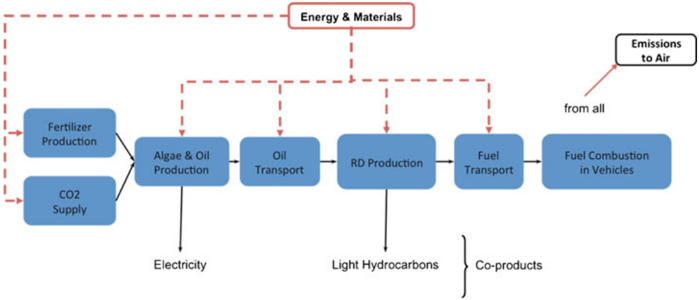
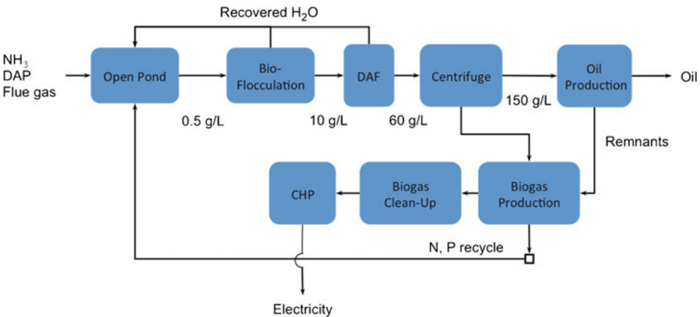
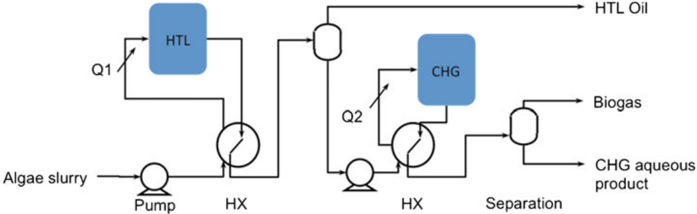
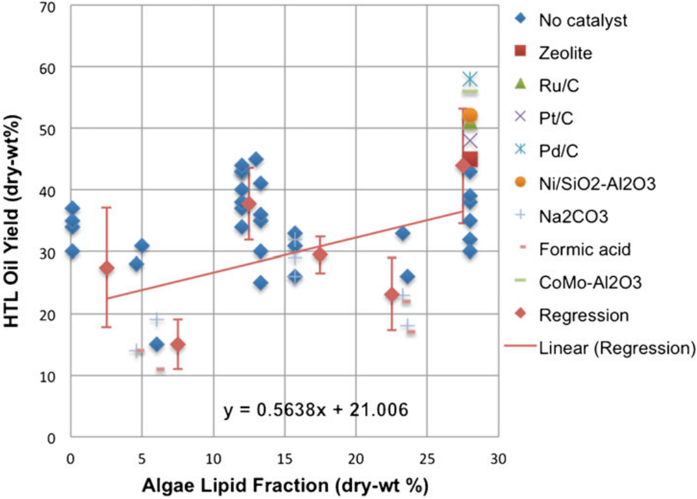
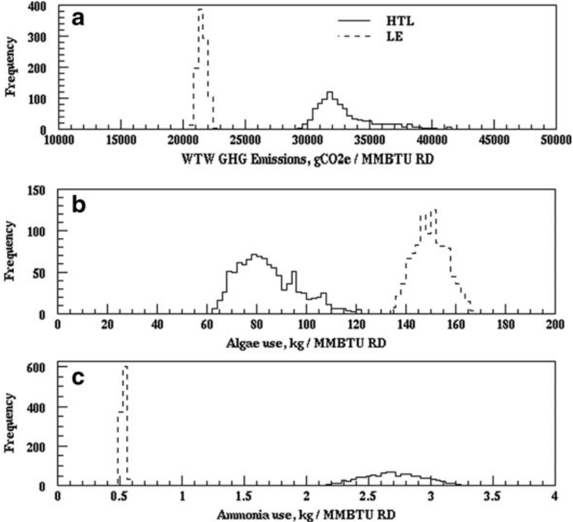
Algae biomass is an attractive biofuel feedstock when grown with high productivity on marginal land. Hydrothermal liquefaction (HTL) produces more oil from algae than lipid extraction (LE) does because protein and carbohydrates are converted, in part, to oil. Since nitrogen in the algae biomass is incorporated into the HTL oil, and since lipid extracted algae for generating heat and electricity are not co-produced by HTL, there are questions regarding implications for emissions and energy use. We studied the HTL and LE pathways for renewable diesel (RD) production by modeling all essential operations from nutrient manufacturing through fuel use. Our objective was to identify the key relationships affecting HTL energy consumption and emissions. LE, with identical upstream growth model and consistent hydroprocessing model, served as reference. HTL used 1.8 fold less algae than did LE but required 5.2 times more ammonia when nitrogen incorporated in the HTL oil was treated as lost. HTL RD had life cycle emissions of 31,000 gCO 2 equivalent (gCO 2 e) compared to 21,500 gCO 2 e for LE based RD per million BTU of RD produced. Greenhouse gas (GHG) emissions increased when yields exceeded 0.4 g HTL oil/g algae because insufficient carbon was left for biogas generation. Key variables in the analysis were the HTL oil yield, the hydrogen demand during upgrading, and the nitrogen content of the HTL oil. Future work requires better data for upgrading renewable oils to RD and requires consideration of nitrogen recycling during upgrading.
Overview
The claims and statistics of this paper haven’t been checked yet.
Free: it reads the open-access text and checks the first 5 claims that cite a source we can check. Create a free account to check every claim.
Integrity signals
Registry
Cites
Statistics
Figures
Verification
Claims the paper makes
The claims and statistics of this paper haven’t been checked yet.
Free: it reads the open-access text and checks the first 5 claims that cite a source we can check. Create a free account to check every claim.
Claims other papers make about this one
Each is checked against this paper’s own text: does it say what the citing paper says it does?
The source backs part of the claim, not all of it — or backs it for a different population, condition or comparison.
In the citing paper
“Frank et al. [34] report a lower GHG result compared to this study which is attributed to differences in downstream processing following biooil recovery through HTL and higher yield.”
From Lifecycle assessment of microalgae to biofuel: Comparison of thermochemical processing pathways (2015) · cites this paper as [34]
Experimental — accuracy not yet measuredThe cited source says what the claim attributes to it.
In the citing paper
“Only a limited number of studies included assessment of thermochemical conversion technologies on the metrics of net energy and greenhouse gas (GHG) emissions has been limited [1, 27, 28, 34, 60].”
From Lifecycle assessment of microalgae to biofuel: Comparison of thermochemical processing pathways (2015) · cites this paper as [34]
In the citing paper
“Frank et al. [34] examined the environmental impact of an HTL process with a well to pump (WTP) system boundary, but includes an additional processing of HTL byproducts to biogas.”
From Lifecycle assessment of microalgae to biofuel: Comparison of thermochemical processing pathways (2015) · cites this paper as [34]
In the citing paper
“HTL has been demonstrated to effectively convert wet, 20% solids, microalgae feedstock into bio-oil [2, 28, 34, 66].”
From Lifecycle assessment of microalgae to biofuel: Comparison of thermochemical processing pathways (2015) · cites this paper as [34]
In the citing paper
“Hydrogen demands for hydroprocessing and renewable diesel yields are determined based on the methods of Frank et al. [34] with details presented in the supplementary information.”
From Lifecycle assessment of microalgae to biofuel: Comparison of thermochemical processing pathways (2015) · cites this paper as [34]
1 more claim about this paper
Create a free account to see every claim other papers make about this one.
Self-check
Percentages, sums and reported differences re-computed from the paper’s own numbers.
The self-check needs the paper’s full text.
Citations
Cites
(2007) · Medical Entomology and Zoology · Cited by 9,612
Rodolfi, L., Chini Zittelli, G., Bassi, N., Padovani, G., Biondi, N., Bonini, G., & Tredici, M. R. (2009) · Biotechnology and Bioengineering · doi:10.1002/bit.22033 · Cited by 2,879 · cited 2×
“2011a, 2012); however, high-lipid algae have low productivity during the lipid accumulation phase (Rodolfi et al. 2009).”
Background(2007) · doi:10.1002/9780470172605 · Cited by 2,813
Life-Cycle Assessment of Biodiesel Production from Microalgae
Lardon, L., Hélias, A., Sialve, B., Steyer, J.-P., & Bernard, O. (2009) · Environmental Science & Technology · doi:10.1021/es900705j · Cited by 1,528
Williams, P. J. L. B., & Laurens, L. M. L. (2010) · Energy & Environmental Science · doi:10.1039/b924978h · Cited by 1,223 · cited 5×
“…we consider HTL RD yields between 0.75 and 0.85 and hydrogen demands between 0.065 and Table 6 Elemental composition of LE, HTL, and soybean oils Weight % Oil C H O N LE a 71 % 11 % 16 % 0.2 % HTL b 73 % 9.2 % 11 % 5.7 % Soybean c 77 % 12 % 12 % 0 % a Table 1 in Williams and Laurens (2010), C1H1.”
BackgroundMethodInfluentialBiller, P., & Ross, A. B. (2011) · Bioresource Technology · doi:10.1016/j.biortech.2010.06.028 · Cited by 1,131 · cited 10×
“…reports different yields for the various fractions (Table 1) and different distributions of solids between oil and aqueous phases (Alba et al. 2012; Biller and Ross 2011; Brown et al. 2010; Duan and Savage 2011; Jena and Das 2011; Jena et al. 2011; Minowa et al. 1995; Valdez et al. 2011; Vardon et…”
BackgroundMethodInfluentialEnvironmental Life Cycle Comparison of Algae to Other Bioenergy Feedstocks
Clarens, A. F., Resurreccion, E. P., White, M. A., & Colosi, L. M. (2010) · Environmental Science & Technology · doi:10.1021/es902838n · Cited by 1,118 · cited 1×
“Previous work showed that electricity production and nutrient recycling greatly affect energy and nutrient demands in the process (Campbell et al. 2009; Clarens et al. 2010, 2011; Frank et al. 2011a, 2012; Lardon et al. 2009; Stephenson et al. 2010).”
BackgroundTechno-Economic Analysis of Autotrophic Microalgae for Fuel Production
Davis, R., Aden, A., & Pienkos, P. T. (2011) · Applied Energy · doi:10.1016/j.apenergy.2011.04.018 · Cited by 1,069 · cited 2×
“High lipid fractions are required to improve economic viability (Davis et al. 2011) and to reduce water consumption and emissions on a fuel-basis (Wigmosta et al. 2011; Frank et al. 2011a, 2012); however, high-lipid algae have low productivity during the lipid accumulation phase (Rodolfi et al.…”
BackgroundHydrothermal liquefaction and gasification of Nannochloropsis sp.
Brown, T. M., Duan, P., & Savage, P. E. (2010) · Energy & Fuels · doi:10.1021/ef100203u · Cited by 745 · cited 8×
“…required and that the HTL oil can contain substantial amounts of nitrogen incorporated from the algal biomass (Alba et al. 2012; Biller and Ross 2011; Brown et al. 2010; Duan and Savage 2011; Jena and Das 2011; Jena et al. 2011; Minowa et al. 1995; Valdez et al. 2011; Vardon et al. 2011; Yu et al.…”
BackgroundMethodInfluentialVardon, D. R., Sharma, B. K., Scott, J., Yu, G., Wang, Z., Schideman, L., Zhang, Y., & Strathmann, T. J. (2011) · Bioresource Technology · doi:10.1016/j.biortech.2011.06.041 · Cited by 662 · cited 7×
“That work indicates that high temperatures (250°C to 350°C) and high pressures (approximately 10 to 20 MPa) are required and that the HTL oil can contain substantial amounts of nitrogen incorporated from the algal biomass (Alba et al. 2012; Biller and Ross 2011; Brown et al. 2010; Duan and Savage 2011; Jena and Das 20…”
BackgroundMethodInfluentialSelf-citationHydrothermal liquefaction of a microalga with heterogeneous catalysts
Duan, P., & Savage, P. E. (2011) · Industrial & Engineering Chemistry Research · doi:10.1021/ie100758s · Cited by 608 · cited 6×
“That work indicates that high temperatures (250°C to 350°C) and high pressures (approximately 10 to 20 MPa) are required and that the HTL oil can contain substantial amounts of nitrogen incorporated from the algal biomass (Alba et al. 2012; Biller and Ross 2011; Brown et al. 2010; Duan and Savage 2011; Jena and Das 20…”
BackgroundInfluentialA Realistic Technology and Engineering Assessment of Algae Biofuel Production
Lundquist, T., Woertz, I., Quinn, N. W. T., & Benemann, J. R. (2010) · DigitalCommons - CalPoly (California State Polytechnic University) · Cited by 579
Stephenson, A. L., Kazamia, E., Dennis, J. S., Howe, C. J., Scott, S. A., & Smith, A. G. (2010) · Energy & Fuels · doi:10.1021/ef1003123 · Cited by 571 · cited 2×
“Previous work showed that electricity production and nutrient recycling greatly affect energy and nutrient demands in the process (Campbell et al. 2009; Clarens et al. 2010, 2011; Frank et al. 2011a, 2012; Lardon et al. 2009; Stephenson et al. 2010).”
BackgroundResultOil production from algal cells of Dunaliella tertiolecta by direct thermochemical liquefaction
Minowa, T., Yokoyama, S.-Y., Kishimoto, M., & Okakura, T. (1995) · Fuel · doi:10.1016/0016-2361(95)80001-x · Cited by 522 · cited 7×
“That work indicates that high temperatures (250°C to 350°C) and high pressures (approximately 10 to 20 MPa) are required and that the HTL oil can contain substantial amounts of nitrogen incorporated from the algal biomass (Alba et al. 2012; Biller and Ross 2011; Brown et al. 2010; Duan and Savage 2011; Jena and Das 20…”
BackgroundInfluentialJena, U., Das, K. C., & Kastner, J. R. (2011) · Bioresource Technology · doi:10.1016/j.biortech.2011.02.057 · Cited by 500 · cited 6×
“That work indicates that high temperatures (250°C to 350°C) and high pressures (approximately 10 to 20 MPa) are required and that the HTL oil can contain substantial amounts of nitrogen incorporated from the algal biomass (Alba et al. 2012; Biller and Ross 2011; Brown et al. 2010; Duan and Savage 2011; Jena and Das 20…”
BackgroundInfluentialGarcia Alba, L., Torri, C., Samorì, C., van der Spek, J., Fabbri, D., Kersten, S. R. A., & Brilman, D. W. F. (. (2012) · Energy & Fuels · doi:10.1021/ef201415s · Cited by 477 · cited 6×
“That work indicates that high temperatures (250°C to 350°C) and high pressures (approximately 10 to 20 MPa) are required and that the HTL oil can contain substantial amounts of nitrogen incorporated from the algal biomass (Alba et al. 2012; Biller and Ross 2011; Brown et al. 2010; Duan and Savage 2011; Jena and Das 20…”
BackgroundInfluentialJena, U., & Das, K. C. (2011) · Energy & Fuels · doi:10.1021/ef201373m · Cited by 405 · cited 6×
“That work indicates that high temperatures (250°C to 350°C) and high pressures (approximately 10 to 20 MPa) are required and that the HTL oil can contain substantial amounts of nitrogen incorporated from the algal biomass (Alba et al. 2012; Biller and Ross 2011; Brown et al. 2010; Duan and Savage 2011; Jena and Das 20…”
BackgroundInfluentialYu, G., Zhang, Y., Schideman, L., Funk, T., & Wang, Z. (2011) · Energy & Environmental Science · doi:10.1039/c1ee01541a · Cited by 348 · cited 9×
“That work indicates that high temperatures (250°C to 350°C) and high pressures (approximately 10 to 20 MPa) are required and that the HTL oil can contain substantial amounts of nitrogen incorporated from the algal biomass (Alba et al. 2012; Biller and Ross 2011; Brown et al. 2010; Duan and Savage 2011; Jena and Das 20…”
BackgroundInfluentialSelf-citationElliott, D. C., Sealock, L. J., & Baker, E. G. (1993) · Industrial & Engineering Chemistry Research · doi:10.1021/ie00020a002 · Cited by 293 · cited 2×
“wet organic feed stream to biogas and ammonia via catalysis with over 99 % efficiency for organic carbon (Elliott et al. 1993; Elliott and Sealock 1996).”
BackgroundMethodNational microalgae biofuel production potential and resource demand
Wigmosta, M. S., Coleman, A. M., Skaggs, R. J., Huesemann, M. H., & Lane, L. J. (2011) · Water Resources Research · doi:10.1029/2010wr009966 · Cited by 289 · cited 2×
“High lipid fractions are required to improve economic viability (Davis et al. 2011) and to reduce water consumption and emissions on a fuel-basis (Wigmosta et al. 2011; Frank et al. 2011a, 2012); however, high-lipid algae have low productivity during the lipid accumulation phase (Rodolfi et al.…”
BackgroundHuo, H., Wang, M., Bloyd, C., & Putsche, V. (2009) · Environmental Science & Technology · doi:10.1021/es8011436 · Cited by 279 · cited 2×
“11 from Huo et al. (2008)”
BackgroundInfluentialEnvironmental Impacts of Algae-Derived Biodiesel and Bioelectricity for Transportation
Clarens, A. F., Nassau, H., Resurreccion, E. P., White, M. A., & Colosi, L. M. (2011) · Environmental Science & Technology · doi:10.1021/es200760n · Cited by 226 · cited 1×
“Previous work showed that electricity production and nutrient recycling greatly affect energy and nutrient demands in the process (Campbell et al. 2009; Clarens et al. 2010, 2011; Frank et al. 2011a, 2012; Lardon et al. 2009; Stephenson et al. 2010).”
BackgroundGREET 1.5 - transportation fuel-cycle model - Vol. 1 : methodology, development, use, and results.
Wang, M. Q. (1999) · doi:10.2172/14775 · Cited by 222 · cited 1×
“GREET is a publicly available LCA tool that investigates numerous fuel and vehicle cycles (Wang 1999a, b; GREET 2011).”
MethodValdez, P. J., Dickinson, J. G., & Savage, P. E. (2011) · Energy & Fuels · doi:10.1021/ef2004046 · Cited by 208 · cited 5×
“That work indicates that high temperatures (250°C to 350°C) and high pressures (approximately 10 to 20 MPa) are required and that the HTL oil can contain substantial amounts of nitrogen incorporated from the algal biomass (Alba et al. 2012; Biller and Ross 2011; Brown et al. 2010; Duan and Savage 2011; Jena and Das 20…”
BackgroundMethodInfluentialOperating problems in anaerobic digestion plants resulting from nitrogen in MSW
Fricke, K., Santen, H., Wallmann, R., Hüttner, A., & Dichtl, N. (2007) · Waste Management · doi:10.1016/j.wasman.2006.03.003 · Cited by 178 · cited 2×
“Since C/N should be 20 to 30 for successful AD (Fricke et al. 2007) and since methanogenic activity ceased at 6,000 mg NH4–N/L (Sawayama et al.”
BackgroundEnvironmental performance of algal biofuel technology options
Vasudevan, V., Stratton, R. W., Pearlson, M. N., Jersey, G. R., Beyene, A. G., Weissman, J. C., Rubino, M., & Hileman, J. I. (2012) · Environmental Science & Technology · doi:10.1021/es2026399 · Cited by 157 · cited 2×
“Additionally, much of the biomass energy is not recovered as liquid fuel but remains in the LEA. Finally, wet extraction processes have not been demonstrated, yet dry processes require excessive drying energy (Vasudevan et al. 2012).”
BackgroundEffect of Ammonium Addition on Methanogenic Community in a Fluidized Bed Anaerobic Digestion
Sawayama, S., Tada, C., Tsukahara, K., & Yagishita, T. (2004) · Journal of Bioscience and Bioengineering · doi:10.1016/s1389-1723(04)70167-x · Cited by 141 · cited 2×
“2007) and since methanogenic activity ceased at 6,000 mg NH4–N/L (Sawayama et al. 2004), the nitrogen level is too high for Mitig Adapt Strateg Glob Change (2013) 18:137–158 139”
BackgroundOpportunities for Biorenewables in Oil Refineries
Marker, T. L. (2005) · doi:10.2172/861458 · Cited by 105 · cited 1×
“Marker et al. (2005) reports upgrading vegetable oil to renewable diesel by hydroprocessing.”
BackgroundUludag‐Demirer, S., & Othman, M. Z. (2009) · Bioresource Technology · doi:10.1016/j.biortech.2009.02.030 · Cited by 96 · cited 2×
“O th er au th or s as sa y ga s vo lu m et ri ca lly treatment with anaerobic digestion (AD) unless special configurations are used that reduce the nitrogen content, e.g., by precipitation (Uludag-Demirer and Othman 2009).”
MethodMethane and nitrous oxide emissions affect the life-cycle analysis of algal biofuels
Frank, E. D., Han, J., Palou-Rivera, I., Elgowainy, A., & Wang, M. Q. (2012) · Environmental Research Letters · doi:10.1088/1748-9326/7/1/014030 · Cited by 86 · cited 5×
“…lipid fractions are required to improve economic viability (Davis et al. 2011) and to reduce water consumption and emissions on a fuel-basis (Wigmosta et al. 2011; Frank et al. 2011a, 2012); however, high-lipid algae have low productivity during the lipid accumulation phase (Rodolfi et al. 2009).”
BackgroundInfluentialSelf-citationCatalytic Hydrotreating of Biomass-Derived Oils
Baker, E. G., & Elliott, D. C. (1988) · ACS Symposium Series · doi:10.1021/bk-1988-0376.ch021 · Cited by 84 · cited 3×
“Four experiments in Baker and Elliott (1988) upgraded HTL oil from woody biomass to an oil with H/C ranging from 1.”
BackgroundInfluentialReaction mechanisms of hydrothermal liquefaction of model compounds and biowaste feedstocks
Wang, Z. (2011) · Illinois Digital Environment for Access to Learning and Scholarship (University of Illinois at Urbana-Champaign) · Cited by 48
Self-citation
Research works printed but not linked: 5
- Campbell PK, Beer T, Batten D (2009) Greenhouse gas sequestration by algae - energy and greenhouse gas life cycle studies. CSIRO, Clayton
- Elliott D, Sealock L Jr (1996) Chemical processing in high-pressure aqueous environments: low-temperature catalytic gasification. Chem Eng Res Des 74:563-566
- Lupton S, Kassa N, Galloway D, Lynch S (2011) Conversion of algal oils to hydrocarbon fuels. Presented at the 1st international conference on algal biomass, biofuels & bioproducts, St. Louis MO, 17-20 July 2011
- Shah RK, Sekulic DP (2002) Fundamentals of heat exchanger design. Wiley, Hoboken
- Wang M (1999a) The Greenhouse gases, regulated emissions, and energy use in transportation (GREET) model version 1.5. Argonne National Laboratory Wang M (1999b) GREET 1.5-transportation fuel-cycle model-Vol. 1: methodology, development, use, and results. ANL/ESD-39. Argonne National Laboratory
Cited by
Techno-Economic Analysis of Autotrophic Microalgae for Fuel Production
Davis, R., Aden, A., & Pienkos, P. T. (2011) · Applied Energy · doi:10.1016/j.apenergy.2011.04.018 · Cited by 1,069
A review of hydrothermal biomass processing
Tekin, K., Karagöz, S., & Bektaş, S. (2014) · Renewable and Sustainable Energy Reviews · doi:10.1016/j.rser.2014.07.216 · Cited by 730
Constraints to Commercialization of Algal Fuels
Chisti, Y. (2013) · Journal of Biotechnology · doi:10.1016/j.jbiotec.2013.07.020 · Cited by 719
“Under certain conditions, the combustible gases produced hrough hydrothermal liquefaction may be used to supply sufficient nergy to run the biomass production processes (Frank et al., 2013).”
BackgroundSustainability of the four generations of biofuels – A review
Mat Aron, N. S., Khoo, K. S., Chew, K. W., Show, P. L., Chen, W., & Nguyen, T. H. P. (2020) · International Journal of Energy Research · doi:10.1002/er.5557 · Cited by 479
Quinn, J. C., & Davis, R. (2015) · Bioresource Technology · doi:10.1016/j.biortech.2014.10.075 · Cited by 476
Metadata
- Authors
- Frank, E. D., Elgowainy, A., Han, J., & Wang, Z.
- Affiliations
- Argonne National Laboratory (US)
- Corresponding author
- Frank, Edward D.
- Venue
- Mitigation and Adaptation Strategies for Global Change
- Published
- 2012-06-07
- Volume
- 18
- Issue
- 1
- Pages
- 137-158
- ISSN
- 1381-2386 (ISSN-L)
- 1573-1596
- OpenAlex
- W2157432012
- Cited by
- 220
- References
- 35
- Citations by year
- 2026: 1 · 2025: 13 · 2024: 8 · 2023: 4 · 2022: 10 · 2021: 20 · 2020: 15 · 2019: 17 · 2018: 17 · 2017: 20 · 2016: 27 · 2015: 21 · 2014: 31 · 2013: 14 · 2012: 1
- FWCI
- 8.23
- Type
- journal article
- Language
- en
- Open access
- hybrid
- doi.org
- Licence
- cc-by
- creativecommons.org/licenses/by/2.0 (tdm)
- Locations
- Mitigation and Adaptation Strategies for Global Change (publishedVersion, cc-by)
- RePEc: Research Papers in Economics (submittedVersion)
- Funders
- U.S. Department of Energy (DE‐ AC02‐06CH11357, Contract No. DE-AC02-06CH11357., AC02‐06CH11357, 06CH11357, No. DE-AC02-06CH11357, DE-AC02-)
- University of Chicago (DE-AC02-06CH11357)
- University of Illinois at Urbana-Champaign
- Office of Energy Efficiency and Renewable Energy (AC02-06CH11357, DE‐AC02‐06CH11357, Contract No. DE-AC02-06CH11357)
- Biomass Program (DE-AC02-06CH11357)
- Office of Energy Efficiency
- Argonne National Laboratory (DE- AC02-06-CH11357, DE-AC02, AC02–06CH11357, No. DE-AC02-06CH11357, 06CH11357, Contract No. DE-AC02-06CH11357.)
- Topics
- Physical Sciences › Energy › Renewable Energy, Sustainability and the Environment › Algal biology and biofuel production
- Physical Sciences › Environmental Science › Environmental Engineering › Environmental Impact and Sustainability
- Life Sciences › Agricultural and Biological Sciences › Agronomy and Crop Science › Bioenergy crop production and management
- Keywords
- hydrothermal liquefaction, lipid extraction, algal biomass, renewable diesel, life cycle assessment, greenhouse gas emissions, nitrogen incorporation, hydroprocessing, biogas, marginal land cultivation, nitrogen recycling, energy consumption
About these checks
Registry, retraction, Cites and statistics results are computed, not judged, with one exception: a printed reference that no index lists is read once by a model before it counts as a citation error. Claims are extracted by a model and kept only when their quote appears verbatim in the text; each cited source is then checked, with a model’s help, for whether it says what the claim relies on. Those verdicts can be wrong — read the claim’s quote and the cited source before relying on one.
Statistics and arithmetic are recomputed, not judged.
Confidence bands are shown only for fields calibrated on our annotated test set. None is calibrated yet, so no band is shown.
What counts as a claim ›How we measure confidence ›How we check this ›
Are you an author, or do you see a problem with this page? Request a review
Data sources
Bibliographic data: Semantic Scholar, OpenAlex, Crossref.
Contains information from the Semantic Scholar Academic Graph Datasets, made available under the ODC Attribution License (ODC-BY 1.0).
Semantic Scholar’s data is described in: Kinney, R., et al. (2023). The Semantic Scholar Open Data Platform. arXiv:2301.10140.
