

Life cycle comparison of hydrothermal liquefaction and lipid extraction pathways to renewable diesel from algae
Open accessThe DOI matches its Crossref record; 33 of the 35 references it cites were found in a registry or an index.
Abstract
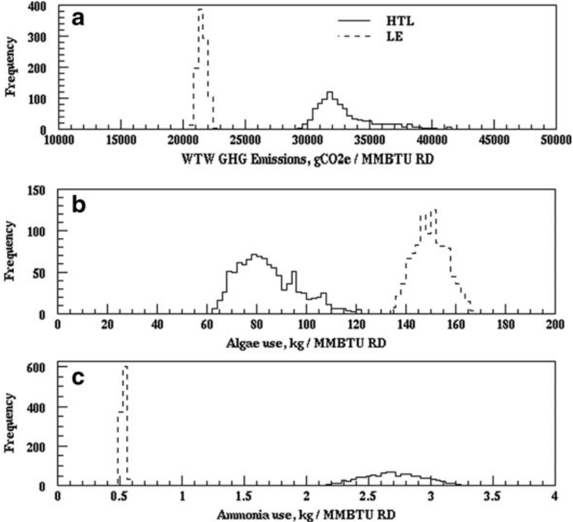
Algae biomass is an attractive biofuel feedstock when grown with high productivity on marginal land. Hydrothermal liquefaction (HTL) produces more oil from algae than lipid extraction (LE) does because protein and carbohydrates are converted, in part, to oil. Since nitrogen in the algae biomass is incorporated into the HTL oil, and since lipid extracted algae for generating heat and electricity are not co-produced by HTL, there are questions regarding implications for emissions and energy use. We studied the HTL and LE pathways for renewable diesel (RD) production by modeling all essential operations from nutrient manufacturing through fuel use. Our objective was to identify the key relationships affecting HTL energy consumption and emissions. LE, with identical upstream growth model and consistent hydroprocessing model, served as reference. HTL used 1.8 fold less algae than did LE but required 5.2 times more ammonia when nitrogen incorporated in the HTL oil was treated as lost. HTL RD had life cycle emissions of 31,000 gCO 2 equivalent (gCO 2 e) compared to 21,500 gCO 2 e for LE based RD per million BTU of RD produced. Greenhouse gas (GHG) emissions increased when yields exceeded 0.4 g HTL oil/g algae because insufficient carbon was left for biogas generation. Key variables in the analysis were the HTL oil yield, the hydrogen demand during upgrading, and the nitrogen content of the HTL oil. Future work requires better data for upgrading renewable oils to RD and requires consideration of nitrogen recycling during upgrading.
Overview
The claims and statistics of this paper haven’t been checked yet.
Free: it reads the open-access text and checks the first 5 claims that cite a source we can check. Create a free account to check every claim.
Integrity signals
Registry
Cites
Statistics
Figures
Verification
Claims the paper makes
The claims and statistics of this paper haven’t been checked yet.
Free: it reads the open-access text and checks the first 5 claims that cite a source we can check. Create a free account to check every claim.
Claims other papers make about this one
Each is checked against this paper’s own text: does it say what the citing paper says it does?
The source backs part of the claim, not all of it — or backs it for a different population, condition or comparison.
In the citing paper
“Frank et al. [34] report a lower GHG result compared to this study which is attributed to differences in downstream processing following biooil recovery through HTL and higher yield.”
From Lifecycle assessment of microalgae to biofuel: Comparison of thermochemical processing pathways (2015) · cites this paper as [34]
Experimental — accuracy not yet measuredThe cited source says what the claim attributes to it.
In the citing paper
“Only a limited number of studies included assessment of thermochemical conversion technologies on the metrics of net energy and greenhouse gas (GHG) emissions has been limited [1, 27, 28, 34, 60].”
From Lifecycle assessment of microalgae to biofuel: Comparison of thermochemical processing pathways (2015) · cites this paper as [34]
In the citing paper
“Frank et al. [34] examined the environmental impact of an HTL process with a well to pump (WTP) system boundary, but includes an additional processing of HTL byproducts to biogas.”
From Lifecycle assessment of microalgae to biofuel: Comparison of thermochemical processing pathways (2015) · cites this paper as [34]
In the citing paper
“HTL has been demonstrated to effectively convert wet, 20% solids, microalgae feedstock into bio-oil [2, 28, 34, 66].”
From Lifecycle assessment of microalgae to biofuel: Comparison of thermochemical processing pathways (2015) · cites this paper as [34]
In the citing paper
“Hydrogen demands for hydroprocessing and renewable diesel yields are determined based on the methods of Frank et al. [34] with details presented in the supplementary information.”
From Lifecycle assessment of microalgae to biofuel: Comparison of thermochemical processing pathways (2015) · cites this paper as [34]
1 more claim about this paper
Create a free account to see every claim other papers make about this one.
Self-check
Percentages, sums and reported differences re-computed from the paper’s own numbers.
The self-check needs the paper’s full text.
Citations
Cites
(2007) · Medical Entomology and Zoology · Cited by 9,612
Rodolfi, L., Chini Zittelli, G., Bassi, N., Padovani, G., Biondi, N., Bonini, G., & Tredici, M. R. (2009) · Biotechnology and Bioengineering · doi:10.1002/bit.22033 · Cited by 2,879 · cited 2×
“2011a, 2012); however, high-lipid algae have low productivity during the lipid accumulation phase (Rodolfi et al. 2009).”
Background(2007) · doi:10.1002/9780470172605 · Cited by 2,813
Life-Cycle Assessment of Biodiesel Production from Microalgae
Lardon, L., Hélias, A., Sialve, B., Steyer, J.-P., & Bernard, O. (2009) · Environmental Science & Technology · doi:10.1021/es900705j · Cited by 1,528
Williams, P. J. L. B., & Laurens, L. M. L. (2010) · Energy & Environmental Science · doi:10.1039/b924978h · Cited by 1,223 · cited 5×
“…we consider HTL RD yields between 0.75 and 0.85 and hydrogen demands between 0.065 and Table 6 Elemental composition of LE, HTL, and soybean oils Weight % Oil C H O N LE a 71 % 11 % 16 % 0.2 % HTL b 73 % 9.2 % 11 % 5.7 % Soybean c 77 % 12 % 12 % 0 % a Table 1 in Williams and Laurens (2010), C1H1.”
BackgroundMethodInfluentialBiller, P., & Ross, A. B. (2011) · Bioresource Technology · doi:10.1016/j.biortech.2010.06.028 · Cited by 1,131 · cited 10×
“…reports different yields for the various fractions (Table 1) and different distributions of solids between oil and aqueous phases (Alba et al. 2012; Biller and Ross 2011; Brown et al. 2010; Duan and Savage 2011; Jena and Das 2011; Jena et al. 2011; Minowa et al. 1995; Valdez et al. 2011; Vardon et…”
BackgroundMethodInfluentialEnvironmental Life Cycle Comparison of Algae to Other Bioenergy Feedstocks
Clarens, A. F., Resurreccion, E. P., White, M. A., & Colosi, L. M. (2010) · Environmental Science & Technology · doi:10.1021/es902838n · Cited by 1,118 · cited 1×
“Previous work showed that electricity production and nutrient recycling greatly affect energy and nutrient demands in the process (Campbell et al. 2009; Clarens et al. 2010, 2011; Frank et al. 2011a, 2012; Lardon et al. 2009; Stephenson et al. 2010).”
BackgroundTechno-Economic Analysis of Autotrophic Microalgae for Fuel Production
Davis, R., Aden, A., & Pienkos, P. T. (2011) · Applied Energy · doi:10.1016/j.apenergy.2011.04.018 · Cited by 1,069 · cited 2×
“High lipid fractions are required to improve economic viability (Davis et al. 2011) and to reduce water consumption and emissions on a fuel-basis (Wigmosta et al. 2011; Frank et al. 2011a, 2012); however, high-lipid algae have low productivity during the lipid accumulation phase (Rodolfi et al.…”
BackgroundHydrothermal liquefaction and gasification of Nannochloropsis sp.
Brown, T. M., Duan, P., & Savage, P. E. (2010) · Energy & Fuels · doi:10.1021/ef100203u · Cited by 745 · cited 8×
“…required and that the HTL oil can contain substantial amounts of nitrogen incorporated from the algal biomass (Alba et al. 2012; Biller and Ross 2011; Brown et al. 2010; Duan and Savage 2011; Jena and Das 2011; Jena et al. 2011; Minowa et al. 1995; Valdez et al. 2011; Vardon et al. 2011; Yu et al.…”
BackgroundMethodInfluential
Research works printed but not linked: 5
- Campbell PK, Beer T, Batten D (2009) Greenhouse gas sequestration by algae - energy and greenhouse gas life cycle studies. CSIRO, Clayton
- Elliott D, Sealock L Jr (1996) Chemical processing in high-pressure aqueous environments: low-temperature catalytic gasification. Chem Eng Res Des 74:563-566
- Lupton S, Kassa N, Galloway D, Lynch S (2011) Conversion of algal oils to hydrocarbon fuels. Presented at the 1st international conference on algal biomass, biofuels & bioproducts, St. Louis MO, 17-20 July 2011
- Shah RK, Sekulic DP (2002) Fundamentals of heat exchanger design. Wiley, Hoboken
- Wang M (1999a) The Greenhouse gases, regulated emissions, and energy use in transportation (GREET) model version 1.5. Argonne National Laboratory Wang M (1999b) GREET 1.5-transportation fuel-cycle model-Vol. 1: methodology, development, use, and results. ANL/ESD-39. Argonne National Laboratory
Cited by
Techno-Economic Analysis of Autotrophic Microalgae for Fuel Production
Davis, R., Aden, A., & Pienkos, P. T. (2011) · Applied Energy · doi:10.1016/j.apenergy.2011.04.018 · Cited by 1,069
A review of hydrothermal biomass processing
Tekin, K., Karagöz, S., & Bektaş, S. (2014) · Renewable and Sustainable Energy Reviews · doi:10.1016/j.rser.2014.07.216 · Cited by 730
Constraints to Commercialization of Algal Fuels
Chisti, Y. (2013) · Journal of Biotechnology · doi:10.1016/j.jbiotec.2013.07.020 · Cited by 719
“Under certain conditions, the combustible gases produced hrough hydrothermal liquefaction may be used to supply sufficient nergy to run the biomass production processes (Frank et al., 2013).”
BackgroundSustainability of the four generations of biofuels – A review
Mat Aron, N. S., Khoo, K. S., Chew, K. W., Show, P. L., Chen, W., & Nguyen, T. H. P. (2020) · International Journal of Energy Research · doi:10.1002/er.5557 · Cited by 479
Quinn, J. C., & Davis, R. (2015) · Bioresource Technology · doi:10.1016/j.biortech.2014.10.075 · Cited by 476
Process development for hydrothermal liquefaction of algae feedstocks in a continuous-flow reactor
Elliott, D. C., Hart, T. R., Schmidt, A. J., Neuenschwander, G. G., Rotness, L. J., Olarte, M. V., Zacher, A. H., Albrecht, K. O., Hallen, R. T., & Holladay, J. E. (2013) · Algal Research · doi:10.1016/j.algal.2013.08.005 · Cited by 472
“Others have attempted life cycle analysis of the concept [27].”
BackgroundValorization of hydrothermal liquefaction aqueous phase: pathways towards commercial viability
Watson, J., Wang, T., Si, B., Chen, W.-T., Aierzhati, A., & Zhang, Y. (2020) · Progress in Energy and Combustion Science · doi:10.1016/j.pecs.2019.100819 · Cited by 394
Kargbo, H., Harris, J. S., & Phan, A. N. (2021) · Renewable and Sustainable Energy Reviews · doi:10.1016/j.rser.2020.110168 · Cited by 333
Chen, G., Zhao, L., & Qi, Y. (2015) · Applied Energy · doi:10.1016/j.apenergy.2014.10.032 · Cited by 314
Ramirez, J., Brown, R., & Rainey, T. (2015) · Energies · doi:10.3390/en8076765 · Cited by 312
Hydroprocessing of bio-crude from continuous hydrothermal liquefaction of microalgae
Biller, P., Sharma, B. K., Kunwar, B., & Ross, A. B. (2015) · Fuel · doi:10.1016/j.fuel.2015.06.077 · Cited by 291
Pilot plant testing of continuous hydrothermal liquefaction of microalgae
Jazrawi, C., Biller, P., Ross, A. B., Montoya, A., Maschmeyer, T., & Haynes, B. S. (2013) · Algal Research · doi:10.1016/j.algal.2013.04.006 · Cited by 289
Lifecycle assessment of microalgae to biofuel: Comparison of thermochemical processing pathways
Bennion, E. P., Ginosar, D. M., Moses, J., Agblevor, F., & Quinn, J. C. (2015) · Applied Energy · doi:10.1016/j.apenergy.2014.12.009 · Cited by 286
“A limited number of studies have evaluated thermochemical conversion technologies on the metrics of net energy and greenhouse gas (GHG) emissions [1,27,28,34,60].”
BackgroundMethodResultInfluentialLife cycle assessment of bio-jet fuel from hydrothermal liquefaction of microalgae
Fortier, M.-O. P., Roberts, G. W., Stagg-Williams, S. M., & Sturm, B. S. M. (2014) · Applied Energy · doi:10.1016/j.apenergy.2014.01.077 · Cited by 264
“As emphasized in past LCAs of algal biofuels [13,36,51–53], results depicting the range of possible environmental impacts are more informative than single values due to the uncertainties involved in the design of algal biofuel production systems.”
BackgroundInfluentialMishra, R. K., kumar, V., Kumar, P., & Mohanty, K. (2022) · Fuel · doi:10.1016/j.fuel.2022.123377 · Cited by 251
Liu, X., Saydah, B., Eranki, P., Colosi, L. M., Greg Mitchell, B., Rhodes, J., & Clarens, A. F. (2013) · Bioresource Technology · doi:10.1016/j.biortech.2013.08.112 · Cited by 246
Neveux, N., Yuen, A. K. L., Jazrawi, C., Magnusson, M., Haynes, B. S., Masters, A. F., Montoya, A., Paul, N. A., Maschmeyer, T., & de Nys, R. (2014) · Bioresource Technology · doi:10.1016/j.biortech.2013.12.083 · Cited by 242
Biomass Conversion Technologies
Adams, P., Bridgwater, T., Lea-Langton, A., Ross, A., & Watson, I. (2018) · Greenhouse Gases Balances of Bioenergy Systems · doi:10.1016/b978-0-08-101036-5.00008-2 · Cited by 222
Skaggs, R. L., Coleman, A. M., Seiple, T. E., & Milbrandt, A. R. (2018) · Renewable and Sustainable Energy Reviews · doi:10.1016/j.rser.2017.09.107 · Cited by 209
Abomohra, A. E.-F., Jin, W., Tu, R., Han, S.-F., Eid, M., & Eladel, H. (2016) · Renewable and Sustainable Energy Reviews · doi:10.1016/j.rser.2016.06.056 · Cited by 206
Advances in direct transesterification of algal oils from wet biomass
Park, J.-Y., Park, M. S., Lee, Y.-C., & Yang, J.-W. (2015) · Bioresource Technology · doi:10.1016/j.biortech.2014.10.089 · Cited by 176
“…considering the soft nature of microalgae compared to lignocellulosic biomass, it may be feasible to adopt a thermochemical process for the production of microalgal biocrude oils instead of selective extraction or conversion of lipid portion to biodiesel (Barreiro et al., 2013; Frank et al., 2013).”
BackgroundHuang, J., Wang, J., Huang, Z., Liu, T., & Li, H. (2023) · Bioresource Technology · doi:10.1016/j.biortech.2022.128390 · Cited by 175
Davis, R. E., Fishman, D. B., Frank, E. D., Johnson, M. C., Jones, S. B., Kinchin, C. M., Skaggs, R. L., Venteris, E. R., & Wigmosta, M. S. (2014) · Environmental Science & Technology · doi:10.1021/es4055719 · Cited by 151
Self-citationUse of Microalgae for Advanced Wastewater Treatment and Sustainable Bioenergy Generation
Hwang, J.-H., Church, J., Lee, S.-J., Park, J., & Lee, W. H. (2016) · Environmental Engineering Science · doi:10.1089/ees.2016.0132 · Cited by 150
“There have been several LCA studies of microalgae biofuels (Batan et al. , 2010; Brentner et al. , 2011; Campbell et al. , 2011; Frank et al. , 2011, 2013; Shirvani et al. , 2011; Vasudevan et al. , 2012; Grierson et al. , 2013; Liu et al. , 2013; Passell et al. , 2013; Sills et al. , 2013;…”
Cherad, R., Onwudili, J. A., Biller, P., Williams, P. T., & Ross, A. B. (2016) · Fuel · doi:10.1016/j.fuel.2015.10.088 · Cited by 150
“Alternatively, the aqueous organic carbon can be used to produce hydrogen via catalytic hydrothermal gasification with the potential of using the hydrogen for upgrading or partial upgrading of the biocrude [17,24].”
MethodLife-cycle assessment of biofuel production from microalgae via various bioenergy conversion systems
Sun, C.-H., Fu, Q., Liao, Q., Xia, A., Huang, Y., Zhu, X., Reungsang, A., & Chang, H.-X. (2019) · Energy · doi:10.1016/j.energy.2019.01.074 · Cited by 165
Eboibi, B. E., Lewis, D. M., Ashman, P. J., & Chinnasamy, S. (2014) · Bioresource Technology · doi:10.1016/j.biortech.2014.07.083 · Cited by 165
Prospects for biodiesel production from algae-based wastewater treatment in Brazil: A review
Kligerman, D. C., & Bouwer, E. J. (2015) · Renewable and Sustainable Energy Reviews · doi:10.1016/j.rser.2015.08.030 · Cited by 163
Gong, J., & You, F. (2014) · AIChE Journal · doi:10.1002/aic.14504 · Cited by 141
“Frank et al.(24,25) compared the LCA’s of algal renewable diesel production with HTL and lipid extraction pathways.”
BackgroundFields, M. W., Hise, A., Lohman, E. J., Bell, T., Gardner, R. D., Corredor, L., Moll, K., Peyton, B. M., Characklis, G. W., & Gerlach, R. (2014) · Applied Microbiology and Biotechnology · doi:10.1007/s00253-014-5694-7 · Cited by 139
“As a result, HTL can increase fuel yields relative to transesterification (Frank et al. 2013), and this technologymay reduce the importance of advanced culturing methods to enhance algal lipid accumulation for biofuel production (Elliott et al. 2013).”
BackgroundA critical review on life cycle analysis of algae biodiesel: current challenges and future prospects
Chamkalani, A., Zendehboudi, S., Rezaei, N., & Hawboldt, K. (2020) · Renewable and Sustainable Energy Reviews · doi:10.1016/j.rser.2020.110143 · Cited by 146
Techno-economic and life-cycle assessment of an attached growth algal biorefinery
Barlow, J. P., Sims, R. C., & Quinn, J. C. (2016) · Bioresource Technology · doi:10.1016/j.biortech.2016.08.091 · Cited by 155
“Frank et al. (2013) found a GWP of -44 g CO2-e MJ -1 for a system with a productivity of 25 g afdw m-2 d-1 and biocrude yield of 38% afdw.”
BackgroundMicroalgae biorefineries: The Brazilian scenario in perspective
Brasil, B. S. A. F., Silva, F. C. P., & de Siqueira, F. G. (2016) · New Biotechnology · doi:10.1016/j.nbt.2016.04.007 · Cited by 145
“This model, however, has been challenged by recent advances in extraction/conversion processes capable of handling wet feedstocks, as well as, converting whole algal biomass into oil [16,46,97,104] (Table 1).”
BackgroundMethodLife Cycle Environmental Impacts of Wastewater-Based Algal Biofuels
Mu, D., Min, M., Krohn, B., Mullins, K. A., Ruan, R., & Hill, J. (2014) · Environmental Science & Technology · doi:10.1021/es5027689 · Cited by 126
Marine brown algae: A conundrum answer for sustainable biofuels production
Song, M., Pham, H. D., Seon, J., & Woo, H. C. (2015) · Renewable and Sustainable Energy Reviews · doi:10.1016/j.rser.2015.05.021 · Cited by 136
DeRose, K., DeMill, C., Davis, R. W., & Quinn, J. C. (2019) · Algal Research · doi:10.1016/j.algal.2019.101412 · Cited by 126
Magdeldin, M., Kohl, T., De Blasio, C., Järvinen, M., Won Park, S., & Giudici, R. (2016) · Energies · doi:10.3390/en9100838 · Cited by 123
“The conceptual bio-refinery, envisages a poly-generative energy structure, with a lower carbon footprint than a whole algae stand-alone hydrothermal plant as reported in literature [54].”
BackgroundRecommendations for Life Cycle Assessment of algal fuels
Collet, P., Hélias, A., Lardon, L. A., Steyer, J., & Bernard, O. (2015) · Applied Energy · doi:10.1016/j.apenergy.2015.03.056 · Cited by 124
A life cycle co-benefits assessment of wind power in China
Xue, B., Ma, Z., Geng, Y., Heck, P., Ren, W., Tobias, M., Maas, A., Jiang, P., de Oliveira, J. A. P., & Fujita, T. (2014) · Renewable and Sustainable Energy Reviews · doi:10.1016/j.rser.2014.08.056 · Cited by 123
An Overview of Microalgae Lipid Extraction in a Biorefinery Framework
Roux, J.-M., Lamotte, H., & Achard, J. (2017) · Energy Procedia · doi:10.1016/j.egypro.2017.03.1137 · Cited by 125
Chen, P. H., & Quinn, J. C. (2021) · Applied Energy · doi:10.1016/j.apenergy.2021.116613 · Cited by 120
Watson, J., Lu, J., de Souza, R., Si, B., Zhang, Y., & Liu, Z. (2019) · Energy · doi:10.1016/j.energy.2018.11.003 · Cited by 109
Delrue, F., Li‐Beisson, Y., Setier, P.-A., Sahut, C., Roubaud, A., Froment, K., & Peltier, G. (2013) · Bioresource Technology · doi:10.1016/j.biortech.2013.02.091 · Cited by 119
“Mass balance calculations for nutrients are based on the microalgae formula from Grobbelaar (2004): CO0.”
BackgroundQuantitative characterization of the aqueous fraction from hydrothermal liquefaction of algae
Maddi, B., Panisko, E., Wietsma, T., Lemmon, T., Swita, M., Albrecht, K., & Howe, D. (2016) · Biomass and Bioenergy · doi:10.1016/j.biombioe.2016.07.010 · Cited by 108
Recent development of hydrothermal liquefaction for algal biorefinery
Gu, X., Martinez-Fernandez, J. S., Pang, N., Fu, X., & Chen, S. (2020) · Renewable and Sustainable Energy Reviews · doi:10.1016/j.rser.2020.109707 · Cited by 115
Seaweed salt from Ulva: A novel first step in a cascading biorefinery model
Magnusson, M., Carl, C., Mata, L., de Nys, R., & Paul, N. A. (2016) · Algal Research · doi:10.1016/j.algal.2016.03.018 · Cited by 102
Botryococcus braunii for biodiesel production
Tasić, M. B., Pinto, L. F. R., Klein, B. C., Veljković, V. B., & Filho, R. M. (2016) · Renewable and Sustainable Energy Reviews · doi:10.1016/j.rser.2016.06.009 · Cited by 115
Hydrothermal liquefaction of Cyanidioschyzon merolae and the influence of catalysts on products
Muppaneni, T., Reddy, H. K., Selvaratnam, T., Dandamudi, K. P. R., Dungan, B. N., Nirmalakhandan, N. N., Schaub, T. M., Holguin, F. O., Voorhies, W. V., Lammers, P. J., et al. (2016) · Bioresource Technology · doi:10.1016/j.biortech.2016.10.022 · Cited by 109
A Review of Algae-Based Produced Water Treatment for Biomass and Biofuel Production
Rahman, A., Agrawal, S., Nawaz, T., Pan, S., & Selvaratnam, T. (2020) · Water · doi:10.3390/w12092351 · Cited by 95
Dang, Q. F., Yu, C., & Luo, Z. (2014) · Fuel · doi:10.1016/j.fuel.2014.04.029 · Cited by 105
Elliott, D. C. (2016) · Algal Research · doi:10.1016/j.algal.2015.12.002 · Cited by 102
Landfills as a biorefinery to produce biomass and capture biogas
Bolan, N. S., Thangarajan, R., Seshadri, B., Jena, U., Das, K. C., Wang, H., & Naidu, R. (2012) · Bioresource Technology · doi:10.1016/j.biortech.2012.08.135 · Cited by 100
Duan, P.-G., Yang, S.-K., Xu, Y.-P., Wang, F., Zhao, D., Weng, Y.-J., & Shi, X.-L. (2018) · Energy · doi:10.1016/j.energy.2018.05.044 · Cited by 92
Venteris, E. R., Skaggs, R. L., Wigmosta, M. S., & Coleman, A. M. (2014) · Biomass and Bioenergy · doi:10.1016/j.biombioe.2014.02.001 · Cited by 97
“propriate for AD [16]).”
BackgroundInfluentialCritical Review of Microalgae LCA Studies for Bioenergy Production
Ketzer, F., Skarka, J., & Rösch, C. (2017) · BioEnergy Research · doi:10.1007/s12155-017-9880-1 · Cited by 94
“[24] describe a renewable diesel production with a hydrothermal liquefaction (HTL) processing step.”
BackgroundContinuous hydrothermal liquefaction of macroalgae in the presence of organic co-solvents
He, Y., Liang, X., Jazrawi, C., Montoya, A., Yuen, A., Cole, A. J., Neveux, N., Paul, N. A., de Nys, R., Maschmeyer, T., et al. (2016) · Algal Research · doi:10.1016/j.algal.2016.05.010 · Cited by 77
Biofuel production from microalgae as feedstock: current status and potential
Han, S.-F., Jin, W.-B., Tu, R.-J., & Wu, W.-M. (2015) · Critical Reviews in Biotechnology · doi:10.3109/07388551.2013.835301 · Cited by 85
“The outcome of LCA of microalgae-based biodiesel production varies with different culture systems, and the different methods used for biomass harvest and oil refinery (Frank et al., 2013; Resurreccion et al., 2012).”
MethodSomers, M. D., & Quinn, J. C. (2019) · Journal of CO2 Utilization · doi:10.1016/j.jcou.2019.01.007 · Cited by 78
Okoro, O. V., Sun, Z., & Birch, J. (2016) · Journal of Cleaner Production · doi:10.1016/j.jclepro.2016.11.141 · Cited by 87
Vuppaladadiyam, A. K., Prinsen, P., Raheem, A., Luque, R., & Zhao, M. (2018) · Environmental Science & Technology · doi:10.1021/acs.est.8b02876 · Cited by 84
Gong, J., & You, F. (2017) · ACS Sustainable Chemistry & Engineering · doi:10.1021/acssuschemeng.7b00631 · Cited by 73
The use of hydrothermal carbonization to recycle nutrients in algal biofuel production
Levine, R. B., Sierra, C. O. S., Hockstad, R., Obeid, W., Hatcher, P. G., & Savage, P. E. (2013) · Environmental Progress & Sustainable Energy · doi:10.1002/ep.11812 · Cited by 73
“Nevertheless, the increased risk of contamination associated with adding organic carbon to an outdoor pond, along with the desire to capture the energy value of this carbon to create on-site heat and power, may incentivize the use of catalytic hydrothermal gasification or related technologies that can process the AP p…”
BackgroundNeveux, N., Magnusson, M., Maschmeyer, T., de Nys, R., & Paul, N. A. (2015) · GCB Bioenergy · doi:10.1111/gcbb.12171 · Cited by 72
“Higher theoretical yields were achieved through HTL as the whole organic frac- tion of biomass is used in the conversion, including pro- teins, carbohydrates and the entire lipid component (Frank et al., 2013).”
BackgroundMethodInfluentialAllen, J. D., Unlu, S., Demirel, Y., Black, P. N., & Riekhof, W. R. (2018) · Bioresources and Bioprocessing · doi:10.1186/s40643-018-0233-5 · Cited by 83
A concise review on waste biomass valorization through thermochemical conversion
Joshi, N. C., Sinha, S., Bhatnagar, P., Nath, Y., Negi, B., Kumar, V., & Gururani, P. (2024) · Current Research in Microbial Sciences · doi:10.1016/j.crmicr.2024.100237 · Cited by 83
“Frank et al. (2013) reported that lipid extraction does not yield as much oil from algae as HTL.”
BackgroundOleaginous yeast platform for producing biofuels via co-solvent hydrothermal liquefaction
Jena, U., McCurdy, A. T., Warren, A., Summers, H. M., Ledbetter, R. N., Hoekman, S. K., Seefeldt, L. C., & Quinn, J. C. (2015) · Biotechnology for Biofuels · doi:10.1186/s13068-015-0345-5 · Cited by 83
Microalgal Biorefineries for Bioenergy Production: Can We Move from Concept to Industrial Reality?
Deprá, M. C., dos Santos, A. M., Severo, I. A., Santos, A. B., Zepka, L. Q., & Lopes, E. J. (2018) · BioEnergy Research · doi:10.1007/s12155-018-9934-z · Cited by 82
Sustainability and life cycle assessments of lignocellulosic and algal pretreatments
Rebello, S., Anoopkumar, A. N., Aneesh, E. M., Sindhu, R., Binod, P., & Pandey, A. (2019) · Bioresource Technology · doi:10.1016/j.biortech.2019.122678 · Cited by 82
Ponnusamy, S., Reddy, H. K., Muppaneni, T., Downes, C. M., & Deng, S. (2014) · Bioresource Technology · doi:10.1016/j.biortech.2014.07.072 · Cited by 80
He, S., Barati, B., Hu, X., & Wang, S. (2022) · Fuel Processing Technology · doi:10.1016/j.fuproc.2022.107563 · Cited by 80
Ge, S., Madill, M., & Champagne, P. (2017) · Biomass and Bioenergy · doi:10.1016/j.biombioe.2017.03.014 · Cited by 80
Santillan‐Jimenez, E., Pace, R. B., Morgan, T. D., Behnke, C. A., Sajkowski, D. J., Lappas, A. A., & Crocker, M. (2019) · Fuel Processing Technology · doi:10.1016/j.fuproc.2019.02.018 · Cited by 79
Mu, D., Ruan, R., Addy, M., Mack, S., Chen, P., & Zhou, Y. (2017) · Bioresource Technology · doi:10.1016/j.biortech.2016.12.108 · Cited by 78
Assessing the potential of polyculture to accelerate algal biofuel production
Newby, D. T., Mathews, T. J., Pate, R. C., Huesemann, M. H., Lane, T. W., Wahlen, B. D., Mandal, S., Engler, R. K., Feris, K. P., & Shurin, J. B. (2016) · Algal Research · doi:10.1016/j.algal.2016.09.004 · Cited by 78
Haider, M. S., Castello, D., Michalski, K. M., Pedersen, T. H., & Rosendahl, L. A. (2018) · Energies · doi:10.3390/en11123360 · Cited by 78
Life Cycle Assessment and Techno-Economic Analysis of Algal Biofuel Production
Mu, D., Xin, C., & Zhou, W. (2020) · Microalgae Cultivation for Biofuels Production · doi:10.1016/b978-0-12-817536-1.00018-7 · Cited by 49
Pathways of processing of wet microalgae for liquid fuel production: A critical review
Chaudry, S., Bahri, P. A., & Moheimani, N. R. (2015) · Renewable and Sustainable Energy Reviews · doi:10.1016/j.rser.2015.08.005 · Cited by 78
Juneja, A., 1 Biological and Ecological Engineering, O. S. U., & S. Murthy, G. (2017) · AIMS Energy · doi:10.3934/energy.2017.2.239 · Cited by 73
“Similar negative values (–46.5 kg CO 2 e per 1000 MJ of RD) were reported for well to pump analysis of renewable diesel production from algae earlier [41].”
InfluentialMeta-analysis and harmonization of life cycle assessment studies for algae biofuels
Tu, Q., Eckelman, M., & Zimmerman, J. (2017) · Environmental Science & Technology · doi:10.1021/acs.est.7b01049 · Cited by 75
Cheng, F., Jarvis, J. M., Yu, J., Jena, U., Nirmalakhandan, N., Schaub, T. M., & Brewer, C. E. (2019) · Bioresource Technology · doi:10.1016/j.biortech.2019.122184 · Cited by 72
Life cycle assessment of green diesel production from microalgae
Pragya, N., & Pandey, K. K. (2015) · Renewable Energy · doi:10.1016/j.renene.2015.08.064 · Cited by 73
Connelly, E. B., Colosi, L. M., Clarens, A. F., & Lambert, J. H. (2015) · Energy & Fuels · doi:10.1021/ef502100f · Cited by 67
Cole, A. J., Dinburg, Y., Haynes, B. S., He, Y., Herskowitz, M., Jazrawi, C., Landau, M. V., Liang, X. T., Magnusson, M. E., Maschmeyer, T., et al. (2016) · Energy & Environmental Science · doi:10.1039/c6ee00414h · Cited by 71
Microalgal Biodiesel Production: Realizing the Sustainability Index
Patnaik, R., & Mallick, N. (2021) · Frontiers in Bioengineering and Biotechnology · doi:10.3389/fbioe.2021.620777 · Cited by 71
Bio-inspired remediation of wastewater: A contemporary approach for environmental clean-up
Singh, D., Goswami, R. K., Agrawal, K., Chaturvedi, V., & Verma, P. (2022) · Current Research in Green and Sustainable Chemistry · doi:10.1016/j.crgsc.2022.100261 · Cited by 70
Techno-economic analysis of solar integrated hydrothermal liquefaction of microalgae
Pearce, M., Shemfe, M. B., & Sansom, C. (2016) · Applied Energy · doi:10.1016/j.apenergy.2016.01.005 · Cited by 71
Techno-economic analysis and global warming potential of a novel offshore macroalgae biorefinery
Greene, J. M., Gulden, J., Wood, G., Huesemann, M. H., & Quinn, J. C. (2020) · Algal Research · doi:10.1016/j.algal.2020.102032 · Cited by 68
Kinnunen, V., Koskinen, P. E. P., & Rintala, J. A. (2014) · Bioresource Technology · doi:10.1016/j.biortech.2013.12.115 · Cited by 69
“Recently, catalytic hydrothermal gasification (CHG) has shown another promising concept to produce fuel gas and recover nitrogen and phosphorus from algal residues (Frank et al., 2013).”
BackgroundEdmundson, S., Huesemann, M., Kruk, R., Lemmon, T., Billing, J., Schmidt, A., & Anderson, D. (2017) · Algal Research · doi:10.1016/j.algal.2017.07.016 · Cited by 65
Summers, H. M., Ledbetter, R. N., McCurdy, A. T., Morgan, M. R., Seefeldt, L. C., Jena, U., Hoekman, S. K., & Quinn, J. C. (2015) · Bioresource Technology · doi:10.1016/j.biortech.2015.07.077 · Cited by 65
Energy requirements for wet solvent extraction of lipids from microalgal biomass
Martin, G. J. O. (2016) · Bioresource Technology · doi:10.1016/j.biortech.2016.01.017 · Cited by 66
Canter, C. E., Blowers, P., Handler, R. M., & Shonnard, D. R. (2015) · Applied Energy · doi:10.1016/j.apenergy.2014.12.065 · Cited by 63
Gerber, L. N., Tester, J. W., Beal, C. M., Huntley, M. E., & Sills, D. L. (2016) · Environmental Science & Technology · doi:10.1021/acs.est.5b05381 · Cited by 57
Advances on the processing of microalgal biomass for energy-driven biorefineries
Cuevas-Castillo, G. A., Navarro-Pineda, F. S., Baz Rodríguez, S. A., & Sacramento Rivero, J. C. (2020) · Renewable and Sustainable Energy Reviews · doi:10.1016/j.rser.2019.109606 · Cited by 56
Orfield, N. D., Fang, A. J., Valdez, P. J., Nelson, M. C., Savage, P. E., Lin, X. N., & Keoleian, G. A. (2014) · ACS Sustainable Chemistry & Engineering · doi:10.1021/sc4004983 · Cited by 55
Cultivation of Microalgae for Biofuel Production: Coupling with Sugarcane-Processing Factories
Zewdie, D. T., & Ali, A. Y. (2020) · Energy Sustainability and Society · doi:10.1186/s13705-020-00262-5 · Cited by 59
Energy consumption during the manufacture of nutrients for algae cultivation
Johnson, M. C., Palou-Rivera, I., & Frank, E. D. (2013) · Algal Research · doi:10.1016/j.algal.2013.08.003 · Cited by 56
“Hydrothermal liquefaction of algal biomass is receiving considerable attention because of its high oil yields, but our analysis of hydrothermal liquefaction data indicated that substantial nitrogen losses may occur via incorporation of nitrogen in the oil product [2].”
BackgroundSelf-citationEffects of co-products on the life-cycle impacts of microalgal biodiesel
Soratana, K., Barr, W. J., & Landis, A. E. (2014) · Bioresource Technology · doi:10.1016/j.biortech.2014.02.070 · Cited by 56
Biodiesel, Bioethanol, and Biobutanol Production from Microalgae
Abomohra, A., & Elshobary, M. E. (2019) · Springer eBooks · doi:10.1007/978-981-13-2264-8_13 · Cited by 56
A meta-analysis of the life cycle greenhouse gas balances of microalgae biodiesel
Garcia, R., Figueiredo, F., Brandão, M., Hegg, M., Castanheira, É., Malça, J., Nilsson, A., & Freire, F. (2020) · The International Journal of Life Cycle Assessment · doi:10.1007/s11367-020-01780-2 · Cited by 51
Metadata
- Authors
- Frank, E. D., Elgowainy, A., Han, J., & Wang, Z.
- Affiliations
- Argonne National Laboratory (US)
- Corresponding author
- Frank, Edward D.
- Venue
- Mitigation and Adaptation Strategies for Global Change
- Published
- 2012-06-07
- Volume
- 18
- Issue
- 1
- Pages
- 137-158
- ISSN
- 1381-2386 (ISSN-L)
- 1573-1596
- OpenAlex
- W2157432012
- Cited by
- 220
- References
- 35
- Citations by year
- 2026: 1 · 2025: 13 · 2024: 8 · 2023: 4 · 2022: 10 · 2021: 20 · 2020: 15 · 2019: 17 · 2018: 17 · 2017: 20 · 2016: 27 · 2015: 21 · 2014: 31 · 2013: 14 · 2012: 1
- FWCI
- 8.23
- Type
- journal article
- Language
- en
- Open access
- hybrid
- doi.org
- Licence
- cc-by
- creativecommons.org/licenses/by/2.0 (tdm)
- Locations
- Mitigation and Adaptation Strategies for Global Change (publishedVersion, cc-by)
- RePEc: Research Papers in Economics (submittedVersion)
- Funders
- U.S. Department of Energy (DE‐ AC02‐06CH11357, Contract No. DE-AC02-06CH11357., AC02‐06CH11357, 06CH11357, No. DE-AC02-06CH11357, DE-AC02-)
- University of Chicago (DE-AC02-06CH11357)
- University of Illinois at Urbana-Champaign
- Office of Energy Efficiency and Renewable Energy (AC02-06CH11357, DE‐AC02‐06CH11357, Contract No. DE-AC02-06CH11357)
- Biomass Program (DE-AC02-06CH11357)
- Office of Energy Efficiency
- Argonne National Laboratory (DE- AC02-06-CH11357, DE-AC02, AC02–06CH11357, No. DE-AC02-06CH11357, 06CH11357, Contract No. DE-AC02-06CH11357.)
- Topics
- Physical Sciences › Energy › Renewable Energy, Sustainability and the Environment › Algal biology and biofuel production
- Physical Sciences › Environmental Science › Environmental Engineering › Environmental Impact and Sustainability
- Life Sciences › Agricultural and Biological Sciences › Agronomy and Crop Science › Bioenergy crop production and management
- Keywords
- hydrothermal liquefaction, lipid extraction, algal biomass, renewable diesel, life cycle assessment, greenhouse gas emissions, nitrogen incorporation, hydroprocessing, biogas, marginal land cultivation, nitrogen recycling, energy consumption
About these checks
Registry, retraction, Cites and statistics results are computed, not judged, with one exception: a printed reference that no index lists is read once by a model before it counts as a citation error. Claims are extracted by a model and kept only when their quote appears verbatim in the text; each cited source is then checked, with a model’s help, for whether it says what the claim relies on. Those verdicts can be wrong — read the claim’s quote and the cited source before relying on one.
Statistics and arithmetic are recomputed, not judged.
Confidence bands are shown only for fields calibrated on our annotated test set. None is calibrated yet, so no band is shown.
What counts as a claim ›How we measure confidence ›How we check this ›
Are you an author, or do you see a problem with this page? Request a review
Data sources
Bibliographic data: Semantic Scholar, OpenAlex, Crossref.
Contains information from the Semantic Scholar Academic Graph Datasets, made available under the ODC Attribution License (ODC-BY 1.0).
Semantic Scholar’s data is described in: Kinney, R., et al. (2023). The Semantic Scholar Open Data Platform. arXiv:2301.10140.
