

Empirical research on international environmental migration: a systematic review
Open accessThe DOI matches its Crossref record; 69 of the 74 references it cites were found in a registry or an index.
Abstract
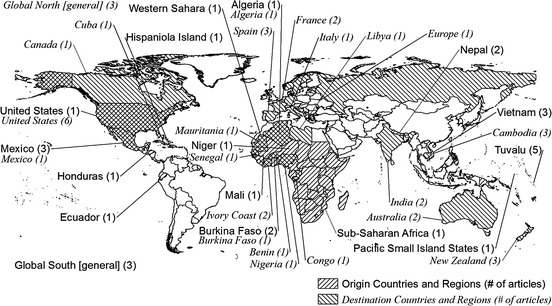
This paper presents the findings of a systematic review of scholarly publications that report empirical findings from studies of environmentally-related international migration. There exists a small, but growing accumulation of empirical studies that consider environmentally-linked migration that spans international borders. These studies provide useful evidence for scholars and policymakers in understanding how environmental factors interact with political, economic and social factors to influence migration behavior and outcomes that are specific to international movements of people, in highlighting promising future research directions, and in raising important considerations for international policymaking. Our review identifies countries of migrant origin and destination that have so far been the subject of empirical research, the environmental factors believed to have influenced these migrations, the interactions of environmental and non-environmental factors as well as the role of context in influencing migration behavior, and the types of methods used by researchers. In reporting our findings, we identify the strengths and challenges associated with the main empirical approaches, highlight significant gaps and future opportunities for empirical work, and contribute to advancing understanding of environmental influences on international migration more generally. Specifically, we propose an exploratory framework to take into account the role of context in shaping environmental migration across borders, including the dynamic and complex interactions between environmental and non-environmental factors at a range of scales.
Overview
The claims and statistics of this paper haven’t been checked yet.
Free: it reads the open-access text and checks the first 5 claims that cite a source we can check. Create a free account to check every claim.
Integrity signals
Registry
Cites
Statistics
Figures
Verification
Claims the paper makes
The claims and statistics of this paper haven’t been checked yet.
Free: it reads the open-access text and checks the first 5 claims that cite a source we can check. Create a free account to check every claim.
Claims other papers make about this one
Each is checked against this paper’s own text: does it say what the citing paper says it does?
The source backs part of the claim, not all of it — or backs it for a different population, condition or comparison.
In the citing paper
“While the majority of studies agree that climatic conditions are important for migration, their results vary substantially, making it difficult to establish when and under which conditions climate migration occurs (Cattaneo et al., 2019;Hunter et al., 2015;Obokata et al., 2014;Piguet, 2010;Warner and Afifi, 2014).”
From Improving the evidence base: A methodological review of the quantitative climate migration literature (2021) · cites this paper as Obokata et al., 2014
Experimental — accuracy not yet measured
Self-check
Percentages, sums and reported differences re-computed from the paper’s own numbers.
The self-check needs the paper’s full text.
Citations
Cites
The effect of environmental change on human migration
Black, R., Adger, W. N., Arnell, N. W., Dercon, S., Geddes, A., & Thomas, D. (2011) · Global Environmental Change · doi:10.1016/j.gloenvcha.2011.10.001 · Cited by 1,279 · cited 1×
“What is more critical than raising fears about ‘‘environmental refugees’’ is to identify barriers to adaptation and mobility (e.g., McLeman and Smit 2006; Bardsley and Hugo 2010; Black et al. 2011).”
BackgroundClimate change, human security and violent conflict
Barnett, J., & Adger, W. N. (2007) · Political Geography · doi:10.1016/j.polgeo.2007.03.003 · Cited by 1,085
Farmers’ Perceptions of Climate Change and Agricultural Adaptation Strategies in Rural Sahel
Mertz, O., Mbow, C., Reenberg, A., & Diouf, A. (2009) · Environmental Management · doi:10.1007/s00267-008-9197-0 · Cited by 978 · cited 2×
“In Nepal and West Africa, migration can become an embedded component of rural households’ wider livelihood diversification strategies, with larger family size making migration more possible (e.g., Afifi 2011; Shrestha and Bhandari 2007; see also Mertz et al. 2009).”
BackgroundAre we adapting to climate change?
Berrang-Ford, L., Ford, J. D., & Paterson, J. (2011) · Global Environmental Change · doi:10.1016/j.gloenvcha.2010.09.012 · Cited by 931 · cited 2×
“We used an approach adapted from Berrang-Ford et al. (2011) to generate systematically an inventory of English-language peer-reviewed articles that examine environmental factors and international migration published as of mid2013.”
MethodEnvironmental refugees: a growing phenomenon of the 21st century.
Myers, N. (2002) · Philosophical Transactions of the Royal Society of London. Series B, Biological Sciences · doi:10.1098/rstb.2001.0953 · Cited by 893 · cited 1×
“…(El-Hinnawi 1985) and 20 years since ecologist Norman Myers issued his first of several warnings in scholarly journals that the twenty-first century would see hundreds of thousands of people flee their homes for causes directly or indirectly attributable to the environment (Myers 1993, 1997, 2002).”
BackgroundMigration as an Adaptation to Climate Change
McLeman, R., & Smit, B. (2006) · Climatic Change · doi:10.1007/s10584-005-9000-7 · Cited by 811 · cited 4×
“What is more critical than raising fears about ‘‘environmental refugees’’ is to identify barriers to adaptation and mobility (e.g., McLeman and Smit 2006; Bardsley and Hugo 2010; Black et al. 2011).”
BackgroundInfluentialSelf-citationLinkages among climate change, crop yields and Mexico–US cross-border migration
Feng, S., Krueger, A. B., & Oppenheimer, M. (2010) · Proceedings of the National Academy of Sciences · doi:10.1073/pnas.1002632107 · Cited by 635 · cited 5×
“Since not all Table 4 Articles by type of research methods Quantitative methods and modelling Qualitative Mixed methods Feng et al. (2010) Bettini (2013) Afifi (2011)* Findley (1994) Farbotko (2005) Alscher (2011)* Gray (2009) Farbotko and Lazrus (2012) Dun (2011)* Gray (2010) McNamara (2007) Gila…”
BackgroundMethodInfluentialThe first climate refugees? Contesting global narratives of climate change in Tuvalu
Farbotko, C., & Lazrus, H. (2012) · Global Environmental Change · doi:10.1016/j.gloenvcha.2011.11.014 · Cited by 610 · cited 10×
“…strategies or livelihoods, whether through nomadism for the Sahrawi people (Gila et al. 2011), seasonal migrations (Afifi 2011; Findley 1994; Henry 2004a, b), and mobile occupations such as fishing (Farbotko and Lazrus 2012), which represent traditional forms of adaptation to environmental change.”
BackgroundMethodInfluentialClimate change, migration and adaptation in Funafuti, Tuvalu
Mortreux, C., & Barnett, J. (2009) · Global Environmental Change · doi:10.1016/j.gloenvcha.2008.09.006 · Cited by 573 · cited 3×
“…reviewed, 23 found some evidence of environmental factors influencing migration across international borders, while five others (Farbotko and Lazrus 2012; McNamara and Gibson 2009; Mortreux and Barnett 2009; Shen and Binns 2012; Shen and Gemenne 2011) that looked for evidence did not find it.”
BackgroundClimate change, environmental degradation and migration
Warner, K., Hamza, M., Oliver-Smith, A., Renaud, F., & Julca, A. (2010) · Natural Hazards · doi:10.1007/s11069-009-9419-7 · Cited by 553 · cited 2×
“…al. (2011) Shen and Gemenne (2011)* Marchiori and Schumacher (2011) Sunil et al. (2007) Marchiori et al. (2012) Warner (2010)* Massey et al. (2010) Warner et al. (2010)* Nawrotzki et al. (2013) Wrathall (2012) Reuveny and Moore (2009) Rowlands (2004) Shrestha and Bhandari (2007) An asterisk…”
Background
Research works printed but not linked: 2
- 29. Jasco, P. (2005). As we may search-Comparison of major features of the web of science, Scopus, and Google Scholar citation based and citation-enhanced databases. Current Science, 89(9), 1537-1547.
- 58. Samers, M. (2010). Migration. London: Routledge.
Cited by
Items 101–163 of 163
Environmentally-Related International Displacement: Following in Graeme Hugo’s Footsteps
Adamo, S. B. (2017) · Springer eBooks · doi:10.1007/978-3-319-67147-5_10 · Cited by 5
Trends and future research in climate migration: a bibliometric analysis of forty years
Khavarian-Garmsir, A. R., Abadi, M. H. H., Sadeghi, A., Rahimi, D., & Asadzadeh, A. (2023) · Environmental Hazards · doi:10.1080/17477891.2023.2265928 · Cited by 8
“However, as Obokata et al. (Obokata et al., 2014) pointed out, future research should clarify whether drought has been the most in fl uential hazard driving climate migrations or whether the large number of studies have been conducted due to easy access to rainfall data.”
BackgroundInfluentialBonneux, I., & PRAAG, L. V. (2024) · Environmental Sociology · doi:10.1080/23251042.2024.2369738 · Cited by 14
“The mixed evidence can be the result of a vast range of case studies and geographic regions (Obokata, Veronis, and McLeman 2014).”
de Paula, S. A., & de Mello, L. F. (2021) · Relaciones Internacionales · doi:10.15366/relacionesinternacionales2021.47.011 · Cited by 5
Mezdour, A., Veronis, L., & McLeman, R. A. (2015) · Advances in global change research · doi:10.1007/978-3-319-25796-9_7 · Cited by 4
Self-citationPreston, V., & Ray, B. K. (2019) · Wiley eBooks · doi:10.1002/9781118786352.wbieg0998.pub2 · Cited by 4
Jennath, A., & Paul, S. K. (2024) · Human Ecology · doi:10.1007/s10745-024-00476-7 · Cited by 3
“Although it is well understood that environmen - tal and climate issues can cause migration, whether migra - tion from hazardous areas can be attributed solely to climate and environmental pressures is still being debated (Cattaneo et al., 2019 ; Hoffmann et al., 2021 ; Obokata et al., 2014).”
Sobczak-Szelc, K. (2024) · Regional Environmental Change · doi:10.1007/s10113-024-02268-7 · Cited by 7
“More studies use a comparative approach to examine the relations between the environment and migration in arid and semi-arid areas (Obokata et al. 2014; Neumann and Hermans 2017; CLIMIG 2018).”
Green attitudes and interregional migration intentions: Evidence from the EU
Panori, A., & Mikropoulou, C. D. (2025) · Papers of the Regional Science Association · doi:10.1016/j.pirs.2025.100134 · Cited by 4
In/security: global geographies of a troubled everyday
Noxolo, P. (2017) · Geography · doi:10.1080/00167487.2017.12094003 · Cited by 3
Modeling Multi-Level Patterns of Environmental Migration in Bangladesh: An Agent-Based Approach
Best, K. B., Gilligan, J. M., & Qu, A. (2021) · Winter Simulation Conference · doi:10.1109/wsc52266.2021.9715380 · Cited by 3
Qu, L., Xiao, W., & Gao, W. (2022) · International Journal of Environmental Research and Public Health · doi:10.3390/ijerph20010193 · Cited by 3
“In developed countries, similar concepts to PAR are environmental migration [34,35] and ecological migration [36].”
BackgroundCashman, A., & Yawson, D. O. (2019) · Resources · doi:10.3390/resources8040174 · Cited by 4
Human Migration and Natural Resources: Global assessment of an adaptive complex system
United Nations Environment Programme (2023) · United Nations Environment Programme eBooks · doi:10.59117/20.500.11822/42636 · Cited by 8
Ayçın, E., & Erarslan, E. (2025) · Societies · doi:10.3390/soc15100269 · Cited by 4
“Population increase and the resulting unemployment and poverty, as well as political instability, conflicts, political events [33], and environmental drivers [34]—such as climate change, drought, land degradation, and sea-level rise—are major driving forces in developing countries [35].”
Effects of Translocal Livelihoods on Rural Change
Steinbrink, M., & Niedenführ, H. (2019) · Springer geography · doi:10.1007/978-3-030-22841-5_6 · Cited by 3
Lietaer, S., PRAAG, L. V., Hut, E., & Michellier, C. (2024) · Migration Studies · doi:10.1093/migration/mnae013 · Cited by 7
The demographic future of migration is African
Foster, K. A., & Hall, M. (2025) · International Migration · doi:10.1111/imig.13377 · Cited by 3
Brüntrup, M. (2019) · Current directions in water scarcity research · doi:10.1016/b978-0-12-814820-4.00020-1 · Cited by 2
Ahmed, K. J., Tasneem, N., Saha, B., & Haq, S. M. A. (2023) · Climate change management · doi:10.1007/978-3-031-26592-1_7 · Cited by 2
Floods of movement: Drivers of human migration under sea-level rise and flood risk
Duijndam, S. (2024) · doi:10.5463/thesis.705 · Cited by 7
Hwang, S., Lee, K. J., & Stodolska, M. (2023) · Journal of Leisure Research · doi:10.1080/00222216.2023.2206830 · Cited by 2
“It is also in accordance with a substantial body of literature documenting the mental and physical health benefits of the natural environment and greenspace (Larson et al., 2016; Schipperijn et al., 2017) and the increasing trend of environmental migrations (Obokata et al., 2014).”
ResultWater governance and immigrants in Western democracies: A systematic review
Isaac, B., & de Loë, R. (2024) · International Journal of Water Governance · doi:10.59490/ijwg.11.2024.6782 · Cited by 1
“This is in line with the methods used for by Obokata et al. (2014).”
BackgroundXing, Z., Guo, J., Zhang, Z., Xue, T., Yang, M. H., & Wu, W. (2024) · Sustainability · doi:10.3390/su16229813 · Cited by 1
Abu, I., Thiel, M. A., Nyamekye, C., Asare, Y. M., Agyapong, E., Agbemor, B. D., Boateng, E. N. K., Ibebuchi, C. C., Ullmann, T., Rauh, J., et al. (2025) · Scientific African · doi:10.1016/j.sciaf.2025.e02546 · Cited by 4
International migration and environment: discussing the role of social remittances
Iannuzzi, G. (2018) · MONDI MIGRANTI · doi:10.3280/mm2017-003009 · Cited by 1
Future Trends: The Challenges of Climate Displacement
Adamo, S. B. (2022) · Essential clinical social work series · doi:10.1007/978-3-031-12600-0_6 · Cited by 2
In the Future Now: Entangled Mobilities and Temporalities in Climate Adaptation in Morocco
Diniega, R. (2024) · Vernetzen - bewegen - verorten · doi:10.1515/9783839473801-008 · Cited by 1
Entangled Future Im/mobilities: Interdisciplinary Perspectives on Mobility Studies
Atanasova, D., Bund, R., Buschmann, D., Diniega, R., Donat, J., Gföllner, B., & Kopf, N. (2024) · Vernetzen - bewegen - verorten · doi:10.1515/9783839473801 · Cited by 2
Water Stress and Migration in Asia
Wrathall, D. J., & Van Den Hoek, J. (2022) · International Handbooks of Population · doi:10.1007/978-3-030-76433-3_9 · Cited by 1
No Space at Home: Gender Ideology and Livelihood in Environmental Forced Migration
Anggaunitakiranantika, A. (2022) · KnE Social Sciences · doi:10.18502/kss.v7i16.12173 · Cited by 1
“Further, the research result also revealed that plentiful researchers working in the environmental field claimed that the phenomenon of agricultural land degradation, land drought, flooding, sea-level rise, land productivity derivation, and deforestation are the causes of people switching livelihoods [8] [24] [25] [26…”
(3ie), I. I. F. I. E., Phillips, D., Waddington, H. S., (3ie), I. I. F. I. E., White, H., & (3ie), I. I. F. I. E. (2015) · doi:10.23846/sr0011 · Cited by 2
Anthropocene and Migration: Challenges in the Twenty-First Century
de Mello, L. F., Giannella, G. D. C., de Paula, S. A., Begalli, M., & Suriano, A. L. (2020) · Encyclopedia of the UN sustainable development goals · doi:10.1007/978-3-319-95867-5_85 · Cited by 1
Sharma, M. P. (2024) · SSRN Electronic Journal · doi:10.2139/ssrn.4681952 · Cited by 2
Población y Ambiente: cuestiones actuales
Adamo, S. B. (2015) · Idéias · doi:10.20396/ideias.v6i1.8649489
Population Movements and Human Security
Gómez, O. A. (2021) · Disaster risk reduction · doi:10.1007/978-981-15-8852-5_9 · Cited by 1
PRAAG, L. V., Hut, E., & Zickgraf, C. (2021) · IMISCOE research series · doi:10.1007/978-3-030-61390-7_9
“…found that gender is entangled with effects of disasters (e.g., McLeman et al. 2016), matters for decision-making during (environmental) migration (Obokata et al. 2014; Van Mol et al. 2018; De Jong 2000; Boyd and Grieco 2003), and leads to different vulnerabilities, sensitivities (Chindarkar…”
BackgroundBrzoska, M., Oßenbrügge, J., Fröhlich, C., & Scheffran, J. (2018) · Springer eBooks · doi:10.1007/978-3-662-55379-4_10
Anthropocene and Migration: Challenges in the 21st Century
de Mello, L. F., Giannella, G. D. C., de Paula, S. A., Begalli, M., & Suriano, A. L. (2020) · Encyclopedia of the UN sustainable development goals · doi:10.1007/978-3-319-71058-7_85-1
Review: Ibn Khaldun's “Muqaddimah” and its significance for migration issues
Juraev, Z., Rasulov, I., & Soliev, K. (2023) · World Journal of Advanced Research and Reviews · doi:10.30574/wjarr.2023.18.2.0964 · Cited by 2
Temperatures, conflict and forced migration in West Asia and North Africa
Ghany, J. A. (2024) · Vienna Yearbook of Population Research · doi:10.1553/p-4mep-8zge · Cited by 3
“The environment is rarely the sole driver of migration, and the link between environmental change and migration is highly dependent on contextual factors (Borderon et al., 2019; Obokata et al., 2014; Black et al., 2011).”
BackgroundForecasting Migration Patterns and Land Border Encounters
Yousuf, R. B., Xu, S., Butler, P., Mayer, B., Self, N., Mares, D., & Ramakrishnan, N. (2024) · IEEE International Conference on Big Data (BigData) · doi:10.1109/bigdata62323.2024.10825714
“…change is now producing a plethora of natural disasters (drought, flooding, wildfires, rising sea levels, etc.) more often and with greater intensity, thereby making some geographic spaces either uninhabitable or significantly difficult for people to have an acceptable standard of living [7].”
Nabong, E. C., Walters, J., & Opdyke, A. (2025) · Research Square · doi:10.21203/rs.3.rs-6130097/v1
SKILLED LABOR MIGRATION AND BARRIERS TO EMPLOYMENT: THE CASE OF MESKHETIAN TURKS
Feyzullah, M., Namal, M. K., & Koçancı, M. (2025) · Yönetim ve Ekonomi Araştırmaları Dergisi · doi:10.11611/yead.1676174 · Cited by 1
Silva, S. P. L. (2025) · Journal of Population Research · doi:10.1007/s12546-025-09391-0
“This surge in scholarly activity was largely influenced by growing evidence of the impacts of climate change, which chan-neled funding and academic attention to human mobility as an adaptation strategy (Obokata et al., 2014).”
Systematic literature reviews in migration studies: approaches to context-sensitive synthesis
Sommerfelt, T., Mjelva, M. B., Carling, J., & Aslany, M. (2025) · Comparative Migration Studies · doi:10.1186/s40878-025-00502-7 · Cited by 1
“Migration drivers, intentions and practices are shaped by highly diverse conditions, making it difficult to summarize overall trends (cf. Obokata, Veronis, and McLeman 2014, p. 119, 122 ff.; Sohst et al., 2020, p. 14).”
Baral, M. P., & Vikash Kumar, K. C. (2025) · Journal of people, plants, and environment · doi:10.11628/ksppe.2025.28.4.375
Why Central Americans Emigrate? Patterns and Gaps Within Academic Research
Sánchez, A. R. (2026) · Politics & Policy · doi:10.1111/polp.70107 · Cited by 1
“…degradation, natural disasters, and both the direct and indirect effects of climate change can push people to leave, while countries with better environmental conditions may attract those seeking a more stable and sustainable living environment (Black et al. 2011; Obokata et al. 2014).”
Predicting the role of inequalities on human mobility patterns
Boldini, A., Lellis, P. D., Imperatore, S., Das, R., Ceferino, L., Heitor, M. V., & Porfiri, M. (2026) · PNAS Nexus · doi:10.1093/pnasnexus/pgaf407 · Cited by 2
Climate-related urban migration: scope and gaps in the academic literaturePreprint
Arregui, S. R., Garmendia, E., & de Murieta, E. S. (2026) · Research Square · doi:10.21203/rs.3.rs-7982606/v1 · Cited by 1
Šimić, A., Selimović, A., Selimović, L. T., Emić, E., & Husarić, M. (2026) · International Journal of Social Psychology Revista de Psicología Social · doi:10.1177/02134748251405266
“Los facto - res económicos fueron señalados como los más influyentes, mientras que los factores ambientales se consideraban los menos importantes, posible-mente debido a las condiciones de vida favorables en los países europeos (Berlemann & Steinhardt, 2017; Obokata et al., 2014; Piguet, 2013).”
InfluentialUnderstanding Drivers and Trends of Habitability in Kiribati from a Systems Perspective
Nabong, E. C., Opdyke, A., & Walters, J. P. (2026) · Environmental Science & Technology · doi:10.1021/acs.est.5c10548
Climate Change, Disasters, Adaptation, Immobility, and Trapped Populations in Türkiye
ÖNCÜ, M. A. (2026) · IGI Global eBooks · doi:10.4018/979-8-3373-6274-8.ch014
Gifted Without Borders: A Systematic Literature Review of Gifted Education for Mobile Populations
Hasanbaşoğlu, B., & Tan, S. (2026) · Gifted Child Quarterly · doi:10.1177/00169862261445109
Sasaki, D., & Fujikura, R. (2026) · Journal of Disaster Research · doi:10.20965/jdr.2026.p0705
Deferred climate-related migration
Melillo, G. N. (2026) · Frontiers in Climate · doi:10.3389/fclim.2026.1800309
Gender in climate relocation policies and practices: Review from Oceania
Acharya, P. (2026) · MAST. Maritime studies/Maritime studies · doi:10.1007/s40152-026-00514-8
Sheikh, M. S., Edelenbos, J., & Gianoli, A. (2026) · Frontiers in Human Dynamics · doi:10.3389/fhumd.2026.1834445
The emergence of climate migration research as an academic field
Kohutova, M., Scholten, P. W. A., & Cortesi, L. (2026) · Frontiers in Climate · doi:10.3389/fclim.2026.1825882
Climate and (Im)mobility research: a systematic review of current trends and future directions
Lažetić, M., Hussein, R. A., & Preston, C. J. (2026) · Population and Environment · doi:10.1007/s11111-026-00535-9
P, P. M., & Gupta, V. (2026) · International Journal of Disaster Risk Reduction · doi:10.1016/j.ijdrr.2026.106513
Metadata
- Authors
- Obokata, R., Veronis, L., & McLeman, R.
- Affiliations
- University of Ottawa (CA)
- Wilfrid Laurier University (CA)
- Corresponding author
- Veronis, Luisa
- ORCID
- McLeman, Robert
- Venue
- Population and Environment
- Published
- 2014-02-22
- Volume
- 36
- Issue
- 1
- Pages
- 111-135
- ISSN
- 0199-0039 (ISSN-L)
- 1573-7810
- PMC
- PMC4131126
- OpenAlex
- W2131393926
- Semantic Scholar
- 2c863209116da5a82bba503475dacd34bfcab438
- Cited by
- 164
- References
- 74
- Citations by year
- 2026: 14 · 2025: 11 · 2024: 26 · 2023: 15 · 2022: 15 · 2021: 20 · 2020: 13 · 2019: 17 · 2018: 10 · 2017: 11 · 2016: 4 · 2015: 7
- FWCI
- 2.42
- Type
- journal article
- Language
- en
- Open access
- hybrid
- doi.org
- Locations
- Population and Environment (publishedVersion, cc-by)
- Europe PMC (PubMed Central) (publishedVersion, cc-by)
- PubMed Central (publishedVersion, cc-by)
- PubMed (publishedVersion)
- Topics
- Social Sciences › Sociology and Political Science › Climate Change, Adaptation, Migration
- Social Sciences › Sociology and Political Science › Migration and Labor Dynamics
- Social Sciences › Sociology and Political Science › Migration, Refugees, and Integration
- Keywords
- environmental migration, international migration, climate-induced migration, migratory behavior, migration policy, research gaps
About these checks
Registry, retraction, Cites and statistics results are computed, not judged, with one exception: a printed reference that no index lists is read once by a model before it counts as a citation error. Claims are extracted by a model and kept only when their quote appears verbatim in the text; each cited source is then checked, with a model’s help, for whether it says what the claim relies on. Those verdicts can be wrong — read the claim’s quote and the cited source before relying on one.
Statistics and arithmetic are recomputed, not judged.
Confidence bands are shown only for fields calibrated on our annotated test set. None is calibrated yet, so no band is shown.
What counts as a claim ›How we measure confidence ›How we check this ›
Are you an author, or do you see a problem with this page? Request a review
Data sources
Bibliographic data: Semantic Scholar, OpenAlex, Crossref.
Contains information from the Semantic Scholar Academic Graph Datasets, made available under the ODC Attribution License (ODC-BY 1.0).
Semantic Scholar’s data is described in: Kinney, R., et al. (2023). The Semantic Scholar Open Data Platform. arXiv:2301.10140.
