

Empirical research on international environmental migration: a systematic review
Open accessThe DOI matches its Crossref record; 69 of the 74 references it cites were found in a registry or an index.
Abstract
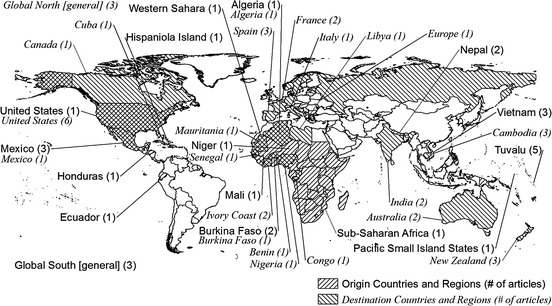
This paper presents the findings of a systematic review of scholarly publications that report empirical findings from studies of environmentally-related international migration. There exists a small, but growing accumulation of empirical studies that consider environmentally-linked migration that spans international borders. These studies provide useful evidence for scholars and policymakers in understanding how environmental factors interact with political, economic and social factors to influence migration behavior and outcomes that are specific to international movements of people, in highlighting promising future research directions, and in raising important considerations for international policymaking. Our review identifies countries of migrant origin and destination that have so far been the subject of empirical research, the environmental factors believed to have influenced these migrations, the interactions of environmental and non-environmental factors as well as the role of context in influencing migration behavior, and the types of methods used by researchers. In reporting our findings, we identify the strengths and challenges associated with the main empirical approaches, highlight significant gaps and future opportunities for empirical work, and contribute to advancing understanding of environmental influences on international migration more generally. Specifically, we propose an exploratory framework to take into account the role of context in shaping environmental migration across borders, including the dynamic and complex interactions between environmental and non-environmental factors at a range of scales.
Overview
The claims and statistics of this paper haven’t been checked yet.
Free: it reads the open-access text and checks the first 5 claims that cite a source we can check. Create a free account to check every claim.
Integrity signals
Registry
Cites
Statistics
Figures
Verification
Claims the paper makes
The claims and statistics of this paper haven’t been checked yet.
Free: it reads the open-access text and checks the first 5 claims that cite a source we can check. Create a free account to check every claim.
Claims other papers make about this one
Each is checked against this paper’s own text: does it say what the citing paper says it does?
The source backs part of the claim, not all of it — or backs it for a different population, condition or comparison.
In the citing paper
“While the majority of studies agree that climatic conditions are important for migration, their results vary substantially, making it difficult to establish when and under which conditions climate migration occurs (Cattaneo et al., 2019;Hunter et al., 2015;Obokata et al., 2014;Piguet, 2010;Warner and Afifi, 2014).”
From Improving the evidence base: A methodological review of the quantitative climate migration literature (2021) · cites this paper as Obokata et al., 2014
Experimental — accuracy not yet measured
Self-check
Percentages, sums and reported differences re-computed from the paper’s own numbers.
The self-check needs the paper’s full text.
Citations
Cites
The effect of environmental change on human migration
Black, R., Adger, W. N., Arnell, N. W., Dercon, S., Geddes, A., & Thomas, D. (2011) · Global Environmental Change · doi:10.1016/j.gloenvcha.2011.10.001 · Cited by 1,279 · cited 1×
“What is more critical than raising fears about ‘‘environmental refugees’’ is to identify barriers to adaptation and mobility (e.g., McLeman and Smit 2006; Bardsley and Hugo 2010; Black et al. 2011).”
BackgroundClimate change, human security and violent conflict
Barnett, J., & Adger, W. N. (2007) · Political Geography · doi:10.1016/j.polgeo.2007.03.003 · Cited by 1,085
Farmers’ Perceptions of Climate Change and Agricultural Adaptation Strategies in Rural Sahel
Mertz, O., Mbow, C., Reenberg, A., & Diouf, A. (2009) · Environmental Management · doi:10.1007/s00267-008-9197-0 · Cited by 978 · cited 2×
“In Nepal and West Africa, migration can become an embedded component of rural households’ wider livelihood diversification strategies, with larger family size making migration more possible (e.g., Afifi 2011; Shrestha and Bhandari 2007; see also Mertz et al. 2009).”
BackgroundAre we adapting to climate change?
Berrang-Ford, L., Ford, J. D., & Paterson, J. (2011) · Global Environmental Change · doi:10.1016/j.gloenvcha.2010.09.012 · Cited by 931 · cited 2×
“We used an approach adapted from Berrang-Ford et al. (2011) to generate systematically an inventory of English-language peer-reviewed articles that examine environmental factors and international migration published as of mid2013.”
MethodEnvironmental refugees: a growing phenomenon of the 21st century.
Myers, N. (2002) · Philosophical Transactions of the Royal Society of London. Series B, Biological Sciences · doi:10.1098/rstb.2001.0953 · Cited by 893 · cited 1×
“…(El-Hinnawi 1985) and 20 years since ecologist Norman Myers issued his first of several warnings in scholarly journals that the twenty-first century would see hundreds of thousands of people flee their homes for causes directly or indirectly attributable to the environment (Myers 1993, 1997, 2002).”
BackgroundMigration as an Adaptation to Climate Change
McLeman, R., & Smit, B. (2006) · Climatic Change · doi:10.1007/s10584-005-9000-7 · Cited by 811 · cited 4×
“What is more critical than raising fears about ‘‘environmental refugees’’ is to identify barriers to adaptation and mobility (e.g., McLeman and Smit 2006; Bardsley and Hugo 2010; Black et al. 2011).”
BackgroundInfluentialSelf-citationLinkages among climate change, crop yields and Mexico–US cross-border migration
Feng, S., Krueger, A. B., & Oppenheimer, M. (2010) · Proceedings of the National Academy of Sciences · doi:10.1073/pnas.1002632107 · Cited by 635 · cited 5×
“Since not all Table 4 Articles by type of research methods Quantitative methods and modelling Qualitative Mixed methods Feng et al. (2010) Bettini (2013) Afifi (2011)* Findley (1994) Farbotko (2005) Alscher (2011)* Gray (2009) Farbotko and Lazrus (2012) Dun (2011)* Gray (2010) McNamara (2007) Gila…”
BackgroundMethodInfluentialThe first climate refugees? Contesting global narratives of climate change in Tuvalu
Farbotko, C., & Lazrus, H. (2012) · Global Environmental Change · doi:10.1016/j.gloenvcha.2011.11.014 · Cited by 610 · cited 10×
“…strategies or livelihoods, whether through nomadism for the Sahrawi people (Gila et al. 2011), seasonal migrations (Afifi 2011; Findley 1994; Henry 2004a, b), and mobile occupations such as fishing (Farbotko and Lazrus 2012), which represent traditional forms of adaptation to environmental change.”
BackgroundMethodInfluentialClimate change, migration and adaptation in Funafuti, Tuvalu
Mortreux, C., & Barnett, J. (2009) · Global Environmental Change · doi:10.1016/j.gloenvcha.2008.09.006 · Cited by 573 · cited 3×
“…reviewed, 23 found some evidence of environmental factors influencing migration across international borders, while five others (Farbotko and Lazrus 2012; McNamara and Gibson 2009; Mortreux and Barnett 2009; Shen and Binns 2012; Shen and Gemenne 2011) that looked for evidence did not find it.”
BackgroundClimate change, environmental degradation and migration
Warner, K., Hamza, M., Oliver-Smith, A., Renaud, F., & Julca, A. (2010) · Natural Hazards · doi:10.1007/s11069-009-9419-7 · Cited by 553 · cited 2×
“…al. (2011) Shen and Gemenne (2011)* Marchiori and Schumacher (2011) Sunil et al. (2007) Marchiori et al. (2012) Warner (2010)* Massey et al. (2010) Warner et al. (2010)* Nawrotzki et al. (2013) Wrathall (2012) Reuveny and Moore (2009) Rowlands (2004) Shrestha and Bhandari (2007) An asterisk…”
BackgroundMigration, immobility and displacement outcomes following extreme events
Black, R., Arnell, N. W., Adger, W. N., Thomas, D., & Geddes, A. (2013) · Environmental Science & Policy · doi:10.1016/j.envsci.2012.09.001 · Cited by 519
Race, socioeconomic status, and return migration to New Orleans after Hurricane Katrina
Fussell, E., Sastry, N., & VanLandingham, M. (2010) · Population and Environment · doi:10.1007/s11111-009-0092-2 · Cited by 504 · cited 2×
“Keywords Environmental migration Environmental refugees International migration Environment-migration nexus Systematic literature review”
BackgroundInfluentialSome Reflections on Structure and Agency in Migration Theory
Bakewell, O. (2010) · Journal of Ethnic and Migration Studies · doi:10.1080/1369183x.2010.489382 · Cited by 495
Population: An Introduction to Concepts and Issues
Lonnquist, L. E., & Weeks, J. R. (1987) · Teaching Sociology · doi:10.2307/1318365 · Cited by 479
The impact of weather anomalies on migration in sub-Saharan Africa
Marchiori, L., Maystadt, J.-F., & Schumacher, I. (2012) · Journal of Environmental Economics and Management · doi:10.1016/j.jeem.2012.02.001 · Cited by 442 · cited 1×
“…and Barnett (2009) Shen and Binns (2012) Kniveton et al. (2011) Shen and Gemenne (2011)* Marchiori and Schumacher (2011) Sunil et al. (2007) Marchiori et al. (2012) Warner (2010)* Massey et al. (2010) Warner et al. (2010)* Nawrotzki et al. (2013) Wrathall (2012) Reuveny and Moore…”
BackgroundClimate Barbarians at the Gate? A critique of apocalyptic narratives on ‘climate refugees’
Bettini, G. (2013) · Geoforum · doi:10.1016/j.geoforum.2012.09.009 · Cited by 432 · cited 4×
“Five of the qualitative methods articles use poststructuralist discourse analysis with which they investigate how discourses about environmental or climatic change and migration have been constructed (Bettini 2013; Farbotko 2005; Farbotko and Lazrus 2012; McNamara 2007; McNamara and Gibson 2009).”
BackgroundMethodInfluentialHenry, S., Schoumaker, B., & Beauchemin, C. (2004) · Population and Environment · doi:10.1023/b:poen.0000036928.17696.e8 · Cited by 427 · cited 10×
“Some tentative connections can be made between certain types of environmental factors and certain types of migration (e.g., drought with internal, short distance, temporary migration in Africa—e.g., Findley 1994; Henry et al. 2004a, b).”
BackgroundInfluentialMigration and Environmental Hazards
Hunter, L. M. (2005) · Population and Environment · doi:10.1007/s11111-005-3343-x · Cited by 411 · cited 2×
“…ia , S p ai n , It al y , M au ri ta n ia , C u b a D ro u g h t, ac ce ss to re so u rc es (g ra zi n g /f ar m in g la n d ), w at er sh o rt ag es ; lo cu st s G ra y (2 0 0 9 , 2 0 1 0 ) E cu ad o r (S o u th er n A n d es ) S p ai n , U n it ed S ta te s L an d q u al it y , ag ri cu lt…”
BackgroundEnvironmental Refugees in a Globally Warmed World
Myers, N. (1993) · BioScience · doi:10.2307/1312319 · Cited by 387 · cited 2×
“…and policymakers in understanding how environmental factors interact with political, economic and social factors to influence migration behavior and outcomes that are specific to international movements of people, in highlighting promising future research directions, and in raising…”
BackgroundClimate Change, Forced Migration, and International Law
McAdam, J. (2012) · Oxford University Press eBooks · doi:10.1093/acprof:oso/9780199587087.001.0001 · Cited by 379
Does Drought Increase Migration? A Study of Migration from Rural Mali during the 1983–1985 Drought
Findley, S. E. (1994) · International Migration Review · doi:10.1177/019791839402800306 · Cited by 379 · cited 15×
“Some tentative connections can be made between certain types of environmental factors and certain types of migration (e.g., drought with internal, short distance, temporary migration in Africa—e.g., Findley 1994; Henry et al. 2004a, b).”
BackgroundMethodInfluentialGeography and Migration Studies: Retrospect and Prospect
King, R. (2012) · Population, Space and Place · doi:10.1002/psp.685 · Cited by 372
Bardsley, D. K., & Hugo, G. J. (2010) · Population and Environment · doi:10.1007/s11111-010-0126-9 · Cited by 365 · cited 1×
“What is more critical than raising fears about ‘‘environmental refugees’’ is to identify barriers to adaptation and mobility (e.g., McLeman and Smit 2006; Bardsley and Hugo 2010; Black et al. 2011).”
BackgroundEnvironmental change and out-migration: evidence from Nepal
Massey, D. S., Axinn, W. G., & Ghimire, D. J. (2010) · Population and Environment · doi:10.1007/s11111-010-0119-8 · Cited by 353 · cited 18×
“In eight of the case studies (Afifi 2011; Alscher 2011; Feng et al. 2010; Findley 1994; Gray 2009, 2010; Massey et al. 2010; Nawrotzki et al. 2013; Shrestha and Bhandari 2007), slow-onset environmental changes, particularly drought, are a factor influencing individuals’ decisions to migrate because of the economic con…”
BackgroundMethodInfluentialEnvironmental Refugees? Classifying Human Migrations Caused by Environmental Change
Bates, D. C. (2002) · Population and Environment · doi:10.1023/a:1015186001919 · Cited by 342 · cited 2×
“Reviewers of the field (e.g., Piguet 2010; Bates 2002; Gemenne 2011; McLeman 2011, 2014; Warner 2010, among others) have observed that discussions about environmental migration are often normative in nature and have called for greater empirical research.”
BackgroundMethodGlobal environmental change and migration: Governance challenges
Warner, K. (2010) · Global Environmental Change · doi:10.1016/j.gloenvcha.2009.12.001 · Cited by 324 · cited 4×
“On the other hand, four case studies mention or describe the role of government-sponsored resettlement plans, with differing effects on reducing vulnerability (Dun 2011; Warner 2010; Warner et al. 2010 same case study; Henry et al. 2004a, b; Massey et al. 2010; Wrathall 2012).”
BackgroundInfluentialMcNamara, K. E., & Gibson, C. (2009) · Geoforum · doi:10.1016/j.geoforum.2009.03.006 · Cited by 243 · cited 5×
“…reviewed, 23 found some evidence of environmental factors influencing migration across international borders, while five others (Farbotko and Lazrus 2012; McNamara and Gibson 2009; Mortreux and Barnett 2009; Shen and Binns 2012; Shen and Gemenne 2011) that looked for evidence did not find it.”
BackgroundInfluentialEnvironment, Land, and Rural Out-migration in the Southern Ecuadorian Andes
Gray, C. L. (2009) · World Development · doi:10.1016/j.worlddev.2008.05.004 · Cited by 236 · cited 8×
“In the cases in which internal migration was investigated alongside international migration (e.g., Dun 2011; Findley 1994; Gray 2009; Henry et al. 2004a), the number of internal migrants was typically found to be greater than the number of international migrants.”
BackgroundMethodInfluentialLinking climate change, environmental degradation, and migration: a methodological overview
Piguet, E. (2010) · WIREs Climate Change · doi:10.1002/wcc.54 · Cited by 226
Agent-based model simulations of future changes in migration flows for Burkina Faso
Kniveton, D., Smith, C., & Wood, S. (2011) · Global Environmental Change · doi:10.1016/j.gloenvcha.2011.09.006 · Cited by 215 · cited 4×
“Some authors (Afifi 2011; Alscher 2011; Dun 2011; Henry et al. 2004a, b; Kniveton et al. 2011; Massey et al. 2010) provide information on the political and economic structures of the nations and regions within which their case studies are situated.”
BackgroundInfluentialBarbier, B., Yacouba, H., Karambiri, H., Zoromé, M., & Somé, B. (2009) · Environmental Management · doi:10.1007/s00267-008-9237-9 · Cited by 205 · cited 2×
“The following exploratory framework may help future studies integrate a dynamic understanding of the role of the broader environmental and nonenvironmental context in their research.”
BackgroundTuvalu and climate change: constructions of environmental displacement in the sydney morning herald
Farbotko, C. (2005) · Geografiska Annaler: Series B, Human Geography · doi:10.1111/j.0435-3684.2005.00199.x · Cited by 197 · cited 2×
“There exists a small, but growing accumulation of empirical studies that consider environmentally-linked migration that spans international borders.”
BackgroundMyers, N. (1997) · Population and Environment · doi:10.1023/a:1024623431924 · Cited by 194 · cited 1×
“…(El-Hinnawi 1985) and 20 years since ecologist Norman Myers issued his first of several warnings in scholarly journals that the twenty-first century would see hundreds of thousands of people flee their homes for causes directly or indirectly attributable to the environment (Myers 1993, 1997, 2002).”
BackgroundSunil, T., Rojas, V. D., & Bradley, D. E. (2007) · Ageing and Society · doi:10.1017/s0144686x07005934 · Cited by 192 · cited 1×
“…et al. (2004b) Mortreux and Barnett (2009) Shen and Binns (2012) Kniveton et al. (2011) Shen and Gemenne (2011)* Marchiori and Schumacher (2011) Sunil et al. (2007) Marchiori et al. (2012) Warner (2010)* Massey et al. (2010) Warner et al. (2010)* Nawrotzki et al. (2013) Wrathall (2012) Reuveny…”
BackgroundMigration caused by climate change: how vulnerable are people inn dryland areas?
Meze-Hausken, E. (2000) · Mitigation and Adaptation Strategies for Global Change · doi:10.1023/a:1026570529614 · Cited by 189 · cited 1×
“…research focuses on internal migration following events such as the Great Plains Dust Bowl of the 1930s, Ethiopian droughts of the 1980s, flooding and dam construction along China’s Yangtze River, and Hurricane Katrina (e.g. McLeman 2006; Meze-Hausken 2000; Yan and Qian 2004; Fussell et al. 2010).”
BackgroundInfluentialMigration and Displacement Triggered by Floods in the Mekong Delta
Dun, O. (2011) · International Migration · doi:10.1111/j.1468-2435.2010.00646.x · Cited by 177 · cited 8×
“In the cases in which internal migration was investigated alongside international migration (e.g., Dun 2011; Findley 1994; Gray 2009; Henry et al. 2004a), the number of internal migrants was typically found to be greater than the number of international migrants.”
BackgroundInfluentialDoes Drought Increase Migration? A Study of Migration from Rural Mali during the 1983-1985 Drought
Findley, S. E. (1994) · International Migration Review · doi:10.2307/2546820 · Cited by 162
Climate and human migration: past experiences, future challenges
(2014) · Choice Reviews Online · doi:10.5860/choice.185341 · Cited by 159
Economic or Environmental Migration? The Push Factors in Niger
Afifi, T. (2011) · International Migration · doi:10.1111/j.1468-2435.2010.00644.x · Cited by 150 · cited 21×
“While a number of articles illustrate the gendered and classed nature of environmental migration through their empirical findings (e.g., Afifi 2011; Alscher 2011; Dun 2011; Findley 1994; Gray 2010; Radel et al. 2010; Wrathall 2012), there is considerable room for greater analysis of the ways these…”
BackgroundMethodInfluentialNawrotzki, R. J., Riosmena, F., & Hunter, L. M. (2013) · Population Research and Policy Review · doi:10.1007/s11113-012-9251-8 · Cited by 134 · cited 9×
“Social capital (particularly familial connections with other migrants) and previous migration experience facilitate migration from Honduras (Wrathall 2012), Mali (Findley 1994), and Nepal (Massey et al. 2010), for example.”
BackgroundMethodInfluentialDevelopments in modelling of climate change-related migration
McLeman, R. A. (2012) · Climatic Change · doi:10.1007/s10584-012-0578-2 · Cited by 132 · cited 2×
“Our study extends and builds upon previous work by Piguet (2010), who reviewed thenexisting methodological approaches with an emphasis on the role of environmental factors in migration that is already occurring and McLeman (2013), who reviewed developments in modelling of climate-related migration.”
BackgroundResultSelf-citationReuveny, R., & Moore, W. H. (2009) · Social Science Quarterly · doi:10.1111/j.1540-6237.2009.00569.x · Cited by 117 · cited 3×
“We used an approach adapted from Berrang-Ford et al. (2011) to generate systematically an inventory of English-language peer-reviewed articles that examine environmental factors and international migration published as of mid2013.”
BackgroundMethodConceptualizing discourses on environmental refugees at the United Nations
McNamara, K. E. (2007) · Population and Environment · doi:10.1007/s11111-007-0058-1 · Cited by 90 · cited 5×
“…(2010) Bettini (2013) Afifi (2011)* Findley (1994) Farbotko (2005) Alscher (2011)* Gray (2009) Farbotko and Lazrus (2012) Dun (2011)* Gray (2010) McNamara (2007) Gila et al. (2011)* Henry et al. (2004a) McNamara and Gibson (2009) Radel et al. (2010) Henry et al. (2004b) Mortreux and Barnett…”
BackgroundInfluentialWhen nature rebels: international migration, climate change, and inequality
Marchiori, L., & Schumacher, I. (2009) · Journal of Population Economics · doi:10.1007/s00148-009-0274-3 · Cited by 87 · cited 2×
“…(2009) Radel et al. (2010) Henry et al. (2004b) Mortreux and Barnett (2009) Shen and Binns (2012) Kniveton et al. (2011) Shen and Gemenne (2011)* Marchiori and Schumacher (2011) Sunil et al. (2007) Marchiori et al. (2012) Warner (2010)* Massey et al. (2010) Warner et al. (2010)* Nawrotzki et…”
BackgroundClimate Change, Migration and Critical International Security Considerations
McLeman, R. A. (2011) · IOM migration research series · doi:10.18356/cbe15386-en · Cited by 85 · cited 2×
“Reviewers of the field (e.g., Piguet 2010; Bates 2002; Gemenne 2011; McLeman 2011, 2014; Warner 2010, among others) have observed that discussions about environmental migration are often normative in nature and have called for greater empirical research.”
BackgroundMethodSelf-citationShen, S., & Gemenne, F. (2011) · International Migration · doi:10.1111/j.1468-2435.2010.00635.x · Cited by 75
Descriptive Analysis of the Individual Migratory Pathways According to Environmental Typologies
Henry, S. J. F., Piché, V., Ouédraogo, D., & Lambin, É. F. (2004) · Population and Environment · doi:10.1023/b:poen.0000036929.19001.a4 · Cited by 72 · cited 17×
“Some tentative connections can be made between certain types of environmental factors and certain types of migration (e.g., drought with internal, short distance, temporary migration in Africa—e.g., Findley 1994; Henry et al. 2004a, b).”
BackgroundInfluentialHunter, L. M., Strife, S., & Twine, W. C. (2010) · Society & Natural Resources · doi:10.1080/08941920903357782 · Cited by 68 · cited 2×
“…such ends, and there are a number of studies that raise potential cautions with respect to interviewees’ perceptions of environmental risks, selectivity in assigning migration causality, and other methodological challenges (e.g. Barbier et al. 2009; Hunter et al. 2010; van der Geest 2010).”
BackgroundRadel, C., Schmook, B. I., & McCandless, S. R. (2010) · Population and Environment · doi:10.1007/s11111-010-0124-y · Cited by 63
Environmental change and migration: methodological considerations from ground-breaking global survey
Warner, K. (2011) · Population and Environment · doi:10.1007/s11111-011-0150-4 · Cited by 62
Environmental Migration and Sustainable Development in the Upper Reaches of the Yangtze River
Tan, Y. L., & Qian, W. Y. (2004) · Population and Environment · doi:10.1023/b:poen.0000039067.43303.66 · Cited by 61 · cited 2×
“Keywords Environmental migration Environmental refugees International migration Environment-migration nexus Systematic literature review”
BackgroundInfluentialMigration out of 1930s Rural Eastern Oklahoma: Insights for Climate Change Research.
McLeman, R. A. (2006) · Lincoln (University of Nebraska) · Cited by 54
Self-citationWrathall, D. J. (2012) · Human Ecology · doi:10.1007/s10745-012-9501-8 · Cited by 54
Environmental security and labor migration in Nepal
Shrestha, S. S., & Bhandari, P. B. (2007) · Population and Environment · doi:10.1007/s11111-007-0059-0 · Cited by 54 · cited 15×
“…(2012) Warner (2010)* Massey et al. (2010) Warner et al. (2010)* Nawrotzki et al. (2013) Wrathall (2012) Reuveny and Moore (2009) Rowlands (2004) Shrestha and Bhandari (2007) An asterisk indicates studies part of the EU’s EACH-FOR project (www.each-for.eu) countries and jurisdictions have…”
BackgroundMethodInfluentialGender, Natural Capital, and Migration in the Southern Ecuadorian Andes
Gray, C. L. (2010) · Environment and Planning A: Economy and Space · doi:10.1068/a42170 · Cited by 53 · cited 6×
“…the gendered and classed nature of environmental migration through their empirical findings (e.g., Afifi 2011; Alscher 2011; Dun 2011; Findley 1994; Gray 2010; Radel et al. 2010; Wrathall 2012), there is considerable room for greater analysis of the ways these markers of difference may affect how…”
BackgroundMethodInfluentialShould the United Nations Framework Convention on Climate Change recognize climate migrants?
Gibb, C., & Ford, J. D. (2012) · Environmental Research Letters · doi:10.1088/1748-9326/7/4/045601 · Cited by 47 · cited 2×
“…adaptation planning and funding under the UN Framework Convention on Climate Change will eventually include the development of strategies for resettling populations from highly vulnerable areas like small island states (for discussion, see Biermann and Boas 2012; Gibb and Ford 2012; McLeman 2014).”
BackgroundEnvironmental Degradation and Migration on Hispaniola Island
Alscher, S. (2011) · International Migration · doi:10.1111/j.1468-2435.2010.00664.x · Cited by 45 · cited 17×
“While a number of articles illustrate the gendered and classed nature of environmental migration through their empirical findings (e.g., Afifi 2011; Alscher 2011; Dun 2011; Findley 1994; Gray 2010; Radel et al. 2010; Wrathall 2012), there is considerable room for greater analysis of the ways these…”
BackgroundMethodInfluentialGemenne, F. (2011) · Open Repository and Bibliography (University of Liège) · Cited by 44
Climate Change and Human Migration: Towards a Global Governance System to Protect Climate Refugees
Biermann, F., & Boas, I. (2012) · Hexagon series on human and environmental security and peace · doi:10.1007/978-3-642-28626-1_15 · Cited by 42 · cited 1×
“…adaptation planning and funding under the UN Framework Convention on Climate Change will eventually include the development of strategies for resettling populations from highly vulnerable areas like small island states (for discussion, see Biermann and Boas 2012; Gibb and Ford 2012; McLeman 2014).”
Background‘Environmental Refugees’: Key Debates and the Contributions of Geographers
Gill, N. (2010) · Geography Compass · doi:10.1111/j.1749-8198.2010.00336.x · Cited by 40 · cited 1×
“Most migration, whether its causal influences are environmental in nature or otherwise, occurs within national boundaries (Gill 2010; McLeman 2014; Samers 2010; Weeks 2008).”
BackgroundLocal Perceptions Of Migration From North-West Ghana
van der Geest, K. (2010) · Africa · doi:10.3366/afr.2010.0404 · Cited by 38 · cited 2×
“…such ends, and there are a number of studies that raise potential cautions with respect to interviewees’ perceptions of environmental risks, selectivity in assigning migration causality, and other methodological challenges (e.g. Barbier et al. 2009; Hunter et al. 2010; van der Geest 2010).”
BackgroundPathways, motivations and challenges: contemporary Tuvaluan migration to New Zealand
Shen, S., & Binns, T. (2010) · GeoJournal · doi:10.1007/s10708-010-9386-2 · Cited by 37 · cited 6×
“…(2007) Gila et al. (2011)* Henry et al. (2004a) McNamara and Gibson (2009) Radel et al. (2010) Henry et al. (2004b) Mortreux and Barnett (2009) Shen and Binns (2012) Kniveton et al. (2011) Shen and Gemenne (2011)* Marchiori and Schumacher (2011) Sunil et al. (2007) Marchiori et al. (2012)…”
BackgroundInfluentialMcLeman, R. A., & Ploeger, S. K. (2011) · Population and Environment · doi:10.1007/s11111-011-0148-y · Cited by 33 · cited 2×
“Another option for extending longitudinal reach is through studies that hindcast environmentally-related migration using historical data, such has been done by Jennings and Gray (2013) for nineteenth century Holland or McLeman and Ploeger (2012) for 1930s Saskatchewan, Canada.”
BackgroundSelf-citationGIS-based modeling of drought and historical population change on the Canadian Prairies
McLeman, R. A., Herold, S., Reljic, Z., Sawada, M., & McKenney, D. W. (2009) · Journal of Historical Geography · doi:10.1016/j.jhg.2009.04.003 · Cited by 33 · cited 1×
“…for migration out of rural Saskatchewan in the 1930s (which included small amounts of migration to the US), McLeman and Ploeger (2012) and McLeman et al. (2010) found it necessary to combine three different types of historical climate data (July– September maximum daily temperatures,…”
BackgroundSelf-citationMigration, Social Networks and Risk
Winkels, A. (2012) · Journal of Vietnamese Studies · doi:10.1525/vs.2012.7.4.92 · Cited by 23 · cited 1×
“We agree with Winkels’ (2012) observation that environmental migration poses risks not simply to the migrant, but to other members of the migrant’s social network, and with Black et al. (2013) that in many cases it is not the environmental migrants, but the immobile—those affected by environmental…”
BackgroundMigration, Environment and Climate Change
Reis, J. J., Gerdau-Radonić, K., Buguet, A., & Spencer, P. S. (2021) · Sustainable development goals series · doi:10.1007/978-3-030-81058-0_6 · Cited by 13
Western Sahara: Migration, Exile and Environment
Gila, Ó. Á., Zaratiegui, A. U., & Diéguez, V. L. D. M. (2011) · International Migration · doi:10.1111/j.1468-2435.2010.00665.x · Cited by 12 · cited 10×
“2010), grazing and farming land for Sahrawi pastoralists in Western Sahara and Algeria (Gila et al. 2011), crop land availability in Reuveny and Moore’s (2009) North–South model, and the shrinking and polluting of Lake Chad and the Niger River in Niger (Afifi 2011).”
BackgroundInfluentialThe Effects of Poverty, Environmental Degradation, and Gender Conditions on South—to—North Migration
Rowlands, D. (2004) · Canadian Journal of Development Studies/Revue canadienne d études du développement · doi:10.1080/02255189.2004.9669002 · Cited by 7 · cited 3×
“We used an approach adapted from Berrang-Ford et al. (2011) to generate systematically an inventory of English-language peer-reviewed articles that examine environmental factors and international migration published as of mid2013.”
BackgroundMethodOn the Origins of Environmental Migration
McLeman, R. A. (2009) · FLASH - Fordham Law Archive of Scholarship & History (Fordham University) · Cited by 6
Self-citation
Research works printed but not linked: 2
- 29. Jasco, P. (2005). As we may search-Comparison of major features of the web of science, Scopus, and Google Scholar citation based and citation-enhanced databases. Current Science, 89(9), 1537-1547.
- 58. Samers, M. (2010). Migration. London: Routledge.
Cited by
The influence of climate variability on internal migration flows in South Africa
Mastrorillo, M., Licker, R., Bohra-Mishra, P., Fagiolo, G., D. Estes, L., & Oppenheimer, M. (2016) · Global Environmental Change · doi:10.1016/j.gloenvcha.2016.04.014 · Cited by 219
“Nevertheless, a growing number of contributions find that environmental factors exert a significant effect on both international and internal migration (Bie Lilleor and Van den Broeck, 2011; Obokata et al., 2014).”
BackgroundHow can migration serve adaptation to climate change? Challenges to fleshing out a policy ideal
Gemenne, F., & Blocher, J. (2017) · The Geographical Journal · doi:10.1111/geoj.12205 · Cited by 212
Country-specific effects of climate variability on human migration
Gray, C., & Wise, E. (2016) · Climatic Change · doi:10.1007/s10584-015-1592-y · Cited by 210
The uneven geography of research on “environmental migration”
Piguet, E., Kaenzig, R., & Guélat, J. (2018) · Population and Environment · doi:10.1007/s11111-018-0296-4 · Cited by 187
“To our knowledge, mapping environmentally induced migration research has not been attempted to date.1 The only exception is Obokata et al. (2014) in this very journal.”
BackgroundMethodHoffmann, R., Šedová, B., & Vinke, K. (2021) · Global Environmental Change · doi:10.1016/j.gloenvcha.2021.102367 · Cited by 159
Metadata
- Authors
- Obokata, R., Veronis, L., & McLeman, R.
- Affiliations
- University of Ottawa (CA)
- Wilfrid Laurier University (CA)
- Corresponding author
- Veronis, Luisa
- ORCID
- McLeman, Robert
- Venue
- Population and Environment
- Published
- 2014-02-22
- Volume
- 36
- Issue
- 1
- Pages
- 111-135
- ISSN
- 0199-0039 (ISSN-L)
- 1573-7810
- PMC
- PMC4131126
- OpenAlex
- W2131393926
- Semantic Scholar
- 2c863209116da5a82bba503475dacd34bfcab438
- Cited by
- 164
- References
- 74
- Citations by year
- 2026: 14 · 2025: 11 · 2024: 26 · 2023: 15 · 2022: 15 · 2021: 20 · 2020: 13 · 2019: 17 · 2018: 10 · 2017: 11 · 2016: 4 · 2015: 7
- FWCI
- 2.42
- Type
- journal article
- Language
- en
- Open access
- hybrid
- doi.org
- Locations
- Population and Environment (publishedVersion, cc-by)
- Europe PMC (PubMed Central) (publishedVersion, cc-by)
- PubMed Central (publishedVersion, cc-by)
- PubMed (publishedVersion)
- Topics
- Social Sciences › Sociology and Political Science › Climate Change, Adaptation, Migration
- Social Sciences › Sociology and Political Science › Migration and Labor Dynamics
- Social Sciences › Sociology and Political Science › Migration, Refugees, and Integration
- Keywords
- environmental migration, international migration, climate-induced migration, migratory behavior, migration policy, research gaps
About these checks
Registry, retraction, Cites and statistics results are computed, not judged, with one exception: a printed reference that no index lists is read once by a model before it counts as a citation error. Claims are extracted by a model and kept only when their quote appears verbatim in the text; each cited source is then checked, with a model’s help, for whether it says what the claim relies on. Those verdicts can be wrong — read the claim’s quote and the cited source before relying on one.
Statistics and arithmetic are recomputed, not judged.
Confidence bands are shown only for fields calibrated on our annotated test set. None is calibrated yet, so no band is shown.
What counts as a claim ›How we measure confidence ›How we check this ›
Are you an author, or do you see a problem with this page? Request a review
Data sources
Bibliographic data: Semantic Scholar, OpenAlex, Crossref.
Contains information from the Semantic Scholar Academic Graph Datasets, made available under the ODC Attribution License (ODC-BY 1.0).
Semantic Scholar’s data is described in: Kinney, R., et al. (2023). The Semantic Scholar Open Data Platform. arXiv:2301.10140.
