

Empirical research on international environmental migration: a systematic review
Open accessThe DOI matches its Crossref record; 69 of the 74 references it cites were found in a registry or an index.
Abstract
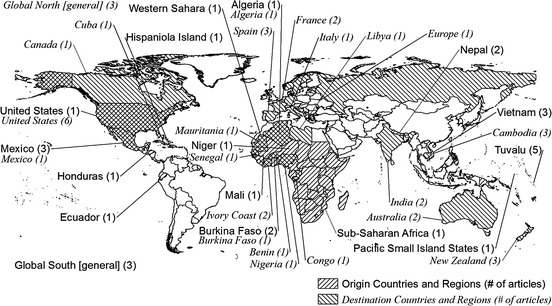
This paper presents the findings of a systematic review of scholarly publications that report empirical findings from studies of environmentally-related international migration. There exists a small, but growing accumulation of empirical studies that consider environmentally-linked migration that spans international borders. These studies provide useful evidence for scholars and policymakers in understanding how environmental factors interact with political, economic and social factors to influence migration behavior and outcomes that are specific to international movements of people, in highlighting promising future research directions, and in raising important considerations for international policymaking. Our review identifies countries of migrant origin and destination that have so far been the subject of empirical research, the environmental factors believed to have influenced these migrations, the interactions of environmental and non-environmental factors as well as the role of context in influencing migration behavior, and the types of methods used by researchers. In reporting our findings, we identify the strengths and challenges associated with the main empirical approaches, highlight significant gaps and future opportunities for empirical work, and contribute to advancing understanding of environmental influences on international migration more generally. Specifically, we propose an exploratory framework to take into account the role of context in shaping environmental migration across borders, including the dynamic and complex interactions between environmental and non-environmental factors at a range of scales.
Overview
The claims and statistics of this paper haven’t been checked yet.
Free: it reads the open-access text and checks the first 5 claims that cite a source we can check. Create a free account to check every claim.
Integrity signals
Registry
Cites
Statistics
Figures
Verification
Claims the paper makes
The claims and statistics of this paper haven’t been checked yet.
Free: it reads the open-access text and checks the first 5 claims that cite a source we can check. Create a free account to check every claim.
Claims other papers make about this one
Each is checked against this paper’s own text: does it say what the citing paper says it does?
The source backs part of the claim, not all of it — or backs it for a different population, condition or comparison.
In the citing paper
“While the majority of studies agree that climatic conditions are important for migration, their results vary substantially, making it difficult to establish when and under which conditions climate migration occurs (Cattaneo et al., 2019;Hunter et al., 2015;Obokata et al., 2014;Piguet, 2010;Warner and Afifi, 2014).”
From Improving the evidence base: A methodological review of the quantitative climate migration literature (2021) · cites this paper as Obokata et al., 2014
Experimental — accuracy not yet measured
Self-check
Percentages, sums and reported differences re-computed from the paper’s own numbers.
The self-check needs the paper’s full text.
Citations
Cites
The effect of environmental change on human migration
Black, R., Adger, W. N., Arnell, N. W., Dercon, S., Geddes, A., & Thomas, D. (2011) · Global Environmental Change · doi:10.1016/j.gloenvcha.2011.10.001 · Cited by 1,279 · cited 1×
“What is more critical than raising fears about ‘‘environmental refugees’’ is to identify barriers to adaptation and mobility (e.g., McLeman and Smit 2006; Bardsley and Hugo 2010; Black et al. 2011).”
BackgroundClimate change, human security and violent conflict
Barnett, J., & Adger, W. N. (2007) · Political Geography · doi:10.1016/j.polgeo.2007.03.003 · Cited by 1,085
Farmers’ Perceptions of Climate Change and Agricultural Adaptation Strategies in Rural Sahel
Mertz, O., Mbow, C., Reenberg, A., & Diouf, A. (2009) · Environmental Management · doi:10.1007/s00267-008-9197-0 · Cited by 978 · cited 2×
“In Nepal and West Africa, migration can become an embedded component of rural households’ wider livelihood diversification strategies, with larger family size making migration more possible (e.g., Afifi 2011; Shrestha and Bhandari 2007; see also Mertz et al. 2009).”
BackgroundAre we adapting to climate change?
Berrang-Ford, L., Ford, J. D., & Paterson, J. (2011) · Global Environmental Change · doi:10.1016/j.gloenvcha.2010.09.012 · Cited by 931 · cited 2×
“We used an approach adapted from Berrang-Ford et al. (2011) to generate systematically an inventory of English-language peer-reviewed articles that examine environmental factors and international migration published as of mid2013.”
MethodEnvironmental refugees: a growing phenomenon of the 21st century.
Myers, N. (2002) · Philosophical Transactions of the Royal Society of London. Series B, Biological Sciences · doi:10.1098/rstb.2001.0953 · Cited by 893 · cited 1×
“…(El-Hinnawi 1985) and 20 years since ecologist Norman Myers issued his first of several warnings in scholarly journals that the twenty-first century would see hundreds of thousands of people flee their homes for causes directly or indirectly attributable to the environment (Myers 1993, 1997, 2002).”
BackgroundMigration as an Adaptation to Climate Change
McLeman, R., & Smit, B. (2006) · Climatic Change · doi:10.1007/s10584-005-9000-7 · Cited by 811 · cited 4×
“What is more critical than raising fears about ‘‘environmental refugees’’ is to identify barriers to adaptation and mobility (e.g., McLeman and Smit 2006; Bardsley and Hugo 2010; Black et al. 2011).”
BackgroundInfluentialSelf-citationLinkages among climate change, crop yields and Mexico–US cross-border migration
Feng, S., Krueger, A. B., & Oppenheimer, M. (2010) · Proceedings of the National Academy of Sciences · doi:10.1073/pnas.1002632107 · Cited by 635 · cited 5×
“Since not all Table 4 Articles by type of research methods Quantitative methods and modelling Qualitative Mixed methods Feng et al. (2010) Bettini (2013) Afifi (2011)* Findley (1994) Farbotko (2005) Alscher (2011)* Gray (2009) Farbotko and Lazrus (2012) Dun (2011)* Gray (2010) McNamara (2007) Gila…”
BackgroundMethodInfluentialThe first climate refugees? Contesting global narratives of climate change in Tuvalu
Farbotko, C., & Lazrus, H. (2012) · Global Environmental Change · doi:10.1016/j.gloenvcha.2011.11.014 · Cited by 610 · cited 10×
“…strategies or livelihoods, whether through nomadism for the Sahrawi people (Gila et al. 2011), seasonal migrations (Afifi 2011; Findley 1994; Henry 2004a, b), and mobile occupations such as fishing (Farbotko and Lazrus 2012), which represent traditional forms of adaptation to environmental change.”
BackgroundMethodInfluentialClimate change, migration and adaptation in Funafuti, Tuvalu
Mortreux, C., & Barnett, J. (2009) · Global Environmental Change · doi:10.1016/j.gloenvcha.2008.09.006 · Cited by 573 · cited 3×
“…reviewed, 23 found some evidence of environmental factors influencing migration across international borders, while five others (Farbotko and Lazrus 2012; McNamara and Gibson 2009; Mortreux and Barnett 2009; Shen and Binns 2012; Shen and Gemenne 2011) that looked for evidence did not find it.”
BackgroundClimate change, environmental degradation and migration
Warner, K., Hamza, M., Oliver-Smith, A., Renaud, F., & Julca, A. (2010) · Natural Hazards · doi:10.1007/s11069-009-9419-7 · Cited by 553 · cited 2×
“…al. (2011) Shen and Gemenne (2011)* Marchiori and Schumacher (2011) Sunil et al. (2007) Marchiori et al. (2012) Warner (2010)* Massey et al. (2010) Warner et al. (2010)* Nawrotzki et al. (2013) Wrathall (2012) Reuveny and Moore (2009) Rowlands (2004) Shrestha and Bhandari (2007) An asterisk…”
Background
Research works printed but not linked: 2
- 29. Jasco, P. (2005). As we may search-Comparison of major features of the web of science, Scopus, and Google Scholar citation based and citation-enhanced databases. Current Science, 89(9), 1537-1547.
- 58. Samers, M. (2010). Migration. London: Routledge.
Cited by
The influence of climate variability on internal migration flows in South Africa
Mastrorillo, M., Licker, R., Bohra-Mishra, P., Fagiolo, G., D. Estes, L., & Oppenheimer, M. (2016) · Global Environmental Change · doi:10.1016/j.gloenvcha.2016.04.014 · Cited by 219
“Nevertheless, a growing number of contributions find that environmental factors exert a significant effect on both international and internal migration (Bie Lilleor and Van den Broeck, 2011; Obokata et al., 2014).”
BackgroundHow can migration serve adaptation to climate change? Challenges to fleshing out a policy ideal
Gemenne, F., & Blocher, J. (2017) · The Geographical Journal · doi:10.1111/geoj.12205 · Cited by 212
Country-specific effects of climate variability on human migration
Gray, C., & Wise, E. (2016) · Climatic Change · doi:10.1007/s10584-015-1592-y · Cited by 210
The uneven geography of research on “environmental migration”
Piguet, E., Kaenzig, R., & Guélat, J. (2018) · Population and Environment · doi:10.1007/s11111-018-0296-4 · Cited by 187
“To our knowledge, mapping environmentally induced migration research has not been attempted to date.1 The only exception is Obokata et al. (2014) in this very journal.”
BackgroundMethodHoffmann, R., Šedová, B., & Vinke, K. (2021) · Global Environmental Change · doi:10.1016/j.gloenvcha.2021.102367 · Cited by 159
Linking climate change, environmental degradation, and migration: An update after 10 years
Piguet, É. (2021) · Wiley Interdisciplinary Reviews Climate Change · doi:10.1002/wcc.746 · Cited by 203
“…than keyword searches on Scopus or the Web of Science, as can be observed by the smaller number of case studies identified in syntheses making use of these tools (Kaczan & Orgill-Meyer, 2020; Maretti et al., 2019; K. Neumann & Hermans, 2017; Obokata et al., 2014; Priovashini & Mallick, 2021).”
MethodKoubi, V., Spilker, G., Schaffer, L., & Böhmelt, T. (2016) · Population and Environment · doi:10.1007/s11111-016-0258-7 · Cited by 125
“…offer intriguing insights into the complex relationship between environmental change and migration, their findings remain, as indicated above, inconclusive (Adger et al. 2015; Hunter et al. 2015; IPCC 2014; Obokata et al. 2014; Gray and Bilsborrow 2013; Black et al. 2011a, c; Raleigh et al. 2008).”
ResultClimate Change and the Neglected Tropical Diseases
Booth, M. (2018) · Advances in Parasitology/Advances in parasitology · doi:10.1016/bs.apar.2018.02.001 · Cited by 168
“The fragmented nature of the change (van Vliet et al., 2013 ) may lead to selective national or international population migration from at risk areas, as has been observed in various countries (reviewed by Obokata et al., 2014) , including Ethiopia (Gray and Mueller, 2012) , Mexico (Nawrotzki et al., 2015) and South A…”
BackgroundMarino, E., & Lazrus, H. (2015) · Human Organization · doi:10.17730/0018-7259-74.4.341 · Cited by 104
Longueville, F. D., Ozer, P., Gemenne, F., Henry, S. J. F., Mertz, O., & Nielsen, J. Ø. (2020) · Climatic Change · doi:10.1007/s10584-020-02704-7 · Cited by 127
“Studies about the environment-migration nexus are largely based on conventional climate data based on recordedmeasures (Obokata et al. 2014).”
MethodA systematic review of climate migration research: Gaps in existing literature
Ghosh, R. C., & Orchiston, C. (2022) · SN Social Sciences · doi:10.1007/s43545-022-00341-8 · Cited by 85
Gendered dimensions of migration in relation to climate change
Lama, P., Hamza, M., & Wester, M. (2020) · Climate and Development · doi:10.1080/17565529.2020.1772708 · Cited by 125
“…with McLeman et al.’s (2016) call for a better examination of the relationship between environmental migration and socio-economic inequality; and Obokata et al. (2014) to take into account the role of context in shaping environmental migration and the complex interaction between environmental…”
BackgroundMigration and displacement risks due to mean sea-level rise
McLeman, R. A. (2018) · Bulletin of the Atomic Scientists · doi:10.1080/00963402.2018.1461951 · Cited by 80
“Longdistance international migration for environmental reasons is actually quite rare, and usually takes place between countries with common borders (such as Nepal and India, Burkina Faso and Côte D’Ivoire, Mexico and the United States, and Nicaragua and Costa Rica) (Obokata, Veronis, and McLeman 2014).”
BackgroundSelf-citationClimate Change Adaptation Options for Coastal Communities and Local Governments
Sinay, L., & Carter, B. (2020) · Climate · doi:10.3390/cli8010007 · Cited by 74
“This approach is common in the health sciences and has been applied increasingly to environmental and climate change studies [15,16].”
BackgroundMorales-Muñoz, H., Jha, S., Bonatti, M., Alff, H., Kurtenbach, S., & Sieber, S. (2020) · Sustainability · doi:10.3390/su12145702 · Cited by 98
“[68], claim that, although the separation of environmental and non-environmental factors is important for analytical purposes, isolating environmental drivers from other drivers is difficult, especially in the context of sustainability and risk reduction [69].”
BackgroundGone with the wind: International migration
Wesselbaum, D., & Aburn, A. (2019) · Global and Planetary Change · doi:10.1016/j.gloplacha.2019.04.008 · Cited by 66
Climate Change, Agriculture and Migration: A Survey
Falco, C., Donzelli, F., & Olper, A. (2018) · Sustainability · doi:10.3390/su10051405 · Cited by 79
“In what follows we focus the attention mainly on more recent macro-studies only partially covered by [50].”
BackgroundInfluentialMigration and climate change – The role of social protection
Silchenko, D., & Murray, Ú. (2022) · Climate Risk Management · doi:10.1016/j.crm.2022.100472 · Cited by 80
Leaving home: place attachment and decisions to move in the face of environmental change
Dandy, J., Horwitz, P., Campbell, R., Drake, D. G., & Leviston, Z. (2019) · Regional Environmental Change · doi:10.1007/s10113-019-01463-1 · Cited by 71
Does climate change influence people’s migration decisions in Maldives?
Kelman, I., Orlowska, J., Upadhyay, H., Stojanov, R., Webersik, C., Simonelli, A. C., Procházka, D., & Němec, D. (2019) · Climatic Change · doi:10.1007/s10584-019-02376-y · Cited by 61
Duijndam, S., Botzen, W. J. W., Hagedoorn, L., & Aerts, J. C. J. H. (2021) · Wiley Interdisciplinary Reviews Climate Change · doi:10.1002/wcc.747 · Cited by 74
“Although younger, male, and higher educated individuals are often depicted as being more likely to take part in environmental migration, especially internationally (Kaczan & OrgillMeyer, 2020; Obokata et al., 2014), this general pattern is not observed for the studies included in this review.”
BackgroundSocial protection as a strategy to address climate-induced migration
Schwan, S., & Yu, X. (2017) · International Journal of Climate Change Strategies and Management · doi:10.1108/ijccsm-01-2017-0019 · Cited by 79
“More empirical research, especially based on longitudinal data, is needed on the barriers to and causes for different types of migration, on the characteristics determining the propensity of households or individuals to migrate, on the interaction of climate and environmental drivers of migration with existing public…”
InfluentialA bibliometric review on the drivers of environmental migration
Priovashini, C., & Mallick, B. (2021) · AMBIO · doi:10.1007/s13280-021-01543-9 · Cited by 64
Displacement and Resettlement: Understanding the Role of Climate Change in Contemporary Migration
Heslin, A., Deckard, N. D., Oakes, R., & Montero-Colbert, A. (2018) · Climate risk management, policy and governance · doi:10.1007/978-3-319-72026-5_10 · Cited by 55
“The decision to leave a place of residence is multifaceted, comprised of both push and pull factors (Bronen et al. 2009; Obokata et al. 2014; Renaud et al. 2007;Warner et al. 2010).”
BackgroundA Region at Risk: The Human Dimensions of Climate Change in Asia and the Pacific
Bank, A. D. (2017) · doi:10.22617/tcs178839-2 · Cited by 119
Climate change and migration: A review and new framework for analysis
Daoust, G. D., & Selby, J. (2024) · Wiley Interdisciplinary Reviews Climate Change · doi:10.1002/wcc.886 · Cited by 77
“…cannot be explained by “ push factors ” alone, and certainly not just environmental push factors (Black, Adger, et al., 2011; Flahaux & De Haas, 2016; Obokata et al., 2014), alongside the recognition that climate-related migration, as well as discourses about and responses to it, are embedded in…”
Decision‐making factor interactions influencing climate migration: A systems‐based systematic review
Nabong, E. C., Hocking, L., Opdyke, A., & Walters, J. P. (2023) · Wiley Interdisciplinary Reviews Climate Change · doi:10.1002/wcc.828 · Cited by 69
“…Piguet, 2022; Safra de Campos et al., 2016), while others limit to geographic areas (Borderon et al., 2019; Kaczan & Orgill-Meyer, 2020; Priodarshini & Mallick, 2021), mobility type (Miller & Vu, 2021; Obokata et al., 2014; Veronis et al., 2018), or specific climate hazard (Duijndam et al., 2022).”
BackgroundInfluentialMaretti, M., Tontodimamma, A., & Biermann, P. (2019) · International Review of Sociology · doi:10.1080/03906701.2019.1641270 · Cited by 62
“Among the different strategies used in literature to obtain an exhaustive picture of the scientific literature on climate-environmental migrations, some authors, such as Obokata, Veronis, and McLeman (2014), have used the ISI Web of Science, consulting the database through keywords.”
MethodUrban governance and the systems approaches to health-environment co-benefits in cities
de Oliveira, J. A. P., Doll, C. N. H., Siri, J. G., Dreyfus, M., Farzaneh, H., & Capon, A. G. (2015) · Cadernos de Saúde Pública · doi:10.1590/0102-311x00010015 · Cited by 46
Climatic factors as drivers of migration: a review
Moore, M., & Wesselbaum, D. (2023) · Environment, Development and Sustainability · doi:10.1007/s10668-022-02191-z · Cited by 42
Outward migration may alter population dynamics and income inequality
Shayegh, S. (2017) · Nature Climate Change · doi:10.1038/nclimate3420 · Cited by 57
Best, K. B., Gilligan, J. M., Baroud, H., Carrico, A. R., Donato, K. M., Ackerly, B. A., & Mallick, B. (2020) · Journal of Computational Social Science · doi:10.1007/s42001-020-00066-9 · Cited by 46
The risks of invisibilization of populations and places in environment-migration research
Borderon, M., Best, K. B., Bailey, K., Hopping, D. L., Dove, M., & Cervantes de Blois, C. L. (2021) · Humanities and Social Sciences Communications · doi:10.1057/s41599-021-00999-0 · Cited by 38
Best, K. B., Gilligan, J. M., Baroud, H., Carrico, A. R., Donato, K. M., & Mallick, B. (2022) · Regional Environmental Change · doi:10.1007/s10113-022-01915-1 · Cited by 40
“Bangladesh is a country located on the floodplain of the Ganges–Brahmaputra-Jamuna Delta, one of the largest river deltas in the world (Passalacqua et al. 2013).”
BackgroundDinc, P., & Eklund, L. (2024) · Climate and Development · doi:10.1080/17565529.2023.2223600 · Cited by 36
“Drought has been found to in fl uence both internal (A fifi et al., 2016; Joarder & Miller, 2013) and international (Obokata et al., 2014) migration decisions through economic losses at the household level.”
BackgroundSingh, C., Tebboth, M. G. L., Spear, D., Ansah, P. A. K., & Mensah, A. M. (2019) · Regional Environmental Change · doi:10.1007/s10113-019-01562-z · Cited by 51
“CCVA research in general and environmental migration in particular have also been critiqued for a relative silence on temporality (Obokata et al. 2014; Fawcett et al. 2017; Adamson et al. 2018) and overreliance on static methodologies such as household surveys to examine inherently dynamic processes such as adaptation…”
Background6. Climate Migration Is about People, Not Numbers
Durand-Delacre, D., Bettini, G., Nash, S. L., Sterly, H., Gioli, G., Hut, E., Boas, I., Farbotko, C., Sakdapolrak, P., de Bruijn, M., et al. (2021) · Open Book Publishers · doi:10.11647/obp.0265.06 · Cited by 38
Understanding the global subnational migration patterns driven by hydrological intrusion exposure
Qiao, R., Gao, S., Liu, X., Xia, L., Zhang, G., Meng, X., Liu, Z., Wang, M., Zhou, S., & Wu, Z. (2024) · Nature Communications · doi:10.1038/s41467-024-49609-y · Cited by 37
Migration, Remittances, and Forest Cover Change in Rural Guatemala and Chiapas, Mexico
Angelsen, A., Aguilar‐Støen, M., Ainembabazi, J. H., Castellanos, E. J., & Taylor, M. J. (2020) · Land · doi:10.3390/land9030088 · Cited by 41
Longueville, F. D., Zhu, Y., & Henry, S. J. F. (2019) · Population and Environment · doi:10.1007/s11111-019-00320-x · Cited by 42
Towards a feminist political ecology of migration in a changing climate
Telenti, S. V. D. (2024) · Geoforum · doi:10.1016/j.geoforum.2024.104076 · Cited by 52
In the Eye of the Storm: Hurricanes, Climate Migration, and Climate Attitudes
Arias, S. B., & Blair, C. (2024) · American Political Science Review · doi:10.1017/s0003055424000352 · Cited by 50
“This is crucial because environmental disasters are the leading cause of climate-related displacement globally and because public opinion on climate migrants is central to understanding the prospects for their integration in receiving communities (Obokata, Veronis, and McLeman 2014).”
Out-migration from Coastal Areas in Ghana and Indonesia—the Role of Environmental Factors
Goldbach, C. (2017) · CESifo Economic Studies · doi:10.1093/cesifo/ifx007 · Cited by 42
Assessing managed flood retreat and community relocation in the Midwest USA
Pinter, N., & Rees, J. C. (2021) · Natural Hazards · doi:10.1007/s11069-021-04592-1 · Cited by 38
PRAAG, L. V., Ou‐Salah, L., Hut, E., & Zickgraf, C. (2021) · IMISCOE research series · doi:10.1007/978-3-030-61390-7 · Cited by 42
Green place rather than green space as a health determinant: A 20-year scoping review
Zhang, Y., Zhang, Y., Terry Van, D. I. J. K., & Yu, Y. (2022) · Environmental Research · doi:10.1016/j.envres.2022.113812 · Cited by 34
Weathering the storm: weather shocks and international labor migration from the Philippines
Pajaron, M., & Vasquez, G. N. A. (2020) · Journal of Population Economics · doi:10.1007/s00148-020-00779-1 · Cited by 29
Here and now: perceptions of Indian Ocean islanders on the climate change and migration nexus
Kelman, I., Upadhyay, H., Simonelli, A. C., Arnall, A., Mohan, D., Lingaraj, G. J., Nair, S., & Webersik, C. (2017) · Geografiska Annaler Series B Human Geography · doi:10.1080/04353684.2017.1353888 · Cited by 26
“Empirical studies are rapidly increasing (Klaiber 2014; Obokata, Veronis, and McLeman 2014) showing how populations deciding or being forced to migrate (or not to migrate) might not always be able to differentiate between climate change related reasons and other environmental reasons (Black,…”
Shuai, J., Cheng, X., Tao, X., Shuai, C., & Wang, B. (2019) · Agronomy Journal · doi:10.2134/agronj2018.10.0681 · Cited by 23
Border and Migration Controls and Migrant Precarity in the Context of Climate Change
Bates-Eamer, N. (2019) · Social Sciences · doi:10.3390/socsci8070198 · Cited by 32
“…migration is over short distances and within national borders or regions, short-term or temporary, from rural to urban areas, and tracks pre-existing social networks (Black et al. 2011; Findley 1994; Gray 2009; Klepp 2017; McAdam 2014; McLeman 2013; Obokata et al. 2014; McLeman and Gemenne 2018).”
BackgroundEnvironmental non-migration: Analysis of drivers, factors, and their significance
Mallick, B. (2022) · World Development Perspectives · doi:10.1016/j.wdp.2022.100475 · Cited by 27
Modeling climate migration: dead ends and new avenues
Beyer, R. M., Schewe, J., & Abel, G. (2023) · Frontiers in Climate · doi:10.3389/fclim.2023.1212649 · Cited by 31
Migration in West Africa: a visual analysis of motivation, causes, and routes
Schürmann, A., Kleemann, J., Teucher, M., Fürst, C., & Conrad, C. (2022) · Ecology and Society · doi:10.5751/es-13489-270316 · Cited by 29
Milan, A., Gioli, G., & Afifi, T. O. (2015) · Earth System Dynamics · doi:10.5194/esd-6-375-2015 · Cited by 26
Evolving agricultural labor markets
Charlton, D. E., Rutledge, Z., & Taylor, J. E. (2021) · Handbook of agricultural economics · doi:10.1016/bs.hesagr.2021.10.003 · Cited by 29
The lost history of managed retreat and community relocation in the United States
Pinter, N. (2021) · Elementa Science of the Anthropocene · doi:10.1525/elementa.2021.00036 · Cited by 24
Zander, K. K., Garnett, S. T., Sterly, H., Ayeb‐Karlsson, S., Šedová, B., Lotze‐Campen, H., Richerzhagen, C., & Baggen, H. S. (2022) · Humanities and Social Sciences Communications · doi:10.1057/s41599-022-01038-2 · Cited by 25
“, 2021) or on international migration (Obokata et al., 2014).”
BackgroundAdaptive Governance to Manage Human Mobility and Natural Resource Stress
Ali, S. H., Clifford, M., Kniveton, D. R., Zickgraf, C., & Ayeb‐Karlsson, S. (2023) · Cambridge University Press eBooks · doi:10.1017/9781009357708 · Cited by 20
Willett, J. L., & Sears, J. S. (2018) · International Social Work · doi:10.1177/0020872818799431 · Cited by 18
“Instead, the challenge when working with these populations is to understand the intersection of complex migration drivers and the ways in which they either facilitate or obstruct desires for movement and adaptation in place (Black et al., 2011; Castles et al., 2014; Obokata et al., 2014).”
BackgroundThe role of water in environmental migration
Stoler, J. B., Pearson, A. L., Rosinger, A. Y., Lee, A. E., Bombardi, R. J., Brewis, A., Keough, S. B., López‐Carr, D., Shrader, C., Stauber, C., et al. (2022) · Wiley Interdisciplinary Reviews Water · doi:10.1002/wat2.1584 · Cited by 23
“Finally, there have been limited attempts to directly model household-level climate-water-migration pathways within the environmental migration literature (Obokata et al., 2014; Piguet et al., 2018).”
BackgroundNeglected Tropical Disease Control – The Case for Adaptive, Location-specific Solutions
Booth, M., & Clements, A. (2018) · Trends in Parasitology · doi:10.1016/j.pt.2018.02.001 · Cited by 22
Introduction: Environment, Migration, and Inequality—A Complex Dynamic
McLeman, R. A., Faist, T., & Schade, J. (2015) · Advances in global change research · doi:10.1007/978-3-319-25796-9_1 · Cited by 26
“This is consistent with empirical studies of international environmental migration (Obokata et al. 2014) and, more importantly, is yet another reminder that standard migration research—its questions, theories, and findings—offers considerable insights into the nexus of environmental change and human mobility.”
ResultSelf-citationHousehold migration in disaster impact analysis: incorporating behavioural responses to risk
Husby, T., & Koks, E. (2017) · Natural Hazards · doi:10.1007/s11069-017-2763-0 · Cited by 20
“…waves of migrating households as a consequence of either gradual effects of climate change or extreme weather events is a contentious topic which has recently received a great deal of attention (Warner 2010; Gemenne 2011; Black et al. 2011a, b, 2013; McLeman 2013; Obokata et al. 2014; Corbyn 2010).”
BackgroundIt’s not just about women: broadening perspectives in gendered environmental mobilities research
Betancourt, T. C., & Zickgraf, C. (2024) · Climate and Development · doi:10.1080/17565529.2024.2393305 · Cited by 22
“Remaining in a place is also the outcome of a decision-making process, and it is only by looking at immobility through this lens that we gain a deeper understanding of the capabilities and aspirations of those who stay (Zickgraf, 2021b; Obokata et al., 2014).”
Environmental Displacement and Mental Well-Being in Banjarnegara, Indonesia
Burrows, K., Pelupessy, D. C., Khoshnood, K., & Bell, M. L. (2021) · Environmental Health Perspectives · doi:10.1289/ehp9391 · Cited by 18
“A robust body of literature (Black et al. 2011a; Obokata et al. 2014) has explored displacement and migration related to climate change, and more recently, scholars have begun to consider how this population movement may impact human health (Mazhin et al. 2020; Schwerdtle et al. 2018).”
Environmental immobility: A systematic review of empirical research
Sengupta, M. (2025) · AMBIO · doi:10.1007/s13280-025-02195-9 · Cited by 23
“This review follows the PRISMA (Preferred Reporting Items for Systematic Reviews and Meta-Analyses) approach, which was first developed in the field of medicine (Moher et al. 2009) and (Obokata et al. 2014; Ghosh and Orchiston 2022; Mortreux et al. 2023; Nabong et al. 2023).”
Water, anxiety, and the human niche: a study in Southern Province, Zambia
Marcantonio, R. A. (2019) · Climate and Development · doi:10.1080/17565529.2019.1617664 · Cited by 18
The role of migration and demographic change in small island futures
Speelman, L. H., Nicholls, R. J., & de Campos, R. S. (2021) · Asian and Pacific migration journal · doi:10.1177/01171968211044082 · Cited by 19
“Such approach requires increased collection of quantitative data, adoption of appropriate modeling approaches such as agent-based modeling and greater collaboration between environmental and migration researchers (Fussell et al., 2014; Obokata et al., 2014; Piguet, 2010).”
The links between climate change and migration: a review of South Asian experiences
Ahmed, M. N. Q., Givens, J. E., & Arredondo, A. (2024) · SN Social Sciences · doi:10.1007/s43545-024-00864-2 · Cited by 24
Roland, H. B., & Curtis, K. J. (2020) · Population and Environment · doi:10.1007/s11111-020-00357-3 · Cited by 14
Leroy, J. L., Gadsden, P., Instituto Nacional de Salud Pública, M., Guijarro, M., & Centro de Investigación y Docencia Económicas, M. (2012) · doi:10.23846/sr1004 · Cited by 14
Multi-level factors influencing climate migration willingness among small-scale farmers
Kalantari, R., Pakravan-Charvadeh, M. R., & Rahimian, M. (2024) · Frontiers in Environmental Science · doi:10.3389/fenvs.2024.1434708 · Cited by 14
Conclusion: Migration as Adaptation: Conceptual Origins, Recent Developments, and Future Directions
McLeman, R. A. (2016) · Global migration issues · doi:10.1007/978-3-319-42922-9_11 · Cited by 13
Self-citationZhou, S., & Chi, G. (2024) · Demographic Research · doi:10.4054/demres.2024.50.2 · Cited by 19
“…2017; Borderon et al. 2019; Fussell, Hunter, and Gray 2014; Hoffmann et al. 2020; Hoffmann, Šedová, and Vinke 2021; Kaenzig and Piguet 2021; Neumann and Hermans 2017; Niva et al. 2021; Obokata, Veronis, and McLeman 2014; Piguet 2010; Šedová, Čizmaziová, and Cook 2021; Miller and Vu 2021).”
BackgroundUpadhyay, H. (2024) · Humanities and Social Sciences Communications · doi:10.1057/s41599-024-04205-9 · Cited by 16
“Existing research suggests that migration directly affects the adaptive capacity and options available to staying populations (Carvajal and Pereira 2010; Cissé et al. 2022; Entzinger and Scholten 2022; McLeman 2010; Obokata et al. 2014; Rao et al. 2020; Singh 2019).”
İçduygu, A., & Gören, H. (2023) · Migration Studies · doi:10.1093/migration/mnad021 · Cited by 20
Environmental influences on skilled worker migration from Bangladesh to Canada
McLeman, R. A., Moniruzzaman, M., & Akter, N. (2017) · Canadian Geographies / Géographies canadiennes · doi:10.1111/cag.12430 · Cited by 18
Self-citationKrishna Bahadur, K. C., Seng, R., & Fraser, E. (2019) · Fisheries Management and Ecology · doi:10.1111/fme.12341 · Cited by 14
“In search of a good life”: Perspectives on village out-migration in a Tanzanian marine park
Raycraft, J. (2019) · Journal of Rural Studies · doi:10.1016/j.jrurstud.2019.05.005 · Cited by 10
The shifting limits of drought adaptation in rural Colombia
Castro, B. (2019) · Current directions in water scarcity research · doi:10.1016/b978-0-12-814820-4.00006-7 · Cited by 12
The Politics of Cross-Border Mobility in Southeast Asia
Ford, M. (2023) · Cambridge University Press eBooks · doi:10.1017/9781108673914 · Cited by 14
PRAAG, L. V. (2021) · Human Ecology · doi:10.1007/s10745-021-00296-z · Cited by 14
“Men and women have different migration motivations and trajectories, and they migrate under different circumstances (Van Praag & Timmerman, 2019; Van Praag et al., 2021; Boyd & Grieco, 2003; Heering et al., 2004; Curran et al., 2006; Donato et al., 2006; Obokata et al., 2014; Evertsen & van der Geest, 2020).”
BackgroundTurner, M. D., Rice, A. M., Fornof, E. M., & Ribot, J. (2025) · Frontiers in Climate · doi:10.3389/fclim.2025.1549686 · Cited by 11
On thresholds in the climate–migration relationship
Owen, P. D., & Wesselbaum, D. (2020) · International Review of Applied Economics · doi:10.1080/02692171.2020.1749242 · Cited by 13
“This value is slightly smaller compared to the estimates obtained by Aburn andWesselbaum (2019) and Ortega and Peri (2013). The latter find a reduction of 3.”
BackgroundResultBurrows, K., Son, J.-Y., & Bell, M. L. (2021) · Sustainability · doi:10.3390/su13116228 · Cited by 11
“As mobility is rarely attributable to a single cause we may miss some people who reported their moves as non-environmental but were in part influenced by environmental factors [23].”
BackgroundDo climate change expectations drive migration? Evidence from migration flows towards OECD countries
Minehan, S., & Wesselbaum, D. (2023) · Global and Planetary Change · doi:10.1016/j.gloplacha.2023.104188 · Cited by 11
Climate Change and Migration Among Early Agriculturalists: From Global to Mississippian Perspectives
Comstock, A. R., Cook, R. A., Blitz, J. H., & Simon, M. L. (2022) · Springer eBooks · doi:10.1007/978-3-030-89082-7_1 · Cited by 10
Silent Exits: Risk and Post-3.11 Skilled Migration from Japan to Australia
Oishi, N., & Hamada, I. (2018) · Social Science Japan Journal · doi:10.1093/ssjj/jyy025 · Cited by 8
“Adaptation in Small Islands: Research Themes and Gaps”
Weir, T. (2020) · Climate change management · doi:10.1007/978-3-030-40552-6_3 · Cited by 11
Compelled and constrained migration: restrictions to migration agency in the Marshall Islands
Roland, H. B. (2023) · Frontiers in Climate · doi:10.3389/fclim.2023.1212780 · Cited by 8
“While findings are specific to the RMI, findings contribute to limited agency-focused environmental migration research and may have relevance for other geographically isolated contexts (Obokata et al., 2014; Hunter et al., 2015).”
BackgroundResultBergmann, J. (2023) · Studien zur Migrations- und Integrationspolitik · doi:10.1007/978-3-658-42298-1 · Cited by 13
Human Mobility Response to Natural Disasters and Environmental Change
Manawadu, L., & Wijeratne, V. P. I. S. (2022) · Sustainable development goals series · doi:10.1007/978-3-030-91010-5_18 · Cited by 7
The Influence of Climate on Migration
Wesselbaum, D. (2019) · Australian Economic Review · doi:10.1111/1467-8462.12345 · Cited by 11
Bayrak, M. M., Hsu, Y., & Hung, L. (2024) · Asia Pacific Viewpoint · doi:10.1111/apv.12426 · Cited by 6
Flores-Palacios, X., Ahmed, B., & Barbera, C. (2023) · Springer eBooks · doi:10.1007/978-3-031-21414-1_2 · Cited by 10
Jennath, A., & Paul, S. K. (2024) · Climate Policy · doi:10.1080/14693062.2024.2385492 · Cited by 9
“While most studies agree that climatic and environmental conditions influence migration, whether migration in such scenarios can be solely attributed to climate and environmental pressures is still debated (Cattaneo et al., 2019; Hoffmann et al., 2021; Obokata et al., 2014).”
Thomas, K. J. A., & Mara, M. N. (2024) · International Migration Review · doi:10.1177/01979183241268306 · Cited by 11
“Within Africa, countries affected by the negative consequences of climate change are now among the world ’ s major sources of environmental migrants (Obokata, Veronis, and McLeman 2014), while student migration to African and non-African destinations has continued to increase (e.g., Mulvey 2021).”
Assessment of the Nutritional Status, Diet and Intestinal Parasites in Hosted Saharawi Children
Gozalbo, M., Guillén, M., Taroncher-Ferrer, S., Cifre, S., Carmena, D., Soriano, J. M., & Trelis, M. (2020) · Children · doi:10.3390/children7120264 · Cited by 6
“The experience was so beneficial that in the mid-1980s the “Holidays in Peace” program was launched, which consists of hosting a Saharawi child (7–13 years old) from the Saharawi Refugee Camp of Tindouf, during the months of July and August [3].”
BackgroundThongchaithanawut, M., Borderon, M., & Sakdapolrak, P. (2024) · Singapore Journal of Tropical Geography · doi:10.1111/sjtg.12562 · Cited by 6
THE PROBLEM OF “CLIMATE REFUGEES” IN VIEW OF INTERNATIONAL HUMANITARIAN LAW – SELECTED ISSUES
Osóbka, P. (2018) · Studia z zakresu nauk prawnoustrojowych Miscellanea · doi:10.5604/01.3001.0013.0368 · Cited by 5
Metadata
- Authors
- Obokata, R., Veronis, L., & McLeman, R.
- Affiliations
- University of Ottawa (CA)
- Wilfrid Laurier University (CA)
- Corresponding author
- Veronis, Luisa
- ORCID
- McLeman, Robert
- Venue
- Population and Environment
- Published
- 2014-02-22
- Volume
- 36
- Issue
- 1
- Pages
- 111-135
- ISSN
- 0199-0039 (ISSN-L)
- 1573-7810
- PMC
- PMC4131126
- OpenAlex
- W2131393926
- Semantic Scholar
- 2c863209116da5a82bba503475dacd34bfcab438
- Cited by
- 164
- References
- 74
- Citations by year
- 2026: 14 · 2025: 11 · 2024: 26 · 2023: 15 · 2022: 15 · 2021: 20 · 2020: 13 · 2019: 17 · 2018: 10 · 2017: 11 · 2016: 4 · 2015: 7
- FWCI
- 2.42
- Type
- journal article
- Language
- en
- Open access
- hybrid
- doi.org
- Locations
- Population and Environment (publishedVersion, cc-by)
- Europe PMC (PubMed Central) (publishedVersion, cc-by)
- PubMed Central (publishedVersion, cc-by)
- PubMed (publishedVersion)
- Topics
- Social Sciences › Sociology and Political Science › Climate Change, Adaptation, Migration
- Social Sciences › Sociology and Political Science › Migration and Labor Dynamics
- Social Sciences › Sociology and Political Science › Migration, Refugees, and Integration
- Keywords
- environmental migration, international migration, climate-induced migration, migratory behavior, migration policy, research gaps
About these checks
Registry, retraction, Cites and statistics results are computed, not judged, with one exception: a printed reference that no index lists is read once by a model before it counts as a citation error. Claims are extracted by a model and kept only when their quote appears verbatim in the text; each cited source is then checked, with a model’s help, for whether it says what the claim relies on. Those verdicts can be wrong — read the claim’s quote and the cited source before relying on one.
Statistics and arithmetic are recomputed, not judged.
Confidence bands are shown only for fields calibrated on our annotated test set. None is calibrated yet, so no band is shown.
What counts as a claim ›How we measure confidence ›How we check this ›
Are you an author, or do you see a problem with this page? Request a review
Data sources
Bibliographic data: Semantic Scholar, OpenAlex, Crossref.
Contains information from the Semantic Scholar Academic Graph Datasets, made available under the ODC Attribution License (ODC-BY 1.0).
Semantic Scholar’s data is described in: Kinney, R., et al. (2023). The Semantic Scholar Open Data Platform. arXiv:2301.10140.
