

The DOI matches its Crossref record; 62 of the 64 references it cites were found in a registry or an index.
Universal Transfers, Tax Breaks and Fertility: Evidence from a Regional Reform in Norway
Open accessAbstract
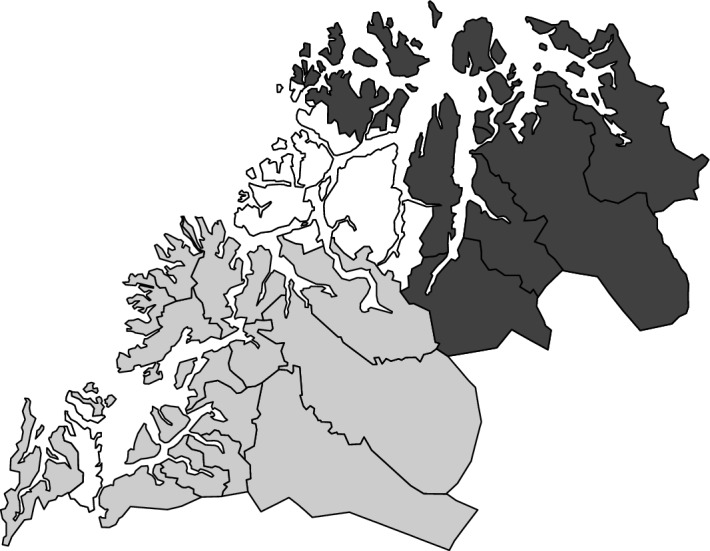
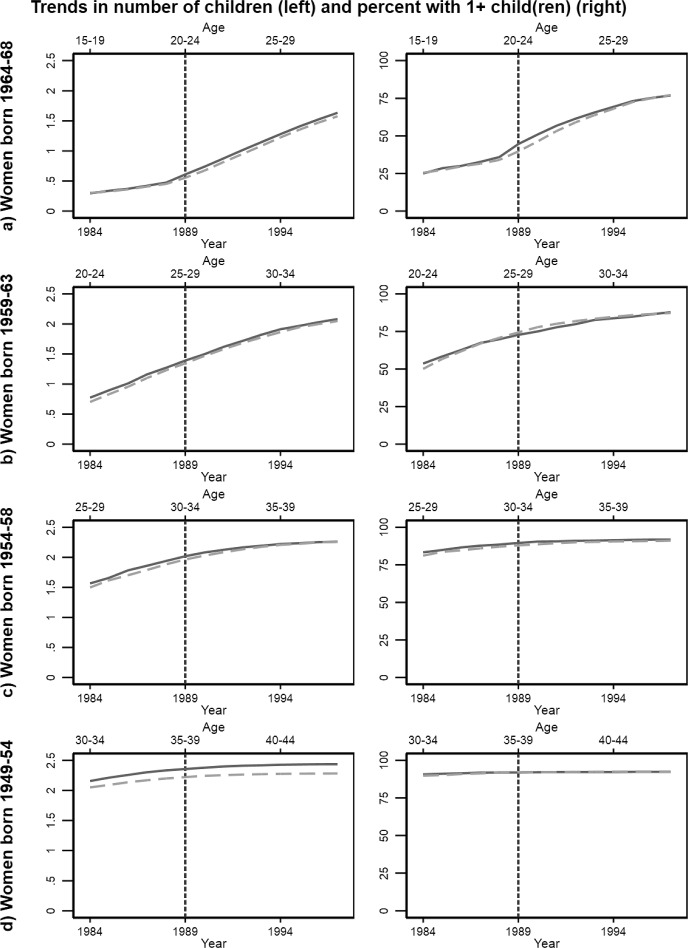
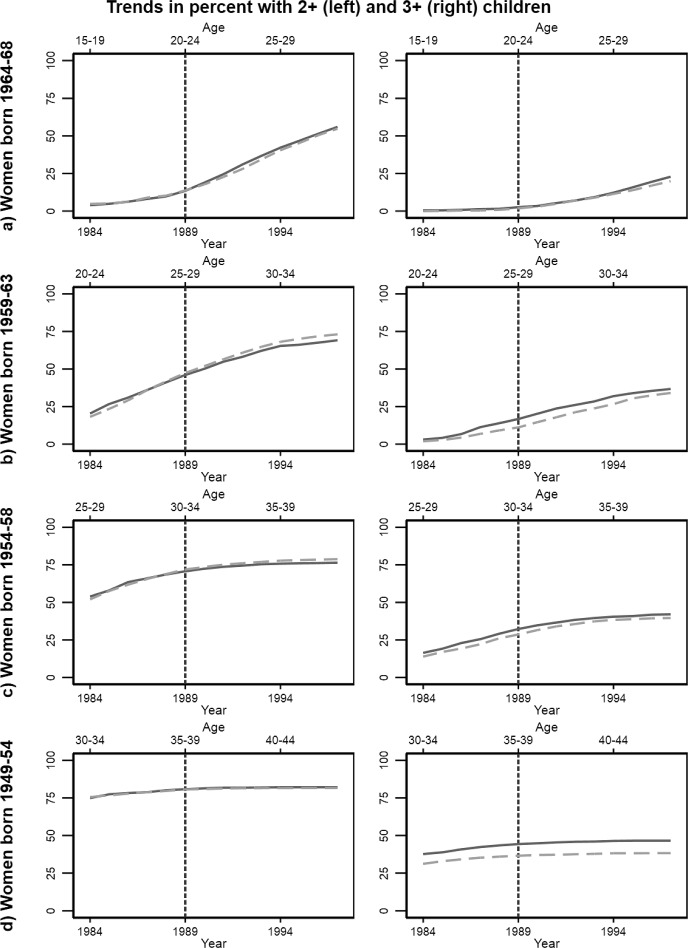
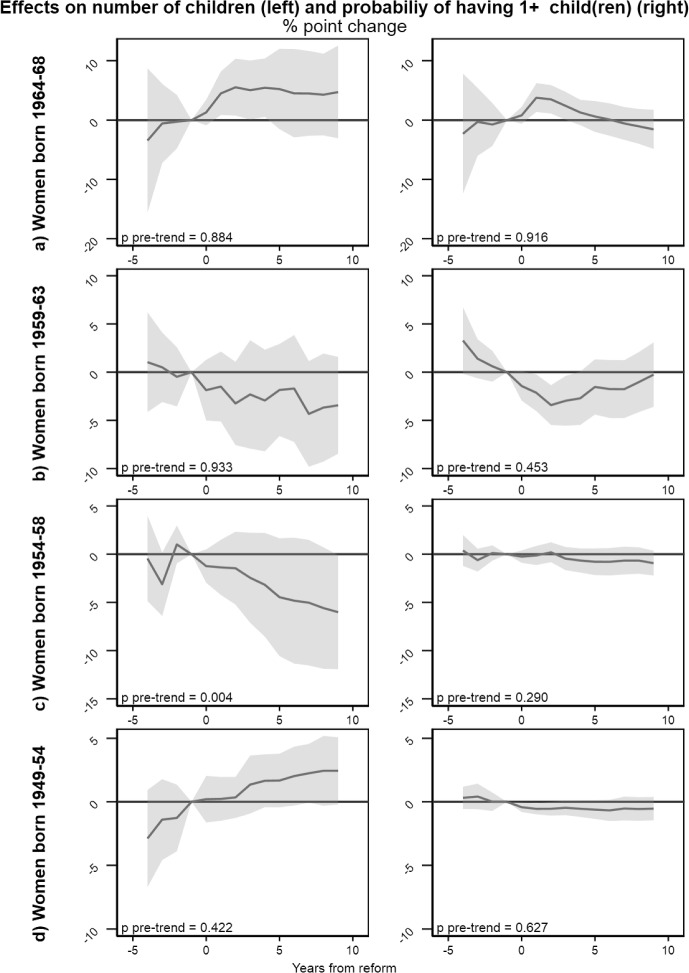
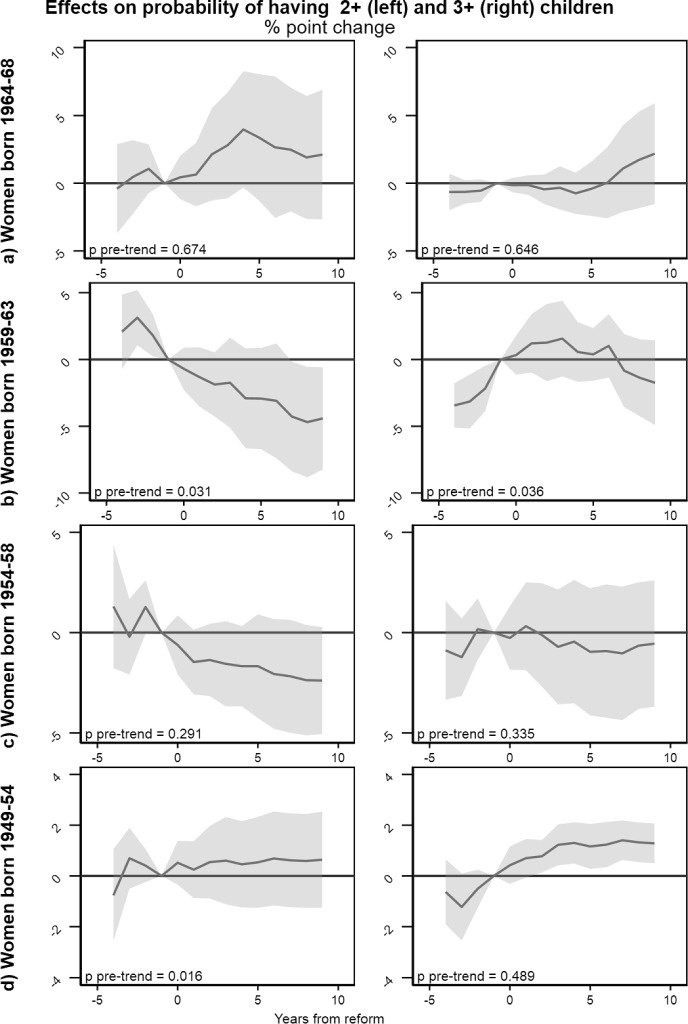
The relatively high fertility in the Nordic countries has attracted considerable academic and political interest. Still, the causal relationship between economic circumstances and fertility in the Nordic context is poorly understood. This paper estimates the effect of tax breaks and universal transfers on fertility in the Nordic context. We analyze the fertility effects of a regional child benefit and tax reform implemented in the northern municipalities of the Norwegian county Troms, using the southern municipalities of the same county as a plausible and empirically similar control group. We use a difference-in-difference/event study design, and estimate multivariate models on individual-level data from administrative registers for the full population. The reform increased fertility among women in their early 20 s. The effects are concentrated among unmarried women, who received the largest subsidies. Our findings suggest that favorable economic conditions have contributed to the relatively high fertility in the Nordic countries. Supplementary Information: The online version contains supplementary material available at 10.1007/s11113-023-09793-z.
Overview
The claims and statistics of this paper haven’t been checked yet.
Run the check — free, no account needed. It reads the open-access text and checks the sources it cites.
Integrity signals
Registry
Cites
Statistics
Figures
Verification
Claims the paper makes
The claims and statistics of this paper haven’t been checked yet.
Run the check — free, no account needed. It reads the open-access text and checks the sources it cites.
Claims other papers make about this one
Each is checked against this paper’s own text: does it say what the citing paper says it does?
The cited source says what the claim attributes to it.
In the citing paper
“The evidence from both Hungary and Norway suggests that large fiscal support for families has a positive impact on fertility (Hart and Galloway 2023; Spéder, Murinkó, and Oláh 2020).”
From Family Policies in Low Fertility Countries: Evidence and Reflections (2025) · cites this paper as Hart and Galloway 2023
Self-check
Percentages, sums and reported differences re-computed from the paper’s own numbers.
The self-check needs the paper’s full text.
Citations
Cites
Becker, G. S. (1991) · doi:10.4159/9780674020665 · Cited by 10,565
Mostly Harmless Econometrics: An Empiricist's Companion
Angrist, J. D., & Pischke, J.-S. (2009) · doi:10.1515/9781400829828 · Cited by 9,467 · cited 2×
“Standard errors are robust with clustering on municipality (Angrist & Pischke, 2009).”
BackgroundThe Three Worlds of Welfare Capitalism
Hicks, A., & Esping-Andersen, G. (1991) · Contemporary Sociology · doi:10.2307/2073705 · Cited by 7,092
A Practitioner’s Guide to Cluster-Robust Inference
Colin Cameron, A., & Miller, D. L. (2015) · Journal of Human Resources · doi:10.3368/jhr.50.2.317 · Cited by 5,037
(2011) · American Economic Review · doi:10.1257/aer.101.5.i · Cited by 4,608
What's trending in difference-in-differences? A synthesis of the recent econometrics literature
Roth, J., Sant’Anna, P. H. C., Bilinski, A., & Poe, J. (2023) · Journal of Econometrics · doi:10.1016/j.jeconom.2023.03.008 · Cited by 2,027
An Economic Analysis of FertilityPreprint
Becker, G. S. (1960) · RePEc: Research Papers in Economics · Cited by 1,826
Children and Their Parents' Labor Supply: Evidence from Exogenous Variation in Family Size
Angrist, J. D., & Evans, W. N. (1996) · National Bureau of Economic Research · doi:10.3386/w5778 · Cited by 1,360 · cited 1×
“1 3 Universal Transfers, Tax Breaks and Fertility: Evidence from… Page 11 of 32 49 It should be noted that if the reform increased childbearing, it will also be expected to reduce female labor supply (at the ages where fertility is increased) (Angrist & Evans, 1996; Cools & Strøm, 2014).”
BackgroundThornton, A., & Young‐DeMarco, L. (2001) · Journal of Marriage and the Family · doi:10.1111/j.1741-3737.2001.01009.x · Cited by 1,042 · cited 2×
“…hand, as living with a partner before having a child has a practical advantage and is to some extent normatively expected (Hobcraft & Kiernan, 1995; Thornton & Young-DeMarco, 2001), one may expect a quicker response to changing economic conditions among women who are living in a formalized union.”
BackgroundUnnatural Experiments? Estimating the Incidence of Endogenous Policies
Besley, T. J., & Case, A. C. (2000) · The Economic Journal · doi:10.1111/1468-0297.00578 · Cited by 671 · cited 1×
“It is of some concern that at least some reforms were initiated in part as a response to falling fertility (Ang, 2015; Milligan, 2005), thus making the reform introduction potentially endogenous to the outcome (Besley & Case, 2000).”
BackgroundThe impact of family policies on fertility in industrialized countries: a review of the literature
Gauthier, A. H. (2007) · Population Research and Policy Review · doi:10.1007/s11113-007-9033-x · Cited by 653 · cited 5×
“, 1984), and also with timing of fertility being more easily affected than quantum (Bergsvik et al., 2021; Gauthier, 2007).”
BackgroundResultInfluentialAmerican Economic Journal: Economic Policy
Shapiro, M. D. (2018) · AEA Papers and Proceedings · doi:10.1257/pandp.108.668 · Cited by 648
On the Interaction between the Quantity and Quality of Children
Becker, G. S., & Lewis, H. G. (1973) · Journal of Political Economy · doi:10.1086/260166 · Cited by 507
Family Benefits and Fertility: An Econometric Analysis
Gauthier, A. H., & Hatzius, J. (1997) · Population Studies · doi:10.1080/0032472031000150066 · Cited by 458 · cited 1×
“(2011); Ermisch (1988); Gauthier and Hatzius (1997); Kalwij (2010); Walker (1995); Zhang et al.”
Demographic and Economic Change in Developed Countries
Léridon, H. (1961) · Population · doi:10.3917/popu.p1961.16n2.0345 · Cited by 448
Subsidizing the Stork: New Evidence on Tax Incentives and Fertility
Milligan, K. (2005) · Review of Economics and Statistics · doi:10.1162/0034653054638382 · Cited by 379
A review of the antecedents of union dissolution
Lyngstad, T. H., & Jalovaara, M. (2010) · Demographic Research · doi:10.4054/demres.2010.23.10 · Cited by 345 · cited 1×
“However, the share of children who lives with both parents falls with age, and co-residential unions are consistently less stable than marriages (Hart et al., 2017; Lyngstad & Jalovaara, 2010), we consider 20% to be a lower bound for the share of the unmarried who are single parents.”
BackgroundChild‐Care Availability and Fertility in Norway
Rindfuss, R. R., Guilkey, D. K., Morgan, S. P., & Kravdal, Ø. (2010) · Population and Development Review · doi:10.1111/j.1728-4457.2010.00355.x · Cited by 326
The pursuit of absolute integrity: How corruption control makes government ineffective
Rose‐Ackerman, S. (1997) · Journal of Policy Analysis and Management · doi:10.1002/(sici)1520-6688(199723)16:4 · Cited by 294
The COVID-19 pandemic and human fertility
Aassve, A., Cavalli, N., Mencarini, L., Plach, S., & Bacci, M. L. (2020) · Science · doi:10.1126/science.abc9520 · Cited by 274
Economics of the family: Marriage, children, and human capital
Yunker, J. A. (1975) · Journal of Behavioral Economics · doi:10.1016/0090-5720(75)90070-4 · Cited by 266
Can Policies Stall the Fertility Fall? A Systematic Review of the (Quasi‐) Experimental Literature
Bergsvik, J., Fauske, A., & Hart, R. K. (2021) · Population and Development Review · doi:10.1111/padr.12431 · Cited by 259 · cited 1×
“, 1984), and also with timing of fertility being more easily affected than quantum (Bergsvik et al., 2021; Gauthier, 2007).”
BackgroundSelf-citationBeyond the Economic Gaze: Childbearing During and After Recessions in the Nordic Countries
Comolli, C. L., Neyer, G. R., Andersson, G. B. J., Dommermuth, L., Fallesen, P., Jalovaara, M., Jónsson, A. K., Kolk, M., & Lappegård, T. (2020) · European Journal of Population / Revue européenne de Démographie · doi:10.1007/s10680-020-09570-0 · Cited by 247
The impact of family policy expenditure on fertility in western Europe
Kalwij, A. (2010) · Demography · doi:10.1353/dem.0.0104 · Cited by 247 · cited 2×
“Public support to families goes together with relatively high fertility in Western countries (Kalwij, 2010).”
BackgroundThe Great Recession and Fertility in Europe: A Sub-national Analysis
Matysiak, A., Sobotka, T., & Vignoli, D. (2021) · European Journal of Population · doi:10.1007/s10680-020-09556-y · Cited by 242 · cited 1×
“Over the last decade, Europe and the US have experienced a sharp fertility decline (Matysiak et al., 2020), and the proportion of European countries with polices aimed at increasing fertility has risen from 51 percent in 2005 to 67 percent in 2015 (United Nations, 2018).”
BackgroundThe Multifaceted Impact of Education on Entry into Motherhood
Lappegård, T., & Rønsen, M. (2005) · European Journal of Population / Revue européenne de Démographie · doi:10.1007/s10680-004-6756-9 · Cited by 238 · cited 1×
“While these changes are small and non-transparent, we cannot rule out a priori that they increased educational enrollment and thereby led to fertility postponement (Lappegård & Rønsen, 2005).”
BackgroundDatta Gupta, N., Smith, N., & Verner, M. (2008) · Review of Economics of the Household · doi:10.1007/s11150-007-9023-0 · Cited by 206
Welfare, Marital Prospects, and Nonmarital Childbearing
Rosenzweig, M. R. (1999) · Journal of Political Economy · doi:10.1086/250102 · Cited by 198 · cited 2×
“Overall, studies with sound causal identification show either no effects, or very small negative effects, on fertility (Dyer & Fairlie, 2004; Fairlie & London, 1997; Joyce et al., 2004; Kearney, 2004; Robins & Fronstin, 1996; Rosenzweig, 1999; Wallace, 2009), see also Bergsvik et al.”
BackgroundFinancial Incentives and Fertility
Cohen, A., Dehejia, R., & Romanov, D. (2013) · The Review of Economics and Statistics · doi:10.1162/rest_a_00342 · Cited by 193
Fertility effects of child benefits
Riphahn, R. T., & Wiynck, F. (2017) · Journal of Population Economics · doi:10.1007/s00148-017-0647-y · Cited by 175
An economic analysis of the timing of childbirth
Happel, S. K., Hill, J. K., & Low, S. (1984) · Population Studies · doi:10.1080/00324728.1984.10410291 · Cited by 173 · cited 2×
“Most importantly, as earnings increase over the life course (Happel et al., 1984), younger women will tend to face stronger monetary constraints than older women.”
BackgroundThe Effect of a Universal Child Benefit on Conceptions, Abortions, and Early Maternal Labor Supply
González, L. (2013) · American Economic Journal: Economic Policy · doi:10.1257/pol.5.3.160 · Cited by 161 · cited 12×
“been among the motivations for recent expansion and introductions of universal child transfers (González, 2013; Milligan, 2005).”
BackgroundMethodResultInfluential(2011) · European Sociological Review · doi:10.1093/esr/jcr061 · Cited by 153
Earnings and first birth probability among Norwegian men and women 1995-2010
Hart, R. K. (2015) · Demographic Research · doi:10.4054/demres.2015.33.38 · Cited by 146 · cited 2×
“An alternative way to describe the relationship between economic resources and fertility would be to correlate e.g. earnings, measured at the individual level, with fertility (see e.g. Hart (2015)).”
BackgroundSelf-citationNot Just Later, but Fewer: Novel Trends in Cohort Fertility in the Nordic Countries
Hellstrand, J., Nisén, J., Miranda, V., Fallesen, P., Dommermuth, L., & Myrskylä, M. (2021) · Demography · doi:10.1215/00703370-9373618 · Cited by 136
Ang, X. L. (2014) · Journal of Family and Economic Issues · doi:10.1007/s10834-014-9394-3 · Cited by 134
Review of Economics of the Household
(2013) · Review of Economics of the Household · doi:10.1007/11150.1573-7152 · Cited by 127
Hobcraft, J., & KIERNAN, K. E. (1995) · London School of Economics and Political Science Research Online (London School of Economics and Political Science) · Cited by 124
The effect of public policies on recent Swedish fertility behavior
Walker, J. R. (1995) · Journal of Population Economics · doi:10.1007/bf00185251 · Cited by 122 · cited 1×
“(2011); Ermisch (1988); Gauthier and Hatzius (1997); Kalwij (2010); Walker (1995); Zhang et al.”
Econometric Analysis of Birth Rate Dynamics in Britain
Ermisch, J. (1988) · The Journal of Human Resources · doi:10.2307/145814 · Cited by 119 · cited 1×
“(2011); Ermisch (1988); Gauthier and Hatzius (1997); Kalwij (2010); Walker (1995); Zhang et al.”
The Effect of Tax-Transfer Policies on Fertility in Canada, 1921-88
Zhang, J., Quan, J., & van Meerbergen, P. (1994) · The Journal of Human Resources · doi:10.2307/146061 · Cited by 116
Is There an Effect of Incremental Welfare Benefits on Fertility Behavior? A Look at the Family Cap
Kearney, M. S. (2004) · The Journal of Human Resources · doi:10.2307/3559016 · Cited by 109
Settlement size and fertility in the Nordic countries
Kulu, H., Vikat, A., & Andersson, G. (2007) · Population Studies · doi:10.1080/00324720701571749 · Cited by 91 · cited 1×
“As fertility trends are found to vary on a rural/urban axis (Kulu et al., 2007), we exclude Tromsø and Harstad from our sample.”
BackgroundWelfare, the Family, and Reproductive Behavior: Research Perspectives
Moffitt, R. (1998) · Cited by 86
The dual strategy: Motherhood and the work contract in Scandinavia
Ellingsæter, A. L., & Rønsen, M. (1996) · European Journal of Population / Revue européenne de Démographie · doi:10.1007/bf01797111 · Cited by 82 · cited 1×
“In other words, the reform did not weaken young mothers’ commitment to the “dual strategy” of work and motherhood (Ellingsæter & Rønsen, 1996).”
BackgroundThe Male Marital Wage Premium: Sorting Vs. Differential Pay
Petersen, T., Penner, A. M., & Høgsnes, G. (2011) · Industrial and Labor Relations Review · doi:10.1177/001979391106400204 · Cited by 55
Can public policies sustain fertility in the Nordic countries?
Rønsen, M., & Skrede, K. (2010) · Demographic Research · doi:10.4054/demres.2010.22.13 · Cited by 54
Parenthood wage penalties in a double income society
Cools, S., & Strøm, M. (2014) · Review of Economics of the Household · doi:10.1007/s11150-014-9244-y · Cited by 47 · cited 1×
“1 3 Universal Transfers, Tax Breaks and Fertility: Evidence from… Page 11 of 32 49 It should be noted that if the reform increased childbearing, it will also be expected to reduce female labor supply (at the ages where fertility is increased) (Angrist & Evans, 1996; Cools & Strøm, 2014).”
BackgroundFamily cap provisions and changes in births and abortions
Joyce, T., Kaestner, R. J., Korenman, S. D., & Henshaw, S. K. (2004) · Population Research and Policy Review · doi:10.1007/s11113-004-3461-7 · Cited by 47
BOOTTEST: Stata module to provide fast execution of the wild bootstrap with null imposed
Roodman, D. M. (2015) · RePEc: Research Papers in Economics · Cited by 44
Dyer, W. T., & Fairlie, R. W. (2004) · Population Research and Policy Review · doi:10.1007/s11113-004-3462-6 · Cited by 43 · cited 2×
“Overall, studies with sound causal identification show either no effects, or very small negative effects, on fertility (Dyer & Fairlie, 2004; Fairlie & London, 1997; Joyce et al., 2004; Kearney, 2004; Robins & Fronstin, 1996; Rosenzweig, 1999; Wallace, 2009), see also Bergsvik et al.”
BackgroundGoldstein, J. R., Lutz, W., & Scherbov, S. (2003) · Population and Development Review · doi:10.1111/j.1728-4457.2003.00699.x · Cited by 41 · cited 1×
“At the societal level lower mean age at birth can in and of itself have a lasting impact on population structure as generational lengths shorten (Goldstein et al., 2003).”
BackgroundWhen to promote, and when to avoid, a population perspective
Duncan, G. J. (2008) · Demography · doi:10.1353/dem.0.0031 · Cited by 39 · cited 1×
“Using an explanatory variable with “quasi-random” variation from policy reforms can handle such omitted variable bias, getting us closer to the causal effect of economic circumstances on fertility (Duncan, 2008).”
BackgroundFertility and the Personal Exemption: Comment
Crump, R. K., Goda, G. S., & Mumford, K. J. (2011) · American Economic Review · doi:10.1257/aer.101.4.1616 · Cited by 39
Tax incentives and fertility in Canada: quantum vs tempo effects
Parent, D., & Wang, L. (2007) · Canadian Journal of Economics/Revue canadienne d'économique · doi:10.1111/j.1365-2966.2007.00413.x · Cited by 37 · cited 1×
“The Canadian province Quebec has some regional discretion in development of family policies, which has inspired several regional difference-in-difference designs, suggesting positive effects (Ang, 2015; Kim, 2014; Milligan, 2005; Parent & Wang, 2007).”
BackgroundTrapped at home: The effect of mothers' temporary labor market exits on their subsequent work career
Drange, N., & Rege, M. S. (2013) · Labour Economics · doi:10.1016/j.labeco.2013.08.003 · Cited by 28 · cited 1×
“CFC is only available for parents of children not in subsidized childcare, and is known to have a lasting negative effect on maternal labor supply (Drange & Rege, 2013).”
BackgroundWelfare benefits and birth decisions of never-married women
Robins, P. K., & Fronstin, P. (1996) · Population Research and Policy Review · doi:10.1007/bf00156741 · Cited by 28 · cited 2×
“Overall, studies with sound causal identification show either no effects, or very small negative effects, on fertility (Dyer & Fairlie, 2004; Fairlie & London, 1997; Joyce et al., 2004; Kearney, 2004; Robins & Fronstin, 1996; Rosenzweig, 1999; Wallace, 2009), see also Bergsvik et al.”
BackgroundLifetime impact of cash transfer on fertility
Kim, Y.-I. A. (2014) · Canadian Studies in Population · doi:10.25336/p64s52 · Cited by 19 · cited 1×
“The Canadian province Quebec has some regional discretion in development of family policies, which has inspired several regional difference-in-difference designs, suggesting positive effects (Ang, 2015; Kim, 2014; Milligan, 2005; Parent & Wang, 2007).”
BackgroundCan a cash transfer to families change fertility behaviour?
Andersen, S. N., Drange, N., & Lappegård, T. (2018) · Demographic Research · doi:10.4054/demres.2018.38.33 · Cited by 18 · cited 1×
“…of the cash-for-care reform in 1998, which could change the economic incentives of childbearing and confound the effects (2) Yi,t = + 9 ∑ dur=−4,dur≠−1 Duri,tXDuri,t + a=39 ∑ a=20 AgeiXAgei + M ∑ m=1 Munii,tXMunii,t + 1997 ∑ y=1984 Yeari,tXYeari,t + i,t 1 3 of our reform (Andersen et al., 2018).”
BackgroundThe effects of family caps on the subsequent fertility decisions of never-married mothers
Wallace, G. L. (2009) · Journal of Population Research · doi:10.1007/s12546-008-9006-x · Cited by 13 · cited 4×
“Overall, studies with sound causal identification show either no effects, or very small negative effects, on fertility (Dyer & Fairlie, 2004; Fairlie & London, 1997; Joyce et al., 2004; Kearney, 2004; Robins & Fronstin, 1996; Rosenzweig, 1999; Wallace, 2009), see also Bergsvik et al.”
BackgroundInfluentialEffects of policy on fertility: A systematic review of (quasi)experiments
Bergsvik, J., Fauske, A., & Hart, R. K. (2020) · NORA - Norwegian Open Research Archives · Cited by 9
Self-citationThe Price Effects of Family Caps on Fertility Decisions of Poor Women
Jagannathan, R., Camasso, M. J., & Harvey, C. (2010) · Journal of Social Service Research · doi:10.1080/01488376.2010.494084 · Cited by 7 · cited 2×
“However, in the context of US welfare programs, there is also a strong normative aspect in policy implementation, discouraging childbearing while on welfare, which could also contribute to negative effects (Jagannathan et al., 2010).”
Background
Research works printed but not linked: 5
- Angell, E., Eikeland, S., Grufeld, L. A., Lie, I., Myhr, S., Nygaard, V., & Pedersen, P. (2012). The action zone in troms and finnmark: Development and evaluation of policies. Technical Report, 2, 10.
- Borjas, G. J. (2012). Labor economics (6th ed.). McGraw-Hill.
- Noack, T. (2010). En stillle revolusjon: Det moderne samboerskapet i Norge [A silent revolution: Cohabitation in modern Norway]. University of Oslo.
- ODI, UNICEF,. (2020). Universal child benefits policy issues and options. UNICEF.
- Texmon, I. (1999). Vedlegg 3: Samliv i Norge mot slutten av 1900-tallet. En beskrivelse av endringer og mangfold. Norges offentlige utredninger(NOU): Samboere og samfunnet (pp. 251–285). Barne- og familiedepartementet.
Cited by
Sorted by citations
Family Policies in Low Fertility Countries: Evidence and Reflections
Gauthier, A. H., & Gietel‐Basten, S. (2025) · Population and Development Review · doi:10.1111/padr.12691 · Cited by 45
Causal Analysis of Policy Effects on Fertility
Hart, R. K., Bergsvik, J., Fauske, A., & Kim, W. (2024) · Springer eBooks · doi:10.1007/978-3-319-57365-6_451-1 · Cited by 14
Self-citationFertility decline and tax revenues in South Korea
Madia, J. E., Moscone, F., Tabaghdehi, S. A. H., An, J.-C., & Lee, C. (2025) · Research in Economics · doi:10.1016/j.rie.2025.101025 · Cited by 3
Šmeringaiová, M. (2024) · Applied Spatial Analysis and Policy · doi:10.1007/s12061-024-09613-7 · Cited by 3
“This is in line with Hart and Galloway ( 2023 ), which found positive effects of tax benefit reforms and improvements in labour market conditions on fertility in Norway.”
de Ziegler, D., Braumann, N., Sean, S., & Toner, J. P. (2025) · Fertility and Sterility · doi:10.1016/j.fertnstert.2025.09.012 · Cited by 2
Metadata
- Authors
- Hart, R. K., & Galloway, T. A.
- Affiliations
- Statistics Norway (NO)
- Corresponding author
- Hart, Rannveig Kaldager
- Venue
- Population Research and Policy Review
- Published
- 2023-05-23
- Volume
- 42
- Issue
- 3
- Pages
- 49-49
- ISSN
- 0167-5923 (ISSN-L)
- 1573-7829
- PMC
- PMC10205036
- OpenAlex
- W4377861192
- Cited by
- 8
- References
- 64
- Citations by year
- 2026: 2 · 2025: 3 · 2024: 3
- FWCI
- 4.66
- Type
- journal article
- Language
- en
- Open access
- hybrid
- doi.org
- Locations
- Population Research and Policy Review (publishedVersion, cc-by)
- PubMed Central (publishedVersion, cc-by)
- PubMed (publishedVersion)
- RePEc: Research Papers in Economics (submittedVersion)
- NORA - Norwegian Open Research Archives (submittedVersion, other-oa)
- Funders
- Norges Forskningsråd (202442S20, 236926, 262700)
- Norwegian Institute of Public Health
- Topics
- Social Sciences › Demography › Family Dynamics and Relationships
- Social Sciences › Gender Studies › Gender, Labor, and Family Dynamics
- Social Sciences › Sociology and Political Science › Social Policies and Family
- Keywords
- fertility, tax incentives, family allowances, unmarried women, young women, Tromsø
About these checks
Registry, retraction, Cites and statistics results are computed, not judged, with one exception: a printed reference that no index lists is read once by a model before it counts as a citation error. Claims are extracted by a model and kept only when their quote appears verbatim in the text; each cited source is then checked, with a model’s help, for whether it says what the claim relies on. Those verdicts can be wrong — read the claim’s quote and the cited source before relying on one.
Statistics and arithmetic are recomputed, not judged.
Confidence bands are shown only for fields calibrated on our annotated test set. None is calibrated yet, so no band is shown.
What counts as a claim ›How we measure confidence ›How we check this ›
Are you an author, or do you see a problem with this page? Request a review
