

The DOI matches its Crossref record; 216 of the 218 references it cites were found in a registry or an index.
Addressing Core Challenges for the Next Generation of Type 2 Translation Research and Systems: The Translation Science to Population Impact (TSci Impact) Framework
Open accessAbstract
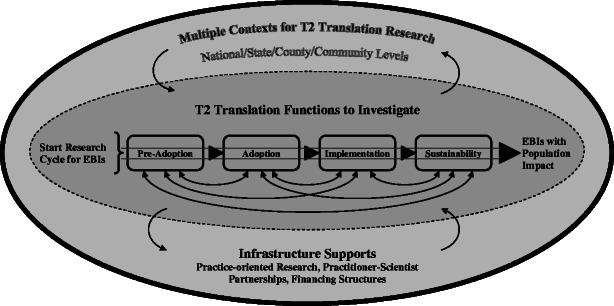
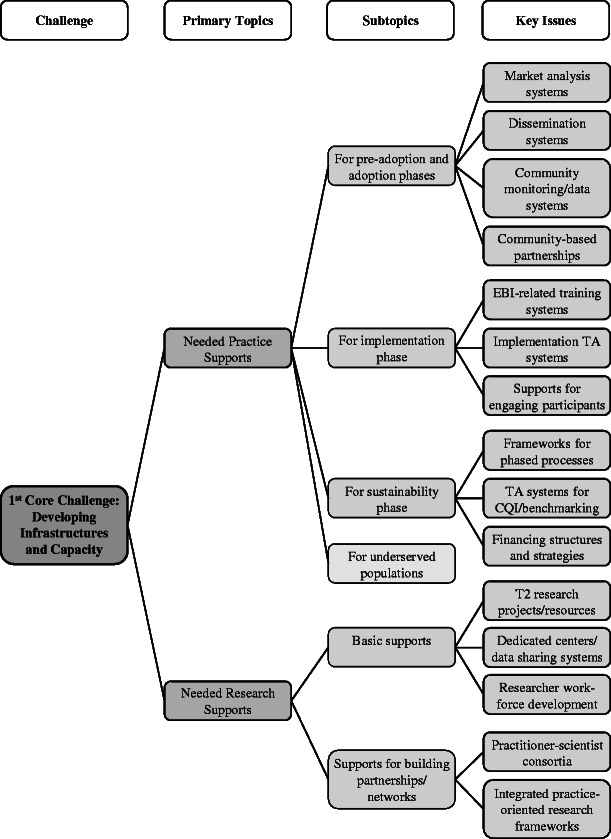
Evidence-based preventive interventions developed over the past two decades represent great potential for enhancing public health and well-being. Research confirming the limited extent to which these interventions have been broadly and effectively implemented, however, indicates much progress is needed to achieve population-level impact. In part, progress requires Type 2 translation research that investigates the complex processes and systems through which evidence-based interventions are adopted, implemented, and sustained on a large scale, with a strong orientation toward devising empirically-driven strategies for increasing their population impact. In this article, we address two core challenges to the advancement of T2 translation research: (1) building infrastructure and capacity to support systems-oriented scaling up of evidence-based interventions, with well-integrated practice-oriented T2 research, and (2) developing an agenda and improving research methods for advancing T2 translation science. We also summarize a heuristic "Translation Science to Population Impact (TSci Impact) Framework." It articulates key considerations in addressing the core challenges, with three components that represent: (1) four phases of translation functions to be investigated (pre-adoption, adoption, implementation, and sustainability); (2) the multiple contexts in which translation occurs, ranging from community to national levels; and (3) necessary practice and research infrastructure supports. Discussion of the framework addresses the critical roles of practitioner-scientist partnerships and networks, governmental agencies and policies at all levels, plus financing partnerships and structures, all required for both infrastructure development and advances in the science. The article concludes with two sets of recommended action steps that could provide impetus for advancing the next generation of T2 translation science and, in turn, potentially enhance the health and well-being of subsequent generations of youth and families.
Overview
The claims and statistics of this paper haven’t been checked yet.
Run the check — free, no account needed. It reads the open-access text and checks the sources it cites.
Integrity signals
Registry
Cites
Statistics
Figures
Verification
Claims the paper makes
The claims and statistics of this paper haven’t been checked yet.
Run the check — free, no account needed. It reads the open-access text and checks the sources it cites.
Claims other papers make about this one
Each is checked against this paper’s own text: does it say what the citing paper says it does?
In the citing paper
“Many studies have deplored the tendency for programs to lose funding, focus, or purpose once the initial investments are removed [71, 72].”
From Social Network Analysis for Program Implementation (2015) · cites this paper as [72]
Self-check
Percentages, sums and reported differences re-computed from the paper’s own numbers.
The self-check needs the paper’s full text.
Citations
Cites
Rogers, E. M., Singhal, A., & Quinlan, M. M. (2019) · Routledge eBooks · doi:10.4324/9780203710753-35 · Cited by 37,670
Health Behavior and Health Education: Theory, Research, and Practice
(1992) · Annals of Internal Medicine · doi:10.7326/0003-4819-116-4-350_1 · Cited by 13,232
Diffusion of Innovations in Service Organizations: Systematic Review and Recommendations
GREENHALGH, T., ROBERT, G., MACFARLANE, F., BATE, P., & KYRIAKIDOU, O. (2004) · The Milbank Quarterly · doi:10.1111/j.0887-378x.2004.00325.x · Cited by 7,448
Durlak, J. A., & DuPre, E. P. (2008) · American Journal of Community Psychology · doi:10.1007/s10464-008-9165-0 · Cited by 5,304
The quality of health care delivered to adults in the United States
McGlynn, E. A., Asch, S. M., Adams, J., Keesey, J., Hicks, J., DeCristofaro, A., & Kerr, E. A. (2003) · New England Journal of Medicine · doi:10.1056/nejmsa022615 · Cited by 5,079
Higgins, S. M. F., Macken, A. P., Cullen, W., Saunders, J., Dunne, C. P., & O’Gorman, C. S. (2013) · PubMed · doi:10.34961/9953 · Cited by 4,807
Morbidity and mortality weekly report
Gay, N., Gay, N., & Day, A. (1997) · The American Journal of Medicine · doi:10.1016/s0002-9343(97)89440-5 · Cited by 4,684
(2005) · Cited by 3,748
Reducing Risks for Mental Disorders: Frontiers for Preventive Intervention Research
(1994) · doi:10.17226/2139 · Cited by 2,073
(2009) · Cited by 2,013
Research works printed but not linked: 10
- Aos, S., Lieb, R., Mayfield, J., Miller, M., & Pennucci, A. (2004). Benefits and costs of prevention and early intervention programs for youth. Olympia: Washington State Institute for Public Policy.
- Chamberlain, P., Saldana, L., Brown, C. H., & Leve, L. D. (2010). Implementation of multidimensional treatment foster care in California: A randomized trial of an evidence-based practice. In M. Roberts-DeGennaro & S. Fogel (Eds.), Empirically supported interventions for community and organizational change. Chicago, IL: Lyceum.
- Flay, B. R., Biglan, A., Boruch, R. F., Castro, F. G., Gottfredson, D., Kellam, S., & Ji, P. (2004). Standards of evidence: Criteria for efficacy, effectiveness, and dissemination. Washington, DC: Society for Prevention Research.
- Greenberg, M. T., Domitrovich, C. E., Graczyk, P. A., & Zins, J. E. (2005). The study of implementation in school-based preventive interventions: Theory, research, and practice (vol. 3). Rockville: Center for Mental Health Services, SAMHSA.
- Greenwald, P. G. (1990). Forward. In Smoking, tobacco, and cancer programs. Rockville: National Cancer Institute, U.S.D.H.H.S.
- Hallfors, D., Sporer, A., Pankratz, M., & Godette, D. (2000). Drug-free schools survey: Report of results. Chapel Hill: University of North Carolina.
- Langford, B. H., Flynn-Khan, M., English, K., Grimm, G., & Taylor, K. (2012). Evidence2Success, making wise investments in children’s futures: Financing strategies and structures. Baltimore: The Annie E. Casey Foundation.
- Livit, M., & Wandersman, A. (2004). Organizational functioning: Facilitating effective interventions and increasing the odds of program success. In D. M. Fetterman & A. Wandersman (Eds.), Empowerment evaluation principals in practice (pp. 123–142). New York: Guilford.
- U. S. Department of Health and Human Services, Health Resources and Services Administration, Maternal and Child Health Bureau. (2011). The health and wellbeing of children in rural areas: A portrait of the nation 2007. Rockville: U.S. DHHS.
- World Health Organization. (2008). The global burden of disease: 2004 update. Geneva: WHO Press.
Cited by
Sorted by citations
Items 201–283 of 283
Subsidized Housing With Services to Address Concentrated Disadvantage
Brisson, D. (2015) · Administration & Society · doi:10.1177/0095399715598340 · Cited by 5
Prevention Science 1970–Present
Bosworth, K., & Sloboda, Z. (2015) · Springer eBooks · doi:10.1007/978-1-4939-3155-2_7 · Cited by 5
Self-citationMapping key actors in family support. A European perspective
García, L. J., Canavan, J., Baena, S., Herrera, D., Lloyd, A., Schima, J., & Grasmeijer, A. J. (2024) · Children and Youth Services Review · doi:10.1016/j.childyouth.2024.107618 · Cited by 5
Integrating Retention Rates into Economic Analyses of Prevention Interventions
Timpe, Z., & Winokur, M. (2018) · Prevention Science · doi:10.1007/s11121-018-0958-6 · Cited by 5
Eisenberg, N., Brown, E. C., Pérez‐Gómez, A., Mejía‐Trujillo, J., Paredes-Aguilar, M., Cardozo, F., de Maipo, F. S. C., & Guttmannova, K. (2020) · Health Promotion International · doi:10.1093/heapro/daaa075 · Cited by 5
Effekte einer Werbekampagne für ausgewählte evidenzbasierte Präventionsprogramme
Frantz, I., & Heinrichs, N. (2014) · Kindheit und Entwicklung · doi:10.1026/0942-5403/a000155 · Cited by 6
Commentary on Participation in Preventive Interventions
Sims, B. E., & Crump, A. D. (2018) · Prevention Science · doi:10.1007/s11121-018-0887-4 · Cited by 5
Okamura, K. H., Okamoto, S. K., Marshall, S. M., Chin, S. K., Garcia, P. M., Powell, B. J., Stern, K. A., Becker, S. J., & Mandell, D. S. (2022) · Implementation Science Communications · doi:10.1186/s43058-022-00359-2 · Cited by 4
Justice Reinvestment as a Global Phenomenon
Homel, R. J. (2014) · Victims & Offenders · doi:10.1080/15564886.2013.860937 · Cited by 4
Fagan, A. A., & Hawkins, J. D. (2015) · American Psychological Association eBooks · doi:10.1037/14550-020 · Cited by 4
Self-citationLeveraging Implementation Science to Improve the Scale-up of School Mental Health Programming
Bradshaw, C. P. (2023) · Issues in clinical child psychology · doi:10.1007/978-3-031-20006-9_27 · Cited by 4
Populationseffekte einer flächendeckenden Implementierung familienbasierter Präventionsprogramme
Frantz, I., & Heinrichs, N. (2016) · Zeitschrift für Klinische Psychologie und Psychotherapie · doi:10.1026/1616-3443/a000344 · Cited by 4
Prevention of Adolescent Risk Behavior and Promotion of Positive Youth Development
Toumbourou, J. W. (2016) · Cambridge University Press eBooks · doi:10.1017/9781316104453.019 · Cited by 4
eB4CAST Approach Improves Science Communication With Stakeholders in a College-Based Health Program
Olfert, M. D., Barr, M. L., Hagedorn, R. L., Wattick, R. A., Zhou, W., Horacek, T. M., Mathews, A., Kattelmann, K. K., Kidd, T., White, A. A., et al. (2020) · Frontiers in Public Health · doi:10.3389/fpubh.2020.00158 · Cited by 4
McCabe, L. A., Ruberti, M. R., & Endres, T. (2022) · Evaluation and Program Planning · doi:10.1016/j.evalprogplan.2022.102049 · Cited by 6
A census-matched survey of dental fear and fear-treatment interest in the United States
Heyman, R. E., Daly, K. A., Aladia, S., Harris, S. L., Roitman, N. A., Kim, A. C., & Slep, A. M. S. (2025) · The Journal of the American Dental Association · doi:10.1016/j.adaj.2025.07.004 · Cited by 5
Scaling Up Evidence-Based Preventive Interventions
Rohrbach, L. A., & Dyal, S. R. (2015) · Springer eBooks · doi:10.1007/978-1-4939-3155-2_9 · Cited by 3
Self-citationSolar, F. C., de Concepción, U., Fernández, P. G., de Concepción, U., Saldivia, S., de Concepción, U., Inostroza, C., de Concepción, U., Novoa, C., & de Concepción, U. (2019) · Papeles del Psicólogo - Psychologist Papers · doi:10.23923/pap.psicol2019.2894 · Cited by 3
Milburn, N. G., Klomhaus, A. M., Comulada, W. S., Lopez, S. A., Bath, E. P. J., Amani, B., Jackson, J., Lee, A., Rice, E. R. W., Semaan, A., et al. (2020) · Prevention Science · doi:10.1007/s11121-020-01157-9 · Cited by 3
Parker, L. A., Jackson, A., & Lanigan, J. D. (2020) · International Journal of Environmental Research and Public Health · doi:10.3390/ijerph17197038 · Cited by 3
Castro, F. G., Barrera, M., & Marsiglia, F. F. (2020) · Springer eBooks · doi:10.1007/978-3-030-36391-8_36 · Cited by 3
Sustaining Crime Prevention at Scale: Transforming Delivery Systems Through Prevention Science
Homel, R. J., Bumbarger, B. K., Freiberg, K., & Branch, S. (2016) · Springer eBooks · doi:10.1007/978-3-319-44124-5_29 · Cited by 3
Advancing Implementation: Toward an Inclusive View of Research in Behavioral Medicine
Fixsen, D. L., Boothroyd, R. I., Blasé, K. A., Fixsen, A. A. M., & Metz, A. J. R. (2018) · Springer eBooks · doi:10.1007/978-0-387-93826-4_8 · Cited by 3
The Society for Prevention Research 20 Years Later: a Summary of Training Needs
Chilenski, S. M., Pasch, K. E., Knapp, A. A., Baker, E. A., Boyd, R. C., Cioffi, C. C., Cooper, B. R., Fagan, A. A., Hill, L. G., Leve, L. D., et al. (2020) · Prevention Science · doi:10.1007/s11121-020-01151-1 · Cited by 3
Self-citationThe Centrality of Law for Prevention
Komro, K. A. (2020) · Prevention Science · doi:10.1007/s11121-020-01155-x · Cited by 4
Commentary on the 2015 SPR Standards of Evidence
Biglan, A., Flay, B. R., & Wagenaar, A. C. (2015) · Prevention Science · doi:10.1007/s11121-015-0582-7 · Cited by 3
Pradana, V. P., Lubis, M., Abdurrahman, L., Alqahtani, R. A., Zamzami, I. F., & Ramadhani, R. (2024) · Electronic Integrated Computer Algorithm Journal · doi:10.62123/enigma.v1i2.20 · Cited by 2
The Search for Social Justice in School-Based Crime and Delinquency Prevention
Payne, A. A. (2024) · The Annals of the American Academy of Political and Social Science · doi:10.1177/00027162251341937 · Cited by 3
Cultural Adaptation of Empirically-Validated Therapies for Treating Drug Dependence
Castro, F. G., & Barrera, M. (2014) · Springer eBooks · doi:10.1007/978-88-470-5322-9_50 · Cited by 2
Methodological Advances in Crime Prevention Research
Sullivan, C. J., & Welsh, B. C. (2016) · Springer eBooks · doi:10.1007/978-3-319-44124-5_28 · Cited by 2
Parenting Advice and Regrets of Empty‐Nesters
Chapman, A., & Schramm, D. G. (2018) · Family Relations · doi:10.1111/fare.12337 · Cited by 2
Evaluation of Coach-Based Technical Assistance: An Evolving Focus on Coachability and Goal Setting
McCarthy, K. J., Perkins, D. F., Roberts, M. A., Potter, S., Guin, A., Carroll, J. B., Deringer, N. C., Ballard, J. E., & Borden, L. M. (2020) · Journal of Human Sciences and Extension · doi:10.54718/qccm1853 · Cited by 2
Chalamandaris, A.-G., Wilmet-Dramaix, M., Robert, A. R., Ertesvåg, S. K., Eslea, M., Senterre, C., & Piette, D. (2017) · Children and Youth Services Review · doi:10.1016/j.childyouth.2017.08.018 · Cited by 2
Natural Products in Leukaemia Research: A Bibliometric Review
Abdelwahab, S. İ., Taha, M. M. E., & Mohan, S. (2025) · Journal of Herbal Medicine · doi:10.1016/j.hermed.2025.100993 · Cited by 1
Parent-Based Sexual and Reproductive Health Interventions for Black Youth: a Scoping Review
Kachingwe, O. N., Perlotto, S., Saluja, S., Walker, S., Mensah, S., & Luker, C. (2026) · Journal of Racial and Ethnic Health Disparities · doi:10.1007/s40615-025-02844-5
Enhancing the Quality of Stakeholder Assessments of Evidenced‐Based Prevention Programs
Fagan, A. A. (2013) · Criminology & Public Policy · doi:10.1111/1745-9133.12034 · Cited by 1
Self-citationParameters of Preventing Substance Misuse in Adolescents
Sussman, S. Y., Liao, Y., Tsai, J., & Fishbein, D. H. (2016) · Springer eBooks · doi:10.1007/978-1-4899-7711-3_11 · Cited by 1
Psychosocial Treatments That “Work” for Ethnic Minority Youth
Holly, L. E., Stoll, R. D., Rapp, A. M., Piña, A., & Chavira, D. A. (2018) · Oxford University Press eBooks · doi:10.1093/oxfordhb/9780190634841.013.10 · Cited by 1
An Integrated Analysis of the Impact of Spanish Family Support Programmes with Informed Evidence
Socías, C. O., Padilla, J. P., Maya, J., Prieto, L. S., Fernández, J. A. A., Baena, S., & Lara, B. L. (2022) · Psicologí a Educativa · doi:10.5093/psed2022a7 · Cited by 1
Difusão de Programas Preventivos em Saúde Mental: Notas Teóricas
Miranda, A. A. V., & Murta, S. G. (2022) · Psicologia Teoria e Pesquisa · doi:10.1590/0102.3772e38421.pt · Cited by 1
Okamoto, S. K., Okamura, K. H., Marshall, S. M., Chin, S. K., Carson, A. B., An, K. J., Song, S. D., Saladino, P. A., Prado, G. J., & Kulis, S. (2024) · Implementation Research and Practice · doi:10.1177/26334895241262823 · Cited by 1
Waterman, E. A., Edwards, K. M., Hopfauf, S. L., Herrington, R., Mullet, N. D., & Trujillo, P. (2025) · Child Abuse & Neglect · doi:10.1016/j.chiabu.2024.107230 · Cited by 1
Hwang, S. H. J., Cirolia, A., Michel, E., & Shapiro, V. B. (2025) · Implementation Science Communications · doi:10.1186/s43058-025-00830-w · Cited by 1
Cain, C. M., Lopez, K. K., Aririguzo, L. C., & Cummings, A. D. L. (2020) · Journal of Applied Research on Children Informing Policy for Children at Risk · doi:10.58464/2155-5834.1416 · Cited by 1
Islam, M. S., & Brennan, C. (2021) · Asia Pacific Journal of Health Management · doi:10.24083/apjhm.v16i2.345 · Cited by 1
Riggs, N. R., Hepburn, S., & Pinks, M. E. (2021) · International review of research in developmental disabilities · doi:10.1016/bs.irrdd.2021.06.001 · Cited by 1
Stoll, R. D. (2015) · Cited by 1
Sarkies, M., Moullin, J. C., Ludwick, T., & Robinson, S. (2021) · Journal of Health Organization and Management · doi:10.1108/jhom-10-2021-513 · Cited by 1
Community-Based Substance Use Prevention
Fagan, A. A., & Lowe, C. C. (2021) · doi:10.1093/obo/9780195396607-0310 · Cited by 1
Self-citationFrey, A. J., Herman, K. C., & Reinke, W. M. (2025) · Journal of Educational and Psychological Consultation · doi:10.1080/10474412.2025.2596784 · Cited by 1
Preventing Crime and Recidivism
Homel, R. J. (2017) · Criminology & Public Policy · doi:10.1111/1745-9133.12319
Castro, F. G., Barrera, M., & Bautista, T. G. (2018) · Springer eBooks · doi:10.1007/978-3-319-93003-9_6 · Cited by 1
A Roadmap for Advancing the Science of Gang Prevention
Fagan, A. A. (2018) · Criminology & Public Policy · doi:10.1111/1745-9133.12400
Self-citationThe Child–Parent Center Preschool-to-Third-Grade Program
Reynolds, A. J. (2018) · Cambridge University Press eBooks · doi:10.1017/9781108349352.009
Kaljee, L., Prentiss, T. C., & Zervos, M. (2019) · Current treatment options in infectious diseases/Current treatment options in infectious disease · doi:10.1007/s40506-019-0183-2
Leadership for Achieving Sustainable Development: Social and Environmental Concerns
Cortés, L. D. G. (2019) · Springer proceedings in business and economics · doi:10.1007/978-3-030-15495-0_41
Simmons, E. C. (2019) · The University of Queensland · doi:10.14264/uql.2019.614
A Generic Template for Implementing Mental Health Promotion
Barry, M. M. (2019) · Springer eBooks · doi:10.1007/978-3-030-23455-3_5
Implementing Research into Everyday Systemic Family Therapy Practice
Withers, M. C., & Duncan, J. M. (2020) · Wiley eBooks · doi:10.1002/9781119438519.ch22
Positive education as a whole school approach: broadening the perspective on learning
Goldberg, J. M. (2020) · doi:10.3990/1.9789036549622 · Cited by 1
Examining Real-World Applicability of Depression Prevention Trials
Stewart, J. M. (2015)
Hansen, S. (2020) · OPUS Publication Server of the University of Stuttgart (University of Stuttgart) · doi:10.18419/opus-11114
Implementing Research into Everyday Systemic Family Therapy Practice
Withers, M. C., & Duncan, J. M. (2020) · Wiley eBooks · doi:10.1002/9781119790181.ch22
Substance Misuse Prevention Program Attendance: Predictors Among Military Families
Kan, M. L., Yeh, H. C., Schainker, L. M., Nelson, J. R., Charm, S., Redmond, C. R., & Spoth, R. L. (2022) · doi:10.3768/rtipress.2022.rr.0048.2212
Self-citationThe Evidence for Evidence-Based Policing
Weisburd, D. L., Jonathan-Zamir, T., Perry, G., & Hasisi, B. (2023) · Cambridge University Press eBooks · doi:10.1017/9781108885737.006
Phụng, C. K. (2023) · Journal Wetenskap Health · doi:10.48173/jwh.v4i2.233
Evolução da sustentabilidade nas Instituições de Ensino Superior (IES)
Bedin, É. P., & de Faria, L. C. (2023) · Revista Gestão & Sustentabilidade · doi:10.36661/2596-142x.2021v3n1.12360
Best Practices for the Evaluation of Prevention Programs
Rue, L. D. L., & Kenny, M. E. (2024) · Cambridge University Press eBooks · doi:10.1017/9781009244503.003
Hage, S. M. (2024) · Cambridge University Press eBooks · doi:10.1017/9781009244503.001
Yan, L., Chen, Z., Goklish, N. A., Mitchell, K., Watchman, C., Stifter, M., O’Keefe, V. M., Barlow, A., Cwik, M. F., Igusa, T., et al. (2025) · Annals of Epidemiology · doi:10.1016/j.annepidem.2025.10.020
Reinke, W. M., Herman, K. C., Frey, A. J., & Owens, S. (2025) · Journal of Educational and Psychological Consultation · doi:10.1080/10474412.2025.2592053
Family support in Europe: theory, policy and practice
García, L. J., & Canavan, J. (2025) · Children and Youth Services Review · doi:10.1016/j.childyouth.2025.108716
Pinheiro-Carozzo, N. P., Murta, S. G., Vinha, L. G. D. A., da Silva, I. M., & Fontaine, A. M. G. V. (2021) · Figshare · doi:10.6084/m9.figshare.14788374
Bullock, H. L., Lavis, J. N., Wilson, M. G., Mulvale, G. M., & Miatello, A. (2021) · Figshare · doi:10.6084/m9.figshare.14432336
Hagemeier, A., Oberste, M., Rosenberger, K. D., Roth, R., Hellmich, M., Fluegel, V., Ruettger, K. B., Dadaczynski, K., Joisten, C., Mause, L., et al. (2026) · BMJ Open · doi:10.1136/bmjopen-2025-111373
Engaging Latino Families in a Sibling-Focused Family Prevention Program
Cahill, K. M., Updegraff, K. A., Umaña‐Taylor, A. J., & Feinberg, M. E. (2026) · Prevention Science · doi:10.1007/s11121-026-01886-3
Translating Science into Practice Using University-State Government Partnerships: The EPIS Model
Welsh, J. A., Gayles, J. G., Chilenski, S. M., Spaw, R., Pennington, M., & Greenberg, M. T. (2026) · Prevention Science · doi:10.1007/s11121-026-01919-x
Self-citationHoward, S. J., Mallawaarachchi, S. R., Peach, L., Paatsch, L., Pangrazio, L., Straker, L. M., Danby, S. J., Eynon, R., & Kervin, L. K. (2026) · The Australian Educational Researcher · doi:10.1007/s13384-026-01002-y
Röding, D., von Holt, I., Decker, L., & Walter, U. (2026) · Prevention Science · doi:10.1007/s11121-026-01961-9
Stapley, E., Mansfield, R., March, A., Burrell, K., Ashworth, E., Deighton, J., & Hayes, D. (2026) · Contemporary School Psychology · doi:10.1007/s40688-026-00611-9
Anand, P. K., Raika, G. R., Gautam, J., & Bhardwaj, P. (2026) · Clinical Epidemiology and Global Health · doi:10.1016/j.cegh.2026.102488
Metadata
- Authors
- Society for Prevention Research Type 2 Translational Task Force Members and Contributing Authors, Spoth, R., Rohrbach, L. A., Greenberg, M., Leaf, P., Brown, C. H., Fagan, A., Catalano, R. F., Pentz, M. A., Sloboda, Z., & Hawkins, J. D.
- Affiliations
- Iowa State University (US)
- University of Southern California (US)
- Pennsylvania State University (US)
- Johns Hopkins University (US)
- University of Miami (US)
- Florida State University (US)
- University of Washington (US)
- JBS International (United States) (US)
- Corresponding author
- Spoth, Richard
- Venue
- Prevention Science
- Published
- 2013-02-21
- Volume
- 14
- Issue
- 4
- Pages
- 319-351
- ISSN
- 1389-4986 (ISSN-L)
- 1573-6695
- PMC
- PMC3696461
- OpenAlex
- W2002173750
- Cited by
- 283
- References
- 218
- Citations by year
- 2026: 8 · 2025: 8 · 2024: 7 · 2023: 13 · 2022: 17 · 2021: 23 · 2020: 32 · 2019: 35 · 2018: 29 · 2017: 26 · 2016: 23 · 2015: 36 · 2014: 19 · 2013: 6
- FWCI
- 50.72
- Type
- journal article
- Language
- en
- Open access
- hybrid
- doi.org
- Locations
- Prevention Science (publishedVersion, cc-by)
- Europe PMC (PubMed Central) (publishedVersion)
- PubMed Central (publishedVersion, cc-by-nc)
- PubMed (publishedVersion)
- Research Explorer (The University of Manchester) (submittedVersion)
- Funders
- National Institutes of Health (5r13da021047-09)
- National Institute on Drug Abuse (P30DA027828, 5R13DA021047-08SI, R01DA013709, 5R13DA021047-09, R13 DA021047)
- Eunice Kennedy Shriver National Institute of Child Health and Human Development (R24HD042828)
- Topics
- Health Sciences › Health Professions › General Health Professions › Health Policy Implementation Science
- Health Sciences › Health Professions › General Health Professions › Health Sciences Research and Education
- Health Sciences › Medicine › Public Health, Environmental and Occupational Health › School Health and Nursing Education
- Keywords
- scaling up interventions, population effects, implementation research, practice-oriented research, research infrastructure, research networks, health policy
- MeSH terms
- Evidence-Based Practice, Translational Research, Biomedical
About these checks
Registry, retraction, Cites and statistics results are computed, not judged, with one exception: a printed reference that no index lists is read once by a model before it counts as a citation error. Claims are extracted by a model and kept only when their quote appears verbatim in the text; each cited source is then checked, with a model’s help, for whether it says what the claim relies on. Those verdicts can be wrong — read the claim’s quote and the cited source before relying on one.
Statistics and arithmetic are recomputed, not judged.
Confidence bands are shown only for fields calibrated on our annotated test set. None is calibrated yet, so no band is shown.
What counts as a claim ›How we measure confidence ›How we check this ›
Are you an author, or do you see a problem with this page? Request a review
