

The DOI matches its Crossref record; 216 of the 218 references it cites were found in a registry or an index.
Addressing Core Challenges for the Next Generation of Type 2 Translation Research and Systems: The Translation Science to Population Impact (TSci Impact) Framework
Open accessAbstract
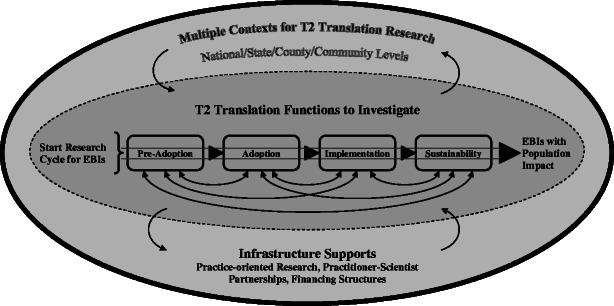
Evidence-based preventive interventions developed over the past two decades represent great potential for enhancing public health and well-being. Research confirming the limited extent to which these interventions have been broadly and effectively implemented, however, indicates much progress is needed to achieve population-level impact. In part, progress requires Type 2 translation research that investigates the complex processes and systems through which evidence-based interventions are adopted, implemented, and sustained on a large scale, with a strong orientation toward devising empirically-driven strategies for increasing their population impact. In this article, we address two core challenges to the advancement of T2 translation research: (1) building infrastructure and capacity to support systems-oriented scaling up of evidence-based interventions, with well-integrated practice-oriented T2 research, and (2) developing an agenda and improving research methods for advancing T2 translation science. We also summarize a heuristic "Translation Science to Population Impact (TSci Impact) Framework." It articulates key considerations in addressing the core challenges, with three components that represent: (1) four phases of translation functions to be investigated (pre-adoption, adoption, implementation, and sustainability); (2) the multiple contexts in which translation occurs, ranging from community to national levels; and (3) necessary practice and research infrastructure supports. Discussion of the framework addresses the critical roles of practitioner-scientist partnerships and networks, governmental agencies and policies at all levels, plus financing partnerships and structures, all required for both infrastructure development and advances in the science. The article concludes with two sets of recommended action steps that could provide impetus for advancing the next generation of T2 translation science and, in turn, potentially enhance the health and well-being of subsequent generations of youth and families.
Overview
The claims and statistics of this paper haven’t been checked yet.
Run the check — free, no account needed. It reads the open-access text and checks the sources it cites.
Integrity signals
Registry
Cites
Statistics
Figures
Verification
Claims the paper makes
The claims and statistics of this paper haven’t been checked yet.
Run the check — free, no account needed. It reads the open-access text and checks the sources it cites.
Claims other papers make about this one
Each is checked against this paper’s own text: does it say what the citing paper says it does?
In the citing paper
“Many studies have deplored the tendency for programs to lose funding, focus, or purpose once the initial investments are removed [71, 72].”
From Social Network Analysis for Program Implementation (2015) · cites this paper as [72]
Self-check
Percentages, sums and reported differences re-computed from the paper’s own numbers.
The self-check needs the paper’s full text.
Citations
Cites
Items 201–216 of 216
Fagan, A. A., Hawkins, J. D., & Catalano, R. F. (2008) · Oxford University Press eBooks · doi:10.1093/acprof:oso/9780195327892.003.0016 · Cited by 22
Self-citationEstimated national spending on prevention--United States, 1988.
(1992) · PubMed · Cited by 21
PODUSKA, J. M., Kellam, S. G., Brown, C. H., Ford, C., Windham, A. M., Keegan, N., & Wang, W. (2009) · Implementation Science · doi:10.1186/1748-5908-4-56 · Cited by 20
Self-citationEconomic Analysis of Methamphetamine Prevention Effects and Employer Costs
Guyll, M., Spoth, R., & Crowley, D. M. (2011) · Journal of Studies on Alcohol and Drugs · doi:10.15288/jsad.2011.72.577 · Cited by 20
Self-citationHantman, I., & Crosse, S. B. (2000) · Cited by 18
Political Science, Public Policy, and Drug Use Prevention
Pentz, M. A., Mares, D. R., Schinke, S. P., & Rohrbach, L. A. (2004) · Substance Use & Misuse · doi:10.1081/ja-200033226 · Cited by 13
Self-citationRingwalt, C., Hanley, S., Ennett, S. T., Vincus, A. A., Bowling, J. M., Haws, S., & Rohrbach, L. A. (2011) · Journal of School Health · doi:10.1111/j.1746-1561.2011.00587.x · Cited by 11
Self-citationThe Definition of Social Policy
Midgley, J. (2009) · Sage eBooks · doi:10.4135/9781452204024.n1 · Cited by 11
Silvia, E. S., Thorne, J., & Tashjian, C. A. (1997) · Cited by 11
Delinquency prevention programs for minorities of color
Hawkins, J. D., & Salisbury, B. R. (1983) · Social Work Research and Abstracts · doi:10.1093/swra/19.4.5 · Cited by 9
Self-citationLillington, G. A. (1972) · JAMA · doi:10.1001/jama.1972.03210020057020 · Cited by 8
Creating Schoolwide Prevention and Intervention Strategies
Sprague, J. R., & Walker, H. M. (2002) · PsycEXTRA Dataset · doi:10.1037/e300492004-001 · Cited by 8
Khinduka, S. K. (2000) · The Journal of Sociology & Social Welfare · Cited by 3
Genomics and Public Health Research
Khoury, M. J., GWINN, M. L., & Bowen, M. (2007) · JAMA · doi:10.1001/jama.297.21.2347-a · Cited by 3
Sloboda, Z. (2012) · Substance Use & Misuse · doi:10.3109/10826084.2012.705723 · Cited by 3
Self-citationDisseminating Effective Approaches to Drug Use Prevention
Pentz, M. A. (2007) · Sage eBooks · doi:10.4135/9781412976930.n22 · Cited by 2
Self-citation
Research works printed but not linked: 10
- Aos, S., Lieb, R., Mayfield, J., Miller, M., & Pennucci, A. (2004). Benefits and costs of prevention and early intervention programs for youth. Olympia: Washington State Institute for Public Policy.
- Chamberlain, P., Saldana, L., Brown, C. H., & Leve, L. D. (2010). Implementation of multidimensional treatment foster care in California: A randomized trial of an evidence-based practice. In M. Roberts-DeGennaro & S. Fogel (Eds.), Empirically supported interventions for community and organizational change. Chicago, IL: Lyceum.
- Flay, B. R., Biglan, A., Boruch, R. F., Castro, F. G., Gottfredson, D., Kellam, S., & Ji, P. (2004). Standards of evidence: Criteria for efficacy, effectiveness, and dissemination. Washington, DC: Society for Prevention Research.
- Greenberg, M. T., Domitrovich, C. E., Graczyk, P. A., & Zins, J. E. (2005). The study of implementation in school-based preventive interventions: Theory, research, and practice (vol. 3). Rockville: Center for Mental Health Services, SAMHSA.
- Greenwald, P. G. (1990). Forward. In Smoking, tobacco, and cancer programs. Rockville: National Cancer Institute, U.S.D.H.H.S.
- Hallfors, D., Sporer, A., Pankratz, M., & Godette, D. (2000). Drug-free schools survey: Report of results. Chapel Hill: University of North Carolina.
- Langford, B. H., Flynn-Khan, M., English, K., Grimm, G., & Taylor, K. (2012). Evidence2Success, making wise investments in children’s futures: Financing strategies and structures. Baltimore: The Annie E. Casey Foundation.
- Livit, M., & Wandersman, A. (2004). Organizational functioning: Facilitating effective interventions and increasing the odds of program success. In D. M. Fetterman & A. Wandersman (Eds.), Empowerment evaluation principals in practice (pp. 123–142). New York: Guilford.
- U. S. Department of Health and Human Services, Health Resources and Services Administration, Maternal and Child Health Bureau. (2011). The health and wellbeing of children in rural areas: A portrait of the nation 2007. Rockville: U.S. DHHS.
- World Health Organization. (2008). The global burden of disease: 2004 update. Geneva: WHO Press.
Cited by
Sorted by citations
Gottfredson, D. C., Cook, T. D., Gardner, F. E. M., Gorman-Smith, D., Howe, G. W., Sandler, I. N., & Zafft, K. M. (2015) · Prevention Science · doi:10.1007/s11121-015-0555-x · Cited by 627
Goldberg, J. M., Sklad, M. J., Elfrink, T. R., Schreurs, K. M. G., Bohlmeijer, E. T., & Clarke, A. M. (2018) · European Journal of Psychology of Education · doi:10.1007/s10212-018-0406-9 · Cited by 397
Translating research to practice in bullying prevention.
Bradshaw, C. P. (2015) · American Psychologist · doi:10.1037/a0039114 · Cited by 360
Social Network Analysis for Program Implementation
Valente, T. W., Palinkas, L. A., Czaja, S., Chu, K.-H., & Brown, C. H. (2015) · PLOS ONE · doi:10.1371/journal.pone.0131712 · Cited by 332
Self-citationOberle, E., Domitrovich, C. E., Meyers, D. C., & Weissberg, R. P. (2016) · Cambridge Journal of Education · doi:10.1080/0305764x.2015.1125450 · Cited by 448
Metadata
- Authors
- Society for Prevention Research Type 2 Translational Task Force Members and Contributing Authors, Spoth, R., Rohrbach, L. A., Greenberg, M., Leaf, P., Brown, C. H., Fagan, A., Catalano, R. F., Pentz, M. A., Sloboda, Z., & Hawkins, J. D.
- Affiliations
- Iowa State University (US)
- University of Southern California (US)
- Pennsylvania State University (US)
- Johns Hopkins University (US)
- University of Miami (US)
- Florida State University (US)
- University of Washington (US)
- JBS International (United States) (US)
- Corresponding author
- Spoth, Richard
- Venue
- Prevention Science
- Published
- 2013-02-21
- Volume
- 14
- Issue
- 4
- Pages
- 319-351
- ISSN
- 1389-4986 (ISSN-L)
- 1573-6695
- PMC
- PMC3696461
- OpenAlex
- W2002173750
- Cited by
- 283
- References
- 218
- Citations by year
- 2026: 8 · 2025: 8 · 2024: 7 · 2023: 13 · 2022: 17 · 2021: 23 · 2020: 32 · 2019: 35 · 2018: 29 · 2017: 26 · 2016: 23 · 2015: 36 · 2014: 19 · 2013: 6
- FWCI
- 50.72
- Type
- journal article
- Language
- en
- Open access
- hybrid
- doi.org
- Locations
- Prevention Science (publishedVersion, cc-by)
- Europe PMC (PubMed Central) (publishedVersion)
- PubMed Central (publishedVersion, cc-by-nc)
- PubMed (publishedVersion)
- Research Explorer (The University of Manchester) (submittedVersion)
- Funders
- National Institutes of Health (5r13da021047-09)
- National Institute on Drug Abuse (P30DA027828, 5R13DA021047-08SI, R01DA013709, 5R13DA021047-09, R13 DA021047)
- Eunice Kennedy Shriver National Institute of Child Health and Human Development (R24HD042828)
- Topics
- Health Sciences › Health Professions › General Health Professions › Health Policy Implementation Science
- Health Sciences › Health Professions › General Health Professions › Health Sciences Research and Education
- Health Sciences › Medicine › Public Health, Environmental and Occupational Health › School Health and Nursing Education
- Keywords
- scaling up interventions, population effects, implementation research, practice-oriented research, research infrastructure, research networks, health policy
- MeSH terms
- Evidence-Based Practice, Translational Research, Biomedical
About these checks
Registry, retraction, Cites and statistics results are computed, not judged, with one exception: a printed reference that no index lists is read once by a model before it counts as a citation error. Claims are extracted by a model and kept only when their quote appears verbatim in the text; each cited source is then checked, with a model’s help, for whether it says what the claim relies on. Those verdicts can be wrong — read the claim’s quote and the cited source before relying on one.
Statistics and arithmetic are recomputed, not judged.
Confidence bands are shown only for fields calibrated on our annotated test set. None is calibrated yet, so no band is shown.
What counts as a claim ›How we measure confidence ›How we check this ›
Are you an author, or do you see a problem with this page? Request a review
