

A multilevel analysis of educational transition rates at secondary level in sub-Saharan Africa
Open accessThe DOI matches its Crossref record; 59 of the 61 references it cites were found in a registry or an index; 3 of the 10 sources its claims cite were checked for support.
Abstract
... This article employs a three-level logit to investigate the key determinants for transitions and their variability across countries and communities ... Leading sources of inequality are wealth, gender, and communities’ prevalence of early marriage ...
Overview
CoChat Summary
## TL;DR
Using DHS data from 30 sub-Saharan African countries, the paper estimates multilevel logit models of transition from lower secondary to upper secondary and from upper secondary to higher education. It finds that wealth, gender, and community early marriage are key barriers, and that transition-rate variation is larger across communities within countries than across countries.
## Key findings
- In the abstract, the paper reports that variation in transition rates is 40–50% larger between communities within countries than between countries themselves, and that heterogeneity is larger for upper secondary transition.
- For the whole SSA sample, the paper reports 76% transition from lower secondary and 50% transition from upper secondary.
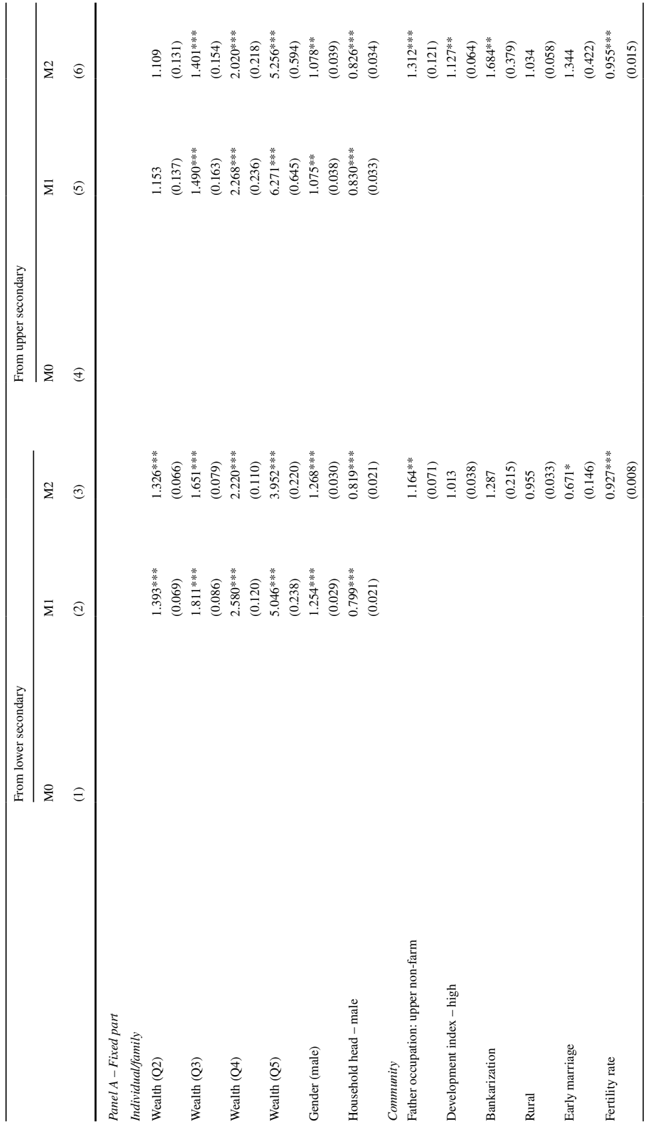
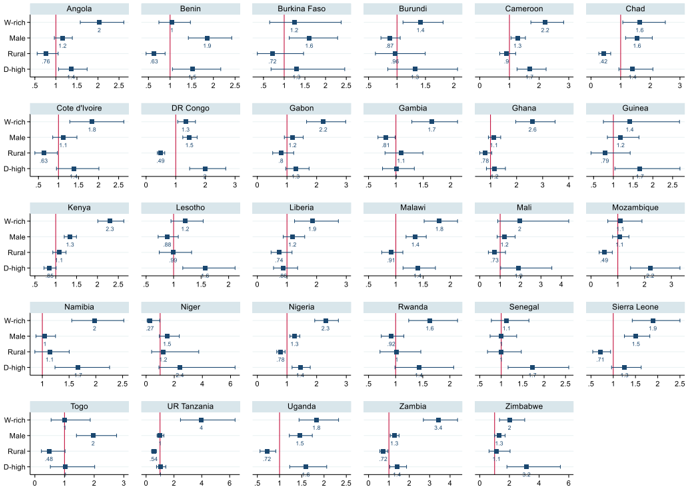
- In the full SSA model for lower secondary transition, a youth from the top wealth quintile has OR = 3.95 relative to the poorest group; for upper secondary transition, the corresponding estimate is OR = 5.26.
- In the full model, male youth are 27% more likely to transition to upper secondary than female youth, and early marriage at the community level is a strong barrier (OR = 0.67); the paper also reports bankarization OR = 1.68 and community qualified jobs OR = 1.16 for lower-secondary transition, with community development and bankarization significant for upper-secondary transition as well.
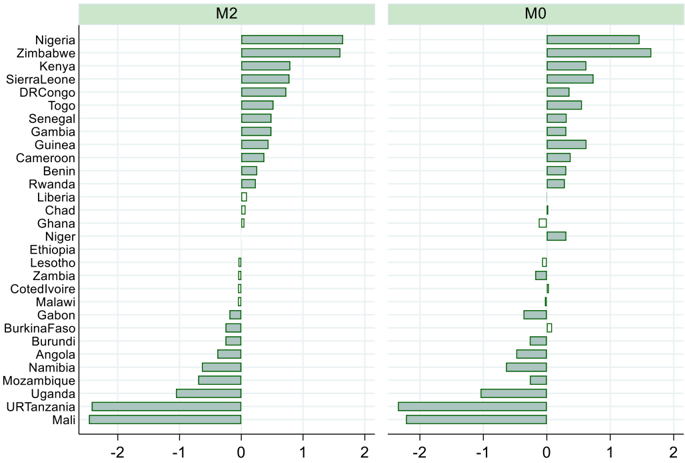
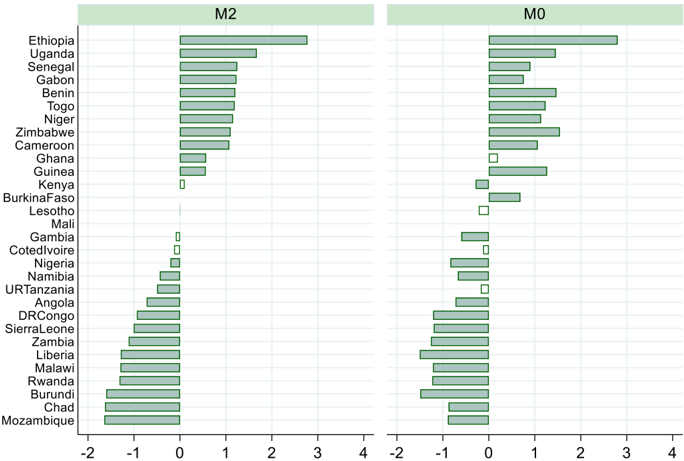
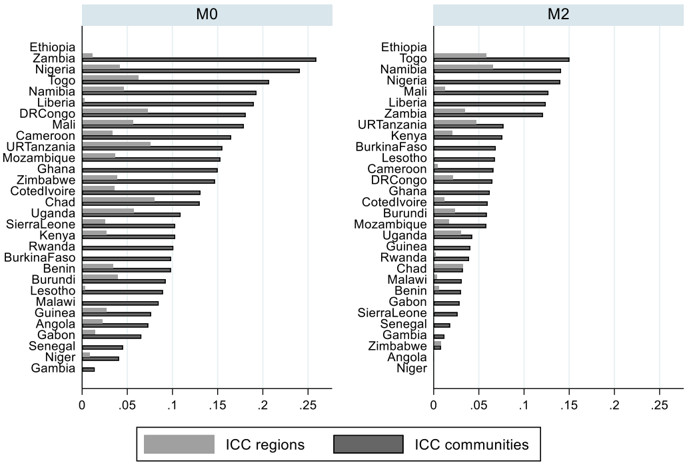
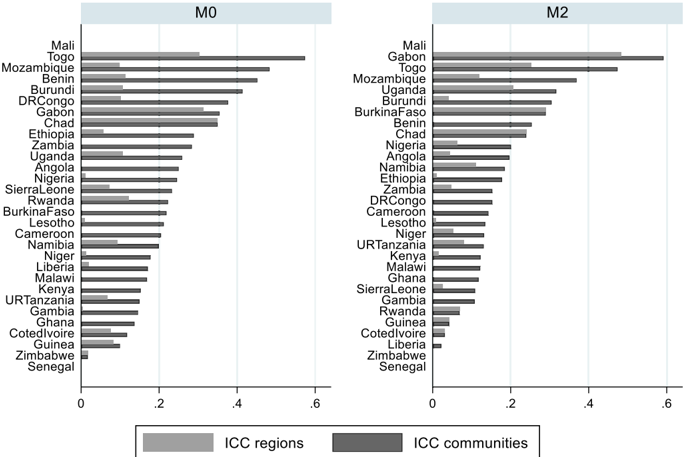
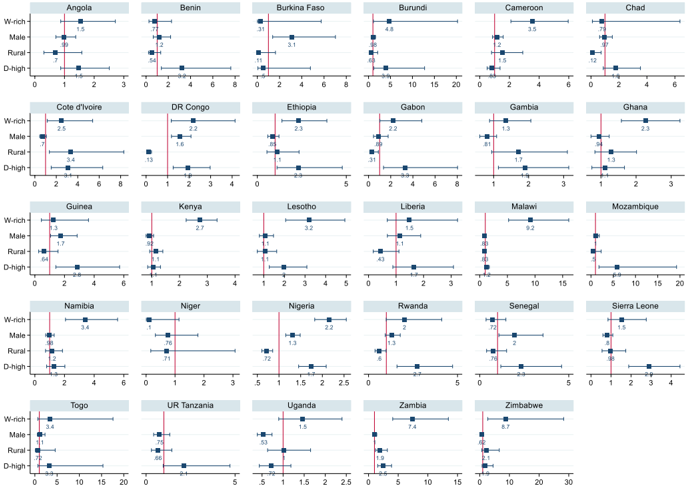
- The paper reports that, after controls, the ICC is 25% at the community level and 18% at the country level for lower-secondary transition, and 38% at the community level and 25% at the country level for upper-secondary transition.
## Methods
- The study uses Demographic and Health Surveys (DHS) from 30 sub-Saharan African countries with survey years from 2010 onwards.
- The main outcomes are two transition rates: lower secondary to upper secondary and a novel indicator, upper secondary to higher education; the primary samples are reported as 54,367 and 21,367 observations, respectively.
- The analysis uses three-level logit multilevel models: individuals nested in communities nested in countries for the pooled SSA analysis, plus country-level models with regions replacing countries as the highest level.
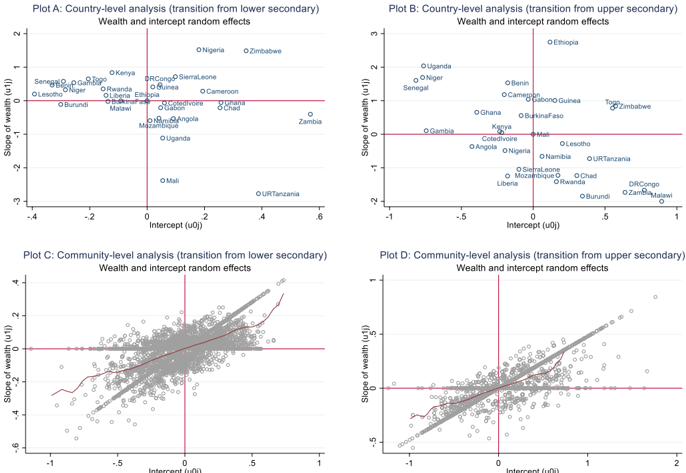
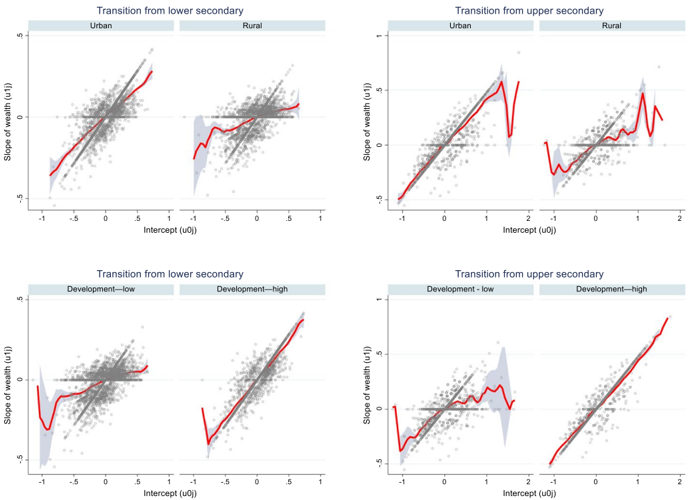
- The paper also estimates random slope models to assess whether wealth effects vary across communities or countries and whether there is a performance-inequality trade-off.
## Limitations
- The paper states that the dataset is cross-sectional, so findings should be interpreted as correlations, not causation.
- It notes possible measurement error in transition rates because they are derived from reported age intervals.
- It states that DHS design limited available covariates for later-life-course educational indicators; specifically, the analysis could not account for demographic factors, family composition, or mothers’ literacy, which the paper says helps explain why a substantial amount of unobserved community heterogeneity remains.
Model-written summary. Check it against the paper before relying on it.
Integrity signals
Registry
Cites
Statistics
Figures
Verification
Claims the paper makes
0 Valid · 2 Not valid · 7 Not checked · 116 Own results and interpretations
The cited sources that could be checked couldn’t confirm or dispute this claim.
In the paper
“The chosen covariates have been shown by studies, such as Evans and Mendez Acosta (2021), to be important drivers of educational outcomes at secondary level.”
What the sources say
- Could not verifycites Evans and Mendez Acosta (2021) matched to “Education in Africa: What Are We Learning?” (2021) sourceExperimental — accuracy not yet measured
Our copy of Evans and Mendez Acosta (2021) is a systematic review of counterfactual impact evaluations of education interventions in Africa (§4.1 Inclusion criteria; §6.3, Fig. 7 describing the 195/145 studies), and it does not estimate or report student/household covariates as drivers of educational outcomes. The secondary-level material it does contain concerns interventions — fee elimination in The Gambia, Kenya and Uganda and Ghana scholarships (§5.3.3), e-readers and role-model films for secondary students (§5.2.2) — and where child characteristics appear they are treatment-effect heterogeneity or unobserved confounding in observational comparisons (§5.4.3, §5.4.1), not covariates shown to drive secondary outcomes. Searched: 'covariates/determinants of learning outcomes at secondary level', 'household wealth parental education gender secondary enrollment completion', 'control variables baseline characteristics regression' — no passage states the claim, and none contradicts it. (LLM, conf=0.70)
boostedstates a cause- Asserted: passes — The authors put it forward as true.
- Checkable: passes — It can be checked against evidence.
- Load-bearing: unclear — It is unclear whether the paper’s conclusions depend on it.
- Based: passes — The paper gives a reason why it holds.
- Could not verify
The cited sources that could be checked couldn’t confirm or dispute this claim.
In the paper
“empirical studies relying on secondary transition rates (i.e., the likelihood of moving from lower to upper secondary and from upper secondary to higher education) are absent.”
What the sources say
- Could not verifycites Huisman & Smits, 2015 matched to “Keeping Children in School: Effects of Household and Context Characteristics on School Dropout in 363 Districts of 30 Developing Countries” (2015) sourceExperimental — accuracy not yet measured
Our copy's only literature-gap statement (Introduction) is that 'Most research on dropout has been conducted in the United States and other highly developed countries. About the situation in less developed countries, much less is known' — it says nothing about studies relying on secondary transition rates. Searches for 'transition rates from lower to upper secondary / upper secondary to higher education' and for data limitations on secondary/higher education returned no passage addressing the claim; the paper's own design (Data/Method, children aged 12-15, discrete-time grade-level dropout analysis, with the primary-to-secondary transition identified as a breaking point in the Abstract and Conclusion) never frames the literature as lacking transition-rate studies. Neither support nor contradiction, so the attribution cannot be checked against our copy. (LLM, conf=0.70)
- Not checked — no full text of the sourcecites Kuepie et al., 2015 matched to “Access to Schooling and Staying in School in Selected Sub‐Saharan African Countries” (2015) source
- Could not verifycites Momo et al., 2019 matched to “A systematic review of the literature on the causes of early school leaving in Africa and Asia” (2019) sourceExperimental — accuracy not yet measured
Our copy of Momo et al. (2019) contains no statement that empirical studies relying on secondary transition rates are absent. The closest material is definitional (Background, discussing 'no transition from primary or secondary school to higher education' per Tukundane et al., 2015) and its inventory of 43 included studies with their data types and methods (Information sources and eligibility criteria), plus references dealing with primary-to-secondary transitions (Siddhu 2011; Lewin & Little 2011; Wudu 2015; Edwards et al. 2014) — none of which asserts the absence the claim attributes. Searches for 'secondary transition rates', 'transition rate ... absent/lacking', 'few studies' and limitations/future-research passages returned nothing on this point. (LLM, conf=0.62)
plain- Asserted: passes — The authors put it forward as true.
- Checkable: passes — It can be checked against evidence.
- Load-bearing: passes — The paper’s conclusions depend on it.
- Based: passes — The paper gives a reason why it holds.
- Rests on an assumption not shown here.
- Could not verify
A result the paper reports from its own data — it cites no other source for it, so there is none to check. The quote shows it is in the paper.
In the paper
“All variances (random effects, Panel B) at levels 2 and 3 are statistically significant regardless of the model fit.”
plain- Asserted: passes — The authors put it forward as true.
- Checkable: passes — It can be checked against evidence.
- Load-bearing: passes — The paper’s conclusions depend on it.
- Based: passes — The paper gives a reason why it holds.
- Rests on an assumption not shown here.
A result the paper reports from its own data — it cites no other source for it, so there is none to check. The quote shows it is in the paper.
In the paper
“the chances of moving from upper secondary to higher education are much lower than towards the last stage of secondary (i.e., to upper secondary).”
plain- Asserted: passes — The authors put it forward as true.
- Checkable: passes — It can be checked against evidence.
- Load-bearing: passes — The paper’s conclusions depend on it.
- Based: passes — The paper gives a reason why it holds.
A result the paper reports from its own data — it cites no other source for it, so there is none to check. The quote shows it is in the paper.
In the paper
“whilst individuals living in communities with a higher prevalence of more qualified jobs (upper non-farm) have larger transition probabilities ( ̂ OR = 1.16).”
plainstates an association- Asserted: passes — The authors put it forward as true.
- Checkable: passes — It can be checked against evidence.
- Load-bearing: passes — The paper’s conclusions depend on it.
- Based: passes — The paper gives a reason why it holds.
69 more claims
Create a free account to see all 125 claims and every source verdict.
- It may state two separate claims as one. 44
- Probably not a substantial claim. 8
- The quote only partly states this claim. 1
Citations
Cites
Women Empowerment and Economic Development
Duflo, E. (2012) · Journal of Economic Literature · doi:10.1257/jel.50.4.1051 · Cited by 2,978 · cited 1×
“Girls who have married early largely do not have control over their earnings, are isolated from support networks, and do not have any social help to sustain their emotional well-being (Duflo, 2012; Raru et al., 2022).”
Handbook of The Economics of Education
(2011) · Handbook of the Economics of Education · doi:10.1016/c2009-0-19772-6 · Cited by 2,525
Multilevel Analysis: Techniques and Applications
Hox, J. J., Moerbeek, M., & van de Schoot, R. (2017) · Routledge eBooks · doi:10.4324/9781315650982 · Cited by 1,671 · cited 1×
“When adding explanatory variables across levels, we rely on the intraclass correlation (ICC) coefficient to gauge an estimation of the decomposition of the variance across the available levels and how much variance is explained at each level by different covariates (Hox et al., 2017).”
Returns to investment in education: a decennial review of the global literature
Psacharopoulos, G., & Patrinos, H. A. (2018) · Education Economics · doi:10.1080/09645292.2018.1484426 · Cited by 869 · cited 1×
“…(2014), when estimating the educational returns for SSA, find that one additional year of education could increase earnings by 13 per cent, and Psacharopoulos and Patrinos (2018) estimate that the private returns to education (i.e., the increase in the earnings from an additional year of…”
Assessment in Education: Principles, Policy & Practice
Wiliam, D. (2008) · Cited by 695
The Challenge of Education and Learning in the Developing World
Kremer, M., Brannen, C., & Glennerster, R. (2013) · Science · doi:10.1126/science.1235350 · Cited by 493 · cited 1×
“…at increasing access and attendance in low-and middle-income countries have found that factors such as reducing prices and distance to schools and assigning merit scholarships are associated with reductions in drop-out rates (Duflo et al., 2021; Glewwe & Muralidharan, 2016; Kremer et al., 2013).”
Comparable Estimates of Returns to Schooling around the World
Montenegro, C. E., & Patrinos, H. A. (2014) · doi:10.1596/1813-9450-7020 · Cited by 411 · cited 1×
“On the economic impacts linked to education, Montenegro and Patrinos (2014), when estimating the educational returns for SSA, find that one additional year of education could increase earnings by 13 per cent, and Psacharopoulos and Patrinos (2018) estimate that the private returns to education…”
Economic Impacts of Child Marriage: A Review of the Literature
Parsons, J., Edmeades, J., Kes, A., Petroni, S., Sexton, M., & Wodon, Q. (2015) · The Review of Faith & International Affairs · doi:10.1080/15570274.2015.1075757 · Cited by 375 · cited 2×
“…reduced education due to early marriage will have lower earnings, productivity, and useful work skills during their entire life, transmitting inequality cross-generationally by having less healthy and less educated children (Baxter et al., 2022; Delprato et al., 2015, 2017; Parsons et al., 2015).”
Facing Forward: Schooling for Learning in Africa
Bashir, S., Lockheed, M., Ninan, E., & Tan, J.-P. (2018) · World Bank, Washington, DC eBooks · doi:10.1596/978-1-4648-1260-6 · Cited by 358 · cited 7×
“…and drop-out rates for basic and secondary education, with information about the transition from basic to secondary school or from lower-secondary to upper-secondary merely descriptive, and the variations between countries not fully explained (Bashir et al., 2018; Majgaard & Mingat, 2012).”
InfluentialReturns to Investment in Education: A Decennial Review of the Global Literature
Psacharopoulos, G., & Patrinos, H. A. (2018) · World Bank, Washington, DC eBooks · doi:10.1596/1813-9450-8402 · Cited by 294
Improving Education Outcomes in Developing Countries
Glewwe, P., & Muralidharan, K. (2016) · Handbook of the Economics of Education · doi:10.1016/b978-0-444-63459-7.00010-5 · Cited by 235
Huisman, J., & Smits, J. (2009) · World Development · doi:10.1016/j.worlddev.2008.01.007 · Cited by 224 · cited 1×
“Gender and household wealth (Kuepie et al., 2015), coupled with the degree development of a community (Huisman & Smits, 2009, 2015)—which can be proxied by poverty and the extent of bankarization (Steinert et al., 2018) as well as the location of a community (Kazeem et al., 2010)—are prime…”
Education in Africa: What Are We Learning?
Evans, D. K., & Mendez Acosta, A. (2021) · Journal of African Economies · doi:10.1093/jae/ejaa009 · Cited by 212 · cited 3×
“One of the main reasons for children dropping out of school in SSA is the cost of schooling and poverty (Evans & Mendez Acosta, 2021; Murtin et al., 2015; Pezzulo et al., 2022).”
Women's Empowerment and Economic Development
Duflo, E. (2011) · National Bureau of Economic Research · doi:10.3386/w17702 · Cited by 202
Arias, O., Evans, D. K., Santos, I., & Arias, O. (2019) · Washington, DC: World Bank and Agence française de développement eBooks · doi:10.1596/978-1-4648-1149-4 · Cited by 183 · cited 2×
“…of) for secondary education persists, most SSA countries would lag behind, and in the next two decades gaps will increase, compared to other countries with similar economic levels from either Latin America or Asia, making the achievement of SDG 4 for SSA countries unattainable (Arias et al., 2019).”
Steinert, J., Zenker, J., Filipiak, U., Movsisyan, A., Cluver, L. D., & Shenderovich, Y. (2017) · World Development · doi:10.1016/j.worlddev.2017.11.018 · Cited by 175 · cited 1×
“…2015), coupled with the degree development of a community (Huisman & Smits, 2009, 2015)—which can be proxied by poverty and the extent of bankarization (Steinert et al., 2018) as well as the location of a community (Kazeem et al., 2010)—are prime determinants of schooling outcomes for the region.”
On the impact of early marriage on schooling outcomes in Sub-Saharan Africa and South West Asia
Delprato, M., Akyeampong, K., Sabates, R., & Hernandez-Fernandez, J. (2015) · International Journal of Educational Development · doi:10.1016/j.ijedudev.2015.06.001 · Cited by 170 · cited 2×
“…reduced education due to early marriage will have lower earnings, productivity, and useful work skills during their entire life, transmitting inequality cross-generationally by having less healthy and less educated children (Baxter et al., 2022; Delprato et al., 2015, 2017; Parsons et al., 2015).”
Self-citationThe Impact of Free Secondary Education: Experimental Evidence from Ghana
Duflo, E., Dupas, P., & Kremer, M. (2021) · National Bureau of Economic Research · doi:10.3386/w28937 · Cited by 162
Webbink, E., Smits, J. P. J. M., & de Jong, E. (2011) · World Development · doi:10.1016/j.worlddev.2011.07.005 · Cited by 154 · cited 1×
“Equally, community factors such as increasing fertility rates will diminish schooling transition (Webbink et al., 2012) because of the additional burden of resources placed on households, whilst (negative) social norms, such as high levels of early marriage, will lead to higher secondary drop-outs…”
Guliani, H., Sepehri, A., & Serieux, J. E. (2013) · Health Policy and Planning · doi:10.1093/heapol/czt045 · Cited by 137 · cited 1×
“…under-five mortality rate is nearly double for children of mothers with no education compared to those who have completed secondary education (UNESCO, 2014), with increasing mother education also having significant impacts on vaccination status and visits for prenatal care (Guliani et al., 2014).”
Associations Between Premarital Sex and Leaving School in Four Sub‐Saharan African Countries
Biddlecom, A., Gregory, R., Lloyd, C. B., & Mensch, B. S. (2008) · Studies in Family Planning · doi:10.1111/j.1728-4465.2008.00179.x · Cited by 122 · cited 1×
“Fathers with lower levels of education are not able to help children with their assignments and this becomes a barrier for students whose fathers have only achieved low educational levels (Biddlecom et al., 2008; Huisman & Smits, 2015).”
Kazeem, A., Jensen, L., & Stokes, C. S. (2010) · Comparative Education Review · doi:10.1086/652139 · Cited by 107 · cited 1×
“…2015), coupled with the degree development of a community (Huisman & Smits, 2009, 2015)—which can be proxied by poverty and the extent of bankarization (Steinert et al., 2018) as well as the location of a community (Kazeem et al., 2010)—are prime determinants of schooling outcomes for the region.”
Intergenerational Education Effects of Early Marriage in Sub-Saharan Africa
Delprato, M., Akyeampong, K., & Dunne, M. (2017) · World Development · doi:10.1016/j.worlddev.2016.11.010 · Cited by 95 · cited 1×
“…reduced education due to early marriage will have lower earnings, productivity, and useful work skills during their entire life, transmitting inequality cross-generationally by having less healthy and less educated children (Baxter et al., 2022; Delprato et al., 2015, 2017; Parsons et al., 2015).”
Self-citationKebede, E. B., Striessnig, E., & Goujon, A. (2021) · Population Studies · doi:10.1080/00324728.2021.1892170 · Cited by 92 · cited 1×
“In contrast, women and girls from wealthier and more educated families tend to marry later, have fewer children, and get pregnant at an older age, but these differences vary significantly by SSA country (Channon & Harper, 2019; Corker et al., 2022; Kebede et al., 2022; Ndagurwa & Chemhaka, 2020).”
Raru, T. B., Ayana, G. M., Zakaria, H. F., & Merga, B. T. (2022) · International Journal of Women's Health · doi:10.2147/ijwh.s350510 · Cited by 81 · cited 2×
“Girls who have married early largely do not have control over their earnings, are isolated from support networks, and do not have any social help to sustain their emotional well-being (Duflo, 2012; Raru et al., 2022).”
Education in Sub-Saharan Africa: A Comparative Analysis
Majgaard, K., & Mingat, A. (2012) · doi:10.1596/978-0-8213-8889-1 · Cited by 80 · cited 3×
“…and drop-out rates for basic and secondary education, with information about the transition from basic to secondary school or from lower-secondary to upper-secondary merely descriptive, and the variations between countries not fully explained (Bashir et al., 2018; Majgaard & Mingat, 2012).”
A Stata module for computing fertility rates and TFRs from birth histories: tfr2
Schoumaker, B. (2013) · Demographic Research · doi:10.4054/demres.2013.28.38 · Cited by 76 · cited 1×
“…by household assets and proportion of fathers with an upper occupation; community fertility rates are calculated using the Stata module tfr2 (Schoumaker, 2013); bankarization measures the proportion of households in the community with a bank account; and infant mortality rate measures child…”
Kellaghan, T., & Greaney, V. (2019) · World Bank, Washington, DC eBooks · doi:10.1596/978-1-4648-1418-1 · Cited by 71 · cited 1×
“…in the SSA region, and fewer will finish upper secondary (4 out of 10), let alone move across these two education levels, on the back of both cumulative disadvantages building throughout the lifecourse and high-stakes exams (Bashir et al., 2018; Kellaghan & Greaney, 2019; Sayed & Kanjee, 2013).”
Huisman, J., & Smits, J. (2015) · Sage Open · doi:10.1177/2158244015609666 · Cited by 66 · cited 4×
“All studies, however, tend to focus on access/drop-out indicators and completion rates (Huisman & Smits, 2015; Kue-pie et al., 2015; Momo et al., 2019) as key indicators, whereas empirical studies relying on secondary transition rates (i.e., the likelihood of moving from lower to upper secondary…”
InfluentialAbuya, B., Oketch, M., & Musyoka, P. (2013) · Compare: A Journal of Comparative and International Education · doi:10.1080/03057925.2012.707458 · Cited by 62 · cited 2×
“Direct and indirect costs are usually higher in rural areas, where, in a context of relatively higher poverty than in urban areas, children and young people spend more time and resources going to school (Abuya et al., 2013; Alegana et al., 2021; Bashir et al., 2018).”
Raru, T. B., Ayana, G. M., Bahiru, N., DERESSA, A. D., Alemu, A., Birhanu, A., Yuya, M., Merga, B. T., Negash, B., & Letta, S. (2022) · Women s Health · doi:10.1177/17455065221076731 · Cited by 60
Blimpo, M. P., Gajigo, O., & Pugatch, T. (2016) · The World Bank Economic Review · doi:10.1093/wber/lhw051 · Cited by 59 · cited 2×
“In contrast, the elimination of secondary school fees in Gambia increased girls’ enrolment by 50 per cent as well as test scores (Blimpo et al., 2019).”
The Impact of Free Secondary Education: Experimental Evidence from GhanaPreprint
Duflo, E., Dupas, P., & Kremer, M. R. (2021) · SSRN Electronic Journal · doi:10.2139/ssrn.3874078 · Cited by 54
Channon, M. D., & Harper, S. E. (2019) · PLoS ONE · doi:10.1371/journal.pone.0219736 · Cited by 47 · cited 1×
“In contrast, women and girls from wealthier and more educated families tend to marry later, have fewer children, and get pregnant at an older age, but these differences vary significantly by SSA country (Channon & Harper, 2019; Corker et al., 2022; Kebede et al., 2022; Ndagurwa & Chemhaka, 2020).”
A systematic review of the literature on the causes of early school leaving in Africa and Asia
Momo, M. S. M., Cabus, S. J., De Witte, K., & Groot, W. (2019) · Review of Education · doi:10.1002/rev3.3134 · Cited by 44 · cited 4×
“[3]).”
InfluentialAnyamele, O. D., Ukawuilulu, J. O., & Akanegbu, B. N. (2016) · Social Indicators Research · doi:10.1007/s11205-015-1225-x · Cited by 40 · cited 1×
“DHS data have been widely used in literature to examine educational outcomes in SSA (see, for instance, Alegana et al., 2021; Anyamele et al., 2017), as well as providing community data as a root of heterogeneity through multilevel modelling (Delprato et al., 2016; Pezzulo et al., 2022; Raru et…”
Brudevold-Newman, A. P. (2021) · Economics of Education Review · doi:10.1016/j.econedurev.2021.102127 · Cited by 38 · cited 1×
“Similarly, in Kenya, the removal of fees has increased students’ educational access, but without an impact on students’ scores (Brudevold-Newman, 2021).”
The effects of cost elimination on secondary school enrolment in Sub-Saharan Africa
Asante, G. (2022) · Educational Review · doi:10.1080/00131911.2022.2028732 · Cited by 36 · cited 1×
“A recent study estimates that, if tuition fees were eliminated in SSA, there would be an average increase of 6 per cent in upper secondary school enrolment (Asante, 2022).”
Grandmothers and Children’s Schooling in Sub-Saharan Africa
Schrijner, S., & Smits, J. P. J. M. (2017) · Human Nature · doi:10.1007/s12110-017-9306-y · Cited by 35
Pezzulo, C., Alegana, V. A., Christensen, A., Bakari, O., & Tatem, A. J. (2022) · PLoS ONE · doi:10.1371/journal.pone.0263734 · Cited by 34 · cited 2×
“One of the main reasons for children dropping out of school in SSA is the cost of schooling and poverty (Evans & Mendez Acosta, 2021; Murtin et al., 2015; Pezzulo et al., 2022).”
Access to Schooling and Staying in School in Selected Sub‐Saharan African Countries
Kuépié, M., Shapiro, D., & Tenikue, M. (2015) · African Development Review · doi:10.1111/1467-8268.12156 · Cited by 31 · cited 3×
“There is evidence that the permanence of girls in schools is usually related to their academic performance (Kuepie et al., 2015).”
Educating Girls and Ending Child marriage : A Priority for Africa
Wodon, Q. T., Malé, C., Montenegro, C. E., Nguyen, H. Q., & Onagoruwa, A. O. (2018) · Cited by 31
Teacher Pay and Educational Outcomes: Evidence from the Rural Hardship Allowance in Zambia
Chelwa, G., Pellicer, M., & Maboshe, M. (2019) · South African Journal of Economics · doi:10.1111/saje.12227 · Cited by 31 · cited 1×
“In Benin, a programme for building rural schools significantly increased enrolment in rural areas (Deschênes & Hotte, 2019), while in Zambia a programme to increase the salary of rural teachers had significant effects on student outcomes as well (Chelwa et al., 2019).”
Omoeva, C., & Gale, C. B. (2016) · International Journal of Educational Development · doi:10.1016/j.ijedudev.2016.05.007 · Cited by 29 · cited 1×
“Other countries, such as Uganda, have reduced tuition fees for upper-secondary education, but without an impact on enrolment, with the most advantaged students receiving this benefit instead of poor-est students (Omoeva & Gale, 2016).”
Assessment in Sub-Saharan Africa: challenges and prospects
Sayed, Y. M., & Kanjee, A. (2013) · Assessment in Education Principles Policy and Practice · doi:10.1080/0969594x.2013.849056 · Cited by 27 · cited 1×
“…in the SSA region, and fewer will finish upper secondary (4 out of 10), let alone move across these two education levels, on the back of both cumulative disadvantages building throughout the lifecourse and high-stakes exams (Bashir et al., 2018; Kellaghan & Greaney, 2019; Sayed & Kanjee, 2013).”
Mapping out-of-school adolescents and youths in low- and middle-income countries
Alegana, V. A., Pezzulo, C., Tatem, A. J., Omar, B., & Christensen, A. (2021) · Humanities and Social Sciences Communications · doi:10.1057/s41599-021-00892-w · Cited by 22 · cited 2×
“Direct and indirect costs are usually higher in rural areas, where, in a context of relatively higher poverty than in urban areas, children and young people spend more time and resources going to school (Abuya et al., 2013; Alegana et al., 2021; Bashir et al., 2018).”
Corker, J., Rossier, C., & Zan, M. L. (2022) · Demographic Research · doi:10.4054/demres.2022.46.29 · Cited by 15 · cited 1×
“In contrast, women and girls from wealthier and more educated families tend to marry later, have fewer children, and get pregnant at an older age, but these differences vary significantly by SSA country (Channon & Harper, 2019; Corker et al., 2022; Kebede et al., 2022; Ndagurwa & Chemhaka, 2020).”
Delprato, M. (2022) · International Journal of Educational Development · doi:10.1016/j.ijedudev.2022.102683 · Cited by 15 · cited 1×
“Educational gender gaps are still large in SSA (for recent regional estimates using twin-samples of opposite sex, see: Delprato, 2022).”
Self-citationDelprato, M., Dunne, M., & Zeitlyn, B. (2015) · International Journal of Quantitative Research in Education · doi:10.1504/ijqre.2016.073633 · Cited by 14 · cited 1×
“…literature to examine educational outcomes in SSA (see, for instance, Alegana et al., 2021; Anyamele et al., 2017), as well as providing community data as a root of heterogeneity through multilevel modelling (Delprato et al., 2016; Pezzulo et al., 2022; Raru et al., 2022; Schrijner & Smits, 2018).”
Self-citationWerner, L. K., Ludwig, J. O., Sié, A., Bagagnan, C. H., Zabré, P., Vandormael, A. M., Harling, G., Neve, J. D., & Fink, G. (2022) · PLoS ONE · doi:10.1371/journal.pone.0270246 · Cited by 14 · cited 3×
“In a recent study for Burkina Faso, Werner et al. (2022a, 2022b) find that, in comparison to individuals with primary education, individuals with secondary or higher education held 26 per cent more assets in the long term.”
InfluentialMasuda, K., & Yamauchi, C. (2018) · Institutional Repositories DataBase (IRDB) · Cited by 13
Baxter, M., Novy‐Marx, M., & D’Angelo, S. (2022) · Development Policy Review · doi:10.1111/dpr.12651 · Cited by 13 · cited 1×
“…reduced education due to early marriage will have lower earnings, productivity, and useful work skills during their entire life, transmitting inequality cross-generationally by having less healthy and less educated children (Baxter et al., 2022; Delprato et al., 2015, 2017; Parsons et al., 2015).”
Odimegwu, C. O., Olamijuwon, E. O., Chisumpa, V. H., Akinyemi, J. O., Singini, M. G., & Somefun, O. D. (2020) · BMC Pregnancy and Childbirth · doi:10.1186/s12884-020-2850-1 · Cited by 10 · cited 1×
“Children of couples who married early and became parents at a young age are also prone to get married and have children at younger ages (Odimegwu et al., 2020).”
Assessing the Effects of an Education Policy on Women's Well-being: Evidence from BeninPreprint
Deschenes, S. N., & Hotte, R. (2019) · RePEc: Research Papers in Economics · Cited by 6
Ndagurwa, P., & Chemhaka, G. B. (2020) · Development Southern Africa · doi:10.1080/0376835x.2020.1747987 · Cited by 4 · cited 1×
“In contrast, women and girls from wealthier and more educated families tend to marry later, have fewer children, and get pregnant at an older age, but these differences vary significantly by SSA country (Channon & Harper, 2019; Corker et al., 2022; Kebede et al., 2022; Ndagurwa & Chemhaka, 2020).”
Fredriksen, B. (2020) · International Review of Education · doi:10.1007/s11159-020-09852-z · Cited by 4
Policy Determinants of School Outcomes under Model Uncertainty: Evidence from S outh A frica
Murtin, F., Laurent, T., Barnard, G., van Rensburg, D. J., Reddy, V., Frempong, G., & Winnaar, L. (2015) · South African Journal of Economics · doi:10.1111/saje.12091 · Cited by 4 · cited 1×
“One of the main reasons for children dropping out of school in SSA is the cost of schooling and poverty (Evans & Mendez Acosta, 2021; Murtin et al., 2015; Pezzulo et al., 2022).”
Hunsaker, S., Baum, D. R., & Ducos, K. (2022) · International Journal of Comparative Education and Development · doi:10.1108/ijced-10-2021-0106 · Cited by 3 · cited 3×
“Hunsaker et al. (2022) found that a scholarship programme in rural Malawi had impacts in reducing the costs of household participation in schooling and travelling costs to school, with scholarship recipients achieving between 1 and 1.5 years additional years schooling and higher rates of graduation.”
InfluentialHunsaker, S., Baum, D. R., & Ducos, K. (2021) · doi:10.31235/osf.io/zab2y
Research works printed but not linked: 1
- Werner, L. K., Ludwig, J.-O., Sie, A., Bagagnan, C. H., Zabré, P., Vandormael, A., & Harling, G. (2022b). Jan-Walter De Neve, and Günther Fink. Health and economic benefits of secondary education in the context of poverty: Evidence from Burkina Faso. PLoS ONE, 17 (7), e0270246. · DOI
Cited by
Frola, A., Delprato, M., & Chudgar, A. (2023) · International Journal of Educational Development · doi:10.1016/j.ijedudev.2023.102939 · Cited by 37
Self-citationSpatial education inequality for attainment indicators in sub-saharan Africa and spillovers effects
Delprato, M., Chudgar, A., & Frola, A. (2024) · World Development · doi:10.1016/j.worlddev.2023.106522 · Cited by 29
Self-citationAli, M. J., Chesneau, C., & Muse, A. H. (2024) · Cogent Education · doi:10.1080/2331186x.2024.2436293 · Cited by 12
“Unlike traditional regression models, multi-level models capture both within-level and between-level variations, providing a more accurate representation of the data (Delprato & Farieta, 2024; Muse et al., 2022).”
Delprato, M., & Shephard, D. D. (2024) · International Journal of Educational Development · doi:10.1016/j.ijedudev.2024.103129 · Cited by 6
Self-citationNjoroge, C. G., & O’Donoghue, C. (2025) · Sustainable Futures · doi:10.1016/j.sftr.2025.101366 · Cited by 1
Metadata
- Authors
- Delprato, M., & Farieta, A.
- Affiliations
- University of Sussex (GB)
- Corresponding author
- Delprato, Marcos
- Farieta, Alejandro
- Venue
- Prospects
- Published
- 2023-07-26
- Volume
- 54
- Issue
- 1
- Pages
- 73-102
- ISSN
- 0033-1538 (ISSN-L)
- 1573-9090
- OpenAlex
- W4385272661
- Semantic Scholar
- 5cf8dc549fe4c26777fdc6e474a2cb4adc48681c
- Cited by
- 9
- References
- 53
- Citations by year
- 2026: 2 · 2025: 2 · 2024: 4 · 2023: 1
- FWCI
- 2.26
- Type
- journal article
- Language
- en
- Open access
- hybrid
- doi.org
- Licence
- cc-by
- creativecommons.org/licenses/by/4.0 (tdm)
- creativecommons.org/licenses/by/4.0 (vor)
- Locations
- Prospects (publishedVersion, cc-by)
- Sussex Research Online (University of Sussex) (submittedVersion, cc-by)
- Figshare (submittedVersion, cc-by)
- Topics
- Social Sciences › Development › Poverty, Education, and Child Welfare
- Social Sciences › Education › School Choice and Performance
- Social Sciences › Sociology and Political Science › Intergenerational and Educational Inequality Studies
- Keywords
- educational transitions, secondary education, sub-Saharan Africa, wealth inequality, gender inequality, early marriage, social norms, educational equity
About these checks
Registry, retraction, Cites and statistics results are computed, not judged, with one exception: a printed reference that no index lists is read once by a model before it counts as a citation error. Claims are extracted by a model and kept only when their quote appears verbatim in the text; each cited source is then checked, with a model’s help, for whether it says what the claim relies on. Those verdicts can be wrong — read the claim’s quote and the cited source before relying on one.
The claim verdicts this report counts are experimental: their accuracy is not yet measured.
A language model drew the claims from the paper on 2026-10-10, under version 3 of the claim definition (model deepseek-v4.1-flash, prompt extract-v3).
A second model labelled each claim on 2026-10-10 (model jev-1.13-20260917, definition revision gold-guideline-v0.2).
Cited sources are checked with a language model’s help (qwen3.8-omni-flash).
Statistics and arithmetic are recomputed, not judged.
Confidence bands are shown only for fields calibrated on our annotated test set. None is calibrated yet, so no band is shown.
What counts as a claim ›How we measure confidence ›How we check this ›
Are you an author, or do you see a problem with this page? Request a review
Data sources
Bibliographic data: Semantic Scholar, OpenAlex, Crossref.
Contains information from the Semantic Scholar Academic Graph Datasets, made available under the ODC Attribution License (ODC-BY 1.0).
Semantic Scholar’s data is described in: Kinney, R., et al. (2023). The Semantic Scholar Open Data Platform. arXiv:2301.10140.
