

Contests, gamification, and persistent engagement in educational technology
Open accessThe DOI matches its Crossref record; 39 of the 39 references it cites were found in a registry or an index; 1 of the 30 sources its claims cite were checked for support.
Abstract
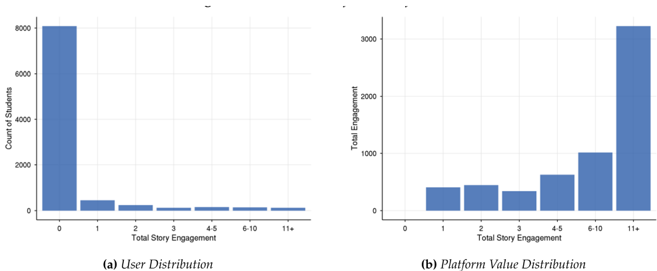
Most users of educational technology disengage within weeks of joining, and whether temporary incentives can durably change engagement remains unclear. We study contest-based gamification in a randomized controlled trial with 10,000 students on an English-learning app in India. Treated students entered a reading contest with leaderboard rankings and prizes for top performers. During the contest, treated students completed 45% more stories than control (0.96, SE 0.32). Twelve weeks after all incentives were removed, treated students completed 76% more stories (0.30, SE 0.14), relative to a control mean of 0.40, and the share of active users rose from 6.5% to 9.6%. Effects are concentrated in the upper tail of the engagement distribution, where nearly all platform activity is generated. Each story completed during the contest generates more lasting engagement for treated than for control students, and persistence extends beyond students who received prizes. Temporary contest-based incentives can durably expand the small segment of engaged users on which educational technology platforms depend.
Overview
CoChat Summary
TL;DR
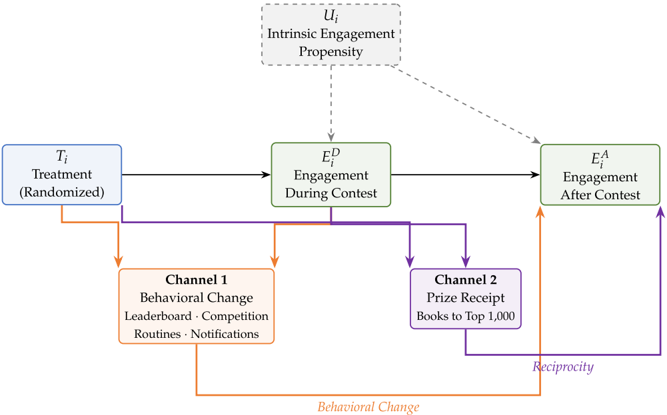
In an RCT with roughly 10,000 students on an English-learning app in India, a reading contest with leaderboard rankings and book prizes increased story completion by 45% during the contest and 76% twelve weeks after all incentives were removed. Effects were concentrated in the upper tail of engagement, and persistence among non-winners plus a rejected surrogacy test suggest behavioral change rather than prize reciprocity alone.
Key findings
- During the contest, treated students completed 0.96 more stories (SE 0.32), a 45% increase, and had 1.09 higher Total Story Engagement (SE 0.37), a 44% increase; they visited the leaderboard nearly twice as often as control students visited the standard leaderboard.
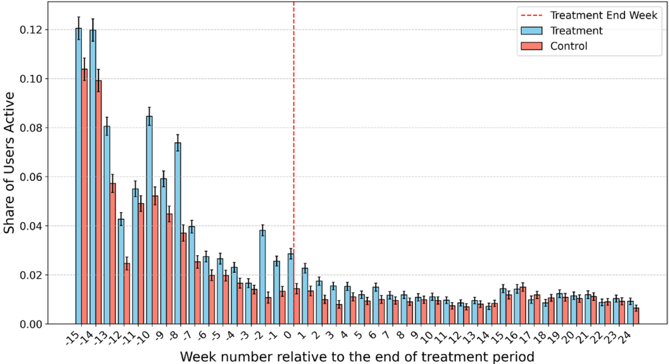
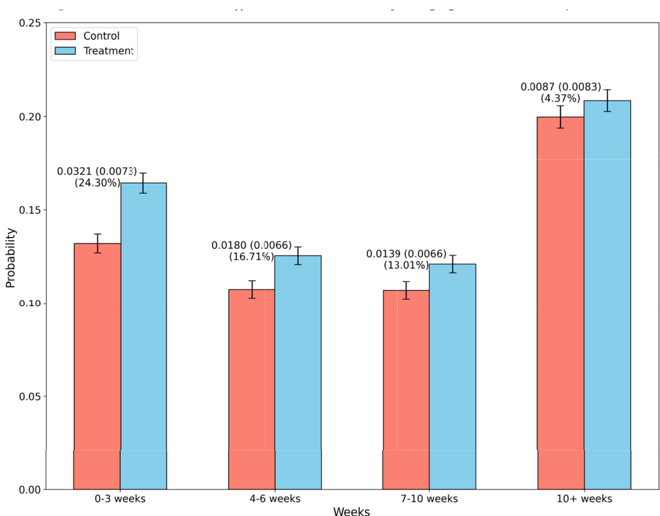
- Post-contest effects persisted: at 4 weeks, treated students completed 0.178 more stories (SE 0.073), a 122% increase over the control mean of 0.146; at 12 weeks, they completed 0.301 more stories (SE 0.139), a 76% increase over the control mean of 0.395. The share of active users rose from 6.5% to 9.6% (3.1 pp, SE 1.4), a 48% relative increase.
- Mechanism tests rejected surrogacy: the interaction between during-contest engagement and treatment was positive and significant at 4 weeks (0.045, SE 0.011 for stories; 0.044, SE 0.011 for engagement). Active non-winners ranked 1,001–1,500 also showed persistence: 0.21 more stories (SE 0.098) at 4 weeks and 0.32 more stories (SE 0.140) at 12 weeks, inconsistent with prize receipt as the sole driver.
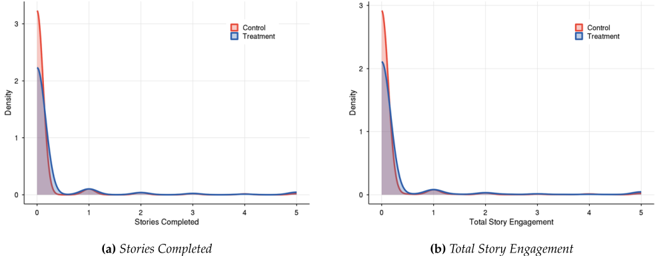
- Effects were concentrated at the upper tail: quantile treatment effects were zero through about the 90th percentile, then reached 1.9 engagement units at the 90th percentile (SE 1.1), 4.4 at the 95th (SE 1.8), and 15.3 at the 99th (SE 5.3) during the contest. The top 1% of treated students completed 16.7 more stories (SE 5.0), a 60% increase over the control 99th percentile of 28.0; at 4 weeks post-contest, effects remained at the 90th (0.4 stories, SE 0.2) and 99th (2.5 stories, SE 1.2) percentiles.
Methods
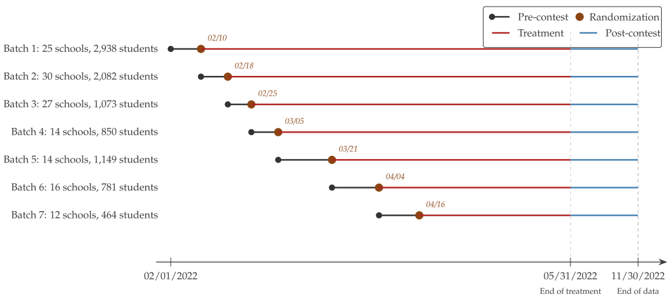
- Design: school-level randomized controlled trial across 138 schools, with the balance table reporting 9,327 students (abstract describes approximately 10,000), stratified by city size and school size and assigned with 50% probability to treatment. Treatment schools entered a reading contest from February 10 to May 31, 2022, with a contest-specific leaderboard ranking students by stories completed and six books delivered to the top 1,000; control schools received the standard app experience. Post-contest observation ran June 1 to November 30, 2022.
- Data and outcomes: Freadom, an English-learning app for Indian children aged 3–12 with over 2,200 short illustrated stories. Primary outcomes were Total Stories Completed and Total Story Engagement, which assigns 0.3 for viewing a story description without starting, 0.5 for starting without finishing, and 1.0 for completing; supplementary outcome was Total Leaderboard Visits.
- Analysis: intention-to-treat effects at the school level, with standard errors clustered at the school level and estimates stratified by assignment date and city tier. The paper also uses quantile treatment effects, a surrogacy test with treatment-by-during-contest-engagement interactions, descriptive comparisons for non-winners ranked 1,001–1,500, within-person change analysis, outlier trimming/winsorization, and session-level time-on-platform tests.
Limitations
- Stated: the study measures engagement, not learning directly, and cannot confirm that increased app usage improves educational outcomes. The short pre-treatment period (8 days on average) limits precision of within-person comparisons. The intervention targeted both students through in-app features and parents through WhatsApp notifications, so the paper cannot distinguish individual habit formation from household routines. The sample consists of families who voluntarily adopted the app, and effects may differ for populations with different baseline motivation. The study covers a single contest design on one platform in one country, leaving generalizability open.
- Stated mechanism caveats: the non-winner comparison is descriptive rather than causal because contest rank is a post-treatment outcome and conditioning on rank band may select different subpopulations across arms. The surrogacy test is necessary but not sufficient. The paper cannot rule out a weaker teacher-reinforcement channel, and the content-difficulty results may reflect compositional change—treatment retaining students already prone to choosing difficult content—rather than within-student behavioral change.
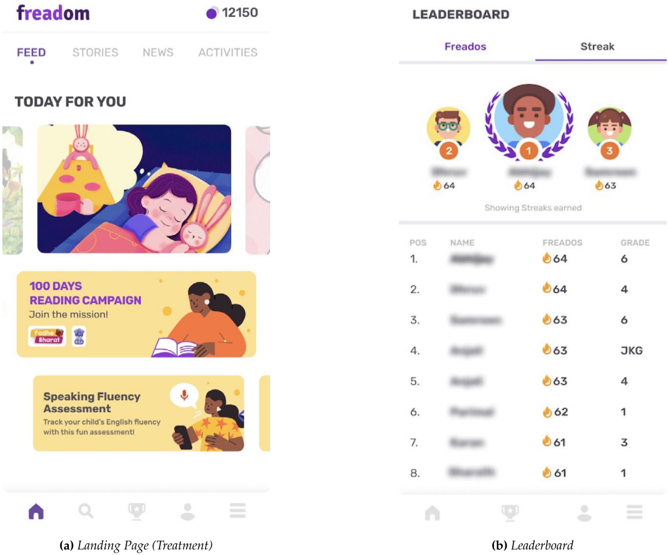
- Evident from the text: treatment was assigned at the school level and the contest was visible to all treated students within a school, so peer competition, teacher encouragement, and classroom social dynamics are bundled with individual incentives and cannot be separated. Treatment also included WhatsApp notifications to parents, so contest/leaderboard/prize effects cannot be isolated from notification effects. The treatment leaderboard was contest-specific and accessible from the app’s landing page, while the control standard leaderboard required navigating away and was used by only one in four active users, so leaderboard exposure differed by design.
Model-written summary. Check it against the paper before relying on it.
Integrity signals
Registry
Cites
Statistics
Figures
Verification
Claims the paper makes
1 Valid · 0 Not valid · 18 Not checked · 107 Own results and interpretations
The sources with a verdict support this claim; the rest weren’t checked yet, have no full text we could read, or their verdicts aren’t rated yet.
In the paper
“A foundational concern with incentivebased interventions is crowding out of intrinsic motivation (Deci et al., 1999;Gneezy & Rustichini, 2000;Lepper et al., 1973).”
§ Contests, gamification, and persistent engagement in educational technology > Extrinsic incentives and intrinsic motivation
What the sources say
- Supportedcites Deci et al., 1999 matched to “A meta-analytic review of experiments examining the effects of extrinsic rewards on intrinsic motivation.” (1999) source
The meta-analysis's central finding, stated in Discussion (pp. 658-659), is that 'tangible rewards tend to have a substantially negative effect on intrinsic motivation' and that 'strategies that focus primarily on the use of extrinsic rewards do, indeed, run a serious risk of diminishing rather than promoting intrinsic motivation.' This directly matches the attributed point that undermining ('crowding out') of intrinsic motivation is the foundational concern with reward/incentive-based strategies. The background passages (pp. 628, 630) likewise frame the 'phenomenon of undermining to be reckoned with' as the core issue the review addresses. (LLM, conf=0.90)
- Not checked yetcites Gneezy & Rustichini, 2000 matched to “Pay Enough or Don't Pay at All*” (2000) source
- Not checked yetcites Lepper et al., 1973 matched to “Undermining children's intrinsic interest with extrinsic reward: A test of the "overjustification" hypothesis.” (1973) source
plainstates a cause- Asserted: passes — The authors put it forward as true.
- Checkable: passes — It can be checked against evidence.
- Load-bearing: passes — The paper’s conclusions depend on it.
- Based: passes — The paper gives a reason why it holds.
- Supported
A result the paper reports from its own data — it cites no other source for it, so there is none to check. The quote shows it is in the paper.
In the paper
“Twelve weeks after all incentives were removed, treated students completed 76% more stories (0.30, SE 0.14), relative to a control mean of 0.40”
- Also stated in: § 1 Introduction · plain
“Twelve weeks after the contest ends, treated students complete 0.30 (SE 0.14) more stories, a 76 percent increase over a control mean of 0.40”
- Also stated in: § 3.1 Gamification effectiveness during and after contest · plain
“Twelve weeks after contest end, treated students completed 0.301 additional stories (SE 0.139), a 76 percent increase over the control mean of 0.395.”
§ Contests, gamification, and persistent engagement in educational technology > Abstract
plainstates a cause- Asserted: passes — The authors put it forward as true.
- Checkable: passes — It can be checked against evidence.
- Load-bearing: passes — The paper’s conclusions depend on it.
- Based: passes — The paper gives a reason why it holds.
- Also stated in: § 1 Introduction · plain
A result the paper states — it cites no source for it, so there is none to check. The quote shows it is in the paper.
In the paper
“Quantile treatment effects are correspondingly zero through approximately the 90th percentile.”
§ Contests, gamification, and persistent engagement in educational technology > 1 Introduction
plain- Asserted: passes — The authors put it forward as true.
- Checkable: passes — It can be checked against evidence.
- Load-bearing: passes — The paper’s conclusions depend on it.
- Based: passes — The paper gives a reason why it holds.
A result the paper reports from its own data — it cites no other source for it, so there is none to check. The quote shows it is in the paper.
In the paper
“None of the three pre-contest engagement outcomes differs significantly across groups”
§ Contests, gamification, and persistent engagement in educational technology > Appendix B Experiment balance
plain- Asserted: passes — The authors put it forward as true.
- Checkable: passes — It can be checked against evidence.
- Load-bearing: passes — The paper’s conclusions depend on it.
- Based: passes — The paper gives a reason why it holds.
A result the paper reports from its own data — it cites no other source for it, so there is none to check. The quote shows it is in the paper.
In the paper
“Table 8 shows β > 0 in all periods.”
§ Contests, gamification, and persistent engagement in educational technology > C.2 Within-person change analysis
plain- Asserted: passes — The authors put it forward as true.
- Checkable: passes — It can be checked against evidence.
- Load-bearing: passes — The paper’s conclusions depend on it.
- Based: passes — The paper gives a reason why it holds.
64 more claims
Create a free account to see all 126 claims and to verify the 28 references still open.
- It may state two separate claims as one. 40
- Probably not a substantial claim. 31
Self-check
Percentages, sums and reported differences re-computed from the paper’s own numbers.
Each contradiction between two passages listed here was confirmed by an independent check.
Rated major: it would touch a result — a value a result rests on, reported and recomputed p-values on opposite sides of the significance level, two passages that conflict with no sign which is right, or a cited work retracted before this paper was published.
In the paper
§ Contests, gamification, and persistent engagement in educational technology > Appendix D Post-contest engagement distributions
“| Stories completed | 0.935 *** | (0.294) | 0.821 *** | (0.236) | 0.711 *** | (0.209) |”
§ Contests, gamification, and persistent engagement in educational technology > 3.1 Gamification effectiveness during and after contest
“During the contest, treated students completed 0.96 additional stories (SE 0.32)”
Rated minor: it would not touch a result — a value no result rests on, a p-value that stays on the same side of the significance level, or a conflict that is clerical, resolved elsewhere in the paper, or outside its own findings.
In the paper
§ Contests, gamification, and persistent engagement in educational technology > Appendix D Post-contest engagement distributions
“In total, 138 schools comprising 9,327 students were randomized”
§ Contests, gamification, and persistent engagement in educational technology > Additional information
“Dropped (≥ p99.9)All 10 223.0 242.6 51.2 Treatment 6 227.3 246.4 72.8Control 4 216.5 236.9 18.8 Kept (< p99.9)All 9,327 2.6 3.0 1.5”
Rated minor: it would not touch a result — a value no result rests on, a p-value that stays on the same side of the significance level, or a conflict that is clerical, resolved elsewhere in the paper, or outside its own findings.
In the paper
§ Contests, gamification, and persistent engagement in educational technology > Appendix B Experiment balance
“4,887 4,440 9,327”
§ Contests, gamification, and persistent engagement in educational technology > Additional information
“Kept (< p99.9)All 9,327 2.6 3.0 1.5 Treatment 4,886 3.1 3.6 1.9 Control 4,441 2.1 2.5 1.0”
Rated minor: it would not touch a result — a value no result rests on, a p-value that stays on the same side of the significance level, or a conflict that is clerical, resolved elsewhere in the paper, or outside its own findings.
In the paper
“we estimate 0.244 additional difficult stories at four weeks (SE 0.071) and 0.293 at twelve weeks (SE 0.141), representing 141 and 61 percent increases relative to control means of 0.162 and 0.492 respectively.”
§ Contests, gamification, and persistent engagement in educational technology > Additional information
Reported 141 · recomputed 150.617284
Citations
Cites
Deci, E. L., Koestner, R., & Ryan, R. M. (1999) · Psychological Bulletin · doi:10.1037/0033-2909.125.6.627 · Cited by 7,176
Does Gamification Work? -- A Literature Review of Empirical Studies on Gamification
Hamari, J., Koivisto, J., & Sarsa, H. (2014) · 2014 47th Hawaii International Conference on System Sciences · doi:10.1109/hicss.2014.377 · Cited by 5,201
Hanus, M. D., & Fox, J. (2015) · Computers & Education · doi:10.1016/j.compedu.2014.08.019 · Cited by 2,927
Intrinsic and extrinsic motivation
Benabou, R., & Tirole, J. (2003) · Review of Economic Studies · doi:10.1111/1467-937x.00253 · Cited by 2,913
The gamification of learning: a meta-analysis
Sailer, M., & Homner, L. (2020) · Educational Psychology Review · doi:10.1007/s10648-019-09498-w · Cited by 2,594
Lepper, M. R., Greene, D., & Nisbett, R. E. (1973) · Journal of Personality and Social Psychology · doi:10.1037/h0035519 · Cited by 2,559
Gamification in theory and action: a survey
Seaborn, K., & Fels, D. I. (2015) · International Journal of Human-Computer Studies · doi:10.1016/j.ijhcs.2014.09.006 · Cited by 2,515
Pay Enough or Don't Pay at All*
Gneezy, U., & Rustichini, A. (2000) · Quarterly Journal of Economics · doi:10.1162/003355300554917 · Cited by 2,175
Surrogate endpoints in clinical trials: Definition and operational criteria
Prentice, R. L. (1989) · Statistics in Medicine · doi:10.1002/sim.4780080407 · Cited by 2,057
When and Why Incentives (Don't) Work to Modify Behavior
Gneezy, U., Meier, S., & Rey-Biel, P. (2011) · Journal of Economic Perspectives · doi:10.1257/jep.25.4.191 · Cited by 1,735
When Should You Adjust Standard Errors for Clustering?
Abadie, A., Athey, S., Imbens, G. W., & Wooldridge, J. M. (2022) · The Quarterly Journal of Economics · doi:10.1093/qje/qjac038 · Cited by 1,460
Self-citationDeconstructing disengagement: analyzing learner subpopulations in massive open online courses
Kizilcec, R. F., Piech, C., & Schneider, E. (2013) · Proceedings of the Third International Conference on Learning Analytics and Knowledge · doi:10.1145/2460296.2460330 · Cited by 984
Initial trends in enrolment and completion of massive open online courses
Jordan, K. (2014) · The International Review of Research in Open and Distributed Learning · doi:10.19173/irrodl.v15i1.1651 · Cited by 862
Exploring the factors affecting MOOC retention: A survey study
Hone, K. S., & El Said, G. R. (2016) · Computers & Education · doi:10.1016/j.compedu.2016.03.016 · Cited by 720
(2009) · Econometrica · doi:10.3982/ecta7416 · Cited by 654
The impact of gamification in educational settings on student learning outcomes: a meta-analysis
Huang, R., Ritzhaupt, A. D., Sommer, M., Zhu, J., Stephen, A., Valle, N., Hampton, J., & Li, J. (2020) · Educational Technology Research and Development · doi:10.1007/s11423-020-09807-z · Cited by 566
The Econometrics of Randomized Experiments
(2017) · Handbook of Economic Field Experiments · doi:10.1016/bs.hefe.2016.10.003 · Cited by 562
Self-citationReich, J., & Ruipérez-Valiente, J. A. (2019) · Science · doi:10.1126/science.aav7958 · Cited by 484
Financial Incentives and Student Achievement: Evidence from Randomized Trials *
Fryer, R. G. (2011) · The Quarterly Journal of Economics · doi:10.1093/qje/qjr045 · Cited by 416
Disrupting education? Experimental evidence on technology-aided instruction in India
Muralidharan, K., Singh, A., & Ganimian, A. J. (2019) · American Economic Review · doi:10.1257/aer.20171112 · Cited by 415
Royer, H., Stehr, M., & Sydnor, J. (2015) · American Economic Journal: Applied Economics · doi:10.1257/app.20130327 · Cited by 392
Consumer Heterogeneity and Paid Search Effectiveness: A Large-Scale Field Experiment
Blake, T., Nosko, C., & Tadelis, S. (2015) · Econometrica · doi:10.3982/ecta12423 · Cited by 354
Retention Futility: Targeting High-Risk Customers Might be Ineffective
Ascarza, E. (2018) · Journal of Marketing Research · doi:10.1509/jmr.16.0163 · Cited by 295
EdTech in Developing Countries: A Review of the Evidence
Rodriguez-Segura, D. (2021) · The World Bank Research Observer · doi:10.1093/wbro/lkab011 · Cited by 208
Gamifying an ICT course: Influences on engagement and academic performance
Çakıroğlu, Ü., Başıbüyük, B., Güler, M., Atabay, M., & Yılmaz Memiş, B. (2017) · Computers in Human Behavior · doi:10.1016/j.chb.2016.12.018 · Cited by 204
Paying to Learn: The Effect of Financial Incentives on Elementary School Test Scores
Bettinger, E. P. (2012) · Review of Economics and Statistics · doi:10.1162/rest_a_00217 · Cited by 172
Ascarza, E., Iyengar, R., & Schleicher, M. (2016) · Journal of Marketing Research · doi:10.1509/jmr.13.0483 · Cited by 117
Athey, S. C., Chetty, R., Imbens, G. W., & Kang, H. (2025) · The Review of Economic Studies · doi:10.1093/restud/rdaf087 · Cited by 87
Self-citationCombating Procrastination on Massive Online Open Courses via Optimal Calls to Action
Huang, N., Zhang, J., Burtch, G., Li, X., & Chen, P. (2021) · Information Systems Research · doi:10.1287/isre.2020.0974 · Cited by 61
Retana, G. F., Forman, C., & Wu, D. J. (2016) · Manufacturing & Service Operations Management · doi:10.1287/msom.2015.0547 · Cited by 47
Treffers‐Daller, J., Mukhopadhyay, L., Balasubramanian, A., Tamboli, V., & Tsimpli, I. M. (2022) · Applied Linguistics · doi:10.1093/applin/amac003 · Cited by 40
Fun Shopping: A Randomized Field Experiment on Gamification
Ho, Y.-J. (., Liu, S., & Wang, L. (2023) · Information Systems Research · doi:10.1287/isre.2022.1147 · Cited by 24
The Impact of Gamification in Educational Settings on Student Learning Outcomes: A Meta-Analysis
Huang, R. (2021) · American Educational Research Association Annual Meeting (AERA) · doi:10.3102/1686773 · Cited by 22
When student incentives do not work: Evidence from a field experiment in Malawi
Berry, J., Kim, H. B., & Son, H. H. (2022) · Journal of Development Economics · doi:10.1016/j.jdeveco.2022.102893 · Cited by 12
Personalized Game Design for Improved User Retention and Monetization in Freemium Mobile GamesPreprint
Ascarza, E., Netzer, O., & Runge, J. (2024) · SSRN Electronic Journal · doi:10.2139/ssrn.4653319 · Cited by 7
Personalized game design for improved user retention and monetization in freemium games
Ascarza, E., Netzer, O., & Runge, J. (2025) · International Journal of Research in Marketing · doi:10.1016/j.ijresmar.2025.01.006 · Cited by 6
The Economics of Algorithmic Personalization: Evidence from an Educational Technology PlatformPreprint
Agrawal, K. S., Athey, S. C., Kanodia, A., Nath, S., & Palikot, E. (2026) · SSRN Electronic Journal · doi:10.2139/ssrn.5996014 · Cited by 3
Self-citationEdTech in Developing Countries: A Review of the Evidence
Rodriguez-Segura, D. (2021) · doi:10.1596/40100
The Economics of Algorithmic Personalization: Evidence from an Educational Technology Platform
Agrawal, K., Athey, S. C., Kanodia, A., Nath, S., & Palikot, E. (2026) · doi:10.2139/ssrn.6425002
Self-citation
Cited by
The Economics of Algorithmic Personalization: Evidence from an Educational Technology PlatformPreprint
Agrawal, K. S., Athey, S. C., Kanodia, A., Nath, S., & Palikot, E. (2026) · SSRN Electronic Journal · doi:10.2139/ssrn.5996014 · Cited by 3
Self-citationIncreasing Parents’ Engagement on EdTech Platforms: Evidence from the Field
Goyal, N., Okuno, A. A., Singhvi, D., & Singhvi, S. (2026) · Operations Research · doi:10.1287/opre.2024.1250 · Cited by 3
A Review on Game-Based Learning for Moral and Digital Citizenship Education
Mahamuni, P. (2026) · INTERANTIONAL JOURNAL OF SCIENTIFIC RESEARCH IN ENGINEERING AND MANAGEMENT · doi:10.55041/ijsrem67746
Metadata
- Authors
- Palikot, E., Agrawal, K., Kanodia, A., & Athey, S.
- Affiliations
- Northeastern University (US)
- Stanford University (US)
- Corresponding author
- Palikot, Emil
- Venue
- Quantitative Marketing and Economics
- Published
- 2026-05-07
- Volume
- 24
- Issue
- 1
- Pages
- 8
- ISSN
- 1570-7156 (ISSN-L)
- 1573-711X
- OpenAlex
- W7160524800
- Cited by
- 3
- References
- 35
- Citations by year
- 2026: 3
- FWCI
- 11.13
- Type
- journal article
- Language
- en
- Open access
- hybrid
- doi.org
- Licence
- cc-by-nc-nd
- creativecommons.org/licenses/by-nc-nd/4.0 (tdm)
- creativecommons.org/licenses/by-nc-nd/4.0 (vor)
- Locations
- Quantitative Marketing and Economics (publishedVersion, cc-by-nc-nd)
- SSRN Electronic Journal (submittedVersion)
- Funders
- Northeastern University USA
- Topics
- Social Sciences › Psychology › Developmental and Educational Psychology › Educational Games and Gamification
- Physical Sciences › Computer Science › Computer Science Applications › Online Learning and Analytics
- Social Sciences › Economics, Econometrics and Finance › Economics and Econometrics › Experimental Behavioral Economics Studies
- Keywords
- gamification, contests, user engagement, user retention, leaderboards, awards, educational technology
About these checks
Registry, retraction, Cites and statistics results are computed, not judged, with one exception: a printed reference that no index lists is read once by a model before it counts as a citation error. Claims are extracted by a model and kept only when their quote appears verbatim in the text; each cited source is then checked, with a model’s help, for whether it says what the claim relies on. Those verdicts can be wrong — read the claim’s quote and the cited source before relying on one.
A language model drew the claims from the paper on 2026-11-23, under version 3 of the claim definition (model deepseek-v4.1-flash, prompt extract-v3).
A second model labelled each claim on 2026-11-23 (model jev-1.13-20260917, definition revision gold-guideline-v0.2).
Cited sources are checked with a language model’s help (qwen3.8-omni-flash).
Statistics and arithmetic are recomputed, not judged.
Confidence bands are shown only for fields calibrated on our annotated test set. None is calibrated yet, so no band is shown.
What counts as a claim ›How we measure confidence ›How we check this ›
Are you an author, or do you see a problem with this page? Request a review
Data sources
Bibliographic data: Semantic Scholar, OpenAlex, Crossref.
Contains information from the Semantic Scholar Academic Graph Datasets, made available under the ODC Attribution License (ODC-BY 1.0).
Semantic Scholar’s data is described in: Kinney, R., et al. (2023). The Semantic Scholar Open Data Platform. arXiv:2301.10140.
