

Effect of Fruit Pomace Addition on Shortbread Cookies to Improve Their Physical and Nutritional Values
Open accessThe DOI matches its Crossref record; 26 of the 26 references it cites were found in a registry or an index.
Abstract
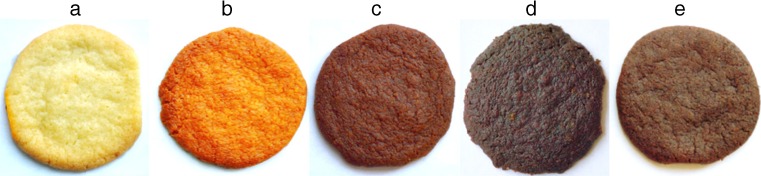
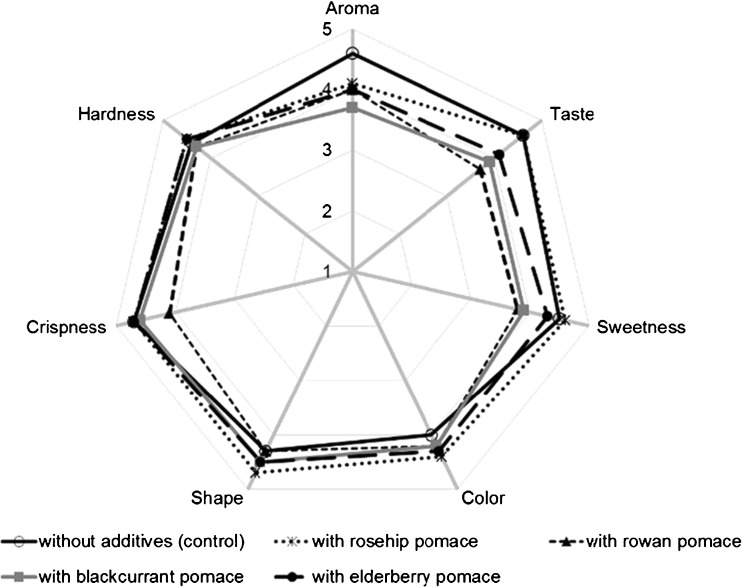
Fruit pomace remaining after juice extraction is still a source of bioactive compounds. Especially rich in these compounds is the pomace from blackcurrant fruit and from fruits of little-known horticultural plants, like: rowan, rosehip and elderberry. The addition of fruit pomace to bakery and confectionery products, especially to those made of white flour, may significantly enrich their composition with dietary fiber, vitamins and phenolic compounds. This study was aimed at determining the effect of 20 % addition of fruit pomace from rosehip, rowan, blackcurrant and elderberry on the properties of shortbread cookies. The pomace-containing cookies, compared to those without additives, were characterized by a darker color with a higher contribution of yellowness, and by higher hardness. The overall organoleptic assessment was comparable for all types of cookies, however the cookies with pomace were characterized by more perceptible taste and aroma, and were sourer. The extracts from pomace-supplemented cookies had a significantly stronger antioxidant capacity than that from the cookies without pomace, but they were ineffective in inhibiting lipid oxidation. The study showed that fruit pomace could improve the nutritional value of shortbread cookies. Furthermore, non-typical color of such a new product may be attractive to consumers.
Overview
The claims and statistics of this paper haven’t been checked yet.
Free: it reads the open-access text and checks the first 5 claims that cite a source we can check. Create a free account to check every claim.
Integrity signals
Registry
Cites
Statistics
Figures
Verification
Claims the paper makes
The claims and statistics of this paper haven’t been checked yet.
Free: it reads the open-access text and checks the first 5 claims that cite a source we can check. Create a free account to check every claim.
Claims other papers make about this one
Each is checked against this paper’s own text: does it say what the citing paper says it does?
The source backs part of the claim, not all of it — or backs it for a different population, condition or comparison.
In the citing paper
“Indeed, it was reported in some studies that substitution rates above 10% cause a decrease in the sensory properties of the product [142,143].”
From From Industrial Food Waste to Bioactive Ingredients: A Review on the Sustainable Management and Transformation of Plant-Derived Food Waste (2023) · cites this paper as [143]
Experimental — accuracy not yet measured
Self-check
Percentages, sums and reported differences re-computed from the paper’s own numbers.
The self-check needs the paper’s full text.
Citations
Cites
Soest, P. J. V., & Wine, R. H. (1967) · Journal of AOAC INTERNATIONAL · doi:10.1093/jaoac/50.1.50 · Cited by 2,419
Antioxidants in fruits and vegetables - the millennium's health
Kaur, C., & Kapoor, H. C. (2001) · International Journal of Food Science and Technology · doi:10.1046/j.1365-2621.2001.00513.x · Cited by 1,492
OTAL PHENOLICS AND TOTAL FLAVONOIDS IN BULGARIAN FRUITS AND VEGETABLES
Marinova, D., Ribarova, F., & Atanassova, M. (2005) · Cited by 555
Soest, P. J. V. (1963) · Journal of AOAC INTERNATIONAL · doi:10.1093/jaoac/46.5.825 · Cited by 277
Mildner‐Szkudlarz, S., Bajerska, J., Zawirska‐Wojtasiak, R., & Górecka, D. (2013) · Journal of the Science of Food and Agriculture · doi:10.1002/jsfa.5774 · Cited by 198
Effect of incorporation of amaranth flour on the quality of cookies
Sindhuja, A., Sudha, M. L., & Rahim, A. (2005) · European Food Research and Technology · doi:10.1007/s00217-005-0039-5 · Cited by 141
Anthocyanin content and antioxidant activity of various red fruit juices
Jakobek, L., Šeruga, M., Medvidović‐Kosanović, M., & Novak, I. (2007) · Deutsche Lebensmittel-Rundschau · Cited by 141
Interaction of vitamin C and flavonoids in elderberry (Sambucus nigra L.) during juice processing
Kaack, K., & Austed, T. (1998) · Plant Foods for Human Nutrition · doi:10.1023/a:1008069422202 · Cited by 128
Elderberry (Sambucus nigra L.) Wine: A Product Rich in Health Promoting Compounds
Schmitzer, V., Veberič, R., Slatnar, A., & Štampar, F. (2010) · Journal of Agricultural and Food Chemistry · doi:10.1021/jf102083s · Cited by 91
Pieszka, M., Gogol, P., Pietras, M., & Pieszka, M. (2015) · Annals of Animal Science · doi:10.2478/aoas-2014-0072 · Cited by 90
Research works printed but not linked: 5
- Sharoba AM, Farrag MA, Abd E-S (2013) Utilization of some fruits and vegetables waste as a source of dietary fiber and its effect on the cake making and its quality attributes. J Agroaliment Proc Technol 19:429–444, http://www.journal-of-agroalimentary.ro/admin/articole/97180L68_Vol_19(4)_2013_429-444.pdf
- Ropciuc S Cenuşă R Căpriţă R Creţescu I Study on the ascorbic acid content of rosehip fruits depending on stationary conditions Anim Sci Biotechnol 2011 44 129 132
- Ribereau-Gayon P Heywood VH Conspectus of the phenolic constituents Plant phenolics 1972 New York Hafner 1 23
- Resurreccion AVA Consumer sensory testing for product development (Chapman & Hall Food Science Book) 1998 Maryland Springer
- Kalisz S Mitek M Nowicka M High-metoxyl pectins influence on the antioxidant compounds content in strawberry juices (in Polish) Żywność Nauk Technol Jakość 2007 14 145 154
Cited by
Food industry by-products used as functional ingredients of bakery products
Martins, Z. E., Pinho, O., & Ferreira, I. M. P. L. V. O. (2017) · Trends in Food Science & Technology · doi:10.1016/j.tifs.2017.07.003 · Cited by 274
Trigo, J. P., Alexandre, E. M. C., Saraiva, J. A., & Pintado, M. E. (2020) · Critical Reviews in Food Science and Nutrition · doi:10.1080/10408398.2019.1572588 · Cited by 247
“Indeed, it has been demonstrated that concentrations above 10% could significantly diminish the organoleptic quality of the final product (Bhol, Lanka, and Bosco 2016; Shabeer et al. 2016; Ta nska et al. 2016; Oliveira et al. 2016).”
BackgroundResultGómez, M., & Martinez, M. M. (2018) · Critical Reviews in Food Science and Nutrition · doi:10.1080/10408398.2017.1305946 · Cited by 226
Iqbal, A., Schulz, P., & Rizvi, S. S. H. (2021) · Food Bioscience · doi:10.1016/j.fbio.2021.101384 · Cited by 175
Positive and negative effects of polyphenol incorporation in baked foods
Ou, J., Wang, M., Zheng, J., & Ou, S. (2019) · Food Chemistry · doi:10.1016/j.foodchem.2019.01.096 · Cited by 163
Metadata
- Authors
- Tańska, M., Roszkowska, B., Czaplicki, S., Borowska, E. J., Bojarska, J., & Dąbrowska, A.
- Affiliations
- University of Warmia and Mazury in Olsztyn (PL)
- Corresponding author
- Czaplicki, Sylwester
- Venue
- Plant Foods for Human Nutrition
- Published
- 2016-06-18
- Volume
- 71
- Issue
- 3
- Pages
- 307-313
- ISSN
- 0033-5134 (ISSN-L)
- 0921-9668
- 1573-9104
- PMC
- PMC4996867
- OpenAlex
- W2434103776
- Cited by
- 105
- References
- 26
- Citations by year
- 2026: 5 · 2025: 14 · 2024: 15 · 2023: 8 · 2022: 15 · 2021: 17 · 2020: 10 · 2019: 10 · 2018: 3 · 2017: 8
- FWCI
- 7.31
- Type
- journal article
- Language
- en
- Open access
- hybrid
- doi.org
- Locations
- Plant Foods for Human Nutrition (publishedVersion, cc-by)
- PubMed Central (publishedVersion, cc-by)
- PubMed (publishedVersion)
- Topics
- Health Sciences › Nursing › Nutrition and Dietetics › Food composition and properties
- Health Sciences › Medicine › Biochemistry (medical) › Phytochemicals and Antioxidant Activities
- Life Sciences › Agricultural and Biological Sciences › Food Science › Food Nutrient Composition and Product Development
- Keywords
- fruit pomace, blackcurrant pomace, phenolic compounds, dietary fiber, antioxidant capacity, lipid oxidation, sensory evaluation, color, texture, nutritional value, bakery products
- MeSH terms
- Antioxidants, Ascorbic Acid, Consumer Behavior, Dietary Fiber, Flour, Food Analysis, Food Handling, Fruit, Humans, Nutritive Value, Phenols, Taste, Vitamins, Rosa, Sambucus, Ribes, Sorbus
About these checks
Registry, retraction, Cites and statistics results are computed, not judged, with one exception: a printed reference that no index lists is read once by a model before it counts as a citation error. Claims are extracted by a model and kept only when their quote appears verbatim in the text; each cited source is then checked, with a model’s help, for whether it says what the claim relies on. Those verdicts can be wrong — read the claim’s quote and the cited source before relying on one.
Statistics and arithmetic are recomputed, not judged.
Confidence bands are shown only for fields calibrated on our annotated test set. None is calibrated yet, so no band is shown.
What counts as a claim ›How we measure confidence ›How we check this ›
Are you an author, or do you see a problem with this page? Request a review
How to cite
Cite CoChat for the checks on this page, and the paper for its own findings.
- This page
- CoChat. (2026). Citation check: Effect of Fruit Pomace Addition on Shortbread Cookies to Improve Their Physical and Nutritional Values. https://app.cochat.ai/papers/10.1007/s11130-016-0561-6
- The paper
- Tańska, M., Roszkowska, B., Czaplicki, S., Borowska, E. J., Bojarska, J., & Dąbrowska, A. (2016). Effect of Fruit Pomace Addition on Shortbread Cookies to Improve Their Physical and Nutritional Values. Plant Foods for Human Nutrition. https://doi.org/10.1007/s11130-016-0561-6
Data sources
Bibliographic data: Semantic Scholar, OpenAlex, Crossref.
Contains information from the Semantic Scholar Academic Graph Datasets, made available under the ODC Attribution License (ODC-BY 1.0).
Semantic Scholar’s data is described in: Kinney, R., et al. (2023). The Semantic Scholar Open Data Platform. arXiv:2301.10140.
