

Effectiveness of psychoeducational support on quality of life in early-stage breast cancer patients: a systematic review and meta-analysis of randomized controlled trials
Open accessThe DOI matches its Crossref record; 50 of the 51 references it cites were found in a registry or an index.
Abstract
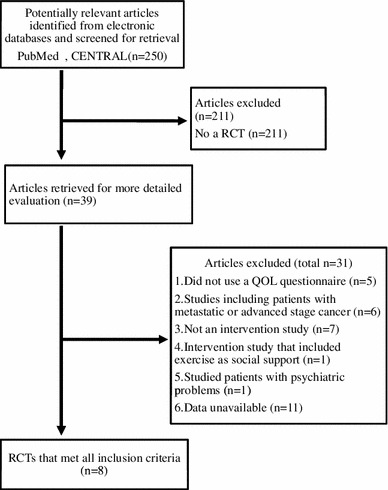
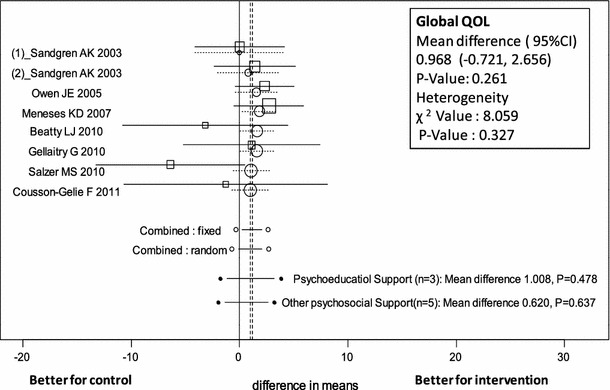
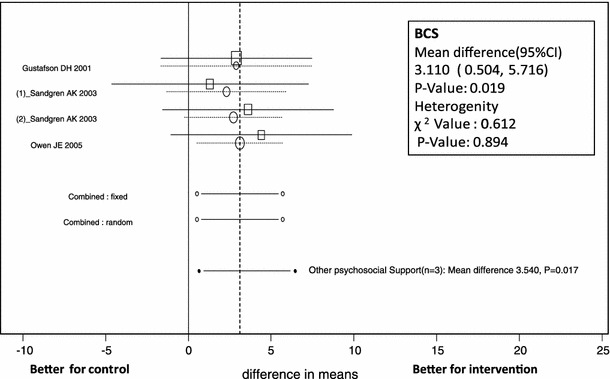
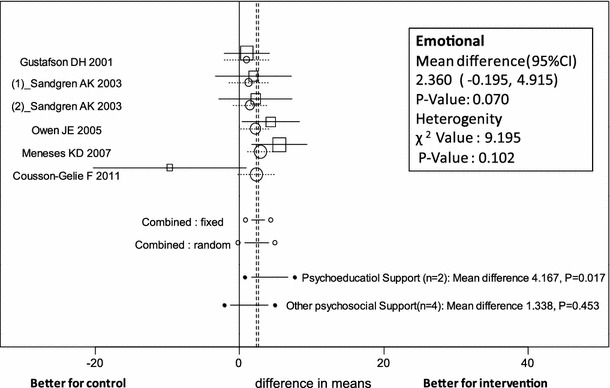
PURPOSE: Most breast cancer patients receive psychosocial support interventions. However, the effectiveness of these interventions has not yet been clarified. Quality of life (QOL) was an important construct that should be considered when assessing these interventions. The purpose was to evaluate the effectiveness of psychosocial and especially psychoeducational support interventions for early-stage breast cancer patients since the follow-up was bound up to 6 months after finishing the intervention. METHODS: We conducted a systematic review and meta-analysis to identify randomized controlled trials with early-stage breast cancer patients receiving psychosocial (psychoeducational and other) support in which QOL was measured as a treatment outcome. We compared mean differences at less than 6 months post-intervention with a control group. The primary outcome was Global Health Status/QOL scale (Global QOL), and secondary outcomes were the subscales of QOL. RESULTS: No significant effect was observed for Global QOL; however, individuals receiving psychosocial support scored higher on the Breast Cancer Symptoms subscale. For psychoeducational support in the psychosocial support, significant effect was observed on the Emotional subscale. CONCLUSIONS: Our analysis strengthens the evidence of the effectiveness of psychosocial support in improving breast cancer symptoms and psychoeducational support in improving emotional well-being within 6 months post-intervention.
Overview
The claims and statistics of this paper haven’t been checked yet.
Free: it reads the open-access text and checks the first 5 claims that cite a source we can check. Create a free account to check every claim.
Integrity signals
Registry
Cites
Statistics
Figures
Verification
Claims the paper makes
The claims and statistics of this paper haven’t been checked yet.
Free: it reads the open-access text and checks the first 5 claims that cite a source we can check. Create a free account to check every claim.
Claims other papers make about this one
Each is checked against this paper’s own text: does it say what the citing paper says it does?
The cited source says what the claim attributes to it.
In the citing paper
“We identified a few meta-analyses investigating psychological intervention in women with breast cancer (Duijts 2011;Guarino 2020;Matsuda 2014;Mustafa 2013;Naaman 2009;Sebri 2021).”
From Psychological interventions for women with non-metastatic breast cancer (2023) · cites this paper as Matsuda 2014
Self-check
Percentages, sums and reported differences re-computed from the paper’s own numbers.
The self-check needs the paper’s full text.
Citations
Cites
Jemal, A., Bray, F., Center, M. M., Ferlay, J., Ward, E., & Forman, D. (2011) · CA: A Cancer Journal for Clinicians · doi:10.3322/caac.20107 · Cited by 54,679
Aaronson, N. K., Ahmedzai, S., Bergman, B., Bullinger, M., Cull, A., Duez, N. J., Filiberti, A., Flechtner, H., Fleishman, S. B., Haes, J. C. J. M. D., et al. (1993) · JNCI Journal of the National Cancer Institute · doi:10.1093/jnci/85.5.365 · Cited by 16,005 · cited 3×
“The EORTC QLQ-C30 and FACTGeneral (FACT-G), probably the two most widely used oncological QOL instruments, were subjected to equating [25].”
MethodCochrane Database of Systematic Reviews
(2011) · Progress in Neurology and Psychiatry · doi:10.1002/pnp.208 · Cited by 4,667
(2019) · doi:10.1188/19.onf · Cited by 3,217
CA: A Cancer Journal for Clinicians
(2010) · CA A Cancer Journal for Clinicians · doi:10.3322/(issn)1542-4863 · Cited by 2,538
Brady, M. J., Cella, D. F., Mo, F., Bonomi, A. E., Tulsky, D. S., Lloyd, S. R., Deasy, S., Cobleigh, M., & Shiomoto, G. (1997) · Journal of Clinical Oncology · doi:10.1200/jco.1997.15.3.974 · Cited by 1,752 · cited 5×
“The standard deviation was taken from a study of the reliability and validity of the FACT-B [23] and QOL-CS [24] if it was not reported in the literature.”
MethodInfluentialThe Cochrane Database of Systematic Reviews
Handoll, H. H. (2004) · The British Journal of Hand Therapy · doi:10.1177/175899830400900201 · Cited by 1,513
“The Medical Journal of Australia”
(1923) · Medical Journal of Australia · doi:10.5694/j.1326-5377.1923.tb64467.x · Cited by 1,439
Do stress-related psychosocial factors contribute to cancer incidence and survival?
Chida, Y., Hamer, M., Wardle, J., & Steptoe, A. (2008) · Nature Clinical Practice Oncology · doi:10.1038/ncponc1134 · Cited by 1,072 · cited 1×
“Future research should focus on evaluating their effectiveness related to long-term outcomes such as mortality and morbidity at follow-up [39].”
BackgroundMeta-Analysis, Decision Analysis, and Cost-Effectiveness Analysis
Petitti, D. B. (1999) · Oxford University Press eBooks · doi:10.1093/acprof:oso/9780195133646.001.0001 · Cited by 925
Cited by
Breast cancer: pathogenesis and treatments
Xiong, X., Zheng, L.-W., Ding, Y., Chen, Y.-F., Cai, Y.-W., Wang, L.-P., Huang, L., Liu, C.-C., Shao, Z.-M., & Yu, K.-D. (2025) · Signal Transduction and Targeted Therapy · doi:10.1038/s41392-024-02108-4 · Cited by 958
Health-related quality of life in breast cancer patients: review of reviews from 2008 to 2018
Mokhtari-Hessari, P., & Montazeri, A. (2020) · Health and Quality of Life Outcomes · doi:10.1186/s12955-020-01591-x · Cited by 437
“Psychoeducational support found to be effective in improving breast cancer symptoms and emotional well-being among breast cancer patients [76].”
BackgroundOlsson Möller, U., Beck, I., Rydén, L., & Malmström, M. (2019) · BMC Cancer · doi:10.1186/s12885-019-5648-7 · Cited by 189
Psychological interventions for women with non-metastatic breast cancer
Jassim, G. A., Whitford, D. L., Hickey, A., & Carter, B. (2015) · Cochrane Database of Systematic Reviews · doi:10.1002/14651858.cd008729.pub2 · Cited by 163
Kalter, J., Verdonck‐de Leeuw, I. M., Sweegers, M. G., Aaronson, N. K., Jacobsen, P. B., Newton, R. U., Courneya, K. S., Aitken, J. F., Armes, J., Arving, C., et al. (2018) · Psycho-Oncology · doi:10.1002/pon.4648 · Cited by 115
Guarino, A., Polini, C., Forte, G., Favieri, F., Boncompagni, I., & Casagrande, M. (2020) · Journal of Clinical Medicine · doi:10.3390/jcm9010209 · Cited by 106
Stress and Quality of Life in Cancer Patients: Medical and Psychological Intervention
Barre, P. V., Padmaja, G., Rana, S., & Tiamongla (2018) · Indian Journal of Psychological Medicine · doi:10.4103/ijpsym.ijpsym_512_17 · Cited by 104
“[10,34] Various meta‐analysis and systematic review of literatures have also supported our findings, be it psychoeducation, guided imagery, or behavioral modification in improving functional adaptation, symptom control, and QoL or reducing stress.[18,35,36] Psychological interventions are also found to improve surviva…”
BackgroundCoping Strategies and Experiences in Women with a Primary Breast Cancer Diagnosis
Hajian, S., Mehrabi, E., Simbar, M., & Houshyari, M. (2017) · PubMed Central · doi:10.22034/apjcp.2017.18.1.215 · Cited by 102
“…has increased due to early detection and effective treatments (Chopra and Kamal 2012; Knobf et al., 2012; Khalili et al., 2013, Koch et al., 2013; Matsuda et al., 2014) and, according to the findings of various studies, the numbers of individuals who survive cancer are going to double by 2030…”
BackgroundPsychoeducation for breast cancer: A systematic review and meta-analysis
Setyowibowo, H., Yudiana, W., Hunfeld, J. A. M., Iskandarsyah, A., Passchier, J., Arzomand, H., Sadarjoen, S. S., de Vries, R., & Sijbrandij, M. (2022) · The Breast · doi:10.1016/j.breast.2022.01.005 · Cited by 88
“Concerning QoL, results were inconclusive, with onemeta-analysis across general cancer patients finding positive effects for psychoeducation [28] whereas another that focused only on BC patients did not find any positive effect on QoL [29].”
BackgroundMethodResultInfluentialAnxiety, Depression and Quality of Life in Breast Cancer Patients in the Levant
Akel, R., Darsa, H. E., Anouti, B., Mukherji, D., Temraz, S. N., Raslan, R., Tfayli, A., & Assi, H. I. (2017) · PubMed · doi:10.22034/apjcp.2017.18.10.2809 · Cited by 61
“This can help improve survival rates and quality of life, as well as reduce healthcare costs (Kroenke et al., 2006; Frick et al., 2007; Matsuda et al., 2014).”
BackgroundBower, J. E., Partridge, A. H., Wolff, A. C., Thorner, E. D., Irwin, M. R., Joffe, H., Petersen, L., Crespi, C. M., & Ganz, P. A. (2021) · Journal of Clinical Oncology · doi:10.1200/jco.21.00279 · Cited by 81
Cipolletta, S., Simonato, C., & Faccio, E. (2019) · Frontiers in Psychology · doi:10.3389/fpsyg.2019.00288 · Cited by 67
Kenzik, K. M., Huang, I., Rizzo, J. D., Shenkman, E. A., & Wingard, J. R. (2014) · Supportive Care in Cancer · doi:10.1007/s00520-014-2420-z · Cited by 63
“behavioral therapy, support groups, and complementary and alternative medicine [40, 41].”
BackgroundRichard, A., Harbeck, N., Wuerstlein, R., & Wilhelm, F. H. (2019) · Psycho-Oncology · doi:10.1002/pon.4957 · Cited by 52
Psychological interventions for women with non-metastatic breast cancer
Jassim, G. A., Doherty, S., Whitford, D. L., & Khashan, A. S. (2023) · Cochrane Database of Systematic Reviews · doi:10.1002/14651858.cd008729.pub3 · Cited by 58
Efficacy and cost‐effectiveness: A study of different treatment approaches in a tertiary pain centre
Vanhaudenhuyse, A., Gillet, A., Malaise, N., Salamun, I., Barsics, C., Grosdent, S., Maquet, D., Nyssen, A., & Faymonville, M. (2015) · European Journal of Pain · doi:10.1002/ejp.674 · Cited by 52
Salakari, M., Pylkkänen, L., Sillanmäki, L., Nurminen, R., Rautava, P., Koskenvuo, M., & Suominen, S. (2017) · The Breast · doi:10.1016/j.breast.2017.06.017 · Cited by 49
Keshavarz, Z., Karimi, E., Golezar, S., Ozgoli, G., & Nasiri, M. (2021) · BMC Women s Health · doi:10.1186/s12905-021-01570-4 · Cited by 43
“Because of early diagnosis and the use of effective therapeutic methods, most women with breast cancer survive [5].”
BackgroundHajian, S., Mehrabi, E., Simbar, M., Houshyari, M., Zayeri, F., & Hajian, P. (2016) · Iranian Journal of Cancer Prevention · doi:10.17795/ijcp-5461 · Cited by 42
“However, cancer diagnosis and treatment process can affect physical, psychological, sexual and social health of women (8).”
BackgroundDönmez, A. A., & Kapucu, S. (2017) · European Journal of Oncology Nursing · doi:10.1016/j.ejon.2017.09.004 · Cited by 42
Fernandes‐Taylor, S., Adesoye, T., & Bloom, J. R. (2015) · Current Opinion in Supportive and Palliative Care · doi:10.1097/spc.0000000000000161 · Cited by 41
Bártolo, A., Pacheco, E., Rodrigues, F., Pereira, A., Monteiro, S., & Santos, I. M. (2019) · Disability and Rehabilitation · doi:10.1080/09638288.2017.1411534 · Cited by 34
The Lived Experience of Iranian Women Confronting Breast Cancer Diagnosis
Mehrabi, E., Hajian, S., Simbar, M., Hoshyari, M., & Zayeri, F. (2016) · Journal of Caring Sciences · doi:10.15171/jcs.2016.005 · Cited by 39
Effectiveness of therapy group in women with localized breast cancer
Pérez, A. B., Peris-Juan, C., & Santaballa, A. (2019) · International Journal of Clinical and Health Psychology · doi:10.1016/j.ijchp.2019.02.001 · Cited by 38
Yuste-Sánchez, M. J., Torres-Lacomba, M., Sánchez, B. S., Prieto‐Merino, D., da Costa, S. P., Cerezo-Téllez, E., & Goñí, Á. Z. (2014) · The Breast · doi:10.1016/j.breast.2014.11.012 · Cited by 39
Multidisciplinary management of breast cancer
Leclerc, A.-F., Jérusalem, G., Devos, M., Crielaard, J.-M., & Maquet, D. (2016) · Archives of Public Health · doi:10.1186/s13690-016-0163-7 · Cited by 35
“Although they vary in terms of content, duration, frequency and modality of access for the patient, these interventions have a positive impact on emotional or psychological distress [36, 39, 40, 42], anxiety [36, 37, 39], depression [36, 37, 39, 41], fatigue [37], sleep disorders [43, 44], body-image [37], stress [37,…”
BackgroundKurt, B., & Kapucu, S. (2018) · European Journal of Integrative Medicine · doi:10.1016/j.eujim.2018.08.002 · Cited by 36
Lelorain, S., Bachelet, A., Bertin, N., & Bourgoin, M. (2017) · Nursing and Health Sciences · doi:10.1111/nhs.12350 · Cited by 29
Rousseau, S. J., Humiston, S. G., Yosha, A., Winters, P., Loader, S., Luong, V., Schwartzbauer, B., & Fiscella, K. A. (2014) · Supportive Care in Cancer · doi:10.1007/s00520-014-2295-z · Cited by 26
“, in a recent systematic review including a meta-analysis of randomized trials, showed that psychoeducational support improved emotional well-being among early-stage breast cancer patients [33].”
Ashing, K. T., & George, M. (2019) · Supportive Care in Cancer · doi:10.1007/s00520-019-04899-7 · Cited by 25
Setyowibowo, H., Hunfeld, J. A. M., Iskandarsyah, A., Yudiana, W., Passchier, J., Sadarjoen, S. S., Badudu, D. F., Suardi, D. R., Hof, E. V., & Sijbrandij, M. (2019) · Psycho-Oncology · doi:10.1002/pon.5316 · Cited by 24
“Our findings are in line with previous studies showing that self-help interventions promote health behaviour.(10,12) However, we did not find reductions in anxiety and depression symptoms or improvements in quality of life or health status comparing the intervention and control groups.”
ResultLeclerc, A.-F., Slomian, J., Jérusalem, G., Coucke, P., Bury, T., Deflandre, D., Devos, M., Bruyère, O., Foidart-Dessalle, M., Kaux, J., et al. (2018) · Clinical Breast Cancer · doi:10.1016/j.clbc.2018.05.004 · Cited by 25
Lee, K., Kang, I. M., Mortimer, J. E., Sattler, F. R., Mack, W. J., Fitzsimons, L. A., Salem, G. J., & Dieli-Conwright, C. M. (2018) · BMJ Open · doi:10.1136/bmjopen-2018-022622 · Cited by 21
García, A. T., Serra, C. M., Huguet, M. A., Gardó, L. G., Esteve, A. A., & Ramos‐Quiroga, J. A. (2023) · Cognitive Therapy and Research · doi:10.1007/s10608-023-10440-2 · Cited by 20
“These treatments can help improve survival rates and reduce healthcare costs (Frick et al., 2007; Kroenke et al., 2006; Matsuda et al., 2014).”
Feldmann, J., Puhan, M. A., & Mütsch, M. (2019) · BMJ Open · doi:10.1136/bmjopen-2018-024587 · Cited by 21
Breast cancer treatment and recovery: pets’ roles as emotional buffers and stressors
Kogan, L. R., Currin-McCulloch, J. A., & Cook, L. S. (2023) · BMC Women s Health · doi:10.1186/s12905-023-02662-z · Cited by 20
“Given the research on the positive effects of social support on breast cancer patients and survivors [76, 112, 113], it is important to note that the majority of participants in our study felt they obtain support from their pets in a multitude of ways.”
BackgroundPark, J., & Bae, S. H. (2017) · Journal of Korean Academy of Nursing · doi:10.4040/jkan.2017.47.2.143 · Cited by 20
“이는 다양한 치료 와 중재에 따른 환자의 예후개선을 평가하는 최종결과변수로 삶의 질이 주요하게 고려되고 있기 때문일 것이다[10].”
InfluentialGarchinski, C. M., DiBiase, A.-M., Wong, R. K. W., & Sagar, S. M. (2014) · Future Oncology · doi:10.2217/fon.14.186 · Cited by 19
Explaining Perceived Priorities in Women with Breast Cancer: A Qualitative Study
Ghaemi, S. Z., Keshavarz, Z., Tahmasebi, S., Akrami, M., & Heydari, S. T. (2019) · Asian Pacific Journal of Cancer Prevention · doi:10.31557/apjcp.2019.20.11.3311 · Cited by 18
“Breast cancer affects the physical, sexual, psychological and social aspects of the afflicted person and her family (Matsuda et al., 2014), so that adaptation to new conditions can lead to tensions in the patient’s personal and family life (Landmark et al.”
BackgroundQuintero, M. F., & Finc, C. (1970) · Psicooncología · doi:10.5209/psic.59174 · Cited by 18
“Matsuda et al. (2014)(18) y Font y Rodriguez (2007)(19) resaltan los resultados de las intervenciones psicosociales en la mejoría de la sintomatología de cáncer de mama, y las intervenciones psicoeducativas para mejorar la experiencia emocional durante la enfermedad, que tienen como…”
BackgroundInfluentialWoo, O. K. L., Lee, A. M., Ng, R., Eckhoff, D., Lo, R. S. K., & Cassinelli, Á. (2024) · Frontiers in Virtual Reality · doi:10.3389/frvir.2023.1304155 · Cited by 17
Psychoeducational Approach to Distress Management of Newly Diagnosed Patients with Breast Cancer
Park, J., Chun, M., Jung, Y. S., Bae, S. H., & Jung, Y.-M. (2018) · Journal of Korean Academy of Nursing · doi:10.4040/jkan.2018.48.6.669 · Cited by 16
Psychologie de la santé et éducation thérapeutique : état des lieux et perspectives
Untas, A., Lelorain, S., Dany, L., & Koleck, M. (2019) · Pratiques Psychologiques · doi:10.1016/j.prps.2018.11.005 · Cited by 16
Psychoedukation mit Krebspatienten: Hintergrund und wissenschaftliche Evidenz
Weis, J., & Heckl, U. (2021) · Der Onkologe · doi:10.1007/s00761-020-00878-4 · Cited by 15
Takano, T., Matsuda, A., Ishizuka, N., Ozaki, Y., Suyama, K., Tanabe, Y., Miura, Y., & Matsushima, E. (2021) · BMC Cancer · doi:10.1186/s12885-021-08333-2 · Cited by 15
“Several meta-analyses have been performed to evaluate the interventions; in two meta-analyses for patients with newly diagnosed early stage cancer, no significant effects were observed for general QOL, while a small improvement was observed when QOL was evaluated using cancer-specific subscales [11] or an emotional su…”
MethodResultSelf-citationOswald, L. B., Baik, S. H., Buscemi, J., Buitrago, D., Iacobelli, F., Guitelman, J., Penedo, F. J., & Yanez, B. R. (2021) · Journal of Psychosocial Oncology · doi:10.1080/07347332.2021.1983688 · Cited by 15
Quiroz, M. A. D., Chicue-Cuervo, P. C., Garcia-Moreno, L., Gaviria-Carrillo, M., Talero‐Gutiérrez, C., & Palacios‐Espinosa, X. (2025) · Multiple Sclerosis Journal - Experimental Translational and Clinical · doi:10.1177/20552173241312527 · Cited by 13
Mirhosseini, S., Vaghee, S., Nabavi, F. H., & Vashani, H. B. (2021) · Family Medicine & Primary Care Review · doi:10.5114/fmpcr.2021.108198 · Cited by 13
“One of the effective psychosocial approaches is supportive psychoeducational interventions that address the concerns caused by the discomfort experienced by individuals [17].”
BackgroundReligion, Spirituality and Coping with Breast Cancer: A Phenomenological Study
Mehrabi, E., Hajian, S., Simbar, M., & Hoshyari, M. (2016) · DOAJ (DOAJ: Directory of Open Access Journals) · Cited by 13
The Quality of Life of Mustard Gas Victims: A Systematic Review.
Satkin, M., Ghanei, M., Ebadi, A., Allahverdi, S., & Elikaei, M. (2017) · PubMed Central · Cited by 13
Setyowibowo, H., Sijbrandij, M., Iskandarsyah, A., Hunfeld, J. A. M., Sadarjoen, S. S., Badudu, D. F., Suardi, D. R., & Passchier, J. (2017) · BMC Cancer · doi:10.1186/s12885-017-3268-7 · Cited by 12
“terventions were effective in increasing emotional wellbeing [20].”
BackgroundZou, G., Simons, A., & Toland, S. (2021) · Nursing Open · doi:10.1002/nop2.994 · Cited by 11
Lelorain, S., Bachelet, A., Goncalves, V., Wortel, E., Billes, M., Seillier, M., Bertin, N., & Bourgoin, M. (2019) · Journal of Advanced Nursing · doi:10.1111/jan.14033 · Cited by 11
Matsuda, A., Yamada, Y., Ishizuka, N., Matsushima, E., Kobayashi, K., Ohkubo, T., & Yamaoka, K. (2019) · Asian Pacific Journal of Cancer Prevention · doi:10.31557/apjcp.2019.20.9.2795 · Cited by 11
“Subjective assessments, including quality of life (QOL), are as important for patients with cancer as objective assessments (e.g., survival and response rates) (Matsuda et al., 2014).”
BackgroundSelf-citationCancer patients’ acceptance of virtual reality interventions for self-emotion regulation
Zeng, F., Li, Q., Cai, S., Xiao, Z., Chen, X., Zhu, W., & Li, J. (2025) · Scientific Reports · doi:10.1038/s41598-025-95160-1 · Cited by 10
“In another study, VR technology interventions assist cancer patients in acquiring knowledge related to the disease, surgery, and rehabilitation, thus alleviating psychological anxiety and preparing patients mentally for the treatment process 53,54 .”
Group Psychoeducation to Improve Cognitive Emotion Regulation in Nigerian Women with Breast Cancer
Onyedibe, M. C., & Ifeagwazi, C. M. (2021) · International Journal of Group Psychotherapy · doi:10.1080/00207284.2021.1932513 · Cited by 10
The Effect of a Bioenergy Economy-based Program on the Wellbeing of Patients with Breast Cancer
Farzanegan, M., Derakshan, A., Jazi, M. S. H., Hemmati, S., & Azizi, A. (2023) · International journal of body, mind and culture · doi:10.22122/ijbmc.v9isp.438 · Cited by 10
After the Psychoeducational Intervention: Turkish Breast Cancer Survivors’ Experiences
İnan, F. Ş., & Üstün, B. (2019) · European Journal of Breast Health · doi:10.5152/ejbh.2018.4255 · Cited by 10
Salakari, M. (2020) · UTUPub (University of Turku) · Cited by 10
Lyons, K. D., Wechsler, S. B., Ejem, D., Stevens, C. J., Azuero, A., Khalidi, S., Hegel, M. T., dos Anjos, S., Codini, M. E., Chamberlin, M. D., et al. (2024) · JAMA Network Open · doi:10.1001/jamanetworkopen.2024.2478 · Cited by 9
Effect of Five A Model Self-management on Quality of Life in Patients with Breast Cancer
Kalhor, M. M., Fathi, M., Ghaderi, B., Roshani, D., Ozairi, S., & Rashidi, K. (2019) · Avicenna Journal of Nursing and Midwifery Care · doi:10.30699/ajnmc.27.4.269 · Cited by 9
Chemotherapy Education and Support: A Model for Use in the Ambulatory Care Setting
Jabaley, T., Rizzo, P., Grenon, N. N., Sullivan, C., Bagley, J., Nassif, M., Siegel, R., & Underhill-Blazey, M. L. (2020) · Clinical journal of oncology nursing · doi:10.1188/20.cjon.e43-e49 · Cited by 9
Experience With A Support Group Intervention Offered to Breast Cancer Women
Ursavaş, F. E., & Karayurt, Ö. (2017) · Meme sağlığı dergisi/Meme sağlığı dergisi · doi:10.5152/tjbh.2017.3350 · Cited by 8
Anxiety and Depression in Patients with Breast Cancer: A Cross-sectional Study
Podvorica, E., Kraja, J., Rrustemi, N., Dugolli, X., & Hyseni, E. (2022) · Open Access Macedonian Journal of Medical Sciences · doi:10.3889/oamjms.2022.8310 · Cited by 8
“This can help improve rates and quality of life, as well as reduce health-care costs [19], [20], and [21].”
BackgroundThe Development of a Nursing Assessment and Symptom Management Clinic
Graze, L., Brady-Copertino, C. J., Varner, A., & Stiver, W. (2014) · Clinical journal of oncology nursing · doi:10.1188/14.cjon.s2.12-16 · Cited by 7
“…Prybil, Bardach, & Fardo, 2014). with cancer Research has consistently demonstrated that systematic nursing symptom assessments and interventions for patients result in better patient outcomes and increased quality of life (Eaton & Tipton, 2009; Matsuda, Yamaoka, Tango, Matsuda, & Nishimoto, 2014).”
Future Research in Psycho-Oncology
Goerling, U., & Mehnert-Theuerkauf, A. (2017) · Recent results in cancer research/Recent Results in Cancer Research · doi:10.1007/978-3-319-64310-6_14 · Cited by 7
Bahri, S., Montazeri, S., Behrozi, N., Maraghi, E., & Shahbazian, H. (2022) · Journal of Advanced Pharmacy Education and Research · doi:10.51847/ghqtk5pnxe · Cited by 6
Zhou, Y., Yani, Z., & Tan, H. (2025) · BMC Psychiatry · doi:10.1186/s12888-025-07678-3 · Cited by 5
“…three aspects: First, as a symbol of female form, sexual characteristics and temperament, breast resection results in body asymmetry, deformity and unconcealed scars, which not only cause physical pain, but also continue disease stigma, social inferiority and psychological problems [28, 29].”
Rani, R., Kaur, S., & Gupta, M. (2021) · International Journal of Community Medicine and Public Health · doi:10.18203/2394-6040.ijcmph20211950 · Cited by 5
“The level of anxiety and depression was classified as normal (0-7), borderline abnormal (8-10) and abnormal (11-21).”
BackgroundMatsuda, A., Yamada, Y., Ishizuka, N., Matsushima, E., Kobayashi, K., Ohkubo, T., & Yamaoka, K. (2018) · Asian Pacific Journal of Cancer Prevention · doi:10.31557/apjcp.2018.19.11.3027 · Cited by 5
Self-citationLebensqualität nach Brustkrebs: Erfassung, Relevanz und effektive Interventionen
Schmidt, M. E., & Steindorf, K. (2021) · TumorDiagnostik & Therapie · doi:10.1055/a-1334-2889 · Cited by 5
Li, H., Song, G., Xiao, B., & Gong, Q. (2024) · Psycho-Oncologie · doi:10.18282/po3599 · Cited by 4
Tadić, D., Dejanovic, S. D., Djokovic, Z. I. T. D., Djoković, D., & Janjic, V. S. (2020) · Journal of B.U.ON. : official journal of the Balkan Union of Oncology · doi:10.5281/zenodo.4709380 · Cited by 4
The Recovery Process When Participating in Cancer Support and Rehabilitation Programs in Sweden
Melin‐Johansson, C., Öhlén, J., Koinberg, I., Berg, L., & Nolbris, M. J. (2015) · Global Qualitative Nursing Research · doi:10.1177/2333393615595965 · Cited by 4
Matsuda, A., Inoue, K., Momiyama, M., Kobayashi, K., Kubota, K., Ohkubo, T., Fischer, M. J., Kroep, J. R., Ramai, S. R. S., Kaptein, A. A., et al. (2019) · The Tohoku Journal of Experimental Medicine · doi:10.1620/tjem.249.121 · Cited by 3
“, survival and response rates) (Matsuda et al. 2014), and PRO is often used as an outcome measure in clinical trials.”
BackgroundMethodSelf-citationMendes-Santos, C. (2021) · Linköping studies in arts and science · doi:10.3384/9789179291143 · Cited by 3
Effect of Intervention Programs for Improving Maternal Adaptation in Korea: Systematic Review
Kang, H. S., Yeom, S. Y., & Jun, E.-Y. (2013) · Korean journal of women health nursing/Yeoseong geon'gang ganho hag'hoeji/Yeoseong geon-gang ganho hakoeji · doi:10.4069/kjwhn.2013.19.3.153 · Cited by 3
Perveen, H., Ayyaz, S., Abbas, S., Sagur, M. K., Ali, R., & Mirza, M. H. (2023) · Bulletin of Business and Economics (BBE) · doi:10.61506/01.00055 · Cited by 2
Universidad de la Costa, B., & Cudris–Torres, L. (2024) · Gaceta Médica de Caracas · doi:10.47307/gmc.2024.132.3.21 · Cited by 2
Chang, Y., Wu, C.-H., Lupo, R., Botti, S., Conte, L., Vitone, M., Massafra, R., Nunzio, G. D., & Vitale, E. (2024) · Holistic Nursing Practice · doi:10.1097/hnp.0000000000000677 · Cited by 2
Naung, M. T. (2019) · Chula Digiverse · doi:10.58837/chula.the.2019.485 · Cited by 2
Seo, S. J., & Nho, J. (2024) · European Journal of Oncology Nursing · doi:10.1016/j.ejon.2024.102714 · Cited by 1
Saruhan, Ç., & Özkan, M. (2025) · European Journal of Oncology Nursing · doi:10.1016/j.ejon.2025.103001 · Cited by 1
Nurse Coaching in Oncology Care to Reduce Stress: A Systematic Review and Meta-Analysis
Vitale, E., Maistrello, L., Avino, K., Colonna, G., Rubbi, I., & Lupo, R. (2026) · Healthcare · doi:10.3390/healthcare14070840 · Cited by 1
“Central among these is the strengthening of social support [34–36].”
Lugtenberg, R. T., Kaptein, A. A., Matsuda, A., Inoue, K., Murray, M., Kobayashi, K., Kubota, K., Putter, H., Yamaoka, K., Nortier, J. W. R., et al. (2021) · Journal of Psychosocial Oncology · doi:10.1080/07347332.2021.1936741 · Cited by 1
Self-citationÉducation thérapeutique du patient
Lehmann, A., Baudrant, M., Calop, N., Janoly-Duménil, A., Trout, H., & Allenet, B. (2018) · Elsevier eBooks · doi:10.1016/b978-2-294-75077-9.00005-0 · Cited by 1
Psycho-Education Intervantion Program Among Women with Breast Cancer
Younis, M. (2021) · Novel Approaches in Cancer Study · doi:10.31031/nacs.2021.06.000627 · Cited by 1
“Psychosocial support is found effective to improve breast cancer indications and psychoeducational support in order to improve emotional health within six month following post intervention Nishimoto [3].”
BackgroundInfluentialPsychoonkologische Behandlungsmethoden
Berberich, H. J. (2022) · Springer eBooks · doi:10.1007/978-3-662-65091-2_15 · Cited by 1
De mãe à paciente: a experiência da maternidade no contexto do câncer
da Silva, F. S., Santos, A. D. S., Haas, S. A., & Levandowski, D. C. (2022) · Contextos Clínicos · doi:10.4013/ctc.2022.153.06 · Cited by 1
Estrategias de enseñanza para el autocuidado de la salud mamaria en jóvenes universitarios
Varela, M. D. R. F., Guerrero, G. A. V., & Pacheco, R. R. H. (2020) · EDUCATECONCIENCIA · doi:10.58299/edu.v28i29.66 · Cited by 1
Zhou, K., Wang, X., Wang, Y., & Liu, A. (2025) · Quality of Life Research · doi:10.1007/s11136-025-03959-2 · Cited by 1
“This finding aligns with reports from other studies of similar psychological interventions [20–25].”
Health-related quality of life among women living with breast cancer in Ghana.
Kugbey, N. (2018) · ResearchSpace (University of KwaZulu-Natal) · Cited by 1
A Psychoeducational Intervention for People Affected by Pancreatic Cancer
Tong, E. (2019) · TSpace (University of Toronto) · Cited by 1
Lane, B. (2021) · Memorial University Research Repository (Memorial University) · doi:10.48336/jf2w-n670 · Cited by 1
Villarreal‐Zegarra, D., Malaquias-Obregon, S. C., García-Serna, J., Vilela-Estrada, A. L., Cabrera-Alva, M., & Copez-Lonzoy, A. J. E. (2022) · Research Square · doi:10.21203/rs.3.rs-1789695/v2 · Cited by 1
García, A. T. (2022) · Tesis Doctorals en Xarxa (Consorci de Serveis Universitaris de Catalunya) · Cited by 1
Mecanismos cognitivos del optimismo en cáncer de mama : relaciones con la calidad de vida
Pujol, S. P., & Universitat Autònoma de Barcelona. Departament de Psicologia Bàsica, E. I. D. L. (2017) · LA Referencia (Red Federada de Repositorios Institucionales de Publicaciones Científicas) · Cited by 2
دین، معنویت و مقابله با سرطان پستان: یک مطالعهی پدیدارشناسی
مهرابی, ع., حاجیان, س., سیمبر, م., & هوشیاری, م. (2016) · پژوهش در دین و سلامت · doi:10.22037/jrrh.v2i2.10279
McCowan, M. E. (2018) · Libraries and Cultural Resources (University of Calgary) · doi:10.11575/prism/31865
Quality of Life and Well-Being of Breast Cancer Patients
Anderson, M., Tucker, D. R., Miller, F. G., Vaz, K., Anderson-Jackson, L., & McGrowder, D. A. (2020) · Advances in psychology, mental health, and behavioral studies (APMHBS) book series · doi:10.4018/978-1-7998-1185-5.ch004
Metadata
- Authors
- Matsuda, A., Yamaoka, K., Tango, T., Matsuda, T., & Nishimoto, H.
- Affiliations
- National Cancer Centre Japan (JP)
- Teikyo University (JP)
- Corresponding author
- Matsuda, Ayako
- Venue
- Quality of Life Research
- Published
- 2013-07-24
- Volume
- 23
- Issue
- 1
- Pages
- 21-30
- ISSN
- 0962-9343 (ISSN-L)
- 1573-2649
- PMC
- PMC3929036
- OpenAlex
- W1975596405
- Semantic Scholar
- d7504ff2acb9fc421325fd1319e6edd3f8316c9f
- Cited by
- 105
- References
- 51
- Citations by year
- 2026: 2 · 2025: 8 · 2024: 5 · 2023: 11 · 2022: 7 · 2021: 13 · 2020: 8 · 2019: 13 · 2018: 11 · 2017: 11 · 2016: 4 · 2015: 4 · 2014: 6 · 2013: 1
- FWCI
- 0.53
- Type
- journal article
- Language
- en
- Open access
- hybrid
- doi.org
- Locations
- Quality of Life Research (publishedVersion, cc-by)
- Europe PMC (PubMed Central) (publishedVersion, cc-by)
- PubMed Central (publishedVersion, cc-by)
- PubMed (publishedVersion)
- Funders
- Ministry of Education, Culture, Sports, Science and Technology
- Japan Society for the Promotion of Science (23590831, 24701038)
- Topics
- Health Sciences › Medicine › Oncology › Cancer survivorship and care
- Health Sciences › Medicine › Public Health, Environmental and Occupational Health › Women's cancer prevention and management
- Health Sciences › Medicine › Oncology › Cancer-related cognitive impairment studies
- Keywords
- psychological and pedagogical support, psychosocial support, early breast cancer, quality of life, breast cancer symptoms, emotional well-being
- MeSH terms
- Breast Neoplasms, Female, Health Status, Humans, Neoplasm Staging, Patient Education as Topic, Psychotherapy, Quality of Life, Surveys and Questionnaires, Research Design, Social Support, Global Health, Program Evaluation, Randomized Controlled Trials as Topic, Treatment Outcome, Survivors
About these checks
Registry, retraction, Cites and statistics results are computed, not judged, with one exception: a printed reference that no index lists is read once by a model before it counts as a citation error. Claims are extracted by a model and kept only when their quote appears verbatim in the text; each cited source is then checked, with a model’s help, for whether it says what the claim relies on. Those verdicts can be wrong — read the claim’s quote and the cited source before relying on one.
Statistics and arithmetic are recomputed, not judged.
Confidence bands are shown only for fields calibrated on our annotated test set. None is calibrated yet, so no band is shown.
What counts as a claim ›How we measure confidence ›How we check this ›
Are you an author, or do you see a problem with this page? Request a review
Data sources
Bibliographic data: Semantic Scholar, OpenAlex, Crossref.
Contains information from the Semantic Scholar Academic Graph Datasets, made available under the ODC Attribution License (ODC-BY 1.0).
Semantic Scholar’s data is described in: Kinney, R., et al. (2023). The Semantic Scholar Open Data Platform. arXiv:2301.10140.
