

Effectiveness of psychoeducational support on quality of life in early-stage breast cancer patients: a systematic review and meta-analysis of randomized controlled trials
Open accessThe DOI matches its Crossref record; 50 of the 51 references it cites were found in a registry or an index.
Abstract
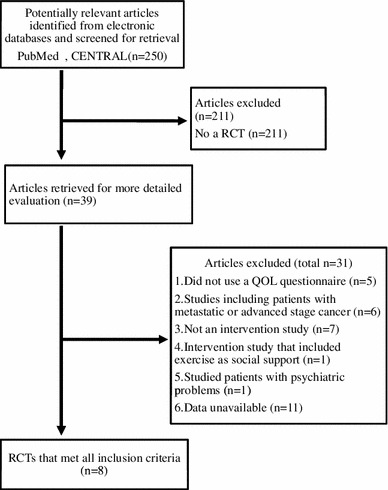
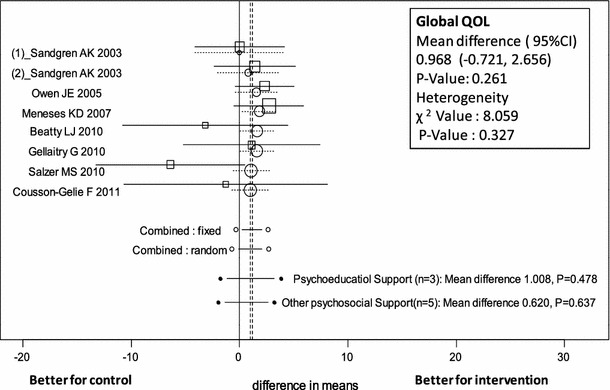
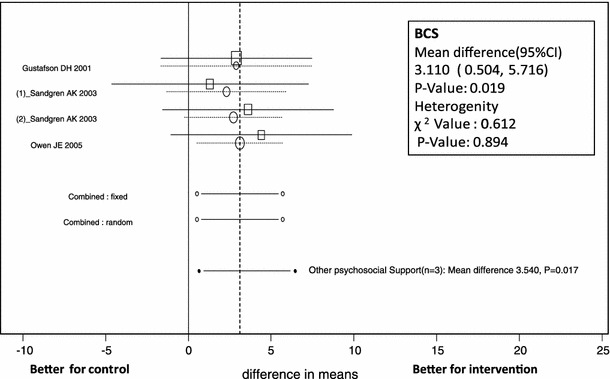
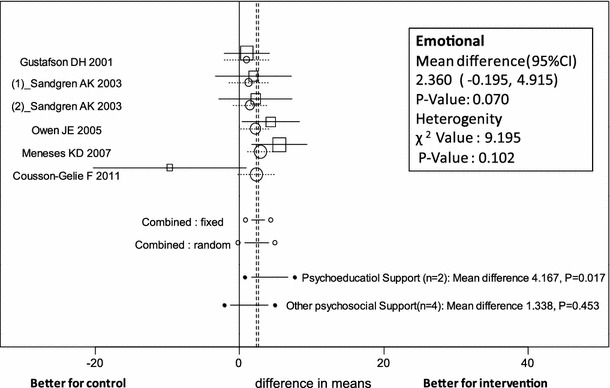
PURPOSE: Most breast cancer patients receive psychosocial support interventions. However, the effectiveness of these interventions has not yet been clarified. Quality of life (QOL) was an important construct that should be considered when assessing these interventions. The purpose was to evaluate the effectiveness of psychosocial and especially psychoeducational support interventions for early-stage breast cancer patients since the follow-up was bound up to 6 months after finishing the intervention. METHODS: We conducted a systematic review and meta-analysis to identify randomized controlled trials with early-stage breast cancer patients receiving psychosocial (psychoeducational and other) support in which QOL was measured as a treatment outcome. We compared mean differences at less than 6 months post-intervention with a control group. The primary outcome was Global Health Status/QOL scale (Global QOL), and secondary outcomes were the subscales of QOL. RESULTS: No significant effect was observed for Global QOL; however, individuals receiving psychosocial support scored higher on the Breast Cancer Symptoms subscale. For psychoeducational support in the psychosocial support, significant effect was observed on the Emotional subscale. CONCLUSIONS: Our analysis strengthens the evidence of the effectiveness of psychosocial support in improving breast cancer symptoms and psychoeducational support in improving emotional well-being within 6 months post-intervention.
Overview
The claims and statistics of this paper haven’t been checked yet.
Free: it reads the open-access text and checks the first 5 claims that cite a source we can check. Create a free account to check every claim.
Integrity signals
Registry
Cites
Statistics
Figures
Verification
Claims the paper makes
The claims and statistics of this paper haven’t been checked yet.
Free: it reads the open-access text and checks the first 5 claims that cite a source we can check. Create a free account to check every claim.
Claims other papers make about this one
Each is checked against this paper’s own text: does it say what the citing paper says it does?
The cited source says what the claim attributes to it.
In the citing paper
“We identified a few meta-analyses investigating psychological intervention in women with breast cancer (Duijts 2011;Guarino 2020;Matsuda 2014;Mustafa 2013;Naaman 2009;Sebri 2021).”
From Psychological interventions for women with non-metastatic breast cancer (2023) · cites this paper as Matsuda 2014
Self-check
Percentages, sums and reported differences re-computed from the paper’s own numbers.
The self-check needs the paper’s full text.
Citations
Cites
Jemal, A., Bray, F., Center, M. M., Ferlay, J., Ward, E., & Forman, D. (2011) · CA: A Cancer Journal for Clinicians · doi:10.3322/caac.20107 · Cited by 54,679
Aaronson, N. K., Ahmedzai, S., Bergman, B., Bullinger, M., Cull, A., Duez, N. J., Filiberti, A., Flechtner, H., Fleishman, S. B., Haes, J. C. J. M. D., et al. (1993) · JNCI Journal of the National Cancer Institute · doi:10.1093/jnci/85.5.365 · Cited by 16,005 · cited 3×
“The EORTC QLQ-C30 and FACTGeneral (FACT-G), probably the two most widely used oncological QOL instruments, were subjected to equating [25].”
MethodCochrane Database of Systematic Reviews
(2011) · Progress in Neurology and Psychiatry · doi:10.1002/pnp.208 · Cited by 4,667
(2019) · doi:10.1188/19.onf · Cited by 3,217
CA: A Cancer Journal for Clinicians
(2010) · CA A Cancer Journal for Clinicians · doi:10.3322/(issn)1542-4863 · Cited by 2,538
Brady, M. J., Cella, D. F., Mo, F., Bonomi, A. E., Tulsky, D. S., Lloyd, S. R., Deasy, S., Cobleigh, M., & Shiomoto, G. (1997) · Journal of Clinical Oncology · doi:10.1200/jco.1997.15.3.974 · Cited by 1,752 · cited 5×
“The standard deviation was taken from a study of the reliability and validity of the FACT-B [23] and QOL-CS [24] if it was not reported in the literature.”
MethodInfluentialThe Cochrane Database of Systematic Reviews
Handoll, H. H. (2004) · The British Journal of Hand Therapy · doi:10.1177/175899830400900201 · Cited by 1,513
“The Medical Journal of Australia”
(1923) · Medical Journal of Australia · doi:10.5694/j.1326-5377.1923.tb64467.x · Cited by 1,439
Do stress-related psychosocial factors contribute to cancer incidence and survival?
Chida, Y., Hamer, M., Wardle, J., & Steptoe, A. (2008) · Nature Clinical Practice Oncology · doi:10.1038/ncponc1134 · Cited by 1,072 · cited 1×
“Future research should focus on evaluating their effectiveness related to long-term outcomes such as mortality and morbidity at follow-up [39].”
BackgroundMeta-Analysis, Decision Analysis, and Cost-Effectiveness Analysis
Petitti, D. B. (1999) · Oxford University Press eBooks · doi:10.1093/acprof:oso/9780195133646.001.0001 · Cited by 925
Exercise interventions on health-related quality of life for cancer survivors
Mishra, S. I., Scherer, R. W., Geigle, P. M., Berlanstein, D. R., Topaloglu, O., Gotay, C. C., & Snyder, C. (2012) · Cochrane Database of Systematic Reviews · doi:10.1002/14651858.cd007566.pub2 · Cited by 808
Youlden, D. R., Cramb, S. M., Dunn, N. A. M., Muller, J. M., Pyke, C. M., & Baade, P. D. (2012) · Cancer Epidemiology · doi:10.1016/j.canep.2012.02.007 · Cited by 709 · cited 1×
“Incidence rates are much higher in more developed countries, and observed improvements in breast cancer survival over recent decades have been attributed to the systematic use of adjuvant therapies [2].”
BackgroundMeasurement of the quality of life in cancer survivors
Ferrell, B. R., Hassey Dow, K., & Grant, M. (1995) · Quality of Life Research · doi:10.1007/bf00634747 · Cited by 689 · cited 3×
“The EORTC QLQ-C30 and FACTGeneral (FACT-G), probably the two most widely used oncological QOL instruments, were subjected to equating [25].”
MethodMishra, S. I., Scherer, R. W., Snyder, C., Geigle, P. M., Berlanstein, D. R., & Topaloglu, O. (2012) · Cochrane Database of Systematic Reviews · doi:10.1002/14651858.cd008465.pub2 · Cited by 679 · cited 1×
“However, most of the interventions aimed at physical symptoms have beneficial effects on QOL at varying follow-up periods [4, 5].”
BackgroundDuijts, S. F. A., Faber, M. M., Oldenburg, H. S. A., van Beurden, M., & Aaronson, N. K. (2011) · Psycho-Oncology · doi:10.1002/pon.1728 · Cited by 452
An Introduction to Meta–Analysis
Konstantopoulos, S. (2008) · Best Practices in Quantitative Methods · doi:10.4135/9781412995627.d15 · Cited by 432
Effect of computer support on younger women with breast cancer
Gustafson, D. H., Hawkins, R., Pingree, S., McTavish, F., Arora, N. K., Mendenhall, J., Cella, D. F., Serlin, R. C., Apantaku, F. M., Stewart, J., et al. (2001) · Journal of General Internal Medicine · doi:10.1046/j.1525-1497.2001.016007435.x · Cited by 387 · cited 2×
“psychosocial support group, the interventions consisted of computer support [16, 19, 21].”
BackgroundFollow-up strategies for women treated for early breast cancer
Moschetti, I., Cinquini, M., Lambertini, M., Levaggi, A., & Liberati, A. (2016) · Cochrane Database of Systematic Reviews · doi:10.1002/14651858.cd001768.pub3 · Cited by 338
Quality of life in long-term cancer survivors.
FERRELL, B. R., Dow, K. H., Leigh, S. A., Ly, J., & Gulasekaram, P. (1995) · PubMed · Cited by 319
Grunfeld, E., Julian, J. A., Pond, G., Maunsell, E., Coyle, D., Folkes, A., Joy, A. A., Provencher, L., Rayson, D., Rheaume, D. E., et al. (2011) · Journal of Clinical Oncology · doi:10.1200/jco.2011.36.8373 · Cited by 313 · cited 1×
“[38], compilation of survivorship care plans and a psychoeducational session were undertaken in a pragmatic trial that was consistent with usual practices and feasible to implement within time and human resource constraints.”
Galway, K., Black, A., Cantwell, M. M., Cardwell, C. R., Mills, M., & Donnelly, M. (2012) · Cochrane Database of Systematic Reviews · doi:10.1002/14651858.cd007064.pub2 · Cited by 220 · cited 6×
“Namely, no significant effects were observed for QOL, while the psychoeducational interventions produced small positive significant effects on QOL [7].”
BackgroundResultInfluentialMishra, S. I., Scherer, R. W., Snyder, C., Geigle, P. M., Berlanstein, D. R., & Topaloglu, O. (2012) · Clinical Otolaryngology · doi:10.1111/coa.12015 · Cited by 206
Randomized pilot of a self-guided internet coping group for women with early-stage breast cancer
Owen, J. E., Klapow, J. C., Roth, D. L., Shuster, J. L., Bellis, J., Meredith, R., & Tucker, D. C. (2005) · Annals of Behavioral Medicine · doi:10.1207/s15324796abm3001_7 · Cited by 192 · cited 2×
“psychosocial support group, the interventions consisted of computer support [16, 19, 21].”
BackgroundMystakidou, K., Tsilika, E., Parpa, E., Katsouda, E., Galanos, A., & Vlahos, L. (2005) · Quality of Life Research · doi:10.1007/s11136-005-4324-3 · Cited by 185 · cited 1×
“patient outcomes [34], and enhanced understanding of patient QOL can help improve clinical care [35].”
BackgroundChan, C. W. H., Richardson, A., & Richardson, J. (2011) · Journal of Pain and Symptom Management · doi:10.1016/j.jpainsymman.2010.04.024 · Cited by 172 · cited 1×
“[30] also described that psychoeducational intervention was a promising treatment for relieving the symptom cluster and each of the individually assessed symptoms.”
BackgroundSelf-efficacy, adjustment style and well-being in breast cancer patients: a longitudinal study
Rottmann, N., Dalton, S. O., Christensen, J., Frederiksen, K., & Johansen, C. (2010) · Quality of Life Research · doi:10.1007/s11136-010-9653-1 · Cited by 170 · cited 1×
“[31] found a significant association between education and self-efficacy that was a significant”
BackgroundMontgomery, M., & McCrone, S. H. (2010) · Journal of Advanced Nursing · doi:10.1111/j.1365-2648.2010.05439.x · Cited by 169 · cited 1×
“In many studies, the majority of the women with breast cancer reported needing increased educational support [10].”
BackgroundQuality of life and clinical trials
(1995) · The Lancet · doi:10.1016/s0140-6736(95)92643-7 · Cited by 157
Meneses, K. D., McNees, P., Loerzel, V. W., Su, X., Zhang, Y., & Hassey, L. A. (2007) · Oncology Nursing Forum · doi:10.1188/07.onf.1007-1016 · Cited by 143 · cited 3×
“[27], we removed this study because the survivors in this study were a subset of the larger group study [18].”
BackgroundMethodBeitz, J. G., Gnecco, C., & Justice, R. L. (1996) · PubMed · Cited by 140
Follow-up strategies for women treated for early breast cancer
Rojas, M., Telaro, E., Russo, A., Fossati, R., Palli, D., Rosselli, T. M. D., Confalonieri, C., & Liberati, A. (2000) · Cochrane Database of Systematic Reviews · doi:10.1002/14651858.cd001768 · Cited by 140
Salzer, M. S., Palmer, S. C., Kaplan, K., Brusilovskiy, E., Ten Have, T., Hampshire, M., Metz, J., & Coyne, J. C. (2010) · Psycho-Oncology · doi:10.1002/pon.1586 · Cited by 131 · cited 2×
“Salzer [16] 2010 USA 4, 12 50/26 Internet peer support 12”
BackgroundFaris, O., & Shein, M. J. (2006) · Circulation · doi:10.1161/circulationaha.106.647800 · Cited by 131
Meta-analysis of the effects of psychosocial interventions on survival time in cancer patients
Smedslund, G., & Ringdal, G. I. (2004) · Journal of Psychosomatic Research · doi:10.1016/s0022-3999(03)00575-0 · Cited by 130 · cited 1×
“In addition, based on a meta-analysis of the effectiveness of psychosocial interventions, a definite conclusion about whether such interventions prolong cancer survival seems premature [40].”
BackgroundFollow-up strategies for women treated for early breast cancer
Rojas, M. P. M., Telaro, E., Moschetti, I., Coe, L., Fossati, R., Liberati, A., & Rosselli, M. D. T. (2000) · Cochrane Database of Systematic Reviews · doi:10.1002/14651858.cd001768.pub2 · Cited by 127 · cited 1×
“Psychosocial support is an important intervention for cancer patients because stress-related psychosocial factors can have an adverse effect on cancer outcomes [29].”
BackgroundComparison of instruments for measuring quality of life in patients with lung cancer.
Hollen, P. J., & Gralla, R. J. (1996) · PubMed · Cited by 101
Equating EORTC QLQ-C30 and FACT-G scores and its use in oncological research
Holzner, B., Bode, R. K., Hahn, E. A., Cella, D. F., Kopp, M., Sperner‐Unterweger, B., & Kemmler, G. (2006) · European Journal of Cancer · doi:10.1016/j.ejca.2006.08.016 · Cited by 83 · cited 1×
“The EORTC QLQ-C30 and FACTGeneral (FACT-G), probably the two most widely used oncological QOL instruments, were subjected to equating [25].”
MethodMoyer, A., Sohl, S. J., Knapp-Oliver, S. K., & Schneider, S. (2009) · Cancer Treatment Reviews · doi:10.1016/j.ctrv.2009.02.003 · Cited by 83 · cited 1×
“other psychosocial support, stress management techniques, and cognitive behavioral therapy [36, 37].”
BackgroundShort-term effects of telephone therapy for breast cancer patients.
Sandgren, A. K., & McCaul, K. D. (2003) · Health Psychology · doi:10.1037/0278-6133.22.3.310 · Cited by 80 · cited 5×
“Sandgren [20] 2003 USA 5 89/55 Health education, emotional expression 3 6”
BackgroundMethodInfluentialGellaitry, G., Peters, K., Bloomfield, D., & Horne, R. (2010) · Psycho-Oncology · doi:10.1002/pon.1532 · Cited by 72 · cited 1×
“Gellaitry [17] 2010 UK 1, 3, 6 38/42 Writing intervention (emotional disclosure, cognitive appraisal, benefit finding, looking to the future) 6 4”
BackgroundAn Introduction to S and S-Plus
Ko, D., & Spector, P. (1995) · Technometrics · doi:10.1080/00401706.1995.10484312 · Cited by 62 · cited 1×
“S-plus and R programs [12, 13] were used for the estimation of the random-effects and fixedeffects models.”
MethodDENIEFFE, S., & GOONEY, M. (2011) · European Journal of Cancer Care · doi:10.1111/j.1365-2354.2010.01223.x · Cited by 60 · cited 1×
“However, breast cancer patients may experience many manifestations resulting from the primary disease and/or treatment for the disease, and face issues related to simultaneously dealing with a multitude of physical and psychological symptoms [3].”
BackgroundPark, J.-H., Bae, S. H., Jung, Y. S., & Kim, K. S. (2012) · Cancer Nursing · doi:10.1097/ncc.0b013e318218266a · Cited by 59
Beatty, L. J., Koczwara, B., Rice, J., & Wade, T. D. (2010) · Medical Journal of Australia · doi:10.5694/j.1326-5377.2010.tb03932.x · Cited by 56 · cited 2×
“Beatty [15] 2010 Australia 3, 6 25/24 Self-help workbook (each chapter containing educational information on common medical and psychosocial issues) 6”
BackgroundMeneses, K., McNees, P., Azuero, A., Loerzel, V. W., Su, X., & Hassey, L. A. (2009) · Cancer Nursing · doi:10.1097/ncc.0b013e3181a850e6 · Cited by 50 · cited 1×
“[27], we removed this study because the survivors in this study were a subset of the larger group study [18].”
MethodChan, R., Brooks, R., Steel, Z., Heung, T., Erlich, J., Chow, J., & Suranyi, M. (2012) · Quality of Life Research · doi:10.1007/s11136-011-9973-9 · Cited by 48 · cited 1×
“Psychosocial constructs that have the strongest association with QOL are stress, affect, and cognitive appraisal [8].”
BackgroundDastan, N. B., & Buzlu, S. (2012) · Asian Pacific Journal of Cancer Prevention · doi:10.7314/apjcp.2012.13.10.5313 · Cited by 38 · cited 2×
“Specially, psychoeducation was shown to cause positive changes in levels of adjustment to cancer in breast cancer patients [9].”
BackgroundCousson-Géalie, F., Bruchon-Schweitzer, M., Atzeni, T., & Houede, N. (2011) · Psychological Reports · doi:10.2466/02.07.15.20.pr0.108.3.923-942 · Cited by 34 · cited 1×
“CoussonGelie [14] 2011 France 1 22/29 Specific intervention (a specific psychosocial intervention) 1 8”
BackgroundMoyer, A., Knapp-Oliver, S. K., Sohl, S. J., Schnieder, S., & Floyd, A. H. L. (2009) · The Cancer Journal · doi:10.1097/ppo.0b013e3181bf51fb · Cited by 29 · cited 1×
“other psychosocial support, stress management techniques, and cognitive behavioral therapy [36, 37].”
BackgroundAn Introduction to S and S-Plus.
Aa, & Spector, P. (1994) · Journal of the American Statistical Association · doi:10.2307/2291038 · Cited by 28
Cited by
Breast cancer: pathogenesis and treatments
Xiong, X., Zheng, L.-W., Ding, Y., Chen, Y.-F., Cai, Y.-W., Wang, L.-P., Huang, L., Liu, C.-C., Shao, Z.-M., & Yu, K.-D. (2025) · Signal Transduction and Targeted Therapy · doi:10.1038/s41392-024-02108-4 · Cited by 958
Health-related quality of life in breast cancer patients: review of reviews from 2008 to 2018
Mokhtari-Hessari, P., & Montazeri, A. (2020) · Health and Quality of Life Outcomes · doi:10.1186/s12955-020-01591-x · Cited by 437
“Psychoeducational support found to be effective in improving breast cancer symptoms and emotional well-being among breast cancer patients [76].”
BackgroundOlsson Möller, U., Beck, I., Rydén, L., & Malmström, M. (2019) · BMC Cancer · doi:10.1186/s12885-019-5648-7 · Cited by 189
Psychological interventions for women with non-metastatic breast cancer
Jassim, G. A., Whitford, D. L., Hickey, A., & Carter, B. (2015) · Cochrane Database of Systematic Reviews · doi:10.1002/14651858.cd008729.pub2 · Cited by 163
Kalter, J., Verdonck‐de Leeuw, I. M., Sweegers, M. G., Aaronson, N. K., Jacobsen, P. B., Newton, R. U., Courneya, K. S., Aitken, J. F., Armes, J., Arving, C., et al. (2018) · Psycho-Oncology · doi:10.1002/pon.4648 · Cited by 115
Metadata
- Authors
- Matsuda, A., Yamaoka, K., Tango, T., Matsuda, T., & Nishimoto, H.
- Affiliations
- National Cancer Centre Japan (JP)
- Teikyo University (JP)
- Corresponding author
- Matsuda, Ayako
- Venue
- Quality of Life Research
- Published
- 2013-07-24
- Volume
- 23
- Issue
- 1
- Pages
- 21-30
- ISSN
- 0962-9343 (ISSN-L)
- 1573-2649
- PMC
- PMC3929036
- OpenAlex
- W1975596405
- Cited by
- 105
- References
- 51
- Citations by year
- 2026: 2 · 2025: 8 · 2024: 5 · 2023: 11 · 2022: 7 · 2021: 13 · 2020: 8 · 2019: 13 · 2018: 11 · 2017: 11 · 2016: 4 · 2015: 4 · 2014: 6 · 2013: 1
- FWCI
- 0.53
- Type
- journal article
- Language
- en
- Open access
- hybrid
- doi.org
- Locations
- Quality of Life Research (publishedVersion, cc-by)
- Europe PMC (PubMed Central) (publishedVersion, cc-by)
- PubMed Central (publishedVersion, cc-by)
- PubMed (publishedVersion)
- Funders
- Ministry of Education, Culture, Sports, Science and Technology
- Japan Society for the Promotion of Science (23590831, 24701038)
- Topics
- Health Sciences › Medicine › Oncology › Cancer survivorship and care
- Health Sciences › Medicine › Public Health, Environmental and Occupational Health › Women's cancer prevention and management
- Health Sciences › Medicine › Oncology › Cancer-related cognitive impairment studies
- Keywords
- psychological and pedagogical support, psychosocial support, early breast cancer, quality of life, breast cancer symptoms, emotional well-being
- MeSH terms
- Breast Neoplasms, Female, Health Status, Humans, Neoplasm Staging, Patient Education as Topic, Psychotherapy, Quality of Life, Surveys and Questionnaires, Research Design, Social Support, Global Health, Program Evaluation, Randomized Controlled Trials as Topic, Treatment Outcome, Survivors
About these checks
Registry, retraction, Cites and statistics results are computed, not judged, with one exception: a printed reference that no index lists is read once by a model before it counts as a citation error. Claims are extracted by a model and kept only when their quote appears verbatim in the text; each cited source is then checked, with a model’s help, for whether it says what the claim relies on. Those verdicts can be wrong — read the claim’s quote and the cited source before relying on one.
Statistics and arithmetic are recomputed, not judged.
Confidence bands are shown only for fields calibrated on our annotated test set. None is calibrated yet, so no band is shown.
What counts as a claim ›How we measure confidence ›How we check this ›
Are you an author, or do you see a problem with this page? Request a review
Data sources
Bibliographic data: Semantic Scholar, OpenAlex, Crossref.
Contains information from the Semantic Scholar Academic Graph Datasets, made available under the ODC Attribution License (ODC-BY 1.0).
Semantic Scholar’s data is described in: Kinney, R., et al. (2023). The Semantic Scholar Open Data Platform. arXiv:2301.10140.
