

Evaluating and establishing national norms for mental wellbeing using the short Warwick–Edinburgh Mental Well-being Scale (SWEMWBS): findings from the Health Survey for England
Open accessThe DOI matches its Crossref record; 26 of the 27 references it cites were found in a registry or an index.
Abstract
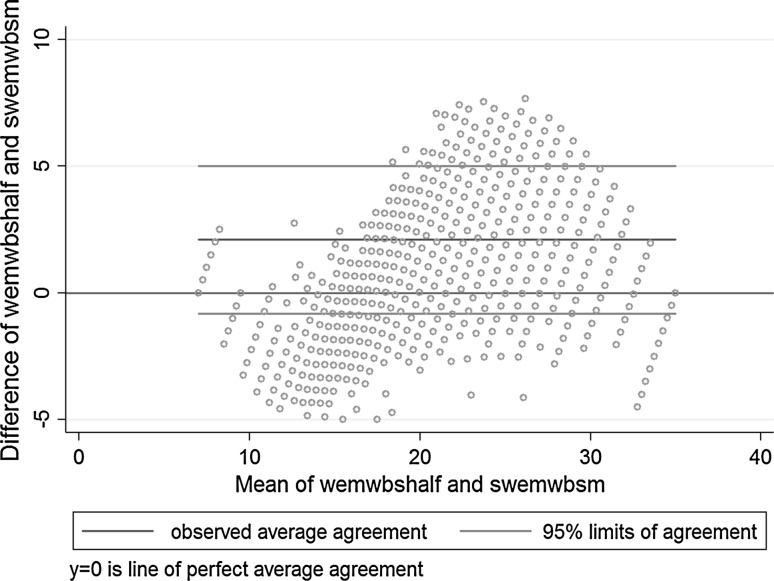
PURPOSE: The Warwick-Edinburgh Mental Well-being Scale (WEMWBS), 14 positively worded statements, is a validated instrument to measure mental wellbeing on a population level. Less is known about the population distribution of the shorter seven-item version (SWEMWBS) or its performance as an instrument to measure wellbeing. METHODS: Using the Health Survey for England 2010-2013 (n = 27,169 adults aged 16+, nationally representative of the population), age- and sex-specific norms were estimated using means and percentiles. Criterion validity was examined using: (1) Spearman correlations (ρ) for SWEMWBS with General Health Questionnaire (GHQ-12), happiness index, EQ-VAS (2) a multinomial logit model with SWEMWBS (low, medium and high wellbeing) as the outcome and demographic, social and health behaviours as explanatory variables. Relative validity was examined by comparing SWEMWBS with WEMWBS using: (1) Spearman correlations (continuous data), and (2) the weighted kappa statistic (categorical), within population subgroups. RESULTS: Mean (median) SWEMWBS was 23.7 (23.2) for men and 23.2 (23.2) for women (p = 0.100). Spearman correlations were moderately sized for the happiness index (ρ = 0.53, P < 0.001), GHQ-12 (ρ = -0.52, p < 0.001) and EQ-VAS (ρ = 0.40, p < 0.001). Participants consuming <1 portion of fruit and vegetables a day versus ≥5 (odds ratio = 1.43 95% Confidence Interval = (1.22-1.66)) and current smokers versus non-smokers (1.28 (1.15-1.41)) were more likely to have low vs medium wellbeing. Participants who binge drank versus non-drinkers were less likely to have high versus medium wellbeing (0.81 (0.71-0.92)). Spearman correlations between SWEMWBS and WEMWBS were above 0.95; weighted kappa statistics showed almost perfect agreement (0.79-0.85). CONCLUSION: SWEMWBS distinguishes mental wellbeing between subgroups, similarly to WEMWBS, but is less sensitive to gender differences.
Overview
The claims and statistics of this paper haven’t been checked yet.
Free: it reads the open-access text and checks the first 5 claims that cite a source we can check. Create a free account to check every claim.
Integrity signals
Registry
Cites
Statistics
Figures
Verification
Claims the paper makes
The claims and statistics of this paper haven’t been checked yet.
Free: it reads the open-access text and checks the first 5 claims that cite a source we can check. Create a free account to check every claim.
Claims other papers make about this one
Each is checked against this paper’s own text: does it say what the citing paper says it does?
The source backs part of the claim, not all of it — or backs it for a different population, condition or comparison.
In the citing paper
“Internal validity of the SWEMWBS has been demonstrated as good to excellent (α = 0.84; Fat et al., 2017).”
From Behind the masks: A cross-sectional study on intolerance of uncertainty, perceived vulnerability to disease and psychological flexibility in relation to state anxiety and wellbeing during the COVID-19 pandemic (2021) · cites this paper as Fat et al., 2017
Experimental — accuracy not yet measuredThe cited source says what the claim attributes to it.
In the citing paper
“Mean pre-intervention scores suggested at the beginning of the study participants were within the ‘low’ wellbeing range (below 19.3; Ng Fat et al., 2017) and were experiencing COVID-related distress (above 6 out of 10).”
From ACTing towards better living during COVID-19: The effects of Acceptance and Commitment therapy for individuals affected by COVID-19 (2022) · cites this paper as Ng Fat et al., 2017
The cited source says what the claim attributes to it.
In the citing paper
“when compared with normative comparison data, wellbeing levels, in particular, remained lower than the published norms”
From Mental health during the COVID-19 pandemic: exploring the role of psychological flexibility and stress-related variables. (2023) · cites this paper as Fat et al., 2017
Self-check
Percentages, sums and reported differences re-computed from the paper’s own numbers.
The self-check needs the paper’s full text.
Citations
Cites
The Measurement of Observer Agreement for Categorical Data
Landis, J. R., & Koch, G. G. (1977) · Biometrics · doi:10.2307/2529310 · Cited by 81,148 · cited 1×
“To assess the strength of agreement, we used the Landis and Koch classification [26]: slight: 0–0.”
MethodCoefficient Alpha and the Internal Structure of Tests
Cronbach, L. J. (1951) · Psychometrika · doi:10.1007/bf02310555 · Cited by 43,931
On Happiness and Human Potentials: A Review of Research on Hedonic and Eudaimonic Well-Being
Ryan, R. M., & Deci, E. L. (2001) · Annual Review of Psychology · doi:10.1146/annurev.psych.52.1.141 · Cited by 11,567
The Warwick-Edinburgh Mental Well-being Scale (WEMWBS): development and UK validation
Tennant, R., Hiller, L., Fishwick, R., Platt, S., Joseph, S., Weich, S., Parkinson, J., Secker, J., & Stewart-Brown, S. (2007) · Health and Quality of Life Outcomes · doi:10.1186/1477-7525-5-63 · Cited by 5,031 · cited 4×
“Similar moderate correlations were found between SWEMWBS and GHQ12 and EQ-VAS, as had been previously demonstrated for WEMWBS [9].”
BackgroundMethodResultInfluentialSelf-citationSubjective wellbeing, health, and ageing
Steptoe, A., Deaton, A., & Stone, A. A. (2015) · The Lancet · doi:10.1016/s0140-6736(13)61489-0 · Cited by 2,455 · cited 1×
“It is linked with good physical health and with longevity among older adults [7].”
BackgroundIs well-being U-shaped over the life cycle?
Blanchflower, D. G., & Oswald, A. J. (2008) · Social Science & Medicine · doi:10.1016/j.socscimed.2008.01.030 · Cited by 1,830 · cited 2×
“Mental wellbeing has been found to have a U-shaped relationship with age [5, 6].”
Stewart-Brown, S., Tennant, A., Tennant, R., Platt, S., Parkinson, J., & Weich, S. (2009) · Health and Quality of Life Outcomes · doi:10.1186/1477-7525-7-15 · Cited by 1,251
Self-citationGiornale Italiano di Psicologia
Amerio, P., Anolli, L., Cornoldi, C., Galli, P. F., Gerbino, W., Mosconi, G., Nicoletti, R., Palmonari, A., Parisi, D., Poli, M., et al. (2006) · Archivio istituzionale della ricerca (Alma Mater Studiorum Università di Bologna) · Cited by 713
Time-Limit Tests: Estimating their Reliability and Degree of Speeding
Cronbach, L. J., & Warrington, W. G. (1951) · Psychometrika · doi:10.1007/bf02289113 · Cited by 677
How Can Measures of Subjective Well-Being Be Used to Inform Public Policy?
Dolan, P., & White, M. P. (2007) · Perspectives on Psychological Science · doi:10.1111/j.1745-6916.2007.00030.x · Cited by 416 · cited 1×
“to assess progress outside of the usual economic and material indicators [1–3].”
BackgroundCohort Profile: The Health Survey for England
Mindell, J., Biddulph, J. P., Hirani, V., Stamatakis, E., Craig, R., Nunn, S., & Shelton, N. (2012) · International Journal of Epidemiology · doi:10.1093/ije/dyr199 · Cited by 312 · cited 15×
“nationally representative sample of the population living in private households in England [22].”
BackgroundInfluentialSelf-citationSabia, S., van Hees, V. T., Shipley, M. J., Trenell, M. I., Hagger-Johnson, G., Elbaz, A., Kivimaki, M., & Singh-Manoux, A. (2014) · American Journal of Epidemiology · doi:10.1093/aje/kwt330 · Cited by 304 · cited 1×
“Since the Spearman correlation coefficient is equal to the slope of the regression between the ranked values of the two measures, its value was estimated by regressing the rank of participants on SWEMWBS on the rank of the physical and mental health variable [24].”
MethodDelara, M., Ghofranipour, F., Azadfallah, P., Tavafian, S. S., Kazemnejad, A., & Montazeri, A. (2012) · Health and Quality of Life Outcomes · doi:10.1186/1477-7525-10-1 · Cited by 304
Maheswaran, H., Weich, S., Powell, J., & Stewart-Brown, S. (2012) · Health and Quality of Life Outcomes · doi:10.1186/1477-7525-10-156 · Cited by 265 · cited 1×
“This difference may prove important in small-scale evaluations of community-based mental wellbeing interventions [29].”
BackgroundSelf-citationCognitive impairment and preferences for current health
King, J. T., Tsevat, J., & Roberts, M. S. (2009) · Health and Quality of Life Outcomes · doi:10.1186/1477-7525-7-1 · Cited by 217
Haver, A., Akerjordet, K., Caputi, P., Furunes, T., & Magee, C. (2015) · Scandinavian Journal of Public Health · doi:10.1177/1403494815588862 · Cited by 182 · cited 1×
“This is consistent with a study that found SWEMWBS to be gender neutral in a Swedish and Norweigan population [27].”
ResultCastellví, P., Forero, C. G., Codony, M., Vilagut, G., Brugulat, P., Medina, A., Gabilondo, A., Mompart, A., Colom, J., Tresserras, R., et al. (2013) · Quality of Life Research · doi:10.1007/s11136-013-0513-7 · Cited by 167
Self-citationTrousselard, M., Steiler, D., Dutheil, F., Claverie, D., Canini, F., Fenouillet, F., Naughton, G., Stewart-Brown, S., & Franck, N. (2016) · Psychiatry Research · doi:10.1016/j.psychres.2016.08.050 · Cited by 152 · cited 1×
“Although both scales have been used to evaluate interventions and to examine the epidemiology of mental wellbeing, more research has been published on the full 14-item scale, including population norms for European countries [12–15].”
MethodSelf-citationSocioeconomic gradients and mental health: implications for public health
Stewart-Brown, S., Samaraweera, P. C., Taggart, F., Kandala, N.-B., & Stranges, S. (2015) · British Journal of Psychiatry · doi:10.1192/bjp.bp.114.147280 · Cited by 138 · cited 17×
“Whether the short seven-item scale exhibits similar properties to the full 14-item scale in a nationally representative sample in England has yet to be explored.”
BackgroundInfluentialSelf-citationStranges, S., Samaraweera, P. C., Taggart, F., Kandala, N.-B., & Stewart-Brown, S. (2014) · BMJ Open · doi:10.1136/bmjopen-2014-005878 · Cited by 130 · cited 3×
“Obesity and being a non-drinker of alcohol were associated with the low end of the mental wellbeing scale but not with the high end, while smoking and low fruit and vegetable intake were associated with both increased odds of the low and decreased odds of the high end of the scale [16].”
BackgroundInfluentialSelf-citationLloyd, K., & Devine, P. (2012) · Journal of Mental Health · doi:10.3109/09638237.2012.670883 · Cited by 122 · cited 1×
“Although both scales have been used to evaluate interventions and to examine the epidemiology of mental wellbeing, more research has been published on the full 14-item scale, including population norms for European countries [12–15].”
MethodBöhnke, J. R., & Croudace, T. J. (2016) · British Journal of Psychiatry · doi:10.1192/bjp.bp.115.165530 · Cited by 78 · cited 1×
“Measuring mental wellbeing as a single construct may mask its multidimensionality [30].”
BackgroundWarwick-Edinburgh Mental Wellbeing Scale (WEMWBS)
(2021) · Springer eBooks · doi:10.1007/978-3-319-91280-6_301816 · Cited by 76
Public mental health: evidenced-based priorities
Mehta, N., Croudace, T. J., & Davies, D. S. C. (2014) · The Lancet · doi:10.1016/s0140-6736(14)61400-8 · Cited by 45 · cited 1×
“to assess progress outside of the usual economic and material indicators [1–3].”
BackgroundGremigni, P., & Stewart-Brown, S. L. (2011) · Warwick Research Archive Portal (University of Warwick) · doi:10.1421/35174 · Cited by 42 · cited 1×
“Although both scales have been used to evaluate interventions and to examine the epidemiology of mental wellbeing, more research has been published on the full 14-item scale, including population norms for European countries [12–15].”
MethodSelf-citationMindell, J. S., Knott, C. S., Fat, L. N., Roth, M. A., Manor, O., Soskolne, V., & Daoud, N. (2014) · Journal of Epidemiology & Community Health · doi:10.1136/jech-2014-203927 · Cited by 28 · cited 1×
“Black African groups were also found to have better self-reported health than White British groups after extensive adjustment for health behaviour and SEP confounders [28]; this may be attributable to a Table 4 continued”
BackgroundSelf-citation
Research works printed but not linked: 6
- Tinkler, L. (2015). Measuring National Well-being: Personal Well-being in the UK, 2014–2015. In ONS. (Ed.), Statistical Bulletin.: ONS.
- McManus S Chanfreau J Lloyd C Predictors of wellbeing 2013 London Natcen
- Natcen Social Research, and University College Medical School Health Survey for England, 2010 [computer file] 2015 3 Colchester UK Data Archive
- NatCen Social Research, University College London, and Department of Epidemiology and Public Health Health Survey for England, 2013 [computer file] 2015 Colchester UK Data Archive
- NatCen Social Research, University College London, and Department of Epidemiology and Public Health Health Survey for England, 2011 [computer file] 2013 Colchester UK Data Archive
- NatCen Social Research, University College London, and Department of Epidemiology and Public Health Health Survey for England, 2012 [computer file] 2014 Colchester UK Data Archive
Cited by
Ammar, A., Brach, M., Trabelsi, K., Chtourou, H., Boukhris, O., Masmoudi, L., Bouaziz, B., Bentlage, E., How, D., Ahmed, M., et al. (2020) · Nutrients · doi:10.3390/nu12061583 · Cited by 2,073
O'Connor, R. C., Wetherall, K., Cleare, S., McClelland, H., Melson, A. J., Niedzwiedz, C. L., O'Carroll, R. E., O'Connor, D. B., Platt, S., Scowcroft, E., et al. (2021) · The British Journal of Psychiatry · doi:10.1192/bjp.2020.212 · Cited by 1,042
Dawson, D. L., & Golijani-Moghaddam, N. (2020) · Journal of Contextual Behavioral Science · doi:10.1016/j.jcbs.2020.07.010 · Cited by 445
Ammar, A., Trabelsi, K., Brach, M., Chtourou, H., Boukhris, O., Masmoudi, L., Bouaziz, B., Bentlage, E., How, D., Ahmed, M., et al. (2021) · Biology of Sport · doi:10.5114/biolsport.2020.96857 · Cited by 418
Ammar, A., Chtourou, H., Boukhris, O., Trabelsi, K., Masmoudi, L., Brach, M., Bouaziz, B., Bentlage, E., How, D., Ahmed, M., et al. (2020) · International Journal of Environmental Research and Public Health · doi:10.3390/ijerph17176237 · Cited by 408
“These questionnaires assess mental well-being (Short Warwick-Edinburgh Mental Well-being Scale (SWEMWBS) [28]), mood and feeling (Short Mood and Feelings Questionnaire (SMFQ) [29]), life satisfaction (Short Life Satisfaction Questionnaire for Lockdowns (SLSQL), social participation (Short Social Participation Question…”
Background
Metadata
- Authors
- Ng Fat, L., Scholes, S., Boniface, S., Mindell, J., & Stewart-Brown, S.
- Affiliations
- University College London (GB)
- King's College London (GB)
- University of Warwick (GB)
- Venue
- Quality of Life Research
- Published
- 2016-11-16
- Volume
- 26
- Issue
- 5
- Pages
- 1129-1144
- ISSN
- 0962-9343 (ISSN-L)
- 1573-2649
- PMC
- PMC5376387
- OpenAlex
- W2553379941
- Cited by
- 548
- References
- 27
- Citations by year
- 2026: 53 · 2025: 73 · 2024: 86 · 2023: 82 · 2022: 91 · 2021: 83 · 2020: 44 · 2019: 20 · 2018: 11 · 2017: 4
- FWCI
- 18.32
- Type
- journal article
- Language
- en
- Open access
- hybrid
- doi.org
- Locations
- Quality of Life Research (publishedVersion, cc-by)
- PubMed Central (publishedVersion, cc-by)
- PubMed (publishedVersion)
- Warwick Research Archive Portal (University of Warwick) (acceptedVersion, cc-by)
- UCL Discovery (University College London) (submittedVersion)
- Research Portal (King's College London) (submittedVersion, cc-by)
- Funders
- University College London
- Topics
- Social Sciences › Psychology › Social Psychology › Psychological Well-being and Life Satisfaction
- Social Sciences › Decision Sciences › Management Science and Operations Research › Psychometric Methodologies and Testing
- Social Sciences › Economics, Econometrics and Finance › Economics and Econometrics › Health Systems, Economic Evaluations, Quality of Life
- Keywords
- psychological well-being, national standards, age- and sex-specific percentiles, criterion validity, relative validity, General Health Questionnaire, happiness index, EQ-VAS, fruit and vegetable intake, smoking, binge drinking, Health Survey for England, questionnaire agreement, mental health screening
- MeSH terms
- Adolescent, Adult, England, Female, Health Surveys, Humans, Male, Mental Health, Psychometrics, Quality of Life, Surveys and Questionnaires, Young Adult
About these checks
Registry, retraction, Cites and statistics results are computed, not judged, with one exception: a printed reference that no index lists is read once by a model before it counts as a citation error. Claims are extracted by a model and kept only when their quote appears verbatim in the text; each cited source is then checked, with a model’s help, for whether it says what the claim relies on. Those verdicts can be wrong — read the claim’s quote and the cited source before relying on one.
Statistics and arithmetic are recomputed, not judged.
Confidence bands are shown only for fields calibrated on our annotated test set. None is calibrated yet, so no band is shown.
What counts as a claim ›How we measure confidence ›How we check this ›
Are you an author, or do you see a problem with this page? Request a review
Data sources
Bibliographic data: Semantic Scholar, OpenAlex, Crossref.
Contains information from the Semantic Scholar Academic Graph Datasets, made available under the ODC Attribution License (ODC-BY 1.0).
Semantic Scholar’s data is described in: Kinney, R., et al. (2023). The Semantic Scholar Open Data Platform. arXiv:2301.10140.
