

Kinetic modelling of testosterone-related differences in the hypothalamic–pituitary–adrenal axis response to stress
Open accessThe DOI matches its Crossref record; 34 of the 34 references it cites were found in a registry or an index.
Abstract
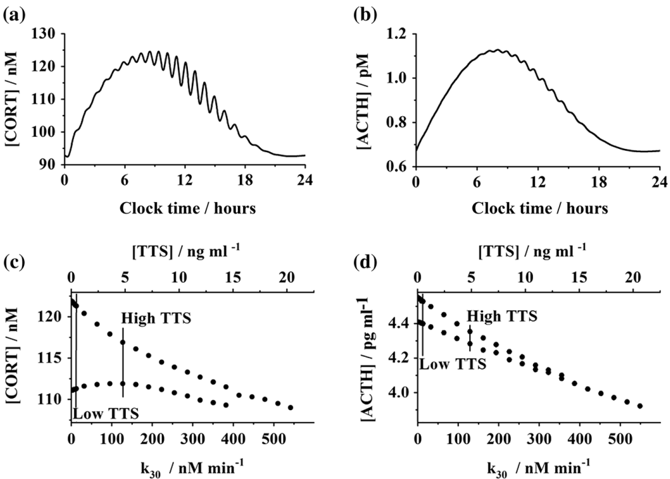
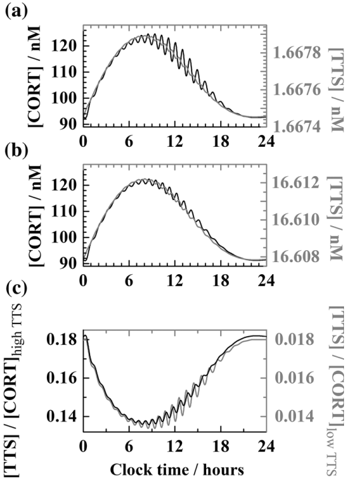
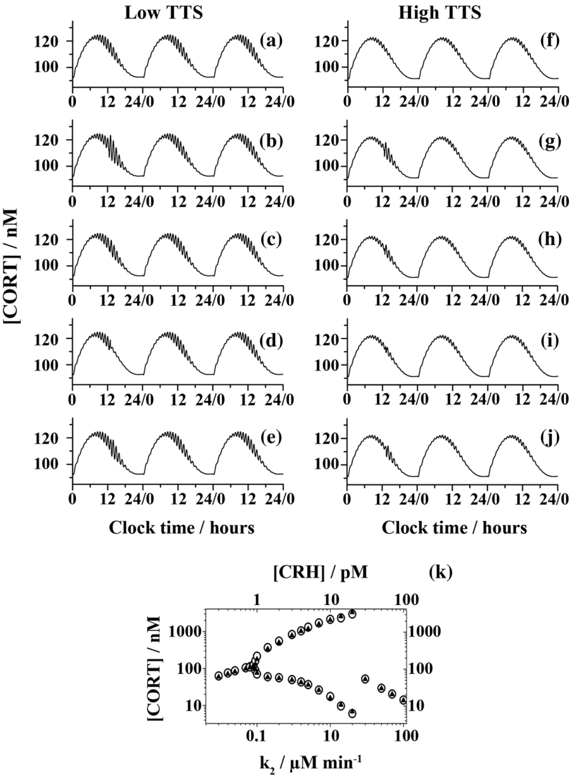
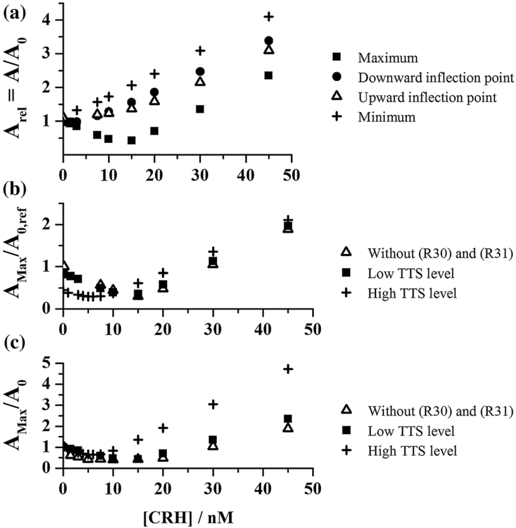
The sex hormone testosterone (TTS) and the hypothalamic–pituitary–adrenal (HPA) axis mutually control one another’s activity, wherein TTS suppresses corticotrophin releasing hormone (CRH) stimulated HPA axis activity, whereas the activation of HPA axis has an inhibitory effect on TTS secretion. With an intention to explain these phenomena, a network reaction model is developed from the previously postulated stoichiometric models for HPA activity where main dynamic behaviors are controlled by two catalytic steps (one autocatalytic and one autoinhibitory) with respect to cortisol, both found experimentally. The capacity of the model to emulate TTS effects on HPA axis dynamics and its response to acute CRH-induced stress is examined using numerical simulations. Model predictions are compared with empirically obtained results reported in the literature. Thus, the reaction kinetic examinations of nonlinear biochemical transformations that constitute the HPA axis, including the negative feedback effect of TTS on HPA axis activity, recapitulates the well-established fact that TTS dampens HPA axis basal activity, decreasing both cortisol level and the amplitude of ultradian cortisol oscillations. The model also replicates TTS inhibitory action on the HPA axis response to acute environmental challenges, particularly CRH-induced stress. In addition, kinetic modelling revealed that TTS induced reduction in ultradian cortisol amplitude arises because the system moves towards a supercritical Hopf bifurcation as TTS is being increased.
Overview
The claims and statistics of this paper haven’t been checked yet.
Free: it reads the open-access text and checks the first 5 claims that cite a source we can check. Create a free account to check every claim.
Integrity signals
Registry
Cites
Statistics
Figures
Verification
Claims the paper makes
The claims and statistics of this paper haven’t been checked yet.
Free: it reads the open-access text and checks the first 5 claims that cite a source we can check. Create a free account to check every claim.
Claims other papers make about this one
Each is checked against this paper’s own text: does it say what the citing paper says it does?
The cited source says what the claim attributes to it.
In the citing paper
“Gender differences in endocrine regulation are also being investigated via mathematical methods, as suggested by a model exploring the effects of testosterone on the HPA axis response to stress [86].”
From Mathematical Modelling of Endocrine Systems (2019) · cites this paper as [86]
Self-check
Percentages, sums and reported differences re-computed from the paper’s own numbers.
The self-check needs the paper’s full text.
Citations
Cites
Numerical Initial Value Problems in Ordinary Differential Equations
I., E., & Gear, C. W. (1973) · Mathematics of Computation · doi:10.2307/2005674 · Cited by 3,926
Numerical Initial Value Problems in Ordinary Differential Equations
Watt, J. M. (1972) · The Computer Journal · doi:10.1093/comjnl/15.2.155 · Cited by 3,518 · cited 2×
“an inhibitory effect on testosterone secretion [22].”
MethodNeural regulation of endocrine and autonomic stress responses
Ulrich-Lai, Y. M., & Herman, J. P. (2009) · Nature Reviews Neuroscience · doi:10.1038/nrn2647 · Cited by 3,318 · cited 1×
“The HPA axis-mediated stress response is initiated by the activation of several neural pathways that momentarily induce the synthesis and secretion of corticotrophin-releasing hormone (CRH) and subsequently the adrenocorticotropic hormone (ACTH) that is released into the general blood circulation [9].”
BackgroundHypothalamic-pituitary-adrenal axis, neuroendocrine factors and stress
Tsigos, C., & Chrousos, G. P. (2002) · Journal of Psychosomatic Research · doi:10.1016/s0022-3999(02)00429-4 · Cited by 2,822
The neurobiology of stress and development.
Gunnar, M., & Quevedo, K. (2007) · Annual Review of Psychology · doi:10.1146/annurev.psych.58.110405.085605 · Cited by 2,011
Regulation of the Hypothalamic‐Pituitary‐Adrenocortical Stress Response
Herman, J. P., McKlveen, J. M., Ghosal, S., Kopp, B., Wulsin, A., Makinson, R., Scheimann, J., & Myers, B. (2016) · Comprehensive Physiology · doi:10.1002/cphy.c150015 · Cited by 1,819
Sex differences in HPA axis responses to stress: a review
Kudielka, B. M., & Kirschbaum, C. (2005) · Biological Psychology · doi:10.1016/j.biopsycho.2004.11.009 · Cited by 1,624 · cited 1×
“While the existence of these bidirectional feedback actions was identified and basic features of their anatomical and biochemical origins were characterized many years ago [29], detailed kinetic mechanisms through which these feedback actions arise and consequences of their action are not yet fully elucidated [30, 31].”
BackgroundANTONI, F. A. (1986) · Endocrine Reviews · doi:10.1210/edrv-7-4-351 · Cited by 883 · cited 1×
“CRH [11, 12] and cholesterol [13, 17], with externally introduced substances (ex.”
BackgroundGonadal Steroid Hormone Receptors and Sex Differences in the Hypothalamo-Pituitary-Adrenal Axis
Handa, R. J., Burgess, L. H., Kerr, J. E., & O'Keefe, J. A. (1994) · Hormones and Behavior · doi:10.1006/hbeh.1994.1044 · Cited by 793 · cited 1×
“While the existence of these bidirectional feedback actions was identified and basic features of their anatomical and biochemical origins were characterized many years ago [29], detailed kinetic mechanisms through which these feedback actions arise and consequences of their action are not yet fully elucidated [30, 31].”
BackgroundFunctional Cross‐Talk Between the Hypothalamic‐Pituitary‐Gonadal and ‐Adrenal Axes
Viau, V. (2002) · Journal of Neuroendocrinology · doi:10.1046/j.1365-2826.2002.00798.x · Cited by 744 · cited 1×
“In agreement with experimental observations [21, 23, 24], the kinetic modelling shows that TTS decreases basal CORT (Figs.”
ResultSex and gender differences in health: Science & Society Series on Sex and Science
Regitz‐Zagrosek, V. (2012) · The EMBO Reports · doi:10.1038/embor.2012.87 · Cited by 572
Glucocorticoids, stress, and fertility.
Whirledge, S., & Cidlowski, J. A. (2010) · PubMed · Cited by 512
RIVIER, C., & VALE, W. (1983) · Endocrinology · doi:10.1210/endo-113-3-939 · Cited by 406
The crucial role of pulsatile activity of the HPA axis for continuous dynamic equilibration
Lightman, S. L., & Conway-Campbell, B. L. (2010) · Nature Reviews Neuroscience · doi:10.1038/nrn2914 · Cited by 390 · cited 1×
“This nonlinear system is characterized by a complex oscillatory dynamics of peptide and steroid hormones with two principal frequencies—ultradian oscillations with a period of 20–120 min that are superimposed on circadian oscillations with a period of about 24 h [4–6], which is essential for providing both a rapid res…”
BackgroundSex Differences in the HPA Axis
Goel, N., Workman, J. L., Lee, T. T., Innala, L., & Viau, V. (2014) · Comprehensive Physiology · doi:10.1002/cphy.c130054 · Cited by 378 · cited 1×
“While the existence of these bidirectional feedback actions was identified and basic features of their anatomical and biochemical origins were characterized many years ago [29], detailed kinetic mechanisms through which these feedback actions arise and consequences of their action are not yet fully elucidated [30, 31].”
BackgroundGavrila, A., Peng, C.-K., Chan, J. L., Mietus, J. E., Goldberger, A. L., & Mantzoros, C. S. (2003) · The Journal of Clinical Endocrinology & Metabolism · doi:10.1210/jc.2002-021721 · Cited by 360
Hartmann, A. (1997) · Neurobiology of Aging · doi:10.1016/s0197-4580(97)80309-0 · Cited by 318
Spiga, F., Walker, J. J., Terry, J. R., & Lightman, S. L. (2014) · Comprehensive Physiology · doi:10.1002/cphy.c140003 · Cited by 267
INTERACTIONS OF CORTISOL, TESTOSTERONE, AND RESISTANCE TRAINING: INFLUENCE OF CIRCADIAN RHYTHMS
Hayes, L. D., Bickerstaff, G. F., & Baker, J. S. (2010) · Chronobiology International · doi:10.3109/07420521003778773 · Cited by 172
Testosterone suppression of CRH-stimulated cortisol in men
Rubinow, D. R., Roca, C. A., Schmidt, P. J., Danaceau, M. A., Putnam, K., Cizza, G., Chrousos, G., & Nieman, L. (2005) · Neuropsychopharmacology · doi:10.1038/sj.npp.1300742 · Cited by 163 · cited 3×
“The aim of this work is twofold: to further strengthen the predictive value of the stoichiometric network reaction model by including the experimentally established inhibitory effect of testosterone (TTS) on CRH-stimulated HPA axis activity [21]; and to assess the capacity of the newly developed model to emulate TTS-r…”
BackgroundResultHanukoglu, I., Feuchtwanger, R., & Hanukoglu, A. (1990) · Journal of Biological Chemistry · doi:10.1016/s0021-9258(17)30545-8 · Cited by 80
Glucocorticoid Regulation of Reproduction
Geraghty, A. C., & Kaufer, D. (2015) · Advances in experimental medicine and biology · doi:10.1007/978-1-4939-2895-8_11 · Cited by 73 · cited 1×
“TTS and the HPA axis mutually control one another’s activity, wherein TTS suppresses CRH-stimulated HPA axis activity whereas activation of HPA axis has an inhibitory effect on TTS production [28].”
BackgroundMathematical modeling of the hypothalamic–pituitary–adrenal system activity
Jelić, S., Čupić, Ž., & Kolar-Anić, L. (2005) · Mathematical Biosciences · doi:10.1016/j.mbs.2005.06.006 · Cited by 64 · cited 2×
“[20], we have shown that complex neurobiological processes and biochemical interactions that constitute the HPA axis can be effectively represented by a stoichiometric network of interactions and transformed into a kinetic model that allows us to use computerized numerical integration of a system of coupled ordinary d…”
MethodResultMarkovic, V. M., Cupic, Z., Vukojevic, V., & Kolar-Anic, L. (2011) · Endocrine Journal · doi:10.1507/endocrj.ej11-0037 · Cited by 54 · cited 4×
“This is best illustrated by the response of the HPA axis to acute perturbations during the day, when ultradian oscillations are large, and during the night, when they are small [13, 14].”
BackgroundMethodResultSelf-citationNeuroendocrinology of Stress: Implications for Growth and Development
Stratakis, C. A., Gold, P. W., & Chrousos, G. P. (1995) · Hormone Research · doi:10.1159/000184269 · Cited by 49
Testosterone insufficiency in women: fact or fiction?
Guay, A. T., & Davis, S. R. (2002) · World Journal of Urology · doi:10.1007/s00345-002-0267-2 · Cited by 47 · cited 1×
“TTS is an androgen hormone that is produced in various locations in the human body, most notably in the gonads, but also in the adrenal glands—in females about one quarter of TTS originates from the HPA axis and is produced in the adrenal cortex [27], whereas in mails the adrenal cortex contributes to TTS production t…”
BackgroundModelling cholesterol effects on the dynamics of the hypothalamic–pituitary–adrenal (HPA) axis
Marković, V. M., Čupić, Ž., Maćešić, S., Stanojević, A., Vukojević, V., & Kolar-Anić, L. (2016) · Mathematical Medicine and Biology · doi:10.1093/imammb/dqu020 · Cited by 31 · cited 2×
“ethanol [15]) or with non-substance disturbances (ex.”
BackgroundSelf-citationJelić, Čupić, Kolar-Anić, & Vukojević (2009) · International Journal of Nonlinear Sciences and Numerical Simulation · doi:10.1515/ijnsns.2009.10.11-12.1451 · Cited by 18 · cited 4×
“This is best illustrated by the response of the HPA axis to acute perturbations during the day, when ultradian oscillations are large, and during the night, when they are small [13, 14].”
BackgroundResultSelf-citationDynamic transitions in a model of the hypothalamic-pituitary-adrenal axis
Čupić, Ž., Marković, V., Maćešić, S. R., Stanojević, A., Damjanovic, S. S., Vukojević, V. B., & Kolar-Anic, L. Z. (2016) · Chaos An Interdisciplinary Journal of Nonlinear Science · doi:10.1063/1.4944040 · Cited by 14
Self-citationEndocrine Testing Protocols: Hypothalamic Pituitary Adrenal Axis
J.Yeo, K.-T., Babić, N., Hannoush, Z. C., & Weiss, R. E. (2014) · MDText.com, Inc. eBooks · Cited by 13
The HPA axis and ethanol: a synthesis of mathematical modelling and experimental observations
Čupić, Ž., Stanojević, A., Marković, V., Kolar-Anic, L. Z., Terenius, L. Y., & Vukojević, V. B. (2016) · Addiction Biology · doi:10.1111/adb.12409 · Cited by 9 · cited 2×
“CRH [11, 12] and cholesterol [13, 17], with externally introduced substances (ex.”
BackgroundSelf-citationInfluence of Prolonged Exercise on the 24-Hour Free Testosterone - Cortisol Ratio Hormonal Profile
Duke, J. W., Rubin, D. A., Daly, W., & Hackney, A. C. (2007) · Medicina Sportiva · doi:10.2478/v10036-007-0009-z · Cited by 7
Abulseoud, O. A., Ho, A. M., Choi, D., Stanojević, A., Čupić, Ž., Kolar-Anic, L. Z., & Vukojević, V. B. (2017) · PLoS ONE · doi:10.1371/journal.pone.0177551 · Cited by 6
Self-citationStanojević, A., Marković, V., Čupić, Ž., Vukojević, V. B., & Kolar-Anic, L. Z. (2017) · Russian Journal of Physical Chemistry A · doi:10.1134/s0036024417130027 · Cited by 2
Self-citation
Cited by
Mathematical Modelling of Endocrine Systems
Zavala, E., Wedgwood, K. C. A., Voliotis, M., Tabak, J., Spiga, F., Lightman, S. L., & Tsaneva-Atanasova, K. (2019) · Trends in Endocrinology & Metabolism · doi:10.1016/j.tem.2019.01.008 · Cited by 81
“Gender differences in endocrine regulation are also being investigated via mathematical methods, as suggested by a model exploring the effects of testosterone on the HPA axis response to stress [86].”
Arazi, H., Aboutalebi, S., Taati, B., Cholewa, J. M., & Candow, D. G. (2022) · Journal of the International Society of Sports Nutrition · doi:10.1080/15502783.2022.2041988 · Cited by 31
Aging, testosterone, and neuroplasticity: friend or foe?
Saleki, K., Banazadeh, M., Saghazadeh, A., & Rezaei, N. (2022) · Reviews in the Neurosciences · doi:10.1515/revneuro-2022-0033 · Cited by 28
Cook, C. J., Fourie, P. J., & Crewther, B. T. (2020) · Stress · doi:10.1080/10253890.2020.1860937 · Cited by 28
Stanojević, A., Marković, V., Čupić, Ž., Kolar-Anic, L. Z., & Vukojević, V. B. (2018) · Current Opinion in Chemical Engineering · doi:10.1016/j.coche.2018.04.003 · Cited by 22
Self-citation
Metadata
- Authors
- Stanojević, A., Marković, V. M., Maćešić, S., Kolar-Anić, L., & Vukojević, V.
- Affiliations
- University of Belgrade (RS)
- Karolinska Institutet (SE)
- Corresponding author
- Vukojević, Vladana
- Venue
- Reaction Kinetics Mechanisms and Catalysis
- Published
- 2017-11-17
- Volume
- 123
- Issue
- 1
- Pages
- 17-30
- ISSN
- 1878-5190 (ISSN-L)
- 1878-5204
- OpenAlex
- W2770575058
- Semantic Scholar
- 04bdf3876ce174b25e404c2a77dffe207e088c7e
- Cited by
- 14
- References
- 34
- Citations by year
- 2026: 1 · 2025: 3 · 2024: 1 · 2022: 4 · 2021: 2 · 2020: 1 · 2019: 1 · 2018: 1
- FWCI
- 0.45
- Type
- journal article
- Language
- en
- Open access
- hybrid
- doi.org
- Locations
- Reaction Kinetics Mechanisms and Catalysis (publishedVersion, cc-by)
- CER (University of Belgrade, Institute of Chemistry, Technology and Metallurgy) (submittedVersion, cc-by)
- Funders
- Ministarstvo Prosvete, Nauke i Tehnološkog Razvoja (172015, 45001)
- European Cooperation in Science and Technology (CM 1304 “Emergence, Evolution of Complex Chemical Systems”)
- Vetenskapsrådet
- Knut och Alice Wallenbergs Stiftelse
- Rajko and Maj Đermanović Fund
- ERASMUS+
- Topics
- Life Sciences › Neuroscience › Behavioral Neuroscience › Stress Responses and Cortisol
- Health Sciences › Medicine › Endocrinology, Diabetes and Metabolism › Adrenal Hormones and Disorders
- Life Sciences › Biochemistry, Genetics and Molecular Biology › Molecular Biology › Gene Regulatory Network Analysis
- Keywords
- testosterone, hypothalamic-pituitary-adrenal axis, corticotropin-releasing factor, cortisol, stress response, negative feedback, Hopf bifurcation, reaction kinetics, stoichiometric modeling, sex hormones
About these checks
Registry, retraction, Cites and statistics results are computed, not judged, with one exception: a printed reference that no index lists is read once by a model before it counts as a citation error. Claims are extracted by a model and kept only when their quote appears verbatim in the text; each cited source is then checked, with a model’s help, for whether it says what the claim relies on. Those verdicts can be wrong — read the claim’s quote and the cited source before relying on one.
Statistics and arithmetic are recomputed, not judged.
Confidence bands are shown only for fields calibrated on our annotated test set. None is calibrated yet, so no band is shown.
What counts as a claim ›How we measure confidence ›How we check this ›
Are you an author, or do you see a problem with this page? Request a review
Data sources
Bibliographic data: Semantic Scholar, OpenAlex, Crossref.
Contains information from the Semantic Scholar Academic Graph Datasets, made available under the ODC Attribution License (ODC-BY 1.0).
Semantic Scholar’s data is described in: Kinney, R., et al. (2023). The Semantic Scholar Open Data Platform. arXiv:2301.10140.
