

The DOI matches its Crossref record; 6 of the 6 references it cites were found in a registry or an index.
Who Speaks for Science?
Abstract
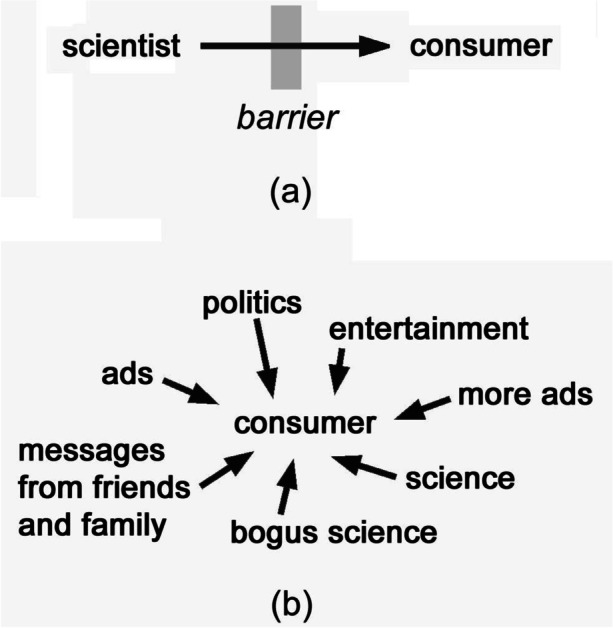
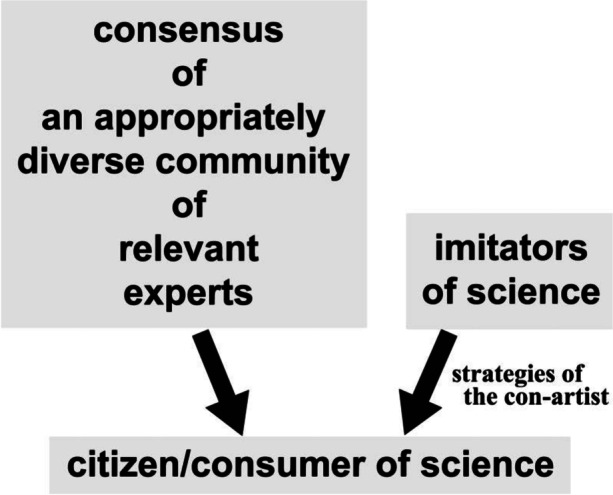
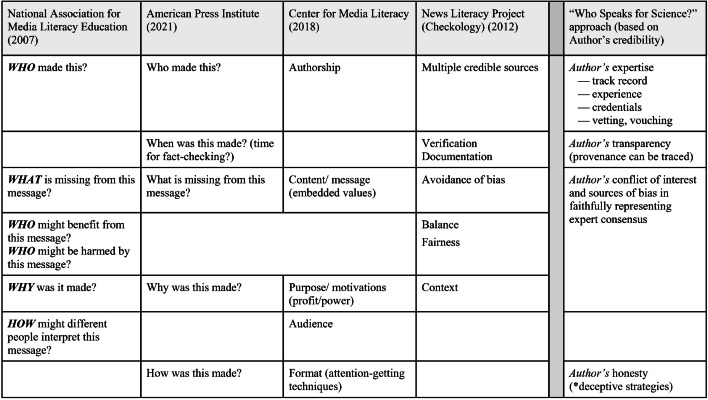
Ironically, flat-Earthers, anti-vaxxers, and climate change naysayers trust in science. Unfortunately, they trust the wrong science. That conundrum lies at the heart of scientific literacy in an age of well-funded commercial and ideological interests and overwhelming digital information. The core question for the citizen-consumer is not philosophically “why trust science?” (Oreskes 2019) but sociologically “who speaks for science?” Teachers can help students learn how to navigate the treacherous territory of inevitably mediated communication and the vulnerabilities of epistemic dependence. Students need to understand the role of science communication practices (media literacy) and the roles of credibility, expertise and honesty and the deceptive strategies used by imitators of science to seem like credible voices for science.
Overview
The claims and statistics of this paper haven’t been checked yet.
Run the check — free, no account needed. It reads the open-access text and checks the sources it cites.
Integrity signals
Registry
Cites
Statistics
Figures
Verification
Claims the paper makes
The claims and statistics of this paper haven’t been checked yet.
Run the check — free, no account needed. It reads the open-access text and checks the sources it cites.
Claims other papers make about this one
Each is checked against this paper’s own text: does it say what the citing paper says it does?
The cited source says what the claim attributes to it.
In the citing paper
“This inversion of the traditional evaluation sequence departs from theoretical perspectives such as Allchin’s [60] “who speaks for science” framework and Osborne and Pimentel’s [17] heuristics, both of which emphasize source-based evaluation as central to credibility assessment.”
From When the source is a bot: How people adapt their evaluation strategies to assess AI-generated content (2026) · cites this paper as [60]
In the citing paper
“Rather, in situations where students' disciplinary knowledge is limited, they can still engage with information critically by using second-order evaluations to decide who and what to believe (Allchin, 2022(Allchin, , 2023;;Branch & Origgi, 2022;Goldman, 2001;Osborne & Pimentel, 2023).”
From Learning to evaluate sources of science (mis)information on the internet: Assessing students' scientific online reasoning (2025) · cites this paper as Allchin, 2022
Self-check
Percentages, sums and reported differences re-computed from the paper’s own numbers.
The self-check needs the paper’s full text.
Citations
Cites
The spread of true and false news online
Vosoughi, S., Roy, D., & Aral, S. (2018) · Science · doi:10.1126/science.aap9559 · Cited by 8,847
Ideology, motivated reasoning, and cognitive reflection
Kahan, D. M. (2013) · Judgment and Decision Making · doi:10.1017/s1930297500005271 · Cited by 1,302
Shifting attention to accuracy can reduce misinformation online
Pennycook, G., Epstein, Z., Mosleh, M., Arechar, A. A., Eckles, D., & Rand, D. G. (2021) · Nature · doi:10.1038/s41586-021-03344-2 · Cited by 1,155
Cook, J., Lewandowsky, S., & Ecker, U. K. H. (2017) · PLOS ONE · doi:10.1371/journal.pone.0175799 · Cited by 971
Misconceptions, Misinformation, and the Logic of Identity-Protective Cognition
Kahan, D. M. (2017) · doi:10.2139/ssrn.2973067 · Cited by 423
Reconceptualizing nature‐of‐science education in the age of social media
Höttecke, D., & Allchin, D. (2020) · Science Education · doi:10.1002/sce.21575 · Cited by 303
Self-citation
Research works printed but not linked: 82
- Agin, D. (2006). Junk science. Thomas Donne Books.
- Allchin, D. (2012a). Science con-artists. American Biology Teacher, 74, 661–666. · DOI · Paper page
- Allchin, D. (2012b). Skepticism and the architecture of trust. American Biology Teacher, 74, 358–362. · DOI
- Allchin, D. (2012c). What counts as science. American Biology Teacher, 74, 291–294. · DOI
- Allchin, D. (2013). Contextualizing creationists. American Biology Teacher, 75, 144–147. · DOI
- Allchin, D. (2015). Global warming: Scam, fraud or hoax? American Biology Teacher, 77, 308–312. · DOI
- Allchin, D. (2018). Alternative facts and fake news. American Biology Teacher, 80, 631–633. · DOI
- Allchin, D. (2020a). The covid conundrum. American Biology Teacher, 82, 429–433. · DOI
- Allchin, D. (2020b). The credibility game. American Biology Teacher, 82, 535–541. · DOI · Paper page
- American Press Institute (2021). Media literacy: Where news comes from. Washington, DC. https://www.americanpressinstitute.org/wp-content/uploads/2013/09/Media-literacy-Evaluating-the-news-and-understanding-where-it-comes-from.pdf
- Basol, M., Roozenbeek, J., Berriche, M., Uenal, F., McClanahan, W. P., & van der Linden, S. (2021). Towards psychological herd immunity: Cross-cultural evidence for two prebunking interventions against COVID-19 misinformation. Bid Data and Society. https://doi.org/10.1177/20539517211013868 · DOI · Paper page
- Bergstrom, C. T., & West, J. D. (2020). / Calling bullshit: The art of skepticism in a data-driven world. Random House.
- Collins, H., & Evans, R. (2007). Rethinking expertise. University of Chicago Press. · DOI · Paper page
- Cromer, A. (1993). Uncommon sense: The heretical nature of science. Oxford University Press.
- Dobelli, R. (2013). The art of thinking clearly. Sceptre.
- Epstein, S. (1995). The construction of lay expertise: AIDS activism and the forging of credibility in the reform of clinical trials. Science, Technology, & Human Values, 20, 408–437. · DOI
- Epstein, S. (1996). Impure science: AIDS, activism, and the politics of knowledge. University of California Press.
- Erduran, S., & Jiménez-Aleixandre, M. P. (2008). Argumentation in science education: An overview. In S. Erduran & M. P. Jimnez-Aleixandre (Eds.), Argumentation in science education: Perspectives from classroom-based research (pp. 3–28). Springer.
- Evans, R. (2008). (2080) The sociology of expertise: The distribution of social fluency. Sociology Compass, 2/1, 281–298. · DOI
- Eyal, G. (2013). For a sociology of expertise: The social origins of the autism epidemic. American Journal of Sociology, 118, 863–907. · DOI
- Feder, K. L. (1999). Frauds, myths, and mysteries (3d ed.). Mayfield.
- Forgas, J. P., & Baumeister, R. (Eds.). (2019). The social psychology of gullibility: Conspiracy theories, fake news and irrational beliefs. Routledge.
- Freedman, D. H. (2010). Wrong: Why experts keep failing us – And how to know when not to trust them. Brown: Little.
- Gardner, M. (1957). Fads and fallacies in the name of science. Dover.
- Gieryn, T. F. (1999). Cultural boundaries of science: Credibility on the line. University of Chicago Press.
- Goldacre, B. (2010). Bad science: Quacks, hacks, and big pharma flacks. Faber and Faber.
- Goldman, A. I. (1999). Knowledge in a social world. Oxford University Press. · DOI
- Goldman, A. I. (2001). Experts: Which ones should you trust? Philosophy and Phenomenological Research, 63, 85–110. · DOI · Paper page
- Gratzer, W. (2000). The undergrowth of knowledge: Delusion, self-deception and human frailty. Oxford University Press. · DOI
- Griffiths, D. (1993). The implications of epistemic dependence on teaching the nature of science for intellectual independence [masters thesis]. St. Johns, Newfoundland: Memorial University.
- Grinnell, F. (1987). The scientific attitude. Routledge.
- Harding, S. (1991). Whose science? Whose knowledge? Cornell University Press.
- Hardwig, J. (1985). Epistemic dependence. Journal of Philosophy, 82(7), 335–349. · DOI · Paper page
- Hardwig, J. (1991). The role of trust in knowledge. Journal of Philosophy, 88, 693–708. · DOI · Paper page
- Helfand, D. J. (2016). A survival guide to the misinformation age. Columbia University Press. · DOI
- Hswen, Y., Xu, X., Hing, A., Hawkins, J. B., Brownstein, J. S., & Gee, G. C. (2021). Association of “#covid19” versus “#chinesevirus” with anti-Asian sentiments on Twitter: March 9–23, 2020. American Journal of Public Health, 111(5), 956–964. · DOI
- Irzik, G., & Kurtulmus, F. (2019). What is epistemic public trust in science? British Journal for the Philosophy of Science, 70(4), 1145–1166. · DOI
- Izrik, G. (2017). Epistemic trust in science and its implications for science education [plenary lecture]. IHPST Biennial Conference (Ankara, Turkey).
- Jasonoff, S. (1990). The fifth branch. Harvard University Press.
- Kahan, D. M., Jenkins-Smith, H., & Braman, D. (2011). Cultural cognition of scientific consensus. Journal of Risk Research, 14, 147–174. · DOI · Paper page
- Kenner, R. (2015). Merchants of doubt. Sony Classic Pictures.
- Kraft, P. W., Lodge, M., & Taber, C. S. (2015). Why people “don’t trust the evidence”: Motivated reasoning and scientific beliefs. Annals of the American Academy of Political and Social Science, 658(1), 121–133. · DOI · Paper page
- Lange, M. (2019). What would reasons for trusting science be? Oreskes, 2019, 181–190.
- Levitan, D. (2017). Not a scientist: How politicians mistake, misrepresent, and utterly mangle science. W.W. Norton.
- Lindee, S. (2019). The epistemology of frozen peas. Oreskes, 2019, 163–180.
- Markowitz, G., & Rosner, D. (2002). Deceit and denial: The deadly politics of industrial pollution. University of California Press.
- Martin, B. (1991). Scientific knowledge in controversy: The social dynamics of the fluoridation debate. State University of New York Press.
- Matthews, M. R. (2019). Feng shui: Teaching about science and pseudoscience. Springer. · DOI
- McGarity, T. O., & Wagner, W. E. (2008). Bending science: How special interests corrupt public health research. Harvard University Press.
- McIntyre, L. (2019). The scientific attitude: Defending science from denial, fraud, and pseudoscience. MIT Press. · DOI
- Michaels, D. (2008). Doubt is their product: How industry’s assault on science threatens your health. Oxford University Press.
- Michaels, D. (2020). The triumph of doubt. Oxford University Press.
- National Academies of Sciences, Engineering, and Medicine. (2015). Trust and confidence at the interfaces of the life sciences and society: Does the public trust science? A Workshop Summary. Washington, DC: The National Academies Press. https://doi.org/10.17226/21798. · DOI
- NGSS Lead States. (2013). Next generation science standards: For states, by states. The National Academies Press.
- Nichols, T. (2017). The death of expertise: The campaign against established knowledge and why it matters. Oxford University Press.
- Norris, S. P. (1995). Learning to live with scientific expertise: Toward a theory of intellectual communalism for guiding science teaching. Science Education, 79, 201–217. · DOI
- Norris, S. P. (1997). Intellectual independence for nonscientists and other content-transcendent goals of science education. Science Education, 81, 239–258. · DOI
- O’Connor, C., & Weatherall, J. O. (2019). The misinformation age: How false beliefs spread. Yale University Press. · DOI
- Oreskes, N. (2019). Why trust science? Princeton University Press. · DOI
- Oreskes, N., & Conway, E. M. (2010). Merchants of doubt: How a handful of scientists obscured the truth on issues from tobacco smoke to global warming. Bloomsbury Press.
- Osborne, J. (2010). Arguing to learn in science: The role of collaborative, critical discourse. Science, 328, 463–466. · DOI
- Park, R. (2000). Voodoo science. The road from foolishness to fraud: Oxford University Press. · DOI
- Pennycook, G., McPhetres, J., Bago, B. & Rand, D. (2021). Beliefs about COVID-19 in Canada, the U.K., and the U.S.A.: A novel test of political polarization and motivated reasoning [preprint]. doi: https://doi.org/10.31234/osf.io/zhjkp · DOI
- Petersen, A.M., Vincent, E.M., & Westerling, A.L. (2019). Discrepancy in scientific authority and media visibility of climate change scientists and contrarians. Nature Communications 10, #3502. · DOI
- Piatelli-Palmarini, M. (1994). Inevitable illusions: How mistakes of reason rule our minds. John Wiley.
- Pigliucci, M. (2010). Nonsense on stilts. University of Chicago Press. · DOI
- Pigliucci, M., & Boudry, M. (2013). The philosophy of pseudoscience. University of Chicago Press. · DOI
- Popper, K. (1962). Conjectures and refutations. The growth of scientific knowledge. Basic Books.
- van Prooijen, J.-W. (2018). The psychology of conspiracy theories. Routledge. · DOI
- Proudfit, M. (2020). Sorting fact from fiction: Media literacy in the biology classroom. American Biology Teacher, 82, 542–544. · DOI
- Rampton, S., & Stauber, J. (2001). Trust Us, we’re experts: How industry manipulates science and gambles with your future. Tarcher/Penguin Putnam.
- Selinger, E., & Crease, R. P. (Eds.). (2006). The philosophy of expertise. Columbia University Press.
- Shermer, M. (2002). Why people believe weird things, revised and expanded. Holt.
- Shermer, M. (2017). Skeptic: Viewing the world with a rational eye. St. Martin’s Griffin.
- Shoemaker, P. J., Vos, T. P., & Reese, S. D. (2009). Journalists as gatekeepers. In K. Wahl-Jorgensen & T. Hanitzsch (Eds.), the Handbook of Journalism Studies (pp. 73–87). Routledge.
- Spence, W., Herrmann, R.B., Johnston, A.C. & Reagor, G. (1993). Responses to Iben Browning’s Prediction of a 1990 New Madrid, Missouri, Earthquake. U.S. Geological Survey Circular 1083. Washington, D.C.: U.S. Government Printing Office. http://pubs.usgs.gov/circ/1993/1083/report.pdf. · DOI
- Toumey, C. (1996). Conjuring science: Scientific symbols and cultural meanings in American life. Rutgers University Press.
- White, D. M. (1950). The “gatekeeper”: A case study in the selection of news. Journalism Quarterly, 27, 383–391. · DOI
- Wolpert, L. (1992). The unnatural nature of science. Harvard University Press.
- Zemplén, G. Á. (2009). Putting sociology first—Reconsidering the role of the social in “nature of science” education. Science & Education, 18, 525–559. · DOI
- Ziman, J. (1968). Public knowledge: The social dimension of knowledge. Cambridge University Press.
- Zimring, J. (2019). What science is and how it really works. Cambridge University Press. · DOI
Cited by
Sorted by citations
Pimentel, D. R. (2025) · Journal of Research in Science Teaching · doi:10.1002/tea.21974 · Cited by 28
Dabran-Zivan, S., Klein-Avraham, I., & Baram-Tsabari, A. (2026) · PLOS One · doi:10.1371/journal.pone.0345300 · Cited by 6
Metadata
- Authors
- Allchin, D.
- ORCID
- Allchin, Douglas
- Venue
- Science & Education
- Published
- 2021-10-16
- Volume
- 31
- Issue
- 6
- Pages
- 1475-1492
- ISSN
- 0926-7220
- 1573-1901
- PMC
- PMC8520088
- Cited by
- 52
- References
- 6
- Language
- en
- Funders
- Not applicable
About these checks
Registry, retraction, Cites and statistics results are computed, not judged, with one exception: a printed reference that no index lists is read once by a model before it counts as a citation error. Claims are extracted by a model and kept only when their quote appears verbatim in the text; each cited source is then checked, with a model’s help, for whether it says what the claim relies on. Those verdicts can be wrong — read the claim’s quote and the cited source before relying on one.
Statistics and arithmetic are recomputed, not judged.
Confidence bands are shown only for fields calibrated on our annotated test set. None is calibrated yet, so no band is shown.
What counts as a claim ›How we measure confidence ›How we check this ›
Are you an author, or do you see a problem with this page? Request a review
