

Google Scholar to overshadow them all? Comparing the sizes of 12 academic search engines and bibliographic databases
Open accessThe DOI matches its Crossref record; 60 of the 61 references it cites were found in a registry or an index, and 1 are not checked yet.
Abstract
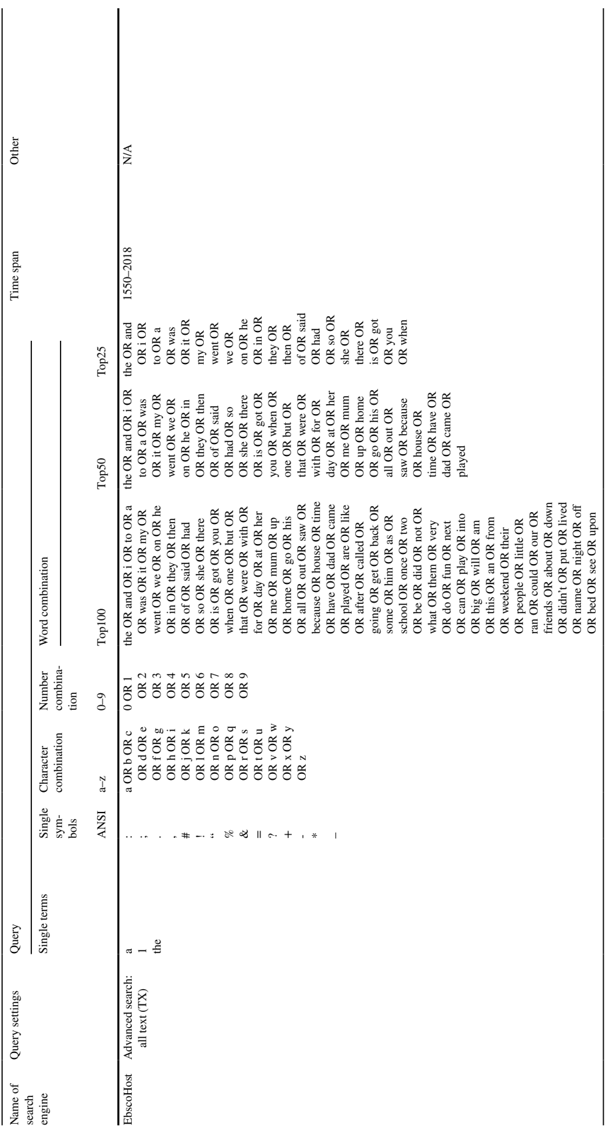
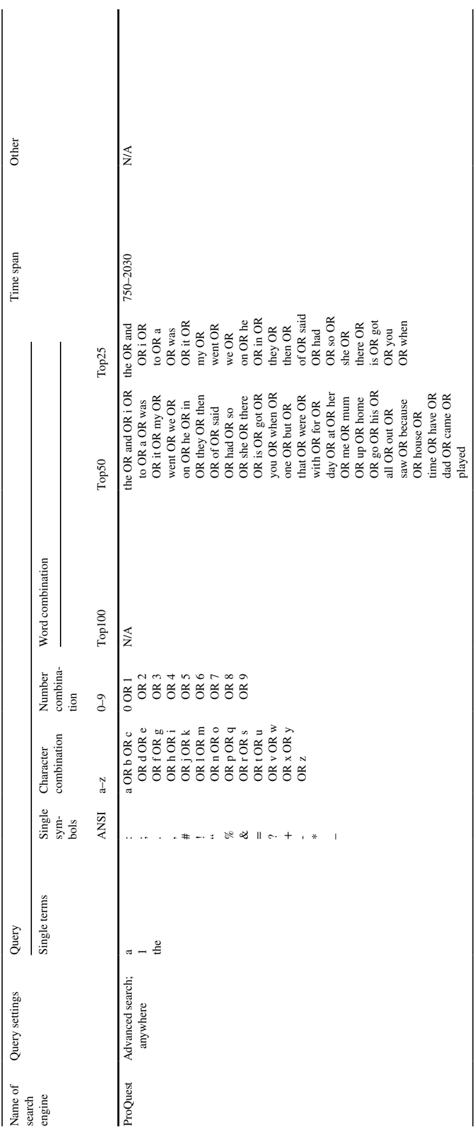
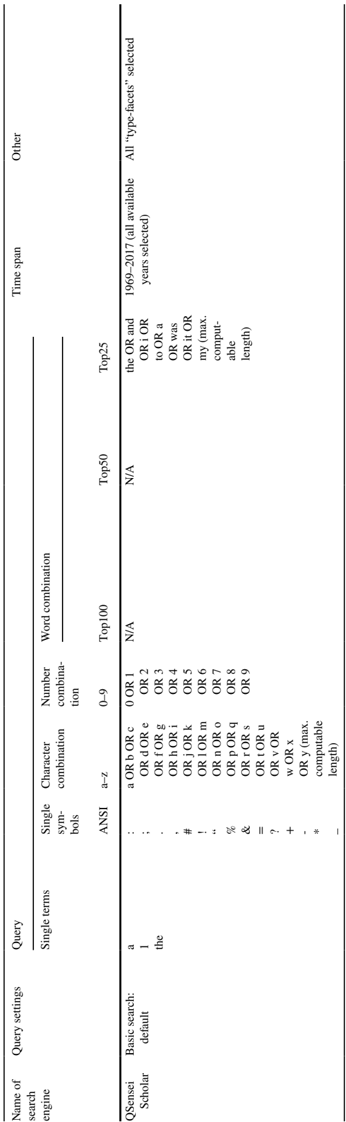
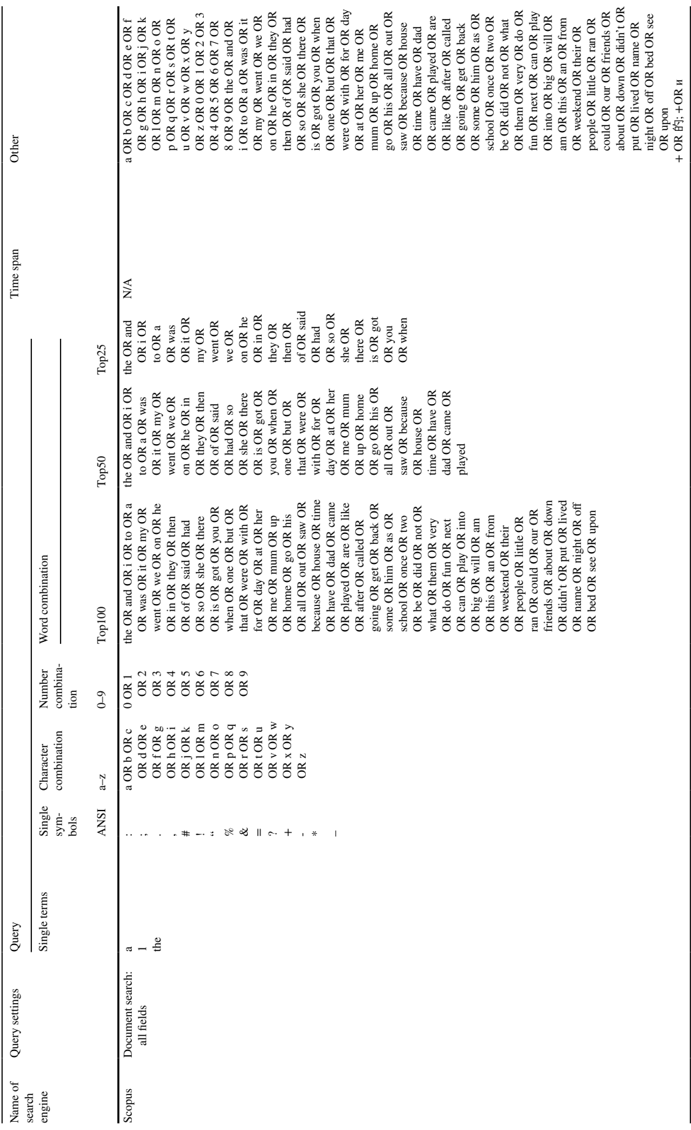
Information on the size of academic search engines and bibliographic databases (ASEBDs) is often outdated or entirely unavailable. Hence, it is difficult to assess the scope of specific databases, such as Google Scholar. While scientometric studies have estimated ASEBD sizes before, the methods employed were able to compare only a few databases. Consequently, there is no up-to-date comparative information on the sizes of popular ASEBDs. This study aims to fill this blind spot by providing a comparative picture of 12 of the most commonly used ASEBDs. In doing so, we build on and refine previous scientometric research by counting query hit data as an indicator of the number of accessible records. Iterative query optimization makes it possible to identify a maximum number of hits for most ASEBDs. The results were validated in terms of their capacity to assess database size by comparing them with official information on database sizes or previous scientometric studies. The queries used here are replicable, so size information can be updated quickly. The findings provide first-time size estimates of ProQuest and EbscoHost and indicate that Google Scholar’s size might have been underestimated so far by more than 50%. By our estimation Google Scholar, with 389 million records, is currently the most comprehensive academic search engine.
Overview
The claims and statistics of this paper haven’t been checked yet.
Free: it reads the open-access text and checks the first 5 claims that cite a source we can check. Create a free account to check every claim.
Integrity signals
Registry
Cites
Statistics
Figures
Verification
Claims the paper makes
The claims and statistics of this paper haven’t been checked yet.
Free: it reads the open-access text and checks the first 5 claims that cite a source we can check. Create a free account to check every claim.
Claims other papers make about this one
Each is checked against this paper’s own text: does it say what the citing paper says it does?
The source backs part of the claim, not all of it — or backs it for a different population, condition or comparison.
In the citing paper
“Unfortunately, the majority of DBs' end users are not usually aware of these limitations and how they can affect the accuracy, reliability, and reproducibility of their task's outcome [15,23].”
From Web of Science (WoS) and Scopus: The Titans of Bibliographic Information in Today’s Academic World (2021) · cites this paper as [23]
Experimental — accuracy not yet measuredThe source backs part of the claim, not all of it — or backs it for a different population, condition or comparison.
In the citing paper
“even when the dates of the last update are indicated to be very recent, the information provided is often clearly not the most recent one, especially regarding the numbers describing DBs coverage, which can confuse users in determining which information they can rely on”
From Web of Science (WoS) and Scopus: The Titans of Bibliographic Information in Today’s Academic World (2021) · cites this paper as [23]
Experimental — accuracy not yet measuredThe cited source says what the claim attributes to it.
In the citing paper
“These characteristics make it the most comprehensive academic search engine [28], removing the need to perform the search in each distinct reputable academic repository.”
From A Review of Design and Evaluation Practices in Mobile Text Entry for Visually Impaired and Blind Persons (2023) · cites this paper as [28]
The cited source says what the claim attributes to it.
In the citing paper
“1 Google Scholar was chosen because it is currently the most comprehensive academic search engine with 389 million records (Gusenbauer, 2019).”
From When Problem Solving Followed by Instruction Works: Evidence for Productive Failure (2021) · cites this paper as Gusenbauer, 2019
The cited source says what the claim attributes to it.
In the citing paper
“In these cases, the convenience and performance of the DB's web interface and provided additional functionalities may also greatly influence the preference of the DB [14,23,24].”
From Web of Science (WoS) and Scopus: The Titans of Bibliographic Information in Today’s Academic World (2021) · cites this paper as [23]
6 more claims about this paper
Create a free account to see every claim other papers make about this one.
Self-check
Percentages, sums and reported differences re-computed from the paper’s own numbers.
The self-check needs the paper’s full text.
Citations
Cites
Martín-Martín, A., Orduna-Malea, E., Thelwall, M., & Delgado López-Cózar, E. (2018) · Journal of Informetrics · doi:10.1016/j.joi.2018.09.002 · Cited by 1,990
Martín-Martín, A., Orduna-Malea, E., Thelwall, M., & López-Cózar, E. D. (2018) · doi:10.31235/osf.io/42nkm · Cited by 1,990
A Comparison between Two Main Academic Literature Collections: Web of Science and Scopus Databases
Chadegani, A. A., Salehi, H., Yunus, M. M., Farhadi, H., Fooladi, M., Farhadi, M., & Ebrahim, N. A. (2013) · Asian Social Science · doi:10.5539/ass.v9n5p18 · Cited by 1,925
Bornmann, L., & Mutz, R. (2015) · Journal of the Association for Information Science and Technology · doi:10.1002/asi.23329 · Cited by 1,576
Accessibility of information on the web
Lawrence, S., & Giles, C. L. (1999) · Nature · doi:10.1038/21987 · Cited by 1,349
The Literature of Bibliometrics, Scientometrics, and Informetrics
Hood, W. W., & Wilson, C. S. (2001) · Scientometrics · doi:10.1023/a:1017919924342 · Cited by 981
Meho, L. I., & Yang, K. (2007) · Journal of the American Society for Information Science and Technology · doi:10.1002/asi.20677 · Cited by 974 · cited 2×
“…have examined ASEBDs individually (Aguillo 2012; Halevi et al. 2017; Mayr and Walter 2007; Orduña-Malea et al. 2015; Hug and Braendle 2017; Harzing 2014) or compared them in pairs or multiples (Meho and Yang 2007; Shultz 2007; Chadegani et al. 2013; Khabsa and Giles 2014; de Winter et al. 2014).”
Search Engines: Information Retrieval in Practice
Croft, B. W., Metzler, D., & Strohman, T. (2009) · Medical Entomology and Zoology · Cited by 797
Online collaboration: Scientists and the social network
Van Noorden, R. (2014) · Nature · doi:10.1038/512126a · Cited by 654
Thelwall, M. (2008) · Journal of Information Science · doi:10.1177/0165551507087238 · Cited by 518 · cited 1×
“2015; Orduña-Malea and Delgado López-Cózar 2014; Hood and Wilson 2001; Thelwall 2008, 2009; Bar-Ilan 2008).”
BackgroundHalevi, G., Moed, H., & Bar-Ilan, J. (2017) · Journal of Informetrics · doi:10.1016/j.joi.2017.06.005 · Cited by 488
Informetrics at the beginning of the 21st century—A review
Bar-Ilan, J. (2008) · Journal of Informetrics · doi:10.1016/j.joi.2007.11.001 · Cited by 466 · cited 1×
“2015; Orduña-Malea and Delgado López-Cózar 2014; Hood and Wilson 2001; Thelwall 2008, 2009; Bar-Ilan 2008).”
BackgroundSearch Engines Information Retrieval in Practice
Yang, C. C. (2010) · Journal of the American Society for Information Science and Technology · doi:10.1002/asi.21194 · Cited by 428
A technique for measuring the relative size and overlap of public Web search engines
Bharat, K., & Broder, A. (1998) · Computer Networks and ISDN Systems · doi:10.1016/s0169-7552(98)00127-5 · Cited by 389
Google Scholar: the pros and the cons
Jacsó, P. (2005) · Online Information Review · doi:10.1108/14684520510598066 · Cited by 383 · cited 1×
“2017; Mingers and Meyer 2017; Aguillo 2012; Orduña-Malea and Delgado López-Cózar 2014; Jacsó 2005, 2008, 2012; Orduna-Malea et al.”
Is Google Scholar useful for bibliometrics? A webometric analysis
Aguillo, I. F. (2012) · Scientometrics · doi:10.1007/s11192-011-0582-8 · Cited by 302 · cited 6×
“Here a multitude of methods were applied including, webometric analysis (Aguillo 2012), capture/recapture methods (Khabsa and Giles 2014), citation analysis (Meho and Yang 2007; Hug and Braendle 2017), and search result comparison (Shultz 2007).”
BackgroundMethodInfluentialSpringer Handbook of Science and Technology Indicators
(2019) · Springer Handbooks · doi:10.1007/978-3-030-02511-3 · Cited by 300
Information Research: an international electronic journal
(2020) · Information Research · doi:10.47989/ir · Cited by 275
The expansion of Google Scholar versus Web of Science: a longitudinal study
de Winter, J. C. F., Zadpoor, A. A., & Dodou, D. (2014) · Scientometrics · doi:10.1007/s11192-013-1089-2 · Cited by 270
Search engine coverage bias: evidence and possible causes
Vaughan, L., & Thelwall, M. (2004) · Information Processing & Management · doi:10.1016/s0306-4573(03)00063-3 · Cited by 259
The Number of Scholarly Documents on the Public Web
Khabsa, M., & Giles, C. L. (2014) · PLoS ONE · doi:10.1371/journal.pone.0093949 · Cited by 227
Is Google enough? Comparison of an internet search engine with academic library resources
Brophy, J., & Bawden, D. (2005) · Aslib Proceedings · doi:10.1108/00012530510634235 · Cited by 213
Measuring Search Engine Quality
Hawking, D., Craswell, N., Bailey, P., & Griffihs, K. (2001) · Information Retrieval · doi:10.1023/a:1011468107287 · Cited by 207
Jacsó, P. (2008) · Online Information Review · doi:10.1108/14684520810866010 · Cited by 206 · cited 2×
“Indeed, search systems often include a significant portion of duplicates and indexing, or other cataloguing errors seemingly boost the total size of the system while not providing any new information to the user (Jacsó 2008; Valderrama-Zurián et al.”
BackgroundGoogle Scholar as a Data Source for Research Assessment
López‐Cózar, E. D., Orduña‐Malea, E., & Martín‐Martín, A. (2019) · Springer handbooks · doi:10.1007/978-3-030-02511-3_4 · Cited by 205
Martín-Martín, A., Orduna-Malea, E., & Delgado López-Cózar, E. (2018) · Scientometrics · doi:10.1007/s11192-018-2820-9 · Cited by 195
Can we use Google Scholar to identify highly-cited documents?
Martin-Martin, A., Orduna-Malea, E., Harzing, A.-W., & Delgado López-Cózar, E. (2017) · Journal of Informetrics · doi:10.1016/j.joi.2016.11.008 · Cited by 183
Comparing test searches in PubMed and Google Scholar
Shultz, M. (2007) · Journal of the Medical Library Association : JMLA · doi:10.3163/1536-5050.95.4.442 · Cited by 174 · cited 2×
“Here a multitude of methods were applied including, webometric analysis (Aguillo 2012), capture/recapture methods (Khabsa and Giles 2014), citation analysis (Meho and Yang 2007; Hug and Braendle 2017), and search result comparison (Shultz 2007).”
BackgroundMethodA longitudinal study of Google Scholar coverage between 2012 and 2013
Harzing, A.-W. K. (2013) · Scientometrics · doi:10.1007/s11192-013-0975-y · Cited by 156 · cited 1×
“…studies have examined ASEBDs individually (Aguillo 2012; Halevi et al. 2017; Mayr and Walter 2007; Orduña-Malea et al. 2015; Hug and Braendle 2017; Harzing 2014) or compared them in pairs or multiples (Meho and Yang 2007; Shultz 2007; Chadegani et al. 2013; Khabsa and Giles 2014; de Winter et al.…”
BackgroundA Systematic Analysis of Duplicate Records in Scopus
Valderrama-Zurián, J.-C., Aguilar-Moya, R., Melero-Fuentes, D., & Aleixandre-Benavent, R. (2015) · Journal of Informetrics · doi:10.1016/j.joi.2015.05.002 · Cited by 154
Methods for estimating the size of Google Scholar
Orduna-Malea, E., Ayllón, J. M., Martín-Martín, A., & Delgado López-Cózar, E. (2015) · Scientometrics · doi:10.1007/s11192-015-1614-6 · Cited by 146
A survey on scholarly data: From big data perspective
Khan, S., Liu, X., Shakil, K. A., & Alam, M. (2017) · Information Processing & Management · doi:10.1016/j.ipm.2017.03.006 · Cited by 137
College Libraries and Student Culture: What We Now Know
Duke, L. M., & Asher, A. (2011) · Digital Commons at Illinois Wesleyan University (Illinois Wesleyan University) · Cited by 129
The Coverage of Microsoft Academic: Analyzing the Publication Output of a University
Hug, S. E., & Brändle, M. P. (2017) · Scientometrics · doi:10.1007/s11192-017-2535-3 · Cited by 120
Retrieving Clinical Evidence: A Comparison of PubMed and Google Scholar for Quick Clinical Searches
Shariff, S. Z., Bejaimal, S. A., Sontrop, J. M., Iansavichus, A. V., Haynes, R. B., Weir, M. A., & Garg, A. X. (2013) · Journal of Medical Internet Research · doi:10.2196/jmir.2624 · Cited by 119
Prins, A. A. M., Costas, R., van Leeuwen, T. N., & Wouters, P. F. (2016) · Research Evaluation · doi:10.1093/reseval/rvv049 · Cited by 112
Coverage, relevance, and ranking: The impact of query operators on Web search engine results
Eastman, C. M., & Jansen, B. J. (2003) · ACM Transactions on Information Systems · doi:10.1145/944012.944015 · Cited by 109
An exploratory study of Google Scholar
Mayr, P., & Walter, A. (2007) · Online Information Review · doi:10.1108/14684520710841784 · Cited by 100
Google and the scholar: the role of Google in scientists' information‐seeking behaviour
Jamali, H. R., & Asadi, S. (2010) · Online Information Review · doi:10.1108/14684521011036990 · Cited by 92
CiteSeer x : A Scholarly Big Dataset
Caragea, C., Wu, J. F., Ciobanu, A. M., Williams, K., Fernández-Ramírez, J., Chen, H., Wu, Z., & Giles, C. L. (2014) · Lecture notes in computer science · doi:10.1007/978-3-319-06028-6_26 · Cited by 90
Search engines information retrieval in practice
Croft, W. B., Metzler, D., & Strohman, T. (2009) · Cited by 90
Information-seeking behavior of basic science researchers: implications for library services
Haines, L. L., Light, J., O'Malley, D., & Delwiche, F. A. (2010) · Journal of the Medical Library Association : JMLA · doi:10.3163/1536-5050.98.1.019 · Cited by 87
About the size of Google Scholar: playing the numbersPreprint
Orduña‐Malea, E., Ayllón, J. M., Martín‐Martín, A., & López‐Cózar, E. D. (2014) · arXiv (Cornell University) · doi:10.48550/arxiv.1407.6239 · Cited by 87
Georgas, H. (2014) · portal Libraries and the Academy · doi:10.1353/pla.2014.0034 · Cited by 85 · cited 1×
“Google Scholar became the number one go-to information source in academia (van Noorden 2014) and is often used due to its convenience and users’ familiarity with the search system (Georgas 2014; Jamali and Asadi 2010; Duke and Asher 2012).”
BackgroundMicrosoft Academic is one year old: the Phoenix is ready to leave the nest
Harzing, A.-W. K., & Alakangas, S. (2017) · Scientometrics · doi:10.1007/s11192-017-2454-3 · Cited by 55
Orduna-Malea, E., Martín-Martín, A., & Delgado López-Cózar, E. (2017) · Revista Española de Documentación Científica · doi:10.3989/redc.2017.4.1500 · Cited by 55
Normalizing Google Scholar data for use in research evaluation
Mingers, J., & Meyer, M. S. (2017) · Scientometrics · doi:10.1007/s11192-017-2415-x · Cited by 53
Google Scholar Metrics evolution: an analysis according to languages
Orduña‐Malea, E., & López‐Cózar, E. D. (2013) · Scientometrics · doi:10.1007/s11192-013-1164-8 · Cited by 47
The silent fading of an academic search engine: the case of Microsoft Academic Search
Orduña-Malea, E., Martín-Martín, A., M. Ayllon, J., & Delgado López-Cózar, E. (2014) · Online Information Review · doi:10.1108/oir-07-2014-0169 · Cited by 40
Jacsó, P. (2012) · Online Information Review · doi:10.1108/14684521211241503 · Cited by 37 · cited 2×
“The database is getting bigger and bigger but in the wrong way, through hoarding giga collections of irrelevant and/or non-scholarly content” (Jacsó 2012, p. 466).”
BackgroundThelwall, M. A. (2018) · RePEc: Research Papers in Economics · Cited by 35
Thelwall, M. (2018) · Journal of Informetrics · doi:10.1016/j.joi.2017.11.001 · Cited by 33 · cited 1×
“This relaunch could have significantly impacted the structure and size of Microsoft Academic (Hug and Braendle 2017) and its performance in retrieving search results with high precision and recall (Thelwall 2018).”
BackgroundDoes Google Scholar contain all highly cited documents (1950-2013)?
Martín‐Martín, A., Orduña‐Malea, E., Ayllón, J. M., & López‐Cózar, E. D. (2014) · arXiv (Cornell University) · doi:10.48550/arxiv.1410.8464 · Cited by 30
Empirical Evidences in Citation-Based Search Engines: Is Microsoft Academic Search dead?Preprint
Orduña‐Malea, E., Ayllón, J. M., Martín‐Martín, A., & López‐Cózar, E. D. (2014) · arXiv (Cornell University) · doi:10.48550/arxiv.1404.7045 · Cited by 30
Search markets and search results: The case of Bing
Wilkinson, D., & Thelwall, M. A. (2013) · Library & Information Science Research · doi:10.1016/j.lisr.2013.04.006 · Cited by 26
Trends in Large-Scale Subject Repositories
Adamick, J., & Reznik-Zellen, R. C. (2010) · D-Lib Magazine · doi:10.1045/november2010-adamick · Cited by 23
"Just Google It"--The Scope of Freely Available Information Sources for Doctoral Thesis Writing.
Grigas, V., Juzėnienė, S., & Velickaite, J. (2017) · Information Research · Cited by 22
CiteSeerX data: semanticizing scholarly papers
Wu, J. F., Liang, C., Yang, H., & Giles, C. L. (2016) · International Workshop on Semantic Big Data (SBD) · doi:10.1145/2928294.2928306 · Cited by 8
Persistent value of older scientific journal articles
Lercher, A. (2016) · Civil War Book Review · doi:10.1007/s1119 · Cited by 8
Barbero (2014) · doi:10.1016/j · Cited by 1
(2003)
Research works printed but not linked: 6
- 13. Arts and Humanities Citation Index (1975-present) 4. Conference Proceedings Citation Index-Science (1990-present) 5. Conference Proceedings Citation Index-Social Science and Humanities (1990-pre- sent)
- 19. Data Citation Index (2010-present) 5. Derwent Innovations Index (2010-present) 6. KCI-Korean Journal Database (1980-present) 7. MEDLINE (1950-present)
- Ortega, J. L. (2014). Academic search engines: A quantitative outlook (Chandos information professional series). Oxford: Chandos Publishing.
- 63. Ortega, J. L. (2014). Academic search engines: A quantitative outlook (Chandos information professional series). Oxford: Chandos Publishing. Oxford University Press. (2008). Oxford wordlist. Oxford: Oxford University Press.
- 64. Pederson, J. P. (2001). International directory of company histories (International Directory of Company Histories Ser) (Vol. 40). Farmington Hills: Saint James Press. (Imprint); Cengage Gale.
- 69. Thelwall, M. (Ed.). (2009). Introduction to webometrics: Quantitative web research for the social sciences (Synthesis lectures on information concepts, retrieval, and services) (Vol. 4). San Francisco: Morgan & Claypool Publishers.
Cited by
Web of Science (WoS) and Scopus: The Titans of Bibliographic Information in Today’s Academic World
Pranckutė, R. (2021) · Publications · doi:10.3390/publications9010012 · Cited by 2,696
“Gusenbauer [23,42] and in several subject specific studies [27,43,83,84].”
BackgroundInfluentialGusenbauer, M., & Haddaway, N. R. (2020) · Research Synthesis Methods · doi:10.1002/jrsm.1378 · Cited by 2,379
“37 In our analysis, we did not assess the quality of the retrieved records, in terms of their fit with a given search intent for example.”
MethodInfluentialSelf-citationSoftware tools for conducting bibliometric analysis in science: An up-to-date review
Moral-Muñoz, J. A., Herrera-Viedma, E., Santisteban-Espejo, A., & Cobo, M. J. (2020) · El Profesional de la Información · doi:10.3145/epi.2020.ene.03 · Cited by 1,675
Martín-Martín, A., Thelwall, M., Orduna-Malea, E., & Delgado López-Cózar, E. (2021) · Scientometrics · doi:10.1007/s11192-020-03690-4 · Cited by 1,018
“2019; Gusenbauer 2018).”
The ABC of systematic literature review: the basic methodological guidance for beginners
Mohamed Shaffril, H. A., Samsuddin, S. F., & Abu Samah, A. (2021) · Quality & Quantity · doi:10.1007/s11135-020-01059-6 · Cited by 656
“2016; Gusenbauer 2019).”
Metadata
- Authors
- Gusenbauer, M.
- Affiliations
- Johannes Kepler University of Linz (AT)
- Corresponding author
- Gusenbauer, Michael
- ORCID
- Gusenbauer, Michael
- Venue
- Scientometrics
- Published
- 2018-11-10
- Volume
- 118
- Issue
- 1
- Pages
- 177-214
- ISSN
- 0138-9130 (ISSN-L)
- 1588-2861
- OpenAlex
- W2900201388
- Cited by
- 687
- References
- 60
- Citations by year
- 2026: 55 · 2025: 89 · 2024: 100 · 2023: 113 · 2022: 116 · 2021: 116 · 2020: 78 · 2019: 20
- FWCI
- 40.74
- Type
- journal article
- Language
- en
- Open access
- hybrid
- doi.org
- Licence
- cc-by
- creativecommons.org/licenses/by/4.0 (tdm)
- Locations
- Scientometrics (publishedVersion, cc-by)
- RePEc: Research Papers in Economics (submittedVersion)
- University Library Linz repository (Johannes Kepler Universitat Linz) (submittedVersion, cc-by)
- Topics
- Social Sciences › Library and Information Sciences › scientometrics and bibliometrics research
- Physical Sciences › Computer Science › Information Systems › Web visibility and informetrics
- Social Sciences › Library and Information Sciences › Library Science and Information
- Keywords
- academic search engines, bibliographic databases, Google Scholar, ProQuest, EBSCOhost
About these checks
Registry, retraction, Cites and statistics results are computed, not judged, with one exception: a printed reference that no index lists is read once by a model before it counts as a citation error. Claims are extracted by a model and kept only when their quote appears verbatim in the text; each cited source is then checked, with a model’s help, for whether it says what the claim relies on. Those verdicts can be wrong — read the claim’s quote and the cited source before relying on one.
Statistics and arithmetic are recomputed, not judged.
Confidence bands are shown only for fields calibrated on our annotated test set. None is calibrated yet, so no band is shown.
What counts as a claim ›How we measure confidence ›How we check this ›
Are you an author, or do you see a problem with this page? Request a review
Data sources
Bibliographic data: Semantic Scholar, OpenAlex, Crossref.
Contains information from the Semantic Scholar Academic Graph Datasets, made available under the ODC Attribution License (ODC-BY 1.0).
Semantic Scholar’s data is described in: Kinney, R., et al. (2023). The Semantic Scholar Open Data Platform. arXiv:2301.10140.
