

Interaction and cognitive engagement: An analysis of four asynchronous online discussions
Open accessThe DOI matches its Crossref record; 47 of the 48 references it cites were found in a registry or an index, and 1 are not checked yet; 1 of the 24 sources its claims cite were checked for support.
Abstract
Online discussion plays a unique role in face-to-face and distance teaching and learning. Interaction and student cognitive engagement during the online discussion are critical for constructing new understanding and knowledge. This article analyzes types of interaction that occur during online discussions, examines levels of student cognitive engagement in each discussion, and explores their effects on and implications for learning and teaching in higher education. By combining methods of social network analysis with qualitative content analysis, the article explores new methodologies for analyzing participation, interaction, and learning that take place online, and suggests areas for research in learning and teaching online.
Verified 2026-11-22 · 1 reference not checked yet
Overview
CoChat Summary
TL;DR
This study combined social network analysis and content analysis of four asynchronous online discussions (71 students across four courses) to examine interaction types and cognitive engagement. It found star and interconnected web interaction types and low-to-high cognitive engagement, with no direct relationship between interaction type and cognitive engagement.
Key findings
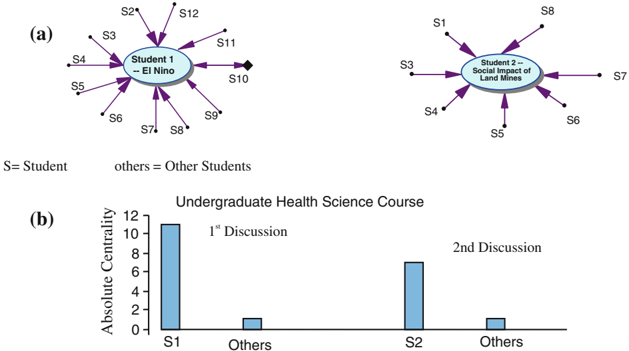
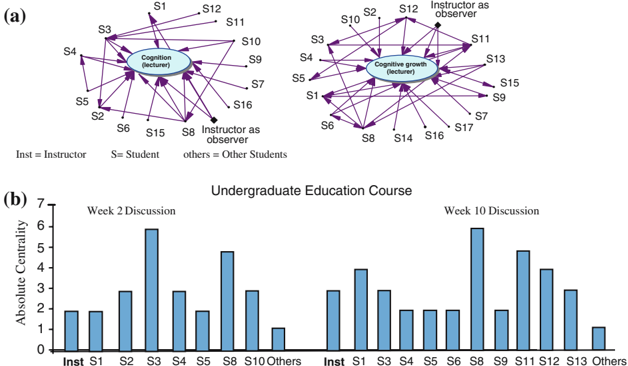
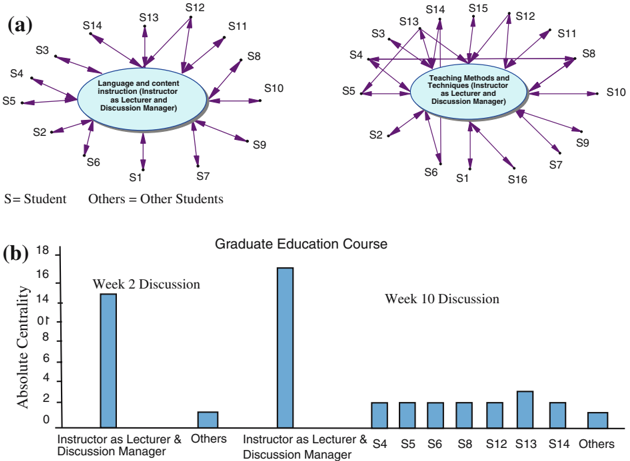
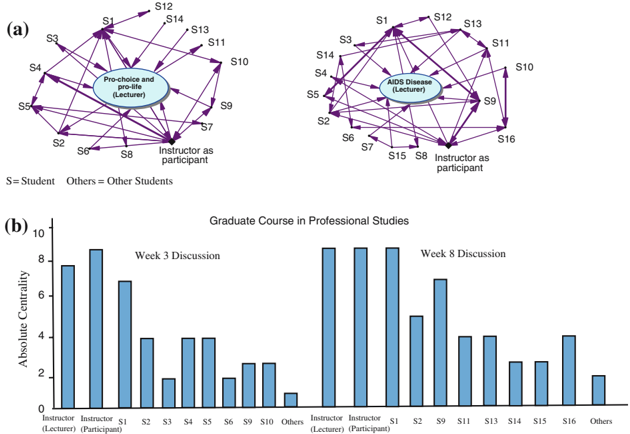
- Two interaction types appeared: star (Classes A and C) and interconnected web (Classes B and D); network density ranged from 0.20 to 0.40 (Class A 0.20/0.29; Class B 0.25/0.25; Class C 0.28/0.28; Class D 0.36/0.40).
- Cognitive engagement varied from low to high: Class A was mostly low (65% Statement Type I in “El Nino”; 28% horizontal questions; 7% explanations; no analytical, evaluative, or reflective messages); Class B was low in Week 1 (76% Type I) and mixed in Week 2 (40% Type I, 15% Question Type I, 15% Type II, 30% Type III); Classes C and D showed higher engagement (e.g., Class C evaluative messages 21% and 18%; Class D had 34% explaining personal opinions and 29% responding to peers).
- No direct relationship was found between interaction type and cognitive engagement: Classes A and C both had star interaction but low vs. high engagement; Classes B and D both had interconnected web interaction but low vs. high engagement.
- Instructor role and discussion design may matter: instructor messages were 0% in Class A, 7%/8% in Class B, 45% in both Class C discussions (evaluative but no mentoring/scaffolding), and 29%/17% in Class D, where the instructor participated as peer and mentor.
Methods
- Participants were 71 students from 3 colleges in a small public university: Class A undergraduate health science (22; 5 male, 17 female), Class B undergraduate education (17; 2 male, 15 female), Class C graduate education (16; 3 male, 13 female), and Class D graduate professional studies (16; 6 male, 10 female); all were required to participate in asynchronous online discussions during a 12–14 week semester.
- Two discussion transcripts were selected from each of the four classes, avoiding the first or last week; 244 messages were analyzed in total.
- Analysis combined social network analysis (network size, centrality, density) with qualitative content analysis using the Analytical Framework for Cognitive Engagement in Discussion, incorporating Zhu’s coding system, Henri’s content-analysis framework, and Bloom’s cognitive domains; two readers assigned levels, compared notes, and reached agreement, with 20 (about 8%) of 244 messages reassigned and later 4 messages (1.2%) re-adjusted.
Limitations
- Stated: the small number of courses and students from limited academic units means findings cannot be generalized; data were insufficient to explore complex relations among variables such as instructor presence, role, expectations, discussion goals, facilitation, questions, class size, delivery format, grade percentage, gender, academic maturity, intrinsic motivation, and prior knowledge.
- Stated: content analysis as a measure of cognitive engagement needs further examination for validity and reliability, and the combined network/content methodology can be modified; reasons for lurking were not studied.
- Evident from the text: the sample is limited to social science courses at one small public university and is predominantly female (average 80% female); no student or instructor interviews were conducted, and formal coding reliability statistics are not reported beyond agreement and reassignment counts.
Model-written summary. Check it against the paper before relying on it.
Integrity signals
Registry
Cites
Statistics
Figures
Verification
Claims the paper makes
1 Valid · 3 Not valid · 16 Not checked · 131 Own results and interpretations
The cited sources support only part of this claim — read each source’s verdict below.
In the paper
“The size of a network and the interaction grow proportionally (Fahy et al., 2001;Ridley & Avery, 1979;Rytina, 1982).”
§ Interaction and cognitive engagement: An analysis of four asynchronous online discussions > Data collection and analysis
What the sources say
- Partly supportedcites Fahy et al., 2001 matched to “Patterns of Interaction in a Computer Conference Transcript” (2001) sourceExperimental — accuracy not yet measured
The Network size section says that as a network grows, the number of potential linkages grows. It does not say actual interaction grows proportionally; the Discussion instead says that increasing size forces participants to be selective in their interactions. (LLM, conf=0.87)
- Not checked — no full text of the sourcecites Ridley & Avery, 1979 matched to “Social Network Influence on the Dyadic Relationship” (1979) source
- Not matchedcites Rytina, 1982
An author–year citation the paper’s reference list doesn’t settle. We don’t search these by name.
plainstates an association- Asserted: passes — The authors put it forward as true.
- Checkable: passes — It can be checked against evidence.
- Load-bearing: unclear — It is unclear whether the paper’s conclusions depend on it.
- Based: passes — The paper gives a reason why it holds.
- Partly supported
A result the paper reports from its own data — it cites no other source for it, so there is none to check. The quote shows it is in the paper.
In the paper
“Sixty-five percent of messages in the ''El Nino'' discussion belonged to Statement Type I”
§ Interaction and cognitive engagement: An analysis of four asynchronous online discussions > Cognitive engagement
plain- Asserted: passes — The authors put it forward as true.
- Checkable: passes — It can be checked against evidence.
- Load-bearing: unclear — It is unclear whether the paper’s conclusions depend on it.
- Based: passes — The paper gives a reason why it holds.
A result the paper reports from its own data — it cites no other source for it, so there is none to check. The quote shows it is in the paper.
In the paper
“About half of the students had an absolute centrality greater than 2.”
§ Interaction and cognitive engagement: An analysis of four asynchronous online discussions > Interaction viewed through the lens of network size, centrality, and density
plain- Asserted: passes — The authors put it forward as true.
- Checkable: passes — It can be checked against evidence.
- Load-bearing: unclear — It is unclear whether the paper’s conclusions depend on it.
- Based: passes — The paper gives a reason why it holds.
A result the paper reports from its own data — it cites no other source for it, so there is none to check. The quote shows it is in the paper.
In the paper
“The network size for the four discussions (Classes A-D) was relatively small, ranging from 8 to 18”
§ Interaction and cognitive engagement: An analysis of four asynchronous online discussions > Interaction viewed through the lens of network size, centrality, and density
plain- Asserted: passes — The authors put it forward as true.
- Checkable: passes — It can be checked against evidence.
- Load-bearing: unclear — It is unclear whether the paper’s conclusions depend on it.
- Based: passes — The paper gives a reason why it holds.
A result the paper reports from its own data — it cites no other source for it, so there is none to check. The quote shows it is in the paper.
In the paper
“Twenty-eight percent messages raised questions that were horizontal in direction with no direct answers.”
§ Interaction and cognitive engagement: An analysis of four asynchronous online discussions > Cognitive engagement
plainSingle case- Asserted: passes — The authors put it forward as true.
- Checkable: passes — It can be checked against evidence.
- Load-bearing: unclear — It is unclear whether the paper’s conclusions depend on it.
- Based: passes — The paper gives a reason why it holds.
75 more claims
Create a free account to see all 151 claims and every source verdict.
- It may state two separate claims as one. 42
- Probably not a substantial claim. 44
Self-check
Percentages, sums and reported differences re-computed from the paper’s own numbers.
Each contradiction between two passages listed here was confirmed by an independent check.
Rated minor: it would not touch a result — a value no result rests on, a p-value that stays on the same side of the significance level, or a conflict that is clerical, resolved elsewhere in the paper, or outside its own findings.
In the paper
§ Interaction and cognitive engagement: An analysis of four asynchronous online discussions > Study participants
“in a regular semester (12-14 weeks)”
§ Interaction and cognitive engagement: An analysis of four asynchronous online discussions > One undergraduate course in health science
“The Internet sessions scheduled for Weeks 3 and 8 (in a 15-week semester) discussed course assignments.”
Rated minor: it would not touch a result — a value no result rests on, a p-value that stays on the same side of the significance level, or a conflict that is clerical, resolved elsewhere in the paper, or outside its own findings.
In the paper
§ Interaction and cognitive engagement: An analysis of four asynchronous online discussions > Interaction viewed through the lens of network size, centrality, and density
“Student 2, who posted the topic ''Social Impact of Land Mines,'' had a centrality of 8.”
§ Interaction and cognitive engagement: An analysis of four asynchronous online discussions > One undergraduate course in health science
“Twelve students participated in the ''El Nino'' discussion and 8 students joined in the discussion on ''Social Impact of Land Mines.''”
Citations
Cites
(1978) · Medical Entomology and Zoology · Cited by 53,488
Bloom, B. S., Engelhart, M. D., Furst, E. J., Hill, W. H., & Krathwohl, D. R. (1956) · Cited by 9,342
Social Network Analysis: A Handbook.
Pappi, F. U., & Scott, J. (1993) · Contemporary Sociology · doi:10.2307/2075047 · Cited by 5,969
(1956) · Medical Entomology and Zoology · Cited by 4,596
The Taxonomy of Educational Objectives
(2012) · Encyclopedia of the Sciences of Learning · doi:10.1007/978-1-4419-1428-6_6027 · Cited by 4,103
Perspectives on socially shared cognition.
(1991) · American Psychological Association eBooks · doi:10.1037/10096-000 · Cited by 3,446
Content Analysis in Communication Research.
de Sola Pool, I., & Berelson, B. (1952) · American Sociological Review · doi:10.2307/2088029 · Cited by 3,099 · cited 1×
“Content analysis, as a research technique for the objective, systematic, quantitative description of the manifest content of communication (Berelson, 1952, p. 519), is adopted to analyze and determine student cognitive engagement in the online discussion.”
MethodCritical thinking, cognitive presence, and computer conferencing in distance education
Garrison, D. R., Anderson, T., & Archer, W. (2001) · American Journal of Distance Education · doi:10.1080/08923640109527071 · Cited by 3,044 · cited 3×
“Garrison et al. (2001) proposed a four-phase model (trigger, exploration, integration, and resolution) to explore and examine the nature and quality of critical inquiry in computer conferencing.”
BackgroundMethodResultGagné, R. M. (1965) · Bibliothèque et Archives nationales du Québec (Québec government) · Cited by 3,016
Assessing Social Presence In Asynchronous Text-based Computer Conferencing
Rourke, L., Anderson, T. D., Garrison, D. R., & Archer, W. (1999) · AUSpace (Athabasca University) · Cited by 2,388
Research works printed but not linked: 4
- 4. Berge, Z.L. & Collins, M. eds. (1995). Computer mediated communication and the online classroom. Vol. 1: Overview and perspectives. Cresskill: Hampton Press, Inc.
- 19. Jeong, A. (2005) Methods and tools for the computational analysis of group interaction and argumentation in asynchronous online discussions. Paper presented at the 2005 Technology and Learning Symposium, New York, NY.
- 30. Riedl, R. (1989). Patterns in computer-mediated discussions. In R. Mason and A. Kaye, eds, Mindweave: Communication, computers, and distance education, pp. 215-220. Pergamon Press: Oxford.
- 36. Stoney, C. & Oliver, R. (1999) Can higher order thinking and cognitive engagement be enhanced with multimedia? Interactive Multimedia Electronic Journal of Computer- Enhanced Learning. Retrieved in February 2006 from http://imej.wfu.edu/articles/ 1999/2/07/index.asp.
Cited by
Measuring student engagement in technology-mediated learning: A review
Henrie, C. R., Halverson, L. R., & Graham, C. R. (2015) · Computers & Education · doi:10.1016/j.compedu.2015.09.005 · Cited by 1,010
Lee, M.-H., & Tsai, C.-C. (2010) · Instructional Science · doi:10.1007/s11251-008-9075-4 · Cited by 628
Fabriz, S., Mendzheritskaya, J., & Stehle, S. (2021) · Frontiers in Psychology · doi:10.3389/fpsyg.2021.733554 · Cited by 453
“…the necessity to differentiate between various types of activation and interaction and ways how students are engaged in the learning process as more crucial for study success compared to the form of course delivery (Zhu, 2006; Skylar, 2009; Nieuwoudt, 2020; Rapanta et al., 2020; Sweetman, 2021).”
BackgroundMeasuring Cognitive Engagement With Self-Report Scales: Reflections From Over 20 Years of Research
Greene, B. A. (2015) · Educational Psychologist · doi:10.1080/00461520.2014.989230 · Cited by 438
“For example, Zhu (2006) studied engagement in online discussions using discourse analysis.”
BackgroundFacilitating Student Engagement Through Educational Technology: Towards a Conceptual Framework
Bond, M., & Bedenlier, S. (2019) · Journal of Interactive Media in Education · doi:10.5334/jime.528 · Cited by 374
Engagement in Online Learning: Student Attitudes and Behavior During COVID-19
Hollister, B., Nair, P., Hill-Lindsay, S., & Chukoskie, L. (2022) · Frontiers in Education · doi:10.3389/feduc.2022.851019 · Cited by 317
“…difficulty, relevance, level of required collaboration, and use of technology can influence the types of interactions a student might encounter that could impact their engagement (Zhu, 2006; Coates, 2007; Zepke and Leach, 2010; Bundick et al., 2014; Almarghani and Mijatovic, 2017; Xiao, 2017).”
BackgroundInfluentialAsynchronous Discussion Forums: Success Factors, Outcomes, Assessments, and Limitations
Andresen, M. A. (2009) · Educational Technology & Society · Cited by 421
Journal of Institutional Research
Idrus, N. (2006) · Cited by 293
Effects of teacher role on student engagement in WeChat-Based online discussion learning
Xu, B., Chen, N.-S., & Chen, G. (2020) · Computers & Education · doi:10.1016/j.compedu.2020.103956 · Cited by 271
Hew, K. F., Cheung, W. S., & Ng, C. S. L. (2010) · Instructional Science · doi:10.1007/s11251-008-9087-0 · Cited by 270
“Behavior of instructor or other participants (e.g., tone of postings—threatening, pontification on the part of others, lack of peer response, lack of instructor response) Bodzin and Park (2000), Hew and Cheung (2003b, c), Hew et al. (2005), Hewitt and Teplovs (1999), Hewitt (2005), Jeong (2004), Oliver and Shaw (2003)…”
BackgroundStudent Engagement in Online Learning: What Works and Why
Meyer, K. A. (2014) · ASHE Higher Education Report · doi:10.1002/aehe.20018 · Cited by 259
Interactivity in online discussions and learning outcomes
Kent, C., Laslo, E., & Rafaeli, S. (2016) · Computers & Education · doi:10.1016/j.compedu.2016.03.002 · Cited by 225
“The context layer offers structural metrics which depict networked based analysis (Zhu, 2006) of the context of the single post in relation t its 'neighbourhood': number of posts explicitly related to it, from it, and its depth (the length of the thread of posts beginning from the root post, and on…”
BackgroundMethodInfluentialStudent engagement and wellbeing over time at a higher education institution
Boulton, C. A., Hughes, E., Kent, C., Smith, J. R., & Williams, H. T. P. (2019) · PLOS ONE · doi:10.1371/journal.pone.0225770 · Cited by 209
An exploratory study of student engagement in gamified online discussions
Ding, L., Er, E., & Orey, M. (2018) · Computers & Education · doi:10.1016/j.compedu.2018.02.007 · Cited by 208
Heo, H., Lim, K. Y., & Kim, Y. (2010) · Computers & Education · doi:10.1016/j.compedu.2010.06.012 · Cited by 200
Studies of student engagement in gamified online discussions
Ding, L., Kim, C., & Orey, M. (2017) · Computers & Education · doi:10.1016/j.compedu.2017.06.016 · Cited by 186
The use of online synchronous discussion for web-based professional development for teachers
Chen, Y., Chen, N.-S., & Tsai, C.-C. (2009) · Computers & Education · doi:10.1016/j.compedu.2009.05.026 · Cited by 175
“…the properties of synchronous online learning that encourages reflection and provides opportunities for teamwork and dialogue, there is a reason to believe that synchronous discussion can be effective in supporting higher-order thinking and creating valuable cognitive presence online (Zhu, 2006).”
BackgroundInfluences of customer participation and customer brand engagement on brand loyalty
Solem, B. A. A. (2016) · Journal of Consumer Marketing · doi:10.1108/jcm-04-2015-1390 · Cited by 206
Hurt, N. E., Moss, G., Bradley, C., Larson, L., Lovelace, M., Prevost, L., Riley, N., Domizi, D., & Camus, M. (2012) · International Journal for the Scholarship of Teaching and Learning · doi:10.20429/ijsotl.2012.060210 · Cited by 146
Ouyang, F., & Chang, Y. (2018) · British Journal of Educational Technology · doi:10.1111/bjet.12647 · Cited by 161
Salvador, C. C., Rochera, M. J., & de Gispert, I. (2014) · Computers & Education · doi:10.1016/j.compedu.2014.01.015 · Cited by 167
Applying gamifications to asynchronous online discussions: A mixed methods study
Ding, L. (2019) · Computers in Human Behavior · doi:10.1016/j.chb.2018.09.022 · Cited by 132
Kuo, Y.-C., & Belland, B. R. (2016) · Educational Technology Research and Development · doi:10.1007/s11423-016-9442-9 · Cited by 150
Investigating Students’ Perceptions of Motivating Factors of Online Class Discussions
Lee, J., & Martin, L. A. (2017) · The International Review of Research in Open and Distributed Learning · doi:10.19173/irrodl.v18i5.2883 · Cited by 173
“By carefully scaffolding student learning that uses appropriate questioning, learners can progress from a basic understanding to a more complex grasp of the course content (Zhu, 2006) and can enhance their own higher-order thinking skills.”
BackgroundResultInfluentialThe effect of social interaction on learning engagement in a social networking environment
Lu, J., & Churchill, D. (2014) · Interactive Learning Environments · doi:10.1080/10494820.2012.680966 · Cited by 117
“To analyze how social interaction by commenting was related to cognitive engagement, an initial set of indicators was developed based on the categories developed by Zhu (2006) and Garrison et al. (2000).”
MethodYang, X., Zhang, M., Kong, L., Wang, Q., & Hong, J. (2020) · Journal of Science Education and Technology · doi:10.1007/s10956-020-09877-x · Cited by 171
“Engagement and interaction between teachers and students during online learning are critical for students to construct an understanding of new knowledge (Zhu 2006).”
BackgroundParticipation, interaction, and academic achievement in an online discussion environment
Zheng, B., & Warschauer, M. (2015) · Computers & Education · doi:10.1016/j.compedu.2015.01.008 · Cited by 150
“Factors that may affect the quality of student participation in online discussions include teachers' instructional design and scaffolding (Zhu, 2006), student awareness of learning purposes, the clarity with which discussions are structured, and instructors' facilitation of the discussion process…”
BackgroundXie, K., Yu, C., & Bradshaw, A. C. (2013) · The Internet and Higher Education · doi:10.1016/j.iheduc.2013.09.003 · Cited by 125
Virtual learning environment engagement and learning outcomes at a ‘bricks-and-mortar’ university
Boulton, C. A., Kent, C., & Williams, H. T. P. (2018) · Computers & Education · doi:10.1016/j.compedu.2018.06.031 · Cited by 140
“…learning environments have been shown to be highly correlated with various types of learning outcomes (Adeyinka & Abdulmumin, 2011; Asterhan & Hever, 2015; Cerezo, Sánchez-Santillán, Paule-Ruiz, & Núñez, 2016; Kuzilek, Hlosta, Herrmannova, Zdrahal, & Wolff, 2015; Song & McNary, 2011; Zhu, 2006).”
Shea, P., Hayes, S., Smith, S. U., Vickers, J., Bidjerano, T., Gozza-Cohen, M., Jian, S.-B., Pickett, A., Wilde, J., & Tseng, C.-H. (2013) · The International Review of Research in Open and Distributed Learning · doi:10.19173/irrodl.v14i3.1466 · Cited by 137
“Given the importance of interaction in the CoI framework, SNA has been adopted by several researchers as a method to better understand individual and group dimensions of online learning (e.g., Aviv, Erlich, Ravid, & Geva, 2003; Cho, Gay, Davidson, & Ingraeffea, 2007; Dawson, 2008, 2010; Dawson, Bakharia, & Heathcote,…”
MethodPandita, A., & Kiran, R. (2023) · Sustainability · doi:10.3390/su15107923 · Cited by 240
Guo, P., Saab, N., Wu, L., & Admiraal, W. (2021) · Journal of Computer Assisted Learning · doi:10.1111/jcal.12586 · Cited by 165
“However, without the participation and detailed guidance of teachers, the cognition processing of students tends to be a shallow exchange of information (Zhu, 2006), particularly for learners who are not familiar with online discussions.”
BackgroundLinguistic Reflections of Student Engagement in Massive Open Online Courses
Wen, M., Yang, D., & Rose, C. (2014) · Proceedings of the International AAAI Conference on Web and Social Media · doi:10.1609/icwsm.v8i1.14512 · Cited by 104
“Previous work uses manual content analysis to ex - amine studentscognitive engagement in computer - mediated communication ( CMC ) ( Fahy et al .”
BackgroundMethodInfluentialTang, Y., & Hew, K. F. (2022) · International Journal of Educational Technology in Higher Education · doi:10.1186/s41239-021-00306-6 · Cited by 102
“It is also common to perform content analysis to examine cognitive engagement in online interactions (e.g., Wang et al., 2014; Xie & Ke, 2011; Zhu, 2006).”
BackgroundPromoting and scaffolding argumentation through reflective asynchronous discussions
Lin, H., Hong, Z., & Lawrenz, F. P. (2012) · Computers & Education · doi:10.1016/j.compedu.2012.01.019 · Cited by 119
Analysis of Problem-Solving-Based Online Asynchronous Discussion Pattern.
Hou, H., Chang, K.-E., & Sung, Y. (2008) · Educational Technology & Society · Cited by 119
Diep, A. N., Cocquyt, C., Zhu, C., & Vanwing, T. (2016) · Computers & Education · doi:10.1016/j.compedu.2016.06.002 · Cited by 126
Llinares, S., & González, J. V. (2007) · Instructional Science · doi:10.1007/s11251-007-9043-4 · Cited by 129
Hou, H., Chang, K.-E., & Sung, Y. (2009) · Interactive Learning Environments · doi:10.1080/10494820903195215 · Cited by 113
“Other researchers use methods such as social interaction analysis (Zhu, 2006) and sequential analysis (Jeong, 2003; Hou, Chang, & Sung, 2007, 2008; Hou, Sung & Chang, 2009) to analyze the interaction process, among which the method of lag sequential analysis (Bakeman & Gottman, 1997) can be used to…”
MethodInteractive virtual technologies in engineering education: Why not 360° videos?
Violante, M. G., Vezzetti, E., & Piazzolla, P. (2019) · International Journal on Interactive Design and Manufacturing (IJIDeM) · doi:10.1007/s12008-019-00553-y · Cited by 103
Morueta, R. T., Gómez, Á. H., & Aguaded, I. (2012) · Interactive Learning Environments · doi:10.1080/10494820.2012.745437 · Cited by 98
“Zhu (2006) explores new methodologies for analyzing participation, interaction and learning in four discussion forums.”
BackgroundMethodInfluentialSo, H. (2008) · Journal of Computer Assisted Learning · doi:10.1111/j.1365-2729.2008.00293.x · Cited by 83
Towards triggering higher-order thinking behaviors in MOOCs
Wang, X., Wen, M., & Rosé, C. P. (2016) · International Conference on Learning Analytics and Knowledge (LAK) · doi:10.1145/2883851.2883964 · Cited by 113
“Zhu [27] listed many variables that may influence interaction and cognitive engagement in an online discussion, including the instructor’s presence, role, discussion questions, etc.”
BackgroundVirtual reality and gamification in marketing higher education: a review and research agenda
Loureiro, S. M. C., Bilro, R. G., & Angelino, F. J. D. A. (2020) · Spanish Journal of Marketing - ESIC · doi:10.1108/sjme-01-2020-0013 · Cited by 123
Cacciamani, S., Cesareni, D., Martini, F., Ferrini, T., & Fujita, N. (2011) · Computers & Education · doi:10.1016/j.compedu.2011.10.019 · Cited by 112
“From a review of the research carried out in this field (Wise et al., 2006; Mazzoni, 2005; Zhu, 2007; Cesareni et al., 2008), it appears that tutor-student interactions have been examined from a quantitative approach.”
Vercellone-Smith, P., Jablokow, K., & Friedel, C. R. (2012) · Computers & Education · doi:10.1016/j.compedu.2012.01.006 · Cited by 81
“With the steep growth in online education, SNA is being used increasingly to gain insights into student interactions, social roles, and knowledge exchange withinweb-based learning environments (Erlin et al., 2009; Haythornthwaite, 2001; Russo & Koesten, 2005; Willging, 2005; Zhu, 2006).”
BackgroundMethodTeng, D. C.-E., Chen, N., Kinshuk, K., & Leo, T. (2011) · Computers & Education · doi:10.1016/j.compedu.2011.10.018 · Cited by 96
An Analysis of MOOC Discussion Forum Interactions from the Most Active Users
Wong, J.-S., Pursel, B., Divinsky, A., & Jansen, B. J. J. (2015) · Lecture notes in computer science · doi:10.1007/978-3-319-16268-3_58 · Cited by 90
“Social network analysis is commonly applied to analyze the interactions on learning forums [4].”
BackgroundAnalyzing the Learning Process of an Online Role-Playing Discussion Activity.
Hou, H. (2012) · Educational Technology & Society · Cited by 85
Three interaction patterns on asynchronous online discussion behaviours: A methodological comparison
Jo, I., Park, Y., & Lee, H. (2017) · Journal of Computer Assisted Learning · doi:10.1111/jcal.12168 · Cited by 62
Saeed, N., Al‐Samarraie, H., Alzahrani, A. I., & Alfarraj, O. (2020) · International Journal of Educational Technology in Higher Education · doi:10.1186/s41239-020-00232-z · Cited by 124
“This finding supports previous studies such as that of Zuh (2006), indicating that stimulating individuals’ interaction and cognitive engagement during online-discussion activity is critical for constructing new understanding and knowledge.”
BackgroundResultMOOC-BERT: Automatically Identifying Learner Cognitive Presence From MOOC Discussion Data
Liu, Z., Kong, X., Chen, H., Liu, S., & Yang, Z. (2023) · IEEE Transactions on Learning Technologies · doi:10.1109/tlt.2023.3240715 · Cited by 72
“In addition, interactive discussion is critical for promoting learners’ cognitive activities, such as critical thinking and the construction of new understandings and knowledge [9].”
BackgroundEffects of gamification on students’ online interactive patterns and peer-feedback
Huang, B., Hwang, G.-J., Hew, K. F., & Warning, P. (2019) · Distance Education · doi:10.1080/01587919.2019.1632168 · Cited by 60
“Zhu (2006) combined the social network analysis approach with content analysis to understand the relationship between students ’ interaction patterns and level of cognitive engagement in online discussions.”
BackgroundEffectiveness of Using Online Discussion Forum for Case Study Analysis
Seethamraju, R. (2014) · Education Research International · doi:10.1155/2014/589860 · Cited by 77
“Zhu’s [31] analysis of topical discussions in several undergraduate, graduate, and professional courses found that only 15–25% of the content was judged as cognitively deep [31].”
BackgroundA Predictive Model to Evaluate Students’ Cognitive Engagement in Online Learning
Shukor, N. A., Tasir, Z., Van der Meijden, H., & Harun, J. (2014) · Procedia - Social and Behavioral Sciences · doi:10.1016/j.sbspro.2014.01.1036 · Cited by 58
Valcke, M., Wever, B. D., Zhu, C., & Deed, C. G. (2009) · The Internet and Higher Education · doi:10.1016/j.iheduc.2009.08.003 · Cited by 80
“9 A number of CSCL-studies adopted Bloom’s taxonomy to direct the analysis of online discussion contributions (Meyer, 2004; Schrire, 2006; Zhu, 2006).”
BackgroundStudent and Teacher Perceptions of Online Student Engagement in an Online Middle School
Louwrens, N. P., & Hartnett, M. K. (2015) · Journal of Open Flexible and Distance Learning · doi:10.61468/jofdl.v19i1.241 · Cited by 96
“Zhu (2006) stated that the discussion forum is “critical for constructing new understanding and knowledge” (p. 451).”
BackgroundPan, W., Feng, B., & Wingate, V. S. (2017) · Journal of Language and Social Psychology · doi:10.1177/0261927x17706983 · Cited by 70
“In reallife situations, however, many support forum users are lurkers who rarely contribute content to online forums (White & Dorman, 2001; Zhu, 2006).”
BackgroundPerceptions of blended learning in Saudi universities
Alebaikan, R. (2010) · OpenGrey (Institut de l'Information Scientifique et Technique) · Cited by 102
Guo, L., Du, J., & Zheng, Q. (2023) · Journal of Computer Assisted Learning · doi:10.1111/jcal.12781 · Cited by 73
Shukor, N. A., Tasir, Z., van der Meijden, H., & Harun, J. (2014) · Educational Technology & Society · Cited by 91
Analysing students’ cognitive engagement in e-learning discussion forums through content analysis
(2021) · Knowledge Management & E-Learning: An International Journal · doi:10.34105/j.kmel.2021.13.003 · Cited by 53
“This supports the conclusion by Zhu (2006) regarding students’ cognitive engagement level in online discussions; Zhu found that the level is correlated to the learning acquired in knowledge and skill acquisition.”
BackgroundResultInfluentialPeng, Y., Li, Y., Su, Y., Chen, K., & Jiang, S. (2022) · The Internet and Higher Education · doi:10.1016/j.iheduc.2022.100845 · Cited by 74
Cheng, K.-H., Hou, H.-T., & Wu, S.-Y. (2014) · Interactive Learning Environments · doi:10.1080/10494820.2011.649766 · Cited by 52
“Zhu, 2006 ) to explore how interactions with peers change before and after checking the emotions of received comments.”
BackgroundAnalysing interactions in online discussions through social network analysis
Ye, D., & Pennisi, S. V. (2022) · Journal of Computer Assisted Learning · doi:10.1111/jcal.12648 · Cited by 65
Online but off-topic: negotiating common ground in small learning groups
Paulus, T. M. (2007) · Instructional Science · doi:10.1007/s11251-007-9042-5 · Cited by 55
“Most studies have focused on the ‘‘on-topic’’ elements of online discussions from a cognitive engagement, deep learning perspective ( Zhu 2006 ).”
BackgroundMeasuring Cognitive Engagement: An Overview of Measurement Instruments and Techniques
Li, S. (2022) · International Journal of Psychology and Educational Studies · doi:10.52380/ijpes.2021.8.3.239 · Cited by 82
“For example, Zhu (2006) developed the Analytical Framework for Cognitive Engagement in Discussion to code students’ levels of cognitive engagement based on collected discussion messages as students participated in asynchronous online discussions.”
Effectiveness of digital education shifting model on high school students’ engagement
Aldhafeeri, F., & Alotaibi, A. A. (2022) · Education and Information Technologies · doi:10.1007/s10639-021-10879-4 · Cited by 102
“As explained earlier, dialogue interconnects between student–instructor, student–student, and student–content interactions (Ert-mer et al., 2011; Lim, 2004; McBrien et al., 2009; Zhu, 2006).”
BackgroundAn adaptive scaffolding e-learning system for middle school students’ physics learning
Chen, C. (2014) · Australasian Journal of Educational Technology · doi:10.14742/ajet.430 · Cited by 60
“…in which the teacher is outside of the learning process or is not immediately available, learners’ engagement in and motivation to complete a task requiring mental effort decreases over time (Sins, Van Joolingen, Savelsbergh, & Van Hout-Wolters, 2008; Whipp & Chiarelli, 2004; Zhu, 2006).”
BackgroundGetenet, S. T., Haeusler, C., Redmond, P., Cantle, R., & Crouch, V. (2024) · Technology Knowledge and Learning · doi:10.1007/s10758-023-09724-z · Cited by 92
“Elevated levels of cognitive engagement hold significant importance as they are closely linked to enhanced knowledge and skill development (Zhu, 2006).”
Putman, S. M., Ford, K., & Tancock, S. M. (2012) · International journal on teaching and learning in higher education · Cited by 58
Do Student-Produced Videos Enhance Engagement and Learning in the Online Environment
Stanley, D., & Zhang, J. (2018) · Online Learning · doi:10.24059/olj.v22i2.1367 · Cited by 58
Interaction in asynchronous discussion forums: peer facilitation techniques
Ng, C. S. L., Cheung, W. S., & Hew, K. F. (2011) · Journal of Computer Assisted Learning · doi:10.1111/j.1365-2729.2011.00454.x · Cited by 53
“Research has shown that well-facilitated online discussions lead to more interaction (Feenberg 1989; Anderson et al. 2001; Gilbert & Dabbagh 2005; Hewitt 2005; Seo 2007) and knowledge construction (Prammanee 2003; Zhu 2006).”
BackgroundO’Rourke, B., & Stickler, U. (2017) · Language Learning in Higher Education · doi:10.1515/cercles-2017-0009 · Cited by 73
“In particular, threaded discussion forums of various kinds have been claimed to support critical thinking in content-focused dialogue (Abrams 2005; Perkins and Murphy 2006; Zhu 2006).”
BackgroundInclusive dyslexia-friendly collaborative online learning environment: Malaysia case study
Pang, L., & Chen, C. J. (2017) · Education and Information Technologies · doi:10.1007/s10639-017-9652-8 · Cited by 54
“Cognitive engagement (CE) includes reflection on learning which can occur through seeking information or initiating a conversation during discussion (Zhu 2006) and the attention of learners on their learning (Rotgans and Schmidt 2011).”
BackgroundErtmer, P. A., & Koehler, A. A. (2017) · Educational Technology Research and Development · doi:10.1007/s11423-017-9563-9 · Cited by 48
3-IN-1 HYBRID LEARNING ENVIRONMENT
Hapke, H., Lee, A., & Dean, T. (2020) · Marketing Education Review · doi:10.1080/10528008.2020.1855989 · Cited by 62
“Cognitive engagement refers to the mental effort directed toward understanding/mastering knowledge and skills (Zhu, 2006).”
BackgroundHuang, C., Tu, Y., He, T., Han, Z., & Wu, X. (2023) · European Journal of Psychology of Education · doi:10.1007/s10212-023-00693-6 · Cited by 59
O’Connor, S., Wang, Y., Cooke, S., Ali, A., Kennedy, S., Lee, J. J., & Booth, R. G. (2023) · Nurse Education in Practice · doi:10.1016/j.nepr.2023.103635 · Cited by 63
Pittenger, A. L., Westberg, S. M., Rowan, M., et al. (2013) · American Journal of Pharmaceutical Education · doi:10.5688/ajpe779197 · Cited by 40
Tsai, Y.-R., & Talley, P. C. (2013) · Computer Assisted Language Learning · doi:10.1080/09588221.2012.757754 · Cited by 54
“Zhu (2006) also highlighted that individual cognitive engagement will be influenced by various factors such as the teacher’s encouragement and facilitation as well as the learners’ intrinsic motivation.”
BackgroundGuo, W., Chen, Y., Lei, J., & Wen, Y. (2014) · Education Sciences · doi:10.3390/educsci4020193 · Cited by 39
“even in social learning situation, the quality of learning still primarily depends on the levels of cognitive engagement of individual learners [57].”
BackgroundNetworks in Education: A Travelogue Through Five Decades
Saqr, M., Poquet, O., & López‐Pernas, S. (2022) · IEEE Access · doi:10.1109/access.2022.3159674 · Cited by 43
Coding procedures to analyse interaction patterns in educational web forums
Manca, S., Delfino, M. M., & Mazzoni, E. (2009) · Journal of Computer Assisted Learning · doi:10.1111/j.1365-2729.2008.00296.x · Cited by 49
“Keywords: Computer-Supported Collaborative Learning; Asynchronous Learning environment; Interaction patterns; Social Network Analysis.”
BackgroundMethodLin, C.-C., & Tsai, C. (2012) · International Journal of Computer-Supported Collaborative Learning · doi:10.1007/s11412-012-9160-1 · Cited by 44
“Aligned with the purposes of this study, an analytical scheme with modified dimensions adopted from the works of Guan et al. (2006) and Zhu (2006) served as the coding system to analyze the transcripts of the annotations and comments for exploring the participants’ cognitive engagement in the…”
BackgroundMethodInfluentialBosman, L., Duval‐Couetil, N., Mayer, B. K., et al. (2019) · International Journal of Engineering Pedagogy (iJEP) · doi:10.3991/ijep.v9i3.9491 · Cited by 37
“Moreover, online discussions deliver several benefits to the instructor and students when integrated into face-to-face classrooms and/or online course environments [35-37].”
BackgroundSchrum, L., Burbank, M. D., & Capps, R. (2007) · The Internet and Higher Education · doi:10.1016/j.iheduc.2007.06.002 · Cited by 36
Cheng, S. C., Hwang, G., & Lai, C. (2019) · Interactive Learning Environments · doi:10.1080/10494820.2019.1636075 · Cited by 36
“participation time and number of articles posted), learning achievements and learning behaviors (Adeyinka & Abdulmumin, 2011; Andresen, 2009; Song & McNary, 2011; Zhu, 2006; Wei, Peng, & Chou, 2015).”
BackgroundAsynchronous Online Discussions During Case-Based Learning: A Problem-Solving Process
Koehler, A. A., Cheng, Z., Fiock, H. S., Janakiraman, S., & Wang, H. (2020) · Online Learning · doi:10.24059/olj.v24i4.2332 · Cited by 57
“…knowledge construction, collaborative learning, cognitive engagement, and socializing among learners (Weltzer-Ward, 2011; Xie & Huang, 2014; Zhu, 2006), they align well with case-based learning, as a key aspect of the process is centered on considering and reflecting on diverse…”
BackgroundParticipation and cognitive quality profiles in an online discussion forum
Naranjo, M., Onrubia, J., & Morral, M. T. S. (2011) · British Journal of Educational Technology · doi:10.1111/j.1467-8535.2011.01179.x · Cited by 41
Sustaining Asynchronous Online Discussions: Contributing Factors and Peer Facilitation Techniques
Ng, C. S. L., Cheung, W. S., & Hew, K. F. (2009) · Journal of Educational Computing Research · doi:10.2190/ec.41.4.e · Cited by 41
“For example, previous research has found that the design of the discussion activity was an important factor affecting participation and interaction in asynchronous online discussion (Dennen, 2005; Xie et al., 2006; Zhu, 2006).”
BackgroundMethodGeorge, A., & Sanders, M. (2017) · Education and Information Technologies · doi:10.1007/s10639-017-9609-y · Cited by 49
Fine grained analysis of students’ online discussion posts
Raković, M., Marzouk, Z., Liaqat, A., Winne, P. H., & Nesbit, J. C. (2020) · Computers & Education · doi:10.1016/j.compedu.2020.103982 · Cited by 39
Bilro, R. G., Loureiro, S. M. C., & Angelino, F. J. D. A. (2021) · Journal of Creative Communications · doi:10.1177/0973258621992644 · Cited by 44
“Moreover, it includes students’ upscale expertise, such as analysing, reviewing or reasoning (Putman et al., 2012; Shukla & Sharma, 2018; Zhu, 2006).”
BackgroundOh, E. G., & Kim, H. S. (2016) · The International Review of Research in Open and Distributed Learning · doi:10.19173/irrodl.v17i5.2456 · Cited by 42
“For learners to exert high-level cognitive efforts such as evaluating others’ perspectives, reasoning through various opinions, and synthesizing their own thoughts based on evidence, online instructors should structure discussions in a way that allows students to experience cognitive dissonance and demands their cogni…”
BackgroundResultInfluentialThe Use of Social Networking to Improve the Quality of Interprofessional Education
Pittenger, A. L. (2013) · American Journal of Pharmaceutical Education · doi:10.5688/ajpe778174 · Cited by 30
“The use of these symbolic strategies is identified separately because of the informal and conversational American Journal of Pharmaceutical Education 2013; 77 (8) Article 174.”
BackgroundMethodInfluentialOuyang, F., & Dai, X. (2021) · Australasian Journal of Educational Technology · doi:10.14742/ajet.7166 · Cited by 39
“For example, Zhu (2006) found that groups with different social network structures (e.g., a star network concentrated on one person or an interconnected network distributed across all persons) had no relationship with students’ cognitive engagement.”
BackgroundThe applicability of social network analysis to the study of networked learning
Toikkanen, T., & Lipponen, L. (2009) · Interactive Learning Environments · doi:10.1080/10494820903281999 · Cited by 31
“Studies that have analysed and compared multiple groups of students to each other are quite rare, but examples include Baldwin, Bedell, and Johnson ( 1997 ), Haythornthwaite ( 1999 ), Shen, Nuankhieo, Huang, Amelung, and Laffey ( 2008 ), and Zhu ( 2006 ).”
BackgroundProcess data from electronic textbooks indicate students' classroom engagement
Reinhold, F., Strohmaier, A., Hoch, S., Reiss, K. M., Böheim, R., & Seidel, T. (2020) · Learning and Individual Differences · doi:10.1016/j.lindif.2020.101934 · Cited by 38
Teaching research methods in a distance education context: Concerns and challenges
Schulze, S. (2009) · South African Journal of Higher Education · doi:10.4314/sajhe.v23i5.48812 · Cited by 32
“New understandings and knowledge construction through online discussion are possible, depending on the Teaching research methods in a distance education context: Concerns and challenges interaction and student cognitive engagement during the discussions (Zhu 2006, 451).”
Method
Metadata
- Authors
- Zhu, E.
- Affiliations
- University of Michigan (US)
- Corresponding author
- Zhu, Erping
- Venue
- Instructional Science
- Published
- 2006-11
- Volume
- 34
- Issue
- 6
- ISSN
- 0020-4277 (ISSN-L)
- 1573-1952
- OpenAlex
- W2127101125
- Cited by
- 363
- References
- 48
- Citations by year
- 2026: 11 · 2025: 9 · 2024: 15 · 2023: 24 · 2022: 24 · 2021: 22 · 2020: 20 · 2019: 25 · 2018: 23 · 2017: 23 · 2016: 15 · 2015: 18 · 2014: 23 · 2013: 22 · 2012: 27
- FWCI
- 46.95
- Type
- journal article
- Language
- en
- Open access
- hybrid
- doi.org
- Licence
- cc-by-nc
- creativecommons.org/licenses/by-nc/2.0 (tdm)
- creativecommons.org/licenses/by-nc/2.0 (vor)
- Locations
- Instructional Science (publishedVersion, cc-by-nc)
- Topics
- Social Sciences › Education › Online and Blended Learning
- Physical Sciences › Computer Science › Computer Science Applications › Online Learning and Analytics
- Social Sciences › Psychology › Developmental and Educational Psychology › Innovative Teaching and Learning Methods
- Keywords
- online discourse, asynchronous discussion, student interaction, cognitive engagement, online learning, higher education, social network analysis, student participation, knowledge construction
About these checks
Registry, retraction, Cites and statistics results are computed, not judged, with one exception: a printed reference that no index lists is read once by a model before it counts as a citation error. Claims are extracted by a model and kept only when their quote appears verbatim in the text; each cited source is then checked, with a model’s help, for whether it says what the claim relies on. Those verdicts can be wrong — read the claim’s quote and the cited source before relying on one.
The claim verdicts this report counts are experimental: their accuracy is not yet measured.
A language model drew the claims from the paper on 2026-10-10, under version 3 of the claim definition (model deepseek-v4.1-flash, prompt extract-v3).
A second model labelled each claim on 2026-10-10 (model jev-1.13-20260917, definition revision gold-guideline-v0.2).
Cited sources are checked with a language model’s help (gpt-6-sol).
Statistics and arithmetic are recomputed, not judged.
Confidence bands are shown only for fields calibrated on our annotated test set. None is calibrated yet, so no band is shown.
What counts as a claim ›How we measure confidence ›How we check this ›
Are you an author, or do you see a problem with this page? Request a review
Data sources
Bibliographic data: Semantic Scholar, OpenAlex, Crossref.
Contains information from the Semantic Scholar Academic Graph Datasets, made available under the ODC Attribution License (ODC-BY 1.0).
Semantic Scholar’s data is described in: Kinney, R., et al. (2023). The Semantic Scholar Open Data Platform. arXiv:2301.10140.
