

Interaction and cognitive engagement: An analysis of four asynchronous online discussions
Open accessThe DOI matches its Crossref record; 47 of the 48 references it cites were found in a registry or an index, and 1 are not checked yet; 1 of the 24 sources its claims cite were checked for support.
Abstract
Online discussion plays a unique role in face-to-face and distance teaching and learning. Interaction and student cognitive engagement during the online discussion are critical for constructing new understanding and knowledge. This article analyzes types of interaction that occur during online discussions, examines levels of student cognitive engagement in each discussion, and explores their effects on and implications for learning and teaching in higher education. By combining methods of social network analysis with qualitative content analysis, the article explores new methodologies for analyzing participation, interaction, and learning that take place online, and suggests areas for research in learning and teaching online.
Verified 2026-11-22 · 1 reference not checked yet
Overview
CoChat Summary
TL;DR
This study combined social network analysis and content analysis of four asynchronous online discussions (71 students across four courses) to examine interaction types and cognitive engagement. It found star and interconnected web interaction types and low-to-high cognitive engagement, with no direct relationship between interaction type and cognitive engagement.
Key findings
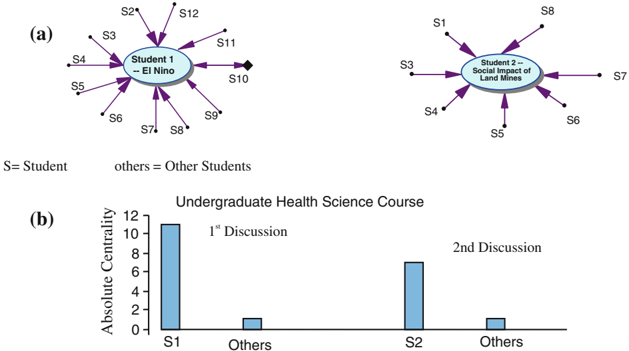
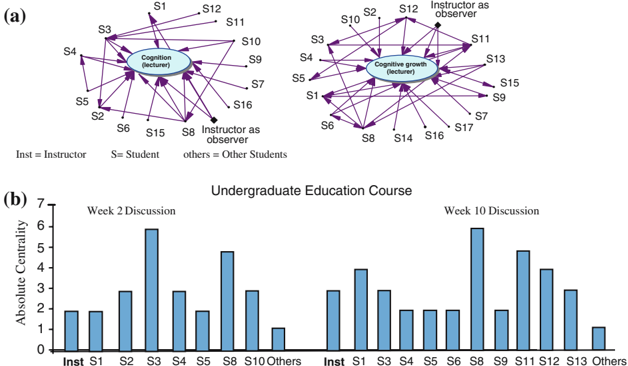
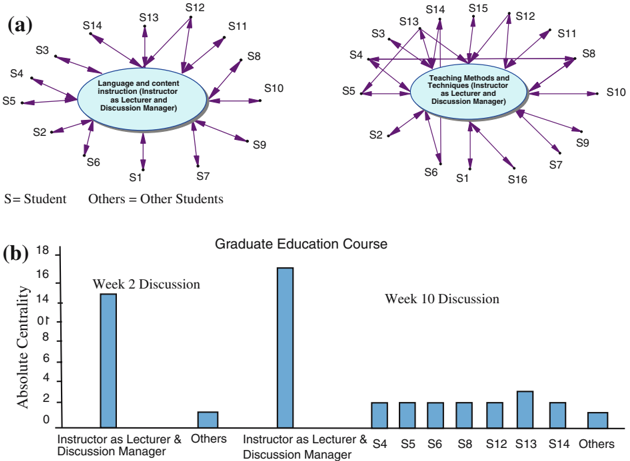
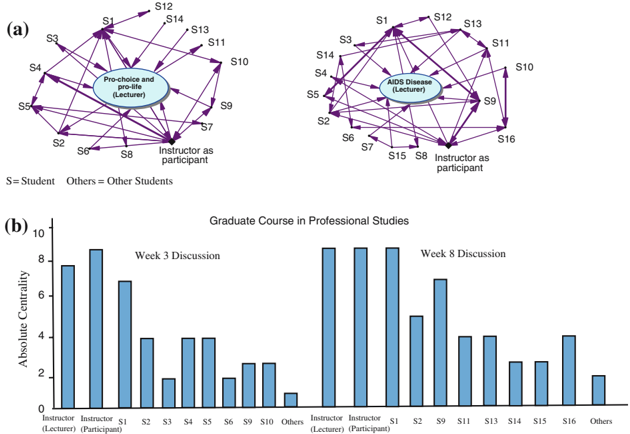
- Two interaction types appeared: star (Classes A and C) and interconnected web (Classes B and D); network density ranged from 0.20 to 0.40 (Class A 0.20/0.29; Class B 0.25/0.25; Class C 0.28/0.28; Class D 0.36/0.40).
- Cognitive engagement varied from low to high: Class A was mostly low (65% Statement Type I in “El Nino”; 28% horizontal questions; 7% explanations; no analytical, evaluative, or reflective messages); Class B was low in Week 1 (76% Type I) and mixed in Week 2 (40% Type I, 15% Question Type I, 15% Type II, 30% Type III); Classes C and D showed higher engagement (e.g., Class C evaluative messages 21% and 18%; Class D had 34% explaining personal opinions and 29% responding to peers).
- No direct relationship was found between interaction type and cognitive engagement: Classes A and C both had star interaction but low vs. high engagement; Classes B and D both had interconnected web interaction but low vs. high engagement.
- Instructor role and discussion design may matter: instructor messages were 0% in Class A, 7%/8% in Class B, 45% in both Class C discussions (evaluative but no mentoring/scaffolding), and 29%/17% in Class D, where the instructor participated as peer and mentor.
Methods
- Participants were 71 students from 3 colleges in a small public university: Class A undergraduate health science (22; 5 male, 17 female), Class B undergraduate education (17; 2 male, 15 female), Class C graduate education (16; 3 male, 13 female), and Class D graduate professional studies (16; 6 male, 10 female); all were required to participate in asynchronous online discussions during a 12–14 week semester.
- Two discussion transcripts were selected from each of the four classes, avoiding the first or last week; 244 messages were analyzed in total.
- Analysis combined social network analysis (network size, centrality, density) with qualitative content analysis using the Analytical Framework for Cognitive Engagement in Discussion, incorporating Zhu’s coding system, Henri’s content-analysis framework, and Bloom’s cognitive domains; two readers assigned levels, compared notes, and reached agreement, with 20 (about 8%) of 244 messages reassigned and later 4 messages (1.2%) re-adjusted.
Limitations
- Stated: the small number of courses and students from limited academic units means findings cannot be generalized; data were insufficient to explore complex relations among variables such as instructor presence, role, expectations, discussion goals, facilitation, questions, class size, delivery format, grade percentage, gender, academic maturity, intrinsic motivation, and prior knowledge.
- Stated: content analysis as a measure of cognitive engagement needs further examination for validity and reliability, and the combined network/content methodology can be modified; reasons for lurking were not studied.
- Evident from the text: the sample is limited to social science courses at one small public university and is predominantly female (average 80% female); no student or instructor interviews were conducted, and formal coding reliability statistics are not reported beyond agreement and reassignment counts.
Model-written summary. Check it against the paper before relying on it.
Integrity signals
Registry
Cites
Statistics
Figures
Verification
Claims the paper makes
1 Valid · 3 Not valid · 16 Not checked · 131 Own results and interpretations
The cited sources support only part of this claim — read each source’s verdict below.
In the paper
“The size of a network and the interaction grow proportionally (Fahy et al., 2001;Ridley & Avery, 1979;Rytina, 1982).”
§ Interaction and cognitive engagement: An analysis of four asynchronous online discussions > Data collection and analysis
What the sources say
- Partly supportedcites Fahy et al., 2001 matched to “Patterns of Interaction in a Computer Conference Transcript” (2001) sourceExperimental — accuracy not yet measured
The Network size section says that as a network grows, the number of potential linkages grows. It does not say actual interaction grows proportionally; the Discussion instead says that increasing size forces participants to be selective in their interactions. (LLM, conf=0.87)
- Not checked — no full text of the sourcecites Ridley & Avery, 1979 matched to “Social Network Influence on the Dyadic Relationship” (1979) source
- Not matchedcites Rytina, 1982
An author–year citation the paper’s reference list doesn’t settle. We don’t search these by name.
plainstates an association- Asserted: passes — The authors put it forward as true.
- Checkable: passes — It can be checked against evidence.
- Load-bearing: unclear — It is unclear whether the paper’s conclusions depend on it.
- Based: passes — The paper gives a reason why it holds.
- Partly supported
A result the paper reports from its own data — it cites no other source for it, so there is none to check. The quote shows it is in the paper.
In the paper
“Sixty-five percent of messages in the ''El Nino'' discussion belonged to Statement Type I”
§ Interaction and cognitive engagement: An analysis of four asynchronous online discussions > Cognitive engagement
plain- Asserted: passes — The authors put it forward as true.
- Checkable: passes — It can be checked against evidence.
- Load-bearing: unclear — It is unclear whether the paper’s conclusions depend on it.
- Based: passes — The paper gives a reason why it holds.
A result the paper reports from its own data — it cites no other source for it, so there is none to check. The quote shows it is in the paper.
In the paper
“About half of the students had an absolute centrality greater than 2.”
§ Interaction and cognitive engagement: An analysis of four asynchronous online discussions > Interaction viewed through the lens of network size, centrality, and density
plain- Asserted: passes — The authors put it forward as true.
- Checkable: passes — It can be checked against evidence.
- Load-bearing: unclear — It is unclear whether the paper’s conclusions depend on it.
- Based: passes — The paper gives a reason why it holds.
A result the paper reports from its own data — it cites no other source for it, so there is none to check. The quote shows it is in the paper.
In the paper
“The network size for the four discussions (Classes A-D) was relatively small, ranging from 8 to 18”
§ Interaction and cognitive engagement: An analysis of four asynchronous online discussions > Interaction viewed through the lens of network size, centrality, and density
plain- Asserted: passes — The authors put it forward as true.
- Checkable: passes — It can be checked against evidence.
- Load-bearing: unclear — It is unclear whether the paper’s conclusions depend on it.
- Based: passes — The paper gives a reason why it holds.
A result the paper reports from its own data — it cites no other source for it, so there is none to check. The quote shows it is in the paper.
In the paper
“Twenty-eight percent messages raised questions that were horizontal in direction with no direct answers.”
§ Interaction and cognitive engagement: An analysis of four asynchronous online discussions > Cognitive engagement
plainSingle case- Asserted: passes — The authors put it forward as true.
- Checkable: passes — It can be checked against evidence.
- Load-bearing: unclear — It is unclear whether the paper’s conclusions depend on it.
- Based: passes — The paper gives a reason why it holds.
75 more claims
Create a free account to see all 151 claims and every source verdict.
- It may state two separate claims as one. 42
- Probably not a substantial claim. 44
Self-check
Percentages, sums and reported differences re-computed from the paper’s own numbers.
Each contradiction between two passages listed here was confirmed by an independent check.
Rated minor: it would not touch a result — a value no result rests on, a p-value that stays on the same side of the significance level, or a conflict that is clerical, resolved elsewhere in the paper, or outside its own findings.
In the paper
§ Interaction and cognitive engagement: An analysis of four asynchronous online discussions > Study participants
“in a regular semester (12-14 weeks)”
§ Interaction and cognitive engagement: An analysis of four asynchronous online discussions > One undergraduate course in health science
“The Internet sessions scheduled for Weeks 3 and 8 (in a 15-week semester) discussed course assignments.”
Rated minor: it would not touch a result — a value no result rests on, a p-value that stays on the same side of the significance level, or a conflict that is clerical, resolved elsewhere in the paper, or outside its own findings.
In the paper
§ Interaction and cognitive engagement: An analysis of four asynchronous online discussions > Interaction viewed through the lens of network size, centrality, and density
“Student 2, who posted the topic ''Social Impact of Land Mines,'' had a centrality of 8.”
§ Interaction and cognitive engagement: An analysis of four asynchronous online discussions > One undergraduate course in health science
“Twelve students participated in the ''El Nino'' discussion and 8 students joined in the discussion on ''Social Impact of Land Mines.''”
Citations
Cites
(1978) · Medical Entomology and Zoology · Cited by 53,488
Bloom, B. S., Engelhart, M. D., Furst, E. J., Hill, W. H., & Krathwohl, D. R. (1956) · Cited by 9,342
Social Network Analysis: A Handbook.
Pappi, F. U., & Scott, J. (1993) · Contemporary Sociology · doi:10.2307/2075047 · Cited by 5,969
(1956) · Medical Entomology and Zoology · Cited by 4,596
The Taxonomy of Educational Objectives
(2012) · Encyclopedia of the Sciences of Learning · doi:10.1007/978-1-4419-1428-6_6027 · Cited by 4,103
Perspectives on socially shared cognition.
(1991) · American Psychological Association eBooks · doi:10.1037/10096-000 · Cited by 3,446
Content Analysis in Communication Research.
de Sola Pool, I., & Berelson, B. (1952) · American Sociological Review · doi:10.2307/2088029 · Cited by 3,099 · cited 1×
“Content analysis, as a research technique for the objective, systematic, quantitative description of the manifest content of communication (Berelson, 1952, p. 519), is adopted to analyze and determine student cognitive engagement in the online discussion.”
MethodCritical thinking, cognitive presence, and computer conferencing in distance education
Garrison, D. R., Anderson, T., & Archer, W. (2001) · American Journal of Distance Education · doi:10.1080/08923640109527071 · Cited by 3,044 · cited 3×
“Garrison et al. (2001) proposed a four-phase model (trigger, exploration, integration, and resolution) to explore and examine the nature and quality of critical inquiry in computer conferencing.”
BackgroundMethodResultGagné, R. M. (1965) · Bibliothèque et Archives nationales du Québec (Québec government) · Cited by 3,016
Assessing Social Presence In Asynchronous Text-based Computer Conferencing
Rourke, L., Anderson, T. D., Garrison, D. R., & Archer, W. (1999) · AUSpace (Athabasca University) · Cited by 2,388
Research works printed but not linked: 4
- 4. Berge, Z.L. & Collins, M. eds. (1995). Computer mediated communication and the online classroom. Vol. 1: Overview and perspectives. Cresskill: Hampton Press, Inc.
- 19. Jeong, A. (2005) Methods and tools for the computational analysis of group interaction and argumentation in asynchronous online discussions. Paper presented at the 2005 Technology and Learning Symposium, New York, NY.
- 30. Riedl, R. (1989). Patterns in computer-mediated discussions. In R. Mason and A. Kaye, eds, Mindweave: Communication, computers, and distance education, pp. 215-220. Pergamon Press: Oxford.
- 36. Stoney, C. & Oliver, R. (1999) Can higher order thinking and cognitive engagement be enhanced with multimedia? Interactive Multimedia Electronic Journal of Computer- Enhanced Learning. Retrieved in February 2006 from http://imej.wfu.edu/articles/ 1999/2/07/index.asp.
Cited by
Items 101–200 of 363
Diep, A. N., Zhu, C., Cocquyt, C., Greef, M. D., & Vanwing, T. (2018) · Studies in Continuing Education · doi:10.1080/0158037x.2018.1518899 · Cited by 32
“Despite employing different vocabularies, the frameworks reviewed highlight that online participation is a complex cognitive, facilitative (Yoon 2006; Zhu 2006; Ke and Xie 2009), and social process (Yoon 2006; Ke and Xie 2009), the purpose of which is to achieve high levels of knowledge construction and foster relatio…”
BackgroundAsif, M., Thomas, G., Awan, M. U., & Din, A. M. (2020) · International Journal of Educational Management · doi:10.1108/ijem-10-2019-0375 · Cited by 54
Cohesion in online environments
Altebarmakian, M., & Alterman, R. (2019) · International Journal of Computer-Supported Collaborative Learning · doi:10.1007/s11412-019-09309-y · Cited by 34
“…are thinking about the material at hand (e.g. Blumenfeld et al. 2006); for example, the work on online discussion forums defines cognitive engagement as “ ... attention to related readings and effort in analyzing and synthesizing readings demonstrated in discussion messages ” (Zhu 2006, p. 454).”
BackgroundWhat Adolescents Can Tell Us: Technology and the Future of Social Work Education
Ahmedani, B. K., Harold, R. D., Fitton, V. A., & Gibson, E. D. S. (2010) · Social Work Education · doi:10.1080/02615479.2010.504767 · Cited by 30
“Students who are shy also participate more fully and thoughtfully online than in the regular classroom (Zhu, 2006).”
BackgroundIdentifying patterns of collaborative knowledge exploration in online asynchronous discussions
Lee, S. W., & Tsai, C. (2010) · Instructional Science · doi:10.1007/s11251-010-9131-8 · Cited by 30
“What may possibly contribute to the observed CKE phenomena in online asynchronous discussions? Previous research has suggested that online discussion interactions and levels of cognitive engagement may be related to participants’ academic level (e.g., Liu and Tsai 2008), instructor’s presence, role or expectations (e.…”
BackgroundInfluentialStudents' Learning in Asynchronous Discussion Forums: A Meta-Analysis
Martono, F., & Salam, U. (2016) · International Journal of Information and Communication Technology Education · doi:10.4018/ijicte.2017010105 · Cited by 27
HoloBoard: a Large-format Immersive Teaching Board based on pseudo HoloGraphics
Gong, J., Han, T., Guo, S., Li, J., Zha, S., Zhang, L., Tian, F., Wang, Q., & Rui, Y. (2021) · ACM Symposium on User Interface Software and Technology (UIST) · doi:10.1145/3472749.3474761 · Cited by 35
Pham, T. N., Thalathoti, V., & Dakich, E. (2014) · Australasian Journal of Educational Technology · doi:10.14742/ajet.608 · Cited by 32
“Later studies by Zhu (2006), Lally, Lipponen, Simons, and de Laat (2007), and Sun (2011) continued to explore various patterns of interaction between learners and peers, and learners and instructors, as well as learners with content.”
BackgroundRajan, M. H., Herbert, C. A., & Polly, P. (2024) · Frontiers in Education · doi:10.3389/feduc.2023.1320822 · Cited by 62
Appropriation of a representational tool in a second-language classroom
Wen, Y., Looi, C., & Chen, W. (2015) · International Journal of Computer-Supported Collaborative Learning · doi:10.1007/s11412-015-9208-0 · Cited by 29
“It has been widely reported in educational literature that such cognitive engagement requiring higher-order-thinking skills is critical to meaningful learning (e.g., Zhu 2006).”
BackgroundSharma, P. R., Akgün, M., & Li, Q. (2023) · Educational Technology Research and Development · doi:10.1007/s11423-023-10261-w · Cited by 41
“Interaction can be broadly defined as mutual and reciprocal responses within an online forum (Zhu, 2006).”
Recent Contributions of Data Mining to Language Learning Research
Warschauer, M., Yim, S., Lee, H., & Zheng, B. (2019) · Annual Review of Applied Linguistics · doi:10.1017/s0267190519000023 · Cited by 32
“Social network analysis has been increasingly adopted in education to examine group interactions and behavior patterns among participants (e.g., Shea et al., 2013; Sun, Lin, Wu, Zhou, & Luo 2018; Xie, Di Tosto, Lu, & Cho, 2018; Zhu, 2006).”
BackgroundMethodHow Do Students View Asynchronous Online Discussions As A Learning Experience?
Bassett, P. (2011) · Interdisciplinary Journal of e-Skills and Lifelong Learning · doi:10.28945/1376 · Cited by 22
“Alignment with curriculum objectives and integration of learning and assessment activities are essential factors in blended learning (Groves and O'Donoghue, 2009; Zhu, 2006).”
InfluentialThe Influence of Group Big-Five Personality Composition on Student Engagement in Online Discussion
Zhang, X., Chen, G., & Xu, B. (2020) · International Journal of Information and Education Technology · doi:10.18178/ijiet.2020.10.10.1452 · Cited by 27
“According to Zhu [33] and Bloom's learning hierarchy, the cognitive engagement was divided into 11 levels in 5 categories (e.”
MethodAngelino, F. J. D. A., Loureiro, S. M. C., & Bilro, R. G. (2021) · Journal of Promotion Management · doi:10.1080/10496491.2021.2009614 · Cited by 27
“Moreover, technological advances have provided people with global communications platforms that promote interaction to exchange information and knowledge (Zhu, 2006).”
BackgroundBlanchette, J. (2011) · Linguistics and Education · doi:10.1016/j.linged.2011.02.007 · Cited by 26
Salvador, C. C., Rochera, M. J., de Gispert, I., & Arceo, F. D. B. (2013) · Digital Education Review · doi:10.1344/der.2013.23.27-45 · Cited by 33
Zhan, X., Sun, D., Wen, Y., Yang, Y., & Zhan, Y. (2022) · Journal of Science Education and Technology · doi:10.1007/s10956-022-09970-3 · Cited by 30
“Our observation framework is based on the Analytical Framework for Cognitive Engagement in Discussion (Zhu, 2006) and Bloom’s Revised Taxonomy (Krathwohl, 2002).”
MethodStudent Engagement in the HyFlex and Online Classrooms: Lessons from the COVID-19 Pandemic
Bozan, K., Gaskin, J. E., & Stoner, C. (2023) · Technology Knowledge and Learning · doi:10.1007/s10758-023-09661-x · Cited by 26
“Several studies have found that engagement is more likely to develop when the student–teacher relationship is strong (Ryan et al., 1994; Zhang & Aasheim, 2011) and students perceive teachers as supportive (Leese, 2009) and knowledgeable (Zhu, 2006).”
(2018) · DOAJ (DOAJ: Directory of Open Access Journals) · Cited by 20
An Affective Cognitive Teaching and Learning Framework in Engineering Education
Lashari, T. A., Alias, M., Akasah, Z. A., et al. (2012) · UTHM Institutional Repository (Universiti Tun Hussein Onn Malaysia) · Cited by 19
Schaefer, T., Fabian, C., & Kopp, T. (2019) · British Journal of Educational Technology · doi:10.1111/bjet.12894 · Cited by 29
Chiu, C., Lin, C., Chen, K., Liu, C., & Ma, H.-C. (2017) · Review of Managerial Science · doi:10.1007/s11846-017-0257-9 · Cited by 20
“Empirical evidence has found that online applications that provide better interactivity are more likely to boost people’s engagement (Zhu 2006) and perceived enjoyment (e.g. Lin and Bhattacherjee 2010; Lowry et al. 2007).”
BackgroundOnline Teacher Education: Exploring the Impact of a Reading and Literacy Program on Student Learning
Weschke, B., Barclay, R., & Vandersall, K. (2011) · Online Learning · doi:10.24059/olj.v15i2.174 · Cited by 23
“Despite the burgeoning literature about the impact of online instruction broadly and increasing demand for online education in general, and teacher education and professional development in particular, there are mixed findings about the efficacy of these modalities, particularly concerning effective participant engage…”
Dorner, H. (2012) · American Journal of Distance Education · doi:10.1080/08923647.2012.692265 · Cited by 22
“Transcripts of interactions among a small group (n = 8) and a larger group (n = 20) of in-service teachers and their mentors were analyzed at the macrolevel and microlevel: at the macrolevel by Social Network Analysis and at the microlevel by content analysis (Garrison, Anderson, and Archer 2001; Zhu 2006).”
MethodMOOC-ASV: analytical statistical visual model of learners’ interaction in videos of MOOC courses
Mubarak, A. A., Ahmed, S. A. M., & Cao, H. (2021) · Interactive Learning Environments · doi:10.1080/10494820.2021.1916768 · Cited by 25
“Others focused on certain aspects of learning engagements (e.g. Zhu, 2006) or targeted small samples(e.g. Costley & Lange, 2017).”
BackgroundDemir, Ö., Çınar, M., & Keskin, S. (2023) · Education and Information Technologies · doi:10.1007/s10639-022-11517-3 · Cited by 23
“When studies of online interaction are examined from past to present, it becomes evident that these studies are commonly handled within the framework of sociocultural and collaborative learning theories (Zhu, 2006).”
BackgroundExploring an Innovative Approach to Enhance Discussion Board Engagement
Hamadi, H. Y., Tafili, A. A., Kates, F. R., Larson, S. A., Ellison, C., & Song, J. (2023) · TechTrends · doi:10.1007/s11528-023-00850-0 · Cited by 28
“Within a discussion board, student interaction and exchange of information, as well as the collaborative effort put forth to create a video, supports the development of a group that holds specific learning goals (Zhu, 2006).”
BackgroundChallenges to web-based learning in pharmacy education in Arabic language speaking countries
Alkoudmani, R. M., & Elkalmi, R. M. (2015) · Archives of Pharmacy Practice · doi:10.4103/2045-080x.160989 · Cited by 20
“Numerous studies have shown barriers regarding offering effective education when using e‐learning such as higher costs, poor interactive face‐to‐face learning, more workload on staff members, and information technology (IT) technical support.[4,5]”
BackgroundNichols, K., Ranasinghe, M., & Hanan, J. (2012) · Instructional Science · doi:10.1007/s11251-012-9253-2 · Cited by 17
“This revised taxonomy has been used and validated as a tool in previous studies to analyse the cognitive process used by students to complete a task (Valcke et al. 2009; Zhu 2006).”
MethodThe Relationship Between Offline Social Capital and Online Learning Interactions
Kent, C., Rechavi, A., & Rafaeli, S. (2019) · International journal of communication · Cited by 33
Yen, C., Bozkurt, A., Tu, C., Sujo-Montes, L. E., Rodas, C. R., Harati, H., & Lockwood, A. B. (2019) · Journal of Educational Technology Development and Exchange · doi:10.18785/jetde.1101.02 · Cited by 20
“…thinking (Klisc et al., 2017; Richardson & Ice, 2010), social interaction (Sun et al., 2018), higher-order thinking (Darabi et al., 2013), cognitive engagement (Zhu, 2006), knowledge and community building (Schrire, 2006; Tirado et al., 2015), academic achievement (Msonde, & Van Aalst, 2017) .”
BackgroundLeflay, K., & Groves, M. (2013) · Journal of Hospitality Leisure Sport & Tourism Education · doi:10.1016/j.jhlste.2012.06.001 · Cited by 17
The “I” in interaction: authorial presense in academic writing
Muñoz, M. C. (2013) · Revista de Lingüística y Lenguas Aplicadas · doi:10.4995/rlyla.2013.1162 · Cited by 28
Li, X., Cox, A. M., & Ford, N. J. (2017) · Journal of Documentation · doi:10.1108/jd-05-2016-0060 · Cited by 18
Gazave, C. M., & Hatcher, A. R. (2017) · Medical Science Educator · doi:10.1007/s40670-017-0374-8 · Cited by 17
“These features of behavioral engagement have been evaluated using surveys [18, 22, 30], direct observation [22, 30], and evaluation of online discussion transcripts [31].”
MethodMaintaining rich dialogic interactions in the transition to synchronous online learning
Jung, H., & Brady, C. E. (2020) · Information and Learning Sciences · doi:10.1108/ils-04-2020-0096 · Cited by 21
Maré, S., & Mutezo, A. T. (2025) · Interactive Learning Environments · doi:10.1080/10494820.2025.2479164 · Cited by 28
“For students to develop and construct new knowledge, engagement and interaction between teachers and students are essential throughout online learning (Akarasriworn & Ku, 2013; Lee, 2018; Weiser et al., 2018; Zhu, 2006).”
Classifying and visualizing students' cognitive engagement in course readings
Yogev, E., Gal, K., Karger, D. R., Facciotti, M. T., & Igo, M. M. (2018) · ACM Conference on Learning @ Scale (L@S) · doi:10.1145/3231644.3231648 · Cited by 21
“Zue [21] studied students’ CE behavior in four different social science classes.”
BackgroundThe Cliques Participation Index (CPI) as an Indicator of Creativity in Online Collaborative Groups
Mazzoni, E. (2014) · Journal of Cognitive Education and Psychology · doi:10.1891/1945-8959.13.1.32 · Cited by 13
“…Mazzoni, Gaffuri, & Gasperi, 2010) and many authors have already described its potentialities for analyzing the levels and patterns of interaction in online learning environments (Daradoumis, Martınez-Mones, & Xhafa, 2004; De Laat, Lally, Lipponen, & Simons, 2007; Martinez et al., 2006; Zhu, 2006).”
BackgroundLewis, D. R., & Lewis, T. Y. (2020) · Innovation in Language Learning and Teaching · doi:10.1080/17501229.2020.1813736 · Cited by 20
The effects of teacher’ feedback: a case study of an online discussion forum in Higher Education
Rochera, M. J., Engel, A., & Salvador, C. C. (2021) · Revista de Educación a Distancia (RED) · doi:10.6018/red.476901 · Cited by 24
The Relationship of High School Student Motivation and Comments in Online Discussion Forums
Sloan, C. (2015) · Journal of Educational Computing Research · doi:10.1177/0735633114568857 · Cited by 18
“Researchers have cited numerous benefits to having students participate in online discussions: They create more equitable participation (Harasim, 2000; Zhu, 2006), allow more time for reflective comments (Hiltz, 1986), facilitate knowledge co-construction and higher level thinking skills (Garrison, 1992; Gunawardena,…”
BackgroundWen, A. S., Zaid, N. M., & Harun, J. (2015) · IEEE Conference on e-Learning, e-Management and e-Services (IC3e) · doi:10.1109/ic3e.2015.7403487 · Cited by 13
“It consists of namely: the students’ behavior of seeking, interpreting, analyzing and summarizing information, critiquing and reasoning through various options and arguments and making decisions in online discussions [12].”
BackgroundCheng, Y., & Jiang, H. (2015) · Computers & Education · doi:10.1016/j.compedu.2015.07.007 · Cited by 18
Vogler, J. S., Munsell, S. E., & Knutson, D. (2019) · Computers & Education · doi:10.1016/j.compedu.2019.103597 · Cited by 17
Salvador, C. C., & Engel, A. (2014) · Anales de Psicología · doi:10.6018/analesps.30.3.201181 · Cited by 22
“This approach is shared by a great many other works which, while not explicitly identifying on-topic talk as their focus, use a number of analysis categories – elaborating and summarizing ideas or concepts, developing and exploring hypotheses, proposing new coconstructions on topics, defining terms and judging definit…”
BackgroundAnalysis of Students’ Listening Behavior Patterns in an Asynchronous Discussion Forum
Durairaj, K., & Umar, I. N. (2015) · Procedia - Social and Behavioral Sciences · doi:10.1016/j.sbspro.2015.01.440 · Cited by 13
Participation in online discussion environments: Is it really effective?
Kurnaz, F. B., Ergün, E., & Ilgaz, H. (2018) · Education and Information Technologies · doi:10.1007/s10639-018-9688-4 · Cited by 13
“The interaction of students’ cognitive knowledge as well as the number and length of the messages should be evaluated in any assessment of student performance (Dennen 2008; Zhu 2006).”
Influencing Factors of Learners’ Cognitive Engagement in an Online Learning Environment
Lin, L., Wang, J., & Meng, X. (2022) · International Journal of Emerging Technologies in Learning (iJET) · doi:10.3991/ijet.v17i17.33851 · Cited by 12
Supporting problem solving with asynchronous online discussions: a social network analysis
Cheng, Z., Long, Y., & Koehler, A. A. (2022) · Educational Technology Research and Development · doi:10.1007/s11423-022-10110-2 · Cited by 18
“Many factors can impact student interaction in online discussions, including students’ prior knowledge of the discussion questions and students’ interests in the discussion prompts (Zhu, 2006).”
BackgroundSidi, Y., Blau, I., & Shamir‐Inbal, T. (2022) · Journal of Computer Assisted Learning · doi:10.1111/jcal.12714 · Cited by 19
How the Visual Rhetoric of Online Discussions Enables and Constrains Students’ Participation
Sherry, M. B. (2017) · Journal of Adolescent & Adult Literacy · doi:10.1002/jaal.683 · Cited by 17
Kim, H. S., & Oh, E. G. (2018) · International Journal of Online Pedagogy and Course Design · doi:10.4018/ijopcd.2018040103 · Cited by 11
“However,manyresearchersconcludethatasynchronousonlinediscussionitselfdoesnot ensuremeaningfullearninganddiscourse(Hew,Cheung,andNg,2010;Zhu,2006).”
Supporting All Students: Productive Mathematical Discourse in Online Environments
Harbour, K. E., & Denham, A. R. (2021) · Intervention in School and Clinic · doi:10.1177/10534512211001849 · Cited by 11
“Furthermore, online discussion boards provide a way for students to participate equally in the conversation (Zhu, 2006).”
BackgroundApplying text mining to predict learners' cognitive engagement
Hayati, H., Idrissi, M. K., & Bennani, S. (2017) · doi:10.1145/3175628.3175655 · Cited by 10
“Zhu defines cognitive engagement by [12] ".”
Shan, J., & Wang, W. (2021) · Interactive Learning Environments · doi:10.1080/10494820.2021.1916764 · Cited by 14
“These two methods have been bound together to explore the quality of discussion from various roles in online discussion forums (Chen & Huang, 2019; Xie et al., 2018; Zhu, 2006).”
BackgroundMethodMentoring Innovation through Online Communications in a Digital Culture
Dorner, H. (2012) · SAGE Publications Ltd eBooks · doi:10.4135/9781446247549.n12 · Cited by 14
Yang, X., Zhang, M., Kong, L., et al. (2020) · Research Square · doi:10.21203/rs.3.rs-40814/v1 · Cited by 10
Using Facebook Groups to Encourage Science Discussions in a Large-Enrollment Biology Class
Pai, A., McGinnis, G., Bryant, D., Cole, M. F., Kovacs, J. L., Stovall, K. C., & Lee, M. (2017) · Journal of Educational Technology Systems · doi:10.1177/0047239516675898 · Cited by 12
“The assumption is that more academically mature students or students with more prior knowledge will engage at a higher level (Zhu, 2006).”
BackgroundAlharbi, M. A. (2018) · Journal of Information Technology Education Research · doi:10.28945/4143 · Cited by 9
“Zhu (2006) Functions: evaluation, scaffolding, mentoring, explanation, statements, questions and reflection In other words, asynchronous technological tools provide learners with enough time to read and reflect on their peers’ or even instructors’ comments and then respond to them, thus showing…”
BackgroundResultInfluentialMompoint‐Gaillard, P., Ragnarsdóttir, G., & Jónasson, J. T. (2022) · Teaching and Teacher Education · doi:10.1016/j.tate.2022.103751 · Cited by 12
Zheng, B., & Warschauer, M. (2018) · Journal of Educational Computing Research · doi:10.1177/0735633118794059 · Cited by 11
Impact of Webquest on Student Engagement
Kaur, S., & Kauts, A. (2018) · Indian Journal of Public Health Research & Development · doi:10.5958/0976-5506.2018.02230.1 · Cited by 10
Kipp, K., Rice, K., Lowenthal, P. R., & Hung, J.-L. (2023) · Educational Technology Research and Development · doi:10.1007/s11423-023-10189-1 · Cited by 12
“Discussions, group projects, and back-channel communications all demonstrate potential in building a sense of course community through course design (O’Shea, Stone, & Delahunty, 2015; Price & Tovar, 2014; Zhu, 2006; Zydney et al., 2012).”
BackgroundZhang, H., Chen, S., & Zheng, S. (2024) · Education and Information Technologies · doi:10.1007/s10639-024-12893-8 · Cited by 17
“Highlevelsofcognitiveengagementareachievedthrough effective interaction guided by teachers, such as balancing teacher-involved activities and task-oriented online discussions (Zhu, 2006), and designing teaching games (Ding et al., 2018) to induce effective student engagement.”
Student discussion forums: what is in it for them?
Pieterse, V., & van Rooyen, I. J. (2011) · Computer Science Education Research Conference · doi:10.5555/2043594.2043599 · Cited by 8
Li, Q., Zhang, J., Xie, X. Y., et al. (2021) · Lecture notes in networks and systems · doi:10.1007/978-3-030-80094-9_34 · Cited by 8
Exploring global online course participants’ interactions: Value of high-level engagement
Jin, H., Karatay, Y., Bordbarjavidi, F., et al. (2022) · ReCALL · doi:10.1017/s0958344021000331 · Cited by 8
“Zhu (2006) characterized interconnected interactions as having higher centrality measures, which means that participants are interacting with multiple people within the course.”
BackgroundCommunity building in the digital age: Dynamics of online sports discussion
López-González, H., Guerrero-Solé, F., & Larrea, O. M. I. (1970) · Communication & Society · doi:10.15581/003.27.35988 · Cited by 20
A Review for the Online Social Networks Literature (2005-2011)
Ravasan, A. Z., Rouhani, S., & Asgary, S. (2014) · European Journal of Business and Management · Cited by 16
How Interactive is a Semantic Network? Concept Maps and Discourse in Knowledge Communities
Kent, C., & Rafaeli, S. (2016) · Hawaii International Conference on System Sciences (HICSS) · doi:10.1109/hicss.2016.265 · Cited by 10
“The context layer offers structural metrics which depict networked based analyses [43] of the context of the single post: the nature of its inside and outside relations.”
BackgroundSchool socialization style, student engagement, and academic performance
Lee, J. (2008) · Carolina Digital Repository (University of North Carolina at Chapel Hill) · doi:10.17615/mh70-g209 · Cited by 13
Wu, L., Yu, S., Liu, Q., Ye, J., Zheng, X., & Wang, J. (2023) · Journal of Computing in Higher Education · doi:10.1007/s12528-023-09389-8 · Cited by 9
“Then ENA was performed on the data to detect differences in cogni-Table Table 5 Coding scheme of cognitive engagement (Zhu, 2006) 1 3 tive engagement between different groups and roles.”
InfluentialSocial Network Analysis of a Blended Learning experience in higher education
López, P. M., Aliaño, Á. M., & Gómez, J. I. A. (2014) · Repositorio Institucional de la Universidad de Huelva (Universidad de Huelva) · Cited by 7
Posting messages and acquiring knowledge in collaborative online tasks
García, C., & Badia, A. (2020) · Technology Pedagogy and Education · doi:10.1080/1475939x.2020.1778076 · Cited by 9
“Online postings are considered to be digital ‘artifacts of learning that demonstrate student behaviours during the learning process’ (Zhu, 2006, p. 464).”
BackgroundDeveloping Online Discussion Boards to Increase Student Engagement During the COVID-19 Pandemic
Khoshnevisan, B., & Rashtchi, M. (2021) · Dual Language Research and Practice Journal · doi:10.21423/dlrpj-v4.a29 · Cited by 14
“While our understanding of benefits of face-to-face and online discussions to engage students is well developed, the data do not apply to preservice teachers’ perceptions of engagement (e.g., Doorn & Schumm, 2013; Perkins & Murphy, 2006; Rovai, 2007; Zhu, 2006).”
BackgroundCorreal, N. L. O., Ocampo, A. O. P., & Arana, D. M. (2018) · Pedagogía y Saberes · doi:10.17227/pys.num48-7371 · Cited by 10
Engaging and Effective Asynchronous Online Discussion Forums
Abawajy, J., & Kim, T.-H. (2011) · Communications in computer and information science · doi:10.1007/978-3-642-27207-3_75 · Cited by 11
Mediational engagement in E-learning: An Activity Theory analysis
Gedera, P., & Sampath, D. (2014) · Research Commons (University of Waikato) · Cited by 12
Shen, Z., Tan, S., & Pritchard, M. J. (2023) · Behaviour and Information Technology · doi:10.1080/0144929x.2023.2259004 · Cited by 9
“In formal learning, online discussions can detect cognitive engagement, as they indicate learners ’ attention to and analysis and synthesis of the learning material (Zhu 2006).”
O envolvimento do aluno no modelo Flipped Classroom implementado na aprendizagem online
Ribeirinha, T., & da Silva, B. D. (2024) · RELATEC Revista Latinoamericana de Tecnología Educativa · doi:10.17398/1695-288x.23.1.43 · Cited by 10
Liu, Z., Gao, Y., Zhang, N., Long, T., Liu, S., & Peng, X. (2024) · Current Psychology · doi:10.1007/s12144-024-06445-z · Cited by 13
“Research has shown that students who are cognitively engaged can create new knowledge (Zhu, 2006) and they reach a high level of understanding in online discussions, resulting in better learning achievement (Persell, 2004 ).”
Culbreth, D., & Martin, F. (2025) · Educational Technology Research and Development · doi:10.1007/s11423-025-10504-y · Cited by 13
“Examples of analysis include self-reported quantitative measures (Greene, 2015), mixed method analysis (Kiatkeeree & Ruangjaroon, 2022; Sung et al., 2021), discourse analysis (Ryu & Lombardi, 2015), and social network analysis (Zhu, 2006).”
Gao, Y., Wu, L., Xiao-tong, L., Ma, X., & Liu, Q. (2024) · Journal of Computer Assisted Learning · doi:10.1111/jcal.12985 · Cited by 8
Buraphadeja, V. (2010) · ProQuest LLC eBooks · Cited by 13
An analytical framework for analyzing student teachers’ verbal interaction in learning situations
Sánchez, V., García, M., & Escudero, I. (2012) · Instructional Science · doi:10.1007/s11251-012-9226-5 · Cited by 10
Shukor, N. A., Tasir, Z., & Harun, A. (2012) · International Journal of Machine Learning and Computing · doi:10.7763/ijmlc.2012.v2.208 · Cited by 8
“These findings are similar to Zhu’s report on students’ cognitive engagement in four online discussions [2].”
BackgroundMethodResultInfluentialResearch on the Use of Puppeteering to Improve Realism in Army Simulations and Training Games
Griffith, T., Dwyer, T., Kinard, C., et al. (2016) · Lecture notes in computer science · doi:10.1007/978-3-319-39907-2_37 · Cited by 6
“Cognitive engagement involves “seeking, interpreting, analyzing and summarizing information, critiquing and reasoning through various opinions and arguments; and making decisions” [11].”
BackgroundHuang, W. D. (2013) · Advances in educational marketing, administration, and leadership book series · doi:10.4018/978-1-4666-4249-2.ch011 · Cited by 6
Gibbs, W. J., & Bernas, R. S. (2008) · Journal of Computing in Higher Education · doi:10.1007/bf03033430 · Cited by 8
Understanding and Analysing Novice Programmer Interactions in a Facebook Programming Group
Maleko, M., Hamilton, M., D’Souza, D., & Scholer, F. (2014) · International Conference on Learning and Teaching in Computing and Engineering (LaTICE) · doi:10.1109/latice.2014.28 · Cited by 6
“…of interactions in FPGs, the focus on cognitive processing will help to understand the knowledge and processing level demonstrated by the novice messages, as according to Zhu [24], student's cognitive engagement during online discussions is critical for constructing new understanding and knowledge.”
BackgroundThe Role of Online Discussion Forums in Newcomers' Labour Market Integration in Canada
Gulanowski, D. (2018) · Carleton University's Institutional Repository (MacOdrum Library, Carleton University) · doi:10.22215/etd/2018-12865 · Cited by 10
“For example, students interacting and exchanging information in online forum discussions showed better understanding of the material (e.g., Badia et al., 2011; Griesbaum et al., 2015; Zhu, 2006).”
BackgroundSetia, S., & Tichy, M. L. (2024) · Cureus · doi:10.7759/cureus.72858 · Cited by 7
“This is supported by studies indicating that the cognitive load experienced by students is lower in synchronous settings, potentially due to the immediate feedback and available guidance [25,26].”
HyFlex teaching experience and reflections in K-12
Filiz, O., Kaya, M. H., & Adıgüzel, T. (2023) · Online Journal of Communication and Media Technologies · doi:10.30935/ojcmt/13858 · Cited by 6
Slamet, T. I., Brush, T. A., & Kwon, K. (2024) · Technology Knowledge and Learning · doi:10.1007/s10758-024-09740-7 · Cited by 9
“In the context of online learning environment, cognitive engagement is apparent through discussion posts – we can observe if learners pay attention to specific information in discussion transcripts (Zhu, 2006).”
COMUNIDADES DE APRENDIZAJE A TRAVÉS DE PLATAFORMAS DE TELEFORMACIÓN
Morueta, R. T., & Gómez, Á. H. (2012) · RIED Revista Iberoamericana de Educación a Distancia · doi:10.5944/ried.2.14.791 · Cited by 9
Knowledge and interaction in on-line discussions in Spanish by advanced language learners
McCabe, A. (2017) · Computer Assisted Language Learning · doi:10.1080/09588221.2017.1312461 · Cited by 10
“For example, Zhu (2006) quantified types of interaction taking place in terms of size of the network (number of participants), centrality (how frequently one point, or member, connected with others) and density (the general level of connecting going on amongst all members).”
BackgroundMethodEffects of different graphic organizers in asynchronous online discussions
Jeon, M., Kwon, K., & Bae, H. (2022) · Educational Technology Research and Development · doi:10.1007/s11423-022-10175-z · Cited by 9
“Specifically, the density of interaction was quantified by the ratio of the number of interactions (i.e., links) to the total possible combinations (Density = 2a/N(N − 1), where a is the number of observed links and N is the total combinations) (Berkowitz, 1982; Fahy et al., 2001; Zhu, 2006).”
Background
Metadata
- Authors
- Zhu, E.
- Affiliations
- University of Michigan (US)
- Corresponding author
- Zhu, Erping
- Venue
- Instructional Science
- Published
- 2006-11
- Volume
- 34
- Issue
- 6
- ISSN
- 0020-4277 (ISSN-L)
- 1573-1952
- OpenAlex
- W2127101125
- Cited by
- 363
- References
- 48
- Citations by year
- 2026: 11 · 2025: 9 · 2024: 15 · 2023: 24 · 2022: 24 · 2021: 22 · 2020: 20 · 2019: 25 · 2018: 23 · 2017: 23 · 2016: 15 · 2015: 18 · 2014: 23 · 2013: 22 · 2012: 27
- FWCI
- 46.95
- Type
- journal article
- Language
- en
- Open access
- hybrid
- doi.org
- Licence
- cc-by-nc
- creativecommons.org/licenses/by-nc/2.0 (tdm)
- creativecommons.org/licenses/by-nc/2.0 (vor)
- Locations
- Instructional Science (publishedVersion, cc-by-nc)
- Topics
- Social Sciences › Education › Online and Blended Learning
- Physical Sciences › Computer Science › Computer Science Applications › Online Learning and Analytics
- Social Sciences › Psychology › Developmental and Educational Psychology › Innovative Teaching and Learning Methods
- Keywords
- online discourse, asynchronous discussion, student interaction, cognitive engagement, online learning, higher education, social network analysis, student participation, knowledge construction
About these checks
Registry, retraction, Cites and statistics results are computed, not judged, with one exception: a printed reference that no index lists is read once by a model before it counts as a citation error. Claims are extracted by a model and kept only when their quote appears verbatim in the text; each cited source is then checked, with a model’s help, for whether it says what the claim relies on. Those verdicts can be wrong — read the claim’s quote and the cited source before relying on one.
The claim verdicts this report counts are experimental: their accuracy is not yet measured.
A language model drew the claims from the paper on 2026-10-10, under version 3 of the claim definition (model deepseek-v4.1-flash, prompt extract-v3).
A second model labelled each claim on 2026-10-10 (model jev-1.13-20260917, definition revision gold-guideline-v0.2).
Cited sources are checked with a language model’s help (gpt-6-sol).
Statistics and arithmetic are recomputed, not judged.
Confidence bands are shown only for fields calibrated on our annotated test set. None is calibrated yet, so no band is shown.
What counts as a claim ›How we measure confidence ›How we check this ›
Are you an author, or do you see a problem with this page? Request a review
Data sources
Bibliographic data: Semantic Scholar, OpenAlex, Crossref.
Contains information from the Semantic Scholar Academic Graph Datasets, made available under the ODC Attribution License (ODC-BY 1.0).
Semantic Scholar’s data is described in: Kinney, R., et al. (2023). The Semantic Scholar Open Data Platform. arXiv:2301.10140.
