

Interaction and cognitive engagement: An analysis of four asynchronous online discussions
Open accessThe DOI matches its Crossref record; 47 of the 48 references it cites were found in a registry or an index, and 1 are not checked yet; 1 of the 24 sources its claims cite were checked for support.
Abstract
Online discussion plays a unique role in face-to-face and distance teaching and learning. Interaction and student cognitive engagement during the online discussion are critical for constructing new understanding and knowledge. This article analyzes types of interaction that occur during online discussions, examines levels of student cognitive engagement in each discussion, and explores their effects on and implications for learning and teaching in higher education. By combining methods of social network analysis with qualitative content analysis, the article explores new methodologies for analyzing participation, interaction, and learning that take place online, and suggests areas for research in learning and teaching online.
Verified 2026-11-22 · 1 reference not checked yet
Overview
CoChat Summary
TL;DR
This study combined social network analysis and content analysis of four asynchronous online discussions (71 students across four courses) to examine interaction types and cognitive engagement. It found star and interconnected web interaction types and low-to-high cognitive engagement, with no direct relationship between interaction type and cognitive engagement.
Key findings
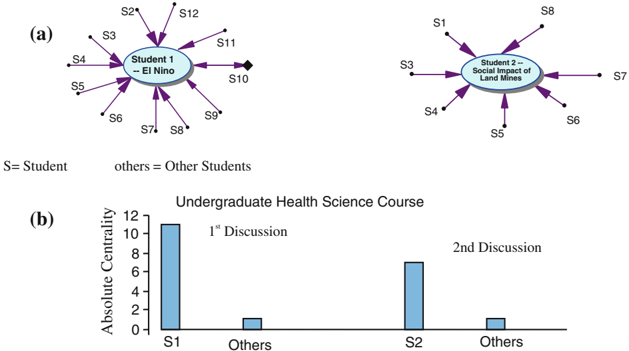
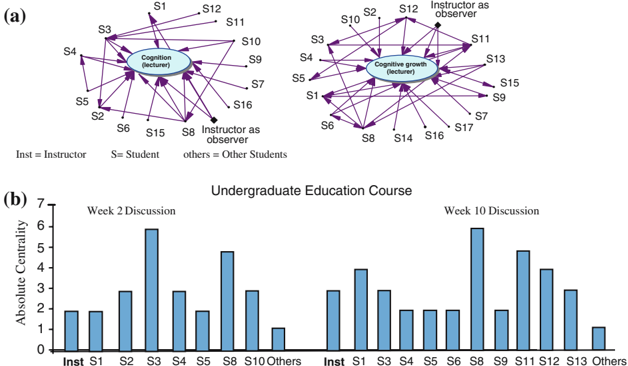
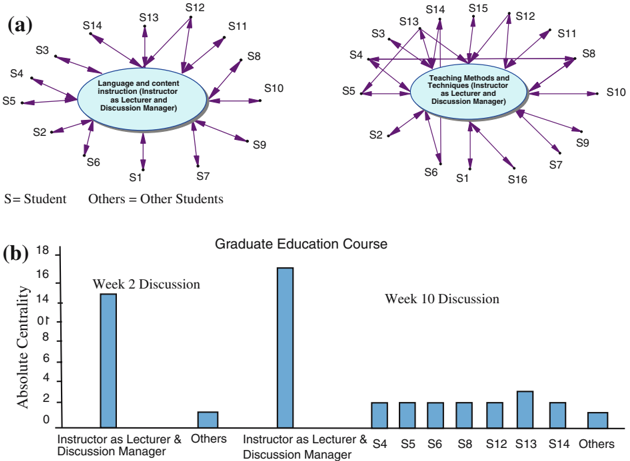
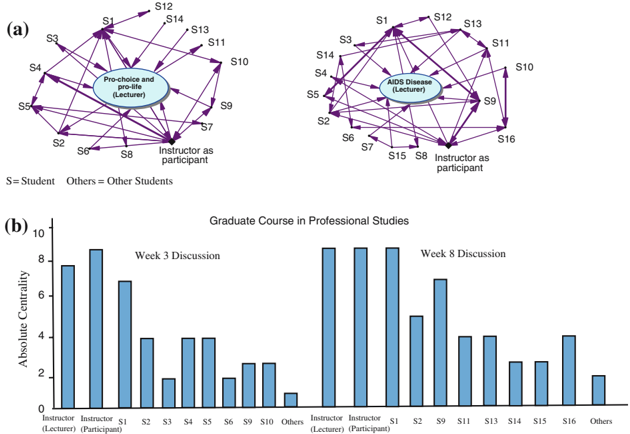
- Two interaction types appeared: star (Classes A and C) and interconnected web (Classes B and D); network density ranged from 0.20 to 0.40 (Class A 0.20/0.29; Class B 0.25/0.25; Class C 0.28/0.28; Class D 0.36/0.40).
- Cognitive engagement varied from low to high: Class A was mostly low (65% Statement Type I in “El Nino”; 28% horizontal questions; 7% explanations; no analytical, evaluative, or reflective messages); Class B was low in Week 1 (76% Type I) and mixed in Week 2 (40% Type I, 15% Question Type I, 15% Type II, 30% Type III); Classes C and D showed higher engagement (e.g., Class C evaluative messages 21% and 18%; Class D had 34% explaining personal opinions and 29% responding to peers).
- No direct relationship was found between interaction type and cognitive engagement: Classes A and C both had star interaction but low vs. high engagement; Classes B and D both had interconnected web interaction but low vs. high engagement.
- Instructor role and discussion design may matter: instructor messages were 0% in Class A, 7%/8% in Class B, 45% in both Class C discussions (evaluative but no mentoring/scaffolding), and 29%/17% in Class D, where the instructor participated as peer and mentor.
Methods
- Participants were 71 students from 3 colleges in a small public university: Class A undergraduate health science (22; 5 male, 17 female), Class B undergraduate education (17; 2 male, 15 female), Class C graduate education (16; 3 male, 13 female), and Class D graduate professional studies (16; 6 male, 10 female); all were required to participate in asynchronous online discussions during a 12–14 week semester.
- Two discussion transcripts were selected from each of the four classes, avoiding the first or last week; 244 messages were analyzed in total.
- Analysis combined social network analysis (network size, centrality, density) with qualitative content analysis using the Analytical Framework for Cognitive Engagement in Discussion, incorporating Zhu’s coding system, Henri’s content-analysis framework, and Bloom’s cognitive domains; two readers assigned levels, compared notes, and reached agreement, with 20 (about 8%) of 244 messages reassigned and later 4 messages (1.2%) re-adjusted.
Limitations
- Stated: the small number of courses and students from limited academic units means findings cannot be generalized; data were insufficient to explore complex relations among variables such as instructor presence, role, expectations, discussion goals, facilitation, questions, class size, delivery format, grade percentage, gender, academic maturity, intrinsic motivation, and prior knowledge.
- Stated: content analysis as a measure of cognitive engagement needs further examination for validity and reliability, and the combined network/content methodology can be modified; reasons for lurking were not studied.
- Evident from the text: the sample is limited to social science courses at one small public university and is predominantly female (average 80% female); no student or instructor interviews were conducted, and formal coding reliability statistics are not reported beyond agreement and reassignment counts.
Model-written summary. Check it against the paper before relying on it.
Integrity signals
Registry
Cites
Statistics
Figures
Verification
Claims the paper makes
1 Valid · 3 Not valid · 16 Not checked · 131 Own results and interpretations
The cited sources support only part of this claim — read each source’s verdict below.
In the paper
“The size of a network and the interaction grow proportionally (Fahy et al., 2001;Ridley & Avery, 1979;Rytina, 1982).”
§ Interaction and cognitive engagement: An analysis of four asynchronous online discussions > Data collection and analysis
What the sources say
- Partly supportedcites Fahy et al., 2001 matched to “Patterns of Interaction in a Computer Conference Transcript” (2001) sourceExperimental — accuracy not yet measured
The Network size section says that as a network grows, the number of potential linkages grows. It does not say actual interaction grows proportionally; the Discussion instead says that increasing size forces participants to be selective in their interactions. (LLM, conf=0.87)
- Not checked — no full text of the sourcecites Ridley & Avery, 1979 matched to “Social Network Influence on the Dyadic Relationship” (1979) source
- Not matchedcites Rytina, 1982
An author–year citation the paper’s reference list doesn’t settle. We don’t search these by name.
plainstates an association- Asserted: passes — The authors put it forward as true.
- Checkable: passes — It can be checked against evidence.
- Load-bearing: unclear — It is unclear whether the paper’s conclusions depend on it.
- Based: passes — The paper gives a reason why it holds.
- Partly supported
A result the paper reports from its own data — it cites no other source for it, so there is none to check. The quote shows it is in the paper.
In the paper
“Sixty-five percent of messages in the ''El Nino'' discussion belonged to Statement Type I”
§ Interaction and cognitive engagement: An analysis of four asynchronous online discussions > Cognitive engagement
plain- Asserted: passes — The authors put it forward as true.
- Checkable: passes — It can be checked against evidence.
- Load-bearing: unclear — It is unclear whether the paper’s conclusions depend on it.
- Based: passes — The paper gives a reason why it holds.
A result the paper reports from its own data — it cites no other source for it, so there is none to check. The quote shows it is in the paper.
In the paper
“About half of the students had an absolute centrality greater than 2.”
§ Interaction and cognitive engagement: An analysis of four asynchronous online discussions > Interaction viewed through the lens of network size, centrality, and density
plain- Asserted: passes — The authors put it forward as true.
- Checkable: passes — It can be checked against evidence.
- Load-bearing: unclear — It is unclear whether the paper’s conclusions depend on it.
- Based: passes — The paper gives a reason why it holds.
A result the paper reports from its own data — it cites no other source for it, so there is none to check. The quote shows it is in the paper.
In the paper
“The network size for the four discussions (Classes A-D) was relatively small, ranging from 8 to 18”
§ Interaction and cognitive engagement: An analysis of four asynchronous online discussions > Interaction viewed through the lens of network size, centrality, and density
plain- Asserted: passes — The authors put it forward as true.
- Checkable: passes — It can be checked against evidence.
- Load-bearing: unclear — It is unclear whether the paper’s conclusions depend on it.
- Based: passes — The paper gives a reason why it holds.
A result the paper reports from its own data — it cites no other source for it, so there is none to check. The quote shows it is in the paper.
In the paper
“Twenty-eight percent messages raised questions that were horizontal in direction with no direct answers.”
§ Interaction and cognitive engagement: An analysis of four asynchronous online discussions > Cognitive engagement
plainSingle case- Asserted: passes — The authors put it forward as true.
- Checkable: passes — It can be checked against evidence.
- Load-bearing: unclear — It is unclear whether the paper’s conclusions depend on it.
- Based: passes — The paper gives a reason why it holds.
75 more claims
Create a free account to see all 151 claims and every source verdict.
- It may state two separate claims as one. 42
- Probably not a substantial claim. 44
Self-check
Percentages, sums and reported differences re-computed from the paper’s own numbers.
Each contradiction between two passages listed here was confirmed by an independent check.
Rated minor: it would not touch a result — a value no result rests on, a p-value that stays on the same side of the significance level, or a conflict that is clerical, resolved elsewhere in the paper, or outside its own findings.
In the paper
§ Interaction and cognitive engagement: An analysis of four asynchronous online discussions > Study participants
“in a regular semester (12-14 weeks)”
§ Interaction and cognitive engagement: An analysis of four asynchronous online discussions > One undergraduate course in health science
“The Internet sessions scheduled for Weeks 3 and 8 (in a 15-week semester) discussed course assignments.”
Rated minor: it would not touch a result — a value no result rests on, a p-value that stays on the same side of the significance level, or a conflict that is clerical, resolved elsewhere in the paper, or outside its own findings.
In the paper
§ Interaction and cognitive engagement: An analysis of four asynchronous online discussions > Interaction viewed through the lens of network size, centrality, and density
“Student 2, who posted the topic ''Social Impact of Land Mines,'' had a centrality of 8.”
§ Interaction and cognitive engagement: An analysis of four asynchronous online discussions > One undergraduate course in health science
“Twelve students participated in the ''El Nino'' discussion and 8 students joined in the discussion on ''Social Impact of Land Mines.''”
Citations
Cites
(1978) · Medical Entomology and Zoology · Cited by 53,488
Bloom, B. S., Engelhart, M. D., Furst, E. J., Hill, W. H., & Krathwohl, D. R. (1956) · Cited by 9,342
Social Network Analysis: A Handbook.
Pappi, F. U., & Scott, J. (1993) · Contemporary Sociology · doi:10.2307/2075047 · Cited by 5,969
(1956) · Medical Entomology and Zoology · Cited by 4,596
The Taxonomy of Educational Objectives
(2012) · Encyclopedia of the Sciences of Learning · doi:10.1007/978-1-4419-1428-6_6027 · Cited by 4,103
Perspectives on socially shared cognition.
(1991) · American Psychological Association eBooks · doi:10.1037/10096-000 · Cited by 3,446
Content Analysis in Communication Research.
de Sola Pool, I., & Berelson, B. (1952) · American Sociological Review · doi:10.2307/2088029 · Cited by 3,099 · cited 1×
“Content analysis, as a research technique for the objective, systematic, quantitative description of the manifest content of communication (Berelson, 1952, p. 519), is adopted to analyze and determine student cognitive engagement in the online discussion.”
MethodCritical thinking, cognitive presence, and computer conferencing in distance education
Garrison, D. R., Anderson, T., & Archer, W. (2001) · American Journal of Distance Education · doi:10.1080/08923640109527071 · Cited by 3,044 · cited 3×
“Garrison et al. (2001) proposed a four-phase model (trigger, exploration, integration, and resolution) to explore and examine the nature and quality of critical inquiry in computer conferencing.”
BackgroundMethodResultGagné, R. M. (1965) · Bibliothèque et Archives nationales du Québec (Québec government) · Cited by 3,016
Assessing Social Presence In Asynchronous Text-based Computer Conferencing
Rourke, L., Anderson, T. D., Garrison, D. R., & Archer, W. (1999) · AUSpace (Athabasca University) · Cited by 2,388
Research works printed but not linked: 4
- 4. Berge, Z.L. & Collins, M. eds. (1995). Computer mediated communication and the online classroom. Vol. 1: Overview and perspectives. Cresskill: Hampton Press, Inc.
- 19. Jeong, A. (2005) Methods and tools for the computational analysis of group interaction and argumentation in asynchronous online discussions. Paper presented at the 2005 Technology and Learning Symposium, New York, NY.
- 30. Riedl, R. (1989). Patterns in computer-mediated discussions. In R. Mason and A. Kaye, eds, Mindweave: Communication, computers, and distance education, pp. 215-220. Pergamon Press: Oxford.
- 36. Stoney, C. & Oliver, R. (1999) Can higher order thinking and cognitive engagement be enhanced with multimedia? Interactive Multimedia Electronic Journal of Computer- Enhanced Learning. Retrieved in February 2006 from http://imej.wfu.edu/articles/ 1999/2/07/index.asp.
Cited by
Items 201–300 of 363
Methodological Considerations for Quantitative Content Analysis of Online Interactions
Tan, S. C., So, H., & Chai, C. S. (2011) · IGI Global eBooks · doi:10.4018/978-1-60960-040-2.ch037 · Cited by 6
“I wonder if …”: The Process of Inquiry in Support of Students’ Co-Learning From Online Discussion
Williams, K. M., Park, J. H., Gaines, R., Choi, E., Lee, J. J., Mattar, L. I., & Schallert, D. L. (2016) · Literacy Research Theory Method and Practice · doi:10.1177/2381336916661515 · Cited by 7
Kent, C., Boulton, C. A., & Williams, H. T. P. (2017) · Open Research Online (The Open University) · Cited by 6
Shumarova, E. V. (2009) · Alexandria (UniSG) (University of St.Gallen) · Cited by 6
Brooks, C. (n.d.) · ProQuest Demo Repository · Cited by 5
A systematic review of factors that predict and mediate conceptual change
Olaogun, O. P., & Hunsu, N. J. (2025) · European Journal of Psychology of Education · doi:10.1007/s10212-025-00959-1 · Cited by 12
“For example, cognitive engagement plays a crucial role in facilitating conceptual change learning because it involves sustained attention and mental effort during learning tasks (Zhu, 2006).”
Educative Sensemaking on Social Media: An Empirical Investigation of Informal Learning on YouTube
Shen, Z., Pritchard, M. S., Tan, S., & Noteboom, C. (2022) · Hawaii International Conference on System Sciences (HICSS) · doi:10.24251/hicss.2022.354 · Cited by 4
Analysis of Media Use and Learning Interaction to Improving Student Engagement
Yulhendri, Y., Mardhotillah, N. I., Alisha, W. P., & Susanti, N. (2022) · Dinamika Pendidikan · doi:10.15294/dp.v17i1.35304 · Cited by 15
“Research variables were measured by using a Likert scale by adopting several studies where the questionnaire for multimedia was adopted (Smith Jr. et al., 2011), interaction learning dopted the questionnaire developed by Allen et al. (1989); Zhu (2006); Rhode (2009); Vuopala et al. (2016).”
MethodExamining Online Communication: A Method for the Quantitative Analysis of Qualitative Data
Hughes, M. G., Griffith, J. A., Byrne, C. L., Nei, D. S., Harkrider, L. N., Zeni, T. A., Shipman, A. S., Connelly, S., & Mumford, M. D. (2016) · Advances in knowledge acquisition, transfer, and management book series/Advances in knowledge acquisition, transfer and management book series · doi:10.4018/978-1-5225-0007-0.ch012 · Cited by 6
Ramasamy, V., Kiper, J. D., Ojha, H., et al. (2019) · 2022 IEEE Frontiers in Education Conference (FIE) · doi:10.1109/fie43999.2019.9028629 · Cited by 4
“education with the resulting inference that, to be effective, online discussions must closely relate to learning goals and course objectives [11].”
BackgroundRochera, M. J., Majós, T. M., Onrubia, J., & de Gispert, I. (2010) · Journal for the Study of Education and Development Infancia y Aprendizaje · doi:10.1174/021037010792215082 · Cited by 4
“Investigadores como Kanuka y Garrison (2004) y Zhu (2006) han puesto de relieve que es necesario tener en cuenta que las conversaciones o los debates en línea no se convierten directamente en interactivos o colaborativos por el mero hecho de utilizar un medio de comunicación asíncrono, ni facilitan…”
BackgroundUnderstanding Online Discourse Strategies for Knowledge Building Through Social Network Analysis
Cucchiara, S., Ligorio, M. B., & Fujita, N. (2013) · Advances in human and social aspects of technology book series · doi:10.4018/978-1-4666-4426-7.ch003 · Cited by 5
Rossi, D. M. (2010) · University of Southern Queensland research data collection · doi:10.26192/q0077 · Cited by 8
Castillo-Hernández, F.-J., Liso, M. R. J., & Couso, D. (2022) · Journal of Computing in Higher Education · doi:10.1007/s12528-022-09312-7 · Cited by 3
“…discourse analysis as a common methodological framework (Cohen et al., 2018) where categories created by the authors are used (Guan et al., 2006; Kwon & Park, 2017; Nandi et al., 2012) or taken from others (Dubuclet et al., 2015; Hew & Cheung, 2011; Hew et al., 2010; Jin & Jeong, 2013; Zhu, 2006).”
BackgroundMethodInfluentialPham, T.-N., & Tran-Mai, P. A. (2025) · Convergence The International Journal of Research into New Media Technologies · doi:10.1177/13548565251328765 · Cited by 8
A study of engagement and collaborative learning in a virtual environment
Altebarmakian, M., & Alterman, R. (2017) · IEEE Frontiers in Education Conference (FIE) · doi:10.1109/fie.2017.8190618 · Cited by 6
“readings demonstrated in discussion messages” [13].”
A GAMIFICATION TECHNIQUE TO INCREASE ENGAGEMENT IN ASYNCHRONOUS ONLINE DISCUSSIONS
(2020) · Issues in Information Systems · doi:10.48009/3_iis_2020_20-30 · Cited by 5
Modeling Student Collaboration Network to Enhance Student Interactions
Ojha, H., Ramasamy, V., Kiper, J. D., et al. (2022) · 2022 IEEE Frontiers in Education Conference (FIE) · doi:10.1109/fie56618.2022.9962567 · Cited by 3
“SNA techniques combined with qualitative content analysis were used to study the impact of the teaching-learning process in higher education, with the resulting inference that, to be effective, online discussions must be closely related to learning goals and course objectives [12].”
MethodHarati, H., Ono, E., Ingram, J., et al. (2023) · Journal of Educational Technology Development and Exchange · doi:10.18785/jetde.1602.03 · Cited by 3
“Instead, they entail instructors and designers careful and precise designing and devising, and skillful facilitation throughout the collaboration in constructing knowledge (Zhu, 2006).”
BackgroundSelf-Regulation and Teacher Feedback in Problem-Based Learning on the Water Hardness
Baptista, M. (2025) · Education Sciences · doi:10.3390/educsci15030309 · Cited by 7
Asif, N., Vertejee, S. S., & Lalani, S. B. (2015) · Journal of Education and Training Studies · doi:10.11114/jets.v3i6.1024 · Cited by 4
“Levels and categories of CE defined by Zhu (2006) were used as a guideline for discourse analysis of the discussion forums of two modules.”
BackgroundMethodResultInfluentialActive Learning and Student Engagement: Issues, Challenges, and Strategies for Online Teaching
Yu, C., & Prince, D. L. (2022) · Advances in higher education and professional development book series · doi:10.4018/978-1-7998-9564-0.ch005 · Cited by 4
Penalva, M. C., Rey, C., & Llinares, S. (2013) · Educación matemática · Cited by 3
Finding trustworthy experts to help problem solving on the programming learning forum
Tseng, S., & Weng, J.-F. (2009) · Interactive Learning Environments · doi:10.1080/10494820903195264 · Cited by 3
“Zhu (2006) discussed the different levels of cognitive engagement for students’ online discussions.”
González, I. G. (2013) · Education in the Knowledge Society (EKS) · doi:10.14201/eks.9447 · Cited by 3
Wiki as a Tool for Engaging Students with a Science Problem Solving Activity
Freire, S., Faria, C., Baptista, M., et al. (2013) · Cited by 3
From I to D: Pronominal Discourse Functions Across the Sections of Research Articles
Muñoz, M. C. (2013) · International Journal of Applied Linguistics & English Literature · doi:10.7575/aiac.ijalel.v.2n.3p.218 · Cited by 4
Yeboah, A. K., Smith, P., Yuan, G., & Nash, C. M. (2015) · Advances in educational technologies and instructional design book series · doi:10.4018/978-1-4666-9582-5.ch019 · Cited by 3
Peer Learning and Social Interactions in an Asynchronous Learning Environment
Ragusa, A. T. (2010) · IGI Global eBooks · doi:10.4018/978-1-60566-368-5.ch017 · Cited by 3
A Design-Based Study for Development of a Model for a Successful Online Discussion Forum
Abouzeid, E., Agarwal, A., & Frambach, J. (2021) · International Journal of Web-Based Learning and Teaching Technologies · doi:10.4018/ijwltt.294574 · Cited by 4
“Others are lurkers, who only read other student posts without making any contribution to the online discussion, as described by several researchers (Zhu, 2006; Palmer & Holt, 2010).”
BackgroundWilson, S. (2023) · Journal of Management and Business Education · doi:10.35564/jmbe.2023.0007 · Cited by 5
Townsend, L. M. (2009) · VTechWorks (Virginia Tech) · Cited by 4
The information use behaviors of graduate students in an online learning community
Cooke, N. A. (2012) · Rutgers University Community Repository (Rutgers University) · doi:10.7282/t3s46qq0 · Cited by 3
Niu, Z., Koszalka, T. A., & Wu, Q. (2024) · American Journal of Distance Education · doi:10.1080/08923647.2024.2393491 · Cited by 2
“Zhu (2006) explored students’ levels of cognitive engagement when their interactions were centered around certain influential students.”
Li, H., Xing, W., Zhu, W., Zhang, S., & Liu, Z. (2025) · Journal of Computing in Higher Education · doi:10.1007/s12528-025-09467-z · Cited by 3
“Cognitive engagement is typically assessed qualitatively through student artifacts to examine cognitive processes (Guertin et al., 2007; Zhu, 2006).”
Use of the Wiki for Cross-Institutional Collaborations
Fuchs, C. (2014) · International Journal of Online Pedagogy and Course Design · doi:10.4018/ijopcd.2015010101 · Cited by 2
Gibbs, W. J., & McKendrick, J. E. (2011) · IGI Global eBooks · doi:10.4018/978-1-60960-040-2.ch034 · Cited by 2
Reyna, J. C., González-Barriga, C. D., & Sáenz, G. A. S. (2023) · Future of Educational Innovation-Workshop Series Data in Action · doi:10.1109/ieeeconf56852.2023.10104745 · Cited by 2
“Engagement and interaction between teachers and students during online learning became critical for students to understand new knowledge [7].”
BackgroundYoon, J., & Olsen, A. A. (2023) · International Journal of Education in Mathematics Science and Technology · doi:10.46328/ijemst.3049 · Cited by 2
“The student-generated video project promoted student interactions and cognitive engagement (Kay, 2012; Zhu, 2006), which inspired students to learn more and understand science conceptions better through visual and audio multimedia presentations.”
BackgroundZuo, M., Zhong, Q., Wang, Q., Yan, Y., Liang, L., Gao, W., & Luo, H. (2024) · Sustainability · doi:10.3390/su16031199 · Cited by 13
Cheng, J. (2019) · American Educational Research Association Annual Meeting (AERA) · doi:10.3102/1441826 · Cited by 3
Online but off-topic: establishing common ground in small learning groups
Paulus, T. M. (2007) · Computer-supported collaborative learning/The Computer-Supported Collaborative Learning Conference · doi:10.3115/1599600.1599710 · Cited by 2
“While collaboration among students is desirable for many reasons in educational contexts, research in the area of online discussions has tended to focus on how deep and substantial the conversations are from the standpoint of the instructor or researcher, with an emphasis on cognitive over other types of engagement (G…”
BackgroundUma Análise Sobre Avaliação Colaborativa em Fórums de Discussão
Uchôa, K. C. A., & Uchôa, J. Q. (2013) · RENOTE · doi:10.22456/1679-1916.36376 · Cited by 2
Özyurt, Ö., & Özyurt, H. (2011) · Turkish Online Journal of Distance Education · doi:10.17718/tojde.49695 · Cited by 5
Asif, N. (2016) · i-manager’s Journal on Educational Psychology · doi:10.26634/jet.13.3.8319 · Cited by 2
Promoting Entreprenuerially Minded Learning through Online Discussions
Bosman, L., Mayer, B. K., & McNamara, P. (2018) · ASEE Annual Conference & Exposition · doi:10.18260/1-2--28773 · Cited by 2
Olmo, M. M., & Alba, B. G. (2022) · Revista RedCA · doi:10.36677/redca.v5i14.18765 · Cited by 2
“Sería interesante, además, para investigaciones futuras, a modo de conclusión y retomando los resultados del estudio de Zhu (2006), tratar de indagar sobre la forma en la que el nivel de participación en los foros y la profundidad de los debates y el compromiso cognitivo del alumnado, guarda…”
BackgroundArdiansyah, A., & Cahyanto, B. (2022) · Jurnal Pendidikan Agama Islam · doi:10.14421/jpai.v20i1.6329 · Cited by 10
Knowledge conversion in VLEs: metrics to detect the SECI process in an e-learning course
Battistoni, E., Pasqualino, P., & Moscetta, M. (2011) · Cineca Institutional Research Information System (Tor Vergata University) · Cited by 2
Perceptions of Preparation of Online Alternative Licensure Teacher Candidates
Brigman, M., & Petty, T. M. (2012) · Advances in higher education and professional development book series · doi:10.4018/978-1-4666-1906-7.ch003 · Cited by 2
Design of a Microlevel Student Engagement Data Capture System
Balasooriya, I., Mor, E., & Rodríguez, M. E. (2017) · Lecture notes on data engineering and communications technologies · doi:10.1007/978-3-319-69835-9_59 · Cited by 4
Affect detection in home-based educational software for young children.
Smeets, R., Broaekman, F., & Bouwers, E. (2019) · Educational Data Mining · Cited by 2
Terra, I. W. A., Wonorahardjo, S., & Suharti, S. (2020) · Journal of Physics Conference Series · doi:10.1088/1742-6596/1465/1/012055 · Cited by 3
Effective moderation in asynchronous discussion forums in online language classrooms
Robbins, J. (2021) · Bellaterra Journal of Teaching & Learning Language & Literature · doi:10.5565/rev/jtl3.898 · Cited by 5
“Earlier research on forums focused on their use within online courses for content subjects (e.g. Garrison, Anderson, & Archer, 1999; 2001; Meyer, 2003; Zhu, 2006), where the learners’ linguistic competence is not a core competence.”
CLASSIFYING LEARNERS’ COGNITIVE ENGAGEMENT FROM ONLINE DISCUSSION USING TEXT MINING
(2017) · International Journal of Latest Trends in Engineering and Technology · doi:10.21172/1.82.029 · Cited by 2
“Zhu defines cognitive engagement by [16] ".”
Interactive communication as an element of student success in online college math courses
Sowell, R. (2009) · Cited by 5
Sociological Insights in Structuring Australian Distance Education
Ragusa, A. T. (2009) · IGI Global eBooks · doi:10.4018/978-1-60566-026-4.ch559 · Cited by 2
“Content analysis is common (Lee & Berter, 2007; Im & Lee, 2004; Marra et al, 2004; Marri, 2007; Zhu, 2006) and supplemented by surveys/interviews.”
MethodEnhancing student learning outcomes in asynchronous online discussion
Klisc, C. (2015) · Murdoch University Research Portal · Cited by 2
Key factors for designing and delivering an effective asynchronous professional learning experience
Cabral, A. P., & Fuller, S. (2023) · Compass Journal of Learning and Teaching · doi:10.21100/compass.v16i1.1392 · Cited by 1
Xie, J., Adjei, M., & Correia, A. (2024) · Online Learning · doi:10.24059/olj.v28i4.4573 · Cited by 2
“…quality of students’ text posts on discussion boards in terms of the level of knowledge construction, which is closely related to cognitive engagement and widely used as an indicator of the quality of discussion posts (e.g., Kwon et al., 2019; Lee & Recker, 2021; Zhao & Sullivan, 2017; Zhu, 2006).”
A Cognitive Topic Modeling Approach for Detailed Learner Analysis in Asynchronous Discussions
Ding, R., Luo, X., Chen, S., Wu, X., Zhang, C., Liu, L., Huang, Y., Chen, L., Huang, J., Zheng, Y., et al. (2025) · IEEE Access · doi:10.1109/access.2025.3573873 · Cited by 3
“Additionally, cognitive engagement is implicit and closely correlated with topic interest, with varying levels of engagement potentially influencing students’ involvement in specific topics [38].”
Ding, J., Fan, Z., Liu, H., Slotta, J. D., Ji, F., & Hu, K. (2025) · International Journal of Computer-Supported Collaborative Learning · doi:10.1007/s11412-025-09457-4 · Cited by 4
“To measure cognitive engagement, Zhu (2006) delineates five dimensions: stating, questioning, reflecting, scaffolding, and guidance.”
Online Teacher Education and Interactive Technologies
Getenet, S. T., & Tualaulelei, E. (2026) · Cambridge University Press eBooks · doi:10.1017/9781009527354 · Cited by 1
Wang, P., & Luo, H. (2026) · The Internet and Higher Education · doi:10.1016/j.iheduc.2026.101088 · Cited by 2
Rich clubs and engagement in online discussions: Implications for participatory learning design
Sharma, P. R., & Lee, M. (2026) · Journal of Computing in Higher Education · doi:10.1007/s12528-026-09503-6 · Cited by 1
Dokhanchi, M., Saremi, S., Shibl, R., Heidari, M., Ahmed, H., Mansoor, D., Himeur, Y., Al-Zaffin, M., Atalla, S., & Mansoor, W. (2026) · Journal of Applied Research in Higher Education · doi:10.1108/jarhe-04-2026-0666 · Cited by 1
Vanin, L., & Castelli, S. (2009) · BOA (University of Milano-Bicocca) · Cited by 6
Loke, J. C.-F. (2012) · Journal of Nursing Education and Practice · doi:10.5430/jnep.v2n2p141 · Cited by 1
“Thus, the group of post graduate healthcare students in Zhu’s [32] was likely to comprise nurses.”
BackgroundMethodResultInfluentialCognition and Emotions in Nigerian Undergraduates’ Frustration during e-Registration
Agbatogun, A. O., Ajelabi, P. A., & Oyewusi, L. M. (2010) · Contemporary Educational Technology · doi:10.30935/cedtech/6037 · Cited by 2
“Zhu (2006) emphasized the fact that cognitive engagement is one of the critical factors during interaction in online environment.”
BackgroundOntología compartida, una mirada desde las redes de aprendizaje, estado del arte
Palacio, O. L. L., Granados, L. F. M., Hernández Barrero, J. C., Cubillos, J. J., & Rodríguez, E. M. (2015) · Dialnet (Universidad de la Rioja) · Cited by 1
Khoo, E., & Forret, M. (2011) · Global Learn · Cited by 1
Vails, S. L. (2009) · Cited by 1
Cho, S. (2018) · International Journal of Learning and Teaching · doi:10.18178/ijlt.4.1.32-36 · Cited by 2
“Instructors and students are challenged with keeping the discussion on topic [7], [8], avoiding procrastination in responding to postings and disorientation [9], keeping high rates of interaction and dialogue [10], and avoiding overlapping exchanges as a result of the excessive focus on new posts…”
BackgroundÇelïk, S. (2018) · Advances in educational technologies and instructional design book series · doi:10.4018/978-1-5225-3229-3.ch003 · Cited by 2
Mutual Benefits of Face-to-Face and Online Interactions
Wen, Y. (2019) · Chinese language learning sciences · doi:10.1007/978-981-15-0271-2_7 · Cited by 1
Analytic Framework for Multimedia and Multimodal Collaborative Learning
Wen, Y. (2019) · Chinese language learning sciences · doi:10.1007/978-981-15-0271-2_5 · Cited by 1
Language Mastery of Refugee Children in Malaysia Despite Adverse Circumstances
Aspin, J. F., & Cheong, L. S. (2019) · International Humanities and Applied Science Journal · doi:10.22441/ihasj.2019.v2i3.03
“The passion which related to a person's intrinsic goals and desires are the core motivations in learners' success (Zhu, 2006).”
BackgroundInfluentialŞendurur, P., & Kilis, S. (2022) · Asia Pacific Education Review · doi:10.1007/s12564-022-09740-1 · Cited by 1
“Taken together, it is notable that group composition in OAD can be designed based upon course goals and learning objectives, and in considering potentially influential factors (Zhu, 2006).”
BackgroundDeveloping Technological Pedagogical Content Knowledge in Elementary Education Programs
Polly, D., Binns, I. C., Putman, S. M., Rock, T. C., & Good, A. J. (2015) · Advances in higher education and professional development book series · doi:10.4018/978-1-4666-8403-4.ch019 · Cited by 2
Çelïk, S. (2021) · IGI Global eBooks · doi:10.4018/978-1-7998-8047-9.ch083 · Cited by 1
Julaihi, A. A. (2023) · Journal of Cognitive Sciences and Human Development · doi:10.33736/jcshd.4877.2023 · Cited by 6
Shen, Z. (2023) · Communications of the Association for Information Systems · doi:10.17705/1cais.05314 · Cited by 6
Research On The Characteristics of Group Cognitive Engagement In Collaborative Learning
Guo, Z., Li, Y., Lei, W., et al. (2023) · doi:10.1145/3629296.3629353 · Cited by 1
“Adapted from the cognitive engagement coding framework proposed by Zhu et al. [20], this study developed a group cognitive engagement coding scheme through trial coding, combined with specific collaborative task contexts.”
Drajatı, N. A., Rochsantiningsih, D., Martono, M., Cahyaningrum, D., Indriyani, E., & Tyarakanita, A. (2024) · AL-ISHLAH Jurnal Pendidikan · doi:10.35445/alishlah.v16i1.4579
“…& Sundmark, 2019), (3) individual work and online discussion (Annamalai, 2017), (4) peer discussion (Boyer et al., 2006; Järvelä & Häkkinen, 2002; Zhu, 2006), (5) teacher-student discussion (Dippold, 2009; Hew, 2015), (6) group discussion (Rodriguez, 2014; Stoten et al., 2018), and (7)…”
Developing Technological Pedagogical Content Knowledge in Elementary Education Programs
Polly, D., Binns, I. C., Putman, S. M., Rock, T. C., & Good, A. J. (2016) · IGI Global eBooks · doi:10.4018/978-1-5225-0164-0.ch044 · Cited by 1
Chemishanova, P., & Tita, C. (2020) · Innovations in higher education teaching and learning · doi:10.1108/s2055-364120200000027013 · Cited by 1
Gera, R., & Chadha, P. (2021) · Digital Commons - University of South Florida (University of South Florida) · doi:10.5038/9781955833042 · Cited by 8
Zhang, L., Cheng, J., Lei, J., Wang, Q., & Yang, F. (2021) · Interactive Learning Environments · doi:10.1080/10494820.2021.2007135 · Cited by 2
Odağ, Ö., & Schreier, M. (2020) · Springer eBooks · doi:10.1007/978-3-658-18234-2_68 · Cited by 2
Cocquyt, C., Diep, A. N., Zhu, C., Greef, M. D., & Vanwing, T. (2018) · Advances in educational technologies and instructional design book series · doi:10.4018/978-1-5225-6292-4.ch003 · Cited by 1
Araújo, E. M. D. L., & Neto, J. D. (2009) · Revista de Ensino de Engenharia · doi:10.15552/2236-0158/abenge.v28n2p29-39 · Cited by 1
Introducing a Pre-Determined Feedback Pool for Evaluating Students’ Online Discussion Participation
Perera‐Diltz, D. M., Davis, R., Smith, S. U., & Sheperis, C. J. (2018) · Journal of Teaching and Learning with Technology · doi:10.14434/jotlt.v7i1.23866 · Cited by 2
Xu, B., Stephens, J. M., & Lee, K. L. (2022) · ASCILITE Publications · doi:10.14742/apubs.2022.28 · Cited by 2
“…and students’ feelings of belonging and value to the school” (Fredricks et al., 2004, p. 63), has been paid relatively less attention by practitioners and researchers compared to behaviours and cognition (K.-C. Chen & Jang, 2010; Cleveland-Innes & Campbell, 2012; Junco et al., 2011; Zhu, 2006).”
BackgroundResultGuerra, E. I. (2015) · California State University ScholarWorks (system-wide DSpace) · Cited by 2
The impact of student facilitation on student engagement in asynchronous online discussion
Bowen, R. T. (2019) · The Research Repository @ WVU (West Virginia University) · doi:10.33915/etd.3779 · Cited by 4
“…sense of community (Buckley, 2011; Hammond, 2017; Moody, 2004), result in critical thinking and new knowledge construction (Chen, Chang, Ouyang, & Zhou, 2018; Williams & Lahman, 2011; Zhu, 2006), and lead to enhanced student engagement in online education (Dixson, 2010; G. E. Moore et al., 2016).”
BackgroundChanges in positioning: An alternative perspective on learning in Massive Open Online Courses
Cui, Y. (2019) · Summit (Simon Fraser University) · Cited by 1
Investigating academics' voluntary usage of a learning management system
Vilela-Malabanan, C. M. (2014) · RMIT Research Repository (RMIT University Library) · doi:10.25439/rmt.27576822 · Cited by 2
Investigating a College Computer Course Delivered in Both Online and Face-to-face Classes
Fu, B. (2012) · TSpace (University of Toronto)
A interação no ensino a distância sob a ótica dos estilos de aprendizagem
Diniz, D. D. (2007) · Digital Library of Theses and Dissertations (Universidade de São Paulo) · doi:10.11606/d.18.2007.tde-20122007-141314 · Cited by 19
de Araújo, E. M. (2009) · Revista de Ensino de Engenharia · doi:10.5335/ree.v28i2.162
Metadata
- Authors
- Zhu, E.
- Affiliations
- University of Michigan (US)
- Corresponding author
- Zhu, Erping
- Venue
- Instructional Science
- Published
- 2006-11
- Volume
- 34
- Issue
- 6
- ISSN
- 0020-4277 (ISSN-L)
- 1573-1952
- OpenAlex
- W2127101125
- Cited by
- 363
- References
- 48
- Citations by year
- 2026: 11 · 2025: 9 · 2024: 15 · 2023: 24 · 2022: 24 · 2021: 22 · 2020: 20 · 2019: 25 · 2018: 23 · 2017: 23 · 2016: 15 · 2015: 18 · 2014: 23 · 2013: 22 · 2012: 27
- FWCI
- 46.95
- Type
- journal article
- Language
- en
- Open access
- hybrid
- doi.org
- Licence
- cc-by-nc
- creativecommons.org/licenses/by-nc/2.0 (tdm)
- creativecommons.org/licenses/by-nc/2.0 (vor)
- Locations
- Instructional Science (publishedVersion, cc-by-nc)
- Topics
- Social Sciences › Education › Online and Blended Learning
- Physical Sciences › Computer Science › Computer Science Applications › Online Learning and Analytics
- Social Sciences › Psychology › Developmental and Educational Psychology › Innovative Teaching and Learning Methods
- Keywords
- online discourse, asynchronous discussion, student interaction, cognitive engagement, online learning, higher education, social network analysis, student participation, knowledge construction
About these checks
Registry, retraction, Cites and statistics results are computed, not judged, with one exception: a printed reference that no index lists is read once by a model before it counts as a citation error. Claims are extracted by a model and kept only when their quote appears verbatim in the text; each cited source is then checked, with a model’s help, for whether it says what the claim relies on. Those verdicts can be wrong — read the claim’s quote and the cited source before relying on one.
The claim verdicts this report counts are experimental: their accuracy is not yet measured.
A language model drew the claims from the paper on 2026-10-10, under version 3 of the claim definition (model deepseek-v4.1-flash, prompt extract-v3).
A second model labelled each claim on 2026-10-10 (model jev-1.13-20260917, definition revision gold-guideline-v0.2).
Cited sources are checked with a language model’s help (gpt-6-sol).
Statistics and arithmetic are recomputed, not judged.
Confidence bands are shown only for fields calibrated on our annotated test set. None is calibrated yet, so no band is shown.
What counts as a claim ›How we measure confidence ›How we check this ›
Are you an author, or do you see a problem with this page? Request a review
Data sources
Bibliographic data: Semantic Scholar, OpenAlex, Crossref.
Contains information from the Semantic Scholar Academic Graph Datasets, made available under the ODC Attribution License (ODC-BY 1.0).
Semantic Scholar’s data is described in: Kinney, R., et al. (2023). The Semantic Scholar Open Data Platform. arXiv:2301.10140.
