

Interaction and cognitive engagement: An analysis of four asynchronous online discussions
Open accessThe DOI matches its Crossref record; 47 of the 48 references it cites were found in a registry or an index, and 1 are not checked yet; 1 of the 24 sources its claims cite were checked for support.
Abstract
Online discussion plays a unique role in face-to-face and distance teaching and learning. Interaction and student cognitive engagement during the online discussion are critical for constructing new understanding and knowledge. This article analyzes types of interaction that occur during online discussions, examines levels of student cognitive engagement in each discussion, and explores their effects on and implications for learning and teaching in higher education. By combining methods of social network analysis with qualitative content analysis, the article explores new methodologies for analyzing participation, interaction, and learning that take place online, and suggests areas for research in learning and teaching online.
Verified 2026-11-22 · 1 reference not checked yet
Overview
CoChat Summary
TL;DR
This study combined social network analysis and content analysis of four asynchronous online discussions (71 students across four courses) to examine interaction types and cognitive engagement. It found star and interconnected web interaction types and low-to-high cognitive engagement, with no direct relationship between interaction type and cognitive engagement.
Key findings
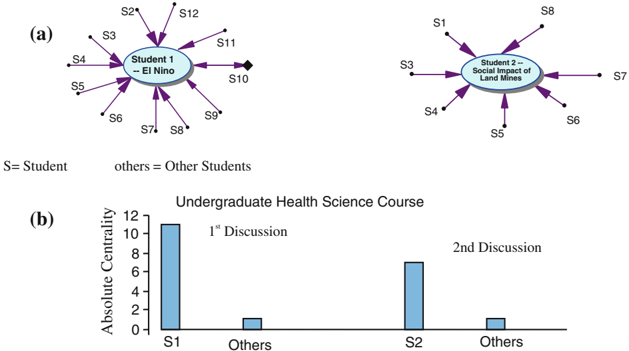
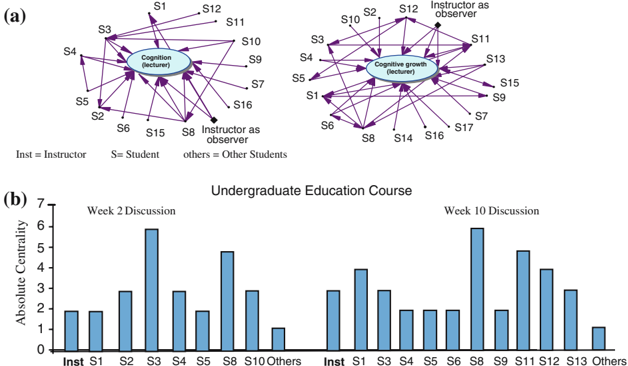
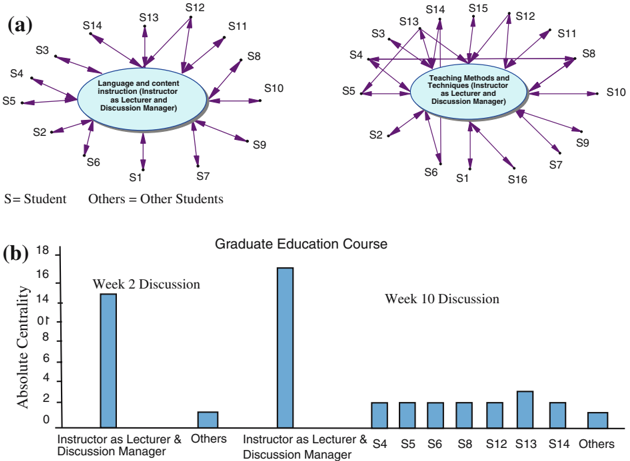
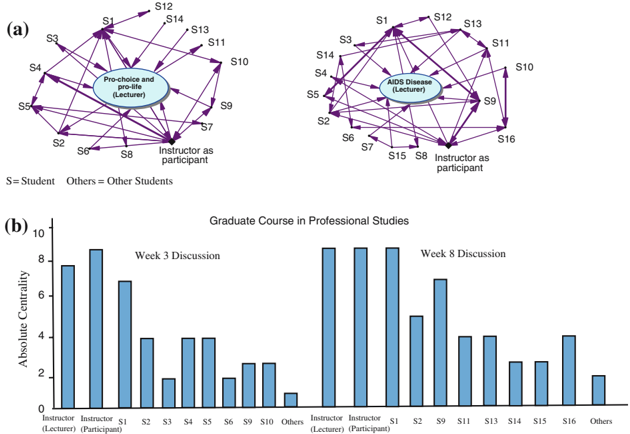
- Two interaction types appeared: star (Classes A and C) and interconnected web (Classes B and D); network density ranged from 0.20 to 0.40 (Class A 0.20/0.29; Class B 0.25/0.25; Class C 0.28/0.28; Class D 0.36/0.40).
- Cognitive engagement varied from low to high: Class A was mostly low (65% Statement Type I in “El Nino”; 28% horizontal questions; 7% explanations; no analytical, evaluative, or reflective messages); Class B was low in Week 1 (76% Type I) and mixed in Week 2 (40% Type I, 15% Question Type I, 15% Type II, 30% Type III); Classes C and D showed higher engagement (e.g., Class C evaluative messages 21% and 18%; Class D had 34% explaining personal opinions and 29% responding to peers).
- No direct relationship was found between interaction type and cognitive engagement: Classes A and C both had star interaction but low vs. high engagement; Classes B and D both had interconnected web interaction but low vs. high engagement.
- Instructor role and discussion design may matter: instructor messages were 0% in Class A, 7%/8% in Class B, 45% in both Class C discussions (evaluative but no mentoring/scaffolding), and 29%/17% in Class D, where the instructor participated as peer and mentor.
Methods
- Participants were 71 students from 3 colleges in a small public university: Class A undergraduate health science (22; 5 male, 17 female), Class B undergraduate education (17; 2 male, 15 female), Class C graduate education (16; 3 male, 13 female), and Class D graduate professional studies (16; 6 male, 10 female); all were required to participate in asynchronous online discussions during a 12–14 week semester.
- Two discussion transcripts were selected from each of the four classes, avoiding the first or last week; 244 messages were analyzed in total.
- Analysis combined social network analysis (network size, centrality, density) with qualitative content analysis using the Analytical Framework for Cognitive Engagement in Discussion, incorporating Zhu’s coding system, Henri’s content-analysis framework, and Bloom’s cognitive domains; two readers assigned levels, compared notes, and reached agreement, with 20 (about 8%) of 244 messages reassigned and later 4 messages (1.2%) re-adjusted.
Limitations
- Stated: the small number of courses and students from limited academic units means findings cannot be generalized; data were insufficient to explore complex relations among variables such as instructor presence, role, expectations, discussion goals, facilitation, questions, class size, delivery format, grade percentage, gender, academic maturity, intrinsic motivation, and prior knowledge.
- Stated: content analysis as a measure of cognitive engagement needs further examination for validity and reliability, and the combined network/content methodology can be modified; reasons for lurking were not studied.
- Evident from the text: the sample is limited to social science courses at one small public university and is predominantly female (average 80% female); no student or instructor interviews were conducted, and formal coding reliability statistics are not reported beyond agreement and reassignment counts.
Model-written summary. Check it against the paper before relying on it.
Integrity signals
Registry
Cites
Statistics
Figures
Verification
Claims the paper makes
1 Valid · 3 Not valid · 16 Not checked · 131 Own results and interpretations
The cited sources support only part of this claim — read each source’s verdict below.
In the paper
“The size of a network and the interaction grow proportionally (Fahy et al., 2001;Ridley & Avery, 1979;Rytina, 1982).”
§ Interaction and cognitive engagement: An analysis of four asynchronous online discussions > Data collection and analysis
What the sources say
- Partly supportedcites Fahy et al., 2001 matched to “Patterns of Interaction in a Computer Conference Transcript” (2001) sourceExperimental — accuracy not yet measured
The Network size section says that as a network grows, the number of potential linkages grows. It does not say actual interaction grows proportionally; the Discussion instead says that increasing size forces participants to be selective in their interactions. (LLM, conf=0.87)
- Not checked — no full text of the sourcecites Ridley & Avery, 1979 matched to “Social Network Influence on the Dyadic Relationship” (1979) source
- Not matchedcites Rytina, 1982
An author–year citation the paper’s reference list doesn’t settle. We don’t search these by name.
plainstates an association- Asserted: passes — The authors put it forward as true.
- Checkable: passes — It can be checked against evidence.
- Load-bearing: unclear — It is unclear whether the paper’s conclusions depend on it.
- Based: passes — The paper gives a reason why it holds.
- Partly supported
A result the paper reports from its own data — it cites no other source for it, so there is none to check. The quote shows it is in the paper.
In the paper
“Sixty-five percent of messages in the ''El Nino'' discussion belonged to Statement Type I”
§ Interaction and cognitive engagement: An analysis of four asynchronous online discussions > Cognitive engagement
plain- Asserted: passes — The authors put it forward as true.
- Checkable: passes — It can be checked against evidence.
- Load-bearing: unclear — It is unclear whether the paper’s conclusions depend on it.
- Based: passes — The paper gives a reason why it holds.
A result the paper reports from its own data — it cites no other source for it, so there is none to check. The quote shows it is in the paper.
In the paper
“About half of the students had an absolute centrality greater than 2.”
§ Interaction and cognitive engagement: An analysis of four asynchronous online discussions > Interaction viewed through the lens of network size, centrality, and density
plain- Asserted: passes — The authors put it forward as true.
- Checkable: passes — It can be checked against evidence.
- Load-bearing: unclear — It is unclear whether the paper’s conclusions depend on it.
- Based: passes — The paper gives a reason why it holds.
A result the paper reports from its own data — it cites no other source for it, so there is none to check. The quote shows it is in the paper.
In the paper
“The network size for the four discussions (Classes A-D) was relatively small, ranging from 8 to 18”
§ Interaction and cognitive engagement: An analysis of four asynchronous online discussions > Interaction viewed through the lens of network size, centrality, and density
plain- Asserted: passes — The authors put it forward as true.
- Checkable: passes — It can be checked against evidence.
- Load-bearing: unclear — It is unclear whether the paper’s conclusions depend on it.
- Based: passes — The paper gives a reason why it holds.
A result the paper reports from its own data — it cites no other source for it, so there is none to check. The quote shows it is in the paper.
In the paper
“Twenty-eight percent messages raised questions that were horizontal in direction with no direct answers.”
§ Interaction and cognitive engagement: An analysis of four asynchronous online discussions > Cognitive engagement
plainSingle case- Asserted: passes — The authors put it forward as true.
- Checkable: passes — It can be checked against evidence.
- Load-bearing: unclear — It is unclear whether the paper’s conclusions depend on it.
- Based: passes — The paper gives a reason why it holds.
75 more claims
Create a free account to see all 151 claims and every source verdict.
- It may state two separate claims as one. 42
- Probably not a substantial claim. 44
Self-check
Percentages, sums and reported differences re-computed from the paper’s own numbers.
Each contradiction between two passages listed here was confirmed by an independent check.
Rated minor: it would not touch a result — a value no result rests on, a p-value that stays on the same side of the significance level, or a conflict that is clerical, resolved elsewhere in the paper, or outside its own findings.
In the paper
§ Interaction and cognitive engagement: An analysis of four asynchronous online discussions > Study participants
“in a regular semester (12-14 weeks)”
§ Interaction and cognitive engagement: An analysis of four asynchronous online discussions > One undergraduate course in health science
“The Internet sessions scheduled for Weeks 3 and 8 (in a 15-week semester) discussed course assignments.”
Rated minor: it would not touch a result — a value no result rests on, a p-value that stays on the same side of the significance level, or a conflict that is clerical, resolved elsewhere in the paper, or outside its own findings.
In the paper
§ Interaction and cognitive engagement: An analysis of four asynchronous online discussions > Interaction viewed through the lens of network size, centrality, and density
“Student 2, who posted the topic ''Social Impact of Land Mines,'' had a centrality of 8.”
§ Interaction and cognitive engagement: An analysis of four asynchronous online discussions > One undergraduate course in health science
“Twelve students participated in the ''El Nino'' discussion and 8 students joined in the discussion on ''Social Impact of Land Mines.''”
Citations
Cites
(1978) · Medical Entomology and Zoology · Cited by 53,488
Bloom, B. S., Engelhart, M. D., Furst, E. J., Hill, W. H., & Krathwohl, D. R. (1956) · Cited by 9,342
Social Network Analysis: A Handbook.
Pappi, F. U., & Scott, J. (1993) · Contemporary Sociology · doi:10.2307/2075047 · Cited by 5,969
(1956) · Medical Entomology and Zoology · Cited by 4,596
The Taxonomy of Educational Objectives
(2012) · Encyclopedia of the Sciences of Learning · doi:10.1007/978-1-4419-1428-6_6027 · Cited by 4,103
Perspectives on socially shared cognition.
(1991) · American Psychological Association eBooks · doi:10.1037/10096-000 · Cited by 3,446
Content Analysis in Communication Research.
de Sola Pool, I., & Berelson, B. (1952) · American Sociological Review · doi:10.2307/2088029 · Cited by 3,099 · cited 1×
“Content analysis, as a research technique for the objective, systematic, quantitative description of the manifest content of communication (Berelson, 1952, p. 519), is adopted to analyze and determine student cognitive engagement in the online discussion.”
MethodCritical thinking, cognitive presence, and computer conferencing in distance education
Garrison, D. R., Anderson, T., & Archer, W. (2001) · American Journal of Distance Education · doi:10.1080/08923640109527071 · Cited by 3,044 · cited 3×
“Garrison et al. (2001) proposed a four-phase model (trigger, exploration, integration, and resolution) to explore and examine the nature and quality of critical inquiry in computer conferencing.”
BackgroundMethodResultGagné, R. M. (1965) · Bibliothèque et Archives nationales du Québec (Québec government) · Cited by 3,016
Assessing Social Presence In Asynchronous Text-based Computer Conferencing
Rourke, L., Anderson, T. D., Garrison, D. R., & Archer, W. (1999) · AUSpace (Athabasca University) · Cited by 2,388
Research works printed but not linked: 4
- 4. Berge, Z.L. & Collins, M. eds. (1995). Computer mediated communication and the online classroom. Vol. 1: Overview and perspectives. Cresskill: Hampton Press, Inc.
- 19. Jeong, A. (2005) Methods and tools for the computational analysis of group interaction and argumentation in asynchronous online discussions. Paper presented at the 2005 Technology and Learning Symposium, New York, NY.
- 30. Riedl, R. (1989). Patterns in computer-mediated discussions. In R. Mason and A. Kaye, eds, Mindweave: Communication, computers, and distance education, pp. 215-220. Pergamon Press: Oxford.
- 36. Stoney, C. & Oliver, R. (1999) Can higher order thinking and cognitive engagement be enhanced with multimedia? Interactive Multimedia Electronic Journal of Computer- Enhanced Learning. Retrieved in February 2006 from http://imej.wfu.edu/articles/ 1999/2/07/index.asp.
Cited by
Items 301–363 of 363
Enterprise pre-sales forums: A preliminary study of metadata and content
Deolalikar, V. (2013) · IEEE International Conference on Big Data (BigData) · doi:10.1109/bigdata.2013.6691680
“The role of asynchronous discussion forums in distance education has been studied extensively, see Dringus and Ellis (2005); Romero and Ventura (2007); Zhu (2006) and references therein.”
BackgroundSchaefer, C. D., & Hoser, B. (2008) · VS Verlag für Sozialwissenschaften eBooks · doi:10.1007/978-3-531-91107-6_21
“Diskussionsforen werden in vielen Kontexten untersucht, z.B. im Bereich Lernen (Zhu 2006), Informationsdiffusion (Takhteyev 2007) oder öffentliche Beteiligung (Scott 2006).”
BackgroundInteração e comunicação em ambientes virtuais de aprendizado
Laguardia, J., Machado, R. R., & Coutinho, E. (2010) · Americanae (AECID Library) · Cited by 2
Identifying Learning Opportunities in Online Collaboration: A variation theory approach
Aditomo, A., & Reimann, P. (2009) · Ubaya Repository (University of Surabaya) · Cited by 1
Morueta, R. T., Gómez, Á. H., & Aguaded, I. (2011)
La construcción de comunidades en la era digital. Dinámicas del diálogo online deportivo
López-González, H., Guerrero-Solé, F., & Larrea, O. M. I. (2014)
Virtual Literature Circles: Best Practices
Ferebee, J. (2013) · California State University ScholarWorks (system-wide DSpace)
Stewart, S. A. (2014) · Library and Archives Canada (Government of Canada)
THE DEVELOPMENT OF FOUR EFL TEACHERS' REFLECTIVE THINKING IN A CALL WORKSHOP
Tseng, J.-J., Cheng, Y., & Lin, C. (2011)
Developing A Framework for Guiding Interaction Design in Distance Learning
Li, W. (2015) · VTechWorks (Virginia Tech) · Cited by 1
The role of the tutor in supporting online engagement in higher education
O‘Hare, S. (2014) · eSpace (Curtin University)
Lee, J. (2013) · Texas ScholarWorks (Texas Digital Library)
A Virtual Online Seminar: Integrating Pedagogy and Technology
Taylor, L. L. (2012) · International Journal of e-Education e-Business e-Management and e-Learning · doi:10.7763/ijeeee.2012.v2.173
Analysis on Collaborative Evaluation in Discussion Forums
Cilene, K., & Uchôa, A. (2012)
Putman, S. M., Kissel, B. T., Vintinner, J. P., & Good, A. J. (2014) · Advances in early childhood and K-12 education · doi:10.4018/978-1-4666-6383-1.ch010
Salam, U. (2012) · IGI Global eBooks · doi:10.4018/978-1-4666-0011-9.ch504 · Cited by 1
Essential Design Features of Online Collaborative Learning
So, H., Lim, W.-Y., & Yeo, J. (2010) · IGI Global eBooks · doi:10.4018/978-1-61520-672-8.ch014
Functional design and implementation proposal of a tool to support collaborative knwoledge building
González, I. G. (2013) · DOAJ (DOAJ: Directory of Open Access Journals)
Miller, A. L. (2016) · J. Willard Marriott Library · doi:10.26053/0h-nzqd-y3g0
I nformation Sciences for Deci Decision Making I nformations, Savoirs, Décisions & Médiations
Vanin, L., Manca, B. S., & Nuovo, A. M. (2010)
Qualitative Forschung in der Medienpsychologie
Odağ, Ö., & Schreier, M. (2017) · Springer eBooks · doi:10.1007/978-3-658-18387-5_68-1
-ANALYSIS OF RELEVANCY USING RAPID MINER WITH AN EXPERIMENTAL STUDY ON POPULAR DISCUSSION FORUM
Radhika, P. (2017) · International Journal of Advanced Research in Computer Science · doi:10.26483/ijarcs.v8i9.4899
“Hauang et al.[6] studied the behaviour of users who make great contributions across different MOOC forums.”
BackgroundShukor, N. A., & Tasir, Z. (2011) · Cited by 1
Bosman, L., Mayer, B. K., & McNamara, P. J. (2017) · e-Publications@Marquette (Marquette University)
Introducing a Pre-Determined Feedback Pool for Evaluating Students’ Online Discussion Participation
Perera‐Diltz, D. M., Davis, R., Smith, S. U., et al. (2018) · Journal of Teaching and Learning with Technology · doi:10.14434//jotlt.v7n1.23866
“There is empirical consensus that discussions positively impact individual learning outcomes in online learning environments (e.g., Agee & Uzuner Smith, 2011, Garrison & Cleveland-Innes, 2005; Paus, Werner, & Jucks, 2012; Vonderwell, 2003; Wu & Hiltz, 2004; Zhu, 2006).”
BackgroundCocquyt, C., Diep, A. N., Zhu, C., Greef, M. D., & Vanwing, T. (2021) · IGI Global eBooks · doi:10.4018/978-1-7998-8598-6.ch017
مشترک, د. خ. م. و. ه. ر. (2019) · تکنولوجيا التربية دراسات وبحوث · doi:10.21608/tessj.2019.63316
The Extent to which Students use their Online Written Feedback while Taking Online Classes
Sawicki, T., & O’Rourke, S. (2017) · International Journal for Cross-Disciplinary Subjects in Education · doi:10.20533/ijcdse.2042.6364.2017.0432 · Cited by 2
“Zhu [12] stated that student learning is not automatic in online learning and that teacher intervention through feedback is an important part of online teaching.”
Backgroundإبراهیم, ه. أ. ج. (2019) · تکنولوجيا التعليم سلسلة دراسات وبحوث · doi:10.21608/tesr.2019.70963
زيدان, أ. أ. (2019) · تکنولوجيا التعليم سلسلة دراسات وبحوث · doi:10.21608/tesr.2019.71187
Too Anxious to Talk: Social Anxiety, Communication, and Academic Experiences in Higher Education
Archbell, K. A. (2020) · Carleton University's Institutional Repository (MacOdrum Library, Carleton University) · doi:10.22215/etd/2020-14091 · Cited by 4
Kipp, K. (2021) · ScholarWorks (Boise State University) · doi:10.18122/td.1781.boisestate
Investigating Teaching and Learning Processes of An online Course From Multiple Perspectives
Ouyang, F. (2018) · University of Minnesota Digital Conservancy (University of Minnesota) · Cited by 1
REACHING COLLEGE STUDENTS WHERE THEY LIVE
Grayson, A. (2008) · ScholarWorks -A service of University of Vermont Libraries (University of Vermont)
Odağ, Ö., & Schreier, M. (2020) · Springer Reference Psychologie · doi:10.1007/978-3-658-18387-5_68-2
How relations, time & size matter in medical education
Hommes, J. E. (2014) · Research Publications (Maastricht University) · doi:10.26481/dis.20140226jh · Cited by 8
Yeboah, A. K., Smith, P., Yuan, G., & Nash, C. M. (2019) · IGI Global eBooks · doi:10.4018/978-1-5225-9279-2.ch065 · Cited by 1
Authors, V. (2013) · The International Review of Research in Open and Distributed Learning · doi:10.19173/irrodl.v14i3.1596
Developing Technological Pedagogical Content Knowledge in Elementary Education Programs
Polly, D., Binns, I. C., Putman, S. M., Rock, T. C., & Good, A. J. (2018) · IGI Global eBooks · doi:10.4018/978-1-5225-7305-0.ch070
Salam, U. (2013) · IGI Global eBooks · doi:10.4018/978-1-61350-077-4.ch016
Schaefer, C. D., & Hoser, B. (2010) · VS Verlag für Sozialwissenschaften eBooks · doi:10.1007/978-3-531-92029-0_21
Han, X., Luo, H., Huang, Q., Deng, X., & Zhang, Z.-L. (2022) · Lecture notes in computer science · doi:10.1007/978-3-031-08939-8_21
The Evaluation System of SPOC Learning Engagement
Lin, J., Yan-ze, Z., Yuhua, W., & Tianqi, G. (2021) · International Conference on Information Technology in Medicine and Education · doi:10.1109/itme53901.2021.00131
“(2006) [29] Questions, statements, reflections, guidance, scaffolding Blumenfeld et al.”
STUDENT’S VOICES ON LANGUAGE LEARNER AUTONOMY IN DISTANCE LEARNING
Nurkamilah, N., & Badriyah, D. Q. (2022) · Journal of English Teaching Applied Linguistics and Literatures (JETALL) · doi:10.20527/jetall.v5i2.13460
Yan, H., Zhang, H., Lam, J. F. I., Wong, C. U. I., & Zhang, D. (2023) · International Conference on Education Development and Studies (ICEDS) · doi:10.1145/3591139.3591150
“The former centering on the person asking the question and the latter having multiple central points leading the discussion, while technology helped to extend learner-instructor and learner-learner interactions but hindered their emotional dimensions [6].”
BackgroundAsmuni, A. (2023) · JPEKBM (Jurnal Pendidikan Ekonomi Kewirausahaan Bisnis dan Manajemen) · doi:10.32682/jpekbm.v7i1.3149 · Cited by 3
การกระตุ้นปัญญาและประสิทธิผลการเรียนรู้ด้วยหนังสืออิเล็กทรอนิกส์แบบปฏิสัมพันธ์
แย้มจรูญ, ถ. (2016) · Chula Digiverse · doi:10.58837/chula.the.2016.86
Chetti, M. S., & Hashim, H. B. (2023) · International Journal of Academic Research in Business and Social Sciences · doi:10.6007/ijarbss/v13-i12/19728 · Cited by 1
E-Evaluation Based Authentication for Virtual Discussion on an Online Platform
Rajkumar, K., S, A. K., & Ragupathi, T. (2024) · International Conference on Disruptive Technologies (ICDT) · doi:10.1109/icdt61202.2024.10489042
““Virtual Discussion Platform” is an application that helps users [12] (which mainly targets users) to share the issues that they face mentally and physically due to this society.”
BackgroundMethodEngagement and online mathematics enrichment for secondary students
Lyakhova, S., & Neate, A. (2024) · Teaching Mathematics and its Applications An International Journal of the IMA · doi:10.1093/teamat/hrae003 · Cited by 1
“…cognitive engagement can also be explored through inference from a student’s written messages by considering their behaviours of seeking, interpreting, analysing and summarizing information, critiquing and reasoning and making decisions in online discussions ( Zhu, 2006; Shukor et al. , 2014).”
Cognitive Engagement Analysis in CSCL: Exploring Educational Potential of Generative AI
Jin, M., Park, E. J., & Lim, K. Y. (2025) · The Journal of Korean Association of Computer Education · doi:10.32431/kace.2025.28.4.004
Learning Synchronous Chat Technology-By-Design In The High School English Classroom
Groenke, S. L., & Grothaus, M. (2013) · Emerald Group Publishing Limited eBooks · doi:10.1108/book-978-1-62396-087-220251008
Richard, L. F. (2012) · Rutgers University Community Repository (Rutgers University) · doi:10.7282/t31j98q2
Exploring the use of an on-line environment to enhance a group fitness program
Simpson, S. (2010) · Scholarship at UWindsor (University of Windsor)
Discussão online no ensino superior: o papel dos fóruns na aprendizagem colaborativa
Oliveira, T., & Morgado, L. (2012) · Portuguese National Funding Agency for Science, Research and Technology (RCAAP Project by FCT)
Anonymous, Chyriwsky, S., Croston, J. H., Kolb, U. C., Schwenzer, S. P., & Urquhart, S. (2026) · Physical Review Physics Education Research · doi:10.1103/ldgz-smd6
Yue, S., & Zhao, X. (2026) · International Conference on Computer Science and Technologies in Education (CSTE) · doi:10.1109/cste69562.2026.11649799
“This aligns with prior research indicating that interactive online environments strengthen social connectedness and cognitive engagement[2][34].”
Zhang, Y., & Lu, F. (2026) · International Conference on Distance Education and Learning (ICDEL) · doi:10.1109/icdel70250.2026.11663706
“Drawing on four cases of asynchronous discussion, Zhu [8] showed that both interaction patterns and the level of cognitive engagement influence the construction of new understanding.”
Chang, Y., Liu, Q., & Li, X. (2026) · Asia Pacific Journal of Education · doi:10.1080/02188791.2026.2726831
Digital transformation to learner satisfaction: An integrated framework approach
Jain, A., Meher, J. R., & Sharma, P. (2026) · Human Systems Management · doi:10.1177/01672533261485400
Challenges: Findings from Previous Empirical Research
Hew, K. F., & Cheung, W. S. (2012) · Springer eBooks · doi:10.1007/978-1-4614-2370-6_2
Discussing writing : peer feedback on writing essays in an online forum for learners of English
Tuomey, E. (2014) · Lancaster EPrints (Lancaster University) · Cited by 3
Metadata
- Authors
- Zhu, E.
- Affiliations
- University of Michigan (US)
- Corresponding author
- Zhu, Erping
- Venue
- Instructional Science
- Published
- 2006-11
- Volume
- 34
- Issue
- 6
- ISSN
- 0020-4277 (ISSN-L)
- 1573-1952
- OpenAlex
- W2127101125
- Cited by
- 363
- References
- 48
- Citations by year
- 2026: 11 · 2025: 9 · 2024: 15 · 2023: 24 · 2022: 24 · 2021: 22 · 2020: 20 · 2019: 25 · 2018: 23 · 2017: 23 · 2016: 15 · 2015: 18 · 2014: 23 · 2013: 22 · 2012: 27
- FWCI
- 46.95
- Type
- journal article
- Language
- en
- Open access
- hybrid
- doi.org
- Licence
- cc-by-nc
- creativecommons.org/licenses/by-nc/2.0 (tdm)
- creativecommons.org/licenses/by-nc/2.0 (vor)
- Locations
- Instructional Science (publishedVersion, cc-by-nc)
- Topics
- Social Sciences › Education › Online and Blended Learning
- Physical Sciences › Computer Science › Computer Science Applications › Online Learning and Analytics
- Social Sciences › Psychology › Developmental and Educational Psychology › Innovative Teaching and Learning Methods
- Keywords
- online discourse, asynchronous discussion, student interaction, cognitive engagement, online learning, higher education, social network analysis, student participation, knowledge construction
About these checks
Registry, retraction, Cites and statistics results are computed, not judged, with one exception: a printed reference that no index lists is read once by a model before it counts as a citation error. Claims are extracted by a model and kept only when their quote appears verbatim in the text; each cited source is then checked, with a model’s help, for whether it says what the claim relies on. Those verdicts can be wrong — read the claim’s quote and the cited source before relying on one.
The claim verdicts this report counts are experimental: their accuracy is not yet measured.
A language model drew the claims from the paper on 2026-10-10, under version 3 of the claim definition (model deepseek-v4.1-flash, prompt extract-v3).
A second model labelled each claim on 2026-10-10 (model jev-1.13-20260917, definition revision gold-guideline-v0.2).
Cited sources are checked with a language model’s help (gpt-6-sol).
Statistics and arithmetic are recomputed, not judged.
Confidence bands are shown only for fields calibrated on our annotated test set. None is calibrated yet, so no band is shown.
What counts as a claim ›How we measure confidence ›How we check this ›
Are you an author, or do you see a problem with this page? Request a review
Data sources
Bibliographic data: Semantic Scholar, OpenAlex, Crossref.
Contains information from the Semantic Scholar Academic Graph Datasets, made available under the ODC Attribution License (ODC-BY 1.0).
Semantic Scholar’s data is described in: Kinney, R., et al. (2023). The Semantic Scholar Open Data Platform. arXiv:2301.10140.
