

Greywater Characteristics, Treatment Systems, Reuse Strategies and User Perception—a Review
Open accessThe DOI matches its Crossref record; 90 of the 95 references it cites were found in a registry or an index; 16 of the 85 sources its claims cite were checked for support.
Abstract
This paper presents a literature review of the quality of greywater generated in different, especially developing, countries, constituents found in greywater, some treatment systems, natural materials for treatment, some reuse strategies and public perception regarding greywater reuse. The review shows that generation rates are mostly influenced by lifestyle, types of fixtures used and climatic conditions. Contaminants found in greywater are largely associated with the type of detergent used and influenced by other household practices. Many of the treatment systems reviewed were unable to provide total treatment as each system has its unique strength in removing a group of targeted pollutants. The review revealed that some naturally occurring materials such as Moringa oleifera, sawdust, can be used to remove targeted pollutants in greywater. The study further showed that user perceptions towards greywater treatment and reuse were only favourable towards non-potable purposes, mostly due to perceived contamination or lack of trust in the level of treatment offered by the treatment system.
Overview
CoChat Summary
TL;DR
This review synthesizes literature on greywater generation, composition, treatment systems, reuse strategies, and user perceptions, with emphasis on developing countries. It finds treatment systems are contaminant-specific rather than comprehensive, natural materials can target pollutants, and reuse acceptance is mainly for non-potable uses due to contamination and trust concerns.
Key findings
- Greywater generation varies widely: from as low as 15 L per person per day in poor areas to several hundred; it accounts for up to 75% of household wastewater, up to 90% with dry toilets, and about 69% of domestic water consumption. Table 1 ranges include Africa/Middle East 14–161 L/c/day and Asia 72–225 L/c/day.
- Contaminants reflect lifestyle, fixtures, and detergents; reported values include BOD5/COD ratios of 0.31–0.71, TSS 190–537 mg/L, turbidity 19–444 NTU, EC 14–3000 μS/cm, pH 5–9, total coliforms 1.2 × 10³–8.2 × 10⁸ counts/100 mL, and E. coli up to 6.5 × 10⁶.
- Reviewed treatment systems each target specific pollutants: filtration removed BOD5 89–98%, COD 37–94%, TSS 53–93%; wetlands removed BOD5 up to 99%, COD 81–82%, TSS 90–98%; MBR removed BOD5 93–97%, COD 86–99%, turbidity 98–99%; UASB removed BOD5 up to 67%, COD 38–79%, oil and grease 83.7%. Natural media such as Moringa oleifera and sawdust can remove targeted pollutants.
- User perceptions favour non-potable reuse; acceptance decreases as recycled water gets closer to human contact, and potable reuse faces opposition linked to perceived health risk, “wisdom of repugnance,” and lack of trust in implementing bodies.
Methods
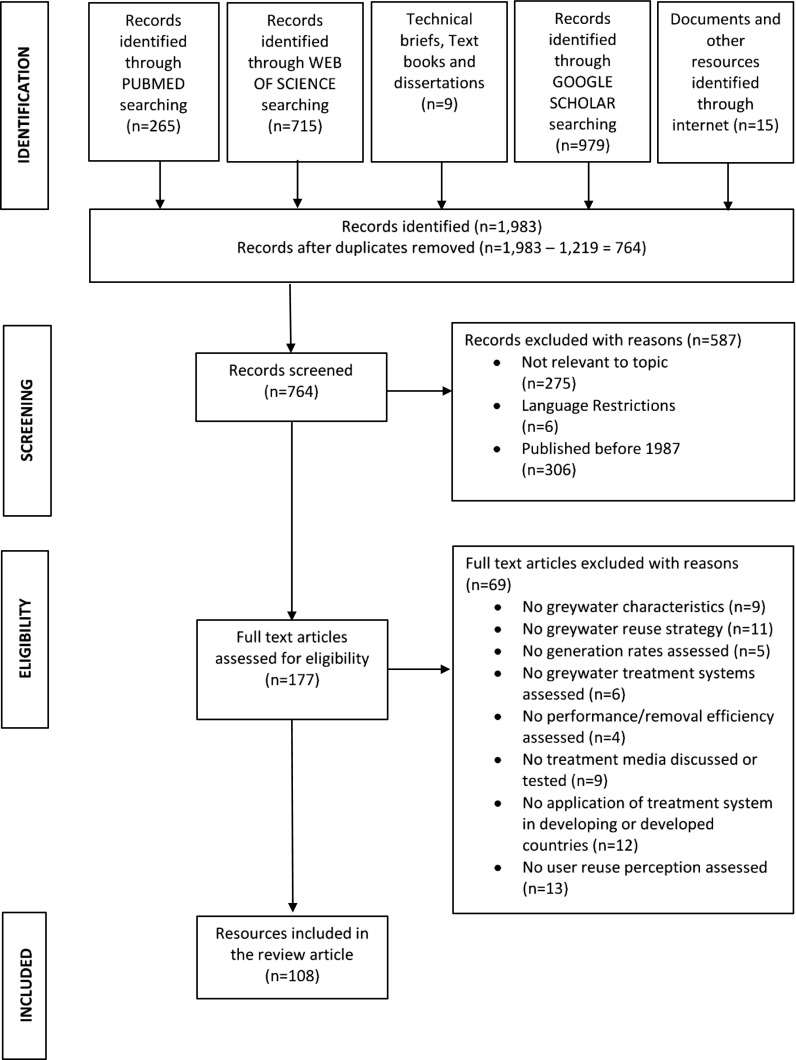
- Literature review using peer-reviewed journals, internet documents, and textbooks; the methodological framework is presented in Fig. 1.
- Synthesizes reported studies on greywater quantity and quality, treatment performance, reuse schemes, and perception surveys across countries, with emphasis on developing countries.
- Narrative synthesis; no primary data collection or meta-analysis is reported.
Limitations
- No dedicated limitations section is stated; the paper notes that treatment systems are contaminant-specific and unable to provide total treatment, quality criteria differ by reuse application, and greywater composition and generation rates vary greatly.
- The paper states all reviewed treatment systems were applicable at large scale and cannot be applied at household level, which it says discourages local-level participation.
- Evident from the text: no systematic search strategy, inclusion/exclusion criteria, or quality appraisal is described; synthesis is narrative and tables contain missing or inconsistently reported data.
Model-written summary. Check it against the paper before relying on it.
Integrity signals
Registry
Cites
Statistics
Figures
Verification
Claims the paper makes
12 Valid · 16 Not valid · 52 Not checked · 54 Own results and interpretations
At least one cited source doesn’t support this claim or points to a different paper, and none confirmed it — see the verdicts below.
In the paper
“which also range between 4 and 14 mg/L (Boyjoo et al. 2013).”
§ Greywater Characteristics, Treatment Systems, Reuse Strategies and User Perception—a Review > Chemical Contaminants
What the sources say
- Disputedcites Boyjoo et al. 2013 matched to “A review of greywater characteristics and treatment processes” (2013) sourceExperimental — accuracy not yet measured
The phosphate row in the greywater characteristics table (indexed under CONCLUSIONS; page unavailable) reports 0.5–1.3, 0.09, and 1 mg/L for the samples with phosphate values. These are below the claimed 4–14 mg/L range; the review does not give that range for greywater phosphate. (LLM, conf=0.83)
Checked by a reasoning model — may be wrong.
plain- Asserted: passes — The authors put it forward as true.
- Checkable: passes — It can be checked against evidence.
- Load-bearing: unclear — It is unclear whether the paper’s conclusions depend on it.
- Based: passes — The paper gives a reason why it holds.
- Disputed
The cited sources support only part of this claim — read each source’s verdict below.
In the paper
“Recent studies have however found pharmaceuticals, health and beauty products, aerosols, pigments (Eriksson et al. 2003) and toxic heavy metals such as Pb, Ni Cd, Cu, Hg and Cr (Aonghusa and Gray 2002; Eriksson et al. 2010) in appreciable concentrations in greywater.”
§ Greywater Characteristics, Treatment Systems, Reuse Strategies and User Perception—a Review > Greywater Composition
What the sources say
- Partly supportedcites Eriksson et al. 2003 matched to “Household chemicals and personal care products as sources for xenobiotic organic compounds in grey wastewater” (2003) sourceExperimental — accuracy not yet measured
The Qualitative screening analyses report medicinal residues, including acetaminophen at 1.5 µg/l, and measured compounds associated with personal care products in grey wastewater. The product inventory lists a pigment among ingredients, but does not establish that pigments were detected in greywater at appreciable concentrations; the passages also do not establish that for aerosols. The heavy-metal clause has separate citations and is not attributed to Eriksson et al. (2003). Page numbers are unavailable in our copy. (LLM, conf=0.87)
- Not checked — no full text of the sourcecites Aonghusa and Gray 2002 matched to “LAUNDRY DETERGENTS AS A SOURCE OF HEAVY METALS IN IRISH DOMESTIC WASTEWATER” (2002) source
- Partly supportedcites Eriksson et al. 2010 matched to “Organic matter and heavy metals in grey-water sludge” (2010) sourceExperimental — accuracy not yet measured
Table 4 (Basic parameters and organic matter) reports Cd, Cu, Ni and Pb in grey-water influent or effluent. The study does not report Hg or Cr, and its findings about relatively high metal concentrations concern grey-water sludge (Table 5), not grey-water itself. The products listed earlier in the citing sentence are attributed to a different citation. (LLM, conf=0.88)
plain- Asserted: passes — The authors put it forward as true.
- Checkable: passes — It can be checked against evidence.
- Load-bearing: unclear — It is unclear whether the paper’s conclusions depend on it.
- Based: passes — The paper gives a reason why it holds.
- Partly supported
The cited sources support only part of this claim — read each source’s verdict below.
In the paper
“The concentration of total suspended solids in greywater can range within 190–537 mg/L as has been reported (Edwin et al. 2014; Oteng-Peprah et al. 2018).”
§ Greywater Characteristics, Treatment Systems, Reuse Strategies and User Perception—a Review > Physical Constituents
What the sources say
- Partly supportedcites Edwin et al. 2014 matched to “Characterization of domestic gray water from point source to determine the potential for urban residential reuse: a short review” (2014) sourceExperimental — accuracy not yet measured
Table 3 (indexed under Conclusion; page unavailable) reports TSS of 190.4 mg/L for combined greywater, approximately the claimed 190 mg/L. It does not report 537 mg/L as a TSS value or give a 190–537 mg/L range, so the upper endpoint is unsupported by this source. (LLM, conf=0.84)
- Not checked — no full text of the sourcecites Oteng-Peprah et al. 2018 matched to “Greywater characterization and generation rates in a peri urban municipality of a developing country” (2018) source
plain- Asserted: passes — The authors put it forward as true.
- Checkable: passes — It can be checked against evidence.
- Load-bearing: unclear — It is unclear whether the paper’s conclusions depend on it.
- Based: passes — The paper gives a reason why it holds.
- Partly supported
The cited sources support only part of this claim — read each source’s verdict below.
In the paper
“XOCs can also be formed by partial modification of chemicals in chemical or biological treatment of greywater (Fatta-Kassinos et al. 2011).”
§ Greywater Characteristics, Treatment Systems, Reuse Strategies and User Perception—a Review > Chemical Contaminants
What the sources say
- Partly supportedcites Fatta-Kassinos et al. 2011 matched to “The risks associated with wastewater reuse and xenobiotics in the agroecological environment” (2011) sourceExperimental — accuracy not yet measured
Section 2, “Elements and chemicals of concern,” says that household chemicals in treated wastewater may be partially modified during biological or chemical treatment and that transformation products can be generated. This supports the formation mechanism, but the paper discusses wastewater generally, not greywater specifically; a search for “greywater” found no passage establishing that setting. (LLM, conf=0.86)
plainstates a cause- Asserted: passes — The authors put it forward as true.
- Checkable: passes — It can be checked against evidence.
- Load-bearing: unclear — It is unclear whether the paper’s conclusions depend on it.
- Based: passes — The paper gives a reason why it holds.
- Partly supported
The cited sources support only part of this claim — read each source’s verdict below.
In the paper
“Kitchen waste are the primary source of nitrogen in greywater”
§ Greywater Characteristics, Treatment Systems, Reuse Strategies and User Perception—a Review > Chemical Contaminants
What the sources say
- Partly supportedcites Boyjoo et al. 2013 matched to “A review of greywater characteristics and treatment processes” (2013) sourceExperimental — accuracy not yet measured
The “GW characteristics and reasons for concern” section says kitchen greywater is high in nutrients and can increase greywater’s COD:N:P ratio. It does not say kitchen waste is the primary source of nitrogen in greywater or compare its nitrogen contribution with other sources; no page number is available in our copy. (LLM, conf=0.82)
plainstates a cause- Asserted: passes — The authors put it forward as true.
- Checkable: passes — It can be checked against evidence.
- Load-bearing: unclear — It is unclear whether the paper’s conclusions depend on it.
- Based: passes — The paper gives a reason why it holds.
- Partly supported
60 more claims · 5 with their cited sources checked
Create a free account to see all 134 claims and to verify the 2 references still open.
- It may state two separate claims as one. 48
- Probably not a substantial claim. 35
Claims other papers make about this one
Each is checked against this paper’s own text: does it say what the citing paper says it does?
The source backs part of the claim, not all of it — or backs it for a different population, condition or comparison.
In the citing paper
“However, the results presented in Fig. 4 suggest that this dosage of biochar and the MO seed extract-based flocculant may not be sufficient for initiating flocculation in greywater that contains humates, clay, and surfactants (Oteng-Peprah et al., 2018).”
From Use of biochar and Moringa oleifera in greywater treatment to remove heavy metals and contaminants of emerging concern (2023) · cites this paper as Oteng-Peprah et al., 2018
Experimental — accuracy not yet measured
Self-check
Percentages, sums and reported differences re-computed from the paper’s own numbers.
Each contradiction between two passages listed here was confirmed by an independent check.
Rated major: it would touch a result — a value a result rests on, reported and recomputed p-values on opposite sides of the significance level, two passages that conflict with no sign which is right, or a cited work retracted before this paper was published.
In the paper
§ Greywater Characteristics, Treatment Systems, Reuse Strategies and User Perception—a Review > Conclusions
“All the treatment systems reviewed were applicable on a large scale and cannot be applied at the household level.”
§ Greywater Characteristics, Treatment Systems, Reuse Strategies and User Perception—a Review > Reuse Strategies
“Was intended to be used to treat greywater from single households to prevent discharge of greywater into the environment.”
Rated minor: it would not touch a result — a value no result rests on, a p-value that stays on the same side of the significance level, or a conflict that is clerical, resolved elsewhere in the paper, or outside its own findings.
In the paper
§ Greywater Characteristics, Treatment Systems, Reuse Strategies and User Perception—a Review > Physical Constituents
“The range of turbidity recorded for greywater is between 19 and 444 NTU”
§ Greywater Characteristics, Treatment Systems, Reuse Strategies and User Perception—a Review > Chemical Contaminants
“| Turbidity (NTU) | – | – | 85 | 619 | 31.1 | 26.5–164 | 20 | 29 |”
Rated minor: it would not touch a result — a value no result rests on, a p-value that stays on the same side of the significance level, or a conflict that is clerical, resolved elsewhere in the paper, or outside its own findings.
In the paper
§ Greywater Characteristics, Treatment Systems, Reuse Strategies and User Perception—a Review > Chemical Contaminants
“The conventional wastewater parameters such as biochemical oxygen demand (BOD5) and chemical oxygen demand (COD) always show a dominance of COD over BOD5.”
§ Greywater Characteristics, Treatment Systems, Reuse Strategies and User Perception—a Review > Chemical Contaminants
“However, other studies have recorded ratios as high as 4:1 (Boyjoo et al. 2013).”
Rated minor: it would not touch a result — a value no result rests on, a p-value that stays on the same side of the significance level, or a conflict that is clerical, resolved elsewhere in the paper, or outside its own findings.
In the paper
§ Greywater Characteristics, Treatment Systems, Reuse Strategies and User Perception—a Review > Physical Constituents
“The concentration of total suspended solids in greywater can range within 190–537 mg/L”
§ Greywater Characteristics, Treatment Systems, Reuse Strategies and User Perception—a Review > Chemical Contaminants
“| TSS (mg/L) | 100–283 | 155 | – | 511 | 17 | 37–153 | 32 | – |”
Citations
Cites
Global water crisis and future food security in an era of climate change
Hanjra, M. A., & Qureshi, M. E. (2010) · Food Policy · doi:10.1016/j.foodpol.2010.05.006 · Cited by 1,387
Water in crisis: a guide to the world’s fresh water resources
Thomas, C. (1994) · International Affairs · doi:10.2307/2623756 · Cited by 1,067
Characteristics of grey wastewater
Eriksson, E., Auffarth, K., Henze, M., & Ledin, A. (2002) · Urban Water · doi:10.1016/s1462-0758(01)00064-4 · Cited by 951
Water in crisis: a guide to the world's fresh water resources
Gleick, P. H. (1993) · Cited by 896
Fate of antibiotics during municipal water recycling treatment processes
Le-Minh, N., Khan, S. J., Drewes, J. E., & Stuetz, R. M. (2010) · Water Research · doi:10.1016/j.watres.2010.06.020 · Cited by 778
Review of the technological approaches for grey water treatment and reuses
Li, F., Wichmann, K., & Otterpohl, R. (2009) · Science of The Total Environment · doi:10.1016/j.scitotenv.2009.02.004 · Cited by 651
Greywater reuse: towards sustainable water management
Al-Jayyousi, O. R. (2003) · Desalination · doi:10.1016/s0011-9164(03)00340-0 · Cited by 457
The risks associated with wastewater reuse and xenobiotics in the agroecological environment
Fatta-Kassinos, D., Kalavrouziotis, I. K., Koukoulakis, P. H., & Vasquez, M. I. (2011) · Science of The Total Environment · doi:10.1016/j.scitotenv.2010.03.036 · Cited by 450
Jenkins, S. H. (1973) · Water Research · doi:10.1016/0043-1354(73)90047-x · Cited by 349
Faecal contamination of greywater and associated microbial risks
Ottoson, J., & Stenström, T. A. (2003) · Water Research · doi:10.1016/s0043-1354(02)00352-4 · Cited by 339
Research works printed but not linked: 11
- Adewumi, J. R, Olanrewaju, O. O, Ilemobade, A. A, van Zyl, J. E (2010) Perceptions towards greywater reuse and proposed model for institutional and commercial settlements in South Africa. In: WISA Biennial Conference and Exhibitions, South Africa, 2010. vol 25th April. 2017,
- Al-Mughalles MH Rahman RA Suja FB Mahmud M Jahil NA Household greywater quantity and quality in Sana’a, Yemen EJGE 2012 17 1025 1034
- Benami M Gillor O Gross A The question of pathogen quantification in disinfected graywater Sci Total Environ 2015 506-507 496 504 10.1016/j.scitotenv.2014.11.051 25437766 · DOI
- De Sena N Public opposition sidelines indirect potable reuse projects Water and Environment Technology 2006 1999 11 16
- Effendi H, Sari DR, Hasibuan S (2015) Moringa oleifera as coagulant for batik effluent treatment. In: 35th Annual Conference of the International Association for Impact Assessment, Firenze Fiera Congress and Exhibition Center, Florence.
- Harindra C Appropriate disposal of sewage in urban and suburban Sri Lanka 2001 UK University of Leeds
- Jeffery P Understanding public receptivity issues regarding ‘in-house’ water recycling 2001 Cranfield UK Results from a UK survey
- Morel, A., Diener, S. (2006) Greywater management in low and middle-income countries, review of different treatment systems for households or neighbourhoods. Swiss Federal Institue of Aquatic Science and Technology (EAWAG),
- Parkinson J Waste not: the facts about indirect potable reuse Humanist 2008 68 4 6
- Sahar SD Mikael P Bjorn V Lars DH Ingrid O Hakan J Efficiency of bark, activated charcoal, foam and sand filters in reducing pollutants from greywater Water, Air, and Soil Pollution 2012 223 3657 3671 10.1007/s11270-012-1139-z · DOI
- Vigneswaran S Sundaravadivel M Recycle and reuse of domestic wastewater in wastewater recycle, reuse and reclamation 2004 Oxford EOLSS
Cited by
Quantity and quality characteristics of greywater: A review
Shaikh, I. N., & Ahammed, M. M. (2020) · Journal of Environmental Management · doi:10.1016/j.jenvman.2020.110266 · Cited by 175
Ozonation treatment processes for the remediation of detergent wastewater: A comprehensive review
Joseph, C. G., Farm, Y. Y., Taufiq‐Yap, Y. H., Pang, C. K., Nga, J. L. H., & Puma, G. L. (2021) · Journal of environmental chemical engineering · doi:10.1016/j.jece.2021.106099 · Cited by 151
Skar, S. L. G., Pineda‐Martos, R., Timpe, A., Pölling, B., Bohn, K., Külvik, M., Delgado, C., Pedras, C., Paço, T. A., Ćujić, M., et al. (2019) · Blue-Green Systems · doi:10.2166/bgs.2019.931 · Cited by 184
Oteng‐Peprah, M., de Vries, N. K., & Acheampong, M. A. (2019) · Journal of Environmental Management · doi:10.1016/j.jenvman.2019.109807 · Cited by 145
Self-citationAkpan, V. E., Omole, D. O., & Bassey, D. E. (2020) · Heliyon · doi:10.1016/j.heliyon.2020.e05246 · Cited by 149
“Also, respondents in another study revealed that respondents were in support of treated WWR for just non-potable purposes (Oteng-Peprah et al., 2018).”
ResultKobayashi, Y., Ashbolt, N. J., Davies, E., & Liu, Y. (2019) · Environment International · doi:10.1016/j.envint.2019.105215 · Cited by 133
Mu’azu, N. D., Abubakar, I. R., & Blaisi, N. I. (2020) · The Science of The Total Environment · doi:10.1016/j.scitotenv.2020.137659 · Cited by 124
Greywater as an Alternative Solution for a Sustainable Management of Water Resources—A Review
Filali, H., Bârsan, N., Souguir, D., Nedeff, V., Tomozei, C. M., & Hachicha, M. (2022) · Sustainability · doi:10.3390/su14020665 · Cited by 118
Patel, P., Gupta, S., & Mondal, P. (2022) · Separation and Purification Technology · doi:10.1016/j.seppur.2022.121327 · Cited by 79
Pearlmutter, D., Pucher, B., Calheiros, C. S. C., Hoffmann, K. A., Aicher, A., Pinho, P., Stracqualursi, A., Koroļova, A., Pobrić, A., Galvão, A. F., et al. (2021) · Water · doi:10.3390/w13162165 · Cited by 88
“Irrigation of NBS_u with treated greywater reduces the amount of fresh water required, on the one hand, and on the other hand, closes the water cycle on-site for some portion of the wastewater [53].”
BackgroundQuispe, J. I. B., Campos, L. C., Mašek, O., & Bogush, A. (2022) · Journal of Water Process Engineering · doi:10.1016/j.jwpe.2022.102908 · Cited by 64
“Perceptions toward greywater reuse among users are fundamental to measuring social acceptability for on-site reclaimed greywater treatment systems [72].”
Biochar as a novel technology for treatment of onsite domestic wastewater: A critical review
Muoghalu, C., Owusu, P. A., Lebu, S., Nakagiri, A., Semiyaga, S., Iorhemen, O. T., & Manga, M. (2023) · Frontiers in Environmental Science · doi:10.3389/fenvs.2023.1095920 · Cited by 71
Khajvand, M., Mostafazadeh, A. K., Drogui, P., & Tyagi, R. D. (2022) · Water Science & Technology · doi:10.2166/wst.2022.226 · Cited by 83
Khajvand, M., Mostafazadeh, A. K., Drogui, P., Tyagi, R. D., & Brien, E. (2022) · Environmental Science and Pollution Research · doi:10.1007/s11356-021-16480-z · Cited by 72
“Some of the substances found in greywater may find their way into the groundwater reserves underlying the area of reuse (Organization 2006).”
BackgroundInfluentialBradley, P. M., Journey, C. A., Button, D. T., Carlisle, D. M., Huffman, B. J., Qi, S. L., Romanok, K. M., & Metre, P. C. V. (2020) · PLoS ONE · doi:10.1371/journal.pone.0228214 · Cited by 64
Nguyen, B. T., Nguyen, T. M. T., & Bach, Q. (2020) · Environmental Monitoring and Assessment · doi:10.1007/s10661-020-08331-0 · Cited by 54
“The wastewater from this pollution source was characterized by a high concentration of E. coli and coliform (Oteng-Peprah et al. 2018; Sunta et al. 2019), which could be leached to the top aquifers from the contaminated water bodies on the land surface (Takal and Quaye-Ballard 2018).”
BackgroundRemoval of surfactants in greywater using low-cost natural adsorbents: A review
Shreya, S., Verma, A. K., Dash, A. K., Bhunia, P., & Dash, R. R. (2021) · Surfaces and Interfaces · doi:10.1016/j.surfin.2021.101532 · Cited by 63
Household attitudes toward wastewater recycling in Saudi Arabia
Abubakar, I. R., & Mu’azu, N. D. (2022) · Utilities Policy · doi:10.1016/j.jup.2022.101372 · Cited by 58
Imron, M. F., Firdaus, A. A. F., Flowerainsyah, Z. O., Rosyidah, D., Fitriani, N., Kurniawan, S. B., Abdullah, S. R. S., Hasan, H. A., & Wibowo, Y. G. (2022) · Journal of Water Process Engineering · doi:10.1016/j.jwpe.2022.103429 · Cited by 64
Virus removal by membrane bioreactors: A review of mechanism investigation and modeling efforts
Zhu, Y., Chen, R., Li, Y.-Y., & Sano, D. (2020) · Water Research · doi:10.1016/j.watres.2020.116522 · Cited by 51
Decentralized treatment and recycling of greywater from a school in rural India
Subramanian, P. S. G., Raj, A. V., Jamwal, P., Connelly, S., Yeluripati, J. B., Richards, S., Ellis, R., & Rao, L. (2020) · Journal of Water Process Engineering · doi:10.1016/j.jwpe.2020.101695 · Cited by 50
Horizontal Flow Constructed Wetland for Greywater Treatment and Reuse: An Experimental Case
Collivignarelli, M. C., Miino, M. C., Gomez, F. H., Torretta, V., Rada, E. C., & Sorlini, S. (2020) · International Journal of Environmental Research and Public Health · doi:10.3390/ijerph17072317 · Cited by 55
Al-Ajalin, F. A. H., Idris, M., Abdullah, S. R. S., Kurniawan, S. B., & Imron, M. F. (2020) · Environmental Technology & Innovation · doi:10.1016/j.eti.2020.101106 · Cited by 50
Moving up the On-Site Sanitation ladder in urban India through better systems and standards
Dasgupta, S., Agarwal, N., & Mukherjee, A. (2020) · Journal of Environmental Management · doi:10.1016/j.jenvman.2020.111656 · Cited by 49
Environmental and energy saving potential from greywater in hotels
Sayegh, M. A., Ludwińska, A., Rajski, K., & Dudkiewicz, E. (2020) · The Science of The Total Environment · doi:10.1016/j.scitotenv.2020.143220 · Cited by 49
Greywater treatment in a green wall using different filter materials and hydraulic loading rates
Sami, M., Hedström, A., Kvarnström, E., McCarthy, D., & Herrmann, I. (2023) · Journal of Environmental Management · doi:10.1016/j.jenvman.2023.117998 · Cited by 45
Venkatesan, G., Arun, K., & Perumal, P. (2021) · Construction and Building Materials · doi:10.1016/j.conbuildmat.2021.125089 · Cited by 47
Gholami, M., O’Sullivan, A. D., & Mackey, H. R. (2023) · Journal of Environmental Management · doi:10.1016/j.jenvman.2023.118917 · Cited by 46
Meeting the Water and Sanitation Challenges of Underbounded Communities in the U.S.
Wells, E. C., Vidmar, A. M., Webb, W. A., Ferguson, A., Verbyla, M. E., Reyes, F. L. D. L., Zhang, Q., & Mihelcic, J. R. (2022) · Environmental Science & Technology · doi:10.1021/acs.est.2c03076 · Cited by 41
Quantity and quality characteristics of greywater from an Indian household
Shaikh, I. N., & Ahammed, M. M. (2022) · Environmental Monitoring and Assessment · doi:10.1007/s10661-022-09820-0 · Cited by 44
An extensive spatiotemporal water quality dataset covering four decades (1980–2022) in China
Lin, J., Wang, P., Wang, J., Zhou, Y., Zhou, X., Yang, P., Zhang, H., Cai, Y., & Yang, Z. (2024) · Earth system science data · doi:10.5194/essd-16-1137-2024 · Cited by 56
Kordana-Obuch, S., Starzec, M., Wojtoń, M., & Słyś, D. (2023) · Energies · doi:10.3390/en16020934 · Cited by 39
Patel, P., Gupta, S., & Mondal, P. (2022) · Journal of environmental chemical engineering · doi:10.1016/j.jece.2022.107155 · Cited by 35
Urban Wastewater Mining for Circular Resource Recovery: Approaches and Technology Analysis
Capodaglio, A. G. (2023) · Water · doi:10.3390/w15223967 · Cited by 40
Portman, M. Ε., Vdov, O., Schütze, M. R., Gilboa, Y., & Friedler, E. (2022) · Journal of Water Reuse and Desalination · doi:10.2166/wrd.2022.002 · Cited by 46
Greywater characterization of an Indian household and potential treatment for reuse
Patil, P. D., Bhange, V. P., Shende, S. S., & Ghorpade, P. S. (2021) · Water-Energy Nexus · doi:10.1016/j.wen.2021.12.001 · Cited by 45
Zhu, N. J., Ghosh, S., Edwards, M. A., & Pruden, A. J. (2021) · Environmental Science & Technology · doi:10.1021/acs.est.1c01199 · Cited by 37
Cost–Benefit Evaluation of Decentralized Greywater Reuse Systems in Rural Public Schools in Chile
Rodríguez, C., Sánchez, R., Rebolledo, N., Schneider, N., Serrano, J., & Leiva, E. (2020) · Water · doi:10.3390/w12123468 · Cited by 34
Pradhan, S., Helal, M. I. D., Al‐Ghamdi, S. G., & Mackey, H. R. (2019) · Chemosphere · doi:10.1016/j.chemosphere.2019.125564 · Cited by 39
Thaher, R. A., Mahmoud, N. J., Al‐Khatib, I. A., & Hung, Y. (2020) · Water · doi:10.3390/w12061679 · Cited by 32
“It is increasingly agreed that grey water can alleviate water shortages [19,20].”
BackgroundHerazo, L. C. S., Marín‐Muñiz, J. L., Castro, S. A. Z., et al. (2019) · International Journal of Environmental Research and Public Health · doi:10.3390/ijerph16020167 · Cited by 32
“Achieving sustainability of the decentralized use of wastewaters is a challenge developing countries are currently facing [1,2].”
BackgroundTabash, I., Elnakar, H., & Khan, M. F. (2024) · Scientific Reports · doi:10.1038/s41598-024-67425-8 · Cited by 45
Socio-demographic factors and treated wastewater reuse in the MENA region: Insights and implications
Asaad, S. A., & Suleiman, A. (2023) · Desalination · doi:10.1016/j.desal.2023.116830 · Cited by 33
Optimization of algal-based membrane bioreactor for greywater treatment
Shafiquzzaman, M., Haider, H., & Ashadullah, A. K. M. (2021) · Process Safety and Environmental Protection · doi:10.1016/j.psep.2021.08.007 · Cited by 32
Implications of water conservation measures on urban water cycle: A review
Jacque, H., Mozafari, B., Dereli, R. K., & Cotterill, S. E. (2024) · Sustainable Production and Consumption · doi:10.1016/j.spc.2024.08.026 · Cited by 40
Mohan, S., Manthapuri, V., & Chitthaluri, S. (2024) · Discover Water · doi:10.1007/s43832-024-00094-w · Cited by 45
“The presence of synthetic chemicals, pharmaceuticals, and xenobiotic organic chemicals (XOCs), which are also called emerging contaminants, whose presence in greywater is increasing in the current times, also tends to increase the COD levels of greywater [35].”
Technologies for pollutant removal and resource recovery from blackwater: a review
Zhang, W., Chu, H., Yang, L., You, X., Yu, Z., Zhang, Y., & Zhou, X. (2023) · Frontiers of Environmental Science & Engineering · doi:10.1007/s11783-023-1683-3 · Cited by 36
Preliminary study on greywater treatment using water hyacinth
Prasad, R., Sharma, D., Yadav, K. D., & Ibrahim, H. (2021) · Applied Water Science · doi:10.1007/s13201-021-01422-4 · Cited by 34
Bioelectrochemical Greywater Treatment for Non-Potable Reuse and Energy Recovery
Cecconet, D., Bolognesi, S., Piacentini, L., Callegari, A., & Capodaglio, A. G. (2021) · Water · doi:10.3390/w13030295 · Cited by 30
Boano, F., Caruso, A., Costamagna, E., Fiore, S., Demichelis, F., Galvão, A. F., Pisoeiro, J., Rizzo, A., & Masi, F. (2020) · ACS ES&T Water · doi:10.1021/acsestwater.0c00117 · Cited by 33
Ntibrey, R. A. K., Kuranchie, F. A., & Gyasi, S. F. (2020) · Heliyon · doi:10.1016/j.heliyon.2020.e04627 · Cited by 39
“This is in line with Oteng-Peprah et al. (2018) who asserts that detergents, shampoo and soaps could result in significantly high pH readings in grey water. Electrical conductivity measured though high was within the range for greywater as predicted by Oteng-Peprah et al. (2018), who in a study of greywater stated bet…”
BackgroundResultInfluentialCharacterization and treatment of industrial laundry wastewaters: a review
Crini, G., Lacalamita, D., Lichtfouse, É., Morin‐Crini, N., Liu, C., Wilson, L. D., Picos‐Corrales, L. A., Akhere, M. A., Sotiropoulou, M., Bradu, C., et al. (2024) · Environmental Chemistry Letters · doi:10.1007/s10311-024-01770-y · Cited by 34
“All this can impact the operation of the treat-ment plant (Sheth et al. 2017; Oteng-Peprah et al. 2018; Santiago et al. 2021).”
Asmal, I. J., Syarif, E., Amin, S., & Walenna, M. A. (2022) · Civil Engineering Journal · doi:10.28991/cej-2022-08-12-05 · Cited by 32
Modelling and simulation of subsurface horizontal flow constructed wetlands
Aguado, R., Parra, O., García, L. L., Manso, M., Urkijo, L., & Mijangos, F. (2022) · Journal of Water Process Engineering · doi:10.1016/j.jwpe.2022.102676 · Cited by 30
Greywater treatment technologies for aquaculture safety: Review
Kurniawan, S., Novarini, Yuliwati, E., Ariyanto, E., Morsin, M., Sanudin, R., & Nafisah, S. (2021) · Journal of King Saud University - Engineering Sciences · doi:10.1016/j.jksues.2021.03.014 · Cited by 34
Peña-Guzmán, C. A., & Gutiérrez, B. E. O. (2022) · Civil Engineering Journal · doi:10.28991/cej-2022-08-12-013 · Cited by 27
Krithika, D., & Philip, L. (2020) · Environmental Monitoring and Assessment · doi:10.1007/s10661-020-08369-0 · Cited by 37
“studies available on the characterization of greywater (Eriksson et al. 2002, Friedler et al. 2006, Mandal et al. 2011; Ghaitidak and Yadav 2013; Edwin et al. 2014; Vakil et al. 2014; Noutsopoulos et al. 2018; Al-Gheethi et al. 2019; Oteng-Peprah and Acheampong 2018), there is less information on the pollutants loads…”
BackgroundInfluentialWastewater reclamation trends in Thailand
Kanchanapiya, P., & Tantisattayakul, T. (2022) · Water Science & Technology · doi:10.2166/wst.2022.375 · Cited by 32
Jahmani, A. K. A., Lakkimsetty, N. R., Joy, V. M., Lakavat, M., & Shaik, F. (2021) · Materials Today Proceedings · doi:10.1016/j.matpr.2021.06.350 · Cited by 25
Sustainability of Batik wastewater quality management strategies: analytical hierarchy process
Sulthonuddin, I., & Herdiansyah, H. (2021) · Applied Water Science · doi:10.1007/s13201-021-01360-1 · Cited by 25
Integrated water, waste and energy management systems – A case study from Curauma, Chile
Vergara‐Araya, M., Lehn, H., & Poganietz, W. (2020) · Resources Conservation and Recycling · doi:10.1016/j.resconrec.2020.104725 · Cited by 30
Performance of lab-scale filtration system for grey water treatment and reuse
Tusiime, A., Solihu, H., Sekasi, J., & Mutanda, H. E. (2022) · Environmental Challenges · doi:10.1016/j.envc.2022.100641 · Cited by 36
Madzaramba, T. H., & Zanamwe, P. (2023) · Journal of Water and Climate Change · doi:10.2166/wcc.2023.414 · Cited by 28
Integrated Methods for Household Greywater Treatment: Modified Biofiltration and Phytoremediation
Waqkene, T., Mereta, S. T., Terfe, A., & Ousman, W. Z. (2023) · Journal of Environmental and Public Health · doi:10.1155/2023/7778240 · Cited by 27
“Te diference in the fndings might be due to the raw GW, which has the majority of its sources coming from the kitchen and laundry, as more turbid greywater is expected from these sources [77].”
BackgroundResultInfluentialPhotocatalytic Degradation of Recalcitrant Pollutants of Greywater
Aslam, M., Fazal, D. B., Ahmad, F., Fazal, A. B., Abdullah, A. Z., Ahmed, M., Qamar, M., & Rafatullah, M. (2022) · Catalysts · doi:10.3390/catal12050557 · Cited by 24
Elevated Vertical-Flow Constructed Wetlands for Light Greywater Treatment
Morandi, C. G., Schreiner, G., Moosmann, P., & Steinmetz, H. (2021) · Water · doi:10.3390/w13182510 · Cited by 33
“The most widely applied technologies for greywater treatment are filtration, moving bed biofilm reactors (MBBR), membrane bioreactors (MBR), constructed wetlands (CW), among others [16].”
BackgroundPorob, S., Craddock, H. A., Motro, Y., Sagi, O., Gdalevich, M., Ezery, Z., Davidovitch, N., Ronen, Z., & Moran‐Gilad, J. (2020) · Water · doi:10.3390/w12051460 · Cited by 24
Piotrowska, B., & Słyś, D. (2022) · Energies · doi:10.3390/en16010137 · Cited by 25
Shi, C., Yan, B., Zuo, X., Wang, C., Li, Z., & Zhu, L. (2022) · Environmental Engineering Research · doi:10.4491/eer.2021.637 · Cited by 22
Greywater Reuse: Contaminant Profile, Health Implications, and Sustainable Solutions
Budeli, P., & Sibali, L. L. (2025) · International Journal of Environmental Research and Public Health · doi:10.3390/ijerph22050740 · Cited by 30
A multi-functional nature-based solution (NBS) for greywater treatment and reuse at the same plot
Rahman, K. Z., Saadi, S. A., Rawahi, M. A., Knappe, J., van Afferden, M., Moeller, L., Bernhard, K., & Müller, R. (2023) · Ecological Engineering · doi:10.1016/j.ecoleng.2023.106952 · Cited by 26
Trends in global greywater reuse: a bibliometric analysis
Pinto, G. O., da Silva, L. C. S., Assad, D. B. N., Pereira, S. H., & Mello, L. D. (2021) · Water Science & Technology · doi:10.2166/wst.2021.429 · Cited by 28
Coagulation Followed by Continuous Sand Filtration for Treatment of Graywater
Shaikh, I. N., & Ahammed, M. M. (2021) · Journal of Hazardous Toxic and Radioactive Waste · doi:10.1061/(asce)hz.2153-5515.0000640 · Cited by 25
Ran, T., Wei, T., Xia, L., et al. (2024) · Chemical Engineering Journal · doi:10.1016/j.cej.2024.151409 · Cited by 20
Rahman, K. Z., Chen, X. H., Blumberg, M., Bernhard, K., Müller, R., Mackenzie, K., Trabitzsch, R., & Moeller, L. (2023) · Water · doi:10.3390/w15193375 · Cited by 26
Huang, Y., Zhang, J., Ren, Z., Xiang, W., Sifat, I., Zhāng, W., Zhu, J., & Li, B. (2023) · Environmental Science Water Research & Technology · doi:10.1039/d3ew00506b · Cited by 38
“223,224 In addition, decision-makers may also be operators and end-users when the agricultural cooperatives operate and manage their own water supply and distribution systems ( e.g. , wells, pumps, irrigation systems, and storage tanks) owned and operated by the cooperative.”
Alsaad, H., Hartmann, M., & Voelker, C. (2021) · Energy and Buildings · doi:10.1016/j.enbuild.2021.111711 · Cited by 20
Numerical study of flow and direct contact condensation of entrained vapor in water jet eductor
Koirala, R., Inthavong, K., & Date, A. (2021) · Experimental and Computational Multiphase Flow · doi:10.1007/s42757-021-0118-2 · Cited by 20
“Sea water and grey water sources are identified as primary alternative water sources to cater for acute water shortage (Werft, 2016; Oteng-Peprah et al., 2018).”
BackgroundMastro, F. D., Cacace, C., Traversa, A., Pallara, M., Cocozza, C., Mottola, F., & Brunetti, G. (2022) · Chemical and Biological Technologies in Agriculture · doi:10.1186/s40538-022-00300-8 · Cited by 26
Ittisupornrat, S., & Theepharaksapan, S. (2023) · Journal of Water Process Engineering · doi:10.1016/j.jwpe.2023.104098 · Cited by 20
Turyasingura, M., Wakatuntu, J., Lubwama, M., Jjagwe, J., Hensel, O., & Olupot, P. W. (2022) · Case Studies in Chemical and Environmental Engineering · doi:10.1016/j.cscee.2022.100284 · Cited by 20
Punyapwar, S., & Mutnuri, S. (2020) · World Journal of Microbiology and Biotechnology · doi:10.1007/s11274-020-02923-1 · Cited by 18
Abdel‐Shafy, H. I., Mansour, M. S. M., & Al-Sulaiman, A. M. (2019) · Water Practice & Technology · doi:10.2166/wpt.2019.065 · Cited by 20
Tugume, M., Ibrahim, M. G. E., Fujii, M., & Nasr, M. (2024) · Waste and Biomass Valorization · doi:10.1007/s12649-024-02458-8 · Cited by 17
“It has also been reported that the hydrolysis of organic compounds becomes a rate-limiting step due to the high surfactant content in the digester medium [25].”
Characterization of segregated greywater from rural Indian Households: An instrumental case study
Perumpully, S. J., Gautam, S., Muralkar, P., & Jebasingh, B. (2023) · Total Environment Research Themes · doi:10.1016/j.totert.2023.100053 · Cited by 18
Olupot, P. W., Menya, E., Jjagwe, J., Wakatuntu, J., Kavuma, T., Wabwire, A., Kavuma, S., Mcmondo, S. O., Nabuuma, B., & Kalibbala, H. M. (2021) · Journal of environmental chemical engineering · doi:10.1016/j.jece.2021.106113 · Cited by 19
Human‐ and infrastructure‐associated bacteria in greywater
Nagarkar, M., Keely, S. P., Brinkman, N. E., & Garland, J. L. (2021) · Journal of Applied Microbiology · doi:10.1111/jam.15118 · Cited by 21
“A recent review of the literature found that the typical temperature range of greywater was 18–35°C, higher than other wastewater sources (Oteng-Peprah et al. 2018).”
BackgroundEffect of washing method and detergent type on laundry greywater characteristics
Shaikh, I. N., & Ahammed, M. M. (2024) · Journal of Water Process Engineering · doi:10.1016/j.jwpe.2024.106103 · Cited by 19
Buslima, F. A., Hasan, H. A., Abdullah, S. R. S., & Othman, A. R. (2024) · Journal of Water Process Engineering · doi:10.1016/j.jwpe.2024.105875 · Cited by 23
Green wall system coupled with slow sand filtration for efficient greywater management at households
Yadav, R. K., Sahoo, S., Yadav, A. K., & Patil, S. A. (2023) · npj Clean Water · doi:10.1038/s41545-023-00285-3 · Cited by 20
Kozyatnyk, I., & Njenga, M. (2023) · Bioresource Technology Reports · doi:10.1016/j.biteb.2023.101615 · Cited by 19
Sharma, K. S., Panchal, K., Chhimwal, M., & Kumar, D. (2023) · Health Sciences Review · doi:10.1016/j.hsr.2023.100111 · Cited by 21
Hadad, E., Fershtman, E., Gal, Z., Silberman, I., & Oron, G. (2022) · Resources Conservation and Recycling · doi:10.1016/j.resconrec.2021.106134 · Cited by 17
Arena, F., Coda, A. R. D., Meschini, V., Verzicco, R., & Liso, A. (2021) · Antimicrobial Resistance and Infection Control · doi:10.1186/s13756-021-01023-5 · Cited by 13
The regime of constructed wetlands in greywater treatment
Uthirakrishnan, U., Manthapuri, V., Harafan, A., Chellam, P. V., & Tamilarasan, K. (2022) · Water Science & Technology · doi:10.2166/wst.2022.159 · Cited by 18
Synthetic greywater treatment using a scalable granular activated carbon bioelectrochemical reactor
Gallardo-Bustos, C., Tapia, N. F., & Vargas, I. T. (2024) · Bioelectrochemistry · doi:10.1016/j.bioelechem.2024.108741 · Cited by 15
Achieving sustainable development goals via green deal strategies
Prasad, M. N. V., Smol, M., & Freitas, H. M. D. O. (2023) · Elsevier eBooks · doi:10.1016/b978-0-323-95278-1.00002-4 · Cited by 19
Thatcher, A., Metson, G. S., & Sepeng, M. (2022) · Ergonomics · doi:10.1080/00140139.2022.2068647 · Cited by 16
“Greywater refers to wastewater from washing and other household chores (Oteng-Peprah, Acheampong, and DeVries 2018).”
BackgroundSun, H., Zhang, H., Zou, X., et al. (2019) · Water Environment Research · doi:10.1002/wer.1199 · Cited by 14
Metadata
- Authors
- Oteng-Peprah, M., Acheampong, M. A., & deVries, N. K.
- Affiliations
- Kumasi Technical University (GH)
- Corresponding author
- Acheampong, Mike Agbesi
- Venue
- Water, Air, & Soil Pollution
- Published
- 2018-07-16
- Volume
- 229
- Issue
- 8
- Pages
- 255-255
- ISSN
- 0049-6979 (ISSN-L)
- 1573-2932
- PMC
- PMC6133124
- OpenAlex
- W2883928573
- Cited by
- 367
- References
- 95
- Citations by year
- 2026: 56 · 2025: 48 · 2024: 62 · 2023: 64 · 2022: 45 · 2021: 49 · 2020: 30 · 2019: 13
- FWCI
- 21.15
- Type
- journal article
- Language
- en
- Open access
- hybrid
- doi.org
- Licence
- cc-by
- creativecommons.org/licenses/by/4.0 (tdm)
- Locations
- Water Air & Soil Pollution (publishedVersion, cc-by)
- Europe PMC (PubMed Central) (publishedVersion, other-oa)
- PubMed Central (publishedVersion, cc-by)
- PubMed (publishedVersion)
- Research Publications (Maastricht University) (submittedVersion, cc-by)
- Greater South Information System
- Funders
- EP-Nuffic (CF9419)
- Topics
- Physical Sciences › Environmental Science › Waste Management and Disposal › Wastewater Treatment and Reuse
- Physical Sciences › Environmental Science › Environmental Engineering › Urban Stormwater Management Solutions
- Physical Sciences › Environmental Science › Waste Management and Disposal › Constructed Wetlands for Wastewater Treatment
- Keywords
- greywater, greywater treatment, greywater reuse, user perception, detergents, Moringa oleifera, sawdust, non-potable water, developing countries
About these checks
Registry, retraction, Cites and statistics results are computed, not judged, with one exception: a printed reference that no index lists is read once by a model before it counts as a citation error. Claims are extracted by a model and kept only when their quote appears verbatim in the text; each cited source is then checked, with a model’s help, for whether it says what the claim relies on. Those verdicts can be wrong — read the claim’s quote and the cited source before relying on one.
The claim verdicts this report counts are experimental: their accuracy is not yet measured.
A language model drew the claims from the paper on 2026-10-10, under version 3 of the claim definition (model deepseek-v4.1-flash, prompt extract-v3).
A second model labelled each claim on 2026-10-10 (model jev-1.13-20260917, definition revision gold-guideline-v0.2).
Cited sources are checked with a language model’s help (gpt-6-sol).
Statistics and arithmetic are recomputed, not judged.
Confidence bands are shown only for fields calibrated on our annotated test set. None is calibrated yet, so no band is shown.
What counts as a claim ›How we measure confidence ›How we check this ›
Are you an author, or do you see a problem with this page? Request a review
Data sources
Bibliographic data: Semantic Scholar, OpenAlex, Crossref.
Contains information from the Semantic Scholar Academic Graph Datasets, made available under the ODC Attribution License (ODC-BY 1.0).
Semantic Scholar’s data is described in: Kinney, R., et al. (2023). The Semantic Scholar Open Data Platform. arXiv:2301.10140.
