

Effects of variable resistance training versus conventional resistance training on muscle hypertrophy: a systematic review.
Open accessThe DOI matches its Crossref record; 37 of the 37 references it cites were found in a registry or an index.
Abstract
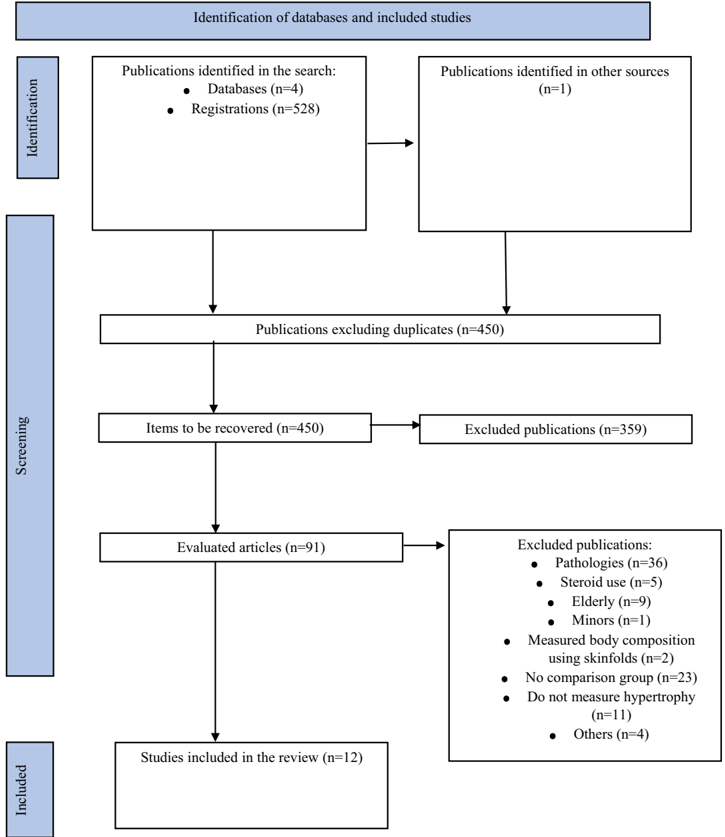
Purpose: Various training factors in combination with high intensity methodologies and techniques have been extensively investigated, with the intention of increasing anabolic, endocrine responses and subsequent structural adaptations. Variable resistance training allows the demands of an exercise to be matched to the muscle’s ability to exert force. The aim of this article is to examine whether variable resistance training produces significant gains in muscle mass compared to conventional resistance training. Methods: A literature search was performed via PubMed, Web of Science, Cochrane and Scopus with search terms including “variable resistance”, “accommodating resistance”, “flywheel resistance”, “bands resistance”, “eccentric overloading resistance”, “isokinetic resistance”, “elastic resistance”, “variable cam”, “chain loaded resistance training”, “hypertrophy”, “resistance training”, strength training” and “power training” in July 2023. Inclusion criteria were studies that measured direct data related to muscle hypertrophy, compared variable resistance training and conventional resistance training and measured body composition using tape measures, ultrasound, dual-energy X-ray absorptiometry (DXA), magnetic resonance imaging and bioimpedance metres. Results: Our search identified a total of 528 articles, and 12 studies met the inclusion criteria. The results of the studies analysed show that similar improvements occur, with no significant differences between the two training protocols. Conclusion: This systematic review revealed that variable resistance training does not produce a greater gain in muscle mass compared to conventional training over a short–medium period of time and with untrained subjects. Therefore, it is necessary to compare these two training methods over longer training periods and with subjects with more experience in resistance training.
Overview
The claims and statistics of this paper haven’t been checked yet.
Free: it reads the open-access text and checks the first 5 claims that cite a source we can check. Create a free account to check every claim.
Integrity signals
Registry
Cites
Statistics
Figures
Verification
Claims the paper makes
The claims and statistics of this paper haven’t been checked yet.
Free: it reads the open-access text and checks the first 5 claims that cite a source we can check. Create a free account to check every claim.
Self-check
Percentages, sums and reported differences re-computed from the paper’s own numbers.
The self-check needs the paper’s full text.
Citations
Cites
Hormonal Responses and Adaptations to Resistance Exercise and Training
Kraemer, W. J., & Ratamess, N. A. (2005) · Sports Medicine · doi:10.2165/00007256-200535040-00004 · Cited by 1,389 · cited 1×
“IGF-1 is one of the most studied anabolic hormones along with GH [35], whilst cortisol and myostatin have a mostly catabolic function through protein degradation [35, 36].”
Designing Resistance Training Programs
Fleck, S. J., & Kraemer, W. J. (2014) · Human Kinetics eBooks · doi:10.5040/9781718225107 · Cited by 1,360
The mechanisms of muscle hypertrophy and their application to resistance training
Schoenfeld, B. J. (2010) · Journal of Strength and Conditioning Research · doi:10.1519/jsc.0b013e3181e840f3 · Cited by 1,214 · cited 8×
“Muscular strength is a physical capacity directly related to a large number of health parameters [1], such as a lower risk of coronary or cardiovascular disease, as well as to sporting performance in different sports [2].”
InfluentialCampos, G., Luecke, T., Wendeln, H., Toma, K., Hagerman, F., Murray, T., Ragg, K., Ratamess, N., Kraemer, W., & Staron, R. (2002) · European Journal of Applied Physiology · doi:10.1007/s00421-002-0681-6 · Cited by 1,066
Individual differences in response to regular physical activity
BOUCHARD, C., & RANKINEN, T. (2001) · Medicine and Science in Sports and Exercise · doi:10.1097/00005768-200106001-00013 · Cited by 939 · cited 1×
“However, according to Bouchard and Rankinen [38], there is a link between genetic variations and skeletal muscle characteristics such as muscle fibre composition that could affect adaptations to training [39].”
A biomechanical analysis of the sticking region in the bench press
ELLIOTT, B. C., WILSON, G. J., & KERR, G. K. (1989) · Medicine & Science in Sports & Exercise · doi:10.1249/00005768-198908000-00018 · Cited by 264 · cited 2×
“Due to the body's leverage systems, the maximum weight that can be used during an exercise is limited by a phenomenon commonly known as sticking point, which creates a more disadvantageous position in ROM, limiting maximal external resistance [8].”
Damas, F., Libardi, C. A., & Ugrinowitsch, C. (2018) · European Journal of Applied Physiology · doi:10.1007/s00421-017-3792-9 · Cited by 254 · cited 1×
“Taking into account the findings of the work of Damas et al. [40] in which it was seen that protocols with less muscle damage achieved similar hypertrophy to those that did, it may be that this method is less harmful and more efficient [6] to achieve this objective, although we cannot find a…”
Resistance training using eccentric overload induces early adaptations in skeletal muscle size
Norrbrand, L., Fluckey, J. D., Pozzo, M., & Tesch, P. A. (2007) · European Journal of Applied Physiology · doi:10.1007/s00421-007-0583-8 · Cited by 253 · cited 2×
“When looking at the case of the quadriceps muscles analysed by Norrbrand et al. [22], it is possible to see how with constant resistance training, only the size of the rectus femoris increased, whilst with variable resistance training, all muscle bellies improved.”
Mohr, M., Krustrup, P., Nielsen, J. J., Nybo, L., Rasmussen, M. K., Juel, C., & Bangsbo, J. (2007) · American Journal of Physiology-Regulatory, Integrative and Comparative Physiology · doi:10.1152/ajpregu.00251.2006 · Cited by 229 · cited 1×
“Considering that adaptations occur in part due to fatigue of the neuromuscular system [12, 13], it is possible that the VRT has the potential to provide a greater stimulus in a smaller unit of training than a CRT.”
Silventoinen, K., Magnusson, P. K. E., Tynelius, P., Batty, G. D., & Rasmussen, F. (2009) · International Journal of Epidemiology · doi:10.1093/ije/dyn231 · Cited by 225 · cited 1×
“Muscular strength is a physical capacity directly related to a large number of health parameters [1], such as a lower risk of coronary or cardiovascular disease, as well as to sporting performance in different sports [2].”
Oranchuk, D. J., Storey, A. G., Nelson, A. R., & Cronin, J. B. (2019) · Scandinavian Journal of Medicine & Science in Sports · doi:10.1111/sms.13375 · Cited by 210
Mangine, G. T., Hoffman, J. R., Gonzalez, A. M., Townsend, J. R., Wells, A. J., Jajtner, A. R., Beyer, K. S., Boone, C. H., Miramonti, A. A., Wang, R., et al. (2015) · Physiological Reports · doi:10.14814/phy2.12472 · Cited by 204
A Biomechanical Evaluation of Resistance: Fundamental Concepts for Training and Sports Performance
Frost, D. M., Cronin, J. B., & Newton, R. U. (2010) · Sports Medicine · doi:10.2165/11319420-000000000-00000 · Cited by 191
Effects of strength training with eccentric overload on muscle adaptation in male athletes
Friedmann-Bette, B., Bauer, T., Kinscherf, R., Vorwald, S., Klute, K., Bischoff, D., Müller, H., Weber, M.-A., Metz, J., Kauczor, H.-U., et al. (2010) · European Journal of Applied Physiology · doi:10.1007/s00421-009-1292-2 · Cited by 185
The Effects of Combining Elastic and Free Weight Resistance on Strength and Power in Athletes
Anderson, C. E., Sforzo, G. A., & Sigg, J. A. (2008) · Journal of Strength and Conditioning Research · doi:10.1519/jsc.0b013e3181634d1e · Cited by 149 · cited 2×
“This should keep the muscle working closer to its maximal capacity at all ROM by reducing the stagnation point, which could have led to greater recruitment of type IIX fibres [15] and hence greater adaptations of these fibres.”
A genetic-based algorithm for personalized resistance-training
Jones, N., Kiely, J., Suraci, B., Collins, D., de Lorenzo, D., Pickering, C., & Grimaldi, K. (2016) · Biology of Sport · doi:10.5604/20831862.1198210 · Cited by 123 · cited 1×
“However, according to Bouchard and Rankinen [38], there is a link between genetic variations and skeletal muscle characteristics such as muscle fibre composition that could affect adaptations to training [39].”
Lowery, R. P., Joy, J. M., Loenneke, J. P., Souza, E. O. D., Machado, M., Dudeck, J. E., & Wilson, J. M. (2013) · Clinical Physiology and Functional Imaging · doi:10.1111/cpf.12099 · Cited by 122 · cited 1×
“It is possible to assume that these changes are due to some gain in muscle mass [30].”
McMahon, G. E., Morse, C. I., Burden, A., Winwood, K., & Onambélé, G. L. (2014) · Journal of Strength and Conditioning Research · doi:10.1519/jsc.0b013e318297143a · Cited by 122 · cited 1×
“…stress may have been produced by different means: on the one hand, in the preacher curl with pulley, training at longer muscle lengths produces more interactions between actin and myosin filaments [31, 32], which would produce greater mechanical tension and, therefore, greater muscle growth.”
Walker, S., Blazevich, A. J., Haff, G. G., Tufano, J. J., Newton, R. U., & Häkkinen, K. (2016) · Frontiers in Physiology · doi:10.3389/fphys.2016.00149 · Cited by 121
Short‐term training for explosive strength causes neural and mechanical adaptations
Tillin, N. A., Pain, M. T. G., & Folland, J. P. (2012) · Experimental Physiology · doi:10.1113/expphysiol.2011.063040 · Cited by 120 · cited 1×
“…the duration of most of the studies may not be sufficient to see the differences in structural adaptations between the two training methods, as it has been shown that during the first weeks, the adaptations to resistance training are mainly neural, whilst morphological changes occur later [26–28].”
Maroto-Izquierdo, S., García-López, D., & de Paz, J. A. (2017) · Journal of Human Kinetics · doi:10.1515/hukin-2017-0096 · Cited by 110
Walker, S., Hulmi, J. J., Wernbom, M., Nyman, K., Kraemer, W. J., Ahtiainen, J. P., & Häkkinen, K. (2013) · European Journal of Applied Physiology · doi:10.1007/s00421-013-2653-4 · Cited by 70 · cited 1×
“Therefore, this systematic review includes 12 studies [6, 14, 16–25].”
Neuromuscular and Hormonal Responses to Constant and Variable Resistance Loadings
Walker, S., Taipale, R. S., Nyman, K., Kraemer, W. J., & Häkkinen, K. (2010) · Medicine & Science in Sports & Exercise · doi:10.1249/mss.0b013e3181e71bcb · Cited by 47 · cited 1×
“The use of VRT has been shown to produce greater acute neural fatigue, higher total testosterone, growth hormone and cortisol compared to constant resistance training (CRT) [10], probably due to greater muscle activity [11].”
Goto, M., Maeda, C., Hirayama, T., Terada, S., Nirengi, S., Kurosawa, Y., Nagano, A., & Hamaoka, T. (2017) · The Journal of Strength and Conditioning Research · doi:10.1519/jsc.0000000000002051 · Cited by 47 · cited 1×
“On the other hand, the barbell preacher curl works at shorter muscle lengths, which can lead to greater metabolic stress and also increase mechanical stress [33].”
Selection of Resistance Exercises for Older Individuals: The Forgotten Variable
Ribeiro, A. S., Nunes, J. P., & Schoenfeld, B. J. (2020) · Sports Medicine · doi:10.1007/s40279-020-01260-5 · Cited by 46 · cited 2×
“Other training variables influencing muscle mass gain, such as repetition range, volume, intensity, frequency and rest time have been extensively investigated [5].”
Endocrine Responses and Adaptations to Strength and Power Training
Kraemer, W. J., & Ratamess, N. A. (2003) · Strength and Power in Sport · doi:10.1002/9780470757215.ch19 · Cited by 43 · cited 3×
“The main mechanisms for muscle mass development are mechanical strain, metabolic stress and muscle damage [2], which are achieved by training with loads mediated by the neuroendocrine system [4].”
Nunes, J. P., Jacinto, J. L., Ribeiro, A. S., Mayhew, J. L., Nakamura, M., Capel, D. M. G., Santos, L. R., dos Santos, L., Cyrino, E. S., & Aguiar, A. F. (2020) · International Journal of Environmental Research and Public Health · doi:10.3390/ijerph17165859 · Cited by 41
Lundberg, T. R., García-Gutiérrez, M. T., Mandić, M., Lilja, M. R., & Fernandez‐Gonzalo, R. (2019) · Applied Physiology, Nutrition, and Metabolism · doi:10.1139/apnm-2018-0774 · Cited by 40
Exercise Does Not Influence Myostatin and Follistatin Messenger RNA Expression in Young Women
Jensky, N. E., Sims, J. K., Dieli-Conwright, C. M., Sattler, F. R., Rice, J. C., & Schroeder, E. T. (2010) · Journal of Strength and Conditioning Research · doi:10.1519/jsc.0b013e3181c8664f · Cited by 37 · cited 2×
“IGF-1 is one of the most studied anabolic hormones along with GH [35], whilst cortisol and myostatin have a mostly catabolic function through protein degradation [35, 36].”
Walker, S., Peltonen, H., Avela, J., & Häkkinen, K. (2011) · Journal of Electromyography and Kinesiology · doi:10.1016/j.jelekin.2010.12.004 · Cited by 33 · cited 1×
“The use of VRT has been shown to produce greater acute neural fatigue, higher total testosterone, growth hormone and cortisol compared to constant resistance training (CRT) [10], probably due to greater muscle activity [11].”
da Matta, T. T., Nascimento, F. X. M. B., Trajano, G. S., Junior, R. F. S., Willardson, J. M., & de Oliveira, L. F. (2015) · Clinical Physiology and Functional Imaging · doi:10.1111/cpf.12277 · Cited by 32
da Matta, T. T., Nascimento, F. X. M. B., Fernandes, I. A., & de Oliveira, L. F. (2014) · Clinical Physiology and Functional Imaging · doi:10.1111/cpf.12151 · Cited by 31
Variable resistance versus constant resistance strength training in adult males
Pipes, T. V. (1978) · European Journal of Applied Physiology · doi:10.1007/bf00429676 · Cited by 30 · cited 2×
“These neural adaptations may occur especially in the case of subjects who are not used to strength training [29], that is, the majority of the participants in these studies, so that morphological changes are more complex to obtain.”
Arazi, H., Salek, L., Nikfal, E., Izadi, M., Tufano, J. J., Elliott, B., & Brughelli, M. (2020) · Journal of Translational Medicine · doi:10.1186/s12967-020-02411-y · Cited by 28 · cited 3×
“Despite the above, little is known about the heterogeneity of hormonal responses to strength training [34].”
InfluentialAndersen, V. S., Pedersen, H., Fimland, M. S., Shaw, M. P., Solstad, T. E. J., Stien, N., Cumming, K. T., & Sæterbakken, A. H. (2020) · Frontiers in Sports and Active Living · doi:10.3389/fspor.2020.598284 · Cited by 20 · cited 4×
“The use of variable resistance allows the load to be adjusted to the muscle's ability to exert force over the full range of motion [3], allowing for greater efficiency, comfort and safety for the athlete [6].”
InfluentialStanıszewski, M., Mastalerz, А., & Urbanik, C. (2020) · Biology of Sport · doi:10.5114/biolsport.2020.92517 · Cited by 15 · cited 6×
“Therefore, this systematic review includes 12 studies [6, 14, 16–25].”
InfluentialUse of a variable-cam for strength training of the elbow flexors
Stanıszewski, M., Urbanik, C., Mastalerz, А., Lutosławska, G., Iwańska, D., Madej, A., Karczewska, M., & Tkaczyk, J. (2015) · Isokinetics and Exercise Science · doi:10.3233/ies-150576 · Cited by 1 · cited 4×
“Therefore, this systematic review includes 12 studies [6, 14, 16–25].”
Influential
Research works printed but not linked: 3
- Urbanik C, Staniszewski M, Mastalerz A, Karczewska M, Lutosławska G, Iwańska D, Madej A, Ostrowska E, Gwarek L, Tkaczyk J (2013) Evaluation of the effectiveness of training on a machine with a variable-cam. Acta Bioeng Biomech 15(4):93-102
- De Lemos Muller CH, Remis TR, Ribeiro JL (2015) Compari- son of the effects of resistance training with and without vascular occlusion in increases of strength and hypertrophy: a review of the literature. Sports Med 11(4):2668-2675
- Mulligan SE, Fleck SJ, Gordon SE, Koziris LP, Triplett-McBride NT, Kraemer WJ (1996) Influence of resistance exercise volume on serum growth hormone and cortisol concentrations in women. J Strength Cond Res 10(4):256-262
Cited by
CURRIER, B. S., D’SOUZA, A. C., SINGH, M. A. F., LOWISZ, C. V., RAWSON, E. S., SCHOENFELD, B. J., SMITH-RYAN, A. E., STEEN, J. P., THOMAS, G. A., TRIPLETT, N. T., et al. (2026) · Medicine & Science in Sports & Exercise · doi:10.1249/mss.0000000000003897 · Cited by 105
Gao, J., Liu, D., Zhu, J., Guo, Q. Y., & Wang, X. (2025) · PeerJ · doi:10.7717/peerj.20212 · Cited by 11
Pan, C., Li, W., Su, Y., & Shi, Y. (2025) · Journal of Exercise Science & Fitness · doi:10.1016/j.jesf.2025.04.001 · Cited by 9
“García et al. 53 found that VRT was more effective than CRT in improving maximum strength, although muscle circumference did not differ significantly between the two groups.”
Xu, Z., Su, S., & Xu, Z. (2026) · PeerJ · doi:10.7717/peerj.20644 · Cited by 5
Gao, J., Gong, Z., Samsudin, S., Abdullah, B., & Dev, R. D. O. (2025) · BMC Sports Science Medicine and Rehabilitation · doi:10.1186/s13102-025-01248-6 · Cited by 4
“…improvements observed in the ICT group reinforce previous findings that unstable surface training elicits greater activation of sensorimotor pathways and enhances spinal reflex responses, ultimately improving an athlete’s ability to maintain balance under dynamic and unpredictable conditions [73].”
Metadata
- Authors
- Fuentes-García, M. A., Malchrowicz-Mośko, E., & Castañeda-Babarro, A.
- Affiliations
- Universidad de Deusto (ES)
- Corresponding author
- Castañeda-Babarro, Arkaitz
- Venue
- Sport Sciences for Health
- Published
- 2023-07-26
- Volume
- 20
- Issue
- 1
- Pages
- 37-45
- ISSN
- 1824-7490 (ISSN-L)
- 1825-1234
- OpenAlex
- W4385272036
- Semantic Scholar
- f5009718f5a13c3e5140c7df1c4a57854a5e1b4d
- Cited by
- 9
- References
- 37
- Citations by year
- 2026: 3 · 2025: 6
- FWCI
- 0.50
- Type
- journal article
- Language
- en
- Open access
- hybrid
- doi.org
- Licence
- cc-by
- creativecommons.org/licenses/by/4.0 (tdm)
- creativecommons.org/licenses/by/4.0 (vor)
- Locations
- Sport Sciences for Health (publishedVersion, cc-by)
- Funders
- Universidad de Deusto
- Topics
- Health Sciences › Medicine › Orthopedics and Sports Medicine › Sports Performance and Training
- Health Sciences › Nursing › Nutrition and Dietetics › Muscle metabolism and nutrition
- Health Sciences › Medicine › Physiology (medical) › Cardiovascular and exercise physiology
- Keywords
- variable resistance training, muscle hypertrophy, muscle mass, body composition, resistance bands, training effects, untrained subjects
About these checks
Registry, retraction, Cites and statistics results are computed, not judged, with one exception: a printed reference that no index lists is read once by a model before it counts as a citation error. Claims are extracted by a model and kept only when their quote appears verbatim in the text; each cited source is then checked, with a model’s help, for whether it says what the claim relies on. Those verdicts can be wrong — read the claim’s quote and the cited source before relying on one.
Statistics and arithmetic are recomputed, not judged.
Confidence bands are shown only for fields calibrated on our annotated test set. None is calibrated yet, so no band is shown.
What counts as a claim ›How we measure confidence ›How we check this ›
Are you an author, or do you see a problem with this page? Request a review
Data sources
Bibliographic data: Semantic Scholar, OpenAlex, Crossref.
Contains information from the Semantic Scholar Academic Graph Datasets, made available under the ODC Attribution License (ODC-BY 1.0).
Semantic Scholar’s data is described in: Kinney, R., et al. (2023). The Semantic Scholar Open Data Platform. arXiv:2301.10140.
