

The DOI matches its Crossref record; 444 of the 445 references it cites were found in a registry or an index.
The Oxygen Paradox, the French Paradox, and age-related diseases
Open accessAbstract
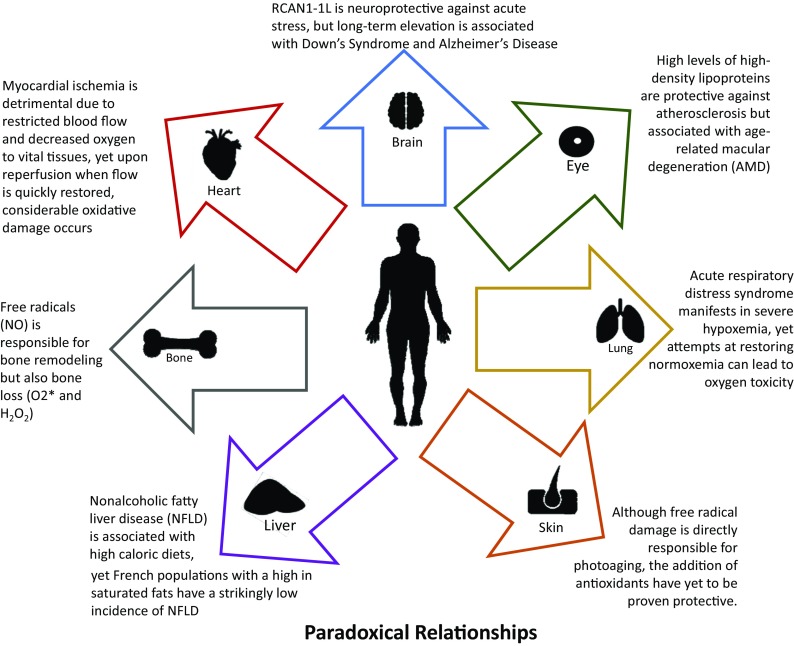
A paradox is a seemingly absurd or impossible concept, proposition, or theory that is often difficult to understand or explain, sometimes apparently self-contradictory, and yet ultimately correct or true. How is it possible, for example, that oxygen "a toxic environmental poison" could be also indispensable for life (Beckman and Ames Physiol Rev 78(2):547-81, 1998; Stadtman and Berlett Chem Res Toxicol 10(5):485-94, 1997)?: the so-called Oxygen Paradox (Davies and Ursini 1995; Davies Biochem Soc Symp 61:1-31, 1995). How can French people apparently disregard the rule that high dietary intakes of cholesterol and saturated fats (e.g., cheese and paté) will result in an early death from cardiovascular diseases (Renaud and de Lorgeril Lancet 339(8808):1523-6, 1992; Catalgol et al. Front Pharmacol 3:141, 2012; Eisenberg et al. Nat Med 22(12):1428-1438, 2016)?: the so-called, French Paradox. Doubtless, the truth is not a duality and epistemological bias probably generates apparently self-contradictory conclusions. Perhaps nowhere in biology are there so many apparently contradictory views, and even experimental results, affecting human physiology and pathology as in the fields of free radicals and oxidative stress, antioxidants, foods and drinks, and dietary recommendations; this is particularly true when issues such as disease-susceptibility or avoidance, "healthspan," "lifespan," and ageing are involved. Consider, for example, the apparently paradoxical observation that treatment with low doses of a substance that is toxic at high concentrations may actually induce transient adaptations that protect against a subsequent exposure to the same (or similar) toxin. This particular paradox is now mechanistically explained as "Adaptive Homeostasis" (Davies Mol Asp Med 49:1-7, 2016; Pomatto et al. 2017a; Lomeli et al. Clin Sci (Lond) 131(21):2573-2599, 2017; Pomatto and Davies 2017); the non-damaging process by which an apparent toxicant can activate biological signal transduction pathways to increase expression of protective genes, by mechanisms that are completely different from those by which the same agent induces toxicity at high concentrations. In this review, we explore the influences and effects of paradoxes such as the Oxygen Paradox and the French Paradox on the etiology, progression, and outcomes of many of the major human age-related diseases, as well as the basic biological phenomenon of ageing itself.
Overview
The claims and statistics of this paper haven’t been checked yet.
Run the check — free, no account needed. It reads the open-access text and checks the sources it cites.
Integrity signals
Registry
Cites
Statistics
Figures
Verification
Claims the paper makes
The claims and statistics of this paper haven’t been checked yet.
Run the check — free, no account needed. It reads the open-access text and checks the sources it cites.
Claims other papers make about this one
Each is checked against this paper’s own text: does it say what the citing paper says it does?
In the citing paper
“Under conditions of an imbalanced redox state, increased mitochondrial ROS production might lead to modifications of the arterial walls180, followed by an inflammatory environment181.”
From Mitochondrial and metabolic dysfunction in ageing and age-related diseases (2022) · cites this paper as [181]
Self-check
Percentages, sums and reported differences re-computed from the paper’s own numbers.
The self-check needs the paper’s full text.
Citations
Cites
1 retracted
Xiao, Y., Yan, W., Lu, L., Wang, Y., Lu, W., Cao, Y. L., & Cai, W. (2015) · Cell Cycle · doi:10.1080/15384101.2015.1026491 · Cited by 74
RetractedCancer incidence and mortality worldwide: Sources, methods and major patterns in GLOBOCAN 2012
Ferlay, J., Soerjomataram, I., Dikshit, R., Eser, S., Mathers, C., Rebelo, M., Parkin, D. M., Forman, D., & Bray, F. (2015) · International Journal of Cancer · doi:10.1002/ijc.29210 · Cited by 28,766
(2000) · New England Journal of Medicine · doi:10.1056/nejm200005043421801 · Cited by 12,941
The metabolic syndrome—a new worldwide definition
Alberti, K. G. M., Zimmet, P., & Shaw, J. (2005) · The Lancet · doi:10.1016/s0140-6736(05)67402-8 · Cited by 9,352 · cited 2×
“insulin resistance, and high blood pressure and blood triglycerides (Alberti et al. 2005).”
BackgroundGlutamate neurotoxicity and diseases of the nervous system
Choi, D. W. (1988) · Neuron · doi:10.1016/0896-6273(88)90162-6 · Cited by 8,188
Molecular Mechanisms of Stress-Responsive Changes in Collagen and Elastin Networks in Skin
Aziz, J., Shezali, H., Radzi, Z., Yahya, N. A., Abu Kassim, N. H., Czernuszka, J., & Rahman, M. T. (2016) · Skin Pharmacology and Physiology · doi:10.1159/000447017 · Cited by 7,323
The L-Arginine-Nitric Oxide Pathway
Epstein, F. H., Moncada, S., & Higgs, A. (1993) · New England Journal of Medicine · doi:10.1056/nejm199312303292706 · Cited by 6,678
Osteoclast differentiation and activation
Boyle, W. J., Simonet, W. S., & Lacey, D. L. (2003) · Nature · doi:10.1038/nature01658 · Cited by 6,670 · cited 1×
“If these two actions are not in balance, pathology ensues (Boyle et al. 2003; Nohl 1993; Wauquier et al. 2009; Vaananen et al. 2000).”
BackgroundHeart Disease and Stroke Statistics—2015 Update: A Report From the American Heart Association
Mozaffarian, D., Benjamin, E. J., Go, A. S., Arnett, D. K., Blaha, M. J., Cushman, M., de Ferranti, S., Després, J.-P., Fullerton, H. J., Howard, V. J., et al. (2015) · Circulation · doi:10.1161/cir.0000000000000152 · Cited by 5,797
Wong, W. L., Su, X., Li, X., Cheung, C. M. G., Klein, R., Cheng, C., & Wong, T. Y. (2014) · The Lancet Global Health · doi:10.1016/s2214-109x(13)70145-1 · Cited by 5,545
Research works printed but not linked: 4
- Garrod AB (1859) Treatise on nature of gout and rheumatic gout. Walton and Maberly, London
- Kurien BT, Mohan C, Scofield H (2012) Mechanisms of tissue damage-free radicals and fibrosis. In: Wallace DJ (ed) Dubois’ Lupus Erythematosus and Related Syndromes E-Book: Expert Consult-Online, 8th edn. Elsevier Health Sciences, London, p 175–189
- Rui Yin QC, Hamblin MR (2015) Skin aging and photoaging, in Skin photoaging. Morgan & Claypool, San Rafael, pp 1–4
- Yaar M, Gilchrest BA (2012) Aging of the skin, in Fitspatrick’s dermatology in general medicine. McGraw Hill, New York, pp 1213–1211
Cited by
Sorted by citations
Mitochondrial and metabolic dysfunction in ageing and age-related diseases
Amorim, J. A., Coppotelli, G., Rolo, A. P., Palmeira, C. M., Ross, J. M., & Sinclair, D. A. (2022) · Nature Reviews Endocrinology · doi:10.1038/s41574-021-00626-7 · Cited by 990
Charlton, N. C., Mastyugin, M., Török, B., & Török, M. (2023) · Molecules · doi:10.3390/molecules28031057 · Cited by 292
“The so-called “French Paradox” especially increased interest in dietary small molecule antioxidants after it was noted that despite high saturated fat and alcohol intake, Mediterranean populations are less likely to develop coronary heart disease [42].”
BackgroundOxInflammation: From Subclinical Condition to Pathological Biomarker
Valacchi, G., Virgili, F., Cervellati, C., & Pecorelli, A. (2018) · Frontiers in Physiology · doi:10.3389/fphys.2018.00858 · Cited by 212
“Possible leaks from this outpost can be then countered by further repair systems such as proteinases, lipases, DNA repair enzymes (Davies et al., 2017).”
BackgroundMelatonin: Clinical Perspectives in Neurodegeneration
Cardinali, D. P. (2019) · Frontiers in Endocrinology · doi:10.3389/fendo.2019.00480 · Cited by 210
“Although the regular intake of antioxidants has been proposed for prevention of neurodegeneration, its effectiveness, however, has been questioned (3).”
BackgroundMarcucci, G., Domazetovic, V., Nediani, C., Ruzzolini, J., Favre, C., & Brandi, M. L. (2023) · Antioxidants · doi:10.3390/antiox12020373 · Cited by 200
“It has also been demonstrated that ROS stimulates osteoclastogenesis through RANKL as reported in human stromal cells [26,81].”
Background
Metadata
- Authors
- Davies, J. M. S., Cillard, J., Friguet, B., Cadenas, E., Cadet, J., Cayce, R., Fishmann, A., Liao, D., Bulteau, A.-L., Derbré, F., Rébillard, A., Burstein, S., Hirsch, E., Kloner, R. A., Jakowec, M., Petzinger, G., Sauce, D., Sennlaub, F., Limon, I., Ursini, F., Maiorino, M., Economides, C., Pike, C. J., Cohen, P., Salvayre, A. N., Halliday, M. R., Lundquist, A. J., Jakowec, N. A., Mechta-Grigoriou, F., Mericskay, M., Mariani, J., Li, Z., Huang, D., Grant, E., Forman, H. J., Finch, C. E., Sun, P. Y., Pomatto, L. C. D., Agbulut, O., Warburton, D., Neri, C., Rouis, M., Cillard, P., Capeau, J., Rosenbaum, J., & Davies, K. J. A.
- Affiliations
- University of Southern California (US)
- Université de Rennes (FR)
- Centre National de la Recherche Scientifique (FR)
- Université de Sherbrooke (CA)
- Good Samaritan Hospital (US)
- École Normale Supérieure de Lyon (FR)
- Université Rennes 2 (FR)
- Huntington Medical Research Institutes (US)
- Inserm (FR)
- Institut de la Vision (FR)
- University of Padua (IT)
- Université Paris-Sud (FR)
- Corresponding author
- Davies, Kelvin J. A.
- ORCID
- Friguet, Bertrand
- Cadenas, Enrique
- Cadet, Jean
- Bulteau, Anne-Laure
- Rébillard, Amélie
- Kloner, Robert A.
- Jakowec, Michael
- Petzinger, Giselle
- Sauce, Delphine
- Sennlaub, Florian
- Limon, Isabelle
- Ursini, Fulvio
- Maiorino, Matilde
- Pike, Christian J.
- Cohen, Pinchas
- Halliday, Matthew R.
- Lundquist, Adam J.
- Jakowec, Nicolaus A.
- Mericskay, Mathias
- Mariani, Jean
- Li, Zhenlin
- Grant, Ellsworth
- Forman, Henry J.
- Finch, Caleb E.
- Sun, Patrick Y.
- Pomatto, Laura C. D.
- Agbulut, Onnik
- Warburton, David
- Rouis, Mustapha
- Capeau, Jacqueline
- Rosenbaum, Jean
- Davies, Kelvin J. A.
- Venue
- GeroScience
- Published
- 2017-12
- Volume
- 39
- Issue
- 5-6
- Pages
- 499-550
- ISSN
- 2152-4041 (ISSN-L)
- 2509-2715
- 2509-2723
- PMC
- PMC5745211
- OpenAlex
- W2779963304
- Cited by
- 82
- References
- 445
- Citations by year
- 2026: 4 · 2025: 4 · 2024: 9 · 2023: 8 · 2022: 7 · 2021: 13 · 2020: 10 · 2019: 19 · 2018: 7
- FWCI
- 1.13
- Type
- journal article
- Language
- en
- Open access
- hybrid
- doi.org
- Licence
- Locations
- GeroScience (publishedVersion, cc-by)
- PubMed Central (publishedVersion, cc-by)
- PubMed (publishedVersion)
- HAL (submittedVersion, cc-by)
- eScholarship (California Digital Library) (submittedVersion)
- eScholarship (California Digital Library) (submittedVersion, cc-by)
- Padua Research Archive (University of Padova) (submittedVersion, cc-by)
- Funders
- National Science Foundation (#DGE-1418060)
- National Institute of Environmental Health Sciences (#ES023864, #R01ES020812, #D43ES022862, #ES003598)
- Institut National de la Santé et de la Recherche Médicale
- National Institute on Aging (# AG-040753, # AG058068, # P01AG034906, # R01AG034430, # AG052374)
- Agence Nationale de la Recherche
- Université Pierre et Marie Curie
- Université Toulouse III - Paul Sabatier
- Conseil Régional de Bretagne
- Ligue Contre le Cancer
- Fondation de France
- Centre National de la Recherche Scientifique
- Assistance Publique - Hôpitaux de Paris
- U.S. Department of Defense (DOD-PC160353U)
- American Foundation for Aging Research
- Don Roberto Gonzalez and Family Foundation
- National Parkinson Foundation
- National Heart, Lung, and Blood Institute (#U01HL122681)
- Pasadena Guild
- Children's Hospital Los Angeles
- the webb foundation
- The Garland Foundation
- Topics
- Health Sciences › Medicine › Biochemistry (medical) › Antioxidant Activity and Oxidative Stress
- Health Sciences › Medicine › Biochemistry (medical) › Phytochemicals and Antioxidant Activities
- Health Sciences › Medicine › Public Health, Environmental and Occupational Health › Nutritional Studies and Diet
- Keywords
- oxygen paradox, French paradox, free radicals, oxidative stress, antioxidants, cardiovascular disease, age-related diseases, healthspan, lifespan, aging, adaptive homeostasis, hormesis, epigenetics, epigenetic reprogramming, epigenetic drift, epigenetic plasticity, epigenetic memory, epigenetic inheritance, epigenetic noise
- MeSH terms
- Diet, High-Protein, Adaptation, Physiological, Aged, Aged, 80 and over, Aging, Female, France, Free Radicals, Humans, Hypercholesterolemia, Male, Middle Aged, Oxygen, Geriatric Assessment, Oxidative Stress, Risk Assessment
About these checks
Registry, retraction, Cites and statistics results are computed, not judged, with one exception: a printed reference that no index lists is read once by a model before it counts as a citation error. Claims are extracted by a model and kept only when their quote appears verbatim in the text; each cited source is then checked, with a model’s help, for whether it says what the claim relies on. Those verdicts can be wrong — read the claim’s quote and the cited source before relying on one.
Statistics and arithmetic are recomputed, not judged.
Confidence bands are shown only for fields calibrated on our annotated test set. None is calibrated yet, so no band is shown.
What counts as a claim ›How we measure confidence ›How we check this ›
Are you an author, or do you see a problem with this page? Request a review
