

ReCiPe2016: a harmonised life cycle impact assessment method at midpoint and endpoint level
Open accessThe DOI matches its Crossref record; 53 of the 54 references it cites were found in a registry or an index.
Abstract
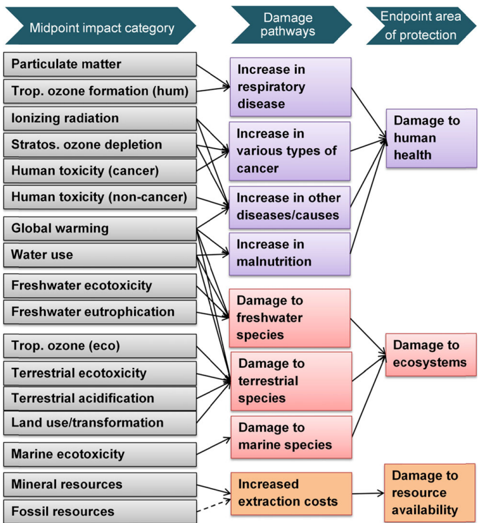
Life cycle impact assessment (LCIA) translates emissions and resource extractions into a limited number of environmental impact scores by means of so-called characterisation factors. There are two mainstream ways to derive characterisation factors, i.e. at midpoint level and at endpoint level. To further progress LCIA method development, we updated the ReCiPe2008 method to its version of 2016. This paper provides an overview of the key elements of the ReCiPe2016 method. We implemented human health, ecosystem quality and resource scarcity as three areas of protection. Endpoint characterisation factors, directly related to the areas of protection, were derived from midpoint characterisation factors with a constant mid-to-endpoint factor per impact category. We included 17 midpoint impact categories. The update of ReCiPe provides characterisation factors that are representative for the global scale instead of the European scale, while maintaining the possibility for a number of impact categories to implement characterisation factors at a country and continental scale. We also expanded the number of environmental interventions and added impacts of water use on human health, impacts of water use and climate change on freshwater ecosystems and impacts of water use and tropospheric ozone formation on terrestrial ecosystems as novel damage pathways. Although significant effort has been put into the update of ReCiPe, there is still major improvement potential in the way impact pathways are modelled. Further improvements relate to a regionalisation of more impact categories, moving from local to global species extinction and adding more impact pathways. Life cycle impact assessment is a fast evolving field of research. ReCiPe2016 provides a state-of-the-art method to convert life cycle inventories to a limited number of life cycle impact scores on midpoint and endpoint level.
Overview
The claims and statistics of this paper haven’t been checked yet.
Free: it reads the open-access text and checks the first 5 claims that cite a source we can check. Create a free account to check every claim.
Integrity signals
Registry
Cites
Statistics
Figures
Verification
Claims the paper makes
The claims and statistics of this paper haven’t been checked yet.
Free: it reads the open-access text and checks the first 5 claims that cite a source we can check. Create a free account to check every claim.
Self-check
Percentages, sums and reported differences re-computed from the paper’s own numbers.
The self-check needs the paper’s full text.
Citations
Cites
(2013) · Cited by 6,752
Accelerating extinction risk from climate change
Urban, M. C. (2015) · Science · doi:10.1126/science.aaa4984 · Cited by 2,436 · cited 2×
“For terrestrial ecosystems, the increase in potentially disappeared fraction of species (PDF) due to an increase in global temperature was derived from the review by Urban (2015).”
BackgroundThe water footprint of humanity
Hoekstra, A. Y., & Mekonnen, M. M. (2012) · Proceedings of the National Academy of Sciences · doi:10.1073/pnas.1109936109 · Cited by 2,260 · cited 2×
“…et al. 2013; Curran et al. 2014 Water use Increase of water consumed Water consumption potential (WCP) m3 water-eq consumed Döll and Siebert 2002; Hoekstra and Mekonnen 2012 Mineral resource scarcity Increase of ore extracted Surplus ore potential (SOP) kg Cu-eq Vieira et al. 2016a Fossil…”
BackgroundMethodAssessing the Environmental Impacts of Freshwater Consumption in LCA
Pfister, S., Koehler, A., & Hellweg, S. (2009) · Environmental Science & Technology · doi:10.1021/es802423e · Cited by 1,321 · cited 2×
“…shortage Pfister et al. 2009 Ecosystems (terrestrial) Decrease in Net Primary Productivity because of water shortage as proxy for total species loss Pfister et al. 2009 Ecosystems (aquatic) Fish species loss due to decreased river discharge Hanafiah et al. 2011 Land use Ecosystems (terrestrial)…”
BackgroundAmbient Air Pollution Exposure Estimation for the Global Burden of Disease 2013
Brauer, M., Freedman, G., Frostad, J., van Donkelaar, A., Martin, R. V., Dentener, F., Dingenen, R. V., Estep, K., Amini, H., Apte, J. S., et al. (2016) · Environmental Science & Technology · doi:10.1021/acs.est.5b03709 · Cited by 1,215
Addressing Global Mortality from Ambient PM2.5
Apte, J. S., Marshall, J. D., Cohen, A. J., & Brauer, M. (2015) · Environmental Science & Technology · doi:10.1021/acs.est.5b01236 · Cited by 995
Joos, F., Roth, R., Fuglestvedt, J. S., Peters, G. P., Enting, I. G., von Bloh, W., Brovkin, V., Burke, E. J., Eby, M., Edwards, N. R., et al. (2013) · Atmospheric Chemistry and Physics · doi:10.5194/acp-13-2793-2013 · Cited by 839
Implementation of life cycle impact assessment methods
Jungbluth, N., Margni, M. D., & Hischier, R. (2010) · Cited by 816
Global modeling of irrigation water requirements
Döll, P., & Siebert, S. (2002) · Water Resources Research · doi:10.1029/2001wr000355 · Cited by 816 · cited 2×
“For agriculture, the consumptive part of the withdrawal was estimated with water requirement ratios based on Döll and Siebert (2002).”
BackgroundMethodIdentifying best existing practice for characterization modeling in life cycle impact assessment
Hauschild, M. Z., Goedkoop, M., Guinée, J., Heijungs, R., Huijbregts, M., Jolliet, O., Margni, M., De Schryver, A., Humbert, S., Laurent, A., et al. (2013) · The International Journal of Life Cycle Assessment · doi:10.1007/s11367-012-0489-5 · Cited by 693
Self-citationHuman alteration of the global nitrogen and phosphorus soil balances for the period 1970–2050
Bouwman, A. F., Beusen, A. H. W., & Billen, G. (2009) · Global Biogeochemical Cycles · doi:10.1029/2009gb003576 · Cited by 625 · cited 1×
“For emissions to agricultural soils, it was assumed that typically 10% of all P is transported from agricultural soil to surface waters (Bouwman et al. 2009).”
BackgroundLand use impacts on biodiversity in LCA: a global approach
de Baan, L., Alkemade, R., & Koellner, T. (2013) · The International Journal of Life Cycle Assessment · doi:10.1007/s11367-012-0412-0 · Cited by 373 · cited 3×
“Relative species loss was determined by comparing field data on local species richness in specific types of natural and human-made land covers (De Baan et al. 2013; Elshout et al. 2014).”
BackgroundChaudhary, A., Verones, F., de Baan, L., & Hellweg, S. (2015) · Environmental Science & Technology · doi:10.1021/acs.est.5b02507 · Cited by 357
Self-citationIs there any empirical support for biodiversity offset policy?
Curran, M., Hellweg, S., & Beck, J. (2014) · Ecological Applications · doi:10.1890/13-0243.1 · Cited by 295 · cited 3×
“For land conversion, passive recovery towards a (semi-)natural, old growth habitat was assumed, based on average recovery times from Curran et al. (2014).”
BackgroundMethodInfluentialHuijbregts, M. A. J., Rombouts, L. J. A., Ragas, A. M. J., & van de Meent, D. (2005) · Integrated Environmental Assessment and Management · doi:10.1897/2004-007r.1 · Cited by 225 · cited 1×
“More details on the scenario building can be found in Huijbregts et al. (2016).”
BackgroundSelf-citationDe Schryver, A. M., Brakkee, K. W., Goedkoop, M. J., & Huijbregts, M. A. J. (2009) · Environmental Science & Technology · doi:10.1021/es800456m · Cited by 218 · cited 2×
“…related to increased malaria, diarrhoea, malnutrition and natural disasters due to increased global mean temperature IPCC 2013; Joos et al. 2013; De Schryver et al. 2009 Ecosystems (terrestrial) Species loss related to changing biome distributions due to increased global temperature IPCC 2013;…”
BackgroundMethodSelf-citation(2015) · LCA Compendium – The Complete World of Life Cycle Assessment · doi:10.1007/978-94-017-9744-3 · Cited by 201
Self-citationHuman health damages due to ionising radiation in life cycle impact assessment
Frischknecht, R., Braunschweig, A., Hofstetter, P., & Suter, P. (2000) · Environmental Impact Assessment Review · doi:10.1016/s0195-9255(99)00042-6 · Cited by 197 · cited 4×
“…air IPCC 2013; Joos et al. 2013 Ozone depletion Stratospheric ozone decrease Ozone depletion potential (ODP) kg CFC-11-eq to air WMO 2011 Ionising radiation Absorbed dose increase Ionising radiation potential (IRP) kBq Co-60-eq to air Frischknecht et al. 2000 Fine particulate matter formation PM2.”
BackgroundMethodInfluentialIntroducing Life Cycle Impact Assessment
Hauschild, M. Z., & Huijbregts, M. A. J. (2015) · LCA compendium · doi:10.1007/978-94-017-9744-3_1 · Cited by 190 · cited 3×
“Life cycle impact assessment (LCIA) supports interpretation of LCA studies by translating emissions and resource extractions into a limited number of environmental impact scores (Hauschild and Huijbregts 2015).”
BackgroundInfluentialSelf-citationLife cycle human health impacts of 875 pesticides
Fantke, P., & Jolliet, O. (2016) · The International Journal of Life Cycle Assessment · doi:10.1007/s11367-015-0910-y · Cited by 187
USES-LCA 2.0—a global nested multi-media fate, exposure, and effects model
van Zelm, R., Huijbregts, M. A. J., & van de Meent, D. (2009) · The International Journal of Life Cycle Assessment · doi:10.1007/s11367-009-0066-8 · Cited by 176 · cited 10×
“…to ingestion and inhalation of toxic substances Van Zelm et al. 2009 Ecosystems (marine) Species loss due to chemical exposure in marine waters Van Zelm et al. 2009 Ecosystems (terrestrial) Species loss due to chemical exposure in soils Van Zelm et al. 2009 Ecosystems (freshwater) Species loss…”
BackgroundMethodInfluentialSelf-citationTowards a meaningful assessment of marine ecological impacts in life cycle assessment (LCA)
Woods, J. S., Veltman, K., Huijbregts, M. A. J., Verones, F., & Hertwich, E. G. (2016) · Environment International · doi:10.1016/j.envint.2015.12.033 · Cited by 166
Self-citationSpatially explicit fate factors of phosphorous emissions to freshwater at the global scale
Helmes, R. J. K., Huijbregts, M. A. J., Henderson, A. D., & Jolliet, O. (2012) · The International Journal of Life Cycle Assessment · doi:10.1007/s11367-012-0382-2 · Cited by 160 · cited 3×
“…to air Roy et al. 2014 Freshwater eutrophication Phosphorus increase in freshwater Freshwater eutrophication potential (FEP) kg P-eq to freshwater Helmes et al. 2012 Human toxicity: cancer Risk increase of cancer disease incidence Human toxicity potential (HTPc) kg 1,4-DCB-eq to urban air Van…”
BackgroundInfluentialSelf-citationHanafiah, M. M., Xenopoulos, M. A., Pfister, S., Leuven, R. S. E. W., & Huijbregts, M. A. J. (2011) · Environmental Science & Technology · doi:10.1021/es1039634 · Cited by 143 · cited 3×
“Finally, the influence of global temperature increase on river discharge and subsequent expected changes in fish species occurrences was taken from Hanafiah et al. (2011).”
BackgroundInfluentialSelf-citationvan Zelm, R., Preiss, P., van Goethem, T., Van Dingenen, R., & Huijbregts, M. (2016) · Atmospheric Environment · doi:10.1016/j.atmosenv.2016.03.044 · Cited by 141 · cited 10×
“Starting from the intake fraction, human effect and damage due to cardiopulmonary and lung cancer mortality of fine particulate matter were determined by Van Zelm et al. (2016).”
BackgroundInfluentialSelf-citationRoy, P., Azevedo, L. B., Margni, M. D., Rosalie Van Zelm, F., Deschênes, L., & Huijbregts, M. A. J. (2014) · The Science of The Total Environment · doi:10.1016/j.scitotenv.2014.08.099 · Cited by 121 · cited 3×
“…to air Van Zelm et al. 2016 Terrestrial acidification Proton increase in natural soils Terrestrial acidification potential (TAP) kg SO2-eq to air Roy et al. 2014 Freshwater eutrophication Phosphorus increase in freshwater Freshwater eutrophication potential (FEP) kg P-eq to freshwater Helmes et…”
BackgroundMethodInfluentialSelf-citationPosthuma, L., & de Zwart, D. (2006) · Environmental Toxicology and Chemistry · doi:10.1897/05-305r.1 · Cited by 110
Global assessment of the effects of terrestrial acidification on plant species richness
Azevedo, L. B., van Zelm, R., Hendriks, A. J., Bobbink, R., & Huijbregts, M. A. J. (2012) · Environmental Pollution · doi:10.1016/j.envpol.2012.11.001 · Cited by 106 · cited 1×
“…et al. 2014 Freshwater eutrophication Ecosystems (aquatic) Loss of aquatic species due to increased phosphorus concentrations Helmes et al. 2012; Azevedo et al. 2013a, b Toxicity Human health Years of life lost and disabled due to cancer and non-cancer effects due to ingestion and inhalation of…”
BackgroundSelf-citationA Systematic Review and Meta-Analysis of Dengue Risk with Temperature Change
Fan, J., Wei, W., Bai, Z., Fan, C., Li, S., Liu, Q., & Yang, K. (2014) · International Journal of Environmental Research and Public Health · doi:10.3390/ijerph120100001 · Cited by 101
Indoor inhalation intake fractions of fine particulate matter: review of influencing factors
Hodas, N., Loh, M., Shin, H. ‐., Li, D., Bennett, D., McKone, T. E., Jolliet, O., Weschler, C. J., Jantunen, M., Lioy, P., et al. (2016) · Indoor Air · doi:10.1111/ina.12268 · Cited by 100
Azevedo, L. B., Henderson, A. D., van Zelm, R., Jolliet, O., & Huijbregts, M. A. J. (2013) · Environmental Science & Technology · doi:10.1021/es403422a · Cited by 87 · cited 1×
“…et al. 2014 Freshwater eutrophication Ecosystems (aquatic) Loss of aquatic species due to increased phosphorus concentrations Helmes et al. 2012; Azevedo et al. 2013a, b Toxicity Human health Years of life lost and disabled due to cancer and non-cancer effects due to ingestion and inhalation of…”
BackgroundSelf-citationValue Choices in Life Cycle Impact Assessment of Stressors Causing Human Health Damage
Schryver, A. M. D., van Zelm, R., Humbert, S., Pfister, S., McKone, T. E., & Huijbregts, M. A. J. (2011) · Journal of Industrial Ecology · doi:10.1111/j.1530-9290.2011.00371.x · Cited by 83 · cited 2×
“…due to mineral extraction increase Vieira et al. 2016b Fossil resource scarcity Resource scarcity Cost increase due to fossil extraction increase Vieira et al. 2016c This information was combined with the disability weight per cancer type (Frischknecht et al. 2000; De Schryver et al. 2011).”
BackgroundMethodSelf-citationRosenbaum, R. K., Meijer, A., Demou, E., Hellweg, S., Jolliet, O., Lam, N. L., Margni, M. D., & McKone, T. E. (2015) · Environmental Science & Technology · doi:10.1021/acs.est.5b00890 · Cited by 83
Ying, S. C., Kocar, B. D., Griffis, S. D., & Fendorf, S. E. (2011) · Environmental Science & Technology · doi:10.1021/es200351m · Cited by 82
Harmonizing the Assessment of Biodiversity Effects from Land and Water Use within LCA
Verones, F., Huijbregts, M. A. J., Chaudhary, A., de Baan, L., Koellner, T., & Hellweg, S. (2015) · Environmental Science & Technology · doi:10.1021/es504995r · Cited by 77
Self-citationKounina, A., Margni, M. D., Shaked, S., Bulle, C., & Jolliet, O. (2014) · Environment International · doi:10.1016/j.envint.2014.04.004 · Cited by 77
Surplus Cost Potential as a Life Cycle Impact Indicator for Metal Extraction
Vieira, M. D. M., Ponsioen, T. C., Goedkoop, M. J., & Huijbregts, M. A. J. (2016) · Resources · doi:10.3390/resources5010002 · Cited by 76 · cited 6×
“Themidpoint characterisation factor for mineral resource scarcity is Surplus Ore Potential (SOP), expressed as kg Cu-eq.”
BackgroundMethodInfluentialSelf-citationSurplus Ore Potential as a Scarcity Indicator for Resource Extraction
Vieira, M. D. M., Ponsioen, T. C., Goedkoop, M. J., & Huijbregts, M. A. J. (2016) · Journal of Industrial Ecology · doi:10.1111/jiec.12444 · Cited by 74 · cited 6×
“Themidpoint characterisation factor for mineral resource scarcity is Surplus Ore Potential (SOP), expressed as kg Cu-eq.”
BackgroundMethodInfluentialSelf-citationSpecies richness–phosphorus relationships for lakes and streams worldwide
Azevedo, L. B., van Zelm, R., Elshout, P. M. F., Hendriks, A. J., LEUVEN, R. S. E. W., Struijś, J., de Zwart, D., & Huijbregts, M. A. J. (2013) · Global Ecology and Biogeography · doi:10.1111/geb.12080 · Cited by 73
Self-citationDong, Y. W., Rosenbaum, R. K., & Hauschild, M. Z. (2015) · Environmental Science & Technology · doi:10.1021/acs.est.5b01625 · Cited by 71
Roy, P., Huijbregts, M. A. J., Deschênes, L., & Margni, M. D. (2012) · Atmospheric Environment · doi:10.1016/j.atmosenv.2012.07.069 · Cited by 69 · cited 2×
“Changes in acid deposition, following changes in air emission of NOx, NH3 and SO2, were calculated with the GEOS-Chem model (Roy et al. 2012a).”
MethodSelf-citationRoy, P., Deschênes, L., & Margni, M. D. (2012) · Environmental Science & Technology · doi:10.1021/es3013563 · Cited by 58 · cited 2×
“Changes in acid deposition, following changes in air emission of NOx, NH3 and SO2, were calculated with the GEOS-Chem model (Roy et al. 2012a).”
MethodCharacterisation factors for life cycle impact assessment of sound emissions
Cucurachi, S., & Heijungs, R. (2013) · The Science of The Total Environment · doi:10.1016/j.scitotenv.2013.07.080 · Cited by 54
Typology of Options for Metal Recycling: Australia’s Perspective
Golev, A., & Corder, G. D. (2015) · Resources · doi:10.3390/resources5010001 · Cited by 54
Elshout, P. M. F., van Zelm, R., Karuppiah, R., Laurenzi, I. J., & Huijbregts, M. A. J. (2014) · The International Journal of Life Cycle Assessment · doi:10.1007/s11367-014-0701-x · Cited by 48 · cited 1×
“Relative species loss was determined by comparing field data on local species richness in specific types of natural and human-made land covers (De Baan et al. 2013; Elshout et al. 2014).”
Self-citationHuman health characterization factors of nano-TiO2 for indoor and outdoor environments
Pini, M., Salieri, B., Ferrari, A. M., Nowack, B., & Hischier, R. (2016) · The International Journal of Life Cycle Assessment · doi:10.1007/s11367-016-1115-8 · Cited by 44
Hayashi, K., Nakagawa, A., Itsubo, N., & Inaba, A. (2004) · The International Journal of Life Cycle Assessment · doi:10.1065/lca2004.11.189 · Cited by 37 · cited 3×
“The human health effect of a decrease in stratospheric ozone concentration, as modelled in the mid-to-endpoint calculation, was derived in two consecutive steps, following Hayashi et al. (2006). The first step relates a change in ozone depletion to an increase in UVB radiation and the second step couples this increase…”
BackgroundInfluentialPlant Species Sensitivity Distributions for ozone exposure
van Goethem, T. M. W. J., Azevedo, L. B., Rosalie Van Zelm, F., Hayes, F., ASHMORE, M. R., & Huijbregts, M. A. J. (2013) · Environmental Pollution · doi:10.1016/j.envpol.2013.02.023 · Cited by 35 · cited 1×
“…et al. 2014 Freshwater eutrophication Ecosystems (aquatic) Loss of aquatic species due to increased phosphorus concentrations Helmes et al. 2012; Azevedo et al. 2013a, b Toxicity Human health Years of life lost and disabled due to cancer and non-cancer effects due to ingestion and inhalation of…”
BackgroundSelf-citationRosenbaum, R. K., Bachmann, T. M., Gold, L. S., Huijbregts, M. A. J., Jolliet, O., Juraske, R., Koehler, A., Larsen, H. F., MacLeod, M., Margni, M., et al. (2008) · The International Journal of Life Cycle Assessment · doi:10.1007/s11367-008-0038-4 · Cited by 31 · cited 2×
“…effects model USES-LCA 2.0, the Uniform System for the Evaluation of Substances adapted for LCA (Van Zelm et al. 2009), as a basis for our calculations, updated to deal with dissociating chemicals (Van Zelm et al. 2013) and using the chemical data from the USEtox database (Rosenbaum et al. 2008).”
MethodInfluentialSelf-citationvan Zelm, R., Stam, G., Huijbregts, M. A. J., & van de Meent, D. (2012) · Chemosphere · doi:10.1016/j.chemosphere.2012.07.014 · Cited by 27 · cited 1×
“…effects model USES-LCA 2.0, the Uniform System for the Evaluation of Substances adapted for LCA (Van Zelm et al. 2009), as a basis for our calculations, updated to deal with dissociating chemicals (Van Zelm et al. 2013) and using the chemical data from the USEtox database (Rosenbaum et al. 2008).”
MethodInfluentialSelf-citationvan Goethem, T. M. W. J., Preiß, P., Azevedo, L. B., Roos, J., Friedrich, R., Huijbregts, M. A. J., & van Zelm, R. (2013) · Atmospheric Environment · doi:10.1016/j.atmosenv.2013.05.009 · Cited by 22
Self-citation
Research works printed but not linked: 2
- 20. Goedkoop M, Heijungs R, Huijbregts MAJ, De Schryver A, Struijs J, van Zelm R (2009) ReCiPe 2008: a life cycle impact assessment method which comprises harmonised category indicators at the midpoint and endpoint levels. First edition. Report i: characterization. The Netherlands: Ruimte en Milieu, Ministerie van Volkshuisvesting, Ruimtelijke Ordening en Milieubeheer
- Vieira MDM, Ponsioen T, Goedkoop M, Huijbregts MAJ (2016c) Fossil resource scarcity. In: Huijbregts MAJ, Steinmann ZJN, Elshout PMF, Stam G, Verones F, Vieira MDM, Van Zelm R (eds) ReCiPe2016. A harmonized life cycle impact assessment method at midpoint and endpoint level. Report I: characterization. RIVM Report 2016-0104. National Institute for Human Health and the Environment, Bilthoven. Chapter 13
Cited by
Luo, H., Barrio, J., Sunny, N., Li, A., Steier, L., Shah, N., Stephens, I. E. L., & Titirici, M. (2021) · Advanced Energy Materials · doi:10.1002/aenm.202101180 · Cited by 447
Corominas, L., Byrne, D. M., Guest, J. S., Hospido, A., Roux, P., Shaw, A., & Short, M. D. (2020) · Water Research · doi:10.1016/j.watres.2020.116058 · Cited by 421
Shah, I. H., Miller, S. A., Jiang, D., & Myers, R. J. (2022) · Nature Communications · doi:10.1038/s41467-022-33289-7 · Cited by 417
Mehmeti, A., Angelis-Dimakis, A., Arampatzis, G., McPhail, S., & Ulgiati, S. (2018) · Environments · doi:10.3390/environments5020024 · Cited by 409
“Concepts such as “Integrated Assessment” and “Sustainability Assessment” shall be used to put forward into decision-making to orient future research and investments.”
BackgroundInfluentialUncovering the true cost of hydrogen production routes using life cycle monetisation
Al-Qahtani, A., Parkinson, B., Hellgardt, K., Shah, N., & Guillen-Gosalbez, G. (2021) · Applied Energy · doi:10.1016/j.apenergy.2020.115958 · Cited by 387
Metadata
- Authors
- Huijbregts, M. A. J., Steinmann, Z. J. N., Elshout, P. M. F., Stam, G., Verones, F., Vieira, M., Zijp, M., Hollander, A., & van Zelm, R.
- Affiliations
- Netherlands Environmental Assessment Agency (NL)
- Radboud University Nijmegen (NL)
- Norwegian University of Science and Technology (NO)
- National Institute for Public Health and the Environment (NL)
- Corresponding author
- Huijbregts, Mark A. J.
- ORCID
- Venue
- The International Journal of Life Cycle Assessment
- Published
- 2016-12-12
- Volume
- 22
- Issue
- 2
- Pages
- 138-147
- ISSN
- 0948-3349 (ISSN-L)
- 1614-7502
- OpenAlex
- W2564630286
- Cited by
- 4,485
- References
- 54
- Citations by year
- 2026: 945 · 2025: 906 · 2024: 682 · 2023: 578 · 2022: 520 · 2021: 391 · 2020: 232 · 2019: 131 · 2018: 78 · 2017: 18 · 2016: 3
- FWCI
- 48.09
- Type
- journal article
- Language
- en
- Update notices
- correction (2020-07-02)
- Open access
- hybrid
- doi.org
- Licence
- cc-by
- creativecommons.org/licenses/by/4.0 (tdm)
- creativecommons.org/licenses/by/4.0 (vor)
- Locations
- The International Journal of Life Cycle Assessment (publishedVersion, cc-by)
- Radboud Repository (Radboud University) (submittedVersion)
- Rivm Repository (Netherlands National Institute for Public Health and the Environment) (submittedVersion)
- Radboud Repository (Radboud University) (submittedVersion, other-oa)
- Funders
- Rijksinstituut voor Volksgezondheid en Milieu (S/607020)
- Topics
- Physical Sciences › Environmental Science › Environmental Engineering › Environmental Impact and Sustainability
- Physical Sciences › Environmental Science › Ecology › Agriculture Sustainability and Environmental Impact
- Physical Sciences › Environmental Science › Environmental Engineering › Sustainability and Ecological Systems Analysis
- Keywords
- life cycle impact assessment, characterization factors, human health effects, ecosystem quality, resource constraints, water use impacts, freshwater ecosystems, tropospheric ozone formation, terrestrial ecosystems, species extinction, environmental interventions, global scale
About these checks
Registry, retraction, Cites and statistics results are computed, not judged, with one exception: a printed reference that no index lists is read once by a model before it counts as a citation error. Claims are extracted by a model and kept only when their quote appears verbatim in the text; each cited source is then checked, with a model’s help, for whether it says what the claim relies on. Those verdicts can be wrong — read the claim’s quote and the cited source before relying on one.
Statistics and arithmetic are recomputed, not judged.
Confidence bands are shown only for fields calibrated on our annotated test set. None is calibrated yet, so no band is shown.
What counts as a claim ›How we measure confidence ›How we check this ›
Are you an author, or do you see a problem with this page? Request a review
Data sources
Bibliographic data: Semantic Scholar, OpenAlex, Crossref.
Contains information from the Semantic Scholar Academic Graph Datasets, made available under the ODC Attribution License (ODC-BY 1.0).
Semantic Scholar’s data is described in: Kinney, R., et al. (2023). The Semantic Scholar Open Data Platform. arXiv:2301.10140.
