

ReCiPe2016: a harmonised life cycle impact assessment method at midpoint and endpoint level
Open accessThe DOI matches its Crossref record; 53 of the 54 references it cites were found in a registry or an index.
Abstract
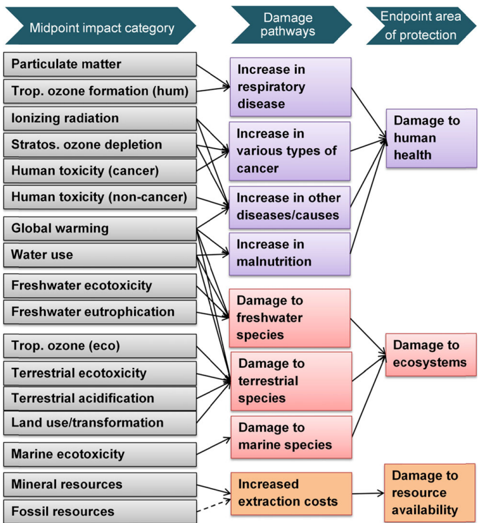
Life cycle impact assessment (LCIA) translates emissions and resource extractions into a limited number of environmental impact scores by means of so-called characterisation factors. There are two mainstream ways to derive characterisation factors, i.e. at midpoint level and at endpoint level. To further progress LCIA method development, we updated the ReCiPe2008 method to its version of 2016. This paper provides an overview of the key elements of the ReCiPe2016 method. We implemented human health, ecosystem quality and resource scarcity as three areas of protection. Endpoint characterisation factors, directly related to the areas of protection, were derived from midpoint characterisation factors with a constant mid-to-endpoint factor per impact category. We included 17 midpoint impact categories. The update of ReCiPe provides characterisation factors that are representative for the global scale instead of the European scale, while maintaining the possibility for a number of impact categories to implement characterisation factors at a country and continental scale. We also expanded the number of environmental interventions and added impacts of water use on human health, impacts of water use and climate change on freshwater ecosystems and impacts of water use and tropospheric ozone formation on terrestrial ecosystems as novel damage pathways. Although significant effort has been put into the update of ReCiPe, there is still major improvement potential in the way impact pathways are modelled. Further improvements relate to a regionalisation of more impact categories, moving from local to global species extinction and adding more impact pathways. Life cycle impact assessment is a fast evolving field of research. ReCiPe2016 provides a state-of-the-art method to convert life cycle inventories to a limited number of life cycle impact scores on midpoint and endpoint level.
Overview
The claims and statistics of this paper haven’t been checked yet.
Free: it reads the open-access text and checks the first 5 claims that cite a source we can check. Create a free account to check every claim.
Integrity signals
Registry
Cites
Statistics
Figures
Verification
Claims the paper makes
The claims and statistics of this paper haven’t been checked yet.
Free: it reads the open-access text and checks the first 5 claims that cite a source we can check. Create a free account to check every claim.
Self-check
Percentages, sums and reported differences re-computed from the paper’s own numbers.
The self-check needs the paper’s full text.
Citations
Cites
(2013) · Cited by 6,752
Accelerating extinction risk from climate change
Urban, M. C. (2015) · Science · doi:10.1126/science.aaa4984 · Cited by 2,436 · cited 2×
“For terrestrial ecosystems, the increase in potentially disappeared fraction of species (PDF) due to an increase in global temperature was derived from the review by Urban (2015).”
BackgroundThe water footprint of humanity
Hoekstra, A. Y., & Mekonnen, M. M. (2012) · Proceedings of the National Academy of Sciences · doi:10.1073/pnas.1109936109 · Cited by 2,260 · cited 2×
“…et al. 2013; Curran et al. 2014 Water use Increase of water consumed Water consumption potential (WCP) m3 water-eq consumed Döll and Siebert 2002; Hoekstra and Mekonnen 2012 Mineral resource scarcity Increase of ore extracted Surplus ore potential (SOP) kg Cu-eq Vieira et al. 2016a Fossil…”
BackgroundMethodAssessing the Environmental Impacts of Freshwater Consumption in LCA
Pfister, S., Koehler, A., & Hellweg, S. (2009) · Environmental Science & Technology · doi:10.1021/es802423e · Cited by 1,321 · cited 2×
“…shortage Pfister et al. 2009 Ecosystems (terrestrial) Decrease in Net Primary Productivity because of water shortage as proxy for total species loss Pfister et al. 2009 Ecosystems (aquatic) Fish species loss due to decreased river discharge Hanafiah et al. 2011 Land use Ecosystems (terrestrial)…”
BackgroundAmbient Air Pollution Exposure Estimation for the Global Burden of Disease 2013
Brauer, M., Freedman, G., Frostad, J., van Donkelaar, A., Martin, R. V., Dentener, F., Dingenen, R. V., Estep, K., Amini, H., Apte, J. S., et al. (2016) · Environmental Science & Technology · doi:10.1021/acs.est.5b03709 · Cited by 1,215
Addressing Global Mortality from Ambient PM2.5
Apte, J. S., Marshall, J. D., Cohen, A. J., & Brauer, M. (2015) · Environmental Science & Technology · doi:10.1021/acs.est.5b01236 · Cited by 995
Joos, F., Roth, R., Fuglestvedt, J. S., Peters, G. P., Enting, I. G., von Bloh, W., Brovkin, V., Burke, E. J., Eby, M., Edwards, N. R., et al. (2013) · Atmospheric Chemistry and Physics · doi:10.5194/acp-13-2793-2013 · Cited by 839
Implementation of life cycle impact assessment methods
Jungbluth, N., Margni, M. D., & Hischier, R. (2010) · Cited by 816
Global modeling of irrigation water requirements
Döll, P., & Siebert, S. (2002) · Water Resources Research · doi:10.1029/2001wr000355 · Cited by 816 · cited 2×
“For agriculture, the consumptive part of the withdrawal was estimated with water requirement ratios based on Döll and Siebert (2002).”
BackgroundMethod
Research works printed but not linked: 2
- 20. Goedkoop M, Heijungs R, Huijbregts MAJ, De Schryver A, Struijs J, van Zelm R (2009) ReCiPe 2008: a life cycle impact assessment method which comprises harmonised category indicators at the midpoint and endpoint levels. First edition. Report i: characterization. The Netherlands: Ruimte en Milieu, Ministerie van Volkshuisvesting, Ruimtelijke Ordening en Milieubeheer
- Vieira MDM, Ponsioen T, Goedkoop M, Huijbregts MAJ (2016c) Fossil resource scarcity. In: Huijbregts MAJ, Steinmann ZJN, Elshout PMF, Stam G, Verones F, Vieira MDM, Van Zelm R (eds) ReCiPe2016. A harmonized life cycle impact assessment method at midpoint and endpoint level. Report I: characterization. RIVM Report 2016-0104. National Institute for Human Health and the Environment, Bilthoven. Chapter 13
Cited by
Luo, H., Barrio, J., Sunny, N., Li, A., Steier, L., Shah, N., Stephens, I. E. L., & Titirici, M. (2021) · Advanced Energy Materials · doi:10.1002/aenm.202101180 · Cited by 447
Corominas, L., Byrne, D. M., Guest, J. S., Hospido, A., Roux, P., Shaw, A., & Short, M. D. (2020) · Water Research · doi:10.1016/j.watres.2020.116058 · Cited by 421
Shah, I. H., Miller, S. A., Jiang, D., & Myers, R. J. (2022) · Nature Communications · doi:10.1038/s41467-022-33289-7 · Cited by 417
Mehmeti, A., Angelis-Dimakis, A., Arampatzis, G., McPhail, S., & Ulgiati, S. (2018) · Environments · doi:10.3390/environments5020024 · Cited by 409
“Concepts such as “Integrated Assessment” and “Sustainability Assessment” shall be used to put forward into decision-making to orient future research and investments.”
BackgroundInfluentialUncovering the true cost of hydrogen production routes using life cycle monetisation
Al-Qahtani, A., Parkinson, B., Hellgardt, K., Shah, N., & Guillen-Gosalbez, G. (2021) · Applied Energy · doi:10.1016/j.apenergy.2020.115958 · Cited by 387
van der Giesen, C., Cucurachi, S., Guinée, J., Kramer, G. J., & Tukker, A. (2020) · Journal of Cleaner Production · doi:10.1016/j.jclepro.2020.120904 · Cited by 386
Luderer, G., Pehl, M., Arvesen, A., Gibon, T., Bodirsky, B. L., de Boer, H. S., Fricko, O., Hejazi, M., Humpenöder, F., Iyer, G., et al. (2019) · Nature Communications · doi:10.1038/s41467-019-13067-8 · Cited by 366
Emerging Engineered Wood for Building Applications
Ding, Y., Pang, Z., Lan, K., Yao, Y., Panzarasa, G., Xu, L., Lo Ricco, M., Rammer, D. R., Zhu, J. Y., Hu, M., et al. (2023) · Chemical Reviews · doi:10.1021/acs.chemrev.2c00450 · Cited by 326
Geminal-atom catalysis for cross-coupling
Hai, X., Zheng, Y., Yu, Q., Guo, N., Xi, S., Zhao, X., Mitchell, S., Luo, X., Tulus, V., Wang, M., et al. (2023) · Nature · doi:10.1038/s41586-023-06529-z · Cited by 314
Life Cycle Assessment of Direct Air Carbon Capture and Storage with Low-Carbon Energy Sources
Terlouw, T., Treyer, K., Bauer, C., & Mazzotti, M. (2021) · Environmental Science & Technology · doi:10.1021/acs.est.1c03263 · Cited by 294
LCA of plastic waste recovery into recycled materials, energy and fuels in Singapore
Khoo, H. H. (2019) · Resources, Conservation and Recycling · doi:10.1016/j.resconrec.2019.02.010 · Cited by 286
Bjørn, A., Chandrakumar, C., Boulay, A.-M., Doka, G., Fang, K., Gondran, N., Hauschild, M. Z., Kerkhof, A., King, H., Margni, M., et al. (2020) · Environmental Research Letters · doi:10.1088/1748-9326/ab89d7 · Cited by 276
Plant-to-planet analysis of CO2-based methanol processes
González-Garay, A., Frei, M. S., Al-Qahtani, A., Mondelli, C., Guillén-Gosálbez, G., & Pérez-Ramírez, J. (2019) · Energy & Environmental Science · doi:10.1039/c9ee01673b · Cited by 266
Koroma, M. S., Costa, D., Philippot, M., Cardellini, G., Hosen, M. S., Coosemans, T., & Messagie, M. (2022) · Science of The Total Environment · doi:10.1016/j.scitotenv.2022.154859 · Cited by 259
“04 (Huijbregts et al., 2017) was used.”
Assessing health and environmental impacts of solvents for producing perovskite solar cells
Vidal, R., Alberola-Borràs, J.-A., Habisreutinger, S. N., Gimeno-Molina, J.-L., Moore, D. T., Schloemer, T. H., Mora-Seró, I., Berry, J. J., & Luther, J. M. (2020) · Nature Sustainability · doi:10.1038/s41893-020-00645-8 · Cited by 254
Sustainable production of value-added carbon nanomaterials from biomass pyrolysis
Zhang, S., Jiang, S.-F., Huang, B.-C., Shen, X.-C., Chen, W.-J., Zhou, T.-P., Cheng, H.-Y., Cheng, B.-H., Wu, C.-Z., Li, W.-W., et al. (2020) · Nature Sustainability · doi:10.1038/s41893-020-0538-1 · Cited by 251
LC‐IMPACT: A regionalized life cycle damage assessment method
Verones, F., Hellweg, S., Antón, A., Azevedo, L. B., Chaudhary, A., Cosme, N., Cucurachi, S., de Baan, L., Dong, Y., Fantke, P., et al. (2020) · Journal of Industrial Ecology · doi:10.1111/jiec.13018 · Cited by 249
Self-citationAlhumayani, H., Gomaa, M., Soebarto, V., & Jabi, W. (2020) · Journal of Cleaner Production · doi:10.1016/j.jclepro.2020.122463 · Cited by 248
“Prior to this, Kafara et al. (2017) conducted a comparative study of 3D printing manufacturing and conventional manufacturing of mould core making for carbon fiber reinforced polymer (CFRP) production.”
MethodGutsch, M., & Leker, J. (2024) · Applied Energy · doi:10.1016/j.apenergy.2023.122132 · Cited by 247
Ex-ante life cycle assessment of commercial-scale cultivated meat production in 2030
Sinke, P., Swartz, E., Sanctorum, H., van der Giesen, C., & Odegard, I. (2023) · The International Journal of Life Cycle Assessment · doi:10.1007/s11367-022-02128-8 · Cited by 247
Exergoenvironmental analysis of bioenergy systems: A comprehensive review
Aghbashlo, M., Khounani, Z., Hosseinzadeh-Bandbafha, H., Gupta, V. K., Amiri, H., Lam, S. S., Morosuk, T., & Tabatabaei, M. (2021) · Renewable and Sustainable Energy Reviews · doi:10.1016/j.rser.2021.111399 · Cited by 240
Hosseinzadeh-Bandbafha, H., Nizami, A.-S., Kalogirou, S. A., Gupta, V. K., Park, Y.-K., Fallahi, A., Sulaiman, A., Ranjbari, M., Rahnama, H., Aghbashlo, M., et al. (2022) · Renewable and Sustainable Energy Reviews · doi:10.1016/j.rser.2022.112411 · Cited by 238
Life cycle assessment and techno-economic analysis of sustainable bioenergy production: a review
Osman, A. I., Fang, B., Zhang, Y., Liu, Y., Yu, J., Farghali, M., Rashwan, A. K., Chen, Z., Chen, L., Ihara, I., et al. (2024) · Environmental Chemistry Letters · doi:10.1007/s10311-023-01694-z · Cited by 236
Turning Food Protein Waste into Sustainable Technologies
Peydayesh, M., Bagnani, M., Soon, W. L., & Mezzenga, R. (2023) · Chemical Reviews · doi:10.1021/acs.chemrev.2c00236 · Cited by 231
Are deep eutectic solvents really green?: A life-cycle perspective
Zaib, Q., Eckelman, M. J., Yang, Y., & Kyung, D. (2022) · Green Chemistry · doi:10.1039/d2gc01752k · Cited by 230
Nizam, N. U. M., Hanafiah, M. M., & Woon, K. S. (2021) · Nanomaterials · doi:10.3390/nano11123324 · Cited by 229
“This stage involves classification, characterization, normalization, evaluation, and weighing the data depending on the impact categories used in the study [78,91,97,98].”
MethodBarbhuiya, S., & Das, B. B. (2023) · Case Studies in Construction Materials · doi:10.1016/j.cscm.2023.e02326 · Cited by 219
“Various impact assessment methods, such as the ReCiPe (Resource Use, Climate Change and Ecosystem Quality) or IMPACT 2002 + , can be employed to translate the LCI results into impact scores [24,95].”
State of the art of post-consumer textile waste upcycling to reach the zero waste milestone
Stanescu, M. D. (2021) · Environmental Science and Pollution Research · doi:10.1007/s11356-021-12416-9 · Cited by 218
Galán-Martín, Á., Tulus, V., Díaz, I., Pozo, C., Pérez-Ramírez, J., & Guillén-Gosálbez, G. (2021) · One Earth · doi:10.1016/j.oneear.2021.04.001 · Cited by 215
Moreau, H., de Jamblinne de Meux, L., Zeller, V., D’Ans, P., Ruwet, C., & Achten, W. M. J. (2020) · Sustainability · doi:10.3390/su12051803 · Cited by 212
Life cycle assessment of H2O electrolysis technologies
Zhao, G., Kraglund, M. R., Frandsen, H. L., Wulff, A. C., Jensen, S. H., Chen, M., & Graves, C. R. (2020) · International Journal of Hydrogen Energy · doi:10.1016/j.ijhydene.2020.05.282 · Cited by 212
Assessment of the environmental impact of polymeric membrane production
Yadav, P., Ismail, N., Essalhi, M., Tysklind, M., Athanassiadis, D., & Tavajohi, N. (2021) · Journal of Membrane Science · doi:10.1016/j.memsci.2020.118987 · Cited by 223
“The environmental impact assessment was conducted using the characterization factors specified for the ReCiPe 2016 (World-H) midpoint method [40].”
Methodological review and detailed guidance for the life cycle interpretation phase
Laurent, A., Weidema, B. P., Bare, J., Liao, X., Maia de Souza, D., Pizzol, M., Sala, S., Schreiber, H., Thonemann, N., & Verones, F. (2020) · Journal of Industrial Ecology · doi:10.1111/jiec.13012 · Cited by 208
Self-citationLife cycle assessment of biochar-to-soil systems: A review
Matuštík, J., Hnátková, T., & Kočí, V. (2020) · Journal of Cleaner Production · doi:10.1016/j.jclepro.2020.120998 · Cited by 206
Future hydrogen economies imply environmental trade-offs and a supply-demand mismatch
Terlouw, T., Rosa, L., Bauer, C., & McKenna, R. (2024) · Nature Communications · doi:10.1038/s41467-024-51251-7 · Cited by 203
Tian, H., Li, J., Yan, M., Tong, Y. W., Wang, C.-H., & Wang, X. (2019) · Applied Energy · doi:10.1016/j.apenergy.2019.113961 · Cited by 200
Damiani, M., Sinkko, T., Caldeira, C., Tosches, D., Robuchon, M., & Sala, S. (2023) · Environmental Impact Assessment Review · doi:10.1016/j.eiar.2023.107134 · Cited by 225
The potential of emerging bio-based products to reduce environmental impacts
Zuiderveen, E. A. R., Kuipers, K. J. J., Caldeira, C., Hanssen, S. V., van der Hulst, M. K., de Jonge, M. M. J., Vlysidis, A., van Zelm, R., Sala, S., & Huijbregts, M. A. J. (2023) · Nature Communications · doi:10.1038/s41467-023-43797-9 · Cited by 185
Self-citationModeling and Simulation of Energy Systems: A Review
Subramanian, A. S. R., Gundersen, T., & Adams, T. A. (2018) · Processes · doi:10.3390/pr6120238 · Cited by 185
Weidner, T., Tulus, V., & Guillén-Gosálbez, G. (2023) · International Journal of Hydrogen Energy · doi:10.1016/j.ijhydene.2022.11.044 · Cited by 182
Escobar, N., Tizado, E. J., zu Ermgassen, E. K. H. J., Löfgren, P., Börner, J., & Godar, J. (2020) · Global Environmental Change · doi:10.1016/j.gloenvcha.2020.102067 · Cited by 176
Global warming potential of lithium-ion battery energy storage systems: A review
Gutsch, M., & Leker, J. (2022) · Journal of Energy Storage · doi:10.1016/j.est.2022.105030 · Cited by 188
Rybaczewska-Błażejowska, M., & JEZIERSKI, D. (2024) · The International Journal of Life Cycle Assessment · doi:10.1007/s11367-024-02326-6 · Cited by 179
“This development was a collaborative effort involving the National Institute for Public Health and the Environment (RIVM) at the Ministry of Health, Welfare and (Huijbregts et al. 2016, 2017).”
Environmental impacts of waste management and valorisation pathways for surplus bread in Sweden
Brancoli, P., Bolton, K., & Eriksson, M. (2020) · Waste Management · doi:10.1016/j.wasman.2020.07.043 · Cited by 180
“1 midpoint and endpoint method, Hierarchist version (Huijbregts et al., 2016).”
MethodEnvironmental Life Cycle Implications of Upscaling Lithium-Ion Battery Production
Chordia, M., Nordelöf, A., & Ellingsen, L. A.-W. (2021) · The International Journal of Life Cycle Assessment · doi:10.1007/s11367-021-01976-0 · Cited by 169
Comparative assessment of alternative marine fuels in life cycle perspective
Bilgili, L. (2021) · Renewable and Sustainable Energy Reviews · doi:10.1016/j.rser.2021.110985 · Cited by 181
Gigli, S., Landi, D., & Germani, M. (2019) · Journal of Cleaner Production · doi:10.1016/j.jclepro.2019.03.223 · Cited by 168
Sánchez-Garrido, A. J., Navarro, I. J., & Yepes, V. (2021) · Journal of Cleaner Production · doi:10.1016/j.jclepro.2021.129724 · Cited by 182
Cho, H. H., Strezov, V., & Evans, T. (2022) · Energy Reports · doi:10.1016/j.egyr.2022.10.053 · Cited by 177
“ReCiPe2016 is one of the most commonly applied environmental impact assessment methods that translates emissions into selected environmental impact categories, such as global warming or freshwater ecotoxicity (Huijbregts et al., 2017).”
Jolliet, O., Antón, A., Boulay, A.-M., Cherubini, F., Fantke, P., Levasseur, A., McKone, T. E., Michelsen, O., Milà i Canals, L., Motoshita, M., et al. (2018) · The International Journal of Life Cycle Assessment · doi:10.1007/s11367-018-1443-y · Cited by 165
Self-citationFrom Unavoidable CO2 Source to CO2 Sink? A Cement Industry Based on CO2 Mineralization
Ostovari, H., Müller, L., Skocek, J., & Bardow, A. (2021) · Environmental Science & Technology · doi:10.1021/acs.est.0c07599 · Cited by 165
Dekker, E., Zijp, M. C., van de Kamp, M. E., Temme, E. H. M., & van Zelm, R. (2019) · The International Journal of Life Cycle Assessment · doi:10.1007/s11367-019-01653-3 · Cited by 165
“…ranking of foods, as impacts with Dutch regionalspecific CFs differed significantly from impacts with globalaverage CFs. Differences between global-average and regional-specific results may be smaller or larger when choosing another country with more or less distinct CFs (Huijbregts et al. 2016).”
BackgroundMethodResultInfluentialSelf-citationLife cycle assessment of plastic waste and energy recovery
Vlasopoulos, A., Malinauskaitė, J., Żabnieńśka-Góra, A., & Jouhara, H. (2023) · Energy · doi:10.1016/j.energy.2023.127576 · Cited by 172
Tian, H., Wang, X., Lim, E. Y., Lee, J. T. E., Ee, A. W. L., Zhang, J., & Tong, Y. W. (2021) · Renewable and Sustainable Energy Reviews · doi:10.1016/j.rser.2021.111489 · Cited by 161
Environmental trade-offs of direct air capture technologies in climate change mitigation toward 2100
Qiu, Y., Lamers, P., Daioglou, V., McQueen, N., de Boer, H.-S., Harmsen, M., Wilcox, J., Bardow, A., & Suh, S. (2022) · Nature Communications · doi:10.1038/s41467-022-31146-1 · Cited by 160
Llantoy, N., Chàfer, M., & Cabeza, L. F. (2020) · Energy and Buildings · doi:10.1016/j.enbuild.2020.110323 · Cited by 173
Mulya, K. S., Zhou, J., Phuang, Z. X., Laner, D., & Woon, K. S. (2022) · The Science of The Total Environment · doi:10.1016/j.scitotenv.2022.154903 · Cited by 177
Greenwood, S. C., Walker, S., Baird, H. M., Parsons, R., Mehl, S., Webb, T. L., Slark, A. T., Ryan, A. J., & Rothman, R. H. (2021) · Sustainable Production and Consumption · doi:10.1016/j.spc.2021.03.022 · Cited by 159
Civancik-Uslu, D., Nhu, T. T., Van Gorp, B., Kresovic, U., Larrain, M., Billen, P., Ragaert, K., De Meester, S., Dewulf, J., & Huysveld, S. (2021) · Resources, Conservation and Recycling · doi:10.1016/j.resconrec.2021.105633 · Cited by 145
Riofrio, A., Alcivar, T., & Baykara, H. (2021) · ACS Omega · doi:10.1021/acsomega.1c01672 · Cited by 158
Preethi, M., G., Kumar, G., Karthikeyan, O. P., Varjani, S., & J., R. B. (2021) · Environmental Technology & Innovation · doi:10.1016/j.eti.2021.102080 · Cited by 158
Comparative life cycle assessment of lithium-ion battery chemistries for residential storage
Le Varlet, T., Schmidt, O., Gambhir, A., Few, S., & Staffell, I. (2020) · Journal of Energy Storage · doi:10.1016/j.est.2020.101230 · Cited by 141
Green solvents in polymeric membrane fabrication: A review
Mehrabani, S. A. N., Vatanpour, V., & Koyuncu, İ. (2022) · Separation and Purification Technology · doi:10.1016/j.seppur.2022.121691 · Cited by 184
Schmidt Rivera, X. C., Gallego-Schmid, A., Najdanovic-Visak, V., & Azapagic, A. (2020) · Resources, Conservation and Recycling · doi:10.1016/j.resconrec.2020.104751 · Cited by 156
“1) impact assessment method (Huijbregts et al., 2017) has been applied to calculate the environmental impacts, according to the hierarchist perspective.”
MethodExploring nutrient recovery from hydroponics in urban agriculture: An environmental assessment
Rufí-Salís, M., Calvo, M. J., Petit‐Boix, A., Villalba, G., & Gabarrell, X. (2020) · Resources Conservation and Recycling · doi:10.1016/j.resconrec.2020.104683 · Cited by 165
Hou, P., Jolliet, O., Zhu, J., & Xu, M. (2019) · Environment International · doi:10.1016/j.envint.2019.105393 · Cited by 163
Rufí-Salís, M., Petit‐Boix, A., Villalba, G., Sanjuan-Delmás, D., Parada, F., Ercilla‐Montserrat, M., Arcas‐Pilz, V., Muñoz‐Liesa, J., Rieradevall, J., & Gabarrell, X. (2020) · Journal of Cleaner Production · doi:10.1016/j.jclepro.2020.121213 · Cited by 162
Comparative Life Cycle Assessment of End-of-Life Silicon Solar Photovoltaic Modules
Lunardi, M. M., Alvarez–Gaitan, J. P., Bilbao, J. I., & Corkish, R. (2018) · Applied Sciences · doi:10.3390/app8081396 · Cited by 152
Thi, H. T. D., Pasztor, T., Fózer, D., Manenti, F., & Tóth, A. J. (2021) · Water · doi:10.3390/w13213023 · Cited by 165
“ReCiPe provides harmonized characterization factors at 18 midpoints and 3 endpoints (effect on human health, biodiversity, resource scarcity) that are representative of the global scale according to three perspectives: individualist, hierarchist, and egalitarian [62].”
BackgroundFeng, T., Guo, W., Li, Q., Meng, Z., & Liang, W. (2022) · Journal of Energy Storage · doi:10.1016/j.est.2022.104767 · Cited by 159
Galant, O., Cerfeda, G., McCalmont, A. S., James, S. L., Porcheddu, A., Delogu, F., Crawford, D. E., Colacino, E., & Spatari, S. (2022) · ACS Sustainable Chemistry & Engineering · doi:10.1021/acssuschemeng.1c06434 · Cited by 149
Life cycle assessment of recycling options for automotive Li-ion battery packs
Kallitsis, E., Korre, A., & Kelsall, G. H. (2022) · Journal of Cleaner Production · doi:10.1016/j.jclepro.2022.133636 · Cited by 135
Bassi, S. A., Boldrin, A., Faraca, G., & Astrup, T. F. (2020) · Resources Conservation and Recycling · doi:10.1016/j.resconrec.2020.105030 · Cited by 164
Caldeira, C., Farcal, L. R., Aguirre, I. G., Mancini, L., Tosches, D., Amelio, A., Rasmussen, K., Hubert, R., Sintes, J. R., & Sala, S. (2022) · PORTO@Iris · doi:10.2760/487955 · Cited by 322
Options for reforming agricultural subsidies from health, climate, and economic perspectives
Springmann, M., & Freund, F. (2022) · Nature Communications · doi:10.1038/s41467-021-27645-2 · Cited by 144
“Further work is also needed to quantify the implications of subsidy reform on other environmental dimensions, including water and pesticide use which some horticultural products do not currently perform well on 13,14,17 .”
BackgroundMethodJärviö, N., Maljanen, N.-L., Kobayashi, Y., Ryynänen, T., & Tuomisto, H. L. (2021) · The Science of The Total Environment · doi:10.1016/j.scitotenv.2021.145764 · Cited by 151
Bekel, K., & Pauliuk, S. (2019) · The International Journal of Life Cycle Assessment · doi:10.1007/s11367-019-01640-8 · Cited by 151
Life cycle assessment of plastic waste end-of-life for India and Indonesia
Neo, E. R. K., Soo, G. C. Y., Tan, D. Z. L., Cady, K., Tong, K. T., & Low, J. S. C. (2021) · Resources Conservation and Recycling · doi:10.1016/j.resconrec.2021.105774 · Cited by 141
Arashiro, L. T., Josa, I., Ferrer, I., Van Hulle, S. W. H., Rousseau, D. P. L., & Garfí, M. (2022) · Science of The Total Environment · doi:10.1016/j.scitotenv.2022.157615 · Cited by 121
Chen, L., Wang, S., Wang, S., Chen, C., Qi, L., Yu, L., Lu, Z., Huang, J., Chen, J., Wang, Z., et al. (2022) · ACS Nano · doi:10.1021/acsnano.2c05635 · Cited by 141
Patel, M. R., & Panwar, N. L. (2023) · Resources Conservation & Recycling Advances · doi:10.1016/j.rcradv.2023.200173 · Cited by 195
Lie-Piang, A., Braconi, N., Boom, R. M., & van der Padt, A. (2021) · Journal of Cleaner Production · doi:10.1016/j.jclepro.2021.126046 · Cited by 138
Shu, X., Guo, Y., Yang, W., Wei, K., & Zhu, G. (2021) · Energy Reports · doi:10.1016/j.egyr.2021.04.038 · Cited by 123
Laso, J., García-Herrero, I., Margallo, M., Vázquez-Rowe, I., Fullana, P., Bala, A., Gazulla, C., Irabien, Á., & Aldaco, R. (2018) · Resources, Conservation and Recycling · doi:10.1016/j.resconrec.2018.02.004 · Cited by 116
Greenhouse gas emissions of electric vehicles in Europe considering different charging strategies
Xu, L., Yilmaz, H. Ü., Wang, Z., Poganietz, W., & Jochem, P. E. P. (2020) · Transportation Research Part D Transport and Environment · doi:10.1016/j.trd.2020.102534 · Cited by 148
Ruiz‐Salmón, I., Laso, J., Margallo, M., Villanueva-Rey, P., Rodríguez, E., Quinteiro, P. S. G. N., Dias, A. C., Almeida, C., Nunes, M. L., Marques, A., et al. (2020) · The Science of The Total Environment · doi:10.1016/j.scitotenv.2020.144094 · Cited by 146
Nabavi‐Pelesaraei, A., Mohammadkashi, N., Naderloo, L., Abbasi, M., & Chau, K. (2022) · The Science of The Total Environment · doi:10.1016/j.scitotenv.2022.154416 · Cited by 138
“Impacts are assessed through different impact classifications, and after that, assessment is computed regarding resource categories, ecosystems, and human health in the inventory (Huijbregts et al., 2017).”
InfluentialRetractedLife cycle sustainability assessment: Lessons learned from case studies
Alejandrino, C., Mercante, I. T., & Bovea, M. D. (2020) · Environmental Impact Assessment Review · doi:10.1016/j.eiar.2020.106517 · Cited by 143
Life cycle assessment of a circular, urban mushroom farm
Dorr, E., Koegler, M., Gabrielle, B., & Aubry, C. (2020) · Journal of Cleaner Production · doi:10.1016/j.jclepro.2020.125668 · Cited by 137
Herrera, A., D’Imporzano, G., Acién Fernandez, F. G., & Adani, F. (2021) · Journal of Cleaner Production · doi:10.1016/j.jclepro.2020.125005 · Cited by 128
Life Cycle Assessment of Bitcoin Mining
Köhler, S., & Pizzol, M. (2019) · Environmental Science & Technology · doi:10.1021/acs.est.9b05687 · Cited by 150
Jin, Y., Wang, L., Song, Y., Zhu, J., Qin, M., Wu, L., Hu, P., Li, F., Fang, L., Chen, C., et al. (2021) · Environmental Science & Technology · doi:10.1021/acs.est.1c02535 · Cited by 129
Paletto, A., Bernardi, S., Pieratti, E., Teston, F., & Romagnoli, M. (2019) · Heliyon · doi:10.1016/j.heliyon.2019.e02070 · Cited by 131
“In the present study, the ReCiPe (I) 2016 method has been adopted [51], which includes both midpoints and endpoints impacts categories, estimated according to one of the three possible perspectives (I 1⁄4 individualist).”
MethodMostashari-Rad, F., Mobtaker, H. G., Taki, M., Ghahderijani, M., Kaab, A., Chau, K., & Nabavi‐Pelesaraei, A. (2020) · Journal of Cleaner Production · doi:10.1016/j.jclepro.2020.123788 · Cited by 136
Steenmeijer, M. A., Rodrigues, J. F. D., Zijp, M. C., & Waaijers, S. L. (2022) · The Lancet Planetary Health · doi:10.1016/s2542-5196(22)00244-3 · Cited by 149
Self-citationMao, D., Yang, S., Ma, L., Ma, W., Yu, Z., Xi, F., & Yu, J. (2023) · Journal of Cleaner Production · doi:10.1016/j.jclepro.2023.140320 · Cited by 145
Tuomisto, H. L., Allan, S. J., & Ellis, M. J. (2022) · The Science of The Total Environment · doi:10.1016/j.scitotenv.2022.158051 · Cited by 146
Resource Footprints are Good Proxies of Environmental Damage
Steinmann, Z. J. N., Schipper, A. M., Hauck, M., Giljum, S., Wernet, G., & Huijbregts, M. A. J. (2017) · Environmental Science & Technology · doi:10.1021/acs.est.7b00698 · Cited by 116
Self-citationPyrolysis of waste surgical masks into liquid fuel and its life-cycle assessment
Li, C., Yuan, X., Sun, Z., Suvarna, M., Hu, X., Wang, X., & Ok, Y. S. (2022) · Bioresource Technology · doi:10.1016/j.biortech.2021.126582 · Cited by 123
Hunfeld, N., Diehl, J. C., Timmermann, M. M., van Exter, P., Bouwens, J., Browne-Wilkinson, S., de Planque, C. A., & Gommers, D. A. M. P. J. (2022) · Intensive Care Medicine · doi:10.1007/s00134-022-06940-6 · Cited by 128
“Next, the ReCiPe impact assessment methodology [18] was used to calculate specific environmental impact categories.”
Method
Metadata
- Authors
- Huijbregts, M. A. J., Steinmann, Z. J. N., Elshout, P. M. F., Stam, G., Verones, F., Vieira, M., Zijp, M., Hollander, A., & van Zelm, R.
- Affiliations
- Netherlands Environmental Assessment Agency (NL)
- Radboud University Nijmegen (NL)
- Norwegian University of Science and Technology (NO)
- National Institute for Public Health and the Environment (NL)
- Corresponding author
- Huijbregts, Mark A. J.
- ORCID
- Venue
- The International Journal of Life Cycle Assessment
- Published
- 2016-12-12
- Volume
- 22
- Issue
- 2
- Pages
- 138-147
- ISSN
- 0948-3349 (ISSN-L)
- 1614-7502
- OpenAlex
- W2564630286
- Semantic Scholar
- 318510507a790e4b13a4320ec9a6a8756ed96ecd
- Cited by
- 4,485
- References
- 54
- Citations by year
- 2026: 945 · 2025: 906 · 2024: 682 · 2023: 578 · 2022: 520 · 2021: 391 · 2020: 232 · 2019: 131 · 2018: 78 · 2017: 18 · 2016: 3
- FWCI
- 48.09
- Type
- journal article
- Language
- en
- Update notices
- correction (2020-07-02)
- Open access
- hybrid
- doi.org
- Licence
- cc-by
- creativecommons.org/licenses/by/4.0 (tdm)
- creativecommons.org/licenses/by/4.0 (vor)
- Locations
- The International Journal of Life Cycle Assessment (publishedVersion, cc-by)
- Radboud Repository (Radboud University) (submittedVersion)
- Rivm Repository (Netherlands National Institute for Public Health and the Environment) (submittedVersion)
- Radboud Repository (Radboud University) (submittedVersion, other-oa)
- Funders
- Rijksinstituut voor Volksgezondheid en Milieu (S/607020)
- Topics
- Physical Sciences › Environmental Science › Environmental Engineering › Environmental Impact and Sustainability
- Physical Sciences › Environmental Science › Ecology › Agriculture Sustainability and Environmental Impact
- Physical Sciences › Environmental Science › Environmental Engineering › Sustainability and Ecological Systems Analysis
- Keywords
- life cycle impact assessment, characterization factors, human health effects, ecosystem quality, resource constraints, water use impacts, freshwater ecosystems, tropospheric ozone formation, terrestrial ecosystems, species extinction, environmental interventions, global scale
About these checks
Registry, retraction, Cites and statistics results are computed, not judged, with one exception: a printed reference that no index lists is read once by a model before it counts as a citation error. Claims are extracted by a model and kept only when their quote appears verbatim in the text; each cited source is then checked, with a model’s help, for whether it says what the claim relies on. Those verdicts can be wrong — read the claim’s quote and the cited source before relying on one.
Statistics and arithmetic are recomputed, not judged.
Confidence bands are shown only for fields calibrated on our annotated test set. None is calibrated yet, so no band is shown.
What counts as a claim ›How we measure confidence ›How we check this ›
Are you an author, or do you see a problem with this page? Request a review
Data sources
Bibliographic data: Semantic Scholar, OpenAlex, Crossref.
Contains information from the Semantic Scholar Academic Graph Datasets, made available under the ODC Attribution License (ODC-BY 1.0).
Semantic Scholar’s data is described in: Kinney, R., et al. (2023). The Semantic Scholar Open Data Platform. arXiv:2301.10140.
