

A framework for implementing holistic and integrated life cycle sustainability assessment of regional bioeconomy
Open accessThe DOI matches its Crossref record; 103 of the 103 references it cites were found in a registry or an index.
Abstract
Purpose: Currently, social, environmental, and economic risks and chances of bioeconomy are becoming increasingly a subject of applied sustainability assessments. Based on life cycle assessment (LCA) methodology, life cycle sustainability assessment (LCSA) aims to combine or integrate social, environmental, and economic assessments. In order to contribute to the current early stage of LCSA development, this study seeks to identify a practical framework for integrated LCSA implementation. Methods: We select possible indicators from existing suitable LCA and LCSA approaches as well as from the literature, and allocate them to a sustainability concept for holistic and integrated LCSA (HILCSA), based on the Sustainable Development Goals (SDGs). In order to conduct a practical implementation of HILCSA, we choose openLCA, because it offers the best current state and most future potential for application of LCSA. Therefore, not only the capabilities of the software and databases, but also the supported methods of life cycle impact assessments (LCIA) are evaluated regarding the requirements of the indicator set and goal and scope of future case studies. Results and discussion: This study presents an overview of available indicators and LCIAs for bioeconomy sustainability assessments as well as their link to the SDGs. We provide a practical framework for HILCSA of regional bioeconomy, which includes an indicator set for regional (product and territorial) bioeconomy assessment, applicable with current software and databases, LCIA methods and methods of normalization, weighting, and aggregation. The implementation of HILCSA in openLCA allows an integrative LCSA by conducting all steps in a single framework with harmonized, aggregated, and coherent results. HILCSA is capable of a sustainability assessment in terms of planetary boundaries, provisioning system and societal needs, as well as communication of results to different stakeholders. Conclusions: Our framework is capable of compensating some deficits of S-LCA, E-LCA, and economic assessments by integration, and shows main advantages compared to additive LCSA. HILCSA is capable of addressing 15 out of 17 SDGs. It addresses open questions and significant problems of LCSAs in terms of goal and scope, LCI, LCIA, and interpretation. Furthermore, HILCSA is the first of its kind actually applicable in an existing software environment. Regional bioeconomy sustainability assessment is bridging scales of global and regional effects and can inform stakeholders comprehensively on various impacts, hotspots, trade-offs, and synergies of regional bioeconomy. However, significant research needs in LCIAs, software, and indicator development remain.
Overview
The claims and statistics of this paper haven’t been checked yet.
Free: it reads the open-access text and checks the first 5 claims that cite a source we can check. Create a free account to check every claim.
Integrity signals
Registry
Cites
Statistics
Figures
Verification
Claims the paper makes
The claims and statistics of this paper haven’t been checked yet.
Free: it reads the open-access text and checks the first 5 claims that cite a source we can check. Create a free account to check every claim.
Claims other papers make about this one
Each is checked against this paper’s own text: does it say what the citing paper says it does?
The cited source says what the claim attributes to it.
In the citing paper
“However, for achieving this understanding on a regional level, there is still a need to further refine the current life cycle assessment tools [28-32].”
Self-check
Percentages, sums and reported differences re-computed from the paper’s own numbers.
The self-check needs the paper’s full text.
Citations
Cites
Transforming Our World: The 2030 Agenda for Sustainable Development
(2018) · A New Era in Global Health · doi:10.1891/9780826190123.ap02 · Cited by 19,351
ReCiPe2016: a harmonised life cycle impact assessment method at midpoint and endpoint level
Huijbregts, M. A. J., Steinmann, Z. J. N., Elshout, P. M. F., Stam, G., Verones, F., Vieira, M., Zijp, M., Hollander, A., & van Zelm, R. (2017) · The International Journal of Life Cycle Assessment · doi:10.1007/s11367-016-1246-y · Cited by 4,485
The Sustainable Development Goals Report 2019
United Nations Department of Economic and Social Affairs (2019) · The Sustainable Development Goals Report · doi:10.18356/55eb9109-en · Cited by 3,543
Life Cycle Assessment: Past, Present, and Future
Guinée, J. B., Heijungs, R., Huppes, G., Zamagni, A., Masoni, P., Buonamici, R., Ekvall, T., & Rydberg, T. (2011) · Environmental Science & Technology · doi:10.1021/es101316v · Cited by 1,692 · cited 2×
“…and trade-offs between economical, ecological, and social issues; which process steps are relevant for most of the impacts (hotspot analysis and pareto-effects (Halog and Manik 2011)); and to what extent structures of a bioeconomy are sustainable or more sustainable than a (fossil) reference.”
Background14. United Nations Environment Programme (UNEP)
Tetzlaff, K. (2010) · Yearbook of International Environmental Law · doi:10.1093/yiel/yvs040 · Cited by 1,589
Time, Labor, and Social Domination: A reinterpretation of marx's critical theory
Postone, M. (1993) · Cambridge University Press eBooks · doi:10.1017/cbo9780511570926 · Cited by 1,525 · cited 1×
“Besides, solely costs are of secondary importance for production and marketing of commodities in capitalism; instead, the prospect of a return on capital and profit remains paramount (Postone 1993; Zeug et al.”
BackgroundA good life for all within planetary boundaries
O’Neill, D. W., Fanning, A. L., Lamb, W. F., & Steinberger, J. K. (2018) · Nature Sustainability · doi:10.1038/s41893-018-0021-4 · Cited by 1,452
Life cycle sustainability assessment of products: (with Comments by Helias A. Udo de Haes, p. 95)
Kloepffer, W. (2008) · The International Journal of Life Cycle Assessment · doi:10.1065/lca2008.02.376 · Cited by 1,129
Environmental life-cycle costing: a code of practice
Swarr, T. E., Hunkeler, D., Klöpffer, W., Pesonen, H.-L., Ciroth, A., Brent, A. C., & Pagan, R. (2011) · The International Journal of Life Cycle Assessment · doi:10.1007/s11367-011-0287-5 · Cited by 656 · cited 2×
“Traditional LCC differs notably in conceptual frameworks, terminology, methodology, and content from LCA and has been debated and questioned in sustainability science (Jørgensen et al. 2010; Swarr et al. 2011; Sala et al. 2012a): It focuses on individual costs and benefits of organizations, mostly neglects global pers…”
BackgroundNational baselines for the Sustainable Development Goals assessed in the SDG Index and Dashboards
Schmidt-Traub, G., Kroll, C., Teksoz, K., Durand-Delacre, D., & Sachs, J. D. (2017) · Nature Geoscience · doi:10.1038/ngeo2985 · Cited by 616 · cited 1×
“Aggregations reduce complexity of assessments to easier communicate results and to avoid cherry picking (Schmidt-Traub et al. 2017) (analytical-reductionist approach).”
BackgroundIMPACT World+: a globally regionalized life cycle impact assessment method
Bulle, C., Margni, M., Patouillard, L., Boulay, A.-M., Bourgault, G., De Bruille, V., Cao, V., Hauschild, M., Henderson, A., Humbert, S., et al. (2019) · The International Journal of Life Cycle Assessment · doi:10.1007/s11367-019-01583-0 · Cited by 599 · cited 2×
“Especially for SDG 16, there are no direct indicator links in the current literature, and it is more a cross-cutting issue for bioeconomy (Calicioglu and Bogdanski 2021).”
BackgroundProduct Environmental Life‐Cycle Assessment Using Input‐Output Techniques
Joshi, S. (1999) · Journal of Industrial Ecology · doi:10.1162/108819899569449 · Cited by 567 · cited 1×
“2012; Joshi 1999), EWMFA, and by hybrid LCA (Budzinski et al.”
MethodA Framework for Social Life Cycle Impact Assessment (10 pp)
Dreyer, L., Hauschild, M., & Schierbeck, J. (2006) · The International Journal of Life Cycle Assessment · doi:10.1065/lca2005.08.223 · Cited by 488
Huijbregts, M. A. J., Steinmann, Z. J. N., Elshout, P. M. F., Stam, G., Verones, F., Vieira, M. D. M., Hollander, A., Zijp, M. C., & van Zelm, R. (2016) · Cited by 384
Ecological Economics: An Introduction
Common, M., & Stagl, S. (2005) · doi:10.1017/cbo9780511805547 · Cited by 338
Sala, S., Farioli, F., & Zamagni, A. (2013) · The International Journal of Life Cycle Assessment · doi:10.1007/s11367-012-0508-6 · Cited by 295
Product Environmental Footprint (PEF) Guide
Manfredi, S., Allacker, K., Pelletier, N. L., Chomkhamsri, K., & de Souza, D. M. (2012) · Lirias · Cited by 286
Bjørn, A., Chandrakumar, C., Boulay, A.-M., Doka, G., Fang, K., Gondran, N., Hauschild, M. Z., Kerkhof, A., King, H., Margni, M., et al. (2020) · Environmental Research Letters · doi:10.1088/1748-9326/ab89d7 · Cited by 276
Onat, N., Kucukvar, M., Halog, A., & Cloutier, S. (2017) · Sustainability · doi:10.3390/su9050706 · Cited by 271
Advancing Integrated Systems Modelling Framework for Life Cycle Sustainability Assessment
Halog, A., & Manik, Y. (2011) · Sustainability · doi:10.3390/su3020469 · Cited by 263 · cited 2×
“…and trade-offs between economical, ecological, and social issues; which process steps are relevant for most of the impacts (hotspot analysis and pareto-effects (Halog and Manik 2011)); and to what extent structures of a bioeconomy are sustainable or more sustainable than a (fossil) reference.”
BackgroundBjørn, A., & Hauschild, M. Z. (2015) · The International Journal of Life Cycle Assessment · doi:10.1007/s11367-015-0899-2 · Cited by 259 · cited 2×
“This has been adopted as normalization reference in the Environmental Footprint method (Bjørn and Hauschild 2015; Sala et al.”
MethodSustainable development – A ‘selling point’ of the emerging EU bioeconomy policy framework?
Ramcilovic-Suominen, S., & Pülzl, H. (2018) · Journal of Cleaner Production · doi:10.1016/j.jclepro.2016.12.157 · Cited by 254 · cited 1×
“Instead, societal and economic transformations entailing bioeconomy are necessary (Ramcilovic-Suominen and Pülzl 2018; Hausknost et al.”
BackgroundSala, S., Crenna, E., Secchi, M., & Sanyé-Mengual, E. (2020) · Journal of Environmental Management · doi:10.1016/j.jenvman.2020.110686 · Cited by 240 · cited 6×
“Regarding the general character of the assessment, there is an ongoing debate on whether to assess sustainability in absolute or relative manner, and latest publications on E-LCA argue increasingly strong for an absolute environmental sustainability assessment (Bjørn et al. 2020; Castellani et al. 2016; Robert et al.…”
BackgroundMethodInfluentialCosta, D., Quinteiro, P., & Dias, A. C. (2019) · Science of The Total Environment · doi:10.1016/j.scitotenv.2019.05.435 · Cited by 237 · cited 5×
“Rather, additional activity variables need to be used (Costa et al. 2019; Urban et al. 2018; Zamagni et al. 2013).”
BackgroundInfluentialLife cycle sustainability assessment in the context of sustainability science progress (part 2)
Sala, S., Farioli, F., & Zamagni, A. (2013) · The International Journal of Life Cycle Assessment · doi:10.1007/s11367-012-0509-5 · Cited by 233
From LCA to Life Cycle Sustainability Assessment: concept, practice and future directions
Zamagni, A., Pesonen, H.-L., & Swarr, T. (2013) · The International Journal of Life Cycle Assessment · doi:10.1007/s11367-013-0648-3 · Cited by 230
Downscaling the planetary boundaries in absolute environmental sustainability assessments – A review
Ryberg, M. W., Andersen, M. M., Owsianiak, M., & Hauschild, M. Z. (2020) · Journal of Cleaner Production · doi:10.1016/j.jclepro.2020.123287 · Cited by 228
Malik, F. (2016) · Cited by 224
Ryberg, M. W., Owsianiak, M., Richardson, K., & Hauschild, M. Z. (2018) · Ecological Indicators · doi:10.1016/j.ecolind.2017.12.065 · Cited by 224 · cited 14×
“Currently under development are planetary boundary LCIAs (Ryberg et al. 2018) addressing challenges of relating LCIs and LCIAs to operational definitions of planetary boundaries (Robert et al.”
BackgroundInfluentialA UNEP/SETAC approach towards a life cycle sustainability assessment—our contribution to Rio+20
Valdivia, S., Ugaya, C. M. L., Hildenbrand, J., Traverso, M., Mazijn, B., & Sonnemann, G. (2013) · The International Journal of Life Cycle Assessment · doi:10.1007/s11367-012-0529-1 · Cited by 222
Hot Air or Comprehensive Progress? A Critical Assessment of the SDGs
Spangenberg, J. H. (2017) · Sustainable Development · doi:10.1002/sd.1657 · Cited by 217 · cited 1×
“Even the SDGs themselves do not deviate from this intrinsic principle (Spangenberg 2017).”
BackgroundLife Cycle Sustainability Assessment: What Is It and What Are Its Challenges?
Guinée, J. (2016) · Taking Stock of Industrial Ecology · doi:10.1007/978-3-319-20571-7_3 · Cited by 213 · cited 5×
“2019), rebound effects (Guinée 2016), trade-offs, biased decision making between social, economic, and environmental aspects (Fauzi et al.”
BackgroundInfluentialExploring the Current Challenges and Opportunities of Life Cycle Sustainability Assessment
Fauzi, R. T., Lavoie, P., Sorelli, L., Heidari, M. D., & Amor, B. (2019) · Sustainability · doi:10.3390/su11030636 · Cited by 208
A Transition to Which Bioeconomy? An Exploration of Diverging Techno-Political Choices
Hausknost, D., Schriefl, E., Lauk, C., & Kalt, G. (2017) · Sustainability · doi:10.3390/su9040669 · Cited by 200
Guidelines for social life cycle assessment of products and organizations
Achten, W., Barbeau-Baril, J., do Carmo, B. B. T., Bolt, P. J., Chandola, Corona, B., Dadhish, Y., Eusanio, M. D., Cesare, S. D., Noi, C. D., et al. (2020) · Dépôt institutionnel de l'Université libre de Bruxelles (Université Libre de Bruxelles) · Cited by 186
Life Cycle Sustainability Dashboard
Traverso, M., Finkbeiner, M., Jørgensen, A., & Schneider, L. (2012) · Journal of Industrial Ecology · doi:10.1111/j.1530-9290.2012.00497.x · Cited by 178 · cited 3×
“Beyond this, the scientific community in LCSA should strive to established more uniform formats of presenting results, e.g., like Life Cycle Sustainability Dashboards (Traverso et al.”
MethodInfluentialSala, S., & Castellani, V. (2019) · Journal of Cleaner Production · doi:10.1016/j.jclepro.2019.118050 · Cited by 176 · cited 4×
“Regarding the general character of the assessment, there is an ongoing debate on whether to assess sustainability in absolute or relative manner, and latest publications on E-LCA argue increasingly strong for an absolute environmental sustainability assessment (Bjørn et al. 2020; Castellani et al. 2016; Robert et al.…”
BackgroundInfluentialFazio, S., Biganzoli, F., Laurentiis, V. D., Zampori, L., Sala, S., & Edward, D. (2018) · Joint Research Centre (European Commission) · doi:10.2760/002447 · Cited by 171
Calicioglu, Ö., & Bogdanski, A. (2020) · New Biotechnology · doi:10.1016/j.nbt.2020.10.010 · Cited by 156
Assessing social impacts in a life cycle perspective—Lessons learned
Hauschild, M. Z., Dreyer, L. C., & Jørgensen, A. (2008) · CIRP Annals · doi:10.1016/j.cirp.2008.03.002 · Cited by 152
Siebert, A., Bezama, A., O’Keeffe, S., & Thrän, D. (2018) · Journal of Cleaner Production · doi:10.1016/j.jclepro.2017.02.146 · Cited by 135
Self-citationDefining the baseline in social life cycle assessment
Jørgensen, A., Finkbeiner, M., Jørgensen, M. S., & Hauschild, M. Z. (2010) · The International Journal of Life Cycle Assessment · doi:10.1007/s11367-010-0176-3 · Cited by 130
Environmental sustainability assessment of bioeconomy value chains
Cristóbal, J., Matos, C. T. D., Aurambout, J.-P., Manfredi, S., & Boyan, K. (2016) · Biomass and Bioenergy · doi:10.1016/j.biombioe.2016.02.002 · Cited by 129
Robert, N., Giuntoli, J., Araújo, R., Avraamides, M., Balzi, E., Barredo, J. I., Baruth, B., Becker, W., Borzacchiello, M. T., Bulgheroni, C., et al. (2020) · New Biotechnology · doi:10.1016/j.nbt.2020.06.001 · Cited by 122
Review of Sustainability Assessment Approaches Based on Life Cycles
Wulf, C., Werker, J., Ball, C. S., Zapp, P., & Kuckshinrichs, W. (2019) · Sustainability · doi:10.3390/su11205717 · Cited by 118
Measurement and Analysis of Eco‐efficiency: An Economist's Perspective
Kuosmanen, T. (2005) · Journal of Industrial Ecology · doi:10.1162/108819805775248025 · Cited by 117 · cited 1×
“2020; Ciroth 2009), decisive for most economic decisions are not absolute balanced costs, but relative costs of opportunities (Kuosmanen 2005).”
BackgroundIngrao, C., Bacenetti, J., Bezama, A., Blok, V., Goglio, P., Koukios, E. G., Lindner, M., Nemecek, T., Siracusa, V., Zabaniotou, A., et al. (2018) · Journal of Cleaner Production · doi:10.1016/j.jclepro.2018.09.068 · Cited by 113
Self-citationIntegrated life cycle sustainability assessment – A practical approach applied to biorefineries
Keller, H., Rettenmaier, N., & Reinhardt, G. A. (2015) · Applied Energy · doi:10.1016/j.apenergy.2015.01.095 · Cited by 105
Feasibility Study: Integration of social aspects into LCA
Grießhammer, R., Benoît, C., Dreyer, L. C., Flysjö, A., Manhart, A., Mazijn, B., Methot, A.-L., & Weidema, B. P. (2006) · Ghent University Academic Bibliography (Ghent University) · Cited by 104
A distance-to-target weighting method for Europe 2020
Castellani, V., Benini, L., Sala, S., & Pant, R. (2016) · The International Journal of Life Cycle Assessment · doi:10.1007/s11367-016-1079-8 · Cited by 104
Cost data quality considerations for eco-efficiency measures
Ciroth, A. (2008) · Ecological Economics · doi:10.1016/j.ecolecon.2008.08.005 · Cited by 103 · cited 2×
“2020; Ciroth 2009), decisive for most economic decisions are not absolute balanced costs, but relative costs of opportunities (Kuosmanen 2005).”
BackgroundLife Cycle Assessment of Forest-Based Products: A Review
Sahoo, K., Bergman, R., Alanya-Rosenbaum, S., Gu, H., & Liang, S. (2019) · Sustainability · doi:10.3390/su11174722 · Cited by 102
Chandrakumar, C., & McLaren, S. J. (2018) · Ecological Indicators · doi:10.1016/j.ecolind.2018.03.063 · Cited by 101
Wulf, C., Werker, J., Zapp, P., Schreiber, A., Schlör, H., & Kuckshinrichs, W. (2018) · Procedia CIRP · doi:10.1016/j.procir.2017.11.144 · Cited by 101 · cited 2×
“As well as especially S-LCA and LCC are still under development and not robustly applicable (Wulf et al. 2018; Keller et al. 2015), which is likewise true for additive and integrated LCSA.”
BackgroundD'Amato, D., Gaio, M., & Semenzin, E. (2020) · Science of The Total Environment · doi:10.1016/j.scitotenv.2019.135859 · Cited by 99
Risks of producing and using indicators of sustainable development goals
Lyytimäki, J. M., Salo, H. H., Lepenies, R., Büttner, L., & Jyri Mustajoki, A. (2020) · Sustainable Development · doi:10.1002/sd.2102 · Cited by 96
Linser, S., & Lier, M. (2020) · Sustainability · doi:10.3390/su12072898 · Cited by 92 · cited 2×
“2020, 2019; Linser and Lier 2020; Calicioglu and Bogdanski 2021).”
BackgroundSiebert, A., Bezama, A., O’Keeffe, S., & Thrän, D. (2018) · The International Journal of Life Cycle Assessment · doi:10.1007/s11367-016-1066-0 · Cited by 91 · cited 1×
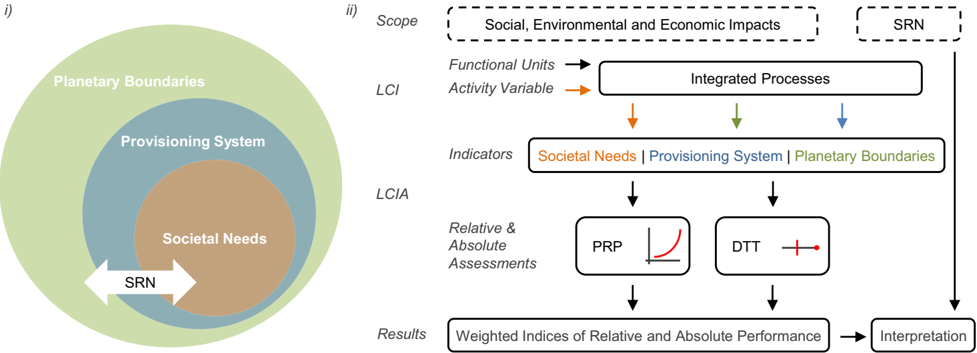
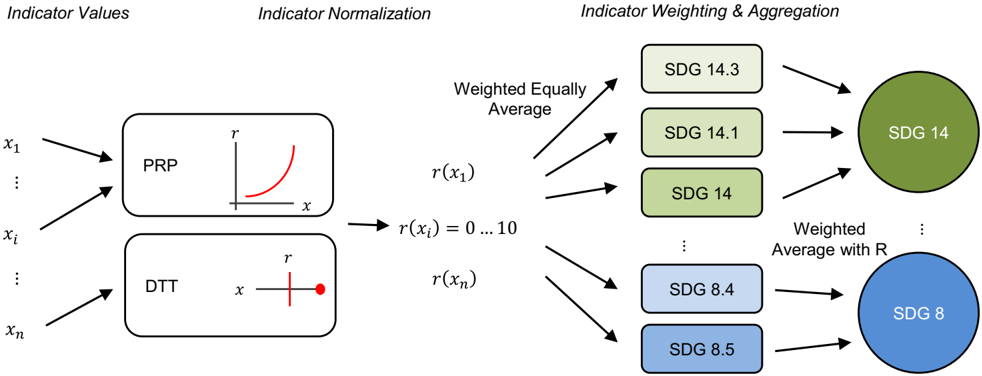
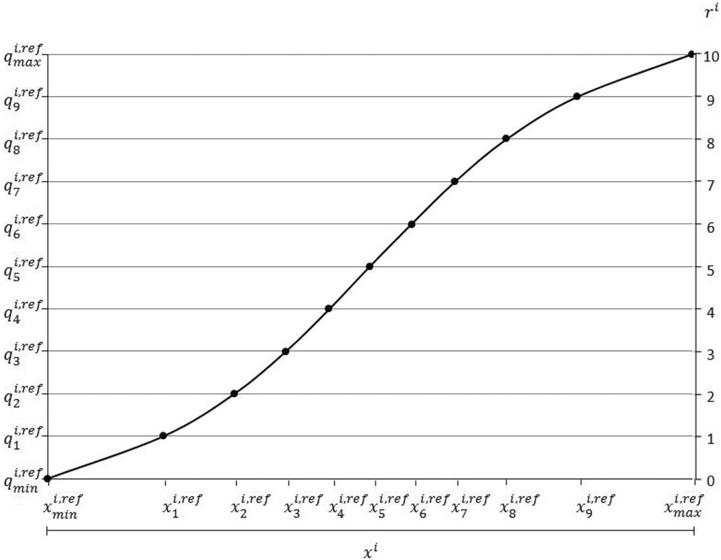
“We carry out evaluations by calculations, which use distributions, threshold values, benchmarks, or ideals as measurement scales and output result for PRP and DTT in a dimensionless score r ranging from rmin = 0 to rmax = 10 (Siebert et al. 2016).”
MethodSelf-citationMeeting Policy Challenges for a Sustainable Bioeconomy
OECD (2018) · OECD eBooks · doi:10.1787/9789264292345-en · Cited by 87
Strengths or bias in social LCA?
Zamagni, A., Amerighi, O., & Buttol, P. (2011) · The International Journal of Life Cycle Assessment · doi:10.1007/s11367-011-0309-3 · Cited by 85 · cited 1×
“Besides, for social (societal needs and social well-being as an end) and economic aspects (efficient, effective, and just provisioning systems), there are no defined quantitative boundaries, rather there are qualitative development pathways which are quite context specific (Jarosch et al. 2020; Siebert et al. 2018b; H…”
BackgroundBudzinski, M., Bezama, A., & Thrän, D. (2017) · Journal of Cleaner Production · doi:10.1016/j.jclepro.2017.05.090 · Cited by 82
Self-citationCarus, M., Dammer, L., Raschka, A., & Skoczinski, P. (2020) · Greenhouse Gases Science and Technology · doi:10.1002/ghg.1992 · Cited by 81
DISAGGREGATING INPUT–OUTPUT MODELS WITH INCOMPLETE INFORMATION
Lindner, S., Legault, J., & Guan, D. (2012) · Economic Systems Research · doi:10.1080/09535314.2012.689954 · Cited by 79 · cited 2×
“(i) Data availability: To model the material flows between sectors of a wood fiber-based bioeconomy and so implicitly its products, disaggregation of national flows from I/O models like EXIOBASE (Vendries Algarin et al. 2015; Wood et al. 2014; Lindner et al. 2012; Joshi 1999), EWMFA, and by hybrid LCA (Budzinski et al.”
MethodZeug, W., Bezama, A., Moesenfechtel, U., Jähkel, A., & Thrän, D. (2019) · Sustainability · doi:10.3390/su11061511 · Cited by 78
Self-citationNormalization and weighting: the open challenge in LCA
Roesch, A., Sala, S., & Jungbluth, N. (2020) · The International Journal of Life Cycle Assessment · doi:10.1007/s11367-020-01790-0 · Cited by 78 · cited 4×
“They are value choices and different individuals; organizations and societies may have different preferences (Andreas et al. 2020).”
BackgroundMethodInfluentialTroullaki, K., Rozakis, S., & Kostakis, V. (2021) · Ecological Economics · doi:10.1016/j.ecolecon.2021.107007 · Cited by 76
Exploring regional transitions to the bioeconomy using a socio-economic indicator: the case of Italy
D’Adamo, I., Falcone, P. M., Imbert, E., & Morone, P. (2020) · Economia Politica · doi:10.1007/s40888-020-00206-4 · Cited by 75
Lessons Learned from a Life Cycle Sustainability Assessment of Rare Earth Permanent Magnets
Wulf, C., Zapp, P., Schreiber, A., Marx, J., & Schlör, H. (2017) · Journal of Industrial Ecology · doi:10.1111/jiec.12575 · Cited by 73
HARMONISING NATIONAL INPUT—OUTPUT TABLES FOR CONSUMPTION-BASED ACCOUNTING — EXPERIENCES FROM EXIOPOL
Wood, R., Hawkins, T. R., Hertwich, E. G., & Tukker, A. (2014) · Economic Systems Research · doi:10.1080/09535314.2014.960913 · Cited by 72
Chandrakumar, C., McLaren, S. J., Jayamaha, N. P., & Ramilan, T. (2018) · Journal of Industrial Ecology · doi:10.1111/jiec.12830 · Cited by 67
Jander, W., Wydra, S., Wackerbauer, J., Grundmann, P., & Piotrowski, S. (2020) · Sustainability · doi:10.3390/su12114683 · Cited by 60
Manfredi, S., Allacker, K., Pelletier, N. L., Schau, E. M., Chomkhamsri, K., Pant, R., & Pennington, D. (2015) · The International Journal of Life Cycle Assessment · doi:10.1007/s11367-014-0839-6 · Cited by 59 · cited 1×
“Environmental Footprint can be seen as the most robust and comparable environmental accounting concept (Manfredi et al. 2015).”
BackgroundBetter energy indicators for sustainable development
Taylor, P., Abdalla, K. L., Quadrelli, R., & Vera, I. (2017) · Nature Energy · doi:10.1038/nenergy.2017.117 · Cited by 57 · cited 1×
“As a typical consequence in LCSA, this framework is not as detailed as in stand-alone methods (Taylor et al. 2017).”
MethodMonitoring the transition towards a bioeconomy: A general framework and a specific indicator
Jander, W., & Grundmann, P. (2019) · Journal of Cleaner Production · doi:10.1016/j.jclepro.2019.07.039 · Cited by 55 · cited 1×
“2020), this substation processes could be assessed by economic-environmental bioeconomy transition indicators currently in development (Jander and Grundmann 2019; Jander et al.”
BackgroundBezama, A., Ingrao, C., O’Keeffe, S., & Thrän, D. (2019) · Sustainability · doi:10.3390/su11247235 · Cited by 55
Self-citationA Regional Socio-Economic Life Cycle Assessment of a Bioeconomy Value Chain
Jarosch, L., Zeug, W., Bezama, A., Finkbeiner, M., & Thrän, D. (2020) · Sustainability · doi:10.3390/su12031259 · Cited by 55 · cited 21×
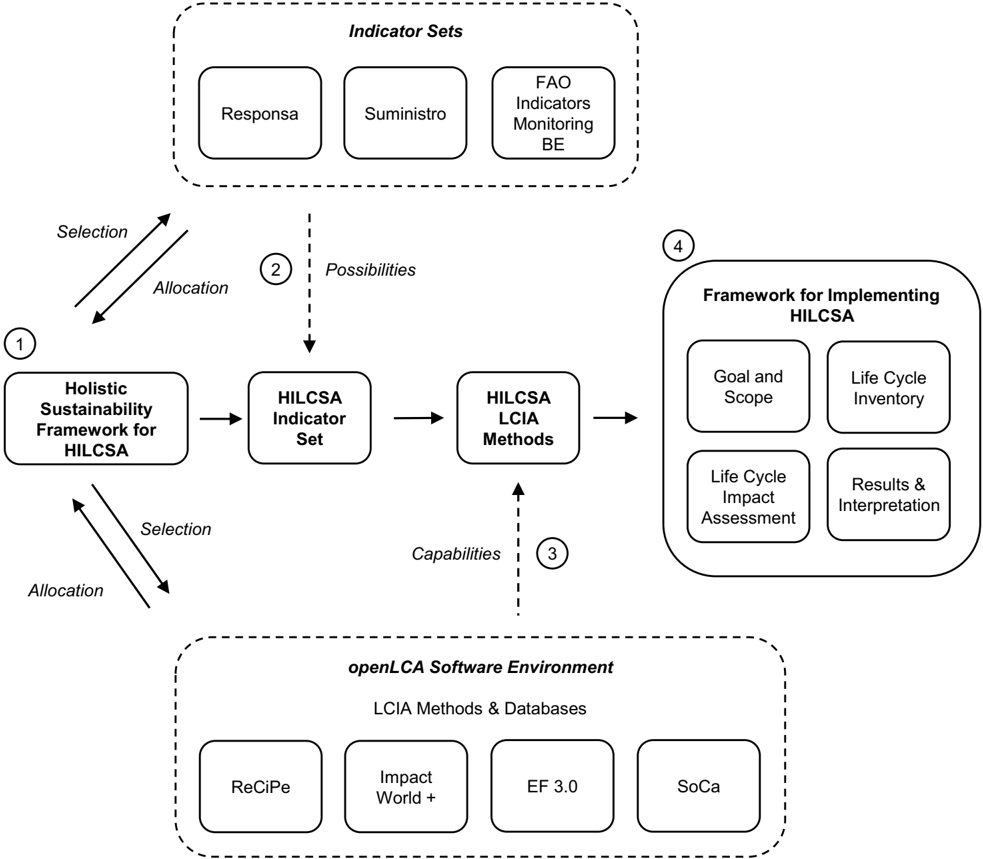
“From previous research, we take our attributional, retrospective RESPONSA S-LCA framework (Siebert et al. 2016, 2018a, b; Jarosch et al. 2020), and the SUMINISTRO framework designed to carry out an E-LCA combined with RESPONSA based on a multicriteria decision analysis approach (Hildebrandt et al.”
BackgroundMethodInfluentialSelf-citationSiebert, A., O'Keeffe, S., Bezama, A., Zeug, W., & Thrän, D. (2018) · Journal of Cleaner Production · doi:10.1016/j.jclepro.2018.06.298 · Cited by 51
Self-citationHildebrandt, J., O'Keeffe, S., Bezama, A., & Thrän, D. (2019) · Journal of Industrial Ecology · doi:10.1111/jiec.12818 · Cited by 51
Self-citationde Schutter, L., Giljum, S., Häyhä, T., Brückner, M., Naqvi, A., Omann, I., & Stagl, S. (2019) · Sustainability · doi:10.3390/su11205705 · Cited by 49
Pichler, M., Brand, U., & Görg, C. (2018) · Environmental Politics · doi:10.1080/09644016.2018.1547260 · Cited by 47 · cited 1×
“2020), social science studies on changing and persistent mentalities (Eversberg and Holz 2020) as well as political economy and ecology (Pichler et al. 2020).”
BackgroundFröhling, M., & Hiete, M. (2020) · Advances in biochemical engineering, biotechnology · doi:10.1007/10_2020_122 · Cited by 46 · cited 1×
“2018; Fröhling and Hiete 2020).”
O’Keeffe, S., Majer, S., Bezama, A., & Thrän, D. (2016) · The International Journal of Life Cycle Assessment · doi:10.1007/s11367-016-1057-1 · Cited by 43 · cited 1×
“The climate, soils, and cultivation practices can vary regionally and thus significantly determine biomass production, its regional distribution, and ecological barriers (O’Keeffe et al. 2016).”
BackgroundSelf-citationThe Third Wave of LCA as the “Decade of Consolidation”
Zimek, M., Schober, A., Mair‐Bauernfeind, C., Baumgartner, R. J., Stern, T., & Füllsack, M. (2019) · Sustainability · doi:10.3390/su11123283 · Cited by 43 · cited 13×
“Especially for LCC and economic assessments, the goal and scope as well as stakeholders of the study are of decisive importance (Wulf et al.”
BackgroundInfluentialIntegration of MCDA Tools in Valuation of Comparative Life Cycle Assessment
Prado, V., Rogers, K., & Seager, T. P. (2012) · Wiley eBooks · doi:10.1002/9781118528372.ch19 · Cited by 42 · cited 1×
“In general, normalization can be done by internal reference (maximum/ minimum values or ratios from within the LCI) or external reference (external data of systems and rankings) (Prado et al. 2012; Wulf et al. 2017).”
BackgroundHildebrandt, J., Budzinski, M., Nitzsche, R., Weber, A., Krombholz, A., Thrän, D., & Bezama, A. (2018) · Resources Conservation and Recycling · doi:10.1016/j.resconrec.2018.10.029 · Cited by 39
Self-citationLife Cycle Approaches to Sustainable Regional Development
(2016) · doi:10.4324/9781315674223 · Cited by 38
Environmental and Social Pressures in Mining. Results from a Sustainability Hotspots Screening
Noi, C. D., & Ciroth, A. (2018) · Resources · doi:10.3390/resources7040080 · Cited by 35
Hildebrandt, J., Bezama, A., & Thrän, D. (2020) · Sustainability · doi:10.3390/su12093896 · Cited by 32
Self-citationZeug, W., Bezama, A., & Thrän, D. (2022) · The International Journal of Life Cycle Assessment · doi:10.1007/s11367-022-02098-x · Cited by 31
Self-citationFritter, M., Lawrence, R., Marcolin, B., & Pelletier, N. L. (2020) · The International Journal of Life Cycle Assessment · doi:10.1007/s11367-020-01745-5 · Cited by 30
Bio-Based Production Systems: Why Environmental Assessment Needs to Include Supporting Systems
Lindqvist, A. N., Broberg, S., Tufvesson, L. M., Khalil, S., & Prade, T. (2019) · Sustainability · doi:10.3390/su11174678 · Cited by 24
Disaggregating the Power Generation Sector for Input‐Output Life Cycle Assessment
Vendries, J., Hawkins, T. R., Marriott, J., Matthews, H. S., & Khanna, V. (2014) · Journal of Industrial Ecology · doi:10.1111/jiec.12207 · Cited by 23
Pilotbericht zum Monitoring der deutschen Bioökonomie
Bringezu, S., Banse, M., Ahmann, L., Bezama, A., Billig, E., Bischof, R., Blanke, C., Brosowski, A., Brüning, S., Borchers, M., et al. (2020) · Publikationsdatenbank der Fraunhofer-Gesellschaft (Fraunhofer-Gesellschaft) · doi:10.17170/kobra-202005131255 · Cited by 21
Self-citationLife cycle methodologies for building circular economy in cities and regions
Balkau, F., & Bezama, A. (2019) · Waste Management & Research The Journal for a Sustainable Circular Economy · doi:10.1177/0734242x19864489 · Cited by 20 · cited 1×
“As a relatively new field, LCAs and LCSAs are considered to be used for regional sustainability assessments (Balkau and Bezama 2019).”
BackgroundSelf-citationMeasuring Relative Sustainability of Regions Using Regional Sustainability Assessment Methodology
Smetana, S. M., Tamásy, C., Mathys, A., & Heinz, V. (2016) · Geographical Analysis · doi:10.1111/gean.12102 · Cited by 19 · cited 1×
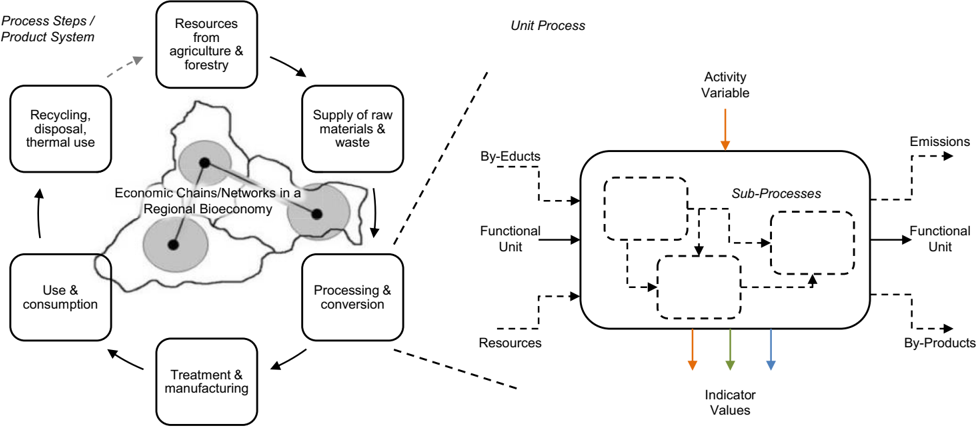
“Long and broad value-added networks can result from a cascade of utilization, recycling, and integrated bio-refineries entailing thermochemical, biochemical, and physicochemical conversion processes with a possible integration of by-products (Smetana et al. 2016).”
BackgroundChandrakumar, C., & McLaren, S. J. (2018) · Springer eBooks · doi:10.1007/978-3-319-66981-6_46 · Cited by 15 · cited 16×
“Whereas absolute sustainability assessment methods (Chandrakumar and McLaren 2018b) compare specific impacts with external environmental carrying capacities (according to planetary boundaries) as impact pathways LCIAs (UNEP 2020), e.g., life cycle climate impacts are related to the 1.5° climate…”
BackgroundInfluentialMarkets, Sustainability Management and Entrepreneurship
Urban, K., Schiesari, C. R., Boysen, O., Hahn, R., Wagner, M., Lewandowski, I. M., Kuckertz, A., Berger, E. S. C., & Reyes, C. A. M. (2017) · Springer eBooks · doi:10.1007/978-3-319-68152-8_8 · Cited by 12
Life Cycle Approaches to Sustainable Regional Development
Balkau, F., & Grant, T. (2018) · Springer eBooks · doi:10.1007/978-3-319-66981-6_48 · Cited by 12
Zeug, W., Bezama, A., & Thrän, D. (2020) · Social Science Open Access Repository (GESIS – Leibniz Institute for the Social Sciences) · doi:10.13140/rg.2.2.16912.02564 · Cited by 8
Self-citationGawel, E., Purkus, A., Pannicke, N., & Hagemann, N. (2016) · Social Science Open Access Repository (GESIS – Leibniz Institute for the Social Sciences) · Cited by 7
Eversberg, D., & Holz, J. (2020) · doi:10.13140/rg.2.2.30275.84007 · Cited by 5
Integration of LCA, LCC, and SLCA methods for assessing a bioeconomy region
Bezama, A., Siebert, A., Hildebrandt, J., & Thrän, D. (2016) · doi:10.4324/9781315674223-52 · Cited by 4 · cited 1×
“, produced by renewable raw materials and renewable energies, is of strategic interest (Bezama et al. 2017).”
BackgroundSelf-citationSynthesis – life cycle approaches and perspectives for sustainable regional development
Balkau, F., & Sonnemann, G. (2016) · doi:10.4324/9781315674223-61 · Cited by 1 · cited 2×
“However, LCSAs face the most significant problems, and in terms of indicators, impact assessment methods, normalization, weighting, aggregation as well as harmonization, many questions are open—but they also seem to have the most potential of empirical sustainability assessments (Balkau and Sonnemann 2017; Ingrao et a…”
Background
Research works printed but not linked: 6
- 1. Acero AP, Rodríguez C, Ciroth A (2016) LCIA methods-impact assessment methods in life cycle assessment and their impact categories. Green Delta, Berlin
- 34. EC (2018) A sustainable bioeconomy for Europe: strengthening the connection between economy, society and the environment- updated bioeconomy strategy. European Commission, Brus- sels. https:// doi. org/ 10. 2777/ 792130 · doi:10.2777/792130
- 49. Hildebrandt J, Budzinski M, Bezama A, O'Keeffe S, Thrän D, Jähkel A (2018a) SUMINISTRO-Sustainability Monitoring Index for assessing regional bio-based Industry Networks. Helmholtz Cen- tre for Environmental Research -UFZ, Leipzig
- 67. Malik F (2015) Strategie des Managements komplexer Systeme. Haupt Verlag, Bern
- 72. Parrique TBJ, Briens F, Kerschner C, Kraus-Polk A, Kuokkanen A, Spangenberg JH (2019) Decoupling debunked-evidence and arguments against green growth as a sole strategy for sustain- ability. The European Environmental Bureau, Brussels
- 92. Suwelack K (2016) Conversion technology and life cycle assessment of renewable resources. Hohenheim University, Hohenheim
Cited by
Life cycle sustainability assessment as a metrics towards SDGs agenda 2030
Backes, J. G., & Traverso, M. (2022) · Current Opinion in Green and Sustainable Chemistry · doi:10.1016/j.cogsc.2022.100683 · Cited by 118
Miao, Y., To, M. H., Siddiqui, M. A., Wang, H., Lodens, S., Chopra, S. S., Kaur, G., Roelants, S. L. K. W., & Lin, C. S. K. (2024) · Frontiers in Chemistry · doi:10.3389/fchem.2024.1327113 · Cited by 92
A framework for integrating ecosystem services as endpoint impacts in life cycle assessment
Hardaker, A., Styles, D., Williams, P., Chadwick, D., & Dandy, N. (2022) · Journal of Cleaner Production · doi:10.1016/j.jclepro.2022.133450 · Cited by 68
Progress of social assessment in the framework of bioeconomy under a life cycle perspective
Rebolledo-Leiva, R., Moreira, M. T., & González‐García, S. (2023) · Renewable and Sustainable Energy Reviews · doi:10.1016/j.rser.2023.113162 · Cited by 69
The Role of Bioeconomy in the Future Energy Scenario: A State-of-the-Art Review
Perišić, M., Barceló, E., Dimić‐Mišić, K., Imani, M., & Spasojević-Brkić, V. K. (2022) · Sustainability · doi:10.3390/su14010560 · Cited by 64
“Looking at European waste hierarchy, it is evident that combustion should only be considered as an option for the very end of the life cycle of biogenic products, and holistic and integrated life cycle assessment methodology should be applied to bioeconomy systems [100].”
Background
Metadata
- Authors
- Zeug, W., Bezama, A., & Thrän, D.
- Affiliations
- Helmholtz Centre for Environmental Research (DE)
- Corresponding author
- Zeug, Walther
- Venue
- The International Journal of Life Cycle Assessment
- Published
- 2021-10
- Volume
- 26
- Issue
- 10
- Pages
- 1998-2023
- ISSN
- 0948-3349 (ISSN-L)
- 1614-7502
- OpenAlex
- W3209006227
- Cited by
- 53
- References
- 103
- Citations by year
- 2026: 9 · 2025: 12 · 2024: 14 · 2023: 9 · 2022: 8 · 2021: 1
- FWCI
- 2.59
- Type
- journal article
- Language
- en
- Open access
- hybrid
- doi.org
- Licence
- cc-by
- creativecommons.org/licenses/by/4.0 (tdm)
- creativecommons.org/licenses/by/4.0 (vor, 21 d)
- Locations
- The International Journal of Life Cycle Assessment (publishedVersion, cc-by)
- Informationszentrum Lebenswissenschaften (ZB MED) (submittedVersion, cc-by)
- Funders
- Helmholtz-Zentrum für Umweltforschung GmbH - UFZ
- Topics
- Physical Sciences › Environmental Science › Environmental Engineering › Environmental Impact and Sustainability
- Life Sciences › Agricultural and Biological Sciences › General Agricultural and Biological Sciences › Bioeconomy and Sustainability Development
- Physical Sciences › Environmental Science › Management, Monitoring, Policy and Law › Environmental and Social Impact Assessments
- Keywords
- life cycle sustainability assessment, regional bioeconomy, Sustainable Development Goals, openLCA, sustainability indicators, planetary boundaries, goal and scope definition, stakeholder communication
About these checks
Registry, retraction, Cites and statistics results are computed, not judged, with one exception: a printed reference that no index lists is read once by a model before it counts as a citation error. Claims are extracted by a model and kept only when their quote appears verbatim in the text; each cited source is then checked, with a model’s help, for whether it says what the claim relies on. Those verdicts can be wrong — read the claim’s quote and the cited source before relying on one.
Statistics and arithmetic are recomputed, not judged.
Confidence bands are shown only for fields calibrated on our annotated test set. None is calibrated yet, so no band is shown.
What counts as a claim ›How we measure confidence ›How we check this ›
Are you an author, or do you see a problem with this page? Request a review
Data sources
Bibliographic data: Semantic Scholar, OpenAlex, Crossref.
Contains information from the Semantic Scholar Academic Graph Datasets, made available under the ODC Attribution License (ODC-BY 1.0).
Semantic Scholar’s data is described in: Kinney, R., et al. (2023). The Semantic Scholar Open Data Platform. arXiv:2301.10140.
