

Balancing the green carbon cycle — Biogenic carbon within life cycle assessment
Open accessThe DOI matches its Crossref record; 42 of the 42 references it cites were found in a registry or an index; 9 of the 48 sources its claims cite were checked for support.
Abstract
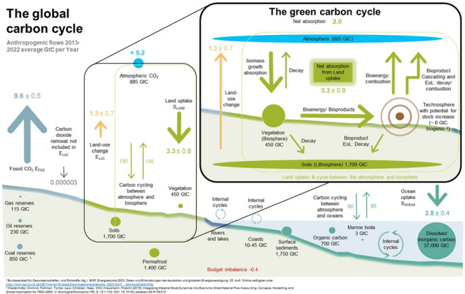
Purpose: Accurate assessment of environmental impacts is key to the successful implementation of sustainability policies in both the short and long term. A critical component, particularly in assessing areas like the developing bioeconomy, is the handling of carbon of biogenic origin. This paper examines current methodologies and their ability to assess biogenic carbon. Methods: We quantitatively evaluate different biogenic carbon accounting methodologies using our new conceptual framework — the green carbon cycle (GCC). The GCC is a subcycle of the global carbon cycle and supports understanding the accuracy of methods in capturing all essential biogenic carbon flows. Applying the GCC, we examine the advantages and disadvantages of dynamic LCA, GWPbio, and the − 1/ + 1 method under identical assumptions in four examples. Results and discussion: The methods reveal both differences and similarities, depending on the specific application. When focusing on growth cycles only, dynamic LCA and GWPbio deliver almost identical results for the assessment of biogenic carbon. However, when extending the view to the entire life cycle of a biomass-based facade cladding, dynamic LCA finds significantly lower impacts than GWP bio , mainly due to the different assumptions concerning the timeframe from biomass growth until end of product life. Based on the distinct strengths and weaknesses of applying the GCC, we provide a decision matrix for practitioners to facilitate the right choice for each application. Conclusion: This paper enables researchers and practitioners to accurately assess biogenic carbon and to determine the best available approximation of the conditions in the GCC. It also identifies similarities and differences between the methods and shows how to overcome some of the identified weaknesses. Graphical Abstract: (Adapted from Friedlingstein et al. (2023)
Overview
CoChat Summary
TL;DR
This paper introduces the “green carbon cycle” (GCC) framework to evaluate how well biogenic carbon accounting methods capture essential biogenic carbon flows. It compares dynamic LCA, GWPbio, and the −1/+1 method under identical assumptions in four examples and provides a decision matrix for practitioners.
Key findings
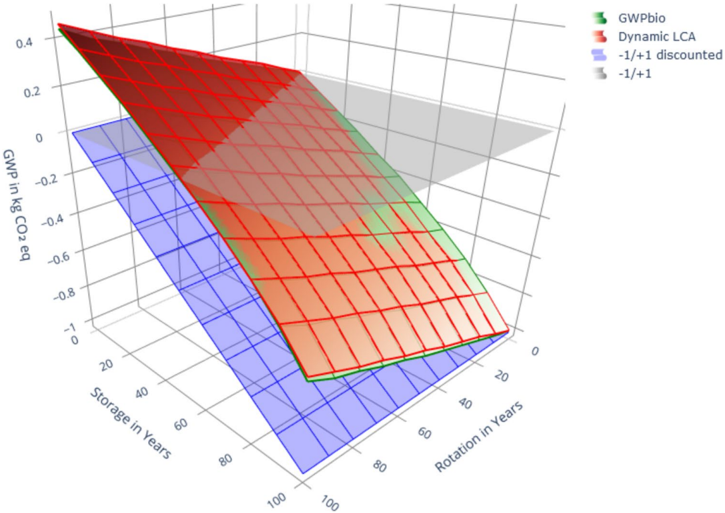
- Dynamic LCA and GWPbio produce almost identical results when only growth cycles are considered; in example 1, their results differ on average by 0.01 kg CO₂ eq.
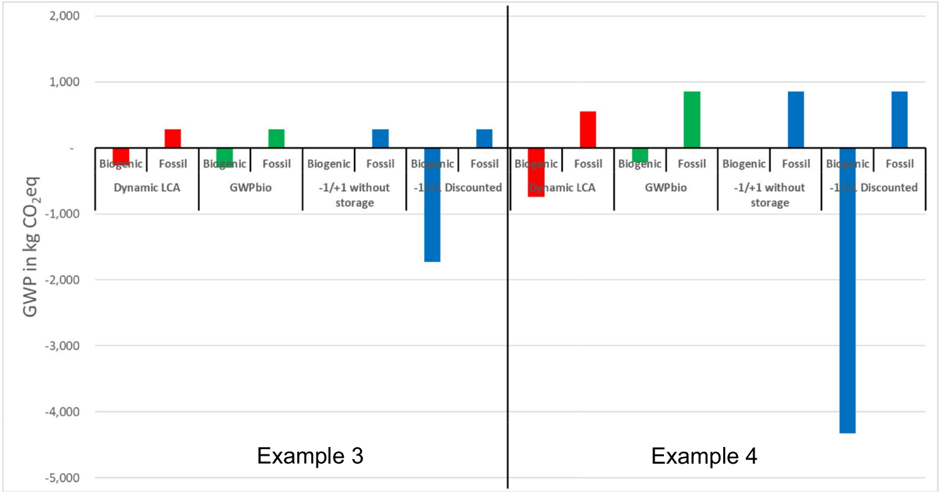
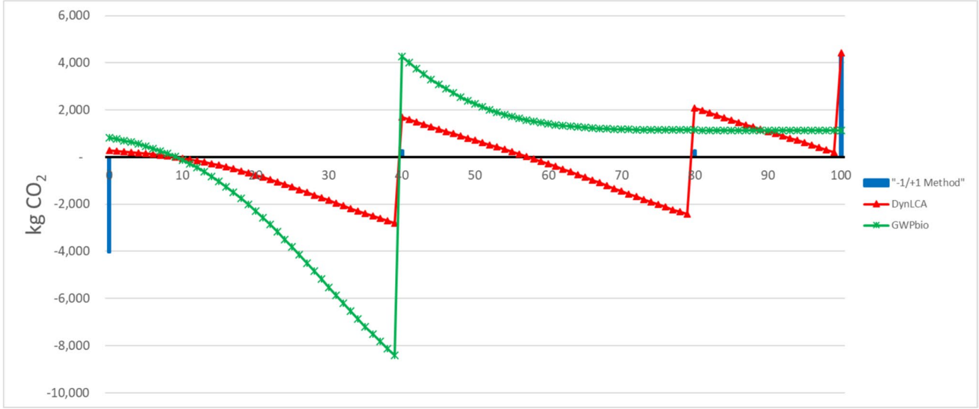
- When the full life cycle of biomass-based facade cladding is assessed, dynamic LCA finds significantly lower impacts than GWPbio, mainly due to different assumptions about the timeframe from biomass growth until end of product life; in example 4, all four methods noticeably diverge.
- For spruce harvest residues (example 2), dynamic LCA impacts are consistently larger than GWPbio: at 0-year storage, dynamic LCA = 0.80 kg CO₂ eq, GWPbio = 0.34 kg CO₂ eq, −1/+1 = 0.00 kg CO₂ eq, and −1/+1 discounted = 0.00 kg CO₂ eq; at 100-year storage, dynamic LCA = −0.20 kg CO₂ eq, GWPbio = −0.66 kg CO₂ eq, −1/+1 = 0.00 kg CO₂ eq, and −1/+1 discounted = −1.00 kg CO₂ eq.
- The paper recommends dynamic LCA overall for its flexibility, especially for secondary biomass and complex cases, while the −1/+1 method is seen as suitable mainly for annual crops; dynamic LCA can also generate static GWPbio factors.
Methods
- Literature review of currently available and commonly used biogenic carbon accounting methods; among 96 analyzed studies dealing with more advanced methods, 39 covered GWPbio and 38 covered dynamic LCA.
- Four examples applied dynamic LCA, GWPbio, and −1/+1 under identical assumptions: same growth function based on a normal distribution defined by rotation period, identical placement of growth, identical time horizons, and GWP100; GWPbio factors were taken from Guest et al. (2013a), while dynamic LCA and −1/+1 were calculated by the authors.
- Examples included: 1 kg biogenic CO₂ from primary biomass with varying rotation and storage times; 1 kg biogenic carbon from spruce harvest residues with an 80-year rotation period; one larch wood cladding for a one-family house (242 m² surface area, 2 cm thickness, 487 kg/m³ density, 2357 kg wood, 50% carbon content, 60-year rotation period, 40-year storage period, 286 kg CO₂ eq fossil emissions, cradle-to-grave); and cladding over a 100-year building lifespan with replacements after 40 and 80 years.
Limitations
- The paper states that all four analyzed methods are not perfect for modeling real-life conditions in the GCC: −1/+1 does not account for temporal aspects; GWPbio uses a static factor, assumes regrowth, is mainly for primary biomass, and published factors only range up to 100-year rotation periods; dynamic LCA suffers from truncation of impacts due to the chosen time horizon and is inconsistent with traditionally static LCA, covering only global warming while other impacts remain static.
- The paper notes that accurate GCC modeling is hampered not only by biogenic carbon assessment methods but also by the LCA approach itself, particularly the definition of a distinct time horizon that truncates impacts occurring outside the assessed timeframe.
- The paper acknowledges a focus on CO₂ as the cGHG in biogenic carbon assessment methods, while noting that other cGHG such as methane also have significant impacts; it also states that current studies often use simplistic growth functions and that more advanced methods for estimating biomass growth under different management and harvesting schemes should be considered in future studies.
Model-written summary. Check it against the paper before relying on it.
Integrity signals
Registry
Cites
Statistics
Figures

Verification
Claims the paper makes
5 Valid · 13 Not valid · 28 Not checked · 127 Own results and interpretations
The cited sources support only part of this claim — read each source’s verdict below.
In the paper
“The concept of GWPbio was first developed by Cherubini et al. (2011), who proposed a characterization factor specific to biogenic CO 2 , considering the temporal delay between harvest and regrowth of biomass.”
What the sources say
- Partly supportedcites Cherubini et al. (2011) matched to “CO2 emissions from biomass combustion for bioenergy: atmospheric decay and contribution to global warming: GLOBAL WARMING POTENTIAL OF CO2 FROM BIOENERGY” (2011) sourceExperimental — accuracy not yet measured
The passage describing the paper’s method says the authors propose GWPbio, an index for warming from biomass-derived CO2, and account for the time emissions remain in the atmosphere before regrowth captures them. It does not establish that they were the first to develop the concept. The indexed passage has no section or page label. (LLM, conf=0.82)
plainstates a cause- Asserted: passes — The authors put it forward as true.
- Checkable: passes — It can be checked against evidence.
- Load-bearing: unclear — It is unclear whether the paper’s conclusions depend on it.
- Based: passes — The paper gives a reason why it holds.
- Partly supported
Every source the paper cites for this claim was checked and supports it.
In the paper
“However, the largest carbon dioxide net uptake occurs through plant growth in terrestrial systems, with around 3.3 Gt of carbon per year (see Graphical abstract).”
What the sources say
- Supportedcites Friedlingstein et al. (2023) matched to “Global Carbon Budget 2023” (2023) source
Section 3.7.2 (pp. 33–34) reports a terrestrial CO₂ sink of about 3.3 Gt C per year in 2013–2022 and links its increase largely to processes that stimulate plant photosynthesis. The reported ocean sink was smaller, at 2.9 Gt C per year over the same decade (p. 5). (LLM, conf=0.90)
plainstates a cause- Asserted: passes — The authors put it forward as true.
- Checkable: passes — It can be checked against evidence.
- Load-bearing: unclear — It is unclear whether the paper’s conclusions depend on it.
- Based: passes — The paper gives a reason why it holds.
- Supported
The cited sources support only part of this claim — read each source’s verdict below.
In the paper
“In practice, published GWPbio factors are applied by several studies, even when the explicit counterfactual to the collection of residues is their decay on site (Havukainen et al. 2018; Olofsson 2021; Pfau et al. 2019).”
What the sources say
- Not checked — no full text of the sourcecites Havukainen et al. 2018 matched to “Life cycle assessment of small-scale combined heat and power plant: Environmental impacts of different forest biofuels and replacing district heat produced from natural gas” (2018) source
- Supportedcites Olofsson 2021 matched to “Time-Dependent Climate Impact of Utilizing Residual Biomass for Biofuels—The Combined Influence of Modelling Choices and Climate Impact Metrics” (2021) source
Section 2.3.1 (Time-Aggregated Approaches) states that published GWP bio factors taken from the literature ([64], [65]; listed in Table 2) are applied in this study, and explicitly notes that 'approximately 78% of the residues are left at the forest site to decay in the reference scenario', i.e. the counterfactual to residue collection is on-site decay (Section 2.1.1 confirms the reference scenario is no use for energy, with residues decaying on site). The paper also flags the limits of that practice — decay emissions only implicitly included, 'the lack of an explicit GWPbio factor for the emissions from the decay' (Section 3.1.1) and the Conclusions' statement that existing GWP bio factors could not be used as a single proxy for time-dependent modelling for logging residues — which matches the 'even when' framing of the citing sentence. One nuance: for the logging-residue case Olofsson deliberately selected the 'elaborated' factors that do account for on-site decay, so the mismatch implied by the claim is milder here than in the other two citations. (LLM, conf=0.82)
- Partly supportedcites Pfau et al. 2019 matched to “Life cycle greenhouse gas benefits or burdens of residual biomass from landscape management” (2019) sourceExperimental — accuracy not yet measured
Section 2.2 applies a GWPbio factor developed by Cherubini et al. to biogenic CO₂ emissions, and Table 1 includes natural decay on site as an application. But Table 1 does not identify on-site decay as the explicit counterfactual to collecting residues: it lists conventional heat as the counterfactual for woody-biomass heat, while the left-on-site application has none. This paper therefore supports the use of GWPbio alongside an on-site-decay scenario, but not the claimed counterfactual relationship. (LLM, conf=0.86)
plain- Asserted: passes — The authors put it forward as true.
- Checkable: passes — It can be checked against evidence.
- Load-bearing: unclear — It is unclear whether the paper’s conclusions depend on it.
- Based: passes — The paper gives a reason why it holds.
The cited sources that could be checked couldn’t confirm or dispute this claim.
In the paper
“The difference between the two methods may only stem from rounding errors and the approximation used by Cherubini et al. (2011).”
What the sources say
- Could not verifycites Cherubini et al. (2011) matched to “CO2 emissions from biomass combustion for bioenergy: atmospheric decay and contribution to global warming: GLOBAL WARMING POTENTIAL OF CO2 FROM BIOENERGY” (2011) sourceExperimental — accuracy not yet measured
The available passage describing the paper’s content (section and page not provided) says it proposes the GWPbio index, but does not compare GWPbio with dynamic LCA. Searches for that comparison, rounding errors, and an approximation found no passage addressing the proposed explanation for the difference. (LLM, conf=0.73)
hedgedstates a possible causeSingle case- Asserted: passes — The authors put it forward as true.
- Checkable: passes — It can be checked against evidence.
- Load-bearing: passes — The paper’s conclusions depend on it.
- Based: passes — The paper gives a reason why it holds.
- Could not verify
A result the paper states — it cites no source for it, so there is none to check. The quote shows it is in the paper.
In the paper
“The - 1/+ 1 discounted shows the effect of discounting with storage time”
plainstates a cause- Asserted: passes — The authors put it forward as true.
- Checkable: passes — It can be checked against evidence.
- Load-bearing: unclear — It is unclear whether the paper’s conclusions depend on it.
- Based: passes — The paper gives a reason why it holds.
79 more claims
Create a free account to see all 173 claims and to verify the 12 references still open.
- Probably not a substantial claim. 50
- It may state two separate claims as one. 51
Citations
Cites
Earth beyond six of nine planetary boundaries
Richardson, K., Steffen, W., Lucht, W., Bendtsen, J., Cornell, S. E., Donges, J. F., Drüke, M., Fetzer, I., Bala, G., von Bloh, W., et al. (2023) · Science Advances · doi:10.1126/sciadv.adh2458 · Cited by 3,311
Friedlingstein, P., O'Sullivan, M., Jones, M. W., Andrew, R. M., Gregor, L., Hauck, J., Le Quéré, C., Luijkx, I. T., Olsen, A., Peters, G. P., et al. (2022) · Earth System Science Data · doi:10.5194/essd-14-4811-2022 · Cited by 1,895
Friedlingstein, P., O'Sullivan, M., Jones, M. W., Andrew, R. M., Bakker, D. C. E., Hauck, J., Landschützer, P., Le Quéré, C., Luijkx, I. T., Peters, G. P., et al. (2023) · Earth System Science Data · doi:10.5194/essd-15-5301-2023 · Cited by 1,500 · cited 2×
“As described by Friedlingstein et al. (2023) or Kirschbaum et al. (2024), the global carbon cycle is one of several natu-ral bio-chemical cycles occurring on Earth.”
InfluentialLife cycle sustainability assessment of products: (with Comments by Helias A. Udo de Haes, p. 95)
Kloepffer, W. (2008) · The International Journal of Life Cycle Assessment · doi:10.1065/lca2008.02.376 · Cited by 1,129 · cited 1×
“Since then, this concept has become increasingly important (Kloepffer 2008).”
Buildings as a global carbon sink
Churkina, G., Organschi, A., Reyer, C. P. O., Ruff, A., Vinke, K., Liu, Z., Reck, B. K., Graedel, T. E., & Schellnhuber, H. J. (2020) · Nature Sustainability · doi:10.1038/s41893-019-0462-4 · Cited by 1,045 · cited 1×
“Thereby, they take up the idea of combating climate change by building up another carbon stock in the form of buildings and infrastructure made from biomass, as described by Churkina et al. (2020).”
Considering Time in LCA: Dynamic LCA and Its Application to Global Warming Impact Assessments
Levasseur, A., Lesage, P., Margni, M., Deschênes, L., & Samson, R. (2010) · Environmental Science & Technology · doi:10.1021/es9030003 · Cited by 731 · cited 1×
“Dynamic LCA was originally proposed by Levasseur et al. (2010) to resolve temporal inconsistencies in the LCA methodology (Shimako et al. 2018).”
CHERUBINI, F., PETERS, G. P., BERNTSEN, T., STRØMMAN, A. H., & HERTWICH, E. (2011) · GCB Bioenergy · doi:10.1111/j.1757-1707.2011.01102.x · Cited by 645 · cited 5×
“Cherubini et al. (2011) use a simple normal distribution as a growth curve for their GWP factors, while even more advanced approaches, as shown by Holtsmark (2015), rely on growth equations, expansion factors, and linear decay for deadwood.”
InfluentialCarbon and decomposition model Yasso for forest soils
Liski, J., Palosuo, T., Peltoniemi, M., & Sievänen, R. (2005) · Ecological Modelling · doi:10.1016/j.ecolmodel.2005.03.005 · Cited by 467 · cited 6×
“For this purpose, we use the Yasso model (Liski et al. 2005) to simulate wood decay equivalent to 1 kg of biogenic carbon.”
InfluentialPawelzik, P., Carus, M., Hotchkiss, J., Narayan, R., Selke, S., Wellisch, M., Weiss, M., Wicke, B., & Patel, M. K. (2013) · Resources, Conservation and Recycling · doi:10.1016/j.resconrec.2013.02.006 · Cited by 318 · cited 1×
“One of the most discussed aspects is how to assess carbon originating from biological sources, so-called biogenic carbon (IPCC 2019), and its effect on climate change when emitted into the atmosphere (Pawelzik et al. 2013).”
Biogenic Carbon and Temporary Storage Addressed with Dynamic Life Cycle Assessment
Levasseur, A., Lesage, P., Margni, M., & Samson, R. (2013) · Journal of Industrial Ecology · doi:10.1111/j.1530-9290.2012.00503.x · Cited by 312 · cited 1×
“Levasseur et al. (2013) then applied the concept to biogenic carbon.”
Biogenic carbon in buildings: a critical overview of LCA methods
Hoxha, E., Passer, A., Saade, M. R. M., Trigaux, D., Shuttleworth, A., Pittau, F., Allacker, K., & Habert, G. (2020) · Buildings and Cities · doi:10.5334/bc.46 · Cited by 291 · cited 6×
“In their analysis, Hoxha et al. (2020) showed the effect of choosing pre-growth or re-growth perspectives for a full life cycle.”
InfluentialLogging residue removal after thinning in Nordic boreal forests: Long-term impact on tree growth
Helmisaari, H.-S., Hanssen, K. H., Jacobson, S., Kukkola, M., Luiro, J., Saarsalmi, A., Tamminen, P., & Tveite, B. (2011) · Forest Ecology and Management · doi:10.1016/j.foreco.2011.02.015 · Cited by 198 · cited 2×
“On the contrary, removing residues may even lower long-term regrowth by removing nutrients (Helmisaari et al. 2011).”
A framework for modelling indirect land use changes in Life Cycle Assessment
Schmidt, J. H., Weidema, B. P., & Brandão, M. (2015) · Journal of Cleaner Production · doi:10.1016/j.jclepro.2015.03.013 · Cited by 197 · cited 1×
“Besides this, vegetation has other effects on climate change, for example, through the change of surface albedo (Kirschbaum et al. 2024) or carbon releases from soils (Schmidt et al. 2015; Wei et al. 2024).”
Guest, G., Cherubini, F., & Strømman, A. H. (2013) · Journal of Industrial Ecology · doi:10.1111/j.1530-9290.2012.00507.x · Cited by 193 · cited 6×
“Guest et al. (2013a) expanded the GWP bio to include the effect of delayed emissions and storage, resulting in GWP bio factors specific to the rotation period and storage duration.”
InfluentialLand Use Effects on Climate: Current State, Recent Progress, and Emerging Topics
Pongratz, J., Schwingshackl, C., Bultan, S., Obermeier, W., Havermann, F., & Guo, S. (2021) · Current Climate Change Reports · doi:10.1007/s40641-021-00178-y · Cited by 187 · cited 1×
“Pongratz et al. (2021) specify the impacts of land use and management on climate change more closely and emphasize the need for sustainable use of biomass (Car-lowitz, 1713).”
Grundlagen der Waldwachstumsforschung
Pretzsch, H. (2019) · Springer eBooks · doi:10.1007/978-3-662-58155-1 · Cited by 110 · cited 1×
“With an average thickness of 2 cm and a density of 487 kg/m 3 for larch (Pretzsch 2019), this is equivalent to 2357 kg of wood with an assumed carbon content of 50%.”
Hawkins, W., Cooper, S., Allen, S., Roynon, J., & Ibell, T. (2021) · Structures · doi:10.1016/j.istruc.2020.12.013 · Cited by 109 · cited 2×
“The choice of where to place the growth in the life cycle can influence results significantly (Hoxha et al. 2020) and is described as an unanswered question (“chicken and egg dilemma”) (Hawkins et al. 2021).”
Temporalis, a generic method and tool for dynamic Life Cycle Assessment
Cardellini, G., Mutel, C. L., Vial, E., & Muys, B. (2018) · Science of The Total Environment · doi:10.1016/j.scitotenv.2018.07.044 · Cited by 106
Brandão, M., Kirschbaum, M. U. F., Cowie, A. L., & Hjuler, S. V. (2019) · GCB Bioenergy · doi:10.1111/gcbb.12593 · Cited by 83 · cited 2×
“A common conclusion in the current literature on the assessment of biogenic carbon is that the results of an analysis are highly dependent on the choice of method (Brandão et al. 2019; Olofsson 2021).”
Sensitivity analysis of temporal parameters in a dynamic LCA framework
Shimako, A. H., Tiruta-Barna, L., Bisinella de Faria, A. B., Ahmadi, A., & Spérandio, M. (2018) · Science of The Total Environment · doi:10.1016/j.scitotenv.2017.12.220 · Cited by 72 · cited 1×
“Dynamic LCA was originally proposed by Levasseur et al. (2010) to resolve temporal inconsistencies in the LCA methodology (Shimako et al. 2018).”
The role of forest residues in the accounting for the global warming potential of bioenergy
Guest, G., Cherubini, F., & Strømman, A. H. (2013) · GCB Bioenergy · doi:10.1111/gcbb.12014 · Cited by 70 · cited 6×
“Guest et al. (2013a) expanded the GWP bio to include the effect of delayed emissions and storage, resulting in GWP bio factors specific to the rotation period and storage duration.”
InfluentialQuantifying the global warming potential of CO 2 emissions from wood fuels
Holtsmark, B. (2015) · GCB Bioenergy · doi:10.1111/gcbb.12110 · Cited by 63 · cited 3×
“Holtsmark (2015) developed the method further to the full living biomass, harvest residues, natural deadwood, and soil carbon through simple expansion factors and decay curves.”
Havukainen, J., Nguyen, M. T., Väisänen, S., & Horttanainen, M. (2018) · Journal of Cleaner Production · doi:10.1016/j.jclepro.2017.10.241 · Cited by 59 · cited 1×
“In practice, published GWP bio factors are applied by several studies, even when the explicit counterfactual to the collection of residues is their decay on site (Havukainen et al. 2018; Olofsson 2021; Pfau et al. 2019).”
Is tree planting an effective strategy for climate change mitigation?
Kirschbaum, M. U. F., Cowie, A. L., Peñuelas, J., Smith, P., Conant, R. T., Sage, R. F., Brandão, M., Cotrufo, M. F., Luo, Y., Way, D. A., et al. (2024) · Science of The Total Environment · doi:10.1016/j.scitotenv.2023.168479 · Cited by 53
Mengis, N., Paul, A. J., & Fernández‐Méndez, M. (2023) · PLOS Climate · doi:10.1371/journal.pclm.0000148 · Cited by 50 · cited 1×
“Mengis et al. (2023) identify the sequestration of CO 2 in the ocean and its ecosystems as an important contribution.”
Fröhling, M., & Hiete, M. (2020) · Advances in biochemical engineering, biotechnology · doi:10.1007/10_2020_122 · Cited by 46 · cited 3×
“It describes — among other approaches — the utilization of biomass to replace fossil resources in the world’s economy (Fröhling & Hiete 2020; Metic et al. 2022).”
Self-citationNet-Zero Embodied Carbon in Buildings with Today’s Available Technologies
Watari, T., Yamashita, N., & Serrenho, A. C. (2024) · Environmental Science & Technology · doi:10.1021/acs.est.3c04618 · Cited by 42 · cited 1×
“For instance, Watari et al. (2024) investigate the impact of the usage of timber for buildings on the carbon cycle in the case of Japanese housing.”
Pscherer, T., & Krommes, S. (2025) · The International Journal of Life Cycle Assessment · doi:10.1007/s11367-024-02387-7 · Cited by 39 · cited 1×
“This approach is widely embraced by official standards and guidelines such as the ILCD handbook, PAS 2050, EN-16485, or ISO-14067 (Hoxha et al. 2020; Cucurachi et al. 2022; Pscherer & Krommes 2024)).”
Conceptual issue of the dynamic GWP indicator and solution
Ventura, A. (2023) · The International Journal of Life Cycle Assessment · doi:10.1007/s11367-022-02028-x · Cited by 37 · cited 1×
“Ventura (2022) later proposed a refined version of dynamic LCA tackling time horizon issues.”
Petrović, B., Eriksson, O., & Zhang, X. (2023) · Building and Environment · doi:10.1016/j.buildenv.2023.110093 · Cited by 31 · cited 1×
“In this case, the method turns into a − 1/0 method and skews the result strongly towards lower impacts (Petrović et al. 2023).”
Life cycle assessment, quo vadis ? Supporting or deterring greenwashing? A survey of practitioners
Brandão, M., Busch, P., & Kendall, A. M. (2024) · Environmental Science Advances · doi:10.1039/d3va00317e · Cited by 28 · cited 1×
“Therefore, bioeconomy has already earned much criticism (Lewandowski 2018; Brandão et al. 2024).”
A climate goal–based, multicriteria method for system evaluation in life cycle assessment
Tiruta-Barna, L. (2021) · The International Journal of Life Cycle Assessment · doi:10.1007/s11367-021-01991-1 · Cited by 24 · cited 1×
“Nevertheless, they require additional assumptions, e.g., specific climate goals or time targets, as discussed by Tiruta-Barna (2021).”
Erratum to: Bioeconomy: Shaping the Transition to a Sustainable, Biobased Economy
Lewandowski, I. M. (2018) · Springer eBooks · doi:10.1007/978-3-319-68152-8_13 · Cited by 16
Energy Flows, Material Cycles and Global Development
Schaub, G., & Turek, T. (2016) · Environmental science and engineering · doi:10.1007/978-3-319-29495-7 · Cited by 14
Life cycle greenhouse gas benefits or burdens of residual biomass from landscape management
Pfau, S. F., Hanssen, S. V., Straatsma, M. W., Koopman, K. R., Leuven, R. S. E. W., & Huijbregts, M. A. J. (2019) · Journal of Cleaner Production · doi:10.1016/j.jclepro.2019.02.001 · Cited by 12
Matuštík, J., & Kočí, V. (2022) · GCB Bioenergy · doi:10.1111/gcbb.12925 · Cited by 12 · cited 1×
“Matuštík and Kočí (2022) argue that regrowth should be considered as trees are always replanted to replace previously cut ones, but going back through time, the first felled trees of a forest were naturally grown, and thus the forest activity causes a chain of regrowth.”
Fates of Terrigenous Dissolved Organic Carbon in the Gulf of Maine
Wei, X., Hayes, D. J., Li, D., Butman, D. E., & Brewin, R. J. W. (2024) · Environmental Science & Technology · doi:10.1021/acs.est.3c08218 · Cited by 9 · cited 1×
“Besides this, vegetation has other effects on climate change, for example, through the change of surface albedo (Kirschbaum et al. 2024) or carbon releases from soils (Schmidt et al. 2015; Wei et al. 2024).”
Proposal of a Dual Circularity Concept for Sustainable Design
Metic, J., Klose, S., McAloone, T. C., Fröhling, M., & Pigosso, D. C. A. (2022) · Proceedings of the Design Society · doi:10.1017/pds.2022.107 · Cited by 6 · cited 2×
“It describes — among other approaches — the utilization of biomass to replace fossil resources in the world’s economy (Fröhling & Hiete 2020; Metic et al. 2022).”
Self-citationOlofsson, J. (2021) · Energies · doi:10.3390/en14144219 · Cited by 5 · cited 2×
“In practice, published GWP bio factors are applied by several studies, even when the explicit counterfactual to the collection of residues is their decay on site (Havukainen et al. 2018; Olofsson 2021; Pfau et al. 2019).”
The Preferability Framework - Enabling life cycle sustainability assessment meta studies
Huber, J., & Fröhling, M. (2024) · Sustainable Production and Consumption · doi:10.1016/j.spc.2024.02.021 · Cited by 3 · cited 1×
“It also complicates meaningful comparisons, at least if the assessments do not provide adequate reference cases for comparisons in the Preferability Framework (Huber & Fröhling 2024).”
Self-citationMengis, N., Paul, A. J., & Fernández‐Méndez, M. (2023) · doi:10.5194/egusphere-egu23-1168 · Cited by 3
Research works printed but not linked: 2
- Cucurachi, S., Steubing, B. Siebler, F., Navarre, N., Caldeira, C., Sala, S. (2022): Prospective LCA methodology for novel and emerging technologies for BIO-based products. https:// doi. org/ 10. 2760/ 167543. · doi:10.2760/167543
- Myhre, G., D. Shindell, F.-M. Bréon, W. Collins, J. Fuglestvedt, J. Huang, D. Koch, J.-F. Lamarque, D. Lee, B. Mendoza, 2013. Anthropogenic and natural radiative forcing supplementary material, in: IPCC (Ed.), Climate change 2013: the physical science basis. Contribution of Working Group I to the Fifth Assessment Report of the Intergovernmental Panel on Climate Change.
Cited by
Chaurasiya, S., Preuss, N., & You, F. (2026) · RSC Sustainability · doi:10.1039/d5su00840a · Cited by 24
From static to dynamic: Reviewing the application and potential of dynamic LCA to bio-based systems
de Jong, M., Corona, B., Junginger, M., & Shen, L. (2026) · The International Journal of Life Cycle Assessment · doi:10.1007/s11367-026-02624-1 · Cited by 10
Haider, H., Shafiquzzaman, M., AlSaleem, S. S., & Ghumman, A. R. (2026) · Membranes · doi:10.3390/membranes16020074 · Cited by 3
“The total energy consumption of 0.6 kWh/m 3 for the EA-ASP, falling almost in the middle of the reported range of 0.3–1.12 kWh/m3 [29,30], can be attributed to efficient aeration, which is the most energy-intensive process in an ASP.”
InfluentialHeijungs, R. (2026) · The International Journal of Life Cycle Assessment · doi:10.1007/s11367-026-02634-z · Cited by 3
Dong, J., Wang, F., Hu, Y., et al. (2026) · Case Studies in Thermal Engineering · doi:10.1016/j.csite.2026.108006 · Cited by 1
Metadata
- Authors
- Füchsl, S., Huber, J., Fröhling, M., & Röder, H.
- Affiliations
- Technical University of Munich (DE)
- Corresponding author
- Füchsl, Stefan
- Venue
- The International Journal of Life Cycle Assessment
- Published
- 2025-06-25
- Volume
- 30
- Issue
- 10
- Pages
- 2300-2313
- ISSN
- 0948-3349 (ISSN-L)
- 1614-7502
- OpenAlex
- W4411621601
- Cited by
- 25
- References
- 39
- Citations by year
- 2026: 23 · 2025: 2
- FWCI
- 6.96
- Type
- journal article
- Language
- en
- Open access
- hybrid
- doi.org
- Licence
- cc-by
- creativecommons.org/licenses/by/4.0 (tdm)
- creativecommons.org/licenses/by/4.0 (vor)
- Locations
- The International Journal of Life Cycle Assessment (publishedVersion, cc-by)
- mediaTUM – the media and publications repository of the Technical University Munich (Technical University Munich) (submittedVersion)
- Funders
- Technische Universität München
- Topics
- Physical Sciences › Environmental Science › Environmental Engineering › Environmental Impact and Sustainability
- Life Sciences › Agricultural and Biological Sciences › General Agricultural and Biological Sciences › Bioeconomy and Sustainability Development
- Physical Sciences › Environmental Science › Environmental Engineering › Sustainability and Ecological Systems Analysis
- Keywords
- biogenic carbon, dynamic life cycle assessment, bioeconomy, carbon cycle, environmental impact assessment, decision matrix
About these checks
Registry, retraction, Cites and statistics results are computed, not judged, with one exception: a printed reference that no index lists is read once by a model before it counts as a citation error. Claims are extracted by a model and kept only when their quote appears verbatim in the text; each cited source is then checked, with a model’s help, for whether it says what the claim relies on. Those verdicts can be wrong — read the claim’s quote and the cited source before relying on one.
The claim verdicts this report counts are experimental: their accuracy is not yet measured.
A language model drew the claims from the paper on 2026-10-10, under version 3 of the claim definition (model deepseek-v4.1-flash, prompt extract-v3).
A second model labelled each claim on 2026-10-10 (model jev-1.13-20260917, definition revision gold-guideline-v0.2).
Cited sources are checked with a language model’s help (gpt-6-sol and qwen3.8-omni-flash).
Statistics and arithmetic are recomputed, not judged.
Confidence bands are shown only for fields calibrated on our annotated test set. None is calibrated yet, so no band is shown.
What counts as a claim ›How we measure confidence ›How we check this ›
Are you an author, or do you see a problem with this page? Request a review
Data sources
Bibliographic data: Semantic Scholar, OpenAlex, Crossref.
Contains information from the Semantic Scholar Academic Graph Datasets, made available under the ODC Attribution License (ODC-BY 1.0).
Semantic Scholar’s data is described in: Kinney, R., et al. (2023). The Semantic Scholar Open Data Platform. arXiv:2301.10140.
