

Fear of COVID-19, Mindfulness, Humor, and Hopelessness: A Multiple Mediation Analysis
Open accessThe DOI matches its Crossref record; 63 of the 63 references it cites were found in a registry or an index.
Abstract
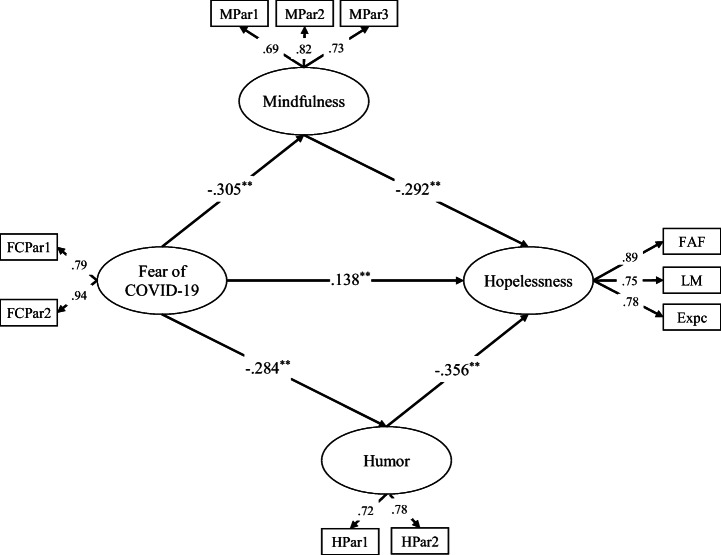
Hopelessness is an important vulnerability factor for depressive symptomology and suicidal ideations. It may also play an important role in the fear of coronavirus 2019 (COVID-19). Therefore, the present study tested the mediating role of mindful awareness and humor (both identified as coping strategies for dealing with stressful situations) in the relationship between fear of COVID-19 and hopelessness. Participants comprised 786 Turkish individuals (562 females and 224 males; aged between 18 and 67 years) from 71 of 81 cities in Turkey. An online convenience sampling method was used to recruit participants. Participants completed surveys including the Fear of COVID-19 Scale, Beck Hopelessness Scale, Mindful Attention Awareness Scale, and Coping Humor Scale. The model was tested using structural equation modeling (SEM) and utilizing bootstrapping. The results of SEM showed that the effect of fear of COVID-19 on hopelessness was partly mediated by mindfulness and humor, and which was supported by bootstrapping. Therefore, higher fear of COVID-19 was associated with lower mindfulness and humor. In turn, lower mindfulness and humor were related with higher hopelessness. Findings are discussed in the context of COVID-19 and the hopelessness literature, and practical implications for counselors are also provided.
Overview
The claims and statistics of this paper haven’t been checked yet.
Free: it reads the open-access text and checks the first 5 claims that cite a source we can check. Create a free account to check every claim.
Integrity signals
Registry
Cites
Statistics
Figures
Verification
Claims the paper makes
The claims and statistics of this paper haven’t been checked yet.
Free: it reads the open-access text and checks the first 5 claims that cite a source we can check. Create a free account to check every claim.
Claims other papers make about this one
Each is checked against this paper’s own text: does it say what the citing paper says it does?
The source backs part of the claim, not all of it — or backs it for a different population, condition or comparison.
In the citing paper
“There is substantial evidence in adults that trait mindfulness promotes resilience to COVID-19 stressors [46–51].”
From Mindfulness supports emotional resilience in children during the COVID-19 pandemic (2023) · cites this paper as [49]
Experimental — accuracy not yet measuredThe cited source says what the claim attributes to it.
In the citing paper
“In addition, a study reported that individuals with lower levels of mindfulness had higher fear of COVID-19 [41] and more severe anxiety symptoms [42].”
From COVID-19 Victimization Experience and College Students’ Mobile Phone Addiction: A Moderated Mediation Effect of Future Anxiety and Mindfulness (2022) · cites this paper as [41]
Self-check
Percentages, sums and reported differences re-computed from the paper’s own numbers.
The self-check needs the paper’s full text.
Citations
Cites
Evaluating Structural Equation Models with Unobservable Variables and Measurement Error
Fornell, C., & Larcker, D. F. (1981) · Journal of Marketing Research · doi:10.2307/3151312 · Cited by 109,314
Evaluating structural equation models with unobservable variables and measurement error
Fornell, C., & Larcker, D. F. (1981) · Journal of Marketing Research · doi:10.1177/002224378101800104 · Cited by 109,190
Hu, L., & Bentler, P. M. (1999) · Structural Equation Modeling A Multidisciplinary Journal · doi:10.1080/10705519909540118 · Cited by 108,788
(2013) · Cited by 44,563
Structural equation modeling in practice: A review and recommended two-step approach
Anderson, J. C., & Gerbing, D. W. (1988) · Psychological Bulletin · doi:10.1037/0033-2909.103.3.411 · Cited by 41,941
The benefits of being present: Mindfulness and its role in psychological well-being
Brown, K. W., & Ryan, R. M. (2003) · Journal of Personality and Social Psychology · doi:10.1037/0022-3514.84.4.822 · Cited by 13,448
Mindfulness-based interventions in context: Past, present, and future
Kabat-Zinn, J. (2003) · Clinical Psychology: Science and Practice · doi:10.1093/clipsy.bpg016 · Cited by 8,615 · cited 1×
“In addition to the use of humor, mindful awareness is also included in the proposed mediation model because it is an important stress reduction and self-regulation strategy (Brown and Ryan 2003; Brown et al. 2007; Kabat-Zinn 2003).”
MethodMindfulness-based interventions in context: Past, present, and future.
Kabat-Zinn, J. (2003) · Clinical Psychology: Science and Practice · doi:10.1093/clipsy/bpg016 · Cited by 8,612
Learned helplessness in humans: Critique and reformulation.
Abramson, L. Y., Seligman, M. E., & Teasdale, J. D. (1978) · Journal of Abnormal Psychology · doi:10.1037//0021-843x.87.1.49 · Cited by 7,121 · cited 1×
“Humor may facilitate alleviating the vicious circle of learned helplessness, which is the key vulnerability factor for depression (Abramson et al. 1978) and help eradicate hopelessness.”
BackgroundThe measurement of pessimism: the hopelessness scale
Beck, A. T., Weissman, A., Lester, D., & Trexler, L. (1974) · Journal of Consulting and Clinical Psychology · doi:10.1037/h0037562 · Cited by 5,494 · cited 2×
“Hopelessness was assessed using the Beck Hopelessness Scale (BHS; Beck et al. 1974).”
BackgroundMethod
Research works printed but not linked: 5
- Cohen, J. (1988). Statistical power analysis for the behavioral sciences (2nd edition). Lawrence Earlbaum Associates.
- Ferguson, D. L. (2016). Is laughter the best medicine? An examination of couples’ abilities to cope with cancer by using humor (Publication no. 3728517) [Doctoral dissertation, the Chicago School of Professional Psychology], ProQuest Dissertations and Theses Global.
- Freud, S. (1928). On humor. The Psychoanalytic Review (1913–1957), 15, 85.
- Ozyeşil, Z., Arslan, C., Kesici, S., & Deniz, M. E. (2011). Adaptation of the Mindful Attention Awareness Scale into Turkish. Education and Science, 36(160), 224–235.
- Yerlikaya, E. E. (2009). Üniversite öğrencilerinin mizah tarzları ile algılanan stres, kaygı ve depresyon düzeyleri arasındaki ilişkinin incelenmesi [Unpublished Doctoral Dissertation]. Çukurova University.
Cited by
Items 101–145 of 145
Arslantaş, H., Öner, H., Koruklu, N., Aslan, R., & Sarı, E. (2025) · Adnan Menderes Üniversitesi Sosyal Bilimler Enstitüsü Dergisi · doi:10.30803/adusobed.1575130 · Cited by 1
Arun, K. (2026) · IGI Global eBooks · doi:10.4018/979-8-2600-2850-6.ch008 · Cited by 1
What you should know about RACISM-20 in the U.S.: a fact sheet in the time of COVID-19
Petteway, R. J. (2022) · Critical Public Health · doi:10.1080/09581596.2022.2078180 · Cited by 1
“But just as rest and finding/ centering joy during these times is critical to self- and collective-care, so is laughter – for countering hopelessness (Fessell, 2020; Saricali et al., 2020), coping (Bellan, 2020; McTague, 2020), and resistance (Outley et al., 2020).”
BackgroundBÜYÜKBAYRAM, Z., Aksoy, M., & Şayan, G. (2022) · Florence Nightingale Journal of Nursing · doi:10.54614/fnjn.2022.21068 · Cited by 1
“…of isolation, and also the frequent use of social media and the accompanying infollution can cause the patients diagnosed with COVID-19 to experience several mental problems such as worry, anxiety, fear, and hopelessness (Kasapoğlu, 2020; Khan et al., 2020; Mukhtar, 2020; Saricali et al., 2020).”
BackgroundMethodRafiei, M., Mohammadi, Z., & Mohamadirizi, S. (2023) · Journal of Education and Health Promotion · doi:10.4103/jehp.jehp_1590_22 · Cited by 1
“[15,16] ] Hopelessness people do not believe in their abilities and have an unfavorable idea to the future, and become frustrated and passive.”
Effect of COVID-19 Exposure and Concerns of Healthcare Workers on Their Hopelessness Levels
Kılınç, N. Ö., & Erci, B. (2023) · DÜSTAD Dünya Sağlık ve Tabiat Bilimleri Dergisi · doi:10.56728/dustad.1388667 · Cited by 2
Bakul, F., Nahar, K., & Ahmed, S. (2023) · Psikoislamika Jurnal Psikologi dan Psikologi Islam · doi:10.18860/psikoislamika.v20i2.22329 · Cited by 1
“Having negative thoughts and feelings about destiny and extreme hopelessness (Saricali et al., 2022) can result in a loss of motivation, mental health issues, and psychiatric diseases like depression, alcoholism (Roberts et al., 2021), and many more.”
BackgroundMert, U. S. T. A., ŞAFAK, M., YILDIZ, Z., & Başkurt, Z. (2024) · Ergoterapi ve Rehabilitasyon Dergisi · doi:10.30720/ered.1308585 · Cited by 1
Formation Mechanism of Traditional Chinese Health Food Purchase Intention Among Young People
Jin, R., Liu, X., Zhu, Y., & Yang, X. (2025) · Sustainability · doi:10.3390/su17020707 · Cited by 3
Hopelessness, Presence of Meaning in Life, and Existential Concern: A Latent Profile Analysis
Sarıçalı, M., & ÇARKIT, E. (2025) · Psikiyatride Guncel Yaklasimlar - Current Approaches in Psychiatry · doi:10.18863/pgy.1679314 · Cited by 1
SturtzSreetharan, C., Kuehn, K., Jolly, D., Puckett, J. A., Hope, D. A., Mocarski, R. A., Jagielski, A., Gutierrez, J., Dunn, T., Juster, R., et al. (2025) · International Journal of Transgender Health · doi:10.1080/26895269.2025.2538738 · Cited by 1
Beitzell, E., Podduturi, P., Hook, M., Jones, A., McKeen, H., & Liss, M. (2021) · OBM Integrative and Complementary Medicine · doi:10.21926/obm.icm.2104053 · Cited by 1
“[12] found mindful awareness to be an important factor in regulating fear of COVID19 and reducing hopelessness.”
The effect of hopelessness on the perceived partner behaviors during Covid‐19 pandemic process
Keskin, G., Gümüşsoy, S., & Yiğitoğlu, G. T. (2022) · Perspectives In Psychiatric Care · doi:10.1111/ppc.13127
“…affects the mental health of individuals in the society; it has also caused stress and anxiety, and there is a difference in the perceived partner behavior of the spouses (Collins et al., 2021; Hank & Steinbach, 2021; Huang & Zhao, 2020; Shevlin et al., 2020; Yıldırım, 2019; Zhu et al., 2020).”
BackgroundLoneliness and Fear of COVID-19 in Polish Adults. The Mediating Role of Generalized Mood
Lewicka-Zelent, A. E., Brudek, P. J., & Czechowska‐Bieluga, M. (2022) · Journal of Modern Science · doi:10.13166/jms/155808 · Cited by 1
Conspiracies and contagion: COVID-19 related beliefs and associated mental health symptomatologyPreprint
Juárez, F. P.-G., Solomonova, E., Nephtali, E., & Gold, I. (2023) · doi:10.31234/osf.io/8bfxz · Cited by 1
Kong, M., Peng, B., Chen, W., Liu, T., & Yin, Z. (2026) · Frontiers in Psychology · doi:10.3389/fpsyg.2026.1735347
“Individuals in a prolonged high-anxiety state are more likely to experience negative attribution and cognitive rigidity, thus magnifying self-denial and hopelessness (Saricali et al., 2022).”
Mindfulness: A Protective Factor for the Psychological Effects of the Covid-19 Pandemic
Harvey, L. (2021) · NORMA
Implications of Fraud Detection Decisions
Rice, M. (2021) · The Research Repository @ WVU (West Virginia University) · doi:10.33915/etd.8314
Editorial: The Handbook of Humour Research—Psychological, Cultural and Social Perspectives
Vanderheiden, E., & Mayer, C. (2021) · Springer eBooks · doi:10.1007/978-3-030-78280-1_1 · Cited by 1
(2022) · The Annals of Clinical and Analytical Medicine · doi:10.4328/acam.21108
Teachers Self-Efficacy and Employee Brand Based Equity: A Perspective of College Students
Li, M. (2022) · Frontiers in Psychology · doi:10.3389/fpsyg.2022.884538 · Cited by 1
Chebli, H., Hanine, I., Nafiaa, H., & Ouanass, A. (2021) · SAS Journal of Medicine · doi:10.36347/sasjm.2021.v07i09.007
Connecting Sustainability Organizational Models with SDGs
Campos Climent, V., Palacio, J. R. S., & Ejarque Catalá, A. T. (2023) · Universitat de València eBooks · doi:10.7203/puv-oa-570-2
Pandemic Thoughts: Life in the Times of COVID-19
Arı, E., & Okt. Özlem, A. T. A. R. (2023) · IMISCOE research series · doi:10.1007/978-3-031-41348-3_23
Sulastiana, M., & Zainal Abidin, R. A. S. (2023) · Journal of Hunan University Natural Sciences · doi:10.55463/issn.1674-2974.50.11.9 · Cited by 4
Psychological Impact of COVID-19 on individuals: Through Active Choices and Passive Adaption
Fang, J., Lau, C. K. M., & Cheng, Y. (2024) · Frontiers research topics · doi:10.3389/978-2-8325-4481-5
MEDIATION OF TRIGUNA DOMINANCE BETWEEN RATIONALITY AND COPING HUMOR
Rathore, S., & Goyal, M. (2024) · International Education and Research Journal · doi:10.21276/ierj24878649350972
Relação entre videogames de ação, mindfulness e medo da COVID-19 em universitários
Rodrigues, R. R., Rodrigues, L. C. D. M., & de Souza, M. L. (2024) · Psico · doi:10.15448/1980-8623.2024.1.42541
Lessons Learned About Trauma Related to Racial Discrimination During COVID-19 in the United States
Strong, M. N., Constantine, M., Donovan, A., & Wong‐Padoongpatt, G. (2024) · Advances in experimental medicine and biology · doi:10.1007/978-3-031-61939-7_19
Sun, X., Armstrong, H. L., & Liao, J. (2024) · Psychology and Sexuality · doi:10.1080/19419899.2024.2415414
“Individuals with high mindfulness also tend to re-evaluate their experiences and adopt a more open and accepting attitude (Kabat-Zinn, 1994) to cope with negative events in their lives (K. W. Brown & Ryan, 2003; Liao et al., 2022; Saricali et al., 2022).”
Bülbül, H., YILMAZ, N., & ELGÜN, M. N. (2024) · Environment Development and Sustainability · doi:10.1007/s10668-024-05687-y
“Excessive concern can change thoughts about personal security and trigger a new behavior pattern (Fozouni et al., 2023 ; Sarıcalı et al., 2022 ).”
Tapan, Ş., & ÖZTÜRK, N. (2024) · Kocaeli Üniversitesi Eğitim Dergisi · doi:10.33400/kuje.1414072
COVID-19 with woman academicians' perspective in Türkiye: Hopelessness and well-being
Kıratlı, D., Uğurlu, M., Yavan, T., & Şahin, E. (2025) · Archives of Environmental & Occupational Health · doi:10.1080/19338244.2025.2455103
Aljawarneh, Y. M., Rajab, L. M., Alyileili, M. S., Al-Kaabi, R., Alhooti, S. H., Alnuaimi, T. A., & Ghunaim, H. Y. (2025) · Dubai Medical Journal · doi:10.18502/dmj.v8i1.18309
“While other studies did not examine psychotherapy exposure as a variable, they underlined the mediating role of mindfulness and its protective effect [23, 24].”
A Study on the Interplay Between Social Media Attitudes and Spirituality in Higher Education
Leon, J. D. (2025) · Hitik International Journal of Catechists and Religious Educators · doi:10.63130/hijcre.v2i1.185 · Cited by 1
Rahman, M. S., Rahman, A., & Habib, M. F. B. (2025) · Health Science Reports · doi:10.1002/hsr2.71017
Okur, S. (2025) · Uluslararası Türk Eğitim Bilimleri Dergisi · doi:10.46778/goputeb.1663361
Daghigh, A., & Harra, R. (2025) · Death Studies · doi:10.1080/07481187.2025.2537970 · Cited by 2
“…the fear of contagion may exacerbate anxiety disorders, depressive symptoms ((APA, 2020, March 25), Shigemura et al., 2020; Newby et al., 2020), and suicidal behavior (Ahuja et al., 2021; Bhuiyan et al., 2021; Nazari et al., 2021; Newby et al., 2020; Saricali et al., 2022; Shigemura et al., 2020).”
Karahan, F. Ş., & Bakalım, O. (2020) · DergiPark (Istanbul University)
Intolerance of Uncertainty as a Predictor of Fear of Covid-19 in University Students
ÇARKIT, E. (2021) · Maarif Mektepleri Uluslararası Eğitim Bilimleri Dergisi · Cited by 1
Wang, H., Liu, J., Liu, Y., & Liu, X. (2026) · Cities · doi:10.1016/j.cities.2026.107166 · Cited by 1
Han, T., & Liu, M. (2026) · Frontiers in Public Health · doi:10.3389/fpubh.2026.1869399
“So far, only a few studies have examined the role of mindfulness in the context of COVID-19 (93–96).”
Metadata
- Authors
- Saricali, M., Satici, S. A., Satici, B., Gocet-Tekin, E., & Griffiths, M. D.
- Affiliations
- Nottingham Trent University (GB)
- Corresponding author
- Griffiths, Mark D.
- Venue
- International Journal of Mental Health and Addiction
- Published
- 2020-11-19
- Volume
- 20
- Issue
- 4
- Pages
- 2151-2164
- ISSN
- 1557-1874 (ISSN-L)
- 1557-1882
- PMC
- PMC7676415
- OpenAlex
- W3104583802
- Cited by
- 146
- References
- 61
- Citations by year
- 2026: 4 · 2025: 16 · 2024: 16 · 2023: 31 · 2022: 42 · 2021: 36 · 2020: 1
- FWCI
- 11.01
- Type
- journal article
- Language
- en
- Open access
- hybrid
- doi.org
- Licence
- cc-by
- creativecommons.org/licenses/by/4.0 (tdm)
- creativecommons.org/licenses/by/4.0 (vor)
- Locations
- International Journal of Mental Health and Addiction (publishedVersion, cc-by)
- PubMed Central (publishedVersion, cc-by)
- PubMed (publishedVersion)
- Nottingham Trent University's Institutional Repository (Nottingham Trent Repository) (acceptedVersion)
- Sakarya Üniversitesi Kurumsal Açık Akademik Arşivi (submittedVersion)
- Funders
- Nottingham Trent University
- Topics
- Social Sciences › Psychology › Clinical Psychology › COVID-19 and Mental Health
- Social Sciences › Psychology › Applied Psychology › Optimism, Hope, and Well-being
- Social Sciences › Psychology › Clinical Psychology › Mindfulness and Compassion Interventions
- Keywords
- fear of COVID-19, hopelessness, mindfulness, humor, coping strategies, mediation, COVID-19 pandemic, psychological vulnerability, depression, suicidal ideation
About these checks
Registry, retraction, Cites and statistics results are computed, not judged, with one exception: a printed reference that no index lists is read once by a model before it counts as a citation error. Claims are extracted by a model and kept only when their quote appears verbatim in the text; each cited source is then checked, with a model’s help, for whether it says what the claim relies on. Those verdicts can be wrong — read the claim’s quote and the cited source before relying on one.
Statistics and arithmetic are recomputed, not judged.
Confidence bands are shown only for fields calibrated on our annotated test set. None is calibrated yet, so no band is shown.
What counts as a claim ›How we measure confidence ›How we check this ›
Are you an author, or do you see a problem with this page? Request a review
Data sources
Bibliographic data: Semantic Scholar, OpenAlex, Crossref.
Contains information from the Semantic Scholar Academic Graph Datasets, made available under the ODC Attribution License (ODC-BY 1.0).
Semantic Scholar’s data is described in: Kinney, R., et al. (2023). The Semantic Scholar Open Data Platform. arXiv:2301.10140.
