

Fear of COVID-19, Mindfulness, Humor, and Hopelessness: A Multiple Mediation Analysis
Open accessThe DOI matches its Crossref record; 63 of the 63 references it cites were found in a registry or an index.
Abstract
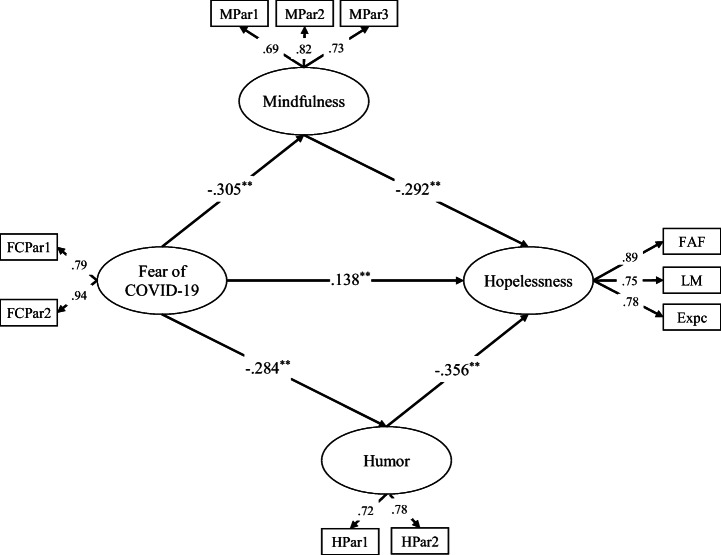
Hopelessness is an important vulnerability factor for depressive symptomology and suicidal ideations. It may also play an important role in the fear of coronavirus 2019 (COVID-19). Therefore, the present study tested the mediating role of mindful awareness and humor (both identified as coping strategies for dealing with stressful situations) in the relationship between fear of COVID-19 and hopelessness. Participants comprised 786 Turkish individuals (562 females and 224 males; aged between 18 and 67 years) from 71 of 81 cities in Turkey. An online convenience sampling method was used to recruit participants. Participants completed surveys including the Fear of COVID-19 Scale, Beck Hopelessness Scale, Mindful Attention Awareness Scale, and Coping Humor Scale. The model was tested using structural equation modeling (SEM) and utilizing bootstrapping. The results of SEM showed that the effect of fear of COVID-19 on hopelessness was partly mediated by mindfulness and humor, and which was supported by bootstrapping. Therefore, higher fear of COVID-19 was associated with lower mindfulness and humor. In turn, lower mindfulness and humor were related with higher hopelessness. Findings are discussed in the context of COVID-19 and the hopelessness literature, and practical implications for counselors are also provided.
Overview
The claims and statistics of this paper haven’t been checked yet.
Free: it reads the open-access text and checks the first 5 claims that cite a source we can check. Create a free account to check every claim.
Integrity signals
Registry
Cites
Statistics
Figures
Verification
Claims the paper makes
The claims and statistics of this paper haven’t been checked yet.
Free: it reads the open-access text and checks the first 5 claims that cite a source we can check. Create a free account to check every claim.
Claims other papers make about this one
Each is checked against this paper’s own text: does it say what the citing paper says it does?
The source backs part of the claim, not all of it — or backs it for a different population, condition or comparison.
In the citing paper
“There is substantial evidence in adults that trait mindfulness promotes resilience to COVID-19 stressors [46–51].”
From Mindfulness supports emotional resilience in children during the COVID-19 pandemic (2023) · cites this paper as [49]
Experimental — accuracy not yet measuredThe cited source says what the claim attributes to it.
In the citing paper
“In addition, a study reported that individuals with lower levels of mindfulness had higher fear of COVID-19 [41] and more severe anxiety symptoms [42].”
From COVID-19 Victimization Experience and College Students’ Mobile Phone Addiction: A Moderated Mediation Effect of Future Anxiety and Mindfulness (2022) · cites this paper as [41]
Self-check
Percentages, sums and reported differences re-computed from the paper’s own numbers.
The self-check needs the paper’s full text.
Citations
Cites
Evaluating Structural Equation Models with Unobservable Variables and Measurement Error
Fornell, C., & Larcker, D. F. (1981) · Journal of Marketing Research · doi:10.2307/3151312 · Cited by 109,314
Evaluating structural equation models with unobservable variables and measurement error
Fornell, C., & Larcker, D. F. (1981) · Journal of Marketing Research · doi:10.1177/002224378101800104 · Cited by 109,190
Hu, L., & Bentler, P. M. (1999) · Structural Equation Modeling A Multidisciplinary Journal · doi:10.1080/10705519909540118 · Cited by 108,788
(2013) · Cited by 44,563
Structural equation modeling in practice: A review and recommended two-step approach
Anderson, J. C., & Gerbing, D. W. (1988) · Psychological Bulletin · doi:10.1037/0033-2909.103.3.411 · Cited by 41,941
The benefits of being present: Mindfulness and its role in psychological well-being
Brown, K. W., & Ryan, R. M. (2003) · Journal of Personality and Social Psychology · doi:10.1037/0022-3514.84.4.822 · Cited by 13,448
Mindfulness-based interventions in context: Past, present, and future
Kabat-Zinn, J. (2003) · Clinical Psychology: Science and Practice · doi:10.1093/clipsy.bpg016 · Cited by 8,615 · cited 1×
“In addition to the use of humor, mindful awareness is also included in the proposed mediation model because it is an important stress reduction and self-regulation strategy (Brown and Ryan 2003; Brown et al. 2007; Kabat-Zinn 2003).”
MethodMindfulness-based interventions in context: Past, present, and future.
Kabat-Zinn, J. (2003) · Clinical Psychology: Science and Practice · doi:10.1093/clipsy/bpg016 · Cited by 8,612
Learned helplessness in humans: Critique and reformulation.
Abramson, L. Y., Seligman, M. E., & Teasdale, J. D. (1978) · Journal of Abnormal Psychology · doi:10.1037//0021-843x.87.1.49 · Cited by 7,121 · cited 1×
“Humor may facilitate alleviating the vicious circle of learned helplessness, which is the key vulnerability factor for depression (Abramson et al. 1978) and help eradicate hopelessness.”
BackgroundThe measurement of pessimism: the hopelessness scale
Beck, A. T., Weissman, A., Lester, D., & Trexler, L. (1974) · Journal of Consulting and Clinical Psychology · doi:10.1037/h0037562 · Cited by 5,494 · cited 2×
“Hopelessness was assessed using the Beck Hopelessness Scale (BHS; Beck et al. 1974).”
BackgroundMethodThe Fear of COVID-19 Scale: Development and Initial Validation
Ahorsu, D. K., Lin, C.-Y., Imani, V., Saffari, M., Griffiths, M. D., & Pakpour, A. H. (2022) · International Journal of Mental Health and Addiction · doi:10.1007/s11469-020-00270-8 · Cited by 4,332 · cited 1×
“Fear of COVID-19 was assessed using the Fear of COVID-19 Scale (FCVS-19; Ahorsu et al. 2020).”
MethodSelf-citationMindfulness: Theoretical Foundations and Evidence for its Salutary Effects
Brown, K. W., Ryan, R. M., & Creswell, J. D. (2007) · Psychological Inquiry · doi:10.1080/10478400701598298 · Cited by 3,654 · cited 1×
“In addition to the use of humor, mindful awareness is also included in the proposed mediation model because it is an important stress reduction and self-regulation strategy (Brown and Ryan 2003; Brown et al. 2007; Kabat-Zinn 2003).”
MethodTimely mental health care for the 2019 novel coronavirus outbreak is urgently needed
Xiang, Y.-T., Yang, Y., Li, W., Zhang, L., Zhang, Q., Cheung, T., & Ng, C. H. (2020) · The Lancet Psychiatry · doi:10.1016/s2215-0366(20)30046-8 · Cited by 3,598 · cited 3×
“During the development of the CHS into Turkish, Yerlikaya (2009) did not carry out any confirmatory factor analysis.”
MethodMan's search for meaning; an introduction to logotherapy
FRANKL, V. E. (1971) · Medical Entomology and Zoology · Cited by 3,151
(1985) · American Journal of Psychiatry · doi:10.1176/ajp.142.5.559 · Cited by 1,723
Garfin, D. R., Silver, R. C., & Holman, E. A. (2020) · Health Psychology · doi:10.1037/hea0000875 · Cited by 1,270 · cited 2×
“In addition, although the media is a source of information, the frequent presence of COVID-19-related information in the media may have a paradoxically negative effect (Garfin et al. 2020).”
BackgroundFear of the coronavirus (COVID-19): Predictors in an online study conducted in March 2020
Mertens, G., Gerritsen, L., Duijndam, S., Salemink, E., & Engelhard, I. M. (2020) · Journal of Anxiety Disorders · doi:10.1016/j.janxdis.2020.102258 · Cited by 1,264
Relationship between hopelessness and ultimate suicide: a replication with psychiatric outpatients
(1990) · American Journal of Psychiatry · doi:10.1176/ajp.147.2.190 · Cited by 1,120
Coronaphobia: Fear and the 2019-nCoV outbreak
Asmundson, G. J. G., & Taylor, S. (2020) · Journal of Anxiety Disorders · doi:10.1016/j.janxdis.2020.102196 · Cited by 1,103 · cited 1×
“The unprecedented nature of the COVID-19 and the uncertainties about the future of the disease are likely to fuel the fear of COVID-19 (Asmundson and Taylor 2020).”
BackgroundSatici, B., Gocet-Tekin, E., Deniz, M. E., & Satici, S. A. (2021) · International Journal of Mental Health and Addiction · doi:10.1007/s11469-020-00294-0 · Cited by 922
Sense of humor as a moderator of the relation between stressors and moods.
Martin, R. A., & Lefcourt, H. M. (1983) · Journal of Personality and Social Psychology · doi:10.1037//0022-3514.45.6.1313 · Cited by 694
Mamun, M. A., & Griffiths, M. D. (2020) · Asian Journal of Psychiatry · doi:10.1016/j.ajp.2020.102073 · Cited by 690
Self-citationSatici, B., Saricali, M., Satici, S. A., & Griffiths, M. D. (2022) · International Journal of Mental Health and Addiction · doi:10.1007/s11469-020-00305-0 · Cited by 580 · cited 1×
“For instance, hopelessness is negatively associated with life satisfaction (Kliem et al. 2018), is a negative predictor of quality of life among older adults (Scogin et al. 2016), and is a negative predictor of resilience towards stressful events (Hjemdal et al. 2012).”
BackgroundSelf-citationSocial Reaction Toward the 2019 Novel Coronavirus (COVID-19)
Lin, C.-Y. (2020) · Asian Journal of Social Health and Behavior · doi:10.4103/shb.shb_11_20 · Cited by 561
Fear of COVID 2019: first suicidal case in India!
Goyal, K., Chauhan, P., Chhikara, K., Gupta, P., & Singh, M. P. (2020) · Asian Journal of Psychiatry · doi:10.1016/j.ajp.2020.101989 · Cited by 559 · cited 2×
“The findings here overlap with studies showing that suicidal ideation, which is closely related to hopelessness, may increase during an epidemic (Bhuiyan et al. 2020; Goyal et al. 2020; Griffiths and Mamun 2020; Yip et al. 2010).”
BackgroundResultThe fear of COVID-19 and its role in preventive behaviours
Pakpour, A. H., & Griffiths, M. D. (2020) · Journal of Concurrent Disorders · doi:10.54127/wcic8036 · Cited by 448
Self-citationBhuiyan, A. K. M. I., Sakib, N., Pakpour, A. H., Griffiths, M. D., & Mamun, M. A. (2021) · International Journal of Mental Health and Addiction · doi:10.1007/s11469-020-00307-y · Cited by 417
Self-citationThe fear of COVID-19 and its role in preventive behaviors
Pakpour, A. H., & Griffiths, M. D. (2020) · Nottingham Trent University's Institutional Repository (Nottingham Trent Repository) · Cited by 400
Yip, P. S. F., Cheung, Y. T., Chau, P. H., & Law, Y. W. (2010) · Crisis · doi:10.1027/0227-5910/a000015 · Cited by 363 · cited 2×
“The findings here overlap with studies showing that suicidal ideation, which is closely related to hopelessness, may increase during an epidemic (Bhuiyan et al. 2020; Goyal et al. 2020; Griffiths and Mamun 2020; Yip et al. 2010).”
BackgroundResultJimenez, S. S., Niles, B. L., & Park, C. L. (2010) · Personality and Individual Differences · doi:10.1016/j.paid.2010.05.041 · Cited by 286
Coping humour, stress, and cognitive appraisals.
Kuiper, N. A., Martin, R. A., & Olinger, L. J. (1993) · Canadian Journal of Behavioural Science / Revue canadienne des sciences du comportement · doi:10.1037/h0078791 · Cited by 274
Umucu, E., & Lee, B. (2020) · Rehabilitation Psychology · doi:10.1037/rep0000328 · Cited by 260
Niemiec, C. P., Brown, K. W., Kashdan, T. B., Cozzolino, P. J., Breen, W. E., Levesque-Bristol, C., & Ryan, R. M. (2010) · Journal of Personality and Social Psychology · doi:10.1037/a0019388 · Cited by 248
Personality traits and the development of depression, hopelessness, and suicide ideation
Chioqueta, A. P., & Stiles, T. C. (2005) · Personality and Individual Differences · doi:10.1016/j.paid.2004.08.010 · Cited by 244
Mental health characteristics associated with dysfunctional coronavirus anxiety
Lee, S. A., Jobe, M. C., & Mathis, A. A. (2021) · Psychological Medicine · doi:10.1017/s003329172000121x · Cited by 191 · cited 3×
“In their studies, Lee et al. (2020) found a strong positive relationship between COVID-19 anxiety and hopelessness as well as suicidal ideation.”
BackgroundResultInfluentialFear of the coronavirus (COVID-19): Predictors in an online study conducted in March 2020Preprint
Mertens, G., Gerritsen, L., Duijndam, S., et al. (2020) · doi:10.31234/osf.io/2p57j · Cited by 183
Kuiper, N. A., McKenzie, S. D., & Belanger, K. A. (1995) · Personality and Individual Differences · doi:10.1016/0191-8869(95)00072-e · Cited by 153
Kaplan, D. M. (2001) · Elsevier eBooks · doi:10.1016/b0-08-043076-7/00776-2 · Cited by 151
COVID-19 suicidal behavior among couples and suicide pacts: Case study evidence from press reports
Griffiths, M. D., & Mamun, M. A. (2020) · Psychiatry Research · doi:10.1016/j.psychres.2020.113105 · Cited by 128
Self-citationRelationship Between Hopelessness and Ultimate Suicide: A Replication With Psychiatric Outpatients
Beck, A. T., Brown, G., Berchick, R. J., Stewart, B. L., & Steer, R. A. (2006) · Focus · doi:10.1176/foc.4.2.291 · Cited by 126
Connecting Mindfulness and Meaning in Life: Exploring the Role of Authenticity
Allan, B. A., Bott, E. M., & Suh, H. (2014) · Mindfulness · doi:10.1007/s12671-014-0341-z · Cited by 110
Caron, J. E. (2002) · Humor - International Journal of Humor Research · doi:10.1515/humr.2002.015 · Cited by 109
Humor Use Moderates the Relation of Stressful Life Events With Psychological Distress
Fritz, H. L., Russek, L. N., & McHugh, M. B. (2017) · Personality and Social Psychology Bulletin · doi:10.1177/0146167217699583 · Cited by 109
Troister, T., D'Agata, M. T., & Holden, R. R. (2015) · Psychological Assessment · doi:10.1037/pas0000126 · Cited by 94
An item-response theory evaluation of the Beck Hopelessness Scale
Young, M. A., Halper, I. S., Clark, D. C., Scheftner, W. A., & FAWCETT, J. A. (1992) · Cognitive Therapy and Research · doi:10.1007/bf01175143 · Cited by 94
Thinking mindfully: How mindfulness relates to rumination and reflection in daily life.
Blanke, E. S., Schmidt, M. J., Riediger, M., & Brose, A. (2020) · Emotion · doi:10.1037/emo0000659 · Cited by 88
Kliem, S., Lohmann, A., Mößle, T., & Brähler, E. (2018) · BMC Psychiatry · doi:10.1186/s12888-018-1646-6 · Cited by 85
BECK UMUTSUZLUK ÖLÇEĞİ GEÇERLİLİK ÇALIŞMASI*
DURAK, A., & Palabıyıkoğlu, R. (1994) · Kriz Dergisi · doi:10.1501/kriz_0000000071 · Cited by 76
Standardization of the Beck Hopelessness Scale in the general population
Kocalevent, R., Finck, C., Pérez-Trujillo, M., Sautier, L., Zill, J. M., & Hinz, A. (2016) · Journal of Mental Health · doi:10.1080/09638237.2016.1244717 · Cited by 73
HJEMDAL, O., FRIBORG, O., & STILES, T. C. (2012) · Scandinavian Journal of Psychology · doi:10.1111/j.1467-9450.2011.00928.x · Cited by 67 · cited 1×
“For instance, hopelessness is negatively associated with life satisfaction (Kliem et al. 2018), is a negative predictor of quality of life among older adults (Scogin et al. 2016), and is a negative predictor of resilience towards stressful events (Hjemdal et al. 2012).”
BackgroundStephan, K. E., & Friston, K. J. (2009) · Elsevier eBooks · doi:10.1016/b978-008045046-9.00308-9 · Cited by 67
Humor and coping with stress: A test under real-life conditions
Bizi, S., Keinan, G., & Beit‐Hallahmi, B. (1988) · Personality and Individual Differences · doi:10.1016/0191-8869(88)90128-6 · Cited by 62
Personality and negative expectancies: Trait structure of the Beck Hopelessness Scale
Velting, D. M. (1999) · Personality and Individual Differences · doi:10.1016/s0191-8869(98)00194-9 · Cited by 62
Physical Distancing and Emotional Closeness Amidst COVID-19
Yip, P. S. F., & Chau, P. H. (2020) · Crisis · doi:10.1027/0227-5910/a000710 · Cited by 62
Optimism Reduces Suicidal Ideation and Weakens the Effect of Hopelessness Among Military Personnel
Bryan, C. J., Ray-Sannerud, B. N., Morrow, C. E., & Etienne, N. (2013) · Cognitive Therapy and Research · doi:10.1007/s10608-013-9536-1 · Cited by 51
Stable Hopelessness and its Predictors in a General Population: A 2‐Year Follow‐Up Study
Haatainen, K. M., Tanskanen, A., Kylmä, J., Honkalampi, K., Koivumaa‐Honkanen, H., Hintikka, J., Antikainen, R., & Viinamäki, H. (2003) · Suicide and Life-Threatening Behavior · doi:10.1521/suli.33.4.373.25237 · Cited by 38
Stress, Coping Styles, and Hopelessness in Self-Poisoners
Elliott, J. L., & Frude, N. (2001) · Crisis · doi:10.1027//0227-5910.22.1.20 · Cited by 36
“I have strong medicine, you see”: Strategic responses to racial microaggressions.
Houshmand, S., Spanierman, L. B., & Stefano, J. D. (2019) · Journal of Counseling Psychology · doi:10.1037/cou0000372 · Cited by 34
Aikido: A martial art with mindfulness, somatic, relational, and spiritual benefits for veterans.
Lukoff, D. G., & Strozzi-Heckler, R. (2017) · Spirituality in Clinical Practice · doi:10.1037/scp0000134 · Cited by 29
Ender, Z., Sarıçalı, M., Satıcı, S. A., & Çapan, B. E. (2018) · British Journal of Guidance and Counselling · doi:10.1080/03069885.2018.1458072 · Cited by 27
Pleasant Events, Hopelessness, and Quality of Life in Rural Older Adults
Scogin, F., Morthland, M., DiNapoli, E. A., LaRocca, M., & Chaplin, W. (2016) · The Journal of Rural Health · doi:10.1111/jrh.12130 · Cited by 22
Model of mindfulness and mental health outcomes: Need fulfillment and resilience as mediators.
Charbonneau, D. (2019) · Canadian Journal of Behavioural Science/Revue canadienne des sciences du comportement · doi:10.1037/cbs0000137 · Cited by 19
Let it be: Mindfulness and releasement—Neglected dimensions of well-being.
Christopher, J. C. (2018) · Journal of Theoretical and Philosophical Psychology · doi:10.1037/teo0000078 · Cited by 13
Research works printed but not linked: 5
- Cohen, J. (1988). Statistical power analysis for the behavioral sciences (2nd edition). Lawrence Earlbaum Associates.
- Ferguson, D. L. (2016). Is laughter the best medicine? An examination of couples’ abilities to cope with cancer by using humor (Publication no. 3728517) [Doctoral dissertation, the Chicago School of Professional Psychology], ProQuest Dissertations and Theses Global.
- Freud, S. (1928). On humor. The Psychoanalytic Review (1913–1957), 15, 85.
- Ozyeşil, Z., Arslan, C., Kesici, S., & Deniz, M. E. (2011). Adaptation of the Mindful Attention Awareness Scale into Turkish. Education and Science, 36(160), 224–235.
- Yerlikaya, E. E. (2009). Üniversite öğrencilerinin mizah tarzları ile algılanan stres, kaygı ve depresyon düzeyleri arasındaki ilişkinin incelenmesi [Unpublished Doctoral Dissertation]. Çukurova University.
Cited by
Systematic Review and Meta-Analysis of Fear of COVID-19
Luo, F., Ghanei Gheshlagh, R., Dalvand, S., Saedmoucheshi, S., & Li, Q. (2021) · Frontiers in Psychology · doi:10.3389/fpsyg.2021.661078 · Cited by 209
Duong, C. D. (2021) · Personality and Individual Differences · doi:10.1016/j.paid.2021.110869 · Cited by 190
Suicide before and during the COVID-19 Pandemic: A Systematic Review with Meta-Analysis
Yan, Y., Hou, J., Li, Q., & Yu, N. X. (2023) · International Journal of Environmental Research and Public Health · doi:10.3390/ijerph20043346 · Cited by 185
“During the pandemic, with lockdown measures implemented, individuals experienced overwhelming fears and worries about COVID-19 due to health issues, uncertainties about the future, stigmatization, and misinformation from media, which were associated with higher hopelessness under the pandemic context [116].”
BackgroundDeniz, M. E. (2021) · Personality and Individual Differences · doi:10.1016/j.paid.2021.110824 · Cited by 124
Stănculescu, E. (2021) · International Journal of Mental Health and Addiction · doi:10.1007/s11469-020-00428-4 · Cited by 81
“…positive psychology framework, other research has explored the psychological resources used as buffers against the negative impact of COVID-19, such as humour, hope and mindfulness (Saricali et al. 2020), as well the relationship between fear of COVID-19 and life satisfaction (Satici et al. 2020a).”
Background
Metadata
- Authors
- Saricali, M., Satici, S. A., Satici, B., Gocet-Tekin, E., & Griffiths, M. D.
- Affiliations
- Nottingham Trent University (GB)
- Corresponding author
- Griffiths, Mark D.
- Venue
- International Journal of Mental Health and Addiction
- Published
- 2020-11-19
- Volume
- 20
- Issue
- 4
- Pages
- 2151-2164
- ISSN
- 1557-1874 (ISSN-L)
- 1557-1882
- PMC
- PMC7676415
- OpenAlex
- W3104583802
- Cited by
- 146
- References
- 61
- Citations by year
- 2026: 4 · 2025: 16 · 2024: 16 · 2023: 31 · 2022: 42 · 2021: 36 · 2020: 1
- FWCI
- 11.01
- Type
- journal article
- Language
- en
- Open access
- hybrid
- doi.org
- Licence
- cc-by
- creativecommons.org/licenses/by/4.0 (tdm)
- creativecommons.org/licenses/by/4.0 (vor)
- Locations
- International Journal of Mental Health and Addiction (publishedVersion, cc-by)
- PubMed Central (publishedVersion, cc-by)
- PubMed (publishedVersion)
- Nottingham Trent University's Institutional Repository (Nottingham Trent Repository) (acceptedVersion)
- Sakarya Üniversitesi Kurumsal Açık Akademik Arşivi (submittedVersion)
- Funders
- Nottingham Trent University
- Topics
- Social Sciences › Psychology › Clinical Psychology › COVID-19 and Mental Health
- Social Sciences › Psychology › Applied Psychology › Optimism, Hope, and Well-being
- Social Sciences › Psychology › Clinical Psychology › Mindfulness and Compassion Interventions
- Keywords
- fear of COVID-19, hopelessness, mindfulness, humor, coping strategies, mediation, COVID-19 pandemic, psychological vulnerability, depression, suicidal ideation
About these checks
Registry, retraction, Cites and statistics results are computed, not judged, with one exception: a printed reference that no index lists is read once by a model before it counts as a citation error. Claims are extracted by a model and kept only when their quote appears verbatim in the text; each cited source is then checked, with a model’s help, for whether it says what the claim relies on. Those verdicts can be wrong — read the claim’s quote and the cited source before relying on one.
Statistics and arithmetic are recomputed, not judged.
Confidence bands are shown only for fields calibrated on our annotated test set. None is calibrated yet, so no band is shown.
What counts as a claim ›How we measure confidence ›How we check this ›
Are you an author, or do you see a problem with this page? Request a review
Data sources
Bibliographic data: Semantic Scholar, OpenAlex, Crossref.
Contains information from the Semantic Scholar Academic Graph Datasets, made available under the ODC Attribution License (ODC-BY 1.0).
Semantic Scholar’s data is described in: Kinney, R., et al. (2023). The Semantic Scholar Open Data Platform. arXiv:2301.10140.
