

Fear of COVID-19, Mindfulness, Humor, and Hopelessness: A Multiple Mediation Analysis
Open accessThe DOI matches its Crossref record; 63 of the 63 references it cites were found in a registry or an index.
Abstract
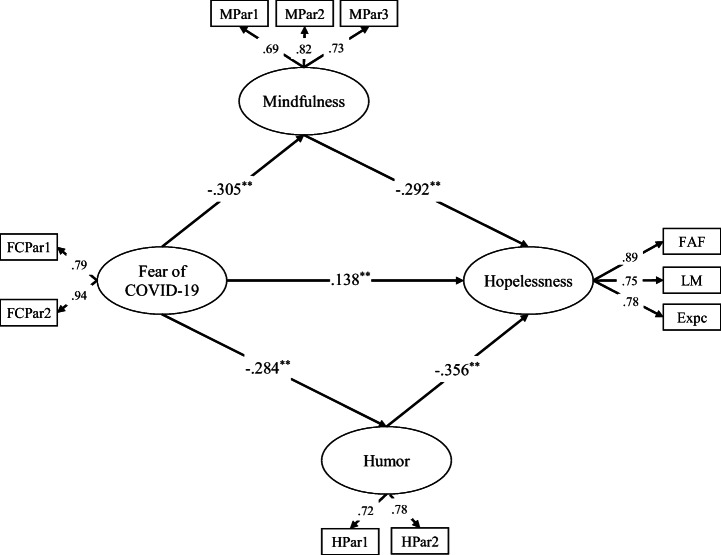
Hopelessness is an important vulnerability factor for depressive symptomology and suicidal ideations. It may also play an important role in the fear of coronavirus 2019 (COVID-19). Therefore, the present study tested the mediating role of mindful awareness and humor (both identified as coping strategies for dealing with stressful situations) in the relationship between fear of COVID-19 and hopelessness. Participants comprised 786 Turkish individuals (562 females and 224 males; aged between 18 and 67 years) from 71 of 81 cities in Turkey. An online convenience sampling method was used to recruit participants. Participants completed surveys including the Fear of COVID-19 Scale, Beck Hopelessness Scale, Mindful Attention Awareness Scale, and Coping Humor Scale. The model was tested using structural equation modeling (SEM) and utilizing bootstrapping. The results of SEM showed that the effect of fear of COVID-19 on hopelessness was partly mediated by mindfulness and humor, and which was supported by bootstrapping. Therefore, higher fear of COVID-19 was associated with lower mindfulness and humor. In turn, lower mindfulness and humor were related with higher hopelessness. Findings are discussed in the context of COVID-19 and the hopelessness literature, and practical implications for counselors are also provided.
Overview
The claims and statistics of this paper haven’t been checked yet.
Free: it reads the open-access text and checks the first 5 claims that cite a source we can check. Create a free account to check every claim.
Integrity signals
Registry
Cites
Statistics
Figures
Verification
Claims the paper makes
The claims and statistics of this paper haven’t been checked yet.
Free: it reads the open-access text and checks the first 5 claims that cite a source we can check. Create a free account to check every claim.
Claims other papers make about this one
Each is checked against this paper’s own text: does it say what the citing paper says it does?
The source backs part of the claim, not all of it — or backs it for a different population, condition or comparison.
In the citing paper
“There is substantial evidence in adults that trait mindfulness promotes resilience to COVID-19 stressors [46–51].”
From Mindfulness supports emotional resilience in children during the COVID-19 pandemic (2023) · cites this paper as [49]
Experimental — accuracy not yet measuredThe cited source says what the claim attributes to it.
In the citing paper
“In addition, a study reported that individuals with lower levels of mindfulness had higher fear of COVID-19 [41] and more severe anxiety symptoms [42].”
From COVID-19 Victimization Experience and College Students’ Mobile Phone Addiction: A Moderated Mediation Effect of Future Anxiety and Mindfulness (2022) · cites this paper as [41]
Self-check
Percentages, sums and reported differences re-computed from the paper’s own numbers.
The self-check needs the paper’s full text.
Citations
Cites
Evaluating Structural Equation Models with Unobservable Variables and Measurement Error
Fornell, C., & Larcker, D. F. (1981) · Journal of Marketing Research · doi:10.2307/3151312 · Cited by 109,314
Evaluating structural equation models with unobservable variables and measurement error
Fornell, C., & Larcker, D. F. (1981) · Journal of Marketing Research · doi:10.1177/002224378101800104 · Cited by 109,190
Hu, L., & Bentler, P. M. (1999) · Structural Equation Modeling A Multidisciplinary Journal · doi:10.1080/10705519909540118 · Cited by 108,788
(2013) · Cited by 44,563
Structural equation modeling in practice: A review and recommended two-step approach
Anderson, J. C., & Gerbing, D. W. (1988) · Psychological Bulletin · doi:10.1037/0033-2909.103.3.411 · Cited by 41,941
The benefits of being present: Mindfulness and its role in psychological well-being
Brown, K. W., & Ryan, R. M. (2003) · Journal of Personality and Social Psychology · doi:10.1037/0022-3514.84.4.822 · Cited by 13,448
Mindfulness-based interventions in context: Past, present, and future
Kabat-Zinn, J. (2003) · Clinical Psychology: Science and Practice · doi:10.1093/clipsy.bpg016 · Cited by 8,615 · cited 1×
“In addition to the use of humor, mindful awareness is also included in the proposed mediation model because it is an important stress reduction and self-regulation strategy (Brown and Ryan 2003; Brown et al. 2007; Kabat-Zinn 2003).”
MethodMindfulness-based interventions in context: Past, present, and future.
Kabat-Zinn, J. (2003) · Clinical Psychology: Science and Practice · doi:10.1093/clipsy/bpg016 · Cited by 8,612
Learned helplessness in humans: Critique and reformulation.
Abramson, L. Y., Seligman, M. E., & Teasdale, J. D. (1978) · Journal of Abnormal Psychology · doi:10.1037//0021-843x.87.1.49 · Cited by 7,121 · cited 1×
“Humor may facilitate alleviating the vicious circle of learned helplessness, which is the key vulnerability factor for depression (Abramson et al. 1978) and help eradicate hopelessness.”
BackgroundThe measurement of pessimism: the hopelessness scale
Beck, A. T., Weissman, A., Lester, D., & Trexler, L. (1974) · Journal of Consulting and Clinical Psychology · doi:10.1037/h0037562 · Cited by 5,494 · cited 2×
“Hopelessness was assessed using the Beck Hopelessness Scale (BHS; Beck et al. 1974).”
BackgroundMethod
Research works printed but not linked: 5
- Cohen, J. (1988). Statistical power analysis for the behavioral sciences (2nd edition). Lawrence Earlbaum Associates.
- Ferguson, D. L. (2016). Is laughter the best medicine? An examination of couples’ abilities to cope with cancer by using humor (Publication no. 3728517) [Doctoral dissertation, the Chicago School of Professional Psychology], ProQuest Dissertations and Theses Global.
- Freud, S. (1928). On humor. The Psychoanalytic Review (1913–1957), 15, 85.
- Ozyeşil, Z., Arslan, C., Kesici, S., & Deniz, M. E. (2011). Adaptation of the Mindful Attention Awareness Scale into Turkish. Education and Science, 36(160), 224–235.
- Yerlikaya, E. E. (2009). Üniversite öğrencilerinin mizah tarzları ile algılanan stres, kaygı ve depresyon düzeyleri arasındaki ilişkinin incelenmesi [Unpublished Doctoral Dissertation]. Çukurova University.
Cited by
Systematic Review and Meta-Analysis of Fear of COVID-19
Luo, F., Ghanei Gheshlagh, R., Dalvand, S., Saedmoucheshi, S., & Li, Q. (2021) · Frontiers in Psychology · doi:10.3389/fpsyg.2021.661078 · Cited by 209
Duong, C. D. (2021) · Personality and Individual Differences · doi:10.1016/j.paid.2021.110869 · Cited by 190
Suicide before and during the COVID-19 Pandemic: A Systematic Review with Meta-Analysis
Yan, Y., Hou, J., Li, Q., & Yu, N. X. (2023) · International Journal of Environmental Research and Public Health · doi:10.3390/ijerph20043346 · Cited by 185
“During the pandemic, with lockdown measures implemented, individuals experienced overwhelming fears and worries about COVID-19 due to health issues, uncertainties about the future, stigmatization, and misinformation from media, which were associated with higher hopelessness under the pandemic context [116].”
BackgroundDeniz, M. E. (2021) · Personality and Individual Differences · doi:10.1016/j.paid.2021.110824 · Cited by 124
Stănculescu, E. (2021) · International Journal of Mental Health and Addiction · doi:10.1007/s11469-020-00428-4 · Cited by 81
“…positive psychology framework, other research has explored the psychological resources used as buffers against the negative impact of COVID-19, such as humour, hope and mindfulness (Saricali et al. 2020), as well the relationship between fear of COVID-19 and life satisfaction (Satici et al. 2020a).”
BackgroundAkbari, M., Spada, M. M., Nikčević, A. V., & Zamani, E. (2021) · Clinical Psychology & Psychotherapy · doi:10.1002/cpp.2628 · Cited by 59
“Recently, a body of studies have shown FC-19 as independent variable in their mediational models (e.g., Bakio glu et al., 2020; Mahmud et al., 2020; Saricali et al., 2020; Satici, Gocet-Tekin, et al., 2020).”
BackgroundKASAPOĞLU, F. (2022) · Journal of Religion and Health · doi:10.1007/s10943-021-01472-7 · Cited by 65
Gupta, S., Nawaz, N., Tripathi, A., Muneer, S., & Ahmad, N. (2021) · Sustainability · doi:10.3390/su13073700 · Cited by 62
“Moreover, this approach is supported by different researchers [110–112] to serve the objective of mediating effect between a proposed relationship(s).”
ResultTikTok as a Knowledge Source for Programming Learners: a New Form of Nanolearning?
Garcia, M. B., Juanatas, I. C., & Juanatas, R. A. (2022) · International Conference on Information and Education Technology (ICIET) · doi:10.1109/iciet55102.2022.9779004 · Cited by 46
“In addition, students rely on humor as a coping strategy during emergency remote education (Garcia & Revano Jr, 2022; Saricali et al., 2020).”
BackgroundYenen, E. T., & ÇARKIT, E. (2021) · Current Psychology · doi:10.1007/s12144-021-02306-1 · Cited by 59
“, 2020), and hopelessness (Sarıçalı et al., 2020); lowers motivation (Taşçı, 2021) and mental well-being (Satıcı et al.”
The crucial role of prolactin-lactogenic hormone in Covid-19
Al-Kuraishy, H. M., Al-Gareeb, A. I., Butnariu, M., & Batiha, G. E. (2022) · Molecular and Cellular Biochemistry · doi:10.1007/s11010-022-04381-9 · Cited by 50
“In a precise manner, dopamine which is an inhibitory releasing factor for PRL release is involved in the pathogenesis of SARS-CoV-2 during CNS invasion [84, 85].”
BackgroundRossi, A. A., Marconi, M., Taccini, F., Verusio, C., & Mannarini, S. (2021) · Behavioral Sciences · doi:10.3390/bs11060087 · Cited by 41
“Research further shows that fear of COVID-19 might be associated with feelings of hopelessness [9].”
BackgroundLaughing all the way to the lockdown: On humor, optimism, and well-being during COVID-19
Reizer, A., Munk, Y., & Frankfurter, L. K. (2021) · Personality and Individual Differences · doi:10.1016/j.paid.2021.111164 · Cited by 47
Matta, S., Rogova, N., & Luna-Cortés, G. (2021) · Personality and Individual Differences · doi:10.1016/j.paid.2021.111352 · Cited by 48
Chen, Y., Liu, Y., Zhang, Y., Li, Z., & Zhou, T. (2021) · Frontiers in Psychology · doi:10.3389/fpsyg.2021.750011 · Cited by 45
Bäuerle, A., Jahre, L. M., Teufel, M., Jansen, C., Musche, V., Schweda, A., Fink, M., Dinse, H., Weismüller, B., Dörrie, N., et al. (2021) · Frontiers in Psychiatry · doi:10.3389/fpsyt.2021.768132 · Cited by 36
Tao, Y., Niu, H., Hou, W., Zhang, L., & Ying, R. (2022) · Journal of Clinical Psychology · doi:10.1002/jclp.23439 · Cited by 35
“Thus, mindfulness can be used to alleviate negative psychological effects (Saricali et al., 2020), as mindful awareness could help reduce rumination among college students, regardless of whether they are in lockdown.”
BackgroundLiu, L., Tu, Y., & Zhou, X. (2022) · Technology in Society · doi:10.1016/j.techsoc.2022.102113 · Cited by 30
Predictors of Mental Health after the First Wave of the COVID-19 Pandemic in Poland
Długosz, P. (2021) · Brain Sciences · doi:10.3390/brainsci11050544 · Cited by 28
“The increased fear of COVID-19 may result from the fact that watching the news depicting death, infected people and the economic crisis may activate fear-related cognitive patterns, which affect the perception of the level of threat posed by the pandemic [7,45].”
BackgroundArslan, G. (2021) · Death Studies · doi:10.1080/07481187.2020.1871122 · Cited by 31
“Coronavirus has become a central theme of social media, electronic sources, and news, which offer suggestions on how people can protect themselves from coronavirus infection (Geçer et al., 2020; Sulaimani & Bagadood, 2020).”
BackgroundChen, L., Li, J., & Huang, J. (2022) · International Journal of Environmental Research and Public Health · doi:10.3390/ijerph19137578 · Cited by 26
“In addition, a study reported that individuals with lower levels of mindfulness had higher fear of COVID-19 [41] and more severe anxiety symptoms [42].”
BackgroundKepenek-Varol, B., Zeren, M., Dinçer, R., & Erkaya, S. (2022) · Journal of Integrative and Complementary Medicine · doi:10.1089/jicm.2021.0381 · Cited by 30
“33 The measures were relaxed again when the number of cases of COVID-19 began to decrease in Turkey.”
Tweet topics and sentiments relating to distance learning among Italian Twitter users
Stracqualursi, L., & Agati, P. (2022) · Scientific Reports · doi:10.1038/s41598-022-12915-w · Cited by 31
Beshai, S., Salimuddin, S., Refaie, N., & Maierhoffer, J. (2022) · Mindfulness · doi:10.1007/s12671-022-02008-0 · Cited by 22
Impact of COVID-19 anxiety on functional foods consuming intention: role of electronic word of mouth
Nguyen, T. T., & Phan, H. T. T. (2022) · Heliyon · doi:10.1016/j.heliyon.2022.e11344 · Cited by 32
Rania, N., & Coppola, I. (2022) · Frontiers in Psychology · doi:10.3389/fpsyg.2022.805706 · Cited by 27
Wang, J., Xu, M., Li, X., & Ni, Y. (2023) · Journal of Affective Disorders · doi:10.1016/j.jad.2023.02.077 · Cited by 23
Factors Related to Mental Health During the COVID-19 Lockdown in Spain
González, R. P., Vicario‐Molina, I., Ortega, E. G., & Picos, A. P. (2021) · Frontiers in Psychology · doi:10.3389/fpsyg.2021.715792 · Cited by 27
Mindfulness supports emotional resilience in children during the COVID-19 pandemic
Treves, I. N., Li, C. E., Wang, K. L., Ozernov-Palchik, O., Olson, H. A., & Gabrieli, J. D. E. (2023) · PLoS ONE · doi:10.1371/journal.pone.0278501 · Cited by 19
Hartstone, J. M., & Medvedev, O. N. (2021) · Mindfulness · doi:10.1007/s12671-021-01731-4 · Cited by 24
“A study facilitated in Turkey (Saricali et al., 2020) demonstrated that lower levels of mindfulness were associated with greater levels of fear of COVID-19 using structural equation modeling with bootstrapping.”
MethodInfluentialCOVID-19, anxiety, and hopelessness: quality of life among healthcare workers in Turkey
Mert, S., Peker Karatoprak, A., Demirhan, Y., Baydemir, C., Çetinarslan, B., Cantürk, Z., Selek, A., Aydin, L., Sözen, M., & Gezer, E. (2022) · Evaluation & the Health Professions · doi:10.1177/01632787211067530 · Cited by 18
Mpofu, S. (2021) · Springer eBooks · doi:10.1007/978-3-030-79279-4_15 · Cited by 18
Sanwald, S., Widenhorn‐Müller, K., Gahr, M., Kammer, T., Schönfeldt‐Lecuona, C., Montag, C., & Kiefer, M. (2022) · BMC Psychiatry · doi:10.1186/s12888-021-03677-2 · Cited by 22
“On the other hand, positivity has been found to be a predictor of happiness during the current pandemic [37] and humor has been shown to be negatively associated with fear of COVID19 [38].”
BackgroundBroos, H. C., Llabre, M. M., Saab, P. G., Leite, R. O., Port, J. H., & Timpano, K. R. (2022) · British Journal of Clinical Psychology · doi:10.1111/bjc.12391 · Cited by 22
“Health worry predicted dysfunctional beliefs both in the early and later phases of the pandemic, consistent with recent literature on the relationship between fear of COVID-19 and feelings of hopelessness and helplessness (e.g., Saricali et al., 2020).”
ResultArt therapists’ fear of COVID-19, subjective well-being, and mindfulness
Jue, J., & Ha, J. H. (2022) · The Arts in Psychotherapy · doi:10.1016/j.aip.2022.101881 · Cited by 23
Wen, X., Rafaï, I., Duchêne, S., & Willinger, M. (2022) · International Journal of Environmental Research and Public Health · doi:10.3390/ijerph19095051 · Cited by 18
“Other studies [41,51] relied on the measurement of mindfulness awareness using the Mindfulness Attention Awareness Scale (MAAS) questionnaire of [54] (more descriptions are provided in Section 2).”
MethodCOVID-19 in Memes: The Adaptive Response of Societies to the Pandemic?
Skórka, P., Grzywacz, B., Moroń, D., & Lenda, M. L. (2022) · International Journal of Environmental Research and Public Health · doi:10.3390/ijerph191912969 · Cited by 20
“A study in Turkey showed that COVID-19-related fear is a powerful predictor of increased hopelessness [24].”
BackgroundLv, S., Tong, C., Na, S., Lü, L., & Zhao, E. (2023) · Behavioral Sciences · doi:10.3390/bs13030243 · Cited by 21
“It has been widely used for analyzing the relationships in mental health [30] and social behavior [31].”
MethodMcBride, S. K., & Ball, J. L. (2022) · International Journal of Disaster Risk Reduction · doi:10.1016/j.ijdrr.2022.102995 · Cited by 24
Bursky, M., Kosuri, M., Walsh Carson, K., Babad, S., Iskhakova, A., & Nikulina, V. (2023) · Psychological Reports · doi:10.1177/00332941211048734 · Cited by 13
“Further, the studies on meditation, MBIs and dispositional mindfulness during lockdown in Italy (Conversano et al., 2020; Matiz et al., 2020; Pizzoli et al., 2020), India (Dubey, Podder & Pandey., 2020), the U.S. (Haliwa et al., 2020), Turkey (Saricali et al., 2020), Poland (Wieglus et al., 2020), Spain (Jiménez et a…”
BackgroundInfluentialDuru, E., & Balkıs, M. (2022) · Journal of Rational-Emotive & Cognitive-Behavior Therapy · doi:10.1007/s10942-022-00488-6 · Cited by 22
“…is related to anxiety (Amen-dola et al., 2021; Hacimusalar et al., 2020; Kazan Kızılkurt et al., 2021; Lee, 2020), depression (Amendola et al., 2021; Pretorius, 2021), fear of COVID-19 (Saricali et al., 2020), stress from COVID-19 (Olah & Ford, 2021), and well-being (Sønder-skov et al., 2020).”
Loneliness and associated factors among older adults during COVID-19 lockdown in Spain
Ortega, E. G., González, R. P., Vicario‐Molina, I., Picos, A. P., & Baz, M. B. O. (2023) · Journal of Applied Developmental Psychology · doi:10.1016/j.appdev.2023.101547 · Cited by 16
“Humorous literature, films and television might be used by health promotion practitioners and therapists to reduce the negative psychological effects of the COVID-19 pandemic (Saricali et al., 2022).”
BackgroundSanabria-Landeros, I. B., Luna, D., Sánchez‐Sánchez, C., Meneses-González, F., Fernández, M. Á. L., de la Peña-León, B., Velázquez, M. S. G., & Méndez-García, S. (2021) · Revista CONAMED · doi:10.35366/102506 · Cited by 17
Gu, Z., Li, P., Zhang, A., Xu, X., & Gu, F. (2022) · Frontiers in Psychology · doi:10.3389/fpsyg.2022.822751 · Cited by 19
“Research on the mental health of the people during this pandemic, in particular, has been the center of attention for many researchers (Knowles, 2001; Lim et al., 2008; de Silva and Roland, 2014; Ohrnberger et al., 2017; Dybdahl and Lien, 2018; Groth et al., 2019; Filipova et al., 2020; Horesh et al., 2020; Lee, 2020;…”
BackgroundMeyer, M. L., Kaesler, A., Wolffgramm, S., Perić, N. L., Bunjaku, G., Dickmann, L., Serino, S., Lernia, D. D., Tuena, C., Bernardelli, L., et al. (2022) · Journal of Clinical Medicine · doi:10.3390/jcm11082080 · Cited by 13
“Moreover, the COVID Feel Good protocol aims at individuals’ mindfulness, which is in turn linked to a reduced hopelessness and fear of COVID-19 [48].”
BackgroundZhang, D., Yang, H., He, Y., & Guo, W. (2025) · Education and Information Technologies · doi:10.1007/s10639-025-13715-1 · Cited by 21
“These indices suggest that this model balances fit and simplicity, providing the best fit with the least complexity (Saricali et al., 2022).”
Jang, Y., Ha, J.-H., & Jue, J. (2021) · Sustainability · doi:10.3390/su131810040 · Cited by 11
Miranda, A. R., Cortez, M. V., Scotta, A. V., & Soria, E. A. (2022) · Midwifery · doi:10.1016/j.midw.2022.103290 · Cited by 12
Yoon, H. J., Lee, J., Han, J. Y., Ko, Y., Kim, H., Seo, Y., & Seo, J. K. (2023) · Journal of Consumer Behaviour · doi:10.1002/cb.2181 · Cited by 13
Türk, N., Arslan, G., Kaya, A., & YILDIRIM, O. (2025) · Journal of Religion and Health · doi:10.1007/s10943-025-02279-6 · Cited by 15
“Similarly, studies reported that increased intolerance of uncertainty leads to decreased happiness (Khodarahimi et al., 2021) and well-being (Saricali et al., 2022).”
Sheykhangafshe, F. B., Alizadeh, D., Niri, V. S., Asgari, F., & Ghodrat, G. (2021) · Quarterly Journal of Child Mental Health · doi:10.52547/jcmh.8.3.2 · Cited by 13
COVID-19 Pandemic and Lockdown: Associations With Personality and Stress Components
Smrdu, M., Kuder, A., Turk, E., Čelik, T., Šet, J., & Kralj‐Fišer, S. (2021) · Psychological Reports · doi:10.1177/00332941211043451 · Cited by 11
“This relates to the report that joking about the COVID-19 epidemic helped extraverted individual cope with it (Saricali et al., 2020).”
BackgroundLam, C. B., Lam, C. S., & Chung, K. K. H. (2022) · Mindfulness · doi:10.1007/s12671-021-01818-y · Cited by 15
“Not surprisingly, these two variables were negatively correlated in our and others’ studies (Belen et al., 2021; Saricali et al., 2020).”
ResultPsychopathy, impulsivity, and internet trolling: role of aggressive humour
Kurtça, T. T., & Demırcı, İ. (2022) · Behaviour and Information Technology · doi:10.1080/0144929x.2022.2133635 · Cited by 11
Maoz, L. B., Lavy, S., & Berkovich‐Ohana, A. (2023) · Child & Family Social Work · doi:10.1111/cfs.13013 · Cited by 9
Jackson, K., Noordien, Z., Padmanabhanunni, A., & Pretorius, T. B. (2022) · INQUIRY The Journal of Health Care Organization Provision and Financing · doi:10.1177/00469580221110520 · Cited by 11
A public opinion propagation model for technological disasters
Zhang, Y., Tang, W., & Ni, T. (2025) · Scientific Reports · doi:10.1038/s41598-025-91244-0 · Cited by 13
Kaya, B. (2025) · The Journal of Genetic Psychology · doi:10.1080/00221325.2025.2584991 · Cited by 11
Roychowdhury, D. (2021) · Asian Journal of Sport and Exercise Psychology · doi:10.1016/j.ajsep.2021.09.004 · Cited by 10
Occupational changes during the COVID-19 lockdown in Jordan
Malkawi, S. H., Alqatarneh, N. S., ملكاوي, أ. ح., Amro, A., & Crowe, T. K. (2021) · Scandinavian Journal of Occupational Therapy · doi:10.1080/11038128.2021.1983017 · Cited by 6
“Several recent studies reported similar results as people from different countries used joking and humour to express their emotions during the pandemic, and to provide support for others while dealing with stress [19,20].”
BackgroundResultPanneer, S., Dutta, S., Palaniswamy, U., Pushparaj, R. R. B., Rose, J. S., & Srinivasan, P. (2023) · Social Development Issues · doi:10.3998/sdi.4342 · Cited by 9
Kastner, C. T. (2024) · Frontiers in Psychology · doi:10.3389/fpsyg.2023.1324329 · Cited by 11
Russian Anecdotes on the "Corona" Theme: Problematics and Poetics
Zavyalova, E. E. (2021) · Galactica Media Journal of Media Studies · doi:10.46539/gmd.v3i3.221 · Cited by 5
Üniversite Öğrencilerinde Covid-19 Korkusunun Yordayıcısı Olarak Belirsizliğe Tahammülsüzlük
ÇARKIT, E. (2021) · Maarif Mektepleri Uluslararası Eğitim Bilimleri Dergisi · doi:10.46762/mamulebd.934997 · Cited by 8
Rahardi, R. K., Handoko, H., Rahmat, W., & Setyaningsih, Y. (2024) · JURNAL ARBITRER · doi:10.25077/ar.11.1.49-59.2024 · Cited by 14
“Humor, when applied without considering the context, can lead to frustration and discomfort for the other party (Faisol & Rahmat, 2021; Eisend, 2022; Saricali et al., 2022; Mulyaningsih et al., 2022).”
BackgroundYeo, H., Kim, E., & Emerson, K. G. (2024) · Journal of Technology in Human Services · doi:10.1080/15228835.2024.2426103 · Cited by 5
“We applied the bootstrapping method with 5000 replications to the SEM analysis because model included mediator variables (Saricali et al., 2022).”
Lundälv, J. V., Nilsson, E. M., & Eriksson, M. (2022) · Baltic screen media review./Baltic screen media review · doi:10.2478/bsmr-2022-0010 · Cited by 4
Sotelo, K. V., Cárdenas, F. P., González, B. Z., Orozco, C. M. V., Rodríguez, I. H., & Pérez, C. L. (2023) · Frontiers in Psychology · doi:10.3389/fpsyg.2022.984374 · Cited by 9
Hope in Hopelessness: Affective Practices in Times of Crisis
Olsson, P., & Rinne, J. (2023) · Ethnologia Fennica · doi:10.23991/ef.v50i2.129331 · Cited by 5
Humorous Linguistic Memes as Students' Coping Relief Against COVID-19 Anxiety
Frigillano, S. D. (2023) · The Normal Lights · doi:10.56278/tnl.v17i2.2175 · Cited by 4
Karahan, F. Ş., & Bakalım, O. (2021) · Spiritual Psychology and Counseling · doi:10.37898/spc.2021.6.1.131 · Cited by 4
“Another research showed that higher fear of COVID-19 was associated with lower mindfulness, lower humor and higher hopelessness (Saricali et al., 2020).”
BackgroundAmin, K. H. A. K., Yusof, M. H., Itam, M. F., Fisal, Z. A. M., Yatim, M. H. M., & Manaf, R. A. (2023) · Malaysian Journal of Medicine and Health Sciences · doi:10.47836/mjmhs.19.1.32 · Cited by 6
badrkhani, M., Motlagh, F. Z., & Pirāni, Z. (2022) · The Journal Of Psychological Science · doi:10.52547/jps.21.116.1649 · Cited by 5
Aprodita, N. P. (2022) · Jurnal Psikologi · doi:10.24014/jp.v18i2.16654 · Cited by 2
COVID-19 KORKUSUNUN YALNIZLIĞA ETKİSİ: ANKSİYETE BOZUKLUĞUNUN DÜZENLEYİCİ ROLÜ
Kızılkaya, S. (2024) · Elektronik Sosyal Bilimler Dergisi · doi:10.17755/esosder.1355284 · Cited by 5
Karadaş, C., Topal, C. A., Özbay, S. Ç., Kanbay, Y., & Ay, A. (2022) · Archives of Psychiatric Nursing · doi:10.1016/j.apnu.2022.07.019 · Cited by 3
“63 Previous studies revealed that higher levels of mindfulness, in addition to preventive health behaviors, made it easier to cope with a stressful situation such as COVID-19; they also improved well-being (Conversano et al., 2020; Saricali et al., 2020).”
BackgroundHumor and fear of COVID-19 in Polish adults: the mediating role of generalized anxiety
Brudek, P. J., & Steuden, S. (2022) · Humor - International Journal of Humor Research · doi:10.1515/humor-2022-0014 · Cited by 3
Cho, Y., Kim, J., Kwack, S. Y., & Youn, N. (2022) · International Journal of Advertising · doi:10.1080/02650487.2022.2131183 · Cited by 5
Ngohayon, J. M., & CULİMAY, E. A. (2023) · Research in Educational Administration & Leadership · doi:10.30828/real.1227718 · Cited by 6
Mehta, M., Golani, T., Saxena, A., & Saxena, P. (2024) · International journal of organizational analysis · doi:10.1108/ijoa-03-2024-4377 · Cited by 7
Humour as a Resource: Psychological, Cultural and Social Perspectives
Vanderheiden, E., & Mayer, C. (2024) · Springer eBooks · doi:10.1007/978-3-031-52288-8_1 · Cited by 3
Adverse Impact of COVID-19 on Hopelessness Levels in Patients With Ischemic Heart Disease
Dunn, S. L., DeVon, H. A., Collins, E. G., Luong, A., Hrynyk, H. P., Cajita, M., & Tintle, N. (2025) · Journal of Cardiopulmonary Rehabilitation and Prevention · doi:10.1097/hcr.0000000000000960 · Cited by 2
Parwez, S., Zainab, & Rahim, S. (2022) · Pakistan Journal of Psychological Research · doi:10.33824/pjpr.2022.37.2.14 · Cited by 3
Dispositional Mindfulness, COVID-19 Burnout, and Life Satisfaction: Examining Longitudinal Mediation
Okur, S., Satıcı, B., Deniz, M. E., & Satıcı, S. A. (2023) · Journal of Rational-Emotive & Cognitive-Behavior Therapy · doi:10.1007/s10942-023-00521-2 · Cited by 2
“In another study conducted during the pandemic, it was revealed that hopelessness caused by COVID-19 was alleviated by dispositional mindfulness (Sarıçalı et al., 2020).”
The Mediating Effect of Religious Attitude on the Relationship Between Mindfulness and Covid-19 Fear
GÜLDAŞ, F. Z. (2023) · Afet ve Risk Dergisi · doi:10.35341/afet.1298603 · Cited by 2
Dashti, A., Murad, H. A., Al-Kandari, A. A., & Dashti, A. (2023) · Journal of Arab & Muslim Media Research · doi:10.1386/jammr_00067_1 · Cited by 2
Nuri, C., & İNSAN, F. (2023) · EKEV Akademi Dergisi · doi:10.17753/sosekev.1302424 · Cited by 2
Juárez, F. P.-G., Solomonova, E., Nephtali, E., & Gold, I. (2023) · Psychiatry Research Communications · doi:10.1016/j.psycom.2023.100153 · Cited by 3
Santos, J. A. A. D. L., Daiz, B. G., & Rosales, E. L. (2022) · Nurse Media Journal of Nursing · doi:10.14710/nmjn.v12i1.44769 · Cited by 4
Almeida, L. S., da Rocha, G. S., & Silva, J. C. (2021) · Research Society and Development · doi:10.33448/rsd-v10i15.23559 · Cited by 4
Ishikawa, H., Kamoda, S., Chen, J., Yamagami, A., & Miyata, H. (2022) · Journal of Health Psychology Research · doi:10.11560/jhpr.211102145 · Cited by 2
Shekhar, S. K. (2022) · Annales Médico-psychologiques revue psychiatrique · doi:10.1016/j.amp.2022.08.002 · Cited by 3
Salud mental en estudiantes durante la contingencia por COVID-19
Pedraza, B. D. L. Á. P., Valdés‐García, K. P., Madrueño-Chávez, T. F., Gualajara-Valdés, J. P., & Rodríguez, D. I. L. (2023) · Revista de Psicología y Ciencias del Comportamiento de la Unidad Académica de Ciencias Jurídicas y Sociales · doi:10.29059/rpcc.20230615-157 · Cited by 2
Migration and Identity through Creative Writing: StOries: Strangers to Ourselves
Kumar, A., & Triandafyllidou, A. (2023) · IMISCOE research series · doi:10.1007/978-3-031-41348-3 · Cited by 5
Kim, H. Y., & Park, H. (2022) · Journal of Korean Academy of Nursing · doi:10.4040/jkan.22078 · Cited by 1
Martin, S. S., Oltra, A., & Monte, J. D. (2023) · BMC Psychiatry · doi:10.1186/s12888-023-04843-4 · Cited by 1
“Some research found that anxiety levels were predictors of hopelessness [74, 75].”
BackgroundKulakaç, N. (2023) · Gümüşhane Üniversitesi Sağlık Bilimleri Dergisi · doi:10.37989/gumussagbil.1275719 · Cited by 1
Canlı, D., & Can, S. (2024) · Journal of Surgery and Medicine · doi:10.28982/josam.7840 · Cited by 2
Dığrak, E., & Akkoç, İ. (2024) · Palliative & Supportive Care · doi:10.1017/s1478951524001238 · Cited by 1
Moore, M., Yunus, F. M., Thompson, K., Keough, M. T., Krank, M. D., Conrod, P., & Stewart, S. H. (2025) · Emerging Adulthood · doi:10.1177/21676968241313068 · Cited by 1
Metadata
- Authors
- Saricali, M., Satici, S. A., Satici, B., Gocet-Tekin, E., & Griffiths, M. D.
- Affiliations
- Nottingham Trent University (GB)
- Corresponding author
- Griffiths, Mark D.
- Venue
- International Journal of Mental Health and Addiction
- Published
- 2020-11-19
- Volume
- 20
- Issue
- 4
- Pages
- 2151-2164
- ISSN
- 1557-1874 (ISSN-L)
- 1557-1882
- PMC
- PMC7676415
- OpenAlex
- W3104583802
- Cited by
- 146
- References
- 61
- Citations by year
- 2026: 4 · 2025: 16 · 2024: 16 · 2023: 31 · 2022: 42 · 2021: 36 · 2020: 1
- FWCI
- 11.01
- Type
- journal article
- Language
- en
- Open access
- hybrid
- doi.org
- Licence
- cc-by
- creativecommons.org/licenses/by/4.0 (tdm)
- creativecommons.org/licenses/by/4.0 (vor)
- Locations
- International Journal of Mental Health and Addiction (publishedVersion, cc-by)
- PubMed Central (publishedVersion, cc-by)
- PubMed (publishedVersion)
- Nottingham Trent University's Institutional Repository (Nottingham Trent Repository) (acceptedVersion)
- Sakarya Üniversitesi Kurumsal Açık Akademik Arşivi (submittedVersion)
- Funders
- Nottingham Trent University
- Topics
- Social Sciences › Psychology › Clinical Psychology › COVID-19 and Mental Health
- Social Sciences › Psychology › Applied Psychology › Optimism, Hope, and Well-being
- Social Sciences › Psychology › Clinical Psychology › Mindfulness and Compassion Interventions
- Keywords
- fear of COVID-19, hopelessness, mindfulness, humor, coping strategies, mediation, COVID-19 pandemic, psychological vulnerability, depression, suicidal ideation
About these checks
Registry, retraction, Cites and statistics results are computed, not judged, with one exception: a printed reference that no index lists is read once by a model before it counts as a citation error. Claims are extracted by a model and kept only when their quote appears verbatim in the text; each cited source is then checked, with a model’s help, for whether it says what the claim relies on. Those verdicts can be wrong — read the claim’s quote and the cited source before relying on one.
Statistics and arithmetic are recomputed, not judged.
Confidence bands are shown only for fields calibrated on our annotated test set. None is calibrated yet, so no band is shown.
What counts as a claim ›How we measure confidence ›How we check this ›
Are you an author, or do you see a problem with this page? Request a review
Data sources
Bibliographic data: Semantic Scholar, OpenAlex, Crossref.
Contains information from the Semantic Scholar Academic Graph Datasets, made available under the ODC Attribution License (ODC-BY 1.0).
Semantic Scholar’s data is described in: Kinney, R., et al. (2023). The Semantic Scholar Open Data Platform. arXiv:2301.10140.
