

The DOI matches its Crossref record; 12 of the 12 references it cites were found in a registry or an index.
Online Gaming Addiction and Basic Psychological Needs Among Adolescents: The Mediating Roles of Meaning in Life and Responsibility
Abstract
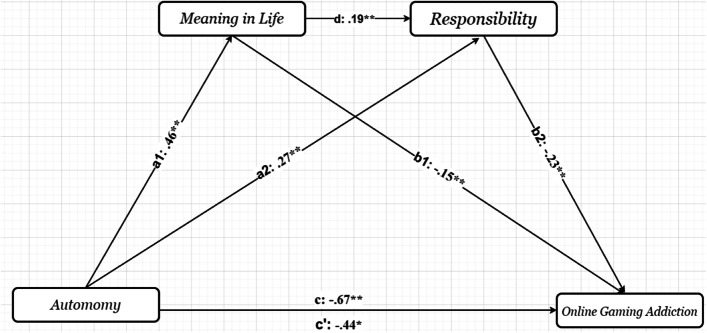
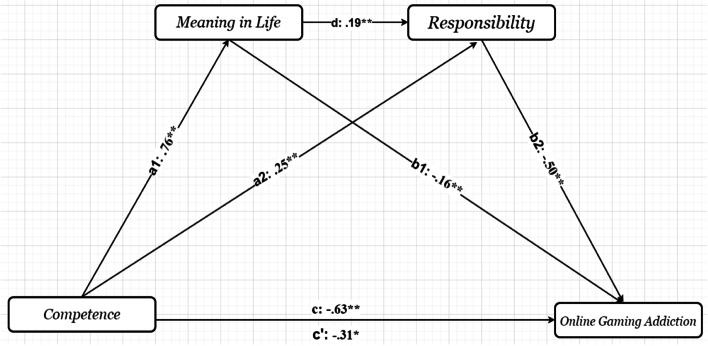
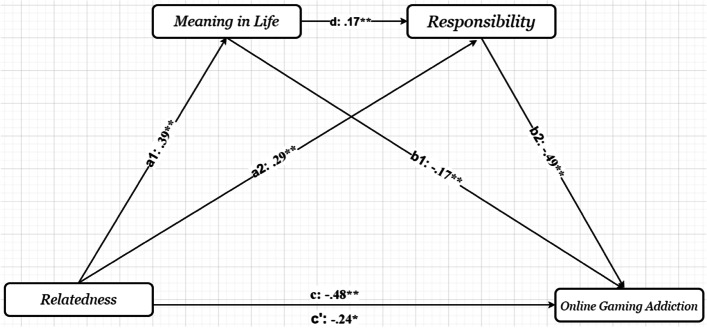
Individuals whose basic needs are naturally satisfied are much less dependent on their environment and more autonomous. Basic psychological needs (i.e., the general motivators of human actions) are significant predictors of online gaming addiction. Moreover, it has been posited that meaning and responsibility in life are at the center of life from an existential point of view. Therefore, a hypothetical model was tested to examine the relationships between basic psychological needs (autonomy, competence, relatedness), online gaming addiction, responsibility, and meaning in life. Data were collected from a sample of 546 participants. Mediation analysis was conducted, and the results indicated that basic psychological needs, online gaming addiction, responsibility, and meaning in life had significant negative and positive relationships. The findings indicated that responsibility and meaning in life had a serial mediating effect in the relationship between basic psychological needs and online gaming addiction. The findings also showed that the inverse relationship between online gaming addiction and basic psychological needs was at least partially explained by meaning in life and responsibility. The results of the present study are of great importance and suggest that interventions to satisfy the basic psychological needs of adolescents may help prevent online gaming addiction.
Overview
The claims and statistics of this paper haven’t been checked yet.
Run the check — free, no account needed. It reads the open-access text and checks the sources it cites.
Integrity signals
Registry
Cites
Statistics
Figures
Verification
Claims the paper makes
The claims and statistics of this paper haven’t been checked yet.
Run the check — free, no account needed. It reads the open-access text and checks the sources it cites.
Claims other papers make about this one
Each is checked against this paper’s own text: does it say what the citing paper says it does?
The cited source says what the claim attributes to it.
In the citing paper
“Unlike gaming or social media, where overuse is often linked to competition, reward cycles, or social validation [71, 135], conversational AI companions provide personalized, reciprocal, and emotionally immersive experiences.”
From Understanding Teen Overreliance on AI Companion Chatbots Through Self-Reported Reddit Narratives (2026) · cites this paper as [71]
Self-check
Percentages, sums and reported differences re-computed from the paper’s own numbers.
The self-check needs the paper’s full text.
Citations
Cites
The "what" and "why" of goal pursuits: Human needs and the self-determination of behavior
Deci, E. L., & Ryan, R. M. (2000) · Psychological Inquiry · doi:10.1207/s15327965pli1104_01 · Cited by 34,210 · cited 8×
“In SDT (Deci & Ryan, 2000), basic psychological needs are expressed as essential psychological nutrients for psychological development, integrity, and well-being.”
InfluentialStatistical Power Analysis for the Behavioral Sciences
Cohen, J. (2013) · doi:10.4324/9780203771587 · Cited by 25,373
Internet Addiction: The Emergence of a New Clinical Disorder
YOUNG, K. S. (1998) · CyberPsychology & Behavior · doi:10.1089/cpb.1998.1.237 · Cited by 5,513
The meaning in life questionnaire: assessing the presence of and search for meaning in life
Steger, M. F., Frazier, P., Oishi, S., & Kaler, M. (2006) · Journal of Counseling Psychology · doi:10.1037/0022-0167.53.1.80 · Cited by 4,843
Park, C. L. (2010) · Psychological Bulletin · doi:10.1037/a0018301 · Cited by 3,174 · cited 1×
“Because there are many definitions of meaning in life, making a standard definition of meaning in life has been difficult (King & Hicks, 2021; Park, 2010).”
Andreassen, C. S., Billieux, J., Griffiths, M. D., Kuss, D. J., Demetrovics, Z., Mazzoni, E., & Pallesen, S. (2016) · Psychology of Addictive Behaviors · doi:10.1037/adb0000160 · Cited by 2,095 · cited 1×
“…with gaming addiction, including attention-deficit/hyperactivity disorder (ADHD), obsessive-compulsive disorder (OCD), anxiety and depression (Andreassen et al., 2016), social anxiety (Karaca et al., 2020), low self-esteem (Kim et al., 2022), inter-personal competence (Lee et al., 2019),…”
Self-citationThe Darker and Brighter Sides of Human Existence: Basic Psychological Needs as a Unifying Concept
Ryan, R. M., & Deci, E. L. (2000) · Psychological Inquiry · doi:10.1207/s15327965pli1104_03 · Cited by 1,344
Glued to Games: How Video Games Draw Us In and Hold Us Spellbound
Rigby, S., & Ryan, R. M. (2011) · doi:10.5040/9798400658105 · Cited by 362
Bailey, T. H., & Phillips, L. J. (2016) · Higher Education Research & Development · doi:10.1080/07294360.2015.1087474 · Cited by 356
Potential Markers for Problematic Internet Use: A Telephone Survey of 2,513 Adults
Aboujaoude, E., Koran, L. M., Gamel, N., Large, M. D., & Serpe, R. T. (2006) · CNS Spectrums · doi:10.1017/s1092852900014875 · Cited by 268
Research works printed but not linked: 148
- Akbağ, M., & Ümmet, D. (2018). Ana-babaya bağlanma ile öznel iyi oluş arasındaki ilişkide temel psikolojik ihtiyaçların doyumunun aracı rolü. Turkish Psychological Counseling and Guidance Journal, 8(50), 59–85. https://dergipark.org.tr/tr/download/article-file/571505
- Albayrak, A. S. (2005). Çoklu doğrusal bağlantı halinde en küçük kareler tekniğinin alternatifi yanlı tahmin teknikleri ve bir uygulama. ZKÜ Sosyal Bilimler Dergisi, 1(1), 105–126. https://dergipark.org.tr/tr/pub/ijmeb/issue/54840/750869
- Allen, J. J., & Anderson, C. A. (2018). Satisfaction and frustration of basic psychological needs in the real world and video games predict internet gaming disorder scores and well being. Computers in Human Behavior, 84, 220–229. https://doi.org/10.1016/j.chb.2018.02.034 · DOI · Paper page
- Amatem. (2008). Bilgisayar ve internet. Ankara: Amatem Yayınları.
- American Psychiatric Association. (2013). Diagnostic and statistical manual of mental disorders (DSM-5®). American Psychiatric Publishing. · DOI · Paper page
- Amini, Z., & Heidary, B. S. (2020). What components of adolescents’ responsibility are effective in preventing addiction? Advanced Biomedical Research, 9(1), 2–8. https://doi.org/10.4103/abr.abr_204_19 · DOI
- Antunes, R., Frontini, R., Amaro, N., Salvador, R., Matos, R., Morouço, P., & Rebelo- Gonçalves, R. (2020). Exploring lifestyle habits, physical activity, anxiety and basic psychological needs in a sample of Portuguese adults during COVID-19. International Journal of Environmental Research and Public Health, 17(12), 4360–4372. https://doi.org/10.3390/ijerph17124360 · DOI
- Arslan, A. (2021). Ortaokul öğrencilerinde oyun bağımlılığı ile sorumluluk duygusu davranışı ve sosyal beceriler arasındaki ilişkinin incelenmesi [Unpublished master’s thesis]. İstanbul Sabahattin Zaim Üniversitesi.
- Arslan, G., & Wong, P. T. (2022). Measuring personal and social responsibility: an existential positive psychology approach. Journal of Happiness and Health, 2(1), 1–11. https://doi.org/10.47602/johah.v2i1.5 · DOI
- Arslan, G., & Yıldırım, M. (2021). Perceived risk, positive youth–parent relationships, and internalizing problems in adolescents: Initial development of the Meaningful School Questionnaire. Child Indicators Research, 14(5), 1911–1929. https://doi.org/10.1007/s12187-021-09841-0 · DOI
- Ates, B., Kaya, A., & Tunç, E. (2018). The ınvestigation of predictors of cyberbullying and cyber victimization in adolescents. International Journal of Progressive Education, 14(5), 103–118. https://doi.org/10.29329/ijpe.2018.157.9 · DOI
- Ballabio, M., Griffiths, M. D., Urbán, R., Quartiroli, A., Demetrovics, Z., & Király, O. (2017). Do gaming motives mediate between psychiatric symptoms and problematic gaming? An empirical survey study. Addiction Research & Theory, 25(5), 397–408. https://doi.org/10.1080/16066359.2017.1305360 · DOI
- Başol, G., & Kaya, A. B. (2018). Motives and consequences of online game addiction: A scale development study. Archives of Neuropsychiatry, 55(3), 225–232. https://doi.org/10.5152/npa.2017.17017 · DOI
- Batmaz, H., & Çelik, E. (2021). Examining the online game addiction level in terms of sensation seeking and loneliness in university students. Addicta: The Turkish Journal on Addictions, 8(2), 126–131. https://doi.org/10.5152/ADDICTA.2021.21017 · DOI
- Batmaz, H., Ulusoy, Y., & İnceoğlu, F. (2020). The mediating role of digital game addiction in the correlation between cyber victimization and cyber bullying. Sciences Studies Journal, 6(73), 5093–5108. https://doi.org/10.26449/sssj.2726 · DOI
- Batmaz, H., Türk, N., & Doğrusever, C. (2021). The mediating role of hope and loneliness in the relationship between meaningful life and psychological resilience in the Covid-19 Pandemic during. Anemon Muş Alparslan Üniversitesi Sosyal Bilimler Dergisi, 9(5), 1403–1420. https://doi.org/10.18506/anemon.895199 · DOI
- Baumeister, R. F., & Vohs, K. D. (2002). The pursuit of meaningfulness in life. In: In C. R. Snyder & S. J. Lopez (Eds.), Handbook of Positive Psychology, (pp. 608–618). Oxford University Press · DOI
- Bayraktar, G., Tozoğlu, E., Gülbahçe, Ö., Öztürk, M. E., & Gülbahçe, A. (2016). Üniversite öğrencilerinin bireysel sosyal sorumluluk düzeylerinin spor ve farklı değişkenler açısından incelenmesi. Uluslararası Hakemli Akademik Spor Sağlık Ve Tıp Bilimleri Dergisi, 18, 77–88.
- Bekir, S., & Çelik, E. (2019). Examining the factors contributing to adolescents’ online game addiction. Anales De Psicología/annals of Psychology, 35(3), 444–452. https://doi.org/10.6018/analesps.35.3.323681 · DOI
- Berkowitz, L., & Daniels, L. R. (1963). Responsibility and dependency. The Journal of Abnormal and Social Psychology, 66(5), 429–436. https://doi.org/10.1037/h0049250 · DOI
- Beranuy, M., Machimbarrena, J. M., Asunción Vega-Osés, M., Carbonell, X., Griffiths, M. D., Pontes, H. M., & González-Cabrera, J. (2020). Spanish validation of the Internet Gaming Disorder Scale-Short Form (IGDS9-SF): Prevalence and relationship with online gambling and quality of life. International Journal of Environmental Research and Public Health, 17(5), 1562–1577. https://doi.org/10.3390/ijerph17051562 · DOI
- Billieux, J., Thorens, G., Khazaal, Y., Zullino, D., Achab, S., & Van der Linden, M. (2015). Problematic involvement in online games: A cluster analytic approach. Computers in Human Behavior, 43, 242–250. https://doi.org/10.1016/j.chb.2014.10.055 · DOI
- Brassai, L., Piko, B. F., & Steger, M. F. (2011). Meaning in life: Is it a protective factor for adolescents’ psychological health? International Journal of Behavioral Medicine, 18(1), 44–51. https://doi.org/10.1007/s12529-010-9089-6 · DOI
- Bugdayci, S. (2019). Examining personal and social responsibility levels of secondary school students. Universal Journal of Educational Research, 7(1), 206–210. https://doi.org/10.13189/ujer.2019.070126 · DOI
- Büyüköztürk, Ş. (2016). Data analysis handbook for social sciences (22nd ed.). Pegem Akademi Publishing.
- Canale, N., Marino, C., Griffiths, M. D., Scacchi, L., Monaci, M. G., & Vieno, A. (2019). The association between problematic online gaming and perceived stress: The moderating effect of psychological resilience. Journal of Behavioral Addictions, 8(1), 174–180. https://doi.org/10.1556/2006.8.2019.01 · DOI
- Canoğulları, Ö. (2014). İnternet bağımlılık düzeyleri farklı ergenlerin cinsiyetlerine göre psikolojik ihtiyaçları, sosyal kaygıları ve anne baba tutum algılarının incelenmesi. (Unpublished Master's thesis), Çukurova Üniversitesi, Adana
- Cantarero, K., Van Tilburg, W. A., & Smoktunowicz, E. (2021). Affirming basic psychological needs promotes mental well-being during the COVID-19 outbreak. Social Psychological and Personality Science, 12(5), 821–828. https://doi.org/10.1177/1948550620942708 · DOI
- Çelik, N. D., & Gazioğlu, E. İ. (2017). Üst-düzey kişilik faktörleri ve yaşamda anlam: temel psikolojik ihtiyaçlarin araci rolü. Balıkesir Üniversitesi Sosyal Bilimler Enstitüsü Dergisi, 20(38), 11–32. https://doi.org/10.31795/baunsobed.645147 · DOI
- Chamarro, A., Oberst, U., Cladellas, R., & Fuster, H. (2020). Effect of the frustration of psychological needs on addictive behaviors in mobile videogamers—The mediating role of use expectancies and time spent gaming. International Journal of Environmental Research and Public Health, 17(17), 6429. https://doi.org/10.3390/ijerph17176429 · DOI
- Chan, G., Huo, Y., Kelly, S., Leung, J., Tisdale, C., & Gullo, M. (2022). The impact of eSports and online video gaming on lifestyle behaviours in youth: A systematic review. Computers in Human Behavior, 126, 106974. https://doi.org/10.1016/j.chb.2021.106974 · DOI
- Chiou, W. B., & Wan, C. S. (2007). Using cognitive dissonance to induce adolescents’ escaping from the claw of online gaming: The roles of personal responsibility and justification of cost. CyberPsychology & Behavior, 10(5), 663–670. https://doi.org/10.1089/cpb.2007.9972 · DOI
- Choi, K., Son, H., Park, M., Han, J., Kim, K., Lee, B., & Gwak, H. (2009). Internet overuse and excessive daytime sleepiness in adolescents. Psychiatry and Clinical Neurosciences, 63, 455–462. https://doi.org/10.1111/j.1440-1819.2009.01925.x · DOI
- Columb, D., Griffiths, M. D., & O’Gara, C. (2022). Online gaming and gaming disorder: More than just a trivial pursuit. Irish Journal of Psychological Medicine, 39(1), 1–7. https://doi.org/10.1017/ipm.2019.31 · DOI
- Cómez-Mármol, A., Martínez, B. J., Sánchez, E. D., Valero, A., & González-Víllora, S. (2017). Personal and social responsibility development through sport participation in youth scholars. Journal of Physical Education and Sport, 17(2), 775–782. https://doi.org/10.7752/jpes.2017.02118 · DOI
- De Pasquale, C., Sciacca, F., Martinelli, V., Chiappedi, M., Dinaro, C., & Hichy, Z. (2020). Relationship of internet gaming disorder with psychopathology and social adaptation in Italian young adults. International Journal of Environmental Research and Public Health, 17(21), 8201. https://doi.org/10.3390/ijerph17218201 · DOI
- Debats, D. L., Van der Lubbe, P. M., & Wezeman, F. R. (1993). On the psychometric properties of the Life Regard Index (LRI): A measure of meaningful life: An evaluation in three independent samples based on the Dutch version. Personality and Individual Differences, 14(2), 337–345. https://doi.org/10.1016/0191-8869(93)90132-M · DOI
- Deci, E. L., & Ryan, R. M. (2011). Levels of analysis, regnant causes of behavior and well-being: The role of psychological needs. Psychological Inquiry, 22(1), 17–22. https://doi.org/10.1080/1047840X.2011.545978 · DOI
- Demirbaş-Çelik, N., & İşmen-Gazioğlu, E. (2015). Meaning in life questionnaire high school form: Turkish validity and reliability. Mehmet Akif Ersoy University Journal of Education Faculty, 33, 42–60.
- Dinçer, B., & Kolan, H. İ. (2020). Ortaokul öğrencilerinin bilgisayar oyun bağımlılığı düzeyleri ile sorumluluk davranışı arasındaki ilişki. Kastamonu Eğitim Dergisi, 28(6), 2319–2330. https://doi.org/10.24106/kefdergi.833550 · DOI
- Dindar, M. (2018). Do people play MMORPGs for extrinsic or intrinsic rewards? Telematics and Informatics, 35(7), 1877–1886. https://doi.org/10.1016/j.tele.2018.06.001 · DOI
- Doğan, D. A., & Pamuk, İ. (2022). Uzaktan eğitim sürecinde ergenlerin çevrimiçi oyunlara yönelik deneyimleri: Fenomenolojik bir araştırma. International Journal of Social Sciences and Education Research, 8(1), 71–86. https://doi.org/10.24289/ijsser.1032025 · DOI
- Doğrusever, C., Türk, N., & Batmaz, H. (2022). The mediating role of meaningful life in the relationship between self-esteem and psychological resilience. İnönü Üniversitesi Eğitim Fakültesi Dergisi, 23(2), 910–928. https://doi.org/10.17679/inuefd.1029866 · DOI
- Dursun, A., & Çapan, B. E. (2018). Ergenlerde dijital oyun bağımlılığı ve psikolojik ihtiyaçlar. İnönü Üniversitesi Eğitim Fakültesi Dergisi, 19(2), 128–140. https://doi.org/10.17679/inuefd.336272 · DOI
- Eakman, A. M. (2013). Relationships between meaningful activity, basic psychological needs, and meaning in life: Test of the meaningful activity and life meaning model. OTJR: Occupation, Participation and Health, 33(2), 100–109. https://doi.org/10.3928/15394492-20130222-02 · DOI
- Erevik, E. K., Landrø, H., Mattson, Å. L., Kristensen, J. H., Kaur, P., & Pallesen, S. (2022). Problem gaming and suicidality: A systematic literature review. Addictive Behaviors Reports, 15, 100419. https://doi.org/10.1016/j.abrep.2022.100419 · DOI
- Erikson, E. (1968). Identity, youth and crisis. Norton.
- Frankl, V. (1969). The will to meaning. New American Library.
- Frankl, V. E. (2009). İnsanın anlam arayışı. Okuyan Us Yayıncılık.
- Gao, Q., Zheng, H., Sun, R., & Lu, S. (2022). Parent-adolescent relationships, peer relationships and adolescent mobile phone addiction: The mediating role of psychological needs satisfaction. Addictive Behaviors, 129, 107260. https://doi.org/10.1016/j.addbeh.2022.107260 · DOI
- George, D. (2010). SPSS for windows step by step: A simple study guide and reference, 17.0 update (10th ed.). Pearson
- Glasser, W. (2005). Responsibility, respect and relationships: Creating emotionally safe classrooms. Quality Educational Programs Inc.
- Griffiths, M. D. (2017). Behavioural addiction and substance addiction should be defined by their similarities not their dissimilarities. Addiction, 112(10), 1718–1720. https://doi.org/10.1111/add.13828 · DOI
- Griffiths, M. D. (2022). Online gaming addiction in youth: Some comments on Rosendo-Rios et al. (2022). Addictive Behaviors, 130, 107311. https://doi.org/10.1016/j.addbeh.2022.107311 · DOI
- Gugliandolo, M. C., Costa, S., Kuss, D. J., Cuzzocrea, F., & Verrastro, V. (2020). Technological addiction in adolescents: The interplay between parenting and psychological basic needs. International Journal of Mental Health and Addiction, 18(5), 1389–1402. https://doi.org/10.1007/s11469-019-00156-4 · DOI
- Haberlin, K. A., & Atkin, D. J. (2022). Mobile gaming and Internet addiction: When is playing no longer just fun and games? Computers in Human Behavior, 126, 106989. https://doi.org/10.1016/j.chb.2021.106989 · DOI
- Hayes, A. F. (2018). Partial, conditional, and moderated moderated mediation: Quantification, inference, and interpretation. Communication Monographs, 85(1), 4–40. https://doi.org/10.1080/03637751.2017.1352100 · DOI · Paper page
- Herodotou, C., Winters, N., & Kambouri, M. (2012). A motivationally oriented approach to understanding game appropriation. International Journal of Human-Computer Interaction, 28(1), 34–47. https://doi.org/10.1080/10447318.2011.566108 · DOI
- Holdorf, W. E., & Greenwald, J. M. (2018). Toward a taxonomy and unified construct of responsibility. Personality and Individual Differences, 132, 115–125. https://doi.org/10.1016/j.paid.2018.05.028 · DOI
- Hui, B. P. H., Wu, A. M., Siu, N. Y., Chung, M. L., & Pun, N. (2019). The effects of need satisfaction and dissatisfaction on flourishing among young Chinese gamers: The mediating role of internet gaming disorder. International Journal of Environmental Research and Public Health, 16(22), 4367. https://doi.org/10.3390/ijerph16224367 · DOI
- Hussain, Z., Griffiths, M. D., & Baguley, T. (2012). Online gaming addiction: Classification, prediction and associated risk factors. Addiction Research & Theory, 20(5), 359–371. https://doi.org/10.3109/16066359.2011.640442 · DOI
- İhsan, S., Yenigün, Ö., Altıncı, E. E., & Öztürk, A. (2011). Temel psikolojik ihtiyaçların tatmininin genel öz yeterlik ve sürekli kaygı üzerine etkisi (Sakarya Üniversitesi Spor Yöneticiliği Bölümü örneği). Spormetre Beden Eğitimi Ve Spor Bilimleri Dergisi, 9(4), 149–156. https://doi.org/10.1501/Sporm_0000000212 · DOI
- Jim, H. S., Richardson, S. A., Golden-Kreutz, D. M., & Andersen, B. L. (2006). Strategies used in coping with a cancer diagnosis predict meaning in life for survivors. Health Psychology, 25, 753–761. https://doi.org/10.1037/0278-6133.25.6.753 · DOI
- Karaca, S., Karakoc, A., Can Gurkan, O., Onan, N., & Unsal Barlas, G. (2020). Investigation of the online game addiction level, sociodemographic characteristics and social anxiety as risk factors for online game addiction in middle school students. Community Mental Health Journal, 56(5), 830–838. https://doi.org/10.1007/s10597-019-00544-z · DOI
- Kardefelt-Winther, D. (2014). Problematizing excessive online gaming and its psychological predictors. Computers in Human Behavior, 31, 118–122. https://doi.org/10.1016/j.chb.2013.10.017 · DOI
- Kaya, A. (2021). Adölesanlarda dijital oyun bağımlılığının mutluluk ve yaşamın anlamına etkisi. Bağımlılık Dergisi, 22(3), 297–304. https://doi.org/10.51982/bagimli.902685 · DOI
- Kesici, A. (2018). Lise öğrencilerinin sorumluluk düzeylerinin çeşitli değişkenlere göre incelenmesi. Gazi Üniversitesi Gazi Eğitim Fakültesi Dergisi, 38(3), 965–985. · DOI
- Kesici, A. (2020). The effect of conscientiousness and gender on digital game addiction in high schoolstudents. Journal of Education and Future, 18, 43–53. · DOI
- Kesici, Ş, et al. (2003). Temel psikolojik ihtiyaçlar ölçeğinin geçerlik ve güvenirliği. Malatya, Turkey: VII. National PDR Congress İnönü University.
- Kilinç, Z., & Gürer, B. (2019). Doğa sporları yapanların temel psikolojik ihtiyaçlarının zihinsel dayanıklılığa etkisi. CBÜ Beden Eğitimi ve Spor Bilimleri Dergisi, 14(2), 222–233. https://doi.org/10.33459/cbubesbd.576242 · DOI
- Kim, D., Nam, J. K., & Keum, C. (2022). Adolescent internet gaming addiction and personality characteristics by game genre. PloS One, 17(2), e0263645. https://doi.org/10.1371/journal.pone.0263645 · DOI
- King, D. L., & Delfabbro, P. H. (2014). The cognitive psychology of internet gaming disorder. Clinical Psychology Review, 34(4), 298–308. https://doi.org/10.1016/j.cpr.2014.03.006 · DOI
- King, L. A., & Hicks, J. A. (2021). The science of meaning in life. Annual Review of Psychology, 72, 561–584. https://doi.org/10.1146/annurev-psych-072420-122921 · DOI
- Király, O., Urbán, R., Griffiths, M. D., Ágoston, C., Nagygyörgy, K., Kökönyei, G., & Demetrovics, Z. (2015). The mediating effect of gaming motivation between psychiatric symptoms and problematic online gaming: An online survey. Journal of Medical Internet Research, 17(4), e3515. https://doi.org/10.2196/jmir.3515 · DOI
- Kokkini, V., Tseliou, E., Abakoumkin, G., & Bozatzis, N. (2022). “Immersed in world of warcraft”: A discursive study of identity management talk about excessive online gaming. Journal of Language and Social Psychology, 41(5), 590–612. https://doi.org/10.1177/0261927X211067820 · DOI
- Kuss, D. J., & Billieux, J. (2017). Technological addictions: Conceptualisation, measurement, etiology and treatment. Addictive Behaviors, 64, 231–233. · DOI
- Kuss, D. J., Dunn, T. J., Wӧlfling, K., Müller, K. W., Hędzelek, M., & Marcinkowski, J. (2017). Excessive Internet use and psychopathology: the role of coping. Clinical Neuropsychiatry, 14(1), 73–81. https://irep.ntu.ac.uk/id/eprint/28364
- Larrieu, M., Billieux, J., & Decamps, G. (2022). Problematic gaming and quality of life in online competitive videogame players: Identification of motivational profiles. Addictive Behaviors, 133, 107363. https://doi.org/10.1016/j.addbeh.2022.107363 · DOI
- Lee, J. Y., Ko, D. W., & Lee, H. (2019). Loneliness, regulatory focus, inter-personal competence, and online game addiction: A moderated mediation model. Internet Research, 29(2), 381–394. https://doi.org/10.1108/IntR-01-2018-0020 · DOI
- Lelonek-Kuleta, B., Bartczuk, R. P., & Wiechetek, M. (2021). Pay for play–Behavioural patterns of pay-to-win gaming. Computers in Human Behavior, 115, 106592. https://doi.org/10.1016/j.chb.2020.106592 · DOI
- Levine, S. L., Brabander, C. J., Moore, A. M., Holding, A. C., & Koestner, R. (2022). Unhappy or unsatisfied: Distinguishing the role of negative affect and need frustration in depressive symptoms over the academic year and during the COVID-19 pandemic. Motivation and Emotion, 46(1), 126–136. https://doi.org/10.1007/s11031-021-09920-3 · DOI
- Liang, Q., Yu, C., Xing, Q., Liu, Q., & Chen, P. (2021). The influence of parental knowledge and basic psychological needs satisfaction on peer victimization and internet gaming disorder among Chinese adolescents: A mediated moderation model. International Journal of Environmental Research and Public Health, 18(5), 2397. https://doi.org/10.3390/ijerph18052397 · DOI
- Liu, D., Wang, Z., Yang, X., Zhang, Y., Zhang, R., & Lin, S. (2021). Perceived autonomy-supportive parenting and internet addiction: Respiratory sinus arrhythmia moderated the mediating effect of basic psychological need satisfaction. Current Psychology, 40(9), 4255–4264. https://doi.org/10.1007/s12144-019-00485-6 · DOI
- Luciana, R. P. (2010). One minute more: Adolescent addiction for virtual world. Procedia-Social and Behavioral Sciences, 2(2), 3706–3710. https://doi.org/10.1016/j.sbspro.2010.03.576 · DOI
- Marcia, J. E. (1980). Identity in adolescence. In J. Adelson (Ed.), Handbook of adolescent psychology (pp. 159–187). Wiley.
- Martins, P., Rosado, A., Ferreira, V., & Biscaia, R. (2015). Examining the validity of the personal-social responsibility questionnaire among athletes. Motriz: Revista de Educação Física, 21(3), 321–328. https://doi.org/10.1590/S1980-65742015000300014 · DOI
- Martins, P., Rosado, A., Ferreira, V., & Biscaia, R. (2017). Personal and social responsibility among athletes: The role of self-determination, achievement goals and engagement. Journal of Human Kinetics, 57(1), 39–50. https://doi.org/10.1515/hukin-2017-0045 · DOI
- Mascaro, N., & Rosen, D. H. (2005). Existential meaning’s role in the enhancement of hope and prevention of depressive symptoms. Journal of Personality, 73(4), 985–1014. https://doi.org/10.1111/j.1467-6494.2005.00336.x · DOI
- Matsumoto, D. (2009). The Cambridge dictionary of psychology. Cambridge University Press.
- McInroy, L. B., & Mishna, F. (2017). Cyberbullying on online gaming platforms for children and youth. Child and Adolescent Social Work Journal, 34(6), 597–607. https://doi.org/10.1007/s10560-017-0498-0 · DOI
- Mergler, A., & Shield, P. (2016). Development of the Personal Responsibility Scale for adolescents. Journal of Adolescence, 100(51), 50–57. https://doi.org/10.1016/j.adolescence.2016.05.011 · DOI
- Mills, D. J., & Allen, J. J. (2020). Self-determination theory, internet gaming disorder, and the mediating role of self-control. Computers in Human Behavior, 105, 106209. https://doi.org/10.1016/j.chb.2019.106209 · DOI
- Mills, D. J., Milyavskaya, M., Heath, N. L., & Derevensky, J. L. (2018). Gaming motivation and problematic video gaming: The role of needs frustration. European Journal of Social Psychology, 48(4), 551–559. https://doi.org/10.1002/ejsp.2343 · DOI · Paper page
- Monacis, L., de Palo, V., Griffiths, M. D., & Sinatra, M. (2017). Exploring individual differences in online addictions: The role of identity and attachment. International Journal of Mental Health and Addiction, 15(4), 853–868. https://doi.org/10.1007/s11469-017-9768-5 · DOI · Paper page
- Mun, I. B., & Lee, S. (2022). A longitudinal study of the impact of parental loneliness on adolescents’ online game addiction: The mediating roles of adolescents’ social skill deficits and loneliness. Computers in Human Behavior, 136, 107375. https://doi.org/10.1016/j.chb.2022.107375 · DOI
- Oliver, M. B., Bowman, N. D., Woolley, J. K., Rogers, R., Sherrick, B. I., & Chung, M. Y. (2016). Video games as meaningful entertainment experiences. Psychology of Popular Media Culture, 5(4), 390–405. https://doi.org/10.1037/ppm0000066 · DOI
- Orkibi, H., & Ronen, T. (2017). Basic psychological needs satisfaction mediates the association between self-control skills and subjective well-being. Frontiers in Psychology, 8, 936. https://doi.org/10.3389/fpsyg.2017.00936 · DOI
- Özen, Y. (2011). Sorumluluk eğitimi. Nobel Yayın Dağıtım.
- Özen, Y. (2013). Sorumluluk duygusu ve davranışı ölçeğinin geliştirilmesi güvenirliği ve geçerliği. Gümüshane University Electronic Journal of the Institute of Social Science, 4(7), 343–356.
- Piri, Z., Majd, M. A., Bazzazyan, S., & ve Ghamari, M. (2018). The mediating role of coping strategies in relation with psychological needs and internet addiction among college student. International Journal of Applied Behavioral Sciences, 5(3), 9–17. https://doi.org/10.22037/ijabs.v5i3.24194 · DOI
- Preacher, K. J., & Hayes, A. F. (2008). Asymptotic and resampling strategies for assessing and comparing indirect effects in multiple mediator models. Behavior Research Methods, 40(3), 879–891. · DOI · Paper page
- Purwaningsih, E., & Nurmala, I. (2021). The impact of online game addiction on adolescent mental health: A systematic review and meta-analysis. Open Access Macedonian Journal of Medical Sciences, 9(F), 260–274. https://doi.org/10.3889/oamjms.2021.6234 · DOI
- Qiu, C., Liu, Q., Yu, C., Li, Z., & Nie, Y. (2022). The influence of meaning in life on children and adolescents’ problematic smartphone use: A three-wave multiple mediation model. Addictive Behaviors, 126, 107199. https://doi.org/10.1016/j.addbeh.2021.107199 · DOI
- Rajab, A. M., Zaghloul, M. S., Enabi, S., Rajab, T. M., Al-Khani, A. M., Basalah, A., & Saquib, N. (2020). Gaming addiction and perceived stress among Saudi adolescents. Addictive Behaviors Reports, 11, 100261. https://doi.org/10.1016/j.abrep.2020.100261 · DOI
- Rigby, S., & Ryan, R. M. (2017). Time well spent? Motivation for entertainment media and its eudaimonic aspects through the lens of self-determination theory. L. Reinecke, M.B. Oliver (Eds.), The Routledge handbook of media use and well-being, international perspectives on theory and research on positive media effects (pp. 34–48). Routledge
- Robinson, S. (2009). The nature of responsibility in a professional setting. Journal of Business Ethics, 88(1), 11–19. https://doi.org/10.1007/s10551-009-0103-3 · DOI
- Rosendo-Rios, V., Trott, S., & Shukla, P. (2022). Systematic literature review online gaming addiction among children and young adults: A framework and research agenda. Addictive Behaviors, 129, 107238. https://doi.org/10.1016/j.addbeh.2022.107238 · DOI
- Ruyter, D. D. (2002). The virtue of taking responsibility. Educational Philosophy and Theory, 34(1), 25–35. https://doi.org/10.1111/j.1469-5812.2002.tb00283.x · DOI
- Ryan, R. M., & Deci, E. L. (2017). Self-determination theory: Basic psychological needs in motivation, development, and wellness. Guilford Publications. · DOI · Paper page
- Ryan, R. M., Rigby, C. S., & Przybylski, A. (2006). The motivational pull of video games: A self-determination theory approach. Motivation and Emotion, 30(4), 344–360. https://doi.org/10.1007/s11031-006-9051-8 · DOI · Paper page
- Ryff, C. D. (1989). Happiness is everything, or is it? Explorations on the psychological well-being. Journal of Personality and Social Psychology, 57, 1069–1081. https://doi.org/10.1037/0022-3514.57.6.1069 · DOI · Paper page
- Sachdeva, A., & Verma, R. (2015). Internet gaming addiction: A technological hazard. International Journal of High Risk Behaviors & Addiction, 4(4), e26359. https://doi.org/10.5812/ijhrba.26359 · DOI
- Şata, M. (2020). Nicel araştırma yaklaşımları. Oğuz, E. (Eds.), Eğitimde araştırma yöntemleri içinde (p. 77–97). Eğiten Kitap Yayıncılık
- Sela, Y., Zach, M., Amichay-Hamburger, Y., Mishali, M., & Omer, H. (2020). Family environment and problematic internet use among adolescents: The mediating roles of depression and fear of missing out. Computers in Human Behavior, 106, 106226. https://doi.org/10.1016/j.chb.2019.106226 · DOI
- Shahzadi, U., Koul, R. B., Haq, M. N. U., & Arshad, M. (2022). Attitude, behavior and responsibility to environmental literacy in education organization: A quantitative assessment. Indian Journal of Economics and Business, 21(1), 709–716. http://www.ashwinanokha.com/IJEB.php
- Shek, D. T., Dou, D., Zhu, X., & Chai, W. (2019). Positive youth development: Current perspectives. Adolescent Health, Medicine and Therapeutics, 10, 131–141. https://doi.org/10.2147/AHMT.S179946 · DOI
- Shen, C. X., Liu, R. D., & Wang, D. (2013). Why are children attracted to the Internet? The role of need satisfaction perceived online and perceived in daily real life. Computers in Human Behavior, 29(1), 185–192. https://doi.org/10.1016/j.chb.2012.08.004 · DOI · Paper page
- Steger, M. F. (2012). Experiencing meaning in life. In P. T. P. Wong (Ed.), The human quest for meaning: Theories, research and applications (pp. 165–184). Taylor & Francis.
- Subrahmanyam, K., & Šmahel, D. (2011). Constructing identity online: Identity exploration and self-presentation. In: Digital youth (pp. 59–80). Springer · DOI
- Sun, R., Gao, Q., Xiang, Y., Chen, T., Liu, T., & Chen, Q. (2020). Parent–child relationships and mobile phone addiction tendency among Chinese adolescents: The mediating role of psychological needs satisfaction and the moderating role of peer relationships. Children and Youth Services Review, 116, 105113. https://doi.org/10.1016/j.childyouth.2020.105113 · DOI
- Tanhan, F., & Özlem, A. (2015). Siber kimliklerin kişiliğe yansıması: Proteus etki (tanımı, nedenleri ve önlenmesi). Online Journal of Technology Addiction and Cyberbullying, 2(2), 1–19.
- Taylı, A. (2006). Akran yardımcılığı uygulaması aracılığıyla lise öğrencilerinde kişisel ve sosyal sorumluluğun arttırılması. [Unpublished doctoral thesis]. Gazi Üniversitesi, Eğitim Bilimleri Enstitüsü. Ankara
- Tazegül, Ü. (2014). Sporun kişilik üzerindeki etkisinin araştırılması. Journal of Academic Social Science Studies, 25, 537–544. · DOI
- Thatcher, A., Wretschko, G., & Fridjhon, P. (2008). Online flow experiences, problematic Internet use and Internet procrastination. Computers in Human Behavior, 24(5), 2236–2254. · DOI
- Turan, M. E. (2021). Empathy and video game addiction in adolescents: Serial mediation by psychological resilience and life satisfaction. International Journal of Progressive Education, 17(4), 282–296. https://doi.org/10.29329/ijpe.2021.366.17 · DOI
- Wang, Q., Luo, X., Tu, R., Xiao, T., & Hu, W. (2022). COVID-19 information overload and cyber aggression during the pandemic lockdown: The mediating role of depression/anxiety and the moderating role of Confucian responsibility thinking. International Journal of Environmental Research and Public Health, 19(3), 1540. https://doi.org/10.3390/ijerph19031540 · DOI
- Wartberg, L., Kriston, L., & Kammerl, R. (2017). Associations of social support, friends only known through the internet, and health-related quality of life with internet gaming disorder in adolescence. Cyberpsychology, Behavior, and Social Networking, 20(7), 436–441. https://doi.org/10.1089/cyber.2016.0535 · DOI
- Wei, H. T., Chen, M. H., Huang, P. C., & Bai, Y. M. (2012). The association between online gaming, social phobia, and depression: An internet survey. BMC Psychiatry, 12(1), 1–7. https://doi.org/10.1186/1471-244X-12-92 · DOI
- Weinstein, N., Ryan, R. M., & Deci, E. L. (2012). Motivation, meaning, and wellness: A self-determination perspective on the creation and internalization of personal meanings and life goals. In P. T. P. Wong (Ed.), The human quest for meaning (pp. 127–152). Routledge. https://doi.org/10.4324/9780203146286-13 · DOI
- Widyanto, L., & Griffiths, M. (2006). Internet addiction: A critical review. International Journal Mental Health and Addiction, 4, 31–51. https://doi.org/10.1007/s11469-006-9009-9 · DOI · Paper page
- Wong, P. T. (2010). The PURE way for a better marriage. International Network on Personal Meaning.
- Wongpakaran, N., Wongpakaran, T., Pinyopornpanish, M., Simcharoen, S., & Kuntawong, P. (2021). Loneliness and problematic internet use: Testing the role of interpersonal problems and motivation for internet use. BMC Psychiatry, 21(1), 447. https://doi.org/10.1186/s12888-021-03457-y · DOI
- Wray-Lake, L., & Syvertsen, A. K. (2011). The developmental roots of social responsibility in childhood and adolescence. New Directions for Child and Adolescent Development, 2011(134), 11–25. https://doi.org/10.1002/cd.308 · DOI
- Wu, A. M., Lei, L. L., & Ku, L. (2013). Psychological needs, purpose in life, and problem video game playing among Chinese young adults. International Journal of Psychology, 48(4), 583–590. https://doi.org/10.1080/00207594.2012.658057 · DOI
- Xiao, X., & Zheng, X. (2022). The effect of parental phubbing on depression in Chinese junior high school students: The mediating roles of basic psychological needs satisfaction and self-esteem. Frontiers in Psychology, 13, 868354. https://doi.org/10.3389/fpsyg.2022.868354 · DOI
- Yalom, I. D. (2020). Existential psychotherapy. Hachette UK.
- Yang, J., Ti, Y., & Ye, Y. (2022). Offline and online social support and short-form video addiction among Chinese adolescents: The mediating role of emotion suppression and relatedness needs. Cyberpsychology, Behavior, and Social Networking, 25(5), 316–322. https://doi.org/10.1089/cyber.2021.0323 · DOI
- Yee, N. (2006). Motivations for play in online games. CyberPsychology & Behavior, 9(6), 772–775. https://doi.org/10.1089/cpb.2006.9.772 · DOI
- Yıkılmaz, M., & Demir-Güdül, M. (2015). Üniversite öğrencilerinde yaşam doyumu, yaşamda anlam ve bilinçli farkındalık arasındaki ilişkiler. Ege Eğitim Dergisi, 16(2), 297–315. https://doi.org/10.12984/eed.09530 · DOI
- Yıldırım, E., & Zeren, Ş. G. (2021). Video game addiction in Turkey: Does it correlate between basic psychological needs and perceived social support? Psycho-Educational Research Reviews, 10 (2), 106–117. From: https://eric.ed.gov/?id=EJ1311681 · DOI
- Yough, M., Gilmetdinova, A., & Finney, E. (2022). Teaching the English language learner at the elementary school: Sense of responsibility in an ill-defined role. Journal of Language, Identity & Education, 21(2), 99–115. https://doi.org/10.1080/15348458.2020.1791707 · DOI
- Young, K. S., & Rodgers, R. C. (2009). The relationship between depression and internetaddiction. CyberPsychology & Behavior, 1(1), 25–28. https://doi.org/10.1089/cpb.1998.1.25 · DOI
- Young-Ju, J., Ae-Kyung, C., Jeong-Jin, K., & ve Min-Yeong, L. (2018). Identification of the structural relationship of basic psychological needs and Facebook addiction and continuance. Journal of the Institute of Internet, Broadcasting and Communication, 16(1), 183–191. https://doi.org/10.7236/JIIBC.2016.16.1.183 · DOI
- Yu, C., Li, X., & Zhang, W. (2015). Predicting adolescent problematic online game use from teacher autonomy support, basic psychological needs satisfaction, and school engagement: A 2-year longitudinal study. Cyberpsychology, Behavior, and Social Networking, 18(4), 228–233. https://doi.org/10.1089/cyber.2014.0385 · DOI
- Zeren, ŞG., & ve Can, S. (2019). Ergenlerin akademik erteleme davranışlarını açıklamada internet bağımlığı ve temel psikolojik ihtiyaçların rolü. Çukurova Üniversitesi Eğitim Fakültesi Dergisi, 48(2), 1012–1040.
- Zhang, M. X., Wang, X., Shu, M. Y., & Wu, A. M. (2019). Purpose in life, social support, and internet gaming disorder among Chinese university students: A 1-year follow-up study. Addictive Behaviors, 99, 106070. https://doi.org/10.1016/j.addbeh.2019.106070 · DOI
- Zhang, S., Feng, R., Fu, Y. N., Liu, Q., He, Y., Turel, O., & He, Q. (2022). The bidirectional relationship between basic psychological needs and meaning in life: A longitudinal study. Personality and Individual Differences, 197, 111784. https://doi.org/10.1016/j.paid.2022.111784 · DOI
- Zhao, H., Li, X., Zhou, J., Nie, Q., & Zhou, J. (2020). The relationship between bullying victimization and online game addiction among Chinese early adolescents: The potential role of meaning in life and gender differences. Children and Youth Services Review, 116, 105261. https://doi.org/10.1016/j.childyouth.2020.105261 · DOI
Cited by
Sorted by citations
Yankouskaya, A., Babiker, A., Rizvi, S., Alshakhsi, S., Liebherr, M., & Ali, R. (2025) · ACM Transactions on the Web · doi:10.1145/3765895 · Cited by 32
Understanding Teen Overreliance on AI Companion Chatbots Through Self-Reported Reddit Narratives
Namvarpour, M. (., Brofsky, B., Medina, J. Y., Akter, M., & Razi, A. (2026) · Proceedings of the 2026 CHI Conference on Human Factors in Computing Systems · doi:10.1145/3772318.3790597 · Cited by 24
Mobile social media use and life satisfaction among adolescents: a moderated mediation model
Meng, S., Kong, F., Dong, W., Zhang, Y., Yu, T., & Jin, X. (2023) · Frontiers in Public Health · doi:10.3389/fpubh.2023.1117745 · Cited by 17
Abolfotouh, M., & Barnawi, N. (2024) · Psychology Research and Behavior Management · doi:10.2147/prbm.s493776 · Cited by 7
Metadata
- Authors
- Kaya, A., Türk, N., Batmaz, H., & Griffiths, M. D.
- Venue
- International Journal of Mental Health and Addiction
- Published
- 2023-01-10
- Volume
- 22
- Issue
- 4
- Pages
- 2413-2437
- ISSN
- 1557-1874
- 1557-1882
- PMC
- PMC9831379
- Cited by
- 80
- References
- 12
- Language
- en
About these checks
Registry, retraction, Cites and statistics results are computed, not judged, with one exception: a printed reference that no index lists is read once by a model before it counts as a citation error. Claims are extracted by a model and kept only when their quote appears verbatim in the text; each cited source is then checked, with a model’s help, for whether it says what the claim relies on. Those verdicts can be wrong — read the claim’s quote and the cited source before relying on one.
Statistics and arithmetic are recomputed, not judged.
Confidence bands are shown only for fields calibrated on our annotated test set. None is calibrated yet, so no band is shown.
What counts as a claim ›How we measure confidence ›How we check this ›
Are you an author, or do you see a problem with this page? Request a review
How to cite
Cite CoChat for the checks on this page, and the paper for its own findings.
- This page
- CoChat. (2026). Citation check: Online Gaming Addiction and Basic Psychological Needs Among Adolescents: The Mediating Roles of Meaning in Life and Responsibility. https://app.cochat.ai/papers/10.1007/s11469-022-00994-9
- The paper
- Kaya, A., Türk, N., Batmaz, H., & Griffiths, M. D. (2024). Online Gaming Addiction and Basic Psychological Needs Among Adolescents: The Mediating Roles of Meaning in Life and Responsibility. International Journal of Mental Health and Addiction. https://doi.org/10.1007/s11469-022-00994-9
